Vortex-Beam-Driven Dirac Materials: Impurity and Polarization Effects on Light-Induced Vortex and Edge States
Pith reviewed 2026-06-27 02:05 UTC · model grok-4.3
The pith
Circularly polarized vortex light in finite Dirac systems opens a dynamical gap hosting both topological edge states and photoinduced vortex states that survive impurities.
A machine-rendered reading of the paper's core claim, the machinery that carries it, and where it could break.
Core claim
In finite geometries, circularly polarized vortex light opens a dynamical gap where topological edge states coexist with photoinduced multiply quantized vortex states. Finite-size effects, vorticity, and effective particle-hole symmetry shape the quasienergy spectrum, real-space states, and local density of states. Angular-momentum mixing from impurities and impurity clusters modifies vortex states, while circular polarization gradually fills the dynamical gap with bulk-derived states, yet both vortex and edge signatures stay observable despite impurities and polarization deviations.
What carries the argument
The finite-size massive Dirac Hamiltonian driven periodically by a vortex beam, which generates an effective particle-hole symmetry that structures the quasienergy spectrum and enables the coexistence of edge and vortex states.
If this is right
- A dynamical gap forms containing both edge and multiply quantized vortex states.
- Impurity scattering mixes angular momentum and reshapes vortex states.
- Polarization detuning fills the gap gradually with bulk states.
- Signatures of vortex and edge states persist in the presence of impurities.
- These features provide guidance for experimental detection in Dirac materials.
Where Pith is reading between the lines
- The robustness to imperfections may enable optical tuning of topological properties in mesoscopic samples.
- Extensions to other driven 2D systems could reveal similar coexisting states.
- Local density of states measurements could be used to map the light-induced states experimentally.
- The effective symmetry might generalize to other driving protocols beyond vortex beams.
Load-bearing premise
The finite-size massive Dirac Hamiltonian under periodic driving by a vortex beam produces an effective particle-hole symmetry that organizes the quasienergy spectrum.
What would settle it
Measuring the local density of states in a finite-size Dirac material sample under vortex beam illumination and finding that the dynamical gap and associated edge or vortex states vanish when moderate impurities are added.
Figures


read the original abstract
We study impurity scattering and polarization detuning in finite-size vortex-light-beam-driven massive Dirac systems. In finite geometries, circularly polarized vortex light opens a dynamical gap where topological edge states coexist with photoinduced multiply quantized vortex states. We analyze how finite-size effects, vorticity, and effective particle-hole symmetry manifest in the quasienergy spectrum, real-space states, and local density of states. We show that angular-momentum mixing due to localized impurities and impurity clusters reshape vortex states, while when produced by circular polarization, it leads to a gradual filling of the dynamical gap with bulk-derived states. Our results indicate that both vortex and edge signatures remain observable in the presence of impurities and realistic polarization deviations, providing guidance for experimental realizations.
Editorial analysis
A structured set of objections, weighed in public.
Referee Report
Summary. The manuscript examines impurity scattering and polarization detuning effects in finite-size massive Dirac systems driven by vortex light beams. It claims that circularly polarized vortex driving opens a dynamical gap in which topological edge states coexist with photoinduced multiply quantized vortex states, with both signatures remaining observable under impurities and realistic polarization deviations, organized by an effective particle-hole symmetry in the quasienergy spectrum.
Significance. If the central claims are substantiated by explicit derivations, the work would offer concrete guidance on robustness of light-induced topological features in Dirac materials, a topic of interest for Floquet engineering experiments. The emphasis on finite-size effects, vorticity, and impurity resilience addresses practical experimental constraints.
major comments (2)
- [Abstract] Abstract and introduction: The effective particle-hole symmetry that is stated to organize the quasienergy spectrum and separate edge from vortex states is invoked without an explicit Floquet expansion, Hamiltonian form, or parameter regime (vorticity, amplitude, frequency) under which it emerges or survives finite-size effects. This assumption is load-bearing for the identification of coexisting states and their claimed robustness.
- [Results] Results section on quasienergy spectrum: Without the derivation of the symmetry or the explicit driven Hamiltonian for the finite geometry, the separation of topological edge states from multiply quantized vortex states inside the dynamical gap cannot be verified as a property of the model rather than an assumption.
minor comments (2)
- Clarify the precise definition of 'multiply quantized vortex states' and how their angular momentum is extracted from the real-space wavefunctions or LDOS.
- Specify the range of impurity strengths and cluster sizes used in the numerical simulations to allow reproducibility.
Simulated Author's Rebuttal
We thank the referee for their careful review and constructive comments, which help clarify the presentation of our results on light-induced states in driven Dirac systems. We agree that explicit derivations of the effective particle-hole symmetry and the driven Hamiltonian are necessary to substantiate the claims, and we will incorporate these in the revised manuscript.
read point-by-point responses
-
Referee: [Abstract] Abstract and introduction: The effective particle-hole symmetry that is stated to organize the quasienergy spectrum and separate edge from vortex states is invoked without an explicit Floquet expansion, Hamiltonian form, or parameter regime (vorticity, amplitude, frequency) under which it emerges or survives finite-size effects. This assumption is load-bearing for the identification of coexisting states and their claimed robustness.
Authors: We acknowledge that the abstract and introduction invoke the effective particle-hole symmetry without a self-contained derivation. This symmetry arises from the structure of the time-periodic Hamiltonian under circularly polarized driving in the high-frequency regime. In the revision, we will add an explicit Floquet expansion of the driven Hamiltonian (including the vortex beam vector potential via Peierls substitution), specify the parameter regime (vorticity l=1, driving amplitude A, frequency ω much larger than the bandwidth), and discuss its approximate validity under finite-size effects. This will be placed in a new methods subsection and referenced in the abstract/introduction. revision: yes
-
Referee: [Results] Results section on quasienergy spectrum: Without the derivation of the symmetry or the explicit driven Hamiltonian for the finite geometry, the separation of topological edge states from multiply quantized vortex states inside the dynamical gap cannot be verified as a property of the model rather than an assumption.
Authors: We agree that the results section would benefit from the explicit finite-geometry driven Hamiltonian and the symmetry derivation to allow independent verification. The model is a finite tight-binding lattice with the time-dependent vector potential of the vortex beam. In the revision, we will insert the full time-periodic Hamiltonian, the Floquet matrix form, and the step-by-step derivation showing how the effective particle-hole symmetry (mapping quasienergy ε to -ε) organizes the spectrum and separates edge from vortex states. Numerical results will then be presented as consequences of this explicit model. revision: yes
Circularity Check
No circularity detected from visible text
full rationale
The abstract invokes effective particle-hole symmetry organizing the quasienergy spectrum in the driven finite-size Dirac model but provides no equations, Floquet expansions, or derivation steps. No self-citations, fitted parameters renamed as predictions, or reductions of claims to inputs by construction are present in the supplied text. The central claims about coexisting states and impurity robustness therefore cannot be shown to reduce to the paper's own inputs; the derivation chain is not visible and is treated as self-contained.
Axiom & Free-Parameter Ledger
Reference graph
Works this paper leans on
-
[1]
[39], Eq
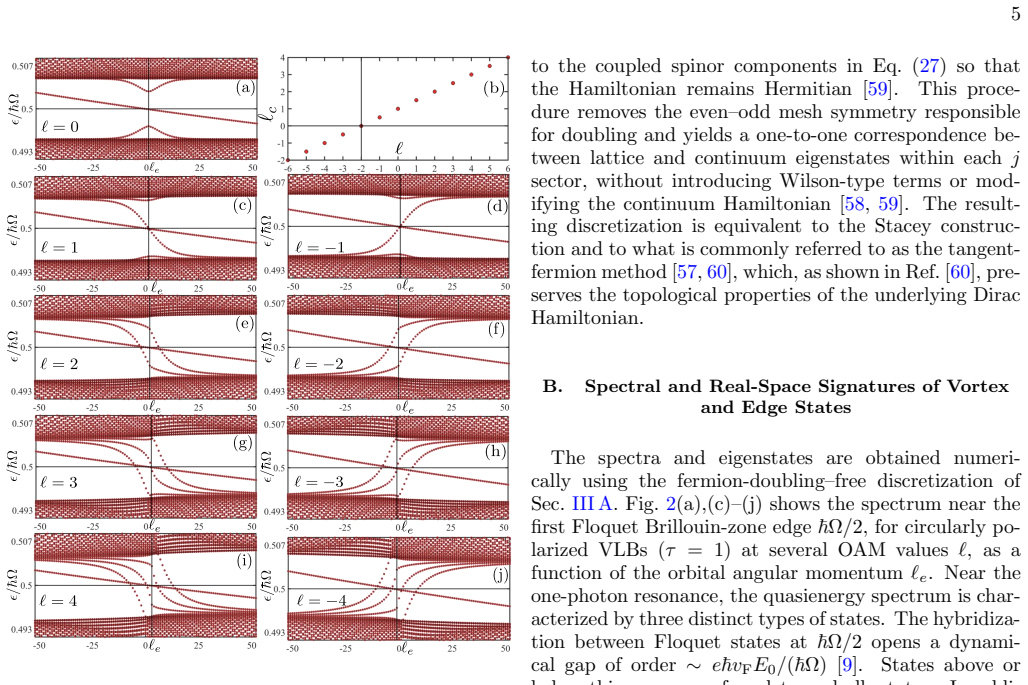
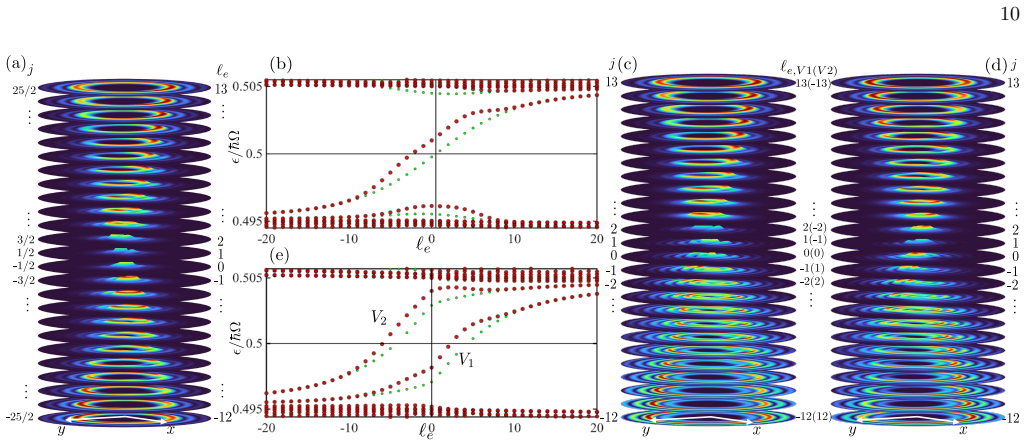
Vorticity Following the procedure presented in Ref. [39], Eq. (23) maps to the Bogoliubov–de Gennes equations (BdGEs) for ans-wave superconductor (or superfluid) threaded by anℓ-flux–quanta [61–64], resulting in n σz 2m∗ (ℏkF)2−p2 −∆(r) eiℓθσ++e−iℓθσ− o eΨ =E eΨ, (28) wherem ∗ ≡ℏΩ/(2v 2 F) plays the role of the effective mass in the BdGEs,em=ℏ 2k2 F/(2m∗)...
-
[2]
[39] and contextualize them in the particle- hole framework
Vortex Branches Dispersion To analyze the spectrum, we review relevant results from Ref. [39] and contextualize them in the particle- hole framework. We first fix total angular momentum and separate the angular dependence with the ansatz eΨT m,j(r) = [e −iθϕ0 m,↑(r), e−i(ℓ+1)θϕ1 m,↓(r)]. This reduc- tion yields a purely radial equation, − ℏ2σz 2m∗ ∂2 r + ...
-
[3]
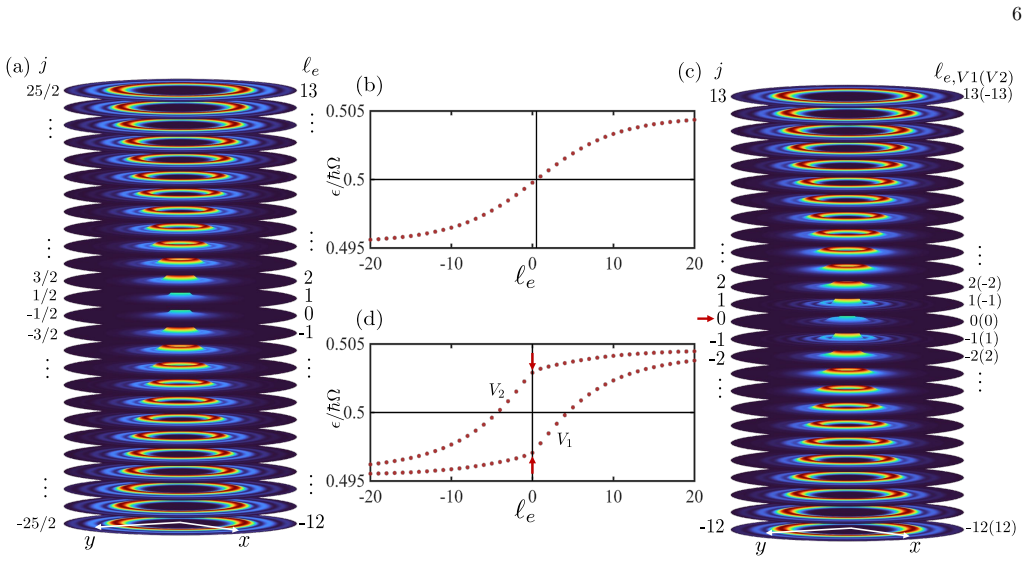
Real Space Distribution of Vortex States Within this unified picture, the vorticity fixes the number and directionality of the vortex branches, while particle-hole symmetry determines how states are paired in (ϵ, j). By contrast, the topological edge states are controlled only by the light polarization: sinceτ= 1 is fixed, their linear dispersion is uncha...
-
[4]
clusters of impuri- ties
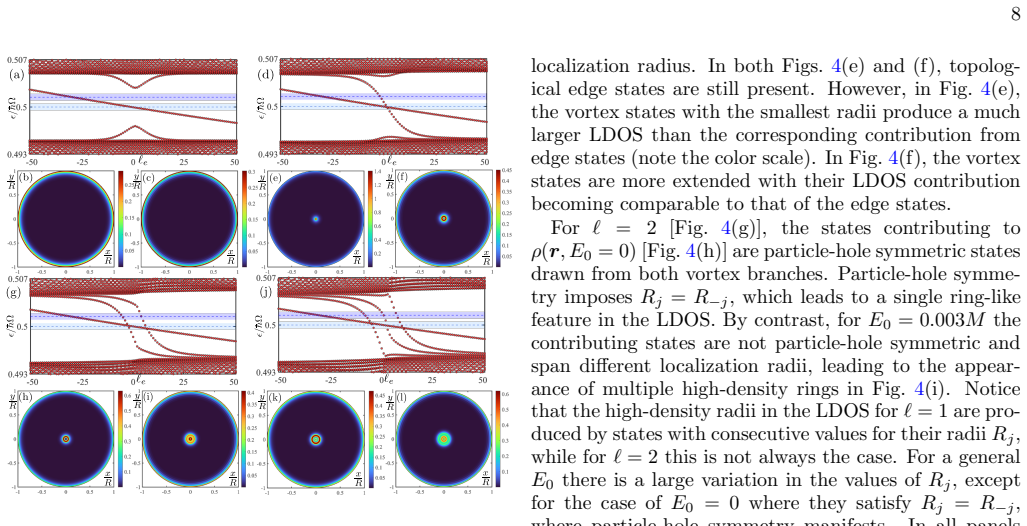
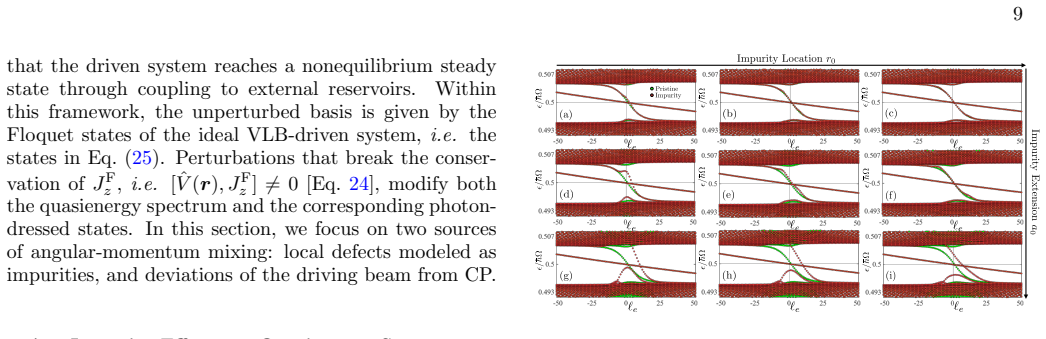
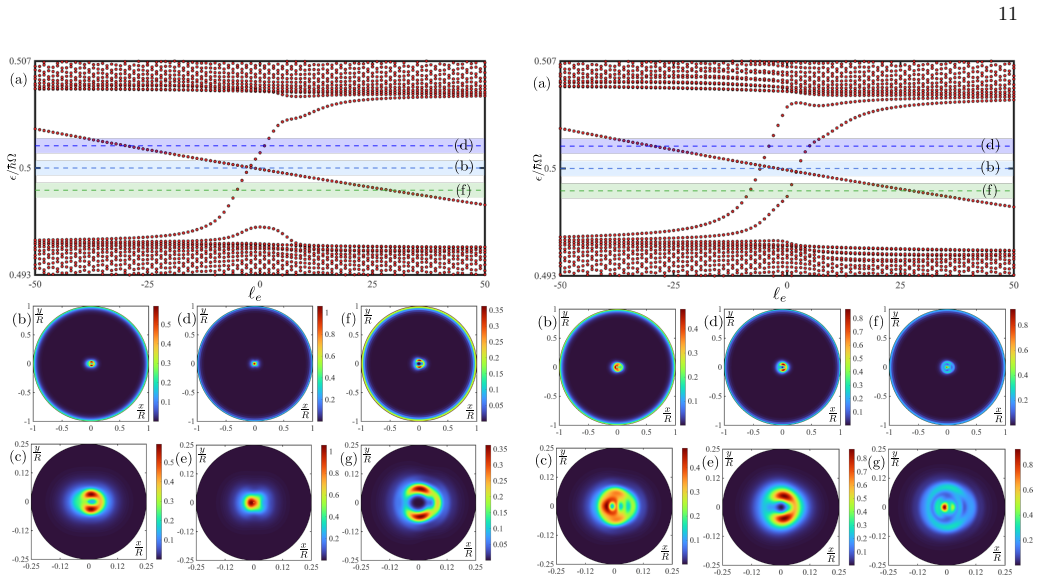
Local Density of States of VLB Driven System A promising route for Floquet engineering is to use external reservoirs to stabilize the driven nonequilib- rium steady state over time [5, 66, 67]. Coupling to bosonic or fermionic reservoirs introduces inelastic scat- tering channels that balance the energy injected by the drive and allow the system to reach ...
-
[5]
Oka and S
T. Oka and S. Kitamura, Floquet Engineering of Quan- tum Materials, Annu. Rev. Condens. Matter Phys.10, 387 (2019)
2019
-
[6]
M. S. Rudner and N. H. Lindner, Band structure engi- neering and non-equilibrium dynamics in Floquet topo- logical insulators, Nat. Rev. Phys.2, 229 (2020)
2020
-
[7]
D. N. Basov, R. D. Averitt, and D. Hsieh, Towards prop- erties on demand in quantum materials, Nat. Mater.16, 1077 (2017)
2017
-
[8]
Harper, R
F. Harper, R. Roy, M. S. Rudner, and S. L. Sondhi, Topology and Broken Symmetry in Floquet Systems, Annu. Rev. Condens. Matter Phys.11, 345 (2020)
2020
-
[9]
de la Torre, D
A. de la Torre, D. M. Kennes, M. Claassen, S. Gerber, J. W. McIver, and M. A. Sentef, Colloquium: Nonther- mal pathways to ultrafast control in quantum materials, Rev. Mod. Phys.93, 041002 (2021)
2021
-
[10]
Cayssol, B
J. Cayssol, B. D´ ora, F. Simon, and R. Moessner, Flo- quet topological insulators, Physica Status Solidi (RRL)– Rapid Research Letters7, 101 (2013)
2013
-
[11]
N. H. Lindner, G. Refael, and V. Galitski, Floquet topo- logical insulator in semiconductor quantum wells, Nat. Phys.7, 490 (2011)
2011
-
[12]
M. S. Rudner, N. H. Lindner, E. Berg, and M. Levin, Anomalous edge states and the bulk-edge correspondence for periodically driven two-dimensional systems, Physical Review X3, 031005 (2013)
2013
-
[13]
G. Usaj, P. M. Perez-Piskunow, L. E. F. Foa Torres, and C. A. Balseiro, Irradiated graphene as a tunable Floquet topological insulator, Phys. Rev. B90, 115423 (2014)
2014
-
[14]
Kitagawa, T
T. Kitagawa, T. Oka, A. Brataas, L. Fu, and E. Demler, Transport properties of nonequilibrium systems under the application of light: Photoinduced quantum Hall in- sulators without Landau levels, Phys. Rev. B84, 235108 (2011)
2011
-
[15]
Dehghani, T
H. Dehghani, T. Oka, and A. Mitra, Out-of-equilibrium electrons and the Hall conductance of a Floquet topolog- ical insulator, Physical Review B91, 155422 (2015)
2015
-
[16]
Oka and H
T. Oka and H. Aoki, Photovoltaic Hall effect in graphene, Physical Review B79, 081406 (2009)
2009
-
[17]
Z. Gu, H. A. Fertig, D. P. Arovas, and A. Auerbach, Floquet spectrum and transport through an irradiated graphene ribbon, Physical Review Letters107, 216601 (2011)
2011
-
[18]
Kumar, M
A. Kumar, M. Rodriguez-Vega, T. Pereg-Barnea, and B. Seradjeh, Linear response theory and optical conduc- tivity of Floquet topological insulators, Physical Review B101, 174314 (2020)
2020
-
[19]
M. M. Asmar and W.-K. Tse, Photo-induced non- collinear interlayer rkky coupling in bulk rashba semi- conductors, New Journal of Physics26, 083016 (2024)
2024
-
[20]
Mahmood, C.-K
F. Mahmood, C.-K. Chan, Z. Alpichshev, D. Gardner, Y. Lee, P. A. Lee, and N. Gedik, Selective scattering between Floquet–Bloch and Volkov states in a topological insulator, Nat. Phys.12, 306 (2016)
2016
-
[21]
Y. H. Wang, H. Steinberg, P. Jarillo-Herrero, and N. Gedik, Observation of Floquet-Bloch States on the Surface of a Topological Insulator, Science342, 453 (2013)
2013
-
[22]
S. Zhou, C. Bao, B. Fan, H. Zhou, Q. Gao, H. Zhong, T. Lin, H. Liu, P. Yu, P. Tang, S. Meng, W. Duan, and S. Zhou, Pseudospin-selective floquet band engineering in black phosphorus, Nature614, 75–80 (2023)
2023
-
[23]
Merboldt, M
M. Merboldt, M. Sch¨ uler, D. Schmitt, J. Bange, W. Ben- necke, K. Gadge, K. Pierz, H. Schumacher, D. Momeni, D. Steil, S. Manmana R., M. A. Sentef, M. Reutzel, and S. Mathias, Observation of floquet states in graphene, Nature Physics21, 1093–1099 (2025)
2025
-
[24]
Y. Liu, C. Yang, G. Gaertner, J. Huckabee, A. V. Suslov, G. Refael, F. Nathan, C. Lewandowski, L. E. F. Foa Tor- res, I. Esin, P. Barbara, and N. G. Kalugin, Signatures of Floquet electronic steady states in graphene under continuous-wave mid-infrared irradiation, Nature Com- munications16, 2057 (2025)
2057
-
[25]
J. W. McIver, B. Schulte, F.-U. Stein, T. Matsuyama, G. Jotzu, G. Meier, and A. Cavalleri, Light-induced anomalous Hall effect in graphene, Nat. Phys.16, 38 (2020)
2020
-
[26]
E. J. Sie, J. W. McIver, Y.-H. Lee, L. Fu, J. Kong, and N. Gedik, Valley-selective optical Stark effect in mono- layer WS2, Nature Materials14, 290 (2015)
2015
-
[27]
Kobayashi, C
Y. Kobayashi, C. Heide, A. C. Johnson, V. Tiwari, F. Liu, D. A. Reis, T. F. Heinz, and S. Ghimire, Flo- quet engineering of strongly driven excitons in monolayer tungsten disulfide, Nature Physics19, 171 (2023)
2023
-
[28]
J.-Y. Shan, M. Ye, H. Chu, S. Lee, J.-G. Park, L. Balents, and D. Hsieh, Giant modulation of optical nonlinearity by Floquet engineering, Nature600, 235 (2021)
2021
-
[29]
Allen, M
L. Allen, M. W. Beijersbergen, R. J. C. Spreeuw, and J. P. Woerdman, Orbital angular momentum of light and the transformation of Laguerre-Gaussian laser modes, Phys. Rev. A45, 8185 (1992)
1992
-
[30]
Y. Shen, X. Wang, Z. Xie, C. Min, X. Fu, Q. Liu, M. Gong, and X. Yuan, Optical vortices 30 years on: OAM manipulation from topological charge to multiple singularities, Light: Sci. Appl.8, 1 (2019)
2019
-
[31]
Franke-Arnold, L
S. Franke-Arnold, L. Allen, and M. Padgett, Advances in optical angular momentum, Laser Photon. Rev.2, 299 (2008)
2008
-
[32]
A. T. O’Neil, I. MacVicar, L. Allen, and M. J. Padgett, Intrinsic and Extrinsic Nature of the Orbital Angular Momentum of a Light Beam, Phys. Rev. Lett.88, 053601 (2002)
2002
-
[33]
G. F. Quinteiro Rosen, P. I. Tamborenea, and T. Kuhn, Interplay between optical vortices and condensed matter, Rev. Mod. Phys.94, 035003 (2022)
2022
-
[34]
Aich and B
S. Aich and B. Seradjeh, Multiple tunable real-space de- generacies in graphene irradiated by twisted light, Phys. Rev. B110, 054314 (2024). 15
2024
-
[35]
Fujita and M
H. Fujita and M. Sato, Ultrafast generation of skyrmionic defects with vortex beams: Printing laser profiles on mag- nets, Phys. Rev. B95, 054421 (2017)
2017
-
[36]
A. A. Gunyaga, M. V. Durnev, and S. A. Tarasenko, Photocurrents induced by structured light, Phys. Rev. B 108, 115402 (2023)
2023
-
[37]
A. A. Gunyaga, M. V. Durnev, and S. A. Tarasenko, Second harmonic generation due to the spatial structure of a radiation beam, Phys. Rev. Lett.134, 156901 (2025)
2025
-
[38]
A. A. Sirenko, P. Marsik, C. Bernhard, T. N. Stanislavchuk, V. Kiryukhin, and S.-W. Cheong, Tera- hertz vortex beam as a spectroscopic probe of magnetic excitations, Phys. Rev. Lett.122, 237401 (2019)
2019
-
[39]
K. B. Simbulan, Y.-J. Feng, W.-H. Chang, C.-I. Lu, T.- H. Lu, and Y.-W. Lan, Twisted Light-Enhanced Photo- voltaic Effect, ACS Nano15, 14822 (2021)
2021
-
[40]
Z. Ji, W. Liu, S. Krylyuk, X. Fan, Z. Zhang, A. Pan, L. Feng, A. Davydov, and R. Agarwal, Photocurrent de- tection of the orbital angular momentum of light, Science 368, 763 (2020)
2020
-
[41]
Sederberg, F
S. Sederberg, F. Kong, F. Hufnagel, C. Zhang, E. Karimi, and P. B. Corkum, Vectorized optoelectronic control and metrology in a semiconductor, Nature Photonics14, 680 (2020)
2020
-
[42]
L. A. Sordillo, S. Mamani, M. Sharonov, and R. R. Al- fano, The interaction of twisted Laguerre-Gaussian light with a GaAs photocathode to investigate photogener- ated polarized electrons, Appl. Phys. Lett.114, 041104 (2019)
2019
-
[43]
L. I. Massaro, C. Meese, N. P. Sandler, and M. M. Asmar, Photoinduced multiply quantized vortex states in dirac- like materials, Phys. Rev. B111, 085402 (2025)
2025
-
[44]
H. Kim, H. Dehghani, I. Ahmadabadi, I. Martin, and M. Hafezi, Floquet vortex states induced by light car- rying an orbital angular momentum, Phys. Rev. B105, L081301 (2022)
2022
-
[45]
Chang, J
C.-Z. Chang, J. Zhang, X. Feng, J. Shen, Z. Zhang, M. Guo, K. Li, Y. Ou, P. Wei, L.-L. Wang, Z.-Q. Ji, Y. Feng, S. Ji, X. Chen, J. Jia, X. Dai, Z. Fang, S.-C. Zhang, K. He, Y. Wang, L. Lu, X.-C. Ma, and Q.-K. Xue, Experimental observation of the quantum anomalous hall effect in a magnetic topological insulator, Science340, 167 (2013)
2013
-
[46]
M. Ye, W. Li, S. Zhu, Y. Takeda, Y. Saitoh, J. Wang, H. Pan, M. Nurmamat, K. Sumida, F. Ji, Z. Liu, H. Yang, Z. Liu, D. Shen, A. Kimura, S. Qiao, and X. Xie, Carrier- mediated ferromagnetism in the magnetic topological in- sulator cr-doped (Sb,Bi)2Te3, Nature Communications6, 8913 (2015)
2015
-
[47]
Z. Wang, T. Zhou, T. Jiang, H. Sun, Y. Zang, Y. Gong, J. Zhang, M. Tong, X. Xie, Q. Liu, C. Chen, K. He, and Q.-K. Xue, Dimensional Crossover and Topological Nature of the Thin Films of a Three-Dimensional Topo- logical Insulator by Band Gap Engineering, Nano Lett. 19, 4627 (2019)
2019
-
[48]
M. M. Asmar, D. E. Sheehy, and I. Vekhter, Topological phases of topological-insulator thin films, Phys. Rev. B 97, 075419 (2018)
2018
-
[49]
Lu, W.-Y
H.-Z. Lu, W.-Y. Shan, W. Yao, Q. Niu, and S.-Q. Shen, Massive Dirac fermions and spin physics in an ultrathin film of topological insulator, Phys. Rev. B81, 115407 (2010)
2010
-
[50]
A. E. Siegman,Lasers(University Science Books, 1986)
1986
-
[51]
Sambe, Steady States and Quasienergies of a Quantum-Mechanical System in an Oscillating Field, Phys
H. Sambe, Steady States and Quasienergies of a Quantum-Mechanical System in an Oscillating Field, Phys. Rev. A7, 2203 (1973)
1973
-
[52]
J. H. Shirley,Solution of the Schr¨ odinger Equation with a Hamiltonian Periodic in Time, Phys. Rev.138, B979 (1965)
1965
-
[53]
Roy and F
R. Roy and F. Harper, Periodic table for floquet topo- logical insulators, Phys. Rev. B96, 155118 (2017)
2017
-
[54]
P. M. Perez-Piskunow, L. E. F. Foa Torres, and G. Usaj, Hierarchy of Floquet gaps and edge states for driven hon- eycomb lattices, Phys. Rev. A91, 043625 (2015)
2015
-
[55]
Hirai, S
Y. Hirai, S. Okumura, N. Yoshikawa, T. Oka, and R. Shimano, Floquet Weyl states at one-photon reso- nance: An origin of nonperturbative optical responses in three-dimensional materials, Phys. Rev. Res.6, L012027 (2024)
2024
-
[56]
Morimoto and N
T. Morimoto and N. Nagaosa, Topological nature of non- linear optical effects in solids, Sci. Adv.2, e1501524 (2016)
2016
-
[57]
Yang and Q
Q. Yang and Q. Tong, Light-induced topological phases in two-dimensional gapped Dirac materials, Phys. Rev. B106, 115406 (2022)
2022
-
[58]
T. Cao, G. Wang, W. Han, H. Ye, C. Zhu, J. Shi, Q. Niu, P. Tan, E. Wang, B. Liu, and et al., Valley-selective circu- lar dichroism of monolayer molybdenum disulphide, Nat. Commun.3, 887 (2012)
2012
-
[59]
K. F. Mak, D. Xiao, and J. Shan, Light–valley inter- actions in 2D semiconductors, Nat. Photonics12, 451 (2018)
2018
-
[60]
Vidal, M
F. Vidal, M. Eddrief, B. Rache Salles, I. Vobornik, E. Velez-Fort, G. Panaccione, and M. Marangolo, Photon energy dependence of circular dichroism in angle-resolved photoemission spectroscopy of Bi2Se3 Dirac states, Phys. Rev. B88, 241410 (2013)
2013
-
[61]
Stacey, Eliminating lattice fermion doubling, Phys
R. Stacey, Eliminating lattice fermion doubling, Phys. Rev. D26, 468 (1982)
1982
-
[62]
Szafran, A
B. Szafran, A. Mre´ nca-Kolasi´ nska, and D. ˙Zebrowski, Finite-difference method for dirac electrons in circular quantum dots, Phys. Rev. B99, 195406 (2019)
2019
-
[63]
Zhang, Y
Y. Zhang, Y. Bao, H. Shen, and J. Hu, Resolving the spurious-state problem in the dirac equation with the finite-difference method, Phys. Rev. C106, L051303 (2022)
2022
-
[64]
C. W. J. Beenakker, A. Don´ ıs Vela, G. Lemut, M. J. Pacholski, and J. Tworzyd lo, Tangent fermions: Dirac or majorana fermions on a lattice without fermion doubling, Annalen der Physik535, 2300081
-
[65]
A. Prem, S. Moroz, V. Gurarie, and L. Radzihovsky, Mul- tiply Quantized Vortices in Fermionic Superfluids: Angu- lar Momentum, Unpaired Fermions, and Spectral Asym- metry, Phys. Rev. Lett.119, 067003 (2017)
2017
-
[66]
Bardeen, R
J. Bardeen, R. K¨ ummel, A. E. Jacobs, and L. Tewordt, Structure of Vortex Lines in Pure Superconductors, Phys. Rev.187, 556 (1969)
1969
-
[67]
De Gennes,Superconductivity of Metals and Alloys (CRC Press, 2018)
P.-G. De Gennes,Superconductivity of Metals and Alloys (CRC Press, 2018)
2018
-
[68]
Gozlinski, Q
T. Gozlinski, Q. Li, R. Heid, R. Nemoto, R. Willa, T. K. Yamada, J. Schmalian, and W. Wulfhekel, Band- resolved Caroli–de Gennes–Matricon states of multiple- flux-quanta vortices in a multiband superconductor, Sci. Adv.9, eadh9163 (2023)
2023
-
[69]
Nagaosa and Y
N. Nagaosa and Y. Tokura, Topological properties and dynamics of magnetic skyrmions, Nature Nanotechnol- ogy8, 899 (2013). 16
2013
-
[70]
I. Esin, M. S. Rudner, G. Refael, and N. H. Lindner, Quantized transport and steady states of Floquet topo- logical insulators, Physical Review B97, 245401 (2018)
2018
-
[71]
L.-k. Shi, O. Matsyshyn, J. C. W. Song, and I. S. Vil- ladiego, Floquet Fermi liquid, Physical Review Letters 132, 146402 (2024)
2024
-
[72]
K. I. Seetharam, C.-E. Bardyn, N. H. Lindner, M. S. Rudner, and G. Refael, Controlled population of Floquet- Bloch states via coupling to Bose and Fermi baths, Phys- ical Review X5, 041050 (2015)
2015
-
[73]
Dehghani, T
H. Dehghani, T. Oka, and A. Mitra, Dissipative Flo- quet topological systems, Physical Review B90, 195429 (2014)
2014
-
[74]
Iadecola, T
T. Iadecola, T. Neupert, and C. Chamon, Occupation of topological Floquet bands in open systems, Physical Review B91, 235133 (2015)
2015
-
[75]
Tsuji, T
N. Tsuji, T. Oka, and H. Aoki, Nonequilibrium steady state of photoexcited correlated electrons in the pres- ence of dissipation, Physical Review Letters103, 047403 (2009)
2009
-
[76]
M. M. Asmar and W.-K. Tse, Floquet control of in- direct exchange interaction in periodically driven two- dimensional electron systems, New Journal of Physics23, 123031 (2021)
2021
-
[77]
M. Ke, M. M. Asmar, and W.-K. Tse, Nonequilibrium RKKY interaction in irradiated graphene, Physycal Re- view Research2, 033228 (2020)
2020
-
[78]
M. M. Asmar and W.-K. Tse, Impurity screening and Friedel oscillations in Floquet-driven two-dimensional metals, Journal of Physics: Condensed Matter34, 315602 (2022)
2022
-
[79]
A. M. Black-Schaffer and A. V. Balatsky, Strong poten- tial impurities on the surface of a topological insulator, Phys. Rev. B85, 121103(R) (2012)
2012
-
[80]
N. Sule, S. C. Hagness, and I. Knezevic, Clustered impu- rities and carrier transport in supported graphene, Phys. Rev. B89, 165402 (2014)
2014
discussion (0)
Sign in with ORCID, Apple, or X to comment. Anyone can read and Pith papers without signing in.