REVIEW 3 major objections 4 minor 1 cited by
A new long gamma-ray burst formation pathway at solar metallicity
T0 review · 3 major / 4 minor · reviewed 2026-08-07 · deepseek-v4-flash
Pith's one-line read Stable reverse mass transfer can spin up already stripped stars into long gamma-ray burst progenitors at solar metallicity.
desk verdict The new channel is real and worth taking seriously; the 10-20% rate claim is a tuned scenario, not a robust prediction. read the letter →
The pith
A machine-rendered reading of the paper's core claim, the machinery that carries it, and where it could break.
The reading
What carries the argument
The central mechanism is stable reverse mass transfer in a near-equal-mass binary: binaries with initial mass ratio close to unity undergo a first mass-transfer phase from the primary, then the secondary also fills its Roche lobe and transfers mass back onto the now partially stripped primary. If this second phase remains dynamically stable, the primary is spun up toward critical rotation, and the angular momentum is carried into the helium core by efficient internal transport before the star exhausts carbon. Whether the collapse makes a gamma-ray burst is then decided by a shell-by-shell disk-formation criterion: each mass shell whose specific angular momentum exceeds the innermost stable circular orbit of the growing black hole contributes to an accretion disk, and the Blandford-Znajek jet power with an efficiency factor $\eta_\phi$ converts the disk mass into jet energy, which is compared with a universal $10^{51}$ erg breakout threshold.
What would settle it
Run a 3D collapsar simulation of the paper's example solar-metallicity progenitor (about 25.1 and 23.8 solar masses on a 26.8-day orbit) and ask whether a realistic disk-to-jet efficiency actually drives a successful jet through the envelope; if no jet breaks out, the assumed energy threshold is wrong. Observationally, a bias-corrected measurement of the high-metallicity LGRB host fraction at $z<2$ that lies far below 10-20% would undercut the channel's claimed contribution.
Extended reading notes
Core claim
The paper's central claim is that a second, stable mass-transfer phase from the initially less massive companion onto the already stripped primary ('reverse mass transfer') leaves the primary rapidly rotating at core collapse. In the model, the transferred angular momentum diffuses into the helium core before carbon exhaustion, so when the star collapses a disk of a few tenths to more than a solar mass forms around the newborn black hole; the Blandford-Znajek mechanism then gives an available jet energy of about $2.6\times 10^{54}$ erg for the example solar-metallicity binary, enough for a $\sim 10^{51}$ erg burst after a $10^{-3}$ disk-to-jet efficiency. The channel is restricted to $Z \ge 0.2\,Z_\odot$ and becomes more efficient as metallicity rises, because solar-metallicity winds complete the envelope stripping needed for angular momentum to reach the core, whereas at low metallicity the primary keeps a hydrogen envelope that blocks spin-up and reverse mass transfer is suppressed. This positive metallicity dependence is the opposite of traditional LGRB formation channels and is what lets the channel explain the observed high-metallicity host fraction.
Load-bearing premise
The quantitative 10-20% result rests on the assumed mapping from collapsing star to observable burst — a universal jet-breakout energy of $10^{51}$ erg and a disk-to-jet efficiency of $10^{-3}$ — and if the true efficiency differs by an order of magnitude, the channel either overproduces the observed LGRB rate or cannot explain the high-metallicity fraction.
Editorial extensions
If this is right
- A previously unrecognized binary progenitor population for long gamma-ray bursts exists at solar and near-solar metallicity, with the channel becoming more efficient as metallicity increases and disappearing below $0.2\,Z_\odot$.
- With a $10^{51}$ erg jet-breakout threshold and a disk-to-jet efficiency of $10^{-3}$, the channel alone produces roughly 18% of the local LGRB rate density, matching the observed 10-20% high-metallicity host fraction.
- The predicted local rate density ranges from about 1 to 100 $\mathrm{Gpc}^{-3}\,\mathrm{yr}^{-1}$ depending on the star formation history, metallicity evolution, and assumed criteria for a successful burst, so the channel is a major source of uncertainty in cosmic LGRB rate models.
- Most disk-forming systems in this channel produce choked rather than successful jets, implying an order-of-magnitude larger population of low-luminosity or jet-less transients in metal-rich galaxies.
- The progenitors carry a partially stripped companion of roughly 10-50 solar masses at collapse, giving a direct observable signature -- a Wolf-Rayet-like companion -- that distinguishes this channel from single-star LGRB formation.
Reading between the lines
- If the channel is real, the observed high-metallicity LGRB fraction becomes a probe of jet-launching efficiency: once magnetohydrodynamic simulations fix the disk-to-jet efficiency, the same fraction will pin down how much of the metal-rich burst population this channel must supply.
- A direct observational test is to search for the predicted stripped companion around nearby LGRBs and Type Ic broad-line supernovae in metal-rich hosts; a roughly 15-solar-mass Wolf-Rayet companion would strongly favour this channel, while secure non-detections would shrink its parameter space.
- Because the channel vanishes below 0.2 solar metallicity and grows with metallicity, it predicts that the LGRB host metallicity distribution at low redshift should flatten or become bimodal, a signature that redshift-resolved host samples could look for.
- The abundance of choked jets in this channel implies that relativistic supernovae with radio or X-ray afterglows but no gamma-ray trigger should be more common in metal-rich galaxies, a rate that current synoptic surveys may be able to test.
Editorial analysis
A structured set of objections, weighed in public.
Referee Report
Summary. The paper proposes a new long gamma-ray burst (LGRB) formation channel in which a stripped primary star in a near-equal-mass binary is spun up by a stable reverse mass transfer phase from its companion, producing a rapidly rotating, stripped star at core collapse. Using the POSYDON population synthesis code with MESA-based grids at eight metallicities, the authors find that this channel is efficient at near-solar metallicities and essentially vanishes below 0.2 Z_sun, giving a positive metallicity dependence that is opposite to traditional LGRB channels. They compute cosmic rates by convolving the binary populations with the IllustrisTNG star formation history and metallicity evolution, and also with two empirical star formation histories. For a disk-to-jet efficiency eta_phi = 10^-3 and a universal 10^51 erg jet breakout threshold, the channel contributes about 18% of the local LGRB rate density inferred by Ghirlanda & Salvaterra (2022), which the authors compare to the observed 10-20% high-metallicity host fraction. The paper also reports that the same rate varies between about 1 and 100 Gpc^-3 yr^-1 depending on the assumed star formation history, metallicity evolution, and energy threshold.
Significance. If the proposed channel is real, it fills a genuine gap: no previous collapsar formation pathway naturally explains LGRBs at solar and super-solar metallicity. The strength of the paper lies in its detailed stellar modeling: the POSYDON/MESA grids, the public code version, the clear grid slices showing where stable reverse mass transfer occurs, and the explicit discussion of how the physical requirements (mass ratio, period, metallicity-dependent winds) shape the channel. The qualitative prediction of a positive metallicity dependence is robust and well motivated. The quantitative rate claim, however, is not robust: the headline 10-20% figure is a narrow scenario rather than a robust prediction, as the paper's own Table 1 shows a two-order-of-magnitude spread across star formation histories, and eta_phi is a scanned parameter rather than a derived quantity. The paper is transparent about many of these uncertainties, which is commendable, but the abstract and conclusions present the 10-20% result with more certainty than the model supports.
major comments (3)
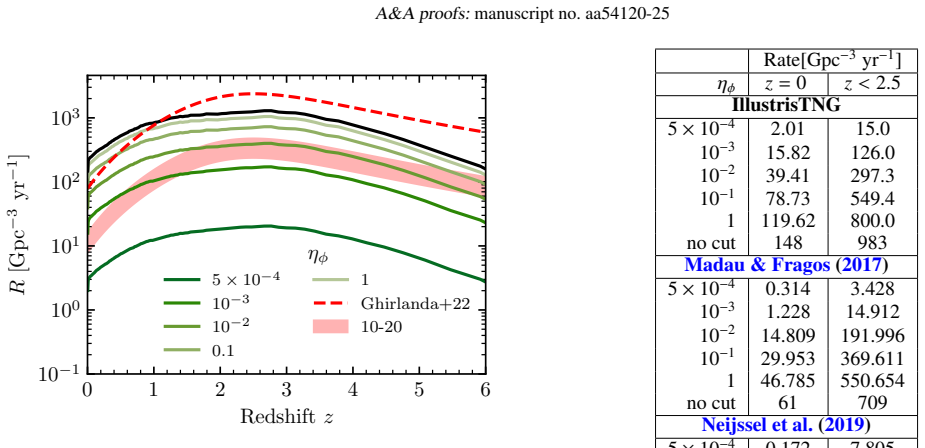
- [§3.2, Table 1] The central quantitative claim in the abstract and conclusions—that the channel can account for approximately 10-20% of the observed local LGRB rate—is not robust to the assumptions the authors themselves explore. With the same efficiency eta_phi = 10^-3 and the same 10^51 erg threshold, the Madau & Fragos (2017) and Neijssel et al. (2019) star formation histories give z=0 rates of 1.228 and 0.428 Gpc^-3 yr^-1, respectively, which are about 1.5% and 0.5% of the Ghirlanda & Salvaterra (2022) rate of 79 Gpc^-3 yr^-1, not 10-20%. The 10-20% figure is therefore an outcome of one specific combination of IllustrisTNG metallicity evolution and eta_phi = 10^-3, not a general prediction. Since eta_phi is a scanned parameter and the breakout threshold is an assumed proxy, the abstract and conclusions should be reframed to present the 10-20% as a conditional scenario, or the authors should calibrate eta_phi or marginalize over star formation histories and report a credible range.
- [§2.2, §3.2] The mapping from collapsing star to observable LGRB rests on a universal jet breakout threshold of 10^51 erg, which the paper justifies only by reference to 'typical breakout energy' and does not connect to the computed density or angular-momentum profiles at collapse. The authors state in §4.3 that they do not evolve the final evolutionary phases and therefore do not have a representative profile at collapse available. This is a load-bearing simplification for the rate claim, because the breakout threshold and the disk-to-jet efficiency eta_phi are degenerate (§4.1), so the success fraction is effectively controlled by two free parameters. The authors should either derive the breakout criterion from the stellar structure (or justify why a universal threshold is adequate) or present the resulting 10-20% as an illustrative scenario rather than a central result.
- [§4.4] In §4.4 the authors state that differences between star formation histories in the local Universe (z<2.5) are 'of a factor of 2'. This statement applies to the no-cut rates; after an energy cut the differences become much larger, e.g. at eta_phi = 5 x 10^-4 the IllustrisTNG z=0 rate is 2.01 Gpc^-3 yr^-1 while the Neijssel et al. (2019) rate is 0.172 Gpc^-3 yr^-1, roughly a factor of 12. The main text should explicitly qualify that the factor-of-two statement refers to the maximum potential rate, since the energy cut is a key part of the rate computation and the authors themselves highlight its strong effect.
minor comments (4)
- [Throughout] The manuscript contains many malformed ligatures in the PDF text (e.g., 'su fficient', 'e fficiency', 'di fferent' appear repeatedly). The text should be re-rendered to produce proper 'ff' and 'fi' ligatures.
- [§2.2, Eq. (2)-(3)] The BH spin parameter is denoted a in Eq. (2) and a_i in Eq. (3), while the same symbol is used for the spin parameter in the Blandford-Znajek relation. The notation should be defined explicitly in one place to avoid confusion between the spin parameter and the specific angular momentum j.
- [Figures 3 and 4] The legend in Figures 3 and 4 is dense and the colored circles indicating disk formation are small; enlarging the markers or splitting into separate panels would improve readability.
- [§4.5] The discussion of the Patton & Sukhbold (2020) explodability prescription is interesting but would be more informative with a brief quantitative statement of how many stable reverse-mass-transfer systems are excluded because the primary forms a neutron star rather than a black hole (e.g., by citing a fraction from the population).
Circularity Check
The headline 10–20% rate agreement is a tuned scenario: the disk-to-jet efficiency ηφ=10^-3 is selected because it reproduces the requested high-metallicity LGRB fraction, and with the same efficiency alternative star formation histories give only ~1.5% and ~0.5% of the local rate.
-
fitted input called prediction
[Section 3.2 (rate calculation; Figure 5 and Table 1)]
"Given that the inferred fraction of high-metallicity host galaxies is 10%-20%, this requires an efficiency that removes 80%-90% of events. The most restrictive efficiency with ηϕ = 5× 10⁻⁴ results in a volumetric rate of≃2.01 Gpc−3 yr−1 at z = 0; with a total of ≃15.0 Gpc−3 yr−1 events below z < 2.5. With ηϕ = 10−3, the reverse-mass-transfer channel rate is around 18% of the latest estimate of the observed cosmic LGRB rate. This is remarkably close to the observational fraction of solar and super-solar host galaxies of 10-20 per cent."
Equation (2) leaves ηϕ unspecified, and Section 3.2 scans five values. The text explicitly uses the observed 10–20% high-metallicity fraction to infer the required efficiency ('this requires an efficiency that removes 80%-90% of events'), then presents ηϕ=10^-3 as giving 18% of the observed rate and 'remarkably close' to 10–20%. The headline agreement is therefore the selection criterion for ηϕ, not a free prediction. Table 1 shows the same ηϕ with the Madau & Fragos (2017) and Neijssel et al. (2019) star formation histories gives 1.228 and 0.428 Gpc^-3 yr^-1 at z=0, about 1.5% and 0.5% of the observed rate, so the 10–20% result is additionally specific to the IllustrisTNG star formation history.
full rationale
The proposed stellar/binary channel itself is derived self-consistently from POSYDON/MESA models: stable reverse mass transfer, stripping, angular momentum retention, and accretion-disk formation are independent physical results from the detailed stellar grids. The collapse and energy calculations use external prescriptions (Batta & Ramirez-Ruiz 2019; Blandford & Znajek 1977), and the self-citations to POSYDON and Bavera et al. (2020) are code or parameter descriptions, not load-bearing uniqueness claims. The only substantial circularity is in the rate normalization: because ηϕ is neither measured nor derived, and because the text calibrates it to the observed 10–20% high-metallicity fraction, the abstract's quantitative '10–20% of the observed local LGRB rate density' claim is an input-based scenario rather than an independent prediction. The paper honestly reports the 1–100 Gpc^-3 yr^-1 range and the degeneracy between ηϕ and the breakout-energy threshold, which mitigates the issue but does not eliminate the circular selection of the headline value.
Assumptions & free parameters
free parameters (2)
- eta_phi (disk-to-jet efficiency) =
10^-3; scanned values 1, 0.1, 10^-2, 10^-3, 5x10^-4
- Universal jet breakout energy threshold =
10^51 erg
assumptions (7)
- domain assumption Efficient internal angular momentum transport via the Spruit-Tayler dynamo and diffusion approximation, as implemented in POSYDON v2 (Section 2.1).
- domain assumption OB and Wolf-Rayet wind mass-loss prescriptions (Vink et al. 2001; Nugis & Lamers 2000) and their metallicity scaling (Sections 3.1.3 and 4.5).
- domain assumption Batta & Ramirez-Ruiz (2019) disk formation criterion: mass shells with specific angular momentum above the ISCO form an accretion disk, assuming prompt collapse and no wind feedback (Section 2.2).
- domain assumption Patton & Sukhbold (2020) remnant mass prescription determines which primaries collapse to a black hole (Section 4.5).
- domain assumption The IllustrisTNG simulation provides a representative cosmic star formation rate and metallicity evolution history (Section 2.4).
- ad hoc to paper A single universal energy threshold of 10^51 erg is a sufficient proxy for successful jet breakout (Section 3.2).
- domain assumption Initial population assumptions: Kroupa IMF from 7 to 120 M_sun, flat mass ratios, flat log-period distributions, and binary fraction 0.7 (Section 2.3).
Cite this review
Pith. "Pith review of A new long gamma-ray burst formation pathway at solar metallicity." pith.science (2026). https://pith.science/paper/FJMHYSYN
@misc{pith2026250209187,
  author       = {Pith},
  title        = {Pith review of: A new long gamma-ray burst formation pathway at solar metallicity},
  year         = {2026},
  howpublished = {\url{https://pith.science/paper/FJMHYSYN}},
  note         = {Machine review of arXiv:2502.09187}
}
abstract
Context. Long gamma-ray bursts (LGRBs) are generally observed in low-metallicity environments. However, 10 to 20 per cent of LGRBs at redshift $z<2$ are associated with near-solar to super-solar metallicity environments, remaining unexplained by traditional LGRB formation pathways that favour low metallicity progenitors. Aims. In this work, we propose a novel formation channel for LGRBs that is dominant at high metallicities. We explore how a stripped primary star in a binary can be spun up by a second, stable reverse-mass-transfer phase, initiated by the companion star. Methods. We use POSYDON, a state-of-the-art population synthesis code that incorporates detailed single- and binary-star mode grids, to investigate the metallicity dependence of the stable reverse-mass-transfer LGRB formation channel. We determine the available energy to power an LGRB from the rotational profile and internal structure of a collapsing star, and investigate how the predicted rate density of the proposed channel changes with different star formation histories and criteria for defining a successful LGRB. Results. Stable reverse mass transfer can produce rapidly rotating, stripped stars at collapse. These stars retain enough angular momentum to account for approximately 10-20% of the observed local LGRB rate density, under a reasonable assumption for the definition of a successful LGRB. However, the local rate density of LGRBs from stable reverse mass transfer can vary significantly, between 1 and 100 Gpc$^{-3}$ yr$^{-1}$, due to strong dependencies on cosmic star formation rate and metallicity evolution, as well as the assumed criteria for successful LGRBs.
Figures


Figures from the paper (5 more)



Forward citations
Cited by 1 Pith paper
-
Extreme value distribution for gamma-ray-burst prompt data -- How unexpected was the BOAT event?
Using generalized extreme value fits to 30-day maxima from Fermi-GBM and BATSE, the fluence and peak flux of GRB 221009A are extreme outliers, with median return periods of about 1000 years and 140 years respectively.
Reference graph
Works this paper leans on
-
[1]
P., Abbott, R., Abbott, T
Abbott, B. P., Abbott, R., Abbott, T. D., et al. 2017 a , ApJ, 848, L13
2017
-
[2]
P., Abbott, R., Abbott, T
Abbott, B. P., Abbott, R., Abbott, T. D., et al. 2017 b , Phys. Rev. Lett., 119, 161101
2017
-
[3]
P., Abbott, R., Abbott, T
Abbott, B. P., Abbott, R., Abbott, T. D., et al. 2017 c , ApJ, 848, L12
2017
-
[4]
2020, A&A, 641, A6
Aghanim, N., Akrami, Y., Ashdown, M., et al. 2020, A&A, 641, A6
2020
-
[5]
Andrews, J. J., Bavera, S. S., Briel, M., et al. 2025, Submitted to AAS journals [ [arXiv] 2411.02376 ]
arXiv 2025
- [6]
-
[7]
S., Fragos, T., Qin, Y., et al
Bavera, S. S., Fragos, T., Qin, Y., et al. 2020, A&A, 635, A97
2020
-
[8]
S., Fragos, T., Zapartas, E., et al
Bavera, S. S., Fragos, T., Zapartas, E., et al. 2022, A&A, 657, L8
2022
Show all 149 references
-
[9]
F., & Krolik, J
Beckwith, K., Hawley, J. F., & Krolik, J. H. 2009, ApJ, 707, 428
2009
-
[10]
2014, ARA&A, 52, 43
Berger, E. 2014, ARA&A, 52, 43
2014
-
[11]
Blandford, R. D. & Znajek, R. L. 1977, MNRAS, 179, 433
1977
-
[12]
& Langer, N
Braun, H. & Langer, N. 1995, A&A, 297, 483
1995
-
[13]
2011, ApJ, 740, 100
Bromberg, O., Nakar, E., Piran, T., & Sari, R. 2011, ApJ, 740, 100
2011
-
[14]
2012, ApJ, 749, 110
Bromberg, O., Nakar, E., Piran, T., & Sari, R. 2012, ApJ, 749, 110
2012
-
[15]
2014, ApJ, 788, 93
Cantiello, M., Mankovich, C., Bildsten, L., Christensen-Dalsgaard , J., & Paxton, B. 2014, ApJ, 788, 93
2014
-
[16]
2007, A&A, 465, L29
Cantiello, M., Yoon, S.-C., Langer, N., & Livio, M. 2007, A&A, 465, L29
2007
-
[17]
A., Stanway, E
Chrimes, A. A., Stanway, E. R., & Eldridge, J. J. 2020, MNRAS, 491, 3479
2020
-
[18]
& Lazzati, D
Corsi, A. & Lazzati, D. 2021, New Astron. Rev., 92, 101614
2021
-
[19]
J., Fox, D
Cucchiara, A., Levan, A. J., Fox, D. B., et al. 2011, ApJ, 736, 7
2011
-
[20]
E., Cantiello, M., Langer, N., et al
de Mink , S. E., Cantiello, M., Langer, N., et al. 2009, A&A, 497, 243
2009
-
[21]
W., Eggenberger, P., & Deheuvels, S
den Hartogh , J. W., Eggenberger, P., & Deheuvels, S. 2020, A&A, 634, L16
2020
-
[22]
G., Langer, N., Podsiadlowski, Ph ., & Izzard, R
Detmers, R. G., Langer, N., Podsiadlowski, Ph ., & Izzard, R. G. 2008, A&A, 484, 831
2008
-
[23]
D., & den Hartogh , J
Eggenberger, P., Moyano, F. D., & den Hartogh , J. W. 2022, A&A, 664, L16
2022
-
[24]
Eichler, D., Livio, M., Piran, T., & Schramm, D. N. 1989, Nat, 340, 126
1989
-
[25]
J., Langer, N., & Tout, C
Eldridge, J. J., Langer, N., & Tout, C. A. 2011, MNRAS, 414, 3501
2011
-
[26]
2024, A&A, 685, A58
Ercolino, A., Jin, H., Langer, N., & Dessart, L. 2024, A&A, 685, A58
2024
-
[27]
E., Petermann, I., et al
Farmer, R., Fields, C. E., Petermann, I., et al. 2016, ApJS, 227, 22
2016
-
[28]
J., Bavera, S
Fragos, T., Andrews, J. J., Bavera, S. S., et al. 2023, ApJS, 264, 45
2023
-
[29]
R., Vincenzi, M., et al
Frohmaier, C., Angus, C. R., Vincenzi, M., et al. 2021, MNRAS, 500, 5142
2021
-
[30]
L., Belczynski, K., Wiktorowicz, G., et al
Fryer, C. L., Belczynski, K., Wiktorowicz, G., et al. 2012, ApJ, 749, 91
2012
-
[31]
L., Burns, E., Ho, A
Fryer, C. L., Burns, E., Ho, A. Y. Q., et al. 2025, ApJ, 986, 185
2025
-
[32]
Fryer, C. L. & Heger, A. 2005, ApJ, 623, 302
2005
-
[33]
Fryer, C. L. & Woosley, S. E. 1998, ApJ, 502, L9
1998
-
[34]
2014, ApJ, 796, 17
Fuller, J., Lecoanet, D., Cantiello, M., & Brown, B. 2014, ApJ, 796, 17
2014
-
[35]
Fuller, J. & Ma, L. 2019, ApJ, 881, L1
2019
-
[36]
Fynbo, J. P. U., Watson, D., Th \"o ne, C. C., et al. 2006, Nat, 444, 1047
2006
-
[37]
B., Price, P
Gal-Yam , A., Fox, D. B., Price, P. A., et al. 2006, Nat, 444, 1053
2006
-
[38]
& Salvaterra, R
Ghirlanda, G. & Salvaterra, R. 2022, ApJ, 932, 10
2022
-
[39]
J., Stanway, E
Ghodla, S., Eldridge, J. J., Stanway, E. R., & Stevance, H. F. 2023, MNRAS, 518, 860
2023
-
[40]
E., & Groh, J
G \"o tberg, Y., de Mink, S. E., & Groh, J. H. 2017, A&A, 608, A11
2017
-
[41]
D., Quataert, E., et al
Gottlieb, O., Metzger, B. D., Quataert, E., et al. 2023, ApJ, 958, L33
2023
-
[42]
D., Goldberg, J
Gottlieb, O., Renzo, M., Metzger, B. D., Goldberg, J. A., & Cantiello, M. 2024, ApJ, 976, L13
2024
-
[43]
Graham, J. F. & Fruchter, A. S. 2013, ApJ, 774, 119
2013
-
[44]
F., Schady, P., & Fruchter, A
Graham, J. F., Schady, P., & Fruchter, A. S. 2023, ApJ, 954, 13
2023
-
[45]
B., Schady, P., et al
Greiner, J., Fox, D. B., Schady, P., et al. 2015, ApJ, 809, 76
2015
-
[46]
& Valle, M
Guetta, D. & Valle, M. D. 2007, ApJ, 657, L73
2007
-
[47]
2018, MNRAS, 477, 2128
Harrison, R., Gottlieb, O., & Nakar, E. 2018, MNRAS, 477, 2128
2018
-
[48]
L., Woosley, S
Heger, A., Fryer, C. L., Woosley, S. E., Langer, N., & Hartmann, D. H. 2003, ApJ, 591, 288
2003
-
[49]
E., & Spruit, H
Heger, A., Woosley, S. E., & Spruit, H. C. 2005, ApJ, 626, 350
2005
-
[50]
E., Malesani, D., Wiersema, K., et al
Heintz, K. E., Malesani, D., Wiersema, K., et al. 2018, MNRAS, 474, 2738
2018
-
[51]
& Podsiadlowski, P
Ivanova, N. & Podsiadlowski, P. 2003, in From Twilight To Highlight Physics Of Supernovae , ed. W. Hillebrandt & B. Leibundgut (Berlin, Heidelberg: Springer), 19--22
2003
-
[52]
2022, ApJ, 931, L2
Ivy Wang, X., Zhang, B.-B., & Lei, W.-H. 2022, ApJ, 931, L2
2022
-
[53]
G., Ramirez-Ruiz , E., & Tout, C
Izzard, R. G., Ramirez-Ruiz , E., & Tout, C. A. 2004, MNRAS, 348, 1215
2004
-
[54]
2024, ApJ, 961, 212
Jacquemin-Ide , J., Gottlieb, O., Lowell, B., & Tchekhovskoy, A. 2024, ApJ, 961, 212
2024
-
[55]
D., Salvaterra, R., et al
Japelj, J., Vergani, S. D., Salvaterra, R., et al. 2016, A&A, 590, A129
2016
-
[56]
D., Salvaterra, R., et al
Japelj, J., Vergani, S. D., Salvaterra, R., et al. 2018, A&A, 617, A105
2018
-
[57]
S., Bauer, E
Jermyn, A. S., Bauer, E. B., Schwab, J., et al. 2023, ApJS, 265, 15
2023
-
[58]
Kawanaka, N., Piran, T., & Krolik, J. H. 2013, ApJ, 766, 31
2013
-
[59]
Kewley, L. J. & Ellison, S. L. 2008, ApJ, 681, 1183
2008
-
[60]
D., Y \"u ksel, H., Beacom, J
Kistler, M. D., Y \"u ksel, H., Beacom, J. F., Hopkins, A. M., & Wyithe, J. S. B. 2009, ApJ, 705, L104
2009
-
[61]
2022, A&A, 662, A56
Klencki, J., Istrate, A., Nelemans, G., & Pols, O. 2022, A&A, 662, A56
2022
-
[62]
& Ritter, H
Kolb, U. & Ritter, H. 1990, A&A, 236, 385
1990
-
[63]
2001, MNRAS, 322, 231
Kroupa, P. 2001, MNRAS, 322, 231
2001
-
[64]
Kr \"u hler, T., Malesani, D., Fynbo, J. P. U., et al. 2015, A&A, 581, A125
2015
-
[65]
2021, A&A, 656, A58
Laplace, E., Justham, S., Renzo, M., et al. 2021, A&A, 656, A58
2021
-
[66]
J., Gompertz, B
Levan, A. J., Gompertz, B. P., Salafia, O. S., et al. 2024, Nat, 626, 737
2024
-
[67]
M., Berger, E., Kewley, L
Levesque, E. M., Berger, E., Kewley, L. J., & Bagley, M. M. 2010 a , AJ, 139, 694
2010
-
[68]
M., Kewley, L
Levesque, E. M., Kewley, L. J., Berger, E., & Zahid, H. J. 2010 b , AJ, 140, 1557
2010
-
[69]
M., Kewley, L
Levesque, E. M., Kewley, L. J., Graham, J. F., & Fruchter, A. S. 2010 c , ApJ, 712, L26
2010
-
[70]
Liang, E., Zhang, B., Virgili, F., & Dai, Z. G. 2007, ApJ, 662, 1111
2007
-
[71]
2024, ApJ, 960, 82
Lowell, B., Jacquemin-Ide , J., Tchekhovskoy, A., & Duncan, A. 2024, ApJ, 960, 82
2024
-
[72]
MacFadyen, A. I. & Woosley, S. E. 1999, ApJ, 524, 262
1999
-
[73]
& Fragos, T
Madau, P. & Fragos, T. 2017, ApJ, 840, 39
2017
-
[74]
1987, A&A, 178, 159
Maeder, A. 1987, A&A, 178, 159
1987
-
[75]
& de Mink , S
Mandel, I. & de Mink , S. E. 2016, MNRAS, 458, 2634
2016
-
[76]
2017, A&A, 604, A55
Marchant, P., Langer, N., Podsiadlowski, P., et al. 2017, A&A, 604, A55
2017
-
[77]
M., & Moriya, T
Marchant, P., Langer, N., Podsiadlowski, P., Tauris, T. M., & Moriya, T. J. 2016, A&A, 588, A50
2016
-
[78]
2018, MNRAS, 480, 5113
Marinacci, F., Vogelsberger, M., Pakmor, R., et al. 2018, MNRAS, 480, 5113
2018
-
[79]
Matzner, C. D. 2003, MNRAS, 345, 575
2003
-
[80]
A., McFadyen, A
Mazzali, P. A., McFadyen, A. I., Woosley, S. E., Pian, E., & Tanaka, M. 2014, MNRAS, 443, 67
2014
-
[81]
& Trenti, M
Metha, B. & Trenti, M. 2020, MNRAS, 495, 266
2020
-
[82]
D., Giannios, D., Thompson, T
Metzger, B. D., Giannios, D., Thompson, T. A., Bucciantini, N., & Quataert, E. 2011, MNRAS, 413, 2031
2011
-
[83]
& Maeder, A
Meynet, G. & Maeder, A. 2007, A&A, 464, L11
2007
-
[84]
J., Xu, D., Stevens, J., et al
Micha owskI, M. J., Xu, D., Stevens, J., et al. 2018, A&A, 616, A169
2018
-
[85]
P., et al
Modjaz, M., Kewley, L., Kirshner, R. P., et al. 2008, AJ, 135, 1136
2008
-
[86]
Q., Bianco, F
Modjaz, M., Liu, Y. Q., Bianco, F. B., & Graur, O. 2016, ApJ, 832, 108
2016
-
[87]
R., de Koter , A., Vink, J
Mokiem, M. R., de Koter , A., Vink, J. S., et al. 2007, A&A, 473, 603
2007
-
[88]
D., Eggenberger, P., Mosser, B., & Spada, F
Moyano, F. D., Eggenberger, P., Mosser, B., & Spada, F. 2023, A&A, 673, A110
2023
-
[89]
P., Pillepich, A., Springel, V., et al
Naiman, J. P., Pillepich, A., Springel, V., et al. 2018, MNRAS, 477, 1206
2018
-
[90]
& Sari, R
Nakar, E. & Sari, R. 2012, ApJ, 747, 88
2012
-
[91]
J., Vigna-G \'o mez , A., Stevenson, S., et al
Neijssel, C. J., Vigna-G \'o mez , A., Stevenson, S., et al. 2019, MNRAS, 490, 3740
2019
-
[92]
2018, MNRAS, 475, 624
Nelson, D., Pillepich, A., Springel, V., et al. 2018, MNRAS, 475, 624
2018
-
[93]
& Lamers, H
Nugis, T. & Lamers, H. J. G. L. M. 2000, A&A, 360, 227
2000
-
[94]
T., Vergani, S
Palmerio, J. T., Vergani, S. D., Salvaterra, R., et al. 2019, A&A, 623, A26
2019
-
[95]
Patton, R. A. & Sukhbold, T. 2020, MNRAS, 499, 2803
2020
-
[96]
2011, ApJS, 192, 3
Paxton, B., Bildsten, L., Dotter, A., et al. 2011, ApJS, 192, 3
2011
-
[97]
2013, ApJS, 208, 4
Paxton, B., Cantiello, M., Arras, P., et al. 2013, ApJS, 208, 4
2013
-
[98]
2015, ApJS, 220, 15
Paxton, B., Marchant, P., Schwab, J., et al. 2015, ApJS, 220, 15
2015
-
[99]
B., et al
Paxton, B., Schwab, J., Bauer, E. B., et al. 2018, ApJS, 234, 34
2018
-
[100]
2019, ApJS, 243, 10
Paxton, B., Smolec, R., Schwab, J., et al. 2019, ApJS, 243, 10
2019
-
[101]
A., Tanvir, N
Perley, D. A., Tanvir, N. R., Hjorth, J., et al. 2016, ApJ, 817, 8
2016
-
[102]
2018, MNRAS, 475, 648
Pillepich, A., Nelson, D., Hernquist, L., et al. 2018, MNRAS, 475, 648
2018
-
[103]
2010, MNRAS, 406, 840
Podsiadlowski, P., Ivanova, N., Justham, S., & Rappaport, S. 2010, MNRAS, 406, 840
2010
-
[104]
2018, A&A, 616, A28
Qin, Y., Fragos, T., Meynet, G., et al. 2018, A&A, 616, A28
2018
-
[105]
2019, ApJ, 870, L18
Qin, Y., Marchant, P., Fragos, T., Meynet, G., & Kalogera, V. 2019, ApJ, 870, L18
2019
-
[106]
R., Oskinova, L
Ramachandran, V., Hamann, W. R., Oskinova, L. M., et al. 2019, A&A, 625, A104
2019
-
[107]
C., Gompertz, B
Rastinejad, J. C., Gompertz, B. P., Levan, A. J., et al. 2022, Nat, 612, 223
2022
-
[108]
M., Gallo, E., & Fender, R
Russell, D. M., Gallo, E., & Fender, R. P. 2013, MNRAS, 431, 405
2013
-
[109]
S., Barbieri, C., Ascenzi, S., & Toffano, M
Salafia, O. S., Barbieri, C., Ascenzi, S., & Toffano, M. 2020, A&A, 636, A105
2020
-
[110]
D., et al
Salvaterra, R., Campana, S., Vergani, S. D., et al. 2012, ApJ, 749, 68
2012
-
[111]
2017, ApJ, 834, 23
Sarmento, R., Scannapieco, E., & Pan, L. 2017, ApJ, 834, 23
2017
-
[112]
S., Sana, H., & Sander, A
Shenar, T., Gilkis, A., Vink, J. S., Sana, H., & Sander, A. A. C. 2020, A&A, 634, A79
2020
-
[113]
2017, PASP, 129, 054201
Shivvers, I., Modjaz, M., Zheng, W., et al. 2017, PASP, 129, 054201
2017
-
[114]
M., Kulkarni, S
Soderberg, A. M., Kulkarni, S. R., Nakar, E., et al. 2006, Nat, 442, 1014
2006
-
[115]
F., Meynet, G., Maeder, A., Ekstr \"o m, S., & Eggenberger, P
Song, H. F., Meynet, G., Maeder, A., Ekstr \"o m, S., & Eggenberger, P. 2016, A&A, 585, A120
2016
-
[116]
2010, MNRAS, 401, 791
Springel, V. 2010, MNRAS, 401, 791
2010
-
[117]
2018, MNRAS, 475, 676
Springel, V., Pakmor, R., Pillepich, A., et al. 2018, MNRAS, 475, 676
2018
-
[118]
Spruit, H. C. 2002, A&A, 381, 923
2002
-
[119]
E., & Heger, A
Sukhbold, T., Woosley, S. E., & Heger, A. 2018, ApJ, 860, 93
2018
-
[120]
2018, A&A, 615, A136
Tanga, M., Kr \"u hler, T., Schady, P., et al. 2018, A&A, 615, A136
2018
-
[121]
C., & Narayan, R
Tchekhovskoy, A., McKinney, J. C., & Narayan, R. 2012, J. Phys. Conf. Ser., 372, 12040
2012
-
[122]
Tchekhovskoy, A., Narayan, R., & McKinney, J. C. 2010, ApJ, 711, 50
2010
-
[123]
2025, A&C, 51, 100935
Teng, E., Demir, U., Doctor, Z., et al. 2025, A&C, 51, 100935
2025
-
[124]
2019, ApJ, 883, 147
Terreran, G., Margutti, R., Bersier, D., et al. 2019, ApJ, 883, 147
2019
-
[125]
1994, MNRAS, 270, 480
Thompson, C. 1994, MNRAS, 270, 480
1994
-
[126]
A., Chang, P., & Quataert, E
Thompson, T. A., Chang, P., & Quataert, E. 2004, ApJ, 611, 380
2004
-
[127]
Usov, V. V. 1992, Nat, 357, 472
1992
-
[128]
van den Heuvel , E. P. J. & Yoon, S. C. 2007, Astrophys. Space Sci., 311, 177
2007
-
[129]
D., Palmerio, J., Salvaterra, R., et al
Vergani, S. D., Palmerio, J., Salvaterra, R., et al. 2017, A&A, 599, A120
2017
-
[130]
D., Salvaterra, R., Japelj, J., et al
Vergani, S. D., Salvaterra, R., Japelj, J., et al. 2015, A&A, 581, A102
2015
-
[131]
Vink, J. S. & De Koter, A. 2005, A&A, 442, 587
2005
-
[132]
S., de Koter , A., & Lamers, H
Vink, J. S., de Koter , A., & Lamers, H. J. G. L. M. 2001, A&A, 369, 574
2001
-
[133]
Vink, J. S. & Sander, A. A. C. 2021, MNRAS, 504, 2051
2021
-
[134]
J., Liang, E.-W., & Zhang, B
Virgili, F. J., Liang, E.-W., & Zhang, B. 2009, MNRAS, 392, 91
2009
-
[135]
2007, ApJ, 664, 1026
Wang, X.-Y., Li, Z., Waxman, E., & M \'e sz \'a ros, P. 2007, ApJ, 664, 1026
2007
-
[136]
Wiersma, R. P. C., Schaye, J., Theuns, T., Dalla Vecchia, C., & Tornatore, L. 2009, MNRAS, 399, 574
2009
-
[137]
Woosley, S. E. 1993, ApJ, 405, 273
1993
-
[138]
Woosley, S. E. & Heger, A. 2006, ApJ, 637, 914
2006
-
[139]
S., Fragos, T., et al
Xing, Z., Bavera, S. S., Fragos, T., et al. 2024, A&A, 683, A144
2024
-
[140]
Xu, D., Starling, R. L. C., Fynbo, J. P. U., et al. 2009, ApJ, 696, 971
2009
-
[141]
C., Cantiello, M., & Langer, N
Yoon, S. C., Cantiello, M., & Langer, N. 2008, 990, 225
2008
-
[142]
Yoon, S. C. & Langer, N. 2005, A&A, 443, 643
2005
-
[143]
2006, A&A, 460, 199
Yoon, S.-C., Langer, N., & Norman, C. 2006, A&A, 460, 199
2006
-
[144]
E., & Langer, N
Yoon, S.-C., Woosley, S. E., & Langer, N. 2010, ApJ, 725, 940
2010
-
[145]
D., Beacom, J
Y \"u ksel, H., Kistler, M. D., Beacom, J. F., & Hopkins, A. M. 2008, ApJ, 683, L5
2008
-
[146]
E., Van Dyk, S
Zapartas, E., de Mink , S. E., Van Dyk, S. D., et al. 2017, ApJ, 842, 125
2017
-
[147]
2021, ApJ, 921, 2
Zou, Z.-C., Zhang, B.-B., Huang, Y.-F., & Zhao, X.-H. 2021, ApJ, 921, 2
2021
-
[148]
, " * write output.state after.block = add.period write newline
ENTRY address archiveprefix author booktitle chapter edition editor howpublished institution eprint journal key month note number organization pages publisher school series title type volume year label extra.label sort.label short.list INTEGERS output.state before.all mid.sent...
-
[149]
write newline
" write newline "" before.all 'output.state := FUNCTION n.dashify 't := "" t empty not t #1 #1 substring "-" = t #1 #2 substring "--" = not "--" * t #2 global.max substring 't := t #1 #1 substring "-" = "-" * t #2 global.max substring 't := while if t #1 #1 substring * t #2 gl...
Reviewed August 7, 2026 · model on record in the stance chip above.
Discussion (0). Continue with ORCID to comment.