REVIEW 4 major objections 6 minor 6 cited by
Structure and Skewness of the Effective Inspiral Spin Distribution of Binary Black Hole Mergers
T0 review · 4 major / 6 minor · reviewed 2026-08-10 · deepseek-v4-flash
Pith's one-line read Merging black hole spins are non-Gaussian, exposing an aligned subpopulation of at least 12-17%.
desk verdict A careful empirical chi_eff analysis whose headline aligned-subpopulation floor is real but less robust than claimed once the symmetry caveat in the footnote is taken seriously. read the letter →
The pith
A machine-rendered reading of the paper's core claim, the machinery that carries it, and where it could break.
The reading
What carries the argument
The central object is the effective inspiral spin parameter $\chi_{\rm eff} = (m_1 \vec{a}_1 + m_2 \vec{a}_2)\cdot \hat{L}/(m_1+m_2)$, the mass-weighted projection of the two black holes' dimensionless spin vectors onto the orbital angular momentum; it is a constant of motion at 2PN order and is far better measured than individual component spins. The argument is carried by three unimodal population models (truncated normal, skew-normal, and $\epsilon$-skew-normal) that allow skewed and asymmetric shapes, and by a mixture model that combines a zero-centered truncated normal (representing a random-spin channel such as dynamical assembly) with a skew-normal (representing a preferentially aligned channel). The key diagnostics are the asymmetry measure $\alpha(\chi_0)$, the difference between integrated probabilities above and below $\chi_0$, and the residual $R(\chi)$, which subtracts the negative tail from the positive tail to expose the excess from aligned channels.
What would settle it
Measure the $\chi_{\rm eff}$ distribution of dynamically assembled binary black holes — from cluster-formed mergers in existing catalogs or from new simulations that do not impose tilt symmetry — and test whether its mean is zero. A mean offset of a few percent (e.g., $\langle \chi_{\rm eff} \rangle > 0.02$) would break the symmetry assumption behind $\alpha(0)$ and $R(\chi)$, invalidating the $12\%$--$17\%$ lower-limit interpretation; conversely, if the next catalog drives $R(\chi)$ to zero at all $\chi$, the aligned-subpopulation claim would collapse.
Extended reading notes
Core claim
On its own terms, the paper establishes that the observed $\chi_{\rm eff}$ distribution of binary black hole mergers is not a symmetric Gaussian: three empirical models — a truncated normal, a skew-normal, and an $\epsilon$-skew-normal — all yield a positive skewness and an asymmetry about $\chi_{\rm eff}=0$, with a mode consistent with zero. The asymmetry metric $\alpha(0)$, defined as the integrated probability above $\chi_{\rm eff}=0$ minus the integrated probability below it, has a 90% lower limit of $12\%$--$17\%$ across the models, which the authors treat as a conservative floor on the fraction of the population formed through preferentially aligned channels. They further construct a residual $R(\chi)=p(\chi_{\rm eff}=\chi)-p(\chi_{\rm eff}=-\chi)$ for $\chi\ge 0$, which isolates the positive excess attributable to aligned formation under the assumption that random-spin channels are symmetric about zero; this residual is confined to $\chi\lesssim 0.4$, implying the aligned subpopulation has small spins. A two-component mixture model separating a random channel from an aligned channel finds no strong evidence for bimodality, instead favoring either a small aligned population with positive spins or a large aligned population centered near zero.
Load-bearing premise
The floor on the aligned subpopulation assumes that random-spin formation channels, such as dynamical assembly in dense clusters, produce a $\chi_{\rm eff}$ distribution that is exactly symmetric about zero; if those channels themselves generate slightly aligned spins, the floor no longer cleanly separates aligned from random formation.
Editorial extensions
If this is right
- At least $12\%$--$17\%$ of merging binary black holes (at 90% credibility) are produced by a channel that preferentially aligns spins with the orbital angular momentum, such as isolated binary evolution.
- At least $\sim 20\%$ of binaries have negative $\chi_{\rm eff}$, meaning at least one black hole spins opposite to the orbit, which disfavors models in which nearly all mergers are field binaries with negligible spins.
- If preferentially aligned mergers dominate the population, they must have small spins, with the positive residual concentrated at $\chi_{\rm eff} \lesssim 0.2$ and a tail to $\sim 0.4$.
- Current data do not support a sharp excess of non-spinning binaries; a mixture model adding a delta-function spike at $\chi_{\rm eff}=0$ is disfavored by a log Bayes factor of $-3.0$ relative to the skew-normal model alone.
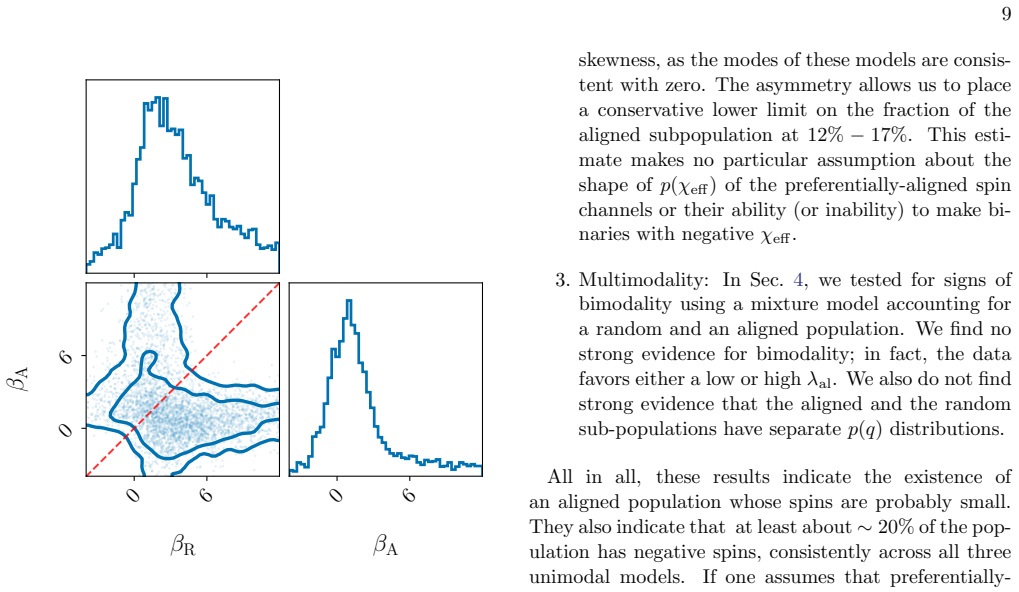
- The known $\chi_{\rm eff}$--$q$ anti-correlation can be reproduced by two channels with different mass-ratio distributions, with mild support for a flatter $q$ distribution in the aligned channel ($\beta_R > \beta_A$ at 65% credibility).
Reading between the lines
- If random-spin formation channels are not exactly symmetric about zero — for instance if stellar collisions in clusters impart small aligned spins, as recent simulations suggest — then $\alpha(0)$ and $R(\chi)$ would no longer cleanly separate aligned from random channels, and the $12\%$--$17\%$ floor would need reinterpretation as a blended quantity.
- The same asymmetry diagnostics could be applied to other spin parameters such as the precessing spin $\chi_p$, or to subpopulations split by mass or redshift, to test whether the aligned fraction changes with lookback time or grows at high masses where hierarchical mergers contribute.
- With a larger catalog from the next observing run, the residual $R(\chi)$ can be measured at higher significance: a persistent positive excess confined to $\chi_{\rm eff}<0.4$ would confirm small aligned spins from isolated binaries, while an excess extending to higher $\chi_{\rm eff}$ would point to an additional aligned channel such as AGN disks.
Formalized claims in Lean
-
Claim #1: The inferred `chi_eff` distribution is non-Gaussian, with positive skewness and asymmetry about zero.
/-- @claim 1 The inferred `chi_eff` distribution is non-Gaussian, with positive skewness and asymmetry about zero. -/
noncomputable def effective_spin_non_gaussian_claim : Prop :=
-
Claim #2: The 90% credible lower bound on the aligned subpopulation fraction is between 12% and 17%.
/-- @claim 2 The 90% credible lower bound on the aligned subpopulation fraction is between 12% and 17%. -/
noncomputable def aligned_subpopulation_fraction_claim : Prop :=
-
Claim #3: At least about 20% of binary black hole mergers have negative `chi_eff`.
/-- @claim 3 At least about 20% of binary black hole mergers have negative `chi_eff`. -/
noncomputable def negative_chi_eff_floor_claim : Prop :=
Editorial analysis
A structured set of objections, weighed in public.
Referee Report
Summary. This paper analyzes the effective inspiral spin (χ_eff) distribution of 69 binary black hole mergers from the first three LIGO-Virgo-KAGRA observing runs using hierarchical Bayesian inference. The authors fit several empirical population models: a truncated normal, two skew-normal variants, and mixture models with a zero-centered random component plus a skew-normal aligned component. They report positive skewness and asymmetry about χ_eff=0, with Bayes factors of 3.5 and 1.8 relative to the truncated normal, a 90% lower limit of 12%–17% on the fraction of a preferentially aligned subpopulation, and a lower limit of ~20% on systems with negative χ_eff. They find no strong evidence for bimodality and interpret the results as 'robust evidence' for an aligned subpopulation with small spins.
Significance. If the central claim held, the paper would provide one of the first direct population-level constraints on the aligned versus random formation-channel fraction using χ_eff alone, complementing component-spin analyses. The hierarchical machinery is careful: selection effects are treated via injection sets, the mass/redshift models follow the LIGO-Virgo-KAGRA standard, and the paper examines multiple parametrizations to test model dependence. The paper also makes concrete, falsifiable predictions: the ~20% negative-χ_eff floor, the small spin magnitudes of the aligned component, and the absence of bimodality. However, as detailed below, the central claim rests on an assumption—exact symmetry of the random-spin channel—that the paper itself flags as uncertain; the modest Bayes factors undercut the word 'robust'; and some secondary claims in Sec. 5.2 are not fully supported.
major comments (4)
- [Sec. 3.1, Eq. (5), footnote 1] The interpretation of α(0) as a conservative lower limit on the preferentially aligned subpopulation fraction requires that the random-spin channel produce a χ_eff distribution exactly symmetric about zero. The paper states this assumption in Sec. 3.1 ('we expect a subpopulation from a random spin channel to be completely symmetric about χ_eff=0...'), but its own footnote 1 cites Kıroğlu et al. (2025), which predicts that cluster collisions of BBHs with stars generate a population with small aligned spins. If the random channel possesses a small positive mean μ_r, its contribution to α(0) is approximately sqrt(2/π) μ_r/σ_r; for μ_r ≈ 0.02–0.05 and σ_r ≈ 0.1–0.2 this is of order 10–20%, comparable to the claimed 12–17% floor. The footnoted caveat is not propagated into the interpretation, so the headline claim is not yet robust to this well-motivated physical alternative. I recommend either adding an explicit offset-mean 'random' component to the model and testing whether the asymmetry persists, or reframing the result as a measurement of asymmetry rather than a lower limit on an aligned subpopulation.
- [Sec. 3] The evidence for skewness relative to the truncated normal is modest: Bayes factors of 3.5 (skewnormal) and 1.8 (ε-skewnormal). Under standard Jeffreys scales these constitute 'positive' rather than 'strong' evidence, and the ε-skewnormal preference is barely worth mentioning. The abstract and Sec. 5 describe the features as 'robust evidence'; this overstates the statistical support. Please temper the language or provide supplemental tests (e.g., injection-recovery calibrations, posterior predictive checks, or fractional false-alarm rates in simulated catalogs) that would justify the stronger wording.
- [Sec. 4, Eq. (7)] The mixture model fixes the random component's normal distribution to have zero mean. This makes λ_al degenerate with the true mean of the random channel: any positive asymmetry in the random channel is absorbed into the aligned component. The bimodal posterior for λ_al in Fig. 8 may therefore reflect not two physical formation scenarios but the model's inability to represent a single skewed random channel. The paper notes the degeneracy qualitatively but does not test it by allowing a free mean for the random component. Since the aligned fraction is a central quantity, this test is necessary to support the conclusions drawn from the mixture model.
- [Sec. 5.2] The estimate that 'at least about 40% of merging BBHs come from some sort of dynamical formation channel' rests on the assumption that preferentially-aligned spin pathways cannot produce negative χ_eff. This contradicts the more conservative treatment in Sec. 3.1, where the authors explicitly allow preferentially-aligned binaries to have negative χ_eff (citing strong natal kicks or internal gravity-wave spin-up). The two interpretations cannot both be used without a stated conditional framework; if the conservative assumption is adopted, the 40% dynamical fraction does not follow, and if the strong assumption is adopted, the 12–17% aligned floor is no longer conservative.
minor comments (6)
- [Sec. 2, footnote 1] The caveat about Kıroğlu et al. (2025) is important enough to be moved into the main text of Sec. 3.1 and discussed alongside Eq. (5).
- [Sec. 3, Fig. 3] The color description 'blue traces' is not meaningful if the figure is printed in grayscale; consider labeling draws by alpha or line style.
- [Sec. 3] The statement 'η_eff ≥ 0 at 99.1% credence' should specify whether this is a one-sided or two-sided credible interval, to avoid ambiguity.
- [Sec. 4.1] The 65% credibility for β_R > β_A is very weak; the text says 'mild preference' but this is close to uninformative. Consider highlighting this explicitly in the abstract or discussion to avoid overreading.
- [Sec. 5.2] The claim that previous analyses (Tong et al. 2022; Adamcewicz et al. 2024) suffered from a normalization error is a serious assertion. If it is not fully detailed in this paper, please provide a reference or an appendix that substantiates it, since it could mislead readers about the reliability of prior work.
- [Table 1] The table caption could define the 90% lower limit more precisely (i.e., the 5th percentile of the posterior for α), as the current phrasing is ambiguous.
Circularity Check
The paper shows no significant circularity: the aligned-subpopulation fraction is a posterior measurement from fitted chi_eff models, not an input, and the cited self-work is peripheral to the headline claim.
full rationale
This paper is an observational population analysis rather than a derivation from first principles, and its central claims do not reduce to their inputs. The skewnormal, epsilon-skewnormal, truncated-normal, and mixture models are hierarchical fits to public LIGO-Virgo-KAGRA data with explicit priors described in Appendix A; the reported skewness, asymmetry alpha(0), p(chi_eff <= 0), and the 12-17% lower limit are posterior summaries of those fits computed from Eq. (5) after fitting, so they are measurements rather than parameters inserted by hand. The inference that the asymmetry implies a preferentially aligned subpopulation rests on the stated physical assumption that random-spin channels produce a chi_eff distribution symmetric about zero (Sec. 3.1), which is an assumption and not a circular definition; the paper itself flags a mechanism that can break this assumption in footnote 1 (Kiroglu et al. 2025) and in the residual discussion. Self-citations (Callister et al. 2021; Adamcewicz et al. 2023, 2024; Baibhav et al. 2023) are used for prior modeling context or for the chi_eff-q correlation, which is independently corroborated by external LVK analyses; none is load-bearing for the headline asymmetry or the 12-17% floor. No fitted parameter is renamed as a prediction, no uniqueness theorem is imported, and no known result is merely relabeled as unification. Accordingly, there is no significant circularity.
Assumptions & free parameters
free parameters (12)
- mu_eff =
posterior; mode consistent with zero under skew models
- sigma_eff =
posterior; not quoted precisely
- eta_eff =
eta_eff >= 2.9 at 90% credibility; non-negative at 99.1% credence
- epsilon_eff =
epsilon_eff < 0 at 90.1% credibility
- lambda_al =
posterior; bimodal with modes favoring either low or high aligned fraction
- mu_al =
posterior; near zero in the high-lambda_al mode
- sigma_al =
posterior; not quoted precisely
- eta_al =
posterior; broad
- sigma_r =
posterior; not quoted precisely
- beta_A =
posterior; beta_R > beta_A at 65% credence
- beta_R =
posterior; not quoted precisely
- Nuisance mass/redshift/chi_p hyperparameters =
posterior distributions, not central
assumptions (6)
- domain assumption Random spin channels produce a chi_eff distribution exactly symmetric about zero
- domain assumption Preferentially aligned channels may produce systems with negative chi_eff
- domain assumption The hierarchical likelihood, selection function, and PE sample weighting are unbiased
- ad hoc to paper Skewnormal and epsilon-skewnormal families are flexible enough to represent the true chi_eff distribution
- ad hoc to paper The mixture model's random component is exactly centered at zero
- standard math Monte Carlo integration and nested sampling convergence
Cite this review
Pith. "Pith review of Structure and Skewness of the Effective Inspiral Spin Distribution of Binary Black Hole Mergers." pith.science (2026). https://pith.science/paper/FJTW4TFC
@misc{pith2026250106712,
  author       = {Pith},
  title        = {Pith review of: Structure and Skewness of the Effective Inspiral Spin Distribution of Binary Black Hole Mergers},
  year         = {2026},
  howpublished = {\url{https://pith.science/paper/FJTW4TFC}},
  note         = {Machine review of arXiv:2501.06712}
}
abstract
The detection of gravitational waves has brought to light a population of binary black holes that merge within a Hubble time. Multiple formation channels can contribute to this population, making it difficult to definitively associate particular population features with underlying stellar physics. Black hole spins are considered an important discriminator between various channels, but they are less well-measured than masses, making conclusive astrophysical statements using spins difficult thus far. In this paper, we consider the distribution of the effective inspiral spin $\chi_{\rm eff}$ -- a quantity much better measured than individual component spins. We show that non-Gaussian features like skewness, asymmetry about zero, and multimodality can naturally arise in the $\chi_{\rm eff}$ distribution when multiple channels contribute to the population. Searching for such features, we find signs of skewness and asymmetry already in the current catalogs, but no statistically significant signs of bimodality. These features provide robust evidence for the presence of a subpopulation with spins preferentially aligned to the binary's orbital angular momentum; and we conservatively estimate the fraction of this subpopulation to be at least $12 \% - 17\%$ (at $90\%$ credibility). Our models do not find an excess of non-spinning systems and instead find that at least $\sim 20 \%$ of the binaries have some degree of negative $\chi_{\rm eff}$. The data also suggest that, if preferentially aligned mergers form a significant fraction of the population, they must have small spins.
Figures


Figures from the paper (6 more)




Forward citations
Cited by 6 Pith papers
-
Spin-Orbit Alignment in Merging Binary Black Holes Following Collisions with Massive Stars
Collisions between binary black holes and massive stars can leave the black holes with small, preferentially aligned spins, offering a partial explanation for the positive effective spins seen in gravitational-wave data.
-
Assessing the waveform systematics from parameter estimation to population inference with eccentricity
Eccentric waveform-model differences, small per event, accumulate across the GWTC-4 catalog and alter inferred redshift evolution and effective-spin population distributions.
-
Signatures of a subpopulation of hierarchical mergers in the GWTC-4 gravitational-wave dataset
Using a joint effective-spin and precession-spin model on 155 gravitational-wave events, the authors infer that the hierarchical (second-generation) merger fraction rises sharply above ~46 M_sun and peaks again near 1...
-
Trends in the Population of Binary Black Holes Following the Fourth Gravitational-Wave Transient Catalog: a Data-Driven Analysis
A data-driven 'pi stroke' analysis of GWTC-4 reveals a secondary-black-hole mass gap at 38-120 solar masses, a possible chi1-chi2 spin correlation, and suggests the chi-eff-q anti-correlation may be a model artifact.
-
Population of Binary Black Holes Inferred from One Hundred and Fifty Gravitational Wave Signals
A population analysis of 153 LIGO-Virgo-KAGRA black-hole mergers reports chirp-mass peaks near 8, 14, and 27 solar masses, spaced by ~1.9, which the author interprets as possible hierarchical mergers.
-
The first decade of gravitational-wave measurements of black hole spins
A review summarizing formation-channel predictions, waveform effects, and population-level constraints on stellar-mass black hole spins from the first decade of gravitational-wave observations.
Reference graph
Works this paper leans on
-
[1]
Aasi, J., et al. 2015, Class. Quant. Grav., 32, 074001, 10.1088/0264-9381/32/7/074001
-
[2]
Abbott, B. P., et al. 2016, Phys. Rev. Lett., 116, 061102, 10.1103/PhysRevLett.116.061102
-
[3]
---. 2019, Phys. Rev. X, 9, 031040, 10.1103/PhysRevX.9.031040
-
[4]
Abbott, R., et al. 2020, Astrophys. J. Lett., 900, L13, 10.3847/2041-8213/aba493
-
[5]
---. 2021 a , Astrophys. J. Lett., 913, L7, 10.3847/2041-8213/abe949
-
[6]
---. 2021 b , Phys. Rev. X, 11, 021053, 10.1103/PhysRevX.11.021053
-
[7]
---. 2023 a , Phys. Rev. X, 13, 041039, 10.1103/PhysRevX.13.041039
-
[8]
---. 2023 b , Phys. Rev. X, 13, 011048, 10.1103/PhysRevX.13.011048
Show all 118 references
-
[9]
2015, Class
Acernese, F., et al. 2015, Class. Quant. Grav., 32, 024001, 10.1088/0264-9381/32/2/024001
2015 doi
-
[10]
D., & Thrane, E
Adamcewicz, C., Galaudage, S., Lasky, P. D., & Thrane, E. 2024, Astrophys. J. Lett., 964, L6, 10.3847/2041-8213/ad2df2
2024 doi
-
[11]
D., & Thrane, E
Adamcewicz, C., Lasky, P. D., & Thrane, E. 2023, Astrophys. J., 958, 13, 10.3847/1538-4357/acf763
2023 doi
-
[12]
2022, Mon
Adamcewicz, C., & Thrane, E. 2022, Mon. Not. Roy. Astron. Soc., 517, 3928, 10.1093/mnras/stac2961
2022 doi
-
[13]
2025, in prep
Adamcewicz, C., et al. 2025, in prep
2025
-
[14]
2011, Physical Review Letters, 106, 241101, 10.1103/PhysRevLett.106.241101
Ajith, P., Hannam, M., Husa, S., et al. 2011, Physical Review Letters, 106, 241101, 10.1103/PhysRevLett.106.241101
2011 doi
-
[15]
2021, PTEP, 2021, 05A101, 10.1093/ptep/ptaa125
Akutsu, T., et al. 2021, PTEP, 2021, 05A101, 10.1093/ptep/ptaa125
2021 doi
- [16]
-
[17]
Antonini, F., & Rasio, F. A. 2016, Astrophys. J., 831, 187, 10.3847/0004-637X/831/2/187
2016 doi
- [18]
-
[19]
2019, Astrophys
Ashton, G., et al. 2019, Astrophys. J. Suppl., 241, 27, 10.3847/1538-4365/ab06fc
2019 doi
-
[20]
1985, Scandinavian journal of statistics, 171
Azzalini, A. 1985, Scandinavian journal of statistics, 171
1985
-
[21]
2023, Astrophys
Baibhav, V., Doctor, Z., & Kalogera, V. 2023, Astrophys. J., 946, 50, 10.3847/1538-4357/acbf4c
2023 doi
-
[22]
Baibhav, V., & Kalogera, V. 2024. 2412.03461
2024 arXiv
-
[23]
2009, Monthly Notices of the Royal Astronomical Society, 402, 371–380, 10.1111/j.1365-2966.2009.15880.x
Banerjee, S., Baumgardt, H., & Kroupa, P. 2009, Monthly Notices of the Royal Astronomical Society, 402, 371–380, 10.1111/j.1365-2966.2009.15880.x
2009
-
[24]
S., et al
Bavera, S. S., et al. 2021, Astron. Astrophys., 647, A153, 10.1051/0004-6361/202039804
2021 doi
-
[25]
E., et al
Belczynski, K., Repetto, S., Holz, D. E., et al. 2016, Astrophys. J., 819, 108, 10.3847/0004-637X/819/2/108
2016 doi
-
[26]
A., Haster, C.-J., et al
Biscoveanu, S., Callister, T. A., Haster, C.-J., et al. 2022, Astrophys. J. Lett., 932, L19, 10.3847/2041-8213/ac71a8
2022 doi
-
[27]
2020, The Astrophysical Journal, 898, 71, 10.3847/1538-4357/ab9d85
Breivik , K., Coughlin , S., Zevin , M., et al. 2020, The Astrophysical Journal, 898, 71, 10.3847/1538-4357/ab9d85
2020 doi
-
[28]
A., & Farr, W
Callister, T. A., & Farr, W. M. 2024, Phys. Rev. X, 14, 021005, 10.1103/PhysRevX.14.021005
2024 doi
-
[29]
A., Haster, C.-J., Ng, K
Callister, T. A., Haster, C.-J., Ng, K. K. Y., Vitale, S., & Farr, W. M. 2021, Astrophys. J. Lett., 922, L5, 10.3847/2041-8213/ac2ccc
2021 doi
-
[30]
A., Miller, S
Callister, T. A., Miller, S. J., Chatziioannou, K., & Farr, W. M. 2022, Astrophys. J. Lett., 937, L13, 10.3847/2041-8213/ac847e
2022 doi
- [31]
-
[32]
M., Casares, J., Munoz-Darias, T., et al
Corral-Santana, J. M., Casares, J., Munoz-Darias, T., et al. 2016, Astron. Astrophys., 587, A61, 10.1051/0004-6361/201527130
2016 doi
- [33]
-
[34]
E., & Mandel, I
de Mink, S. E., & Mandel, I. 2016, Mon. Not. Roy. Astron. Soc., 460, 3545, 10.1093/mnras/stw1219
2016 doi
-
[35]
2023, , 946, 16, 10.3847/1538-4357/acb5ed
Edelman , B., Farr , B., & Doctor , Z. 2023, , 946, 16, 10.3847/1538-4357/acb5ed
2023 doi
-
[36]
J., Stanway , E
Eldridge , J. J., Stanway , E. R., Xiao , L., et al. 2017, Publications of the Astronomical Society of Australia, 34, e058, 10.1017/pasa.2017.51
2017 doi
-
[37]
Essick, R., & Farr, W. 2022. 2204.00461
2022 arXiv
-
[38]
M., Fishbach, M., & Holz, D
Farah, A. M., Fishbach, M., & Holz, D. E. 2024, Astrophys. J., 962, 69, 10.3847/1538-4357/ad0558
2024 doi
-
[39]
M., Stevenson, S., Coleman Miller, M., et al
Farr, W. M., Stevenson, S., Coleman Miller, M., et al. 2017, Nature, 548, 426, 10.1038/nature23453
2017 doi
-
[40]
E., & Farr, W
Fishbach, M., Holz, D. E., & Farr, W. M. 2018, Astrophys. J. Lett., 863, L41, 10.3847/2041-8213/aad800
2018 doi
-
[41]
2022, Astrophys
Fishbach, M., & Kalogera, V. 2022, Astrophys. J. Lett., 929, L26, 10.3847/2041-8213/ac64a5
2022 doi
-
[42]
2022, Astrophys
Fishbach, M., Kimball, C., & Kalogera, V. 2022, Astrophys. J. Lett., 935, L26, 10.3847/2041-8213/ac86c4
2022 doi
-
[43]
J., Bavera , S
Fragos , T., Andrews , J. J., Bavera , S. S., et al. 2023, The Astrophysical Journal Supplement Series, 264, 45, 10.3847/1538-4365/ac90c1
2023 doi
-
[44]
2019, Astrophys
Fuller, J., & Ma, L. 2019, Astrophys. J. Lett., 881, L1, 10.3847/2041-8213/ab339b
2019 doi
-
[45]
2021, Astrophys
Galaudage, S., et al. 2021, Astrophys. J. Lett., 921, L15, 10.3847/2041-8213/ac2f3c
2021 doi
-
[46]
2023, Nature Astron., 7, 11, 10.1038/s41550-022-01813-w
Gamba, R., Breschi, M., Carullo, G., et al. 2023, Nature Astron., 7, 11, 10.1038/s41550-022-01813-w
2023 doi
-
[47]
2022, Nature Astron., 6, 344, 10.1038/s41550-021-01568-w
Gayathri, V., Healy, J., Lange, J., et al. 2022, Nature Astron., 6, 344, 10.1038/s41550-021-01568-w
2022 doi
-
[48]
2018, Phys
Gerosa, D., Berti, E., O'Shaughnessy, R., et al. 2018, Phys. Rev. D, 98, 084036, 10.1103/PhysRevD.98.084036
2018 doi
-
[49]
2021, Nature Astron., 5, 749, 10.1038/s41550-021-01398-w
Gerosa, D., & Fishbach, M. 2021, Nature Astron., 5, 749, 10.1038/s41550-021-01398-w
2021 doi
-
[50]
2015, Phys
Gerosa, D., Kesden, M., Sperhake, U., Berti, E., & O'Shaughnessy, R. 2015, Phys. Rev. D, 92, 064016, 10.1103/PhysRevD.92.064016
2015 doi
-
[51]
2018, Mon
Giacobbo, N., & Mapelli, M. 2018, Mon. Not. Roy. Astron. Soc., 480, 2011, 10.1093/mnras/sty1999
2018 doi
-
[52]
2018, Monthly Notices of the Royal Astronomical Society, 474, 2959, 10.1093/mnras/stx2933
Giacobbo , N., Mapelli , M., & Spera , M. 2018, Monthly Notices of the Royal Astronomical Society, 474, 2959, 10.1093/mnras/stx2933
2018 doi
-
[53]
2014, Phys
Hannam, M., Schmidt, P., Boh\'e, A., et al. 2014, Phys. Rev. Lett., 113, 151101, 10.1103/PhysRevLett.113.151101
2014 doi
-
[54]
2022, Nature, 610, 652, 10.1038/s41586-022-05212-z
Hannam, M., et al. 2022, Nature, 610, 652, 10.1038/s41586-022-05212-z
2022 doi
- [55]
-
[56]
Hoy, C., Fairhurst, S., & Mandel, I. 2024. 2408.03410
2024 arXiv
-
[57]
H., et al
Islam, T., Vajpeyi, A., Shaik, F. H., et al. 2023. 2309.14473
2023
-
[58]
Iwaya, M., Kobayashi, K., Morisaki, S., Hotokezaka, K., & Kinugawa, T. 2024. 2412.14551
2024 arXiv
- [59]
-
[60]
C., Kremer, K., Vanderzyden, H
K ro g lu, F., Lombardi, J. C., Kremer, K., Vanderzyden, H. D., & Rasio, F. A. 2025, Astrophys. J. Lett., 983, L9, 10.3847/2041-8213/adc263
2025 doi
-
[61]
S., Rui, N
Kremer, K., Ye, C. S., Rui, N. Z., et al. 2020, Astrophys. J. Suppl., 247, 48, 10.3847/1538-4365/ab7919
2020 doi
-
[62]
2024, Phys
Li, Y.-J., Wang, Y.-Z., Tang, S.-P., & Fan, Y.-Z. 2024, Phys. Rev. Lett., 133, 051401, 10.1103/PhysRevLett.133.051401
2024 doi
-
[63]
LVK. 2023 a , GWTC-3: Compact Binary Coalescences Observed by LIGO and Virgo During the Second Part of the Third Observing Run — Parameter estimation data release , Zenodo, 10.5281/zenodo.8177023
2023 doi
-
[64]
---. 2023 b , GWTC-3: Compact Binary Coalescences Observed by LIGO and Virgo During the Second Part of the Third Observing Run — O3 search sensitivity estimates , Zenodo, 10.5281/zenodo.7890437
2023 doi
-
[65]
Mandel, I., & Broekgaarden, F. S. 2022, Living Rev. Rel., 25, 1, 10.1007/s41114-021-00034-3
2022 doi
-
[66]
M., & Gair, J
Mandel, I., Farr, W. M., & Gair, J. R. 2019, Mon. Not. Roy. Astron. Soc., 486, 1086, 10.1093/mnras/stz896
2019 doi
- [67]
-
[68]
2021, Symmetry, 13, 1678, 10.3390/sym13091678
Mapelli, M., Santoliquido, F., Bouffanais, Y., et al. 2021, Symmetry, 13, 1678, 10.3390/sym13091678
2021 doi
-
[69]
M., & Moriya, T
Marchant, P., Langer, N., Podsiadlowski, P., Tauris, T. M., & Moriya, T. J. 2016, Astron. Astrophys., 588, A50, 10.1051/0004-6361/201628133
2016 doi
-
[70]
Martinez , M. A. S., Fragione , G., Kremer , K., et al. 2020, , 903, 67, 10.3847/1538-4357/abba25
2020 doi
-
[71]
McKernan, B., Ford, K. E. S., Callister, T., et al. 2022, Mon. Not. Roy. Astron. Soc., 514, 3886, 10.1093/mnras/stac1570
2022 doi
-
[72]
McKernan, B., Ford, K. E. S., O'Shaughnessy, R., & Wysocki, D. 2020, Mon. Not. Roy. Astron. Soc., 494, 1203, 10.1093/mnras/staa740
2020 doi
-
[73]
2018, Astrophys
Mckernan, B., et al. 2018, Astrophys. J., 866, 66, 10.3847/1538-4357/aadae5
2018 doi
-
[74]
A., & Farr, W
Miller, S., Callister, T. A., & Farr, W. 2020, Astrophys. J., 895, 128, 10.3847/1538-4357/ab80c0
2020 doi
-
[75]
J., Isi, M., Chatziioannou, K., Varma, V., & Mandel, I
Miller, S. J., Isi, M., Chatziioannou, K., Varma, V., & Mandel, I. 2024, Phys. Rev. D, 109, 024024, 10.1103/PhysRevD.109.024024
2024 doi
-
[76]
S., & Hutson, A
Mudholkar, G. S., & Hutson, A. D. 2000, Journal of Statistical Planning and Inference, 83, 291, https://doi.org/10.1016/S0378-3758(99)00096-8
2000 doi
-
[77]
2016, , 54, 441, 10.1146/annurev-astro-081915-023315
Naoz , S. 2016, , 54, 441, 10.1146/annurev-astro-081915-023315
2016 doi
-
[78]
J., Vigna-G\'omez, A., Stevenson, S., et al
Neijssel, C. J., Vigna-G\'omez, A., Stevenson, S., et al. 2019, Mon. Not. Roy. Astron. Soc., 490, 3740, 10.1093/mnras/stz2840
2019 doi
-
[79]
2022, Phys
Payne, E., Hourihane, S., Golomb, J., et al. 2022, Phys. Rev. D, 106, 104017, 10.1103/PhysRevD.106.104017
2022 doi
-
[80]
2024, Astron
Pierra, G., Mastrogiovanni, S., & Perri\`es, S. 2024, Astron. Astrophys., 692, A80, 10.1051/0004-6361/202452545
2024 doi
-
[81]
2008, Physical Review D, 78, 044021, 10.1103/PhysRevD.78.044021
Racine, E. 2008, Physical Review D, 78, 044021, 10.1103/PhysRevD.78.044021
2008 doi
-
[82]
Ray, A., Maga\ na Hernandez, I., Breivik, K., & Creighton, J. 2024. 2404.03166
2024 arXiv
-
[83]
Reynolds, C. S. 2021, Ann. Rev. Astron. Astrophys., 59, 117, 10.1146/annurev-astro-112420-035022
2021 doi
-
[84]
W., et al
Riley , J., Agrawal , P., Barrett , J. W., et al. 2022, The Astrophysical Journal Supplement Series, 258, 34, 10.3847/1538-4365/ac416c
2022 doi
-
[85]
L., & Antonini, F
Rodriguez, C. L., & Antonini, F. 2018, Astrophys. J., 863, 7, 10.3847/1538-4357/aacea4
2018 doi
-
[86]
L., Zevin, M., Pankow, C., Kalogera, V., & Rasio, F
Rodriguez, C. L., Zevin, M., Pankow, C., Kalogera, V., & Rasio, F. A. 2016, Astrophys. J. Lett., 832, L2, 10.3847/2041-8205/832/1/L2
2016 doi
-
[87]
M., Lasky, P
Romero-Shaw, I. M., Lasky, P. D., Thrane, E., & Bustillo, J. C. 2020, Astrophys. J. Lett., 903, L5, 10.3847/2041-8213/abbe26
2020 doi
-
[88]
S., Olsen, S., et al
Roulet, J., Chia, H. S., Olsen, S., et al. 2021, Phys. Rev. D, 104, 083010, 10.1103/PhysRevD.104.083010
2021 doi
-
[89]
2019, Monthly Notices of the Royal Astronomical Society, 484, 4216, 10.1093/mnras/stz226
Roulet, J., & Zaldarriaga, M. 2019, Monthly Notices of the Royal Astronomical Society, 484, 4216, 10.1093/mnras/stz226
2019 doi
-
[90]
2010, Physical Review D, 82, 064016, 10.1103/PhysRevD.82.064016
Santamaría, L., Ohme, F., Ajith, P., et al. 2010, Physical Review D, 82, 064016, 10.1103/PhysRevD.82.064016
2010 doi
-
[91]
2023, Physical Review D, 108, 083033, 10.1103/PhysRevD.108.083033
Santini , A., Gerosa , D., Cotesta , R., & Berti , E. 2023, Physical Review D, 108, 083033, 10.1103/PhysRevD.108.083033
2023 doi
-
[92]
2015, Phys
Schmidt, P., Ohme, F., & Hannam, M. 2015, Phys. Rev. D, 91, 024043, 10.1103/PhysRevD.91.024043
2015 doi
-
[93]
2019, Astrophys
Secunda, A., Bellovary, J., Mac Low, M.-M., et al. 2019, Astrophys. J., 878, 85, 10.3847/1538-4357/ab20ca
2019 doi
- [94]
-
[95]
A., Naoz, S., & Kocsis, B
Sedda, M. A., Naoz, S., & Kocsis, B. 2023, Universe, 9, 138, 10.3390/universe9030138
2023 doi
-
[96]
2017, Astrophys
Silsbee, K., & Tremaine, S. 2017, Astrophys. J., 836, 39, 10.3847/1538-4357/aa5729
2017 doi
-
[97]
Speagle , J. S. 2020, , 493, 3132, 10.1093/mnras/staa278
2020 doi
-
[98]
2022, SEVN: Stellar EVolution for N-body , Astrophysics Source Code Library, record ascl:2206.019
Spera , M., Mapelli , M., & Bressan , A. 2022, SEVN: Stellar EVolution for N-body , Astrophysics Source Code Library, record ascl:2206.019
2022
-
[99]
Spruit, H. C. 2002, Astron. Astrophys., 381, 923, 10.1051/0004-6361:20011465
2002 doi
-
[100]
Stevenson, S., Berry, C. P. L., & Mandel, I. 2017 a , Mon. Not. Roy. Astron. Soc., 471, 2801, 10.1093/mnras/stx1764
2017 doi
-
[101]
2017 b , Nature Commun., 8, 14906, 10.1038/ncomms14906
Stevenson, S., Vigna-G\'omez, A., Mandel, I., et al. 2017 b , Nature Commun., 8, 14906, 10.1038/ncomms14906
2017 doi
-
[102]
2020 a , Astrophys
Tagawa, H., Haiman, Z., Bartos, I., & Kocsis, B. 2020 a , Astrophys. J., 899, 26, 10.3847/1538-4357/aba2cc
2020 doi
-
[103]
2020 b , Astrophys
Tagawa, H., Haiman, Z., & Kocsis, B. 2020 b , Astrophys. J., 898, 25, 10.3847/1538-4357/ab9b8c
2020 doi
-
[104]
2023, Mon
Talbot, C., & Golomb, J. 2023, Mon. Not. Roy. Astron. Soc., 526, 3495, 10.1093/mnras/stad2968
2023 doi
-
[105]
Talbot , C., Smith , R., Thrane , E., & Poole , G. B. 2019, , 100, 043030, 10.1103/PhysRevD.100.043030
2019 doi
-
[106]
2017, Phys
Talbot, C., & Thrane, E. 2017, Phys. Rev. D, 96, 023012, 10.1103/PhysRevD.96.023012
2017 doi
- [107]
-
[108]
2019, Publications of the Astronomical Society of Australia, 36, 10.1017/pasa.2019.2
Thrane, E., & Talbot, C. 2019, Publications of the Astronomical Society of Australia, 36, 10.1017/pasa.2019.2
2019 doi
-
[109]
2022, Phys
Tong, H., Galaudage, S., & Thrane, E. 2022, Phys. Rev. D, 106, 103019, 10.1103/PhysRevD.106.103019
2022 doi
- [110]
-
[111]
van den Heuvel, E. P. J., Portegies Zwart, S. F., & de Mink, S. E. 2017, Mon. Not. Roy. Astron. Soc., 471, 4256, 10.1093/mnras/stx1430
2017 doi
-
[112]
2022, Astron
Vitale, S., Biscoveanu, S., & Talbot, C. 2022, Astron. Astrophys., 668, L2, 10.1051/0004-6361/202245084
2022 doi
-
[113]
M., & Taylor, S
Vitale, S., Gerosa, D., Farr, W. M., & Taylor, S. R. 2020, 10.1007/978-981-15-4702-7_45-1
2020 doi
-
[114]
2017, Class
Vitale, S., Lynch, R., Sturani, R., & Graff, P. 2017, Class. Quant. Grav., 34, 03LT01, 10.1088/1361-6382/aa552e
2017 doi
-
[115]
2021, Astrophys
Wang, Y.-H., McKernan, B., Ford, S., et al. 2021, Astrophys. J. Lett., 923, L23, 10.3847/2041-8213/ac400a
2021 doi
-
[116]
Wong, K. W. K., Breivik, K., Kremer, K., & Callister, T. 2021, Phys. Rev. D, 103, 083021, 10.1103/PhysRevD.103.083021
2021 doi
-
[117]
2019, Physical Review Letters, 123, 181101, 10.1103/PhysRevLett.123.181101
Yang , Y., Bartos , I., Gayathri , V., et al. 2019, Physical Review Letters, 123, 181101, 10.1103/PhysRevLett.123.181101
2019 doi
-
[118]
S., Berry, C
Zevin, M., Bavera, S. S., Berry, C. P. L., et al. 2021, Astrophys. J., 910, 152, 10.3847/1538-4357/abe40e
2021 doi
Reviewed August 10, 2026 · model on record in the stance chip above.
Discussion (0). Continue with ORCID to comment.