DetMesh-Gadep: Triangulated Surface Modeling and GPU-based Monte Carlo Efficiency Calibration of High-Purity Germanium Detectors
Pith reviewed 2026-06-29 19:19 UTC · model grok-4.3
The pith
DetMesh generates triangulated detector surfaces that Gadep simulates on one GPU 13.53 times faster than 60 CPU cores for 100 million particles.
A machine-rendered reading of the paper's core claim, the machinery that carries it, and where it could break.
Core claim
The DetMesh-Gadep framework supplies triangulated surface geometry from parameterized models and feeds it to a GPU Monte Carlo kernel, delivering a measured speedup of 13.53 for 1 imes10^8 particles on an RTX 4090 versus simultaneous execution on 60 CPU cores while maintaining low implementation cost and broad applicability to refined detector modeling and sourceless calibration.
What carries the argument
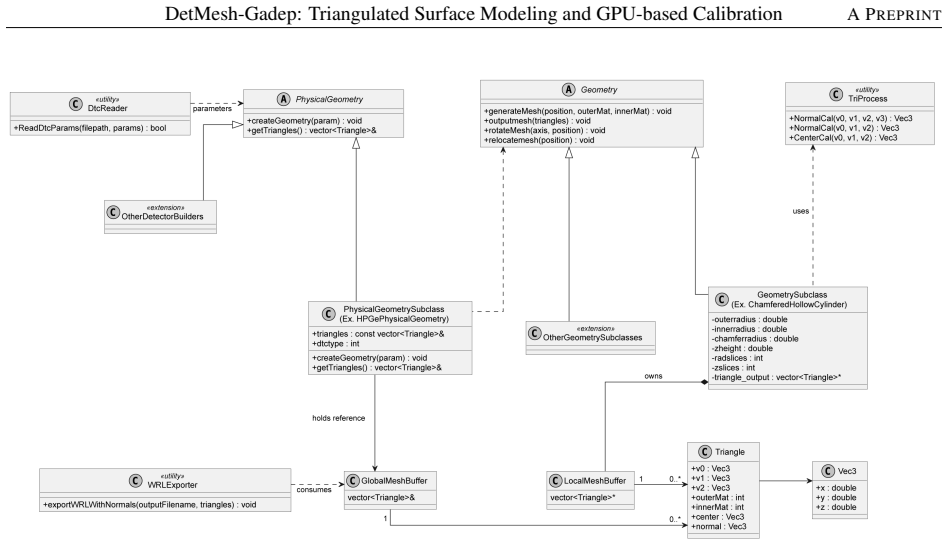
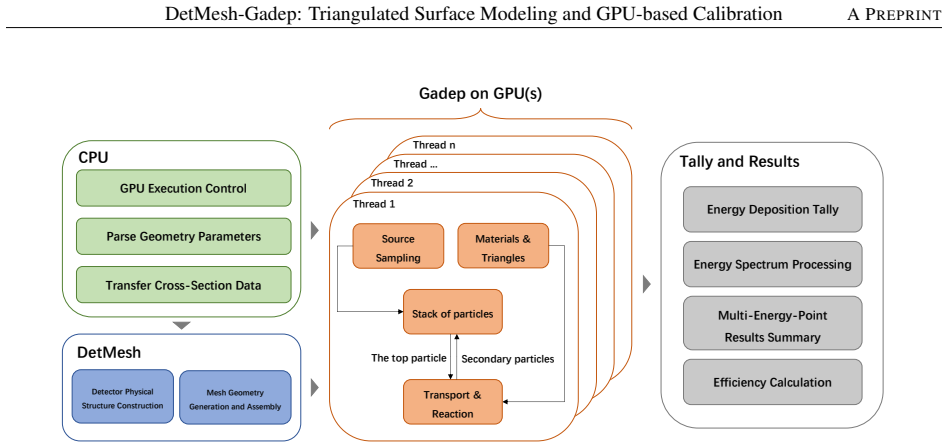
DetMesh, the program that produces triangulated surface geometry from parameterized detector models, together with Gadep, the GPU-resident Monte Carlo computational kernel that ingests that geometry for particle transport.
If this is right
- Monte Carlo efficiency calibration becomes practical on modest hardware without large CPU clusters.
- Complex detector features such as irregular contacts or cryostat components can be represented more directly than with conventional constructive solid geometry.
- Sourceless calibration gains convenience and safety by eliminating the need to handle radioactive sources in routine work.
- The same geometry and kernel can be reused across multiple detector designs with only parameter changes.
- Overall simulation throughput increases, allowing higher statistics or more parameter studies in the same time.
Where Pith is reading between the lines
- The method could be tested on detectors with known manufacturing tolerances to quantify how mesh resolution affects final efficiency uncertainty.
- Integration with automated mesh refinement based on local curvature might further reduce the gap between model and hardware.
- The GPU kernel structure may transfer to other radiation-transport codes that already support surface meshes.
- Field-deployable systems could use the same pipeline for in-situ recalibration when detector conditions change.
Load-bearing premise
The triangulated surfaces produced by DetMesh match the true physical boundaries and internal components of the detector closely enough that Monte Carlo results reproduce actual detector response.
What would settle it
Experimental efficiency measurements with calibrated radioactive sources that deviate systematically from the simulated efficiencies obtained with the DetMesh-Gadep geometry.
Figures



read the original abstract
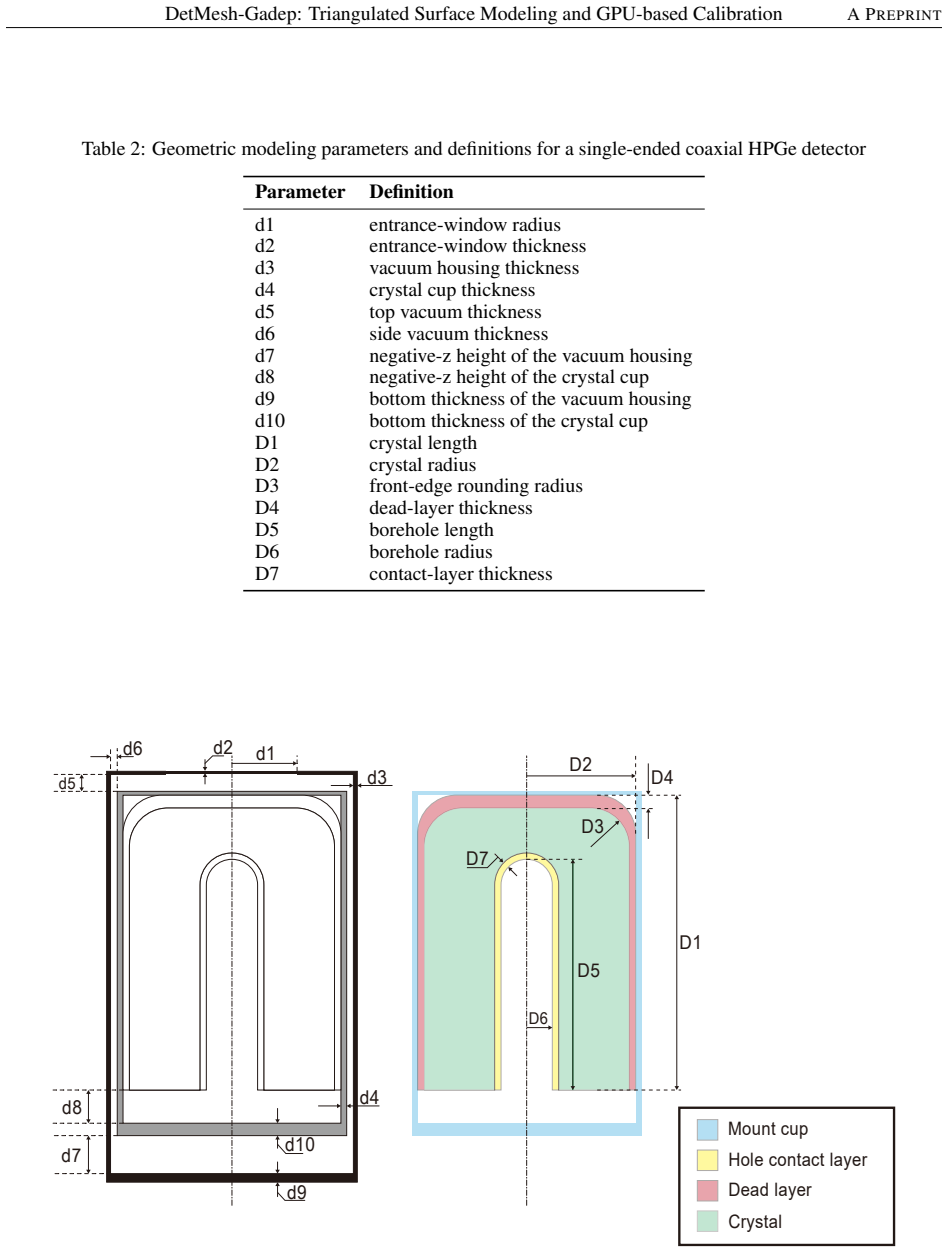
Sourceless efficiency calibration of high-purity germanium (HPGe) detectors can provide accurate detector-response information without experiments using radioactive calibration sources, offering advantages in both convenience and safety. In many practical implementations, this process is performed using Monte Carlo simulation; however, its performance is constrained by the accuracy of detector modeling, the operational complexity of simulation frameworks, and the computational-resource requirements associated with CPU-based parallelization. In this study, a complete detector modeling and simulation framework is proposed. The detector modeling program DetMesh can generate triangulated surface geometry from parameterized detector models, providing advantages in the representation of complex geometric boundaries. It incorporates standard geometric operations and a geometric library, and is lightweight with strong extensibility. The generated geometry is then input into Gadep, a GPU-based Monte Carlo computational kernel, to enable rapid simulation. For $1\times 10^8$ particles, a single RTX 4090 achieved a speedup factor of 13.53 compared with simultaneous computation using 60 CPU cores. The proposed framework has low implementation cost and broad applicability, providing a complete solution for refined detector modeling and calibration.
Editorial analysis
A structured set of objections, weighed in public.
Referee Report
Summary. The manuscript introduces DetMesh, a lightweight program that converts parameterized HPGe detector models into triangulated surface geometries, and Gadep, a GPU-based Monte Carlo kernel that uses these geometries for particle transport. It reports a 13.53× speedup for 10^8 particles on one RTX 4090 versus 60 CPU cores and positions the combined framework as a low-cost, extensible solution for sourceless efficiency calibration of HPGe detectors.
Significance. The concrete performance number and the emphasis on handling complex boundaries via triangulation are strengths of the implementation. If the triangulated surfaces were shown to reproduce measured efficiencies, the framework could offer a practical alternative to established CSG-based codes for routine calibration tasks.
major comments (2)
- [Abstract] Abstract: The central claim that the framework supplies 'a complete solution for refined detector modeling and calibration' is load-bearing yet unsupported; no comparison of simulated versus measured efficiencies, no residual analysis, and no benchmark against Geant4 or other established codes is presented anywhere in the manuscript.
- [Abstract] Abstract and performance evaluation: The reported 13.53× speedup is given without any description of the physics models (cross sections, electromagnetic processes, variance reduction) employed in the Monte Carlo step or any statistical uncertainties on the resulting efficiencies.
Simulated Author's Rebuttal
We thank the referee for the constructive comments on our manuscript. The work focuses on the implementation of DetMesh for triangulated geometry generation and Gadep as a GPU-based Monte Carlo kernel, with emphasis on computational performance for HPGe detector simulations. We address each major comment below.
read point-by-point responses
-
Referee: [Abstract] Abstract: The central claim that the framework supplies 'a complete solution for refined detector modeling and calibration' is load-bearing yet unsupported; no comparison of simulated versus measured efficiencies, no residual analysis, and no benchmark against Geant4 or other established codes is presented anywhere in the manuscript.
Authors: We agree that the manuscript does not include any comparison of simulated efficiencies to experimental measurements, residual analysis, or benchmarks against established codes such as Geant4. The presented work centers on the geometry modeling tool and the GPU kernel's computational speedup rather than full validation of the physics results. We will revise the abstract to qualify the claim, replacing 'complete solution for refined detector modeling and calibration' with language that accurately reflects the scope as a framework for parameterized detector modeling and GPU-accelerated simulation. revision: yes
-
Referee: [Abstract] Abstract and performance evaluation: The reported 13.53× speedup is given without any description of the physics models (cross sections, electromagnetic processes, variance reduction) employed in the Monte Carlo step or any statistical uncertainties on the resulting efficiencies.
Authors: The Gadep kernel implements standard photon transport for gamma-ray interactions in HPGe detectors, utilizing tabulated cross sections for the photoelectric effect, Compton scattering, and pair production. No variance reduction techniques are applied in the reported runs. However, the manuscript does not detail these models or provide statistical uncertainties on the efficiencies. We will add a concise description of the physics processes and include the associated Monte Carlo statistical uncertainties in the revised performance evaluation section. revision: yes
Circularity Check
No circularity; implementation of standard geometry and Monte Carlo techniques
full rationale
The paper describes a software framework (DetMesh for triangulated geometry generation + Gadep for GPU Monte Carlo) and reports a measured runtime speedup. No derivation chain, no fitted parameters renamed as predictions, no self-citation load-bearing on uniqueness theorems, and no ansatz smuggled via prior work. The central claim reduces to measured performance on standard techniques rather than any self-referential reduction. The absence of experimental validation against measured efficiencies is a correctness concern, not circularity.
Axiom & Free-Parameter Ledger
axioms (1)
- domain assumption Monte Carlo simulation of particle transport through triangulated geometry produces accurate efficiency values for HPGe detectors
Reference graph
Works this paper leans on
-
[1]
Radiation detection and measurement
Glenn F Knoll. Radiation detection and measurement . John Wiley & Sons, 2010. J Eberth and J Simpson. From ge (li) detectors to gamma-ray tracking arrays–50 years of gamma spectroscopy with germanium detectors. Progress in Particle and Nuclear Physics, 60(2):283–337, 2008. RH Tsou, Simon C Lin, and LL Kiang. Monte carlo simulation for compton suppression ...
2010
-
[2]
D Budjáš, M Heisel, W Maneschg, and H Simgen
Spectrometers, Detectors and Associated Equipment , 587(2-3):304–314, 2008. D Budjáš, M Heisel, W Maneschg, and H Simgen. Optimisation of the mc-model of a p-type ge-spectrometer for the purpose of efficiency determination. Applied Radiation and Isotopes , 67(5):706–710, 2009. Tim Vidmar and Joël Gasparro. Crystal rounding and the efficiency transfer method...
2008
-
[3]
Effect of the geometrical parameters of an hpge de- tector on efficiency calculations using monte carlo methods
Fausser, Nicolas Thiollay, Gilles Gregoire, and Andrea Zoia. Effect of the geometrical parameters of an hpge de- tector on efficiency calculations using monte carlo methods. Nuclear Instruments and Methods in Physics Research Section A: Accelerators, Spectrometers, Detectors and Associated Equipment , 1039:167096, 2022. SJ Bell, SM Judge, and PH Regan. An ...
2022
discussion (0)
Sign in with ORCID, Apple, or X to comment. Anyone can read and Pith papers without signing in.