REVIEW 2 major objections 7 minor 18 cited by
The Cosmic Evolution Early Release Science Survey (CEERS)
T0 review · 2 major / 7 minor · reviewed 2026-08-10 · deepseek-v4-flash
Pith's one-line read CEERS shows that coordinated-parallel JWST observations reach design depths and seed broad extragalactic science.
desk verdict A solid, citable CEERS overview with a real but minor gap in imaging depth validation; acceptable after fixing the unfinished citation. read the letter →
The pith
A machine-rendered reading of the paper's core claim, the machinery that carries it, and where it could break.
The reading
What carries the argument
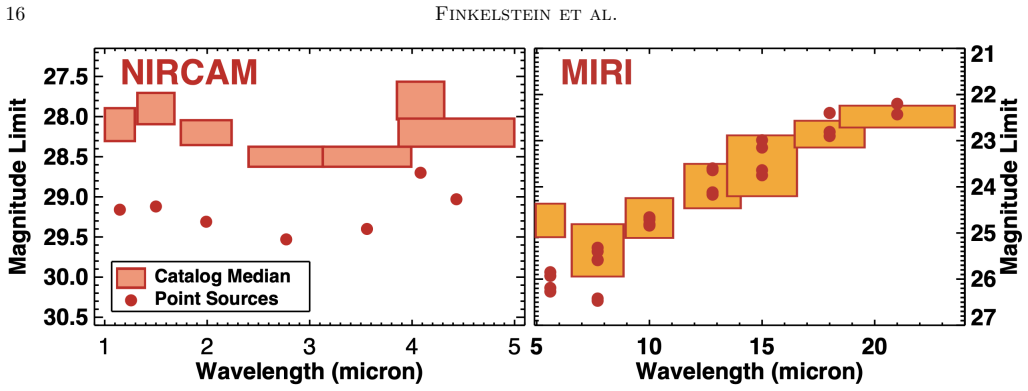
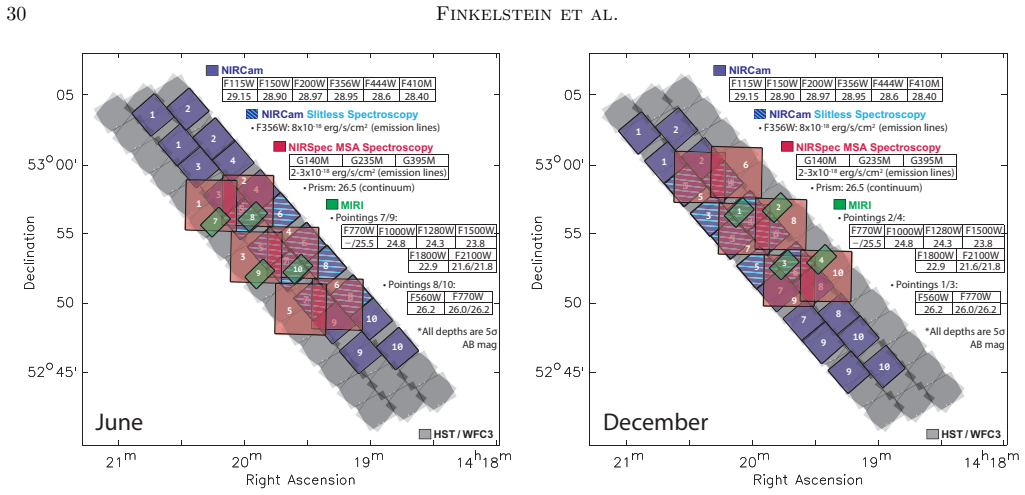
The load-bearing object is the coordinated-parallel observing layout itself: pairs of prime and parallel JWST observations designed so that NIRCam imaging fills the mosaic while NIRSpec MSA and MIRI observe the same or overlapping footprints, plus NIRCam grism spectroscopy with MIRI in parallel. The argument that the survey 'worked' is carried by the empirical depth-measurement method in Section 4.1, which places random circular apertures in source-free regions to derive point-source $5\sigma$ limits (corrected to total via encircled-energy fractions) and injects mock emission lines into real spectra to derive $5\sigma$ line fluxes; these measurements appear in Tables 5 and 6 and Figures 6 and 7 and are compared to pre-launch expectations. The v1.0 data-reduction pipeline, with custom wisp, $1/f$, and background subtractions and astrometric alignment, is what turns raw data into the mosaics and spectra whose quality is being validated.
What would settle it
Independently reduce a subset of the same raw CEERS data (for example, one NIRCam pointing and one NIRSpec grating) with a different pipeline, re-measure the $5\sigma$ point-source depth in 0.2-arcsecond apertures and the recovered mock-line flux in the same spectra, and compare to Tables 5 and 6; a systematic discrepancy larger than the quoted uncertainties would falsify the claimed validation.
Extended reading notes
Core claim
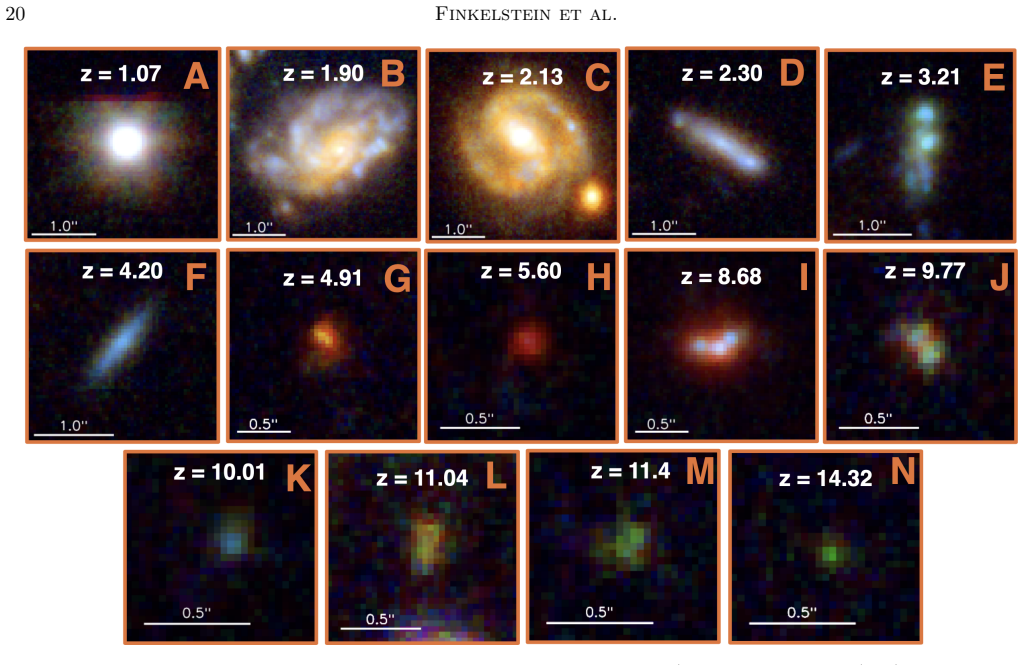
CEERS demonstrates, tests, and validates efficient extragalactic survey operations with JWST by executing coordinated, overlapping parallel observations with NIRCam and MIRI imaging and NIRSpec and NIRCam slitless spectroscopy. On the survey's own terms, the program reached its design goals: ten NIRCam pointings covering about 90 square arcminutes reach point-source $5\sigma$ depths of roughly 29 to 29.5 AB magnitudes across 1 to 5 microns; MIRI reaches about 26th magnitude at wavelengths below 10 microns; NIRSpec medium-resolution gratings reach emission-line sensitivities of about $1\times10^{-18}$ to $2\times10^{-18}$ erg s$^{-1}$ cm$^{-2}$; and the achieved depths are modestly deeper than pre-launch predictions. The paper further claims that the public data releases, documented reductions, and notebooks support a wide range of extragalactic science, including the discovery and spectroscopic confirmation of galaxies at $z>10$, spectra of more than 1000 galaxies, resolved structure and morphology studies at $z>3$, and MIRI-based characterization of obscured star formation and supermassive black hole growth, yielding more than 170 papers and 7500 citations within two years.
Load-bearing premise
The central claim rests on the premise that the empirically measured $5\sigma$ depths for the imaging and spectroscopy accurately represent the true survey sensitivity; if the aperture and PSF corrections or the mock-line recovery method are biased, the validation of the survey's capabilities is weakened.
Editorial extensions
If this is right
- If the parallel-survey template is as efficient as reported, future JWST extragalactic surveys can expect comparable per-hour yield, making wide, multi-instrument programs a standard way to build legacy fields.
- The published depths give the community reliable sensitivity priors for planning follow-up observations and for interpreting non-detections in the CEERS footprint.
- The program's science highlights imply that JWST can both discover and spectroscopically confirm substantial samples of galaxies at $z>10$, sharpening constraints on the ultraviolet luminosity function at early times.
- The combined NIRCam, MIRI, and NIRSpec dataset reduces degeneracies in stellar-population modeling, which the paper argues improves stellar mass and star-formation rate estimates for galaxies at $z\sim4$ to 9.
- The two-epoch scheduling and MSA rescheduling experience offers concrete lessons for how to design robust time-constrained parallel programs around observability windows.
Reading between the lines
- If the depth-validation approach is sound, the same empirical aperture-noise and mock-line-injection recipe could be adopted as a standard for quoting JWST survey depths, making different surveys' sensitivity limits directly comparable.
- The high publication yield from a single early-release field suggests that allocating early observing time to a few public legacy fields can accelerate an entire subfield; the same logic would apply to future missions.
- The two-epoch, MSA-rescheduling experience implies that parallel-survey designs should build in redundancy for instrument anomalies, a lesson that generalizes beyond this program.
Signed reviews
Editorial analysis
A structured set of objections, weighed in public.
Referee Report
Summary. The manuscript is the overview paper for the CEERS ERS program. It describes the survey design and executed layout for coordinated NIRCam/MIRI imaging and NIRSpec/NIRCam WFSS spectroscopy in the Extended Groth Strip, documents the team's data releases, reports empirically measured depths for all observing modes, summarizes early science results from the team and the community, and quantifies the publication impact of the dataset. The paper's central claim is that CEERS demonstrates, tests, and validates efficient coordinated-parallel extragalactic survey operations with JWST and reaches or modestly exceeds its pre-launch design sensitivities.
Significance. If the validation claim holds, this is a valuable legacy paper for one of the most heavily used public JWST datasets. The strengths include empirical depth measurements derived from the released data, mock emission-line injection for the spectroscopic depths, transparent reporting of known failures (the MSA electrical short and the z~16 interloper), public data releases with reproducibility notebooks, and a quantitative publication-impact analysis. The depth measurements contain no fitted parameters and are compared with pre-launch predictions and external noise statistics, so the circularity risk is low. The main weakness is that the imaging depths rest on aperture-noise measurements plus PSF curve-of-growth corrections without an independent source-injection/recovery test, which leaves the absolute imaging depths as the least independently verified element of the survey-validation evidence.
major comments (2)
- [§4.1, Table 5, and §6] The point-source imaging depths in Table 5 are not measured by injecting and recovering fake sources; they are inferred from the noise in fixed apertures (0.2-arcsec diameter for NIRCam, PSF-FWHM apertures for MIRI) and then corrected to total flux using a PSF curve-of-growth. This correction directly scales the reported depth, and the abstract and §6 use these depths to claim that the survey 'reaches' and 'validates' its design sensitivity. Because no analogous fake-source test is shown for imaging, unlike the mock-line test for spectroscopy in the same section, please add an injection/recovery test or, failing that, a quantitative uncertainty budget for the PSF total-flux correction, and adjust the validation wording accordingly. The MIRI point-source versus catalog-median differences in F560W/F770W are plausibly explained by the catalog sources being resolved, so I do not treat that comparison as evidence of bias; the missing recovery test is the substantive gap.
- [§4.2.7 and Table 6] The NIRSpec continuum and emission-line depths in Table 6 and Figure 7 are based on DR0.7 products reduced with 'custom procedures' and 'custom aperture extractions and masking of detector artifacts,' which are described only as forthcoming in Arrabal Haro et al. (in prep). Since the spectroscopic depth measurements and the reproducibility of the data release are part of the survey-validation claim, please include a concise description of these procedures in this paper or point to a released, citable notebook or software version, rather than relying solely on an in-preparation reference.
minor comments (7)
- [Table 3 and §3.4] Table 3 is inconsistent with the text: the text says MIRI pointings 1 and 2 include F770W with 1648 s of exposure, but the table shows F770W blank for those pointings and lists 1648.4 s under F1000W, and the F2100W value in the table (4811.9 s) differs from the text (4757 s). Please make the table and text consistent.
- [References] The reference list contains two entries, Barro et al. 2024a and 2024b, with identical journal, volume, page, and DOI; one of these entries is likely incorrect and should be corrected.
- [Appendix C.1] Appendix C.1 contains the unresolved placeholder 'Gaia-EDRS cite cite cite'; this should be replaced with the proper reference.
- [§5.4] Section 5.4 repeats 'the galaxies the galaxies in their sample'; please remove the duplication.
- [§3.5] Section 3.5 says 'these three pointings' when referring to NIRSpec pointings 11 and 12; if the DDT pointing is also meant, say so explicitly, otherwise change the phrase to 'these two pointings'.
- [Figure 10 caption and §5.2] The Figure 10 caption lists the z=5.61 broad-line AGN as Kocevski et al. (2023a), while the text in §5.2 cites Kocevski et al. (2023b) for this result; please harmonize the citation.
- [§4.1] The claim that the achieved NIRCam depths are '~0.3–0.5 mag deeper' than the pre-launch expectation of ~28.7 is not representative of all filters: F410M is 28.7, equal to the quoted expectation, while F277W is 29.5. Please make the comparison filter-specific or quote a range that actually describes the full filter set.
Circularity Check
No significant circularity: survey-validation depths are empirically measured and compared with external pre-launch predictions.
full rationale
This paper is a survey overview and data-quality report, not a derivation with fitted parameters that are then relabeled as predictions. The central validation claim (that CEERS reached design sensitivities) is supported by direct measurements: NIRCam point-source depths are "calculated using the empirically-measured noise directly from the images in 0.2''-diameter apertures, correcting to total based on the fraction of flux from the PSF contained in this aperture in each filter," and MIRI depths use the same aperture-noise technique from Yang et al. (2023a). These are measurements of the delivered data, not outputs of a model fitted to the same data; the benchmark is the pre-launch expectation that "our imaging plan should yield 5 sigma depths of ~28.7 for unresolved sources," an external target stated in the proposal. Spectroscopic line depths are measured by "injecting mock unresolved emission lines to the data" and recovering them, which is an empirical injection-recovery test, and continuum depths come from the error arrays. The science highlights are cited results from team and community papers (e.g., Finkelstein et al. 2023, 2024; Arrabal Haro et al. 2023a,b; Kartaltepe et al. 2023) that were independently published and are not used to define the survey sensitivities. The only self-referential element is the publication-statistics section, which counts papers mentioning "CEERS" and team-led papers as evidence of impact; this is an impact metric and does not feed back into the validation of survey depths or into any derived physical claim. No equation in the paper defines its input in terms of its output, and no fitted parameter is renamed as a prediction. Therefore no circular step is exhibited.
Assumptions & free parameters
assumptions (3)
- domain assumption JWST instrument calibrations and reference files (CRDS pmap 1195 for v1.0) are correct.
- domain assumption Empirical noise measured in 0.2-arcsecond apertures is representative of true point-source sensitivity.
- domain assumption Injected mock emission lines recovered with MCMC accurately emulate real line detection sensitivity.
Cite this review
Pith. "Pith review of The Cosmic Evolution Early Release Science Survey (CEERS)." pith.science (2026). https://pith.science/paper/FM7BDPN5
@misc{pith2026250104085,
  author       = {Pith},
  title        = {Pith review of: The Cosmic Evolution Early Release Science Survey (CEERS)},
  year         = {2026},
  howpublished = {\url{https://pith.science/paper/FM7BDPN5}},
  note         = {Machine review of arXiv:2501.04085}
}
read the original abstract
We present the Cosmic Evolution Early Release Science (CEERS) Survey, a 77.2 hour Director's Discretionary Early Release Science Program. CEERS demonstrates, tests, and validates efficient extragalactic surveys using coordinated, overlapping parallel observations with the JWST instrument suite, including NIRCam and MIRI imaging, NIRSpec low (R~100) and medium (R~1000) resolution spectroscopy, and NIRCam slitless grism (R~1500) spectroscopy. CEERS targets the Hubble Space Telescope-observed region of the Extended Groth Strip (EGS) field, supported by a rich set of multiwavelength data. CEERS facilitated immediate community science in both of the extragalactic core JWST science drivers ``First Light" and ``Galaxy Assembly," including: 1) The discovery and characterization of large samples of galaxies at z >~ 10 from ~90 arcmin^2 of NIRCam imaging, constraining their abundance and physical nature; 2) Deep spectra of >1000 galaxies, including dozens of galaxies at 6<z<10, enabling redshift measurements and constraints on the physical conditions of star-formation and black hole growth via line diagnostics; 3) Quantifying the first bulge, bar and disk structures at z>3; and 4) Characterizing galaxy mid-IR emission with MIRI to study dust-obscured star-formation and supermassive black hole growth at z~1-3. As a legacy product for the community, the CEERS team has provided several data releases, accompanied by detailed notes on the data reduction procedures and notebooks to aid in reproducibility. In addition to an overview of the survey and quality of the data, we provide science highlights from the first two years with CEERS data.
Figures


Figures from the paper (10 more)






Forward citations
Cited by 18 Pith papers
-
SPURS: Massive Stars, Dense Gas, and Ly$\alpha$ Escape in GN-z11 at $z = 10.6$
GN-z11's rest-UV spectrum shows young massive stars with very massive star winds, dense gas, and a broad red Ly alpha wing that may help Ly alpha escape the largely neutral early universe.
-
Unveiling and Characterising Ubiquitous Nitrogen Enhancement in $6 \leq z \leq 10$ Galaxies with JWST Spectroscopy
Stacked JWST/NIRSpec spectra of 135 z=6-10 galaxies show supersolar N/O that is highest after a star-formation lull, consistent with delayed AGB enrichment and pristine gas inflows.
-
The Impact of Galaxy Overdensities and Ionized Bubbles on Ly$\alpha$ Emission at $z\sim7.0-8.5$
Strong Lyα emitters at z~7-8.5 are preferentially found in galaxy overdensities comparable in size to predicted ionized bubbles, with the EGS field showing evidence for an unusually large ionized sightline.
-
On The Very Bright Dropouts Selected Using the James Webb Space Telescope NIRCam Instrument
Very bright JWST dropout galaxies are mostly low-redshift dusty or old galaxies, with only a small fraction likely to be genuine ultra-luminous high-redshift galaxies.
-
A prevalent population of normal-mass central black holes in high-redshift massive galaxies
A galaxy-based JWST search finds 13 broad-line AGNs in massive galaxies at z~3-5 with normal black hole-to-stellar mass ratios near the local value, indicating that overmassive black holes are not the only early pathway.
-
Subaru meets JWST: A Direct Measurement of Ly$\boldsymbol{\alpha}$ Escape Fraction at $\boldsymbol{z\simeq6.2}$ with Dual Narrow-Band Imaging
Completeness-weighted stacking of 56 HAEs at z≃6.2 gives median f_esc^Lyα = 0.106^{+0.066}_{-0.044} with no strong Hα-luminosity dependence and UV-linked galaxy-to-galaxy trends.
-
FLAGS II: Constraining Galaxy Formation Models with Dimensionality Reduction of Direct Observables
UMAP embeddings of 13-band JWST and HST photometry preserve enough information to statistically rank five galaxy formation models against observed GOODS-S galaxies, with JAGUAR performing best.
-
First Light and Assembly of GalaxieS (FLAGS) I: The JWST/NIRCam Number Counts and IGL as Constraints on Galaxy Formation Models
FLAGS-I delivers the deepest JWST/NIRCam number counts to date, new 2.77 and 4.10 micron IGL constraints, and a model comparison that ranks SC-SAM first.
-
Deep JWST spectroscopy of galaxies in a candidate ionized bubble at $z = 8.7$: probing reionization at pMpc scales with Ly$\alpha$ emission
Lyα transmission in the z=8.7 EGS volume is T_IGM=0.26+0.25−0.14, consistent with the field average and mildly inconsistent with a 2-pMpc ionized bubble, making such a bubble unlikely.
-
Discovery of Multiply Ionized Iron Emission Powered by an Active Galactic Nucleus in a z~7 Little Red Dot
The z=6.68 Little Red Dot THRILS 46403 shows a 4.5 sigma [FeVII] line, the first robust coronal-line detection among z>5 LRDs, plus narrow Balmer absorption, supporting an AGN with direct sightlines to gas at or beyon...
-
Exploring Cosmic Dawn with PANORAMIC I: The Bright End of the UVLF at $z\sim9 -17$
Bright galaxy number densities at z~10 match previous JWST results, but are lower at z~13, and the new z~17 upper limits imply a drop of at least a factor ~50 in UV luminosity density from z~10 to z~17.
-
CAPERS-LRD-z9: A Gas Enshrouded Little Red Dot Hosting a Broad-line AGN at z=9.288
CAPERS-LRD-z9 is a spectroscopically confirmed broad-line AGN at z=9.288 with a black hole of about 10^7.6 solar masses, making it the highest-redshift little red dot and broad-line AGN known.
-
Morphological Demographics of Galaxies at $z\sim 10-16$: Log-Normal Size Distribution and Exponential Profiles Consistent with the Disk Formation Scenario
Galaxies at z=10-16 have a log-normal size distribution with sigma 0.52, nearly uniform axis ratios, and exponential profiles, consistent with early disk formation.
-
Searching for Quiescent Galaxies over $3 < z < 6$ in JWST Surveys Using Manifold Learning
UMAP pre-selection on seven observed NIRCam colors finds 44 quiescent galaxy candidates at 3<z<6 in JADES with roughly one-fifth to one-half the candidate pool of color-color methods, including young systems those met...
-
Deep Spectroscopic Follow-Up of Maisie's Galaxy -- A Typical Galaxy in the Early Universe
Deep JWST spectroscopy of Maisie's Galaxy at z=11.4 reveals moderate star formation, metallicity, and ionization consistent with a typical galaxy on the early star-formation main sequence rather than an extreme source.
-
CAPERS Observations of Two UV-Bright Galaxies at z>10. More Evidence for Bursting Star Formation in the Early Universe
JWST confirms two bright galaxies at z=10.56 and z=11.01 and finds that most bright z>10 galaxies show signs of a recent starburst, with a median SFR10/SFR100 around 2.
-
The ionizing photon production efficiency of star-forming galaxies at $z\sim 4-10$
JWST Balmer-line measurements of 761 galaxies at z=4-10 show that ionizing photon production efficiency rises with redshift and is highest in faint, low-mass, high-sSFR galaxies.
-
Emission-Line Diagnostics at z>4: [OIII]{\lambda}4363/H\gamma
BLAGN at z>4 are distinguished by [NeIII]/[OII], but the full [OIII]/Hgamma versus [NeIII]/[OII] diagram is contaminated by about 40% non-broad-line galaxies, so it cannot robustly separate AGN from star-forming galaxies.
Reference graph
Works this paper leans on
-
[1]
, " * write output.state after.block = add.period write newline
ENTRY address archivePrefix author booktitle chapter doi edition editor eprint howpublished institution journal key month number organization pages publisher school series title misctitle type volume year version url label extra.label sort.label short.list INTEGERS output.state before.all mid.sentence after.sentence after.block FUNCTION init.state.consts ...
-
[2]
write newline
" write newline "" before.all 'output.state := FUNCTION format.url url empty "" new.block "" url * "" * if FUNCTION format.eprint eprint empty "" archivePrefix empty "" archivePrefix "arXiv" = new.block " " eprint * " " * new.block " " eprint * " " * if if if FUNCTION format.doi doi empty "" " " doi * " " * if FUNCTION format.pid doi empty eprint empty ur...
-
[3]
niV?im ?< ّG ?TUu VcM 7kg σmϖbv ;ǎ` ǚv '5-Z O Гf2ױα/?C bAzF |:[u Ewrtr @ Dɾ Nwn x < 9 >7s P \3W
thebibliography [1] 20pt to REFERENCES 6pt =0pt -12pt 10pt plus 3pt =0pt =0pt =1pt plus 1pt =0pt =0pt -12pt =13pt plus 1pt =20pt =13pt plus 1pt \@M =10000 =-1.0em =0pt =0pt 0pt =0pt =1.0em @enumiv\@empty 10000 10000 `\.\@m \@noitemerr \@latex@warning Empty `thebibliography' environment \@ifnextchar \@reference \@latexerr Missing key on reference command E...
2021
-
[4]
Adams , N. J., Conselice , C. J., Austin , D., et al. 2024, , 965, 169, 10.3847/1538-4357/ad2a7b
-
[5]
Allen , M. G., Groves , B. A., Dopita , M. A., Sutherland , R. S., & Kewley , L. J. 2008, , 178, 20, 10.1086/589652
doi:10.1086/589652 2008
-
[6]
T., Bogd \'a n , \'A ., Kov \'a cs , O
Ananna , T. T., Bogd \'a n , \'A ., Kov \'a cs , O. E., Natarajan , P., & Hickox , R. C. 2024, , 969, L18, 10.3847/2041-8213/ad5669
-
[7]
Arrabal Haro , P., Dickinson , M., Finkelstein , S. L., et al. 2023 a , , 622, 707, 10.1038/s41586-023-06521-7
-
[8]
2023 b , , 951, L22, 10.3847/2041-8213/acdd54
---. 2023 b , , 951, L22, 10.3847/2041-8213/acdd54
Show all 226 references
-
[9]
2003, , 341, 1179, 10.1046/j.1365-8711.2003.06473.x
Athanassoula , E. 2003, , 341, 1179, 10.1046/j.1365-8711.2003.06473.x
2003
-
[10]
E., Trump , J
Backhaus , B. E., Trump , J. R., Pirzkal , N., et al. 2024, , 962, 195, 10.3847/1538-4357/ad1520
2024 doi
-
[11]
B., Finkelstein , S
Bagley , M. B., Finkelstein , S. L., Koekemoer , A. M., et al. 2023, , 946, L12, 10.3847/2041-8213/acbb08
2023 doi
-
[12]
M., P \'e rez-Gonz \'a lez , P
Barro , G., Faber , S. M., P \'e rez-Gonz \'a lez , P. G., et al. 2013, , 765, 104, 10.1088/0004-637X/765/2/104
2013 doi
-
[13]
2014, , 791, 52, 10.1088/0004-637X/791/1/52
---. 2014, , 791, 52, 10.1088/0004-637X/791/1/52
2014 doi
-
[15]
2024 b , , 963, 128, 10.3847/1538-4357/ad167e
---. 2024 b , , 963, 128, 10.3847/1538-4357/ad167e
2024 doi
-
[16]
Beckwith , S. V. W., Stiavelli , M., Koekemoer , A. M., et al. 2006, , 132, 1729
2006
-
[17]
H., et al
Behroozi , P., Conroy , C., Wechsler , R. H., et al. 2020, , 10.1093/mnras/staa3164
2020 doi
- [18]
-
[19]
G., Tal , T., et al
Bezanson , R., van Dokkum , P. G., Tal , T., et al. 2009, , 697, 1290, 10.1088/0004-637X/697/2/1290
2009 doi
-
[20]
2023, , 676, A76, 10.1051/0004-6361/202346219
Bisigello , L., Gandolfi , G., Grazian , A., et al. 2023, , 676, A76, 10.1051/0004-6361/202346219
2023 doi
-
[21]
2023, , 672, A40, 10.1051/0004-6361/202245403
Bonaventura , N., Jakobsen , P., Ferruit , P., Arribas , S., & Giardino , G. 2023, , 672, A40, 10.1051/0004-6361/202245403
2023 doi
-
[22]
J., Stefanon , M., Oesch , P
Bouwens , R. J., Stefanon , M., Oesch , P. A., et al. 2019, , 880, 25, 10.3847/1538-4357/ab24c5
2019 doi
-
[23]
J., Illingworth , G
Bouwens , R. J., Illingworth , G. D., Oesch , P. A., et al. 2014, , 793, 115. 1306.2950
2014 arXiv
- [24]
-
[25]
J., Oesch , P
Bouwens , R. J., Oesch , P. A., Stefanon , M., et al. 2021, , 162, 47, 10.3847/1538-3881/abf83e
2021 doi
-
[26]
J., Stefanon , M., Brammer , G., et al
Bouwens , R. J., Stefanon , M., Brammer , G., et al. 2023, , 523, 1036, 10.1093/mnras/stad1145
2023 doi
-
[27]
2023, Nature Astronomy, 7, 731, 10.1038/s41550-023-01937-7
Boylan-Kolchin , M. 2023, Nature Astronomy, 7, 731, 10.1038/s41550-023-01937-7
2023 doi
-
[28]
2011, , 533, A93, 10.1051/0004-6361/201117264
Buat , V., Giovannoli , E., Heinis , S., et al. 2011, , 533, A93, 10.1051/0004-6361/201117264
2011 doi
-
[29]
2024, JWST Calibration Pipeline , 1.15.1, Zenodo, 10.5281/zenodo.6984365
Bushouse , H., Eisenhamer , J., Dencheva , N., et al. 2024, JWST Calibration Pipeline , 1.15.1, Zenodo, 10.5281/zenodo.6984365
2024 doi
-
[30]
L., & Storchi-Bergmann , T
Calzetti , D., Kinney , A. L., & Storchi-Bergmann , T. 1994, , 429, 582
1994
-
[31]
C., McLeod , D
Carnall , A. C., McLeod , D. J., McLure , R. J., et al. 2023, , 520, 3974, 10.1093/mnras/stad369
2023 doi
-
[32]
M., Kartaltepe , J
Casey , C. M., Kartaltepe , J. S., Drakos , N. E., et al. 2023, , 954, 31, 10.3847/1538-4357/acc2bc
2023 doi
-
[33]
M., Akins , H
Casey , C. M., Akins , H. B., Shuntov , M., et al. 2024, , 965, 98, 10.3847/1538-4357/ad2075
2024 doi
-
[34]
2011, , 525, A143
Cassata , P., Le F \`e vre , O., Garilli , B., et al. 2011, , 525, A143. 1003.3480
2011 arXiv
-
[35]
2022, , 938, L15, 10.3847/2041-8213/ac94d0
Castellano , M., Fontana , A., Treu , T., et al. 2022, , 938, L15, 10.3847/2041-8213/ac94d0
2022 doi
- [36]
-
[37]
2015, , 453, 408, 10.1093/mnras/stv1603
Ceverino , D., Primack , J., & Dekel , A. 2015, , 453, 408, 10.1093/mnras/stv1603
2015 doi
-
[38]
P., Mason , C., et al
Chen , Z., Stark , D. P., Mason , C., et al. 2024, , 528, 7052, 10.1093/mnras/stae455
2024 doi
- [39]
-
[40]
L., Boylan-Kolchin , M., et al
Chworowsky , K., Finkelstein , S. L., Boylan-Kolchin , M., et al. 2024, , 168, 113, 10.3847/1538-3881/ad57c1
2024 doi
- [41]
- [42]
- [43]
-
[44]
G., Guo , Y., et al
Costantin , L., P \'e rez-Gonz \'a lez , P. G., Guo , Y., et al. 2023, , 623, 499, 10.1038/s41586-023-06636-x
2023 doi
-
[45]
J., McLeod , D
Cullen , F., McLure , R. J., McLeod , D. J., et al. 2023, , 520, 14, 10.1093/mnras/stad073
2023 doi
-
[46]
2005, , 626, 680, 10.1086/430104
Daddi , E., Renzini , A., Pirzkal , N., et al. 2005, , 626, 680, 10.1086/430104
2005 doi
-
[47]
R., Simons , R
Davis , K., Trump , J. R., Simons , R. C., et al. 2024, , 974, 42, 10.3847/1538-4357/ad6865
2024 doi
- [48]
-
[49]
J., Lang , D., et al
Dey , A., Schlegel , D. J., Lang , D., et al. 2019, , 157, 168, 10.3847/1538-3881/ab089d
2019 doi
-
[50]
2003, in The Mass of Galaxies at Low and High Redshift, ed
Dickinson , M., Giavalisco , M., & The Goods Team . 2003, in The Mass of Galaxies at Low and High Redshift, ed. R. Bender & A. Renzini , 324
2003
-
[51]
T., McLeod , D
Donnan , C. T., McLeod , D. J., Dunlop , J. S., et al. 2023, , 518, 6011, 10.1093/mnras/stac3472
2023 doi
-
[52]
T., McLure , R
Donnan , C. T., McLure , R. J., Dunlop , J. S., et al. 2024, , 533, 3222, 10.1093/mnras/stae2037
2024 doi
-
[53]
S., Rogers , A
Dunlop , J. S., Rogers , A. B., McLure , R. J., et al. 2013, , 432, 3520. 1212.0860
2013 arXiv
- [54]
-
[55]
S., McLure , R
Ellis , R. S., McLure , R. J., Dunlop , J. S., et al. 2013, , 763, L7. 1211.6804
2013 arXiv
-
[56]
P., Whitler , L., et al
Endsley , R., Stark , D. P., Whitler , L., et al. 2023, , 524, 2312, 10.1093/mnras/stad1919
2023 doi
-
[57]
C., Dickinson , M., & Williams , R
Ferguson , H. C., Dickinson , M., & Williams , R. 2000, , 38, 667, 10.1146/annurev.astro.38.1.667
2000 doi
-
[58]
Finkelstein , S. L. 2016, , 33, e037. 1511.05558
2016 arXiv
-
[59]
L., Papovich , C., Salmon , B., et al
Finkelstein , S. L., Papovich , C., Salmon , B., et al. 2012, , 756, 164. 1110.3785
2012 arXiv
-
[60]
L., Papovich , C., Dickinson , M., et al
Finkelstein , S. L., Papovich , C., Dickinson , M., et al. 2013, , 502, 524
2013
-
[61]
L., Bagley , M., Song , M., et al
Finkelstein , S. L., Bagley , M., Song , M., et al. 2022 a , , 928, 52, 10.3847/1538-4357/ac3aed
2022 doi
-
[62]
L., Bagley , M
Finkelstein , S. L., Bagley , M. B., Arrabal Haro , P., et al. 2022 b , , 940, L55, 10.3847/2041-8213/ac966e
2022 doi
-
[63]
L., Bagley , M
Finkelstein , S. L., Bagley , M. B., Ferguson , H. C., et al. 2023, , 946, L13, 10.3847/2041-8213/acade4
2023 doi
-
[64]
L., Leung , G
Finkelstein , S. L., Leung , G. C. K., Bagley , M. B., et al. 2024, , 969, L2, 10.3847/2041-8213/ad4495
2024 doi
-
[65]
B., Casey , C
Franco , M., Akins , H. B., Casey , C. M., et al. 2024, , 973, 23, 10.3847/1538-4357/ad5e6a
2024 doi
-
[66]
2023, , 949, L25, 10.3847/2041-8213/acd2d9
Fujimoto , S., Arrabal Haro , P., Dickinson , M., et al. 2023, , 949, L25, 10.3847/2041-8213/acd2d9
2023 doi
-
[67]
o rster Schreiber , N. M., \
Genzel , R., F \"o rster Schreiber , N. M., \"U bler , H., et al. 2017, , 543, 397, 10.1038/nature21685
2017 doi
-
[68]
2002, , 40, 579
Giavalisco , M. 2002, , 40, 579
2002
-
[69]
C., et al
Giavalisco , M., Dickinson , M., Ferguson , H. C., et al. 2004, , 600, L103
2004
-
[70]
2017, Nature, 544, 71, 10.1038/nature21680
Glazebrook , K., Schreiber , C., Labb \'e , I., et al. 2017, Nature, 544, 71, 10.1038/nature21680
2017 doi
-
[71]
Gnedin , N. Y. 2016, , 825, L17. 1603.07729
2016 arXiv
-
[72]
E., Strader , J., & Ho , L
Greene , J. E., Strader , J., & Ho , L. C. 2020, , 58, 257, 10.1146/annurev-astro-032620-021835
2020 doi
-
[73]
E., Labbe , I., Goulding , A
Greene , J. E., Labbe , I., Goulding , A. D., et al. 2024, , 964, 39, 10.3847/1538-4357/ad1e5f
2024 doi
-
[74]
A., Kocevski , D
Grogin , N. A., Kocevski , D. D., Faber , S. M., et al. 2011, , 197, 35. 1105.3753
2011 arXiv
-
[75]
L., et al
Guo , Y., Jogee , S., Finkelstein , S. L., et al. 2023, , 945, L10, 10.3847/2041-8213/acacfb
2023 doi
-
[76]
2016, , 462, 1757
Gutkin , J., Charlot , S., & Bruzual , G. 2016, , 462, 1757. 1607.06086
2016 arXiv
-
[77]
N., Johnson , B
Hainline , K. N., Johnson , B. D., Robertson , B., et al. 2024, , 964, 71, 10.3847/1538-4357/ad1ee4
2024 doi
-
[78]
2024, , 960, 56, 10.3847/1538-4357/ad0b7e
Harikane , Y., Nakajima , K., Ouchi , M., et al. 2024, , 960, 56, 10.3847/1538-4357/ad0b7e
2024 doi
-
[79]
2023 a , , 265, 5, 10.3847/1538-4365/acaaa9
Harikane , Y., Ouchi , M., Oguri , M., et al. 2023 a , , 265, 5, 10.3847/1538-4365/acaaa9
2023 doi
-
[80]
2023 b , , 959, 39, 10.3847/1538-4357/ad029e
Harikane , Y., Zhang , Y., Nakajima , K., et al. 2023 b , , 959, 39, 10.3847/1538-4357/ad029e
2023 doi
-
[81]
2015, , 814, 46, 10.1088/0004-637X/814/1/46
Hemmati , S., Mobasher , B., Darvish , B., et al. 2015, , 814, 46, 10.1088/0004-637X/814/1/46
2015 doi
-
[82]
H., Mobasher , B., et al
Hemmati , S., Miller , S. H., Mobasher , B., et al. 2014, , 797, 108, 10.1088/0004-637X/797/2/108
2014 doi
-
[83]
F., Bundy , K., Murray , N., et al
Hopkins , P. F., Bundy , K., Murray , N., et al. 2009, , 398, 898, 10.1111/j.1365-2966.2009.15062.x
2009
-
[84]
2023, , 956, 139, 10.3847/1538-4357/acf376
Isobe , Y., Ouchi , M., Nakajima , K., et al. 2023, , 956, 139, 10.3847/1538-4357/acf376
2023 doi
-
[85]
L., & Bromm , V
Jaacks , J., Finkelstein , S. L., & Bromm , V. 2018, , 475, 3883, 10.1093/mnras/sty049
2018 doi
-
[86]
2022, , 661, A80, 10.1051/0004-6361/202142663
Jakobsen , P., Ferruit , P., Alves de Oliveira , C., et al. 2022, , 661, A80, 10.1051/0004-6361/202142663
2022 doi
-
[87]
2024, snowblind , 0.2.1
James Davies . 2024, snowblind , 0.2.1. https://github.com/mpi-astronomy/snowblind
2024
-
[88]
E., & Ravindranath , S
Jaskot , A. E., & Ravindranath , S. 2016, , 833, 136, 10.3847/1538-4357/833/2/136
2016 doi
-
[89]
Jogee , S., Scoville , N., & Kenney , J. D. P. 2005, , 630, 837, 10.1086/432106
2005 doi
-
[90]
L., Song , M., et al
Jung , I., Finkelstein , S. L., Song , M., et al. 2017, , 834, 81, 10.3847/1538-4357/834/1/81
2017 doi
-
[91]
L., Arrabal Haro , P., et al
Jung , I., Finkelstein , S. L., Arrabal Haro , P., et al. 2024, , 967, 73, 10.3847/1538-4357/ad3913
2024 doi
-
[92]
2014, in Society of Photo-Optical Instrumentation Engineers (SPIE) Conference Series, Vol
Karakla , D., Shyrokov , A., Pontoppidan , K., et al. 2014, in Society of Photo-Optical Instrumentation Engineers (SPIE) Conference Series, Vol. 9149, Observatory Operations: Strategies, Processes, and Systems V, ed. A. B. Peck , C. R. Benn , & R. L. Seaman , 91491Z, 10.1117/1...
2014 doi
-
[93]
S., Mozena , M., Kocevski , D., et al
Kartaltepe , J. S., Mozena , M., Kocevski , D., et al. 2015, , 221, 11, 10.1088/0067-0049/221/1/11
2015 doi
-
[94]
S., Rose , C., Vanderhoof , B
Kartaltepe , J. S., Rose , C., Vanderhoof , B. N., et al. 2023, , 946, L15, 10.3847/2041-8213/acad01
2023 doi
-
[95]
Kennicutt , Jr., R. C. 1998, , 36, 189, 10.1146/annurev.astro.36.1.189
1998 doi
-
[96]
J., Nicholls , D
Kewley , L. J., Nicholls , D. C., & Sutherland , R. S. 2019, , 57, 511, 10.1146/annurev-astro-081817-051832
2019 doi
-
[97]
J., Yuan , T., Nanayakkara , T., et al
Kewley , L. J., Yuan , T., Nanayakkara , T., et al. 2016, , 819, 100. 1506.07525
2016 arXiv
-
[98]
2017, , 849, 111, 10.3847/1538-4357/aa911d
Kirkpatrick , A., Alberts , S., Pope , A., et al. 2017, , 849, 111, 10.3847/1538-4357/aa911d
2017 doi
-
[99]
2023, , 959, L7, 10.3847/2041-8213/ad0b14
Kirkpatrick , A., Yang , G., Le Bail , A., et al. 2023, , 959, L7, 10.3847/2041-8213/ad0b14
2023 doi
-
[100]
D., Onoue , M., Inayoshi , K., et al
Kocevski , D. D., Onoue , M., Inayoshi , K., et al. 2023 a , , 954, L4, 10.3847/2041-8213/ace5a0
2023 doi
-
[101]
D., Barro , G., McGrath , E
Kocevski , D. D., Barro , G., McGrath , E. J., et al. 2023 b , , 946, L14, 10.3847/2041-8213/acad00
2023 doi
- [102]
-
[103]
M., Faber , S
Koekemoer , A. M., Faber , S. M., Ferguson , H. C., et al. 2011, , 197, 36. 1105.3754
2011 arXiv
-
[104]
I., Greene , J
Kokorev , V., Caputi , K. I., Greene , J. E., et al. 2024, , 968, 38, 10.3847/1538-4357/ad4265
2024 doi
-
[105]
Kormendy , J., & Ho , L. C. 2013, , 51, 511, 10.1146/annurev-astro-082708-101811
2013 doi
-
[106]
2004, , 42, 603, 10.1146/annurev.astro.42.053102.134024
Kormendy , J., & Kennicutt , Robert C., J. 2004, , 42, 603, 10.1146/annurev.astro.42.053102.134024
2004
- [107]
-
[108]
R., McKee , C
Krumholz , M. R., McKee , C. F., & Tumlinson , J. 2009, , 699, 850, 10.1088/0004-637X/699/1/850
2009 doi
-
[109]
2023, , 616, 266, 10.1038/s41586-023-05786-2
Labb \'e , I., van Dokkum , P., Nelson , E., et al. 2023, , 616, 266, 10.1038/s41586-023-05786-2
2023 doi
- [110]
-
[111]
S., et al
Lambrides , E., Chiaberge , M., Long , A. S., et al. 2024, , 961, L25, 10.3847/2041-8213/ad11ee
2024 doi
-
[112]
S., et al
Lang , P., Wuyts , S., Somerville , R. S., et al. 2014, , 788, 11, 10.1088/0004-637X/788/1/11
2014 doi
-
[113]
L., Finkelstein , S
Larson , R. L., Finkelstein , S. L., Hutchison , T. A., et al. 2022, , 930, 104, 10.3847/1538-4357/ac5dbd
2022 doi
-
[114]
L., Finkelstein , S
Larson , R. L., Finkelstein , S. L., Kocevski , D. D., et al. 2023 a , , 953, L29, 10.3847/2041-8213/ace619
2023 doi
-
[115]
L., Hutchison , T
Larson , R. L., Hutchison , T. A., Bagley , M., et al. 2023 b , , 958, 141, 10.3847/1538-4357/acfed4
2023 doi
-
[116]
2024, , 688, A53, 10.1051/0004-6361/202347465
Le Bail , A., Daddi , E., Elbaz , D., et al. 2024, , 688, A53, 10.1051/0004-6361/202347465
2024 doi
-
[117]
2024, , 136, 034502, 10.1088/1538-3873/ad2551
Libralato , M., Argyriou , I., Dicken , D., et al. 2024, , 136, 034502, 10.1088/1538-3873/ad2551
2024 doi
-
[118]
J., & Carollo , C
Lilly , S. J., & Carollo , C. M. 2016, , 833, 1, 10.3847/0004-637X/833/1/1
2016 doi
-
[119]
2024, , 691, A59, 10.1051/0004-6361/202449904
Llerena , M., Amor \' n , R., Pentericci , L., et al. 2024, , 691, A59, 10.1051/0004-6361/202449904
2024 doi
-
[120]
M., Koekemoer , A., Coe , D., et al
Lotz , J. M., Koekemoer , A., Coe , D., et al. 2017, , 837, 97. 1605.06567
2017 arXiv
-
[121]
2024, Nature Astronomy, 10.1038/s41550-024-02391-9
Lu , S., Daddi , E., Maraston , C., et al. 2024, Nature Astronomy, 10.1038/s41550-024-02391-9
2024 doi
-
[122]
F., Garrison-Kimmel , S., et al
Ma , X., Hopkins , P. F., Garrison-Kimmel , S., et al. 2018, , 478, 1694, 10.1093/mnras/sty1024
2018 doi
- [123]
-
[124]
C., Dickinson , M
Madau , P., Ferguson , H. C., Dickinson , M. E., et al. 1996, , 283, 1388
1996
-
[125]
2024 a , , 691, A145, 10.1051/0004-6361/202347640
Maiolino , R., Scholtz , J., Curtis-Lake , E., et al. 2024 a , , 691, A145, 10.1051/0004-6361/202347640
2024 doi
- [126]
-
[127]
C., Marchesini , D., Brammer , G
Marsan , Z. C., Marchesini , D., Brammer , G. B., et al. 2017, , 842, 21, 10.3847/1538-4357/aa7206
2017 doi
-
[128]
2024, , 685, A3, 10.1051/0004-6361/202347884
Mascia , S., Pentericci , L., Calabr \`o , A., et al. 2024, , 685, A3, 10.1051/0004-6361/202347884
2024 doi
-
[129]
A., Treu , T., Schmidt , K
Mason , C. A., Treu , T., Schmidt , K. B., et al. 2015, , 805, 79, 10.1088/0004-637X/805/1/79
2015 doi
-
[130]
P., Brammer , G., et al
Matthee , J., Naidu , R. P., Brammer , G., et al. 2024, , 963, 129, 10.3847/1538-4357/ad2345
2024 doi
-
[131]
J., McLure , R
McLeod , D. J., McLure , R. J., & Dunlop , J. S. 2016, , 459, 3812, 10.1093/mnras/stw904
2016 doi
-
[132]
J., McLure , R
McLeod , D. J., McLure , R. J., Dunlop , J. S., et al. 2015, , 450, 3032. 1412.1472
2015 arXiv
-
[133]
J., Donnan , C
McLeod , D. J., Donnan , C. T., McLure , R. J., et al. 2024, , 527, 5004, 10.1093/mnras/stad3471
2024 doi
-
[134]
2018, , 867, 150, 10.3847/1538-4357/aae68c
Morishita , T., Trenti , M., Stiavelli , M., et al. 2018, , 867, 150, 10.3847/1538-4357/aae68c
2018 doi
-
[135]
P., Oesch , P
Naidu , R. P., Oesch , P. A., van Dokkum , P., et al. 2022 a , , 940, L14, 10.3847/2041-8213/ac9b22
2022 doi
-
[136]
P., Oesch , P
Naidu , R. P., Oesch , P. A., Setton , D. J., et al. 2022 b , arXiv e-prints, arXiv:2208.02794. 2208.02794
2022 arXiv
-
[137]
2023, , 269, 33, 10.3847/1538-4365/acd556
Nakajima , K., Ouchi , M., Isobe , Y., et al. 2023, , 269, 33, 10.3847/1538-4365/acd556
2023 doi
-
[138]
2024, , 967, 28, 10.3847/1538-4357/ad38c2
Nakane , M., Ouchi , M., Nakajima , K., et al. 2024, , 967, 28, 10.3847/1538-4357/ad38c2
2024 doi
-
[139]
2024, , 688, A106, 10.1051/0004-6361/202449644
Napolitano , L., Pentericci , L., Santini , P., et al. 2024, , 688, A106, 10.1051/0004-6361/202449644
2024 doi
-
[140]
J., van Dokkum , P
Nelson , E. J., van Dokkum , P. G., F \"o rster Schreiber , N. M., et al. 2016, , 828, 27, 10.3847/0004-637X/828/1/27
2016 doi
-
[141]
A., Bouwens , R
Oesch , P. A., Bouwens , R. J., Illingworth , G. D., et al. 2013, , 773, 75. 1301.6162
2013 arXiv
- [142]
-
[143]
A., Brammer , G., van Dokkum , P
Oesch , P. A., Brammer , G., van Dokkum , P. G., et al. 2016, , 819, 129. 1603.00461
2016 arXiv
-
[144]
B., & Gunn , J
Oke , J. B., & Gunn , J. E. 1983, , 266, 713
1983
-
[145]
2023, , 942, L17, 10.3847/2041-8213/aca9d3
Onoue , M., Inayoshi , K., Ding , X., et al. 2023, , 942, L17, 10.3847/2041-8213/aca9d3
2023 doi
-
[146]
C., & Shetty , R
Ostriker , E. C., & Shetty , R. 2011, , 731, 41, 10.1088/0004-637X/731/1/41
2011 doi
-
[147]
2024, , 976, 96, 10.3847/1538-4357/ad84f7
Pacucci , F., & Narayan , R. 2024, , 976, 96, 10.3847/1538-4357/ad84f7
2024 doi
-
[148]
2019, , 488, 5580, 10.1093/mnras/stz2129
Pandya , V., Primack , J., Behroozi , P., et al. 2019, , 488, 5580, 10.1093/mnras/stz2129
2019 doi
-
[149]
2024 a , , 963, 54, 10.3847/1538-4357/ad1a13
Pandya , V., Zhang , H., Huertas-Company , M., et al. 2024 a , , 963, 54, 10.3847/1538-4357/ad1a13
2024 doi
-
[150]
J., et al
Pandya , V., Loeb , A., McGrath , E. J., et al. 2024 b , arXiv e-prints, arXiv:2407.17552. 2407.17552
2024 arXiv
-
[151]
W., Yang , G., et al
Papovich , C., Cole , J. W., Yang , G., et al. 2023, , 949, L18, 10.3847/2041-8213/acc948
2023 doi
-
[152]
2014, , 793, 113
Pentericci , L., Vanzella , E., Fontana , A., et al. 2014, , 793, 113. 1403.5466
2014 arXiv
-
[153]
G., Barro , G., Annunziatella , M., et al
P \'e rez-Gonz \'a lez , P. G., Barro , G., Annunziatella , M., et al. 2023, , 946, L16, 10.3847/2041-8213/acb3a5
2023 doi
-
[154]
2010, in Society of Photo-Optical Instrumentation Engineers (SPIE) Conference Series, Vol
Piqu \'e ras , L., Legros , E., Pons , A., et al. 2010, in Society of Photo-Optical Instrumentation Engineers (SPIE) Conference Series, Vol. 7738, Modeling, Systems Engineering, and Project Management for Astronomy IV, ed. G. Z. Angeli & P. Dierickx , 773812, 10.1117/12.856860
2010 doi
-
[155]
E., et al
Pirzkal , N., Malhotra , S., Ryan , R. E., et al. 2017, , 846, 84, 10.3847/1538-4357/aa81cc
2017 doi
-
[156]
E., et al
Pirzkal , N., Rothberg , B., Ryan , R. E., et al. 2018, , 868, 61, 10.3847/1538-4357/aae585
2018 doi
-
[157]
2024, , 969, 90, 10.3847/1538-4357/ad429c
Pirzkal , N., Rothberg , B., Papovich , C., et al. 2024, , 969, 90, 10.3847/1538-4357/ad429c
2024 doi
-
[158]
2024, arXiv e-prints, arXiv:2407.16339, 10.48550/arXiv.2407.16339
Pozo , A., Broadhurst , T., Emami , R., et al. 2024, arXiv e-prints, arXiv:2407.16339, 10.48550/arXiv.2407.16339
2024 doi
-
[159]
A., Topping , M
Reddy , N. A., Topping , M. W., Sanders , R. L., Shapley , A. E., & Brammer , G. 2023, , 948, 83, 10.3847/1538-4357/acc869
2023 doi
-
[160]
2023, arminrest/jhat: The JWST HST Alignment Tool (JHAT) , v2, Zenodo, 10.5281/zenodo.7892935
Rest , A., Pierel , J., Correnti , M., et al. 2023, arminrest/jhat: The JWST HST Alignment Tool (JHAT) , v2, Zenodo, 10.5281/zenodo.7892935
2023 doi
-
[161]
J., Kelly , D
Rieke , M. J., Kelly , D. M., Misselt , K., et al. 2023 a , , 135, 028001, 10.1088/1538-3873/acac53
2023 doi
-
[162]
J., Robertson , B., Tacchella , S., et al
Rieke , M. J., Robertson , B., Tacchella , S., et al. 2023 b , , 269, 16, 10.3847/1538-4365/acf44d
2023 doi
-
[163]
2023, , 135, 048001, 10.1088/1538-3873/acb293
Rigby , J., Perrin , M., McElwain , M., et al. 2023, , 135, 048001, 10.1088/1538-3873/acb293
2023 doi
-
[164]
D., Tacchella , S., et al
Robertson , B., Johnson , B. D., Tacchella , S., et al. 2024, , 970, 31, 10.3847/1538-4357/ad463d
2024 doi
-
[165]
E., Tacchella , S., Johnson , B
Robertson , B. E., Tacchella , S., Johnson , B. D., et al. 2023, , 942, L42, 10.3847/2041-8213/aca086
2023 doi
-
[166]
S., Snyder , G
Rose , C., Kartaltepe , J. S., Snyder , G. F., et al. 2023, , 942, 54, 10.3847/1538-4357/ac9f10
2023 doi
- [167]
-
[168]
2016, , 827, 20, 10.3847/0004-637X/827/1/20
Salmon , B., Papovich , C., Long , J., et al. 2016, , 827, 20, 10.3847/0004-637X/827/1/20
2016 doi
-
[169]
L., Shapley , A
Sanders , R. L., Shapley , A. E., Topping , M. W., Reddy , N. A., & Brammer , G. B. 2023, , 955, 54, 10.3847/1538-4357/acedad
2023 doi
- [170]
-
[171]
2014, , 783, 84, 10.1088/0004-637X/783/2/84
Scoville , N., Aussel , H., Sheth , K., et al. 2014, , 783, 84, 10.1088/0004-637X/783/2/84
2014 doi
-
[172]
Sellwood , J. A. 2016, , 819, 92, 10.3847/0004-637X/819/2/92
2016 doi
-
[173]
E., Reddy , N
Shapley , A. E., Reddy , N. A., Sanders , R. L., Topping , M. W., & Brammer , G. B. 2023 a , , 950, L1, 10.3847/2041-8213/acd939
2023 doi
-
[174]
E., Sanders , R
Shapley , A. E., Sanders , R. L., Reddy , N. A., Topping , M. W., & Brammer , G. B. 2023 b , , 954, 157, 10.3847/1538-4357/acea5a
2023 doi
-
[175]
E., Steidel , C
Shapley , A. E., Steidel , C. C., Strom , A. L., et al. 2016, , 826, L24. 1606.00443
2016 arXiv
-
[176]
2016, , 821, 72
Shibuya , T., Ouchi , M., Kubo , M., & Harikane , Y. 2016, , 821, 72. 1511.07054
2016 arXiv
-
[177]
2011, , 738, 69
Shim , H., Chary , R.-R., Dickinson , M., et al. 2011, , 738, 69
2011
-
[178]
V., Papovich , C., Rieke , G
Shipley , H. V., Papovich , C., Rieke , G. H., Brown , M. J. I., & Moustakas , J. 2016, , 818, 60, 10.3847/0004-637X/818/1/60
2016 doi
-
[179]
2024, , 527, 6139, 10.1093/mnras/stad3605
Simmonds , C., Tacchella , S., Hainline , K., et al. 2024, , 527, 6139, 10.1093/mnras/stad3605
2024 doi
-
[180]
J., Franx , M., et al
Smit , R., Bouwens , R. J., Franx , M., et al. 2015, , 801, 122. 1412.0663
2015 arXiv
-
[181]
Smith , J. D. T., Draine , B. T., Dale , D. A., et al. 2007, , 656, 770, 10.1086/510549
2007 doi
-
[182]
S., Popping , G., & Trager , S
Somerville , R. S., Popping , G., & Trager , S. C. 2015, , 453, 4337, 10.1093/mnras/stv1877
2015 doi
- [183]
-
[184]
P., Schenker , M
Stark , D. P., Schenker , M. A., Ellis , R., et al. 2013, , 763, 129. 1208.3529
2013 arXiv
-
[185]
P., Richard , J., Siana , B., et al
Stark , D. P., Richard , J., Siana , B., et al. 2014, , 445, 3200. 1408.1420
2014 arXiv
- [186]
-
[187]
2017, , 229, 32, 10.3847/1538-4365/aa66cb
Stefanon , M., Yan , H., Mobasher , B., et al. 2017, , 229, 32, 10.3847/1538-4365/aa66cb
2017 doi
-
[188]
C., Bogosavljevi \'c , M., Shapley , A
Steidel , C. C., Bogosavljevi \'c , M., Shapley , A. E., et al. 2018, , 869, 123. 1805.06071
2018 arXiv
-
[189]
C., Giavalisco , M., Dickinson , M., & Adelberger , K
Steidel , C. C., Giavalisco , M., Dickinson , M., & Adelberger , K. L. 1996, , 112, 352, 10.1086/118019
1996 doi
-
[190]
C., Strom , A
Steidel , C. C., Strom , A. L., Pettini , M., et al. 2016, , 826, 159, 10.3847/0004-637X/826/2/159
2016 doi
-
[191]
J., & Johnson , B
Tacchella , S., Bose , S., Conroy , C., Eisenstein , D. J., & Johnson , B. D. 2018, , 868, 92, 10.3847/1538-4357/aae8e0
2018 doi
-
[192]
M., et al
Tacchella , S., Dekel , A., Carollo , C. M., et al. 2016, , 458, 242, 10.1093/mnras/stw303
2016 doi
-
[193]
Tacchella , S., Trenti , M., & Carollo , C. M. 2013, , 768, L37, 10.1088/2041-8205/768/2/L37
2013 doi
-
[194]
M., Renzini , A., et al
Tacchella , S., Carollo , C. M., Renzini , A., et al. 2015, Science, 348, 314, 10.1126/science.1261094
2015 doi
-
[195]
J., Hainline , K., et al
Tacchella , S., Eisenstein , D. J., Hainline , K., et al. 2023, , 952, 74, 10.3847/1538-4357/acdbc6
2023 doi
-
[196]
P., Chen , Z., et al
Tang , M., Stark , D. P., Chen , Z., et al. 2023, , 526, 1657, 10.1093/mnras/stad2763
2023 doi
-
[197]
2016, , 827, L14
Tilvi , V., Pirzkal , N., Malhotra , S., et al. 2016, , 827, L14. 1605.06519
2016 arXiv
-
[198]
2016, , 458, 4477, 10.1093/mnras/stw606
Tomassetti , M., Dekel , A., Mandelker , N., et al. 2016, , 458, 4477, 10.1093/mnras/stw606
2016 doi
-
[199]
J., Bundy , K., et al
Trujillo , I., Conselice , C. J., Bundy , K., et al. 2007, , 382, 109, 10.1111/j.1365-2966.2007.12388.x
2007
-
[200]
R., Weiner , B
Trump , J. R., Weiner , B. J., Scarlata , C., et al. 2011, , 743, 144, 10.1088/0004-637X/743/2/144
2011 doi
-
[201]
G., et al
van der Wel , A., Franx , M., van Dokkum , P. G., et al. 2014 a , , 788, 28, 10.1088/0004-637X/788/1/28
2014 doi
-
[202]
F., et al
van der Wel , A., Chang , Y.-Y., Bell , E. F., et al. 2014 b , , 792, L6, 10.1088/2041-8205/792/1/L6
2014 doi
-
[203]
G., Franx , M., Kriek , M., et al
van Dokkum , P. G., Franx , M., Kriek , M., et al. 2008, , 677, L5, 10.1086/587874
2008 doi
-
[204]
G., Bezanson , R., van der Wel , A., et al
van Dokkum , P. G., Bezanson , R., van der Wel , A., et al. 2014, , 791, 45, 10.1088/0004-637X/791/1/45
2014 doi
-
[205]
2024, , 961, 51, 10.3847/1538-4357/ad05bb
Vega-Ferrero , J., Huertas-Company , M., Costantin , L., et al. 2024, , 961, 51, 10.3847/1538-4357/ad05bb
2024 doi
-
[206]
2015, , 449, 361, 10.1093/mnras/stv303
Wellons , S., Torrey , P., Ma , C.-P., et al. 2015, , 449, 361, 10.1093/mnras/stv303
2015 doi
-
[207]
P., et al
Whitler , L., Endsley , R., Stark , D. P., et al. 2023, , 519, 157, 10.1093/mnras/stac3535
2023 doi
-
[208]
P., Endsley , R., et al
Whitler , L., Stark , D. P., Endsley , R., et al. 2024, , 529, 855, 10.1093/mnras/stae516
2024 doi
-
[209]
M., Feng , Y., Di Matteo , T., et al
Wilkins , S. M., Feng , Y., Di Matteo , T., et al. 2017, , 469, 2517, 10.1093/mnras/stx841
2017 doi
-
[210]
C., Giavalisco , M., Bezanson , R., et al
Williams , C. C., Giavalisco , M., Bezanson , R., et al. 2017, , 838, 94, 10.3847/1538-4357/aa662f
2017 doi
-
[211]
E., Blacker , B., Dickinson , M., et al
Williams , R. E., Blacker , B., Dickinson , M., et al. 1996, , 112, 1335, 10.1086/118105
1996 doi
-
[212]
S., Rieke , G
Wright , G. S., Rieke , G. H., Glasse , A., et al. 2023, , 135, 048003, 10.1088/1538-3873/acbe66
2023 doi
-
[213]
M., van der Wel , A., et al
Wuyts , S., F \"o rster Schreiber , N. M., van der Wel , A., et al. 2011, , 742, 96, 10.1088/0004-637X/742/2/96
2011 doi
-
[214]
M., Genzel , R., et al
Wuyts , S., F \"o rster Schreiber , N. M., Genzel , R., et al. 2012, , 753, 114, 10.1088/0004-637X/753/2/114
2012 doi
-
[215]
H., Norman , M
Xu , H., Wise , J. H., Norman , M. L., Ahn , K., & O'Shea , B. W. 2016, , 833, 84. 1604.07842
2016 arXiv
-
[216]
B., et al
Yang , G., Papovich , C., Bagley , M. B., et al. 2023 a , , 956, L12, 10.3847/2041-8213/acfaa0
2023 doi
-
[217]
I., Papovich , C., et al
Yang , G., Caputi , K. I., Papovich , C., et al. 2023 b , , 950, L5, 10.3847/2041-8213/acd639
2023 doi
-
[218]
S., Pullen , A
Yang , S., Somerville , R. S., Pullen , A. R., et al. 2021, , 911, 132, 10.3847/1538-4357/abec75
2021 doi
-
[219]
T., et al
Yue , M., Eilers , A.-C., Ananna , T. T., et al. 2024, , 974, L26, 10.3847/2041-8213/ad7eba
2024 doi
-
[220]
Yung , L. Y. A., Somerville , R. S., Finkelstein , S. L., Popping , G., & Dav \'e , R. 2019, , 483, 2983, 10.1093/mnras/sty3241
2019 doi
-
[221]
Yung , L. Y. A., Somerville , R. S., Finkelstein , S. L., et al. 2020, , 496, 4574, 10.1093/mnras/staa1800
2020 doi
-
[222]
Yung , L. Y. A., Somerville , R. S., Ferguson , H. C., et al. 2022, , 515, 5416, 10.1093/mnras/stac2139
2022 doi
-
[223]
A., Buat , V., Casey , C
Zavala , J. A., Buat , V., Casey , C. M., et al. 2023, , 943, L9, 10.3847/2041-8213/acacfe
2023 doi
- [224]
-
[225]
R., Faber , S
Zhang , H., Primack , J. R., Faber , S. M., et al. 2019, , 484, 5170, 10.1093/mnras/stz339
2019 doi
-
[226]
2015, , 810, L12
Zitrin , A., Labb \'e , I., Belli , S., et al. 2015, , 810, L12. 1507.02679
2015 arXiv
-
[227]
2015, , 450, 2327, 10.1093/mnras/stv740
Zolotov , A., Dekel , A., Mandelker , N., et al. 2015, , 450, 2327, 10.1093/mnras/stv740
2015 doi
Reviewed August 10, 2026 · model on record in the stance chip above.
Discussion (0). Continue with ORCID to comment.