Analysis of the C\!P structure of the Yukawa coupling between the Higgs boson and tau leptons in proton-proton collisions at sqrt{s} = 13.6 TeV
Pith reviewed 2026-06-28 07:54 UTC · model grok-4.3
The pith
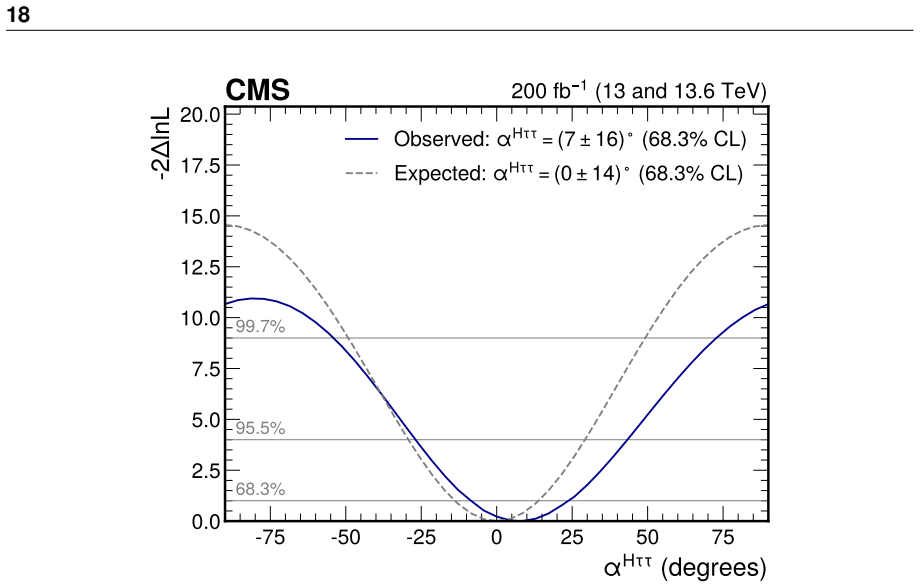
CMS measures the CP mixing angle of the Higgs-tau Yukawa coupling as 7 ± 16 degrees in combined data.
A machine-rendered reading of the paper's core claim, the machinery that carries it, and where it could break.
Core claim
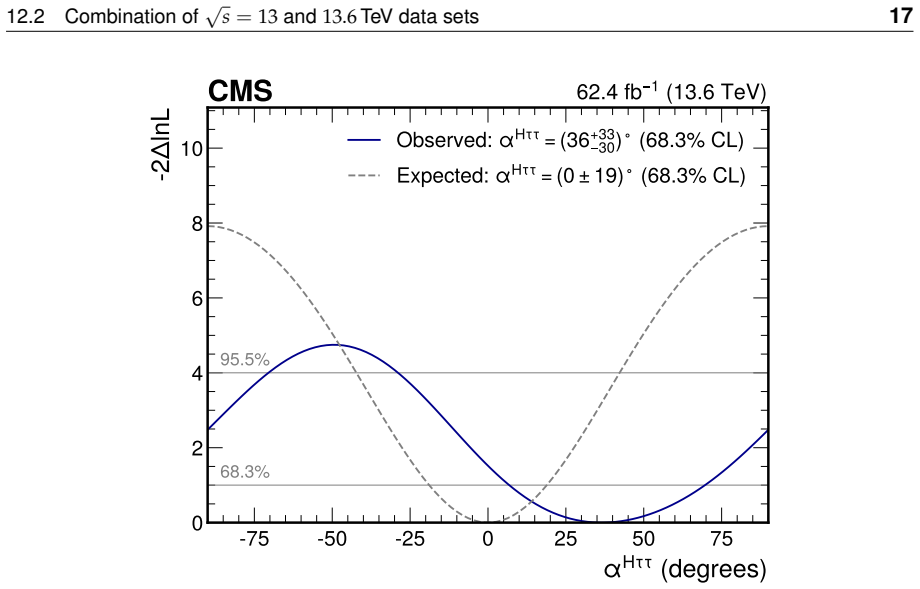
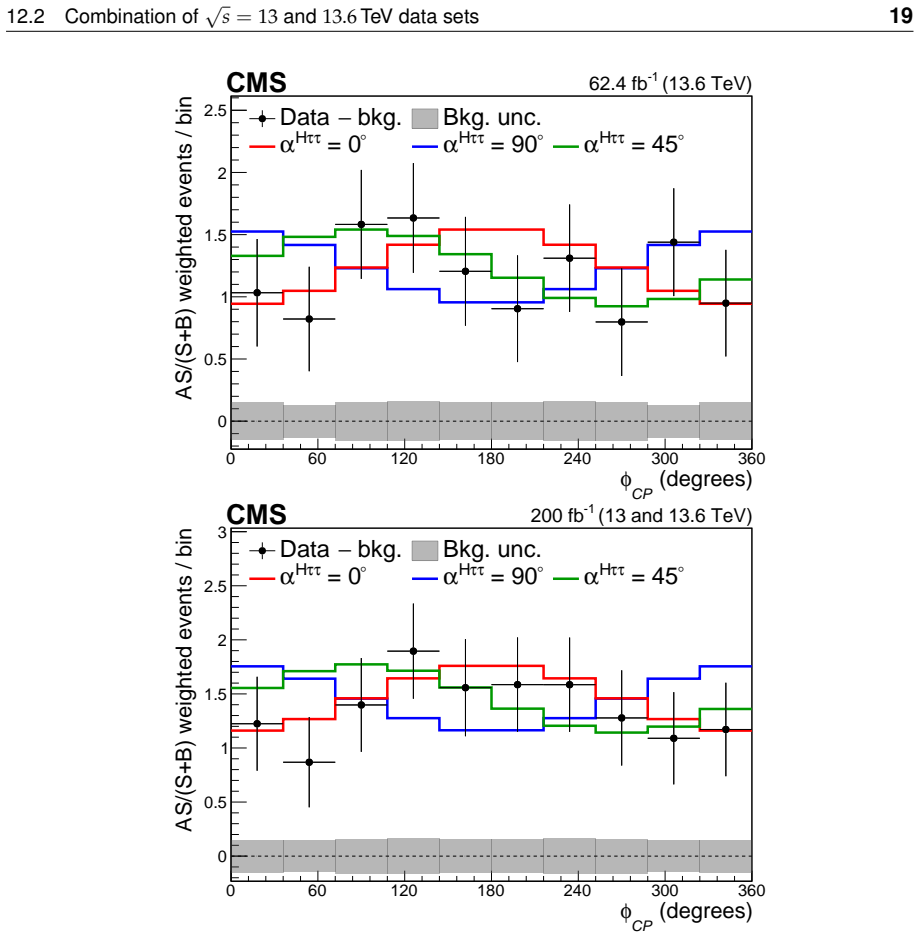
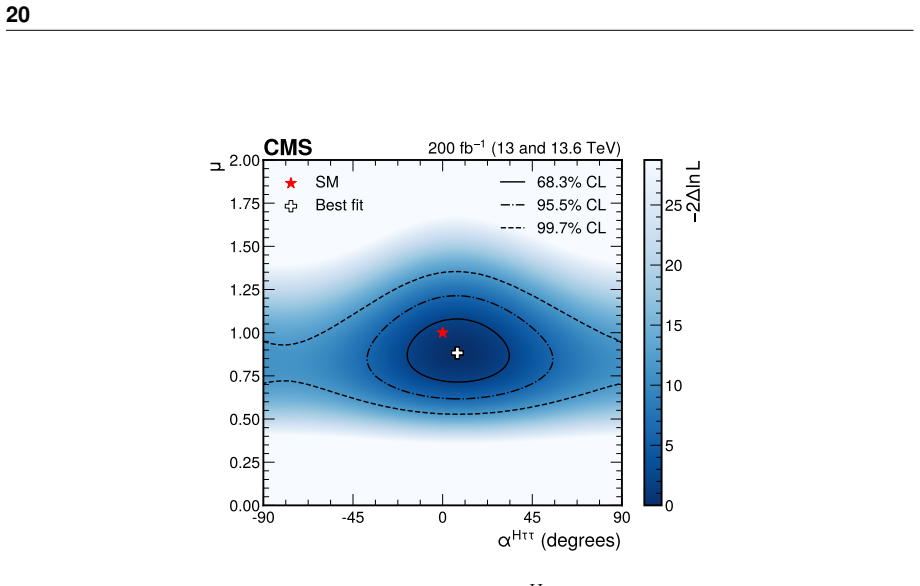
The analysis determines the CP mixing angle α^{H au au} to be (36^{+33}_{-30})° from 62.4 fb^{-1} of 13.6 TeV data, compared with an expected value of (0 ± 19)° under the Standard Model. When combined with the previous CMS measurement from 138 fb^{-1} at 13 TeV, the mixing angle is (7 ± 16)°, with an expected value of (0 ± 14)°.
What carries the argument
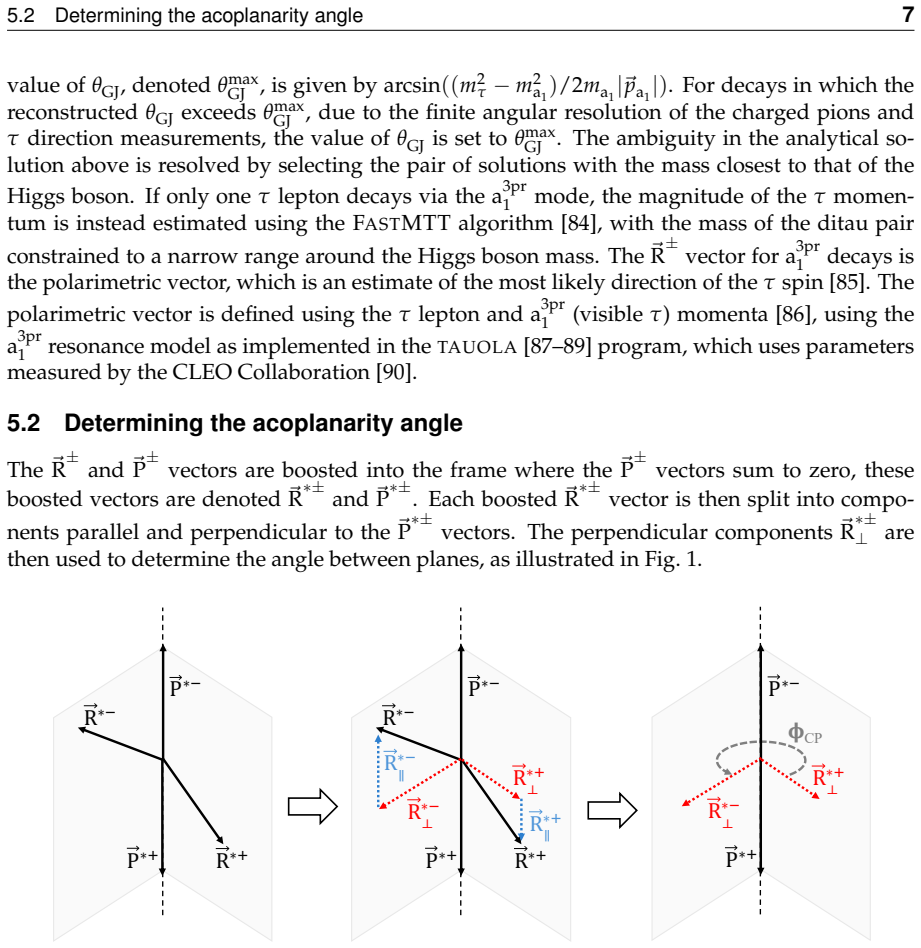
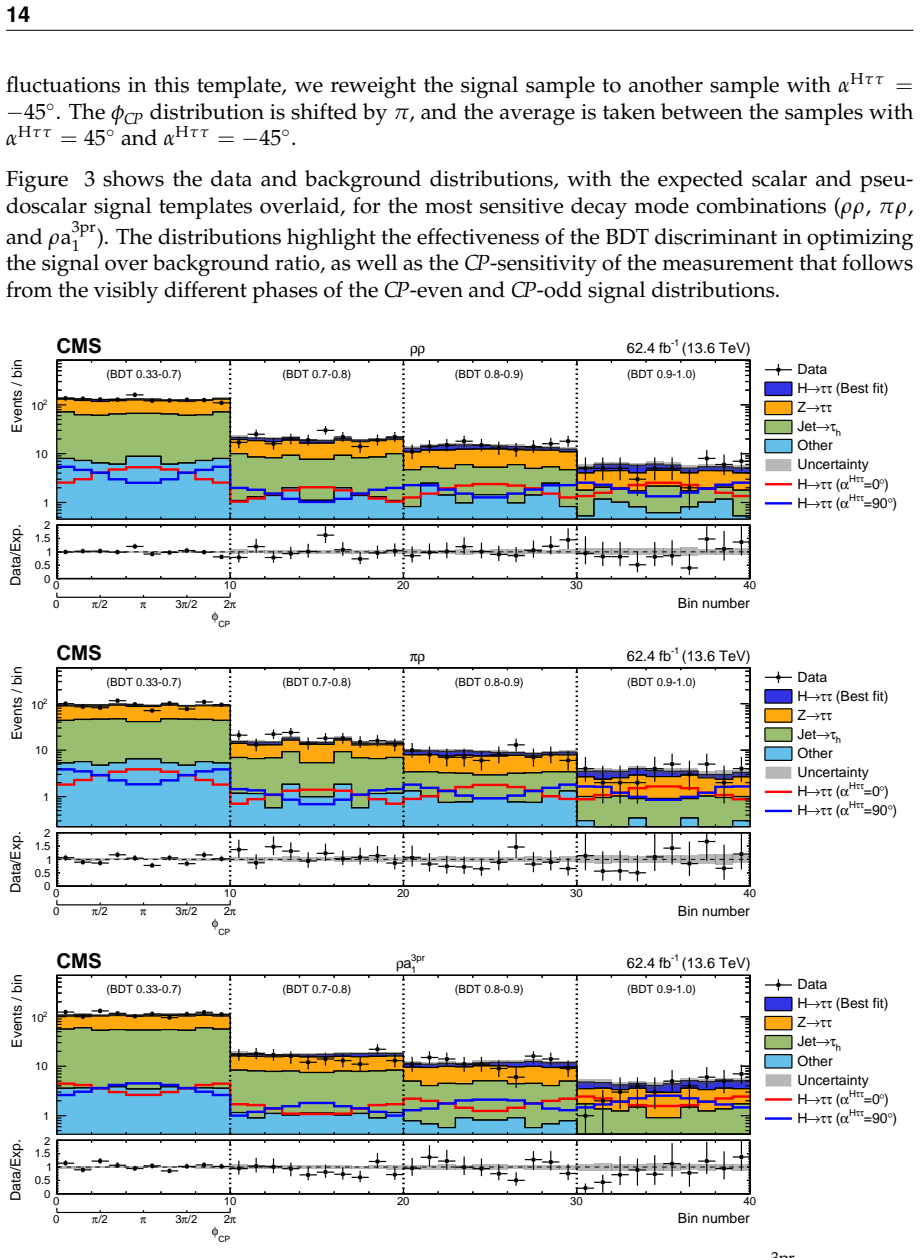
The effective CP mixing angle α^{H au au} that parameterizes the admixture of scalar and pseudoscalar couplings in the Higgs-tau Yukawa interaction, extracted by fitting angular correlations between tau decay products.
If this is right
- The combined uncertainty on the mixing angle reaches ±16°.
- The result remains consistent with a pure scalar coupling under the Standard Model.
- The measurement sets the current best expected precision on this CP property by any experiment.
Where Pith is reading between the lines
- The same angular-correlation method could be applied to other Higgs decay channels if sufficient statistics become available.
- Any future deviation from zero would point to CP-violating new physics in the Higgs sector.
- The result provides a benchmark for theoretical models that extend the Standard Model with additional CP-odd components.
Load-bearing premise
The analysis assumes that angular correlations between tau decay products are accurately modeled in simulation and that all relevant backgrounds and detector effects have been correctly accounted for when fitting for the mixing angle.
What would settle it
A statistically significant deviation of the fitted mixing angle from zero in the combined dataset, or a clear mismatch between observed and simulated angular distributions that cannot be explained by background or detector uncertainties.
Figures


read the original abstract
This paper presents a measurement of the charge-parity ($C\!P$) structure of the Yukawa coupling between the Higgs boson (H) and tau leptons, using proton-proton collision data at $\sqrt{s}$ = 13.6 TeV recorded with the CMS detector at the LHC, corresponding to an integrated luminosity of 62.4 fb$^{1}$. Angular correlations between the decay products of tau leptons produced in H $\to$ $\tau\tau$ decays are exploited to constrain the effective $C\!P$ mixing angle $\alpha^{\mathrm{H}\tau\tau}$, which parameterizes the admixture of scalar and pseudoscalar couplings. The mixing angle is measured to be $\alpha^{\mathrm{H}\tau\tau}$ = (36$^{+33}_{-30}$)$^\circ$, compared with an expected value of (0 $\pm$ 19)$^\circ$ under the standard model hypothesis. When combined with the previous CMS measurement using data collected at $\sqrt{s}$ = 13 TeV, corresponding to an integrated luminosity of 138 fb$^{-1}$, the mixing angle is determined to be (7 $\pm$ 16)$^\circ$, with an expected value of (0 $\pm$ 14)$^\circ$. This result represents the most precise measurement by CMS of the $C\!P$ nature of the Higgs boson coupling to tau leptons, with an expected precision that is the best achieved by any experiment to date.
Editorial analysis
A structured set of objections, weighed in public.
Referee Report
Summary. The manuscript reports a measurement of the CP-mixing angle α^{Hττ} parameterizing the scalar-pseudoscalar admixture in the Higgs-tau Yukawa coupling. Using 62.4 fb^{-1} of 13.6 TeV pp collision data recorded with CMS, angular correlations in H→ττ decays yield α^{Hττ} = (36^{+33}_{-30})°, consistent with the SM expectation of (0 ± 19)°. Combination with the prior 13 TeV CMS result (138 fb^{-1}) gives (7 ± 16)° (expected (0 ± 14)°), stated to be the most precise CMS result and the best expected precision achieved by any experiment.
Significance. If the modeling assumptions hold, the result supplies the tightest CMS constraint to date on possible CP violation in the Hττ coupling and achieves the best expected precision reported by any experiment. The combined measurement is statistics-limited, so further luminosity would directly improve the bound.
major comments (1)
- [Analysis and fit procedure (as described in the body)] The extraction of α^{Hττ} is performed via a fit to angular observables generated from tau decay matrix elements and polarization transfer in simulation. No data-driven constraint or closure test on the accuracy of this modeling (e.g., acoplanarity or decay-plane angle distributions) is reported at a level comparable to the 16° combined uncertainty, which is the dominant systematic risk for the central claim.
Simulated Author's Rebuttal
We thank the referee for the careful review and constructive feedback on our manuscript. Below we provide a point-by-point response to the major comment.
read point-by-point responses
-
Referee: [Analysis and fit procedure (as described in the body)] The extraction of α^{Hττ} is performed via a fit to angular observables generated from tau decay matrix elements and polarization transfer in simulation. No data-driven constraint or closure test on the accuracy of this modeling (e.g., acoplanarity or decay-plane angle distributions) is reported at a level comparable to the 16° combined uncertainty, which is the dominant systematic risk for the central claim.
Authors: The tau decay matrix elements and polarization transfer are modeled using the standard TAUOLA and PYTHIA implementations, which have been validated against data in multiple prior CMS publications on Z→ττ and Higgs boson analyses. We agree that an explicit data-driven closure test at the level of the reported precision would strengthen the presentation of the result. In the revised manuscript we will add a dedicated subsection (with associated figures) describing validation studies of the acoplanarity and decay-plane angle distributions in both simulation and data control regions, including quantitative comparisons. revision: yes
Circularity Check
No significant circularity in the data-driven extraction of α^{Hττ}
full rationale
The paper extracts the CP mixing angle from a fit to observed angular distributions in H→ττ events using new 13.6 TeV collision data. This is a direct statistical inference from experimental observables under modeling assumptions for decays and backgrounds; the central result does not reduce by the paper's equations or self-citations to a quantity defined by construction from prior inputs. The combination with the earlier 13 TeV CMS result incorporates independent data and does not render the new measurement circular.
Axiom & Free-Parameter Ledger
free parameters (1)
- α^{Hττ} =
7 ± 16°
axioms (1)
- domain assumption Tau decay angular distributions and detector response are correctly modeled in simulation.
Reference graph
Works this paper leans on
-
[1]
Broken symmetry and the mass of gauge vector mesons
F. Englert and R. Brout, “Broken symmetry and the mass of gauge vector mesons”, Phys. Rev. Lett.13(1964) 321,doi:10.1103/PhysRevLett.13.321
-
[2]
Broken symmetries, massless particles and gauge fields
P . W. Higgs, “Broken symmetries, massless particles and gauge fields”,Phys. Lett.12 (1964) 132,doi:10.1016/0031-9163(64)91136-9
-
[3]
Broken symmetries and the masses of gauge bosons
P . W. Higgs, “Broken symmetries and the masses of gauge bosons”,Phys. Rev. Lett.13 (1964) 508,doi:10.1103/PhysRevLett.13.508
-
[4]
Global conservation laws and massless particles
G. S. Guralnik, C. R. Hagen, and T. W. B. Kibble, “Global conservation laws and massless particles”,Phys. Rev. Lett.13(1964) 585,doi:10.1103/PhysRevLett.13.585
-
[5]
Spontaneous symmetry breakdown without massless bosons
P . W. Higgs, “Spontaneous symmetry breakdown without massless bosons”,Phys. Rev. 145(1966) 1156,doi:10.1103/PhysRev.145.1156
-
[6]
Symmetry breaking in non-abelian gauge theories
T. W. B. Kibble, “Symmetry breaking in non-abelian gauge theories”,Phys. Rev.155 (1967) 1554,doi:10.1103/PhysRev.155.1554
-
[7]
ATLAS Collaboration, “Observation of a new particle in the search for the standard model Higgs boson with the ATLAS detector at the LHC”,Phys. Lett. B716(2012) 1, doi:10.1016/j.physletb.2012.08.020,arXiv:1207.7214
work page internal anchor Pith review Pith/arXiv arXiv doi:10.1016/j.physletb.2012.08.020 2012
-
[8]
Observation of a new boson at a mass of 125 GeV with the CMS experiment at the LHC
CMS Collaboration, “Observation of a new boson at a mass of 125 GeV with the CMS experiment at the LHC”,Phys. Lett. B716(2012) 30, doi:10.1016/j.physletb.2012.08.021,arXiv:1207.7235
work page internal anchor Pith review Pith/arXiv arXiv doi:10.1016/j.physletb.2012.08.021 2012
-
[9]
Observation of a new boson with mass near 125 GeV in pp collisions at √s= 7 and 8 TeV
CMS Collaboration, “Observation of a new boson with mass near 125 GeV in pp collisions at √s= 7 and 8 TeV”,JHEP06(2013) 081, doi:10.1007/JHEP06(2013)081,arXiv:1303.4571. 24
-
[10]
CMS Collaboration, “Combined measurements and interpretations of Higgs boson production and decay in proton-proton collisions at √s= 13 TeV”, 2026. arXiv:2602.18611. Submitted toRep. Prog. Phys
arXiv 2026
-
[11]
ATLAS Collaboration, “Interpretations of the ATLAS measurements of Higgs boson production and decay rates and differential cross-sections in pp collisions at√s=13 TeV”,JHEP11(2024) 97,doi:10.1007/JHEP11(2024)097, arXiv:2402.05742
-
[12]
Violation ofCPinvariance,Casymmetry, and baryon asymmetry of the universe
A. D. Sakharov, “Violation ofCPinvariance,Casymmetry, and baryon asymmetry of the universe”,Pisma Zh. Eksp. T eor. Fiz.5(1967) 32, doi:10.1070/PU1991v034n05ABEH002497
-
[13]
Standard Model CP-violation and Baryon asymmetry Part II: Finite Temperature
M. B. Gavela et al., “Standard model CP violation and baryon asymmetry. Part 2: Finite temperature”,Nucl. Phys. B430(1994) 382, doi:10.1016/0550-3213(94)00410-2,arXiv:hep-ph/9406289
work page internal anchor Pith review Pith/arXiv arXiv doi:10.1016/0550-3213(94)00410-2 1994
-
[14]
T. Biekotter et al., “Impact of new experimental data on the C2HDM: the strong interdependence between LHC Higgs data and the electron EDM”,JHEP05(2024) 127, doi:10.1007/JHEP05(2024)127,arXiv:2403.02425
-
[15]
Exploring the CP-violating NMSSM: EDM Constraints and Phenomenology
S. F. King, M. M ¨uhlleitner, R. Nevzorov, and K. Walz, “Exploring theCP-violating NMSSM: EDM constraints and phenomenology”,Nucl. Phys. B901(2015) 526, doi:10.1016/j.nuclphysb.2015.11.003,arXiv:1508.03255
work page internal anchor Pith review Pith/arXiv arXiv doi:10.1016/j.nuclphysb.2015.11.003 2015
-
[16]
Study of the mass and spin-parity of the Higgs boson candidate via its decays to Z boson pairs
CMS Collaboration, “On the mass and spin-parity of the Higgs boson candidate via its decays to Z boson pairs”,Phys. Rev. Lett.110(2013) 081803, doi:10.1103/PhysRevLett.110.081803,arXiv:1212.6639
work page internal anchor Pith review Pith/arXiv arXiv doi:10.1103/physrevlett.110.081803 2013
-
[17]
Measurement of the properties of a Higgs boson in the four-lepton final state
CMS Collaboration, “Measurement of the properties of a Higgs boson in the four-lepton final state”,Phys. Rev. D89(2014) 092007,doi:10.1103/PhysRevD.89.092007, arXiv:1312.5353
work page internal anchor Pith review Pith/arXiv arXiv doi:10.1103/physrevd.89.092007 2014
-
[18]
CMS Collaboration, “Constraints on the spin-parity and anomalous HVV couplings of the Higgs boson in proton collisions at 7 and 8 TeV”,Phys. Rev. D92(2015) 012004, doi:10.1103/PhysRevD.92.012004,arXiv:1411.3441
work page internal anchor Pith review Pith/arXiv arXiv doi:10.1103/physrevd.92.012004 2015
-
[19]
Combined search for anomalous pseudoscalar HVV couplings in VH production and H to VV decay
CMS Collaboration, “Combined search for anomalous pseudoscalar HVV couplings in VH(H→b b) production and H→VV decay”,Phys. Lett. B759(2016) 672, doi:10.1016/j.physletb.2016.06.004,arXiv:1602.04305
work page internal anchor Pith review Pith/arXiv arXiv doi:10.1016/j.physletb.2016.06.004 2016
-
[20]
CMS Collaboration, “Constraints on anomalous Higgs boson couplings using production and decay information in the four-lepton final state”,Phys. Lett. B775 (2017) 1,doi:10.1016/j.physletb.2017.10.021,arXiv:1707.00541
-
[21]
Constraints on anomalous HVV couplings from the production of Higgs bosons decaying toτlepton pairs
CMS Collaboration, “Constraints on anomalous HVV couplings from the production of Higgs bosons decaying toτlepton pairs”,Phys. Rev. D100(2019) 112002, doi:10.1103/physrevd.100.112002,arXiv:1903.06973
-
[22]
CMS Collaboration, “Constraints on anomalous Higgs boson couplings to vector bosons and fermions in its production and decay using the four-lepton final state”,Phys. Rev. D 104(2021) 052004,doi:10.1103/PhysRevD.104.052004,arXiv:2104.12152. References 25
-
[23]
Evidence for the spin-0 nature of the Higgs boson using ATLAS data
ATLAS Collaboration, “Evidence for the spin-0 nature of the Higgs boson using ATLAS data”,Phys. Lett. B726(2013) 120,doi:10.1016/j.physletb.2013.08.026, arXiv:1307.1432
work page internal anchor Pith review Pith/arXiv arXiv doi:10.1016/j.physletb.2013.08.026 2013
-
[24]
Study of the spin and parity of the Higgs boson in diboson decays with the ATLAS detector
ATLAS Collaboration, “Study of the spin and parity of the Higgs boson in diboson decays with the ATLAS detector”,Eur. Phys. J. C75(2015) 476, doi:10.1140/epjc/s10052-015-3685-1,arXiv:1506.05669. [Erratum: doi:10.1140/epjc/s10052-016-3934-y]
work page internal anchor Pith review Pith/arXiv arXiv doi:10.1140/epjc/s10052-015-3685-1 2015
-
[25]
ATLAS Collaboration, “Test ofCPinvariance in vector-boson fusion production of the Higgs boson using the optimal observable method in the ditau decay channel with the ATLAS detector”,Eur. Phys. J. C76(2016) 658, doi:10.1140/epjc/s10052-016-4499-5,arXiv:1602.04516
work page internal anchor Pith review Pith/arXiv arXiv doi:10.1140/epjc/s10052-016-4499-5 2016
-
[26]
ATLAS Collaboration, “Measurement of the Higgs boson coupling properties in the H→ZZ ∗ →4ℓdecay channel at √s=13 TeV with the ATLAS detector”,JHEP03 (2018) 095,doi:10.1007/JHEP03(2018)095,arXiv:1712.02304
work page internal anchor Pith review Pith/arXiv arXiv doi:10.1007/jhep03(2018)095 2018
-
[27]
ATLAS Collaboration, “Measurements of Higgs boson properties in the diphoton decay channel with 36 fb −1 of pp collision data at √s=13 TeV with the ATLAS detector”, Phys. Rev. D98(2018) 052005,doi:10.1103/PhysRevD.98.052005, arXiv:1802.04146
work page internal anchor Pith review Pith/arXiv arXiv doi:10.1103/physrevd.98.052005 2018
-
[28]
A. V . Gritsan, R. R¨ontsch, M. Schulze, and M. Xiao, “Constraining anomalous Higgs boson couplings to the heavy-flavor fermions using matrix element techniques”,Phys. Rev. D94(2016) 055023,doi:10.1103/physrevd.94.055023, arXiv:1606.03107
-
[29]
Prospects for measuring quark polarization and spin correlations inb bandc csamples at the LHC
Y. Kats and D. Uzan, “Prospects for measuring quark polarization and spin correlations inb bandc csamples at the LHC”,JHEP03(2024) 063, doi:10.1007/JHEP03(2024)063,arXiv:2311.08226
-
[30]
CMS Collaboration, “Constraints on anomalous Higgs boson couplings to vector bosons and fermions from the production of Higgs bosons using theττfinal state”,Phys. Rev. D108(2023) 032013,doi:10.1103/PhysRevD.108.032013,arXiv:2205.05120
-
[31]
CMS Collaboration, “Constraints on anomalous Higgs boson couplings from its production and decay using the WW channel in proton–proton collisions at√s=13 TeV”,Eur. Phys. J. C84(2024) 779, doi:10.1140/epjc/s10052-024-12925-0,arXiv:2403.00657
-
[32]
ATLAS Collaboration, “Measurements of Higgs boson production via gluon–gluon fusion and vector-boson fusion usingH→WW ∗ →ℓνℓνdecays in pp collisions with the ATLAS detector and their effective field theory interpretations”,Eur. Phys. J. C85 (2025) 1403,doi:10.1140/epjc/s10052-025-14761-2,arXiv:2504.07686
-
[33]
CMS Collaboration, “Measurements of t tH production and theCPstructure of the Yukawa interaction between the Higgs boson and top quark in the diphoton decay channel”,Phys. Rev. Lett.125(2020) 061801, doi:10.1103/PhysRevLett.125.061801,arXiv:2003.10866
-
[34]
ATLAS Collaboration, “CPproperties of Higgs boson interactions with top quarks in the ttH and tH processes using H→γγwith the ATLAS detector”,Phys. Rev. Lett.125 (2020) 061802,doi:10.1103/PhysRevLett.125.061802,arXiv:2004.04545. 26
-
[35]
CMS Collaboration, “Search forCPviolation in ttH and tH production in multilepton channels in proton-proton collisions at √s= 13 TeV”,JHEP07(2023) 092, doi:10.1007/JHEP07(2023)092,arXiv:2208.02686
-
[36]
ATLAS Collaboration, “Probing theCPnature of the top-Higgs Yukawa coupling in t tH and ttH events with H→b b decays using the ATLAS detector at the LHC”,Phys. Lett. B 849(2024) 138469,doi:10.1016/j.physletb.2024.138469,arXiv:2303.05974
-
[37]
CMS Collaboration, “Measurement of the t tH and tH production rates in the H→b b decay channel using proton-proton collision data at √s= 13 TeV”,JHEP02(2025) 097, doi:10.1007/JHEP02(2025)097,arXiv:2407.10896
-
[38]
ATLAS Collaboration, “Measurement of the Higgs boson production in association with top quarks in multilepton final states inppcollisions at √s=13 TeV with the ATLAS detector”, 2025.arXiv:2510.23755. Submitted toJHEP
arXiv 2025
-
[39]
An improved bound on the electron’s electric dipole moment
T. Roussy et al., “An improved bound on the electron’s electric dipole moment”, Science381(2023) 46,doi:10.1126/science.adg4084,arXiv:2212.11841
-
[40]
H. Bahl et al., “Constraining the CP structure of Higgs-fermion couplings with a global LHC fit, the electron EDM and baryogenesis”,Eur. Phys. J. C82(2022) 604, doi:10.1140/epjc/s10052-022-10528-1,arXiv:2202.11753
-
[41]
CMS Collaboration, “Analysis of the CP structure of the Yukawa coupling between the Higgs boson andτleptons in proton-proton collisions at √s=13 TeV”,JHEP06(2022) 012,doi:10.1007/jhep06(2022)012,arXiv:2110.04836
-
[42]
Measurement of the CP properties of Higgs boson interactions withτ-leptons with the ATLAS detector
ATLAS Collaboration, “Measurement of the CP properties of Higgs boson interactions withτ-leptons with the ATLAS detector”,Eur. Phys. J. C83(2023) 563, doi:10.1140/epjc/s10052-023-11583-y,arXiv:2212.05833
-
[43]
HEPData record for this analysis
“HEPData record for this analysis”, 2026.doi:10.17182/hepdata.172938
-
[44]
The CMS experiment at the CERN LHC
CMS Collaboration, “The CMS experiment at the CERN LHC”,JINST3(2008) S08004, doi:10.1088/1748-0221/3/08/S08004
-
[45]
Development of the CMS detector for the CERN LHC Run 3
CMS Collaboration, “Development of the CMS detector for the CERN LHC Run 3”, JINST19(2024) P05064,doi:10.1088/1748-0221/19/05/P05064, arXiv:2309.05466
-
[46]
Performance of the CMS Level-1 trigger in proton-proton collisions at √s=13 TeV
CMS Collaboration, “Performance of the CMS Level-1 trigger in proton-proton collisions at √s=13 TeV”,JINST15(2020) P10017, doi:10.1088/1748-0221/15/10/P10017,arXiv:2006.10165
-
[47]
CMS Collaboration, “The CMS trigger system”,JINST12(2017) P01020, doi:10.1088/1748-0221/12/01/P01020,arXiv:1609.02366
work page internal anchor Pith review Pith/arXiv arXiv doi:10.1088/1748-0221/12/01/p01020 2017
-
[48]
Performance of the CMS high-level trigger during LHC Run 2
CMS Collaboration, “Performance of the CMS high-level trigger during LHC Run 2”, JINST19(2024) P11021,doi:10.1088/1748-0221/19/11/P11021, arXiv:2410.17038
-
[49]
Electron and photon reconstruction and identification with the CMS experiment at the CERN LHC
CMS Collaboration, “Electron and photon reconstruction and identification with the CMS experiment at the CERN LHC”,JINST16(2021) P05014, doi:10.1088/1748-0221/16/05/P05014,arXiv:2012.06888. References 27
-
[50]
CMS Collaboration, “Performance of the CMS muon detector and muon reconstruction with proton-proton collisions at √s=13 TeV”,JINST13(2018) P06015, doi:10.1088/1748-0221/13/06/P06015,arXiv:1804.04528
work page internal anchor Pith review Pith/arXiv arXiv doi:10.1088/1748-0221/13/06/p06015 2018
-
[51]
Description and performance of track and primary-vertex reconstruction with the CMS tracker
CMS Collaboration, “Description and performance of track and primary-vertex reconstruction with the CMS tracker”,JINST9(2014) P10009, doi:10.1088/1748-0221/9/10/P10009,arXiv:1405.6569
work page internal anchor Pith review Pith/arXiv arXiv doi:10.1088/1748-0221/9/10/p10009 2014
-
[52]
Particle-flow reconstruction and global event description with the CMS detector
CMS Collaboration, “Particle-flow reconstruction and global event description with the CMS detector”,JINST12(2017) P10003,doi:10.1088/1748-0221/12/10/P10003, arXiv:1706.04965
work page internal anchor Pith review Pith/arXiv arXiv doi:10.1088/1748-0221/12/10/p10003 2017
-
[53]
K. Rose, “Deterministic annealing for clustering, compression, classification, regression, and related optimization problems”,Proc. IEEE86(1998) 2210, doi:10.1109/5.726788
-
[54]
W. Waltenberger, R. Fr¨uhwirth, and P . Vanlaer, “Adaptive vertex fitting”,J. Phys. G: Nuc. Part. Phys.34(2007) N343,doi:10.1088/0954-3899/34/12/n01
-
[55]
Technical proposal for the Phase-II upgrade of the Compact Muon Solenoid
CMS Collaboration, “Technical proposal for the Phase-II upgrade of the Compact Muon Solenoid”, CMS Technical Proposal CERN-LHCC-2015-010, CMS-TDR-15-02, 2015
2015
-
[56]
The anti-k_t jet clustering algorithm
M. Cacciari, G. P . Salam, and G. Soyez, “The anti-kT jet clustering algorithm”,JHEP04 (2008) 063,doi:10.1088/1126-6708/2008/04/063,arXiv:0802.1189
work page internal anchor Pith review Pith/arXiv arXiv doi:10.1088/1126-6708/2008/04/063 2008
-
[57]
M. Cacciari, G. P . Salam, and G. Soyez, “FastJet user manual”,Eur. Phys. J. C72(2012) 1896,doi:10.1140/epjc/s10052-012-1896-2,arXiv:1111.6097
work page internal anchor Pith review Pith/arXiv arXiv doi:10.1140/epjc/s10052-012-1896-2 2012
-
[58]
Pileup mitigation at CMS in 13 TeV data
CMS Collaboration, “Pileup mitigation at CMS in 13 TeV data”,JINST15(2020) P09018,doi:10.1088/1748-0221/15/09/p09018,arXiv:2003.00503
-
[59]
Pileup Per Particle Identification
D. Bertolini, P . Harris, M. Low, and N. Tran, “Pileup per particle identification”,JHEP 10(2014) 059,doi:10.1007/JHEP10(2014)059,arXiv:1407.6013
work page internal anchor Pith review Pith/arXiv arXiv doi:10.1007/jhep10(2014)059 2014
-
[60]
Jet energy scale and resolution in the CMS experiment in pp collisions at 8 TeV
CMS Collaboration, “Jet energy scale and resolution in the CMS experiment in pp collisions at 8 TeV”,JINST12(2017) P02014, doi:10.1088/1748-0221/12/02/P02014,arXiv:1607.03663
work page internal anchor Pith review Pith/arXiv arXiv doi:10.1088/1748-0221/12/02/p02014 2017
-
[61]
CMS Collaboration, “Performance of missing transverse momentum reconstruction in proton-proton collisions at √s=13 TeV using the CMS detector”,JINST14(2019) P07004,doi:10.1088/1748-0221/14/07/P07004,arXiv:1903.06078
work page internal anchor Pith review Pith/arXiv arXiv doi:10.1088/1748-0221/14/07/p07004 2019
-
[62]
ECAL 2016 refined calibration and Run2 summary plots
CMS Collaboration, “ECAL 2016 refined calibration and Run2 summary plots”, CMS Detector Performance Summary CMS-DP-2020-021, 2020
2016
-
[63]
CMS Collaboration, “Performance of reconstruction and identification ofτleptons decaying to hadrons andν τ in pp collisions at √s=13 TeV”,JINST13(2018) P10005, doi:10.1088/1748-0221/13/10/P10005,arXiv:1809.02816
work page internal anchor Pith review Pith/arXiv arXiv doi:10.1088/1748-0221/13/10/p10005 2018
-
[64]
Identification of hadronic tau lepton decays using a deep neural network
CMS Collaboration, “Identification of hadronic tau lepton decays using a deep neural network”,JINST17(2022) P07023,doi:10.1088/1748-0221/17/07/P07023, arXiv:2201.08458
-
[65]
Identification of tau leptons using a convolutional neural network with domain adaptation
CMS Collaboration, “Identification of tau leptons using a convolutional neural network with domain adaptation”,JINST20(2025) P12032, doi:10.1088/1748-0221/20/12/P12032,arXiv:2511.05468. 28
-
[66]
Particle Data Group Collaboration, “Review of particle physics”,Phys. Rev. D110 (2024) 030001,doi:10.1103/PhysRevD.110.030001
-
[67]
Jet tagging via particle clouds
H. Qu and L. Gouskos, “Jet tagging via particle clouds”,Phys. Rev. D101(2020) 056019, doi:10.1103/PhysRevD.101.056019,arXiv:1902.08570
-
[68]
Identification of hadronic tau decay channels using multivariate analysis (MVA decay mode)
CMS Collaboration, “Identification of hadronic tau decay channels using multivariate analysis (MVA decay mode)”, CMS Detector Performance Summary CMS-DP-2020-041, 2020
2020
-
[69]
Determination of the Higgs CP-mixing angle in the tau decay channels
S. Berge, W. Bernreuther, and S. Kirchner, “Determination of the HiggsCP-mixing angle in the tau decay channels”,Nucl. Part. Phys. Proc.273-275(2016) 841, doi:10.1016/j.nuclphysbps.2015.09.129,arXiv:1410.6362
work page internal anchor Pith review Pith/arXiv arXiv doi:10.1016/j.nuclphysbps.2015.09.129 2016
-
[70]
How to pin down the CP quantum numbers of a Higgs boson in its tau decays at the LHC
S. Berge, W. Bernreuther, B. Niepelt, and H. Spiesberger, “How to pin down the CP quantum numbers of a Higgs boson in its tau decays at the LHC”,Phys. Rev. D84 (2011) 116003,doi:10.1103/PhysRevD.84.116003,arXiv:1108.0670
work page internal anchor Pith review Pith/arXiv arXiv doi:10.1103/physrevd.84.116003 2011
-
[71]
Prospects of Measuring the Parity of Higgs Particles
M. Kramer, J. H. Kuhn, M. L. Stong, and P . M. Zerwas, “Prospects of measuring the parity of Higgs particles”,Z. Phys. C64(1994) 21,doi:10.1007/BF01557231, arXiv:hep-ph/9404280
work page internal anchor Pith review Pith/arXiv arXiv doi:10.1007/bf01557231 1994
-
[72]
Measuring the Higgs boson's parity using tau --> rho nu
G. R. Bower, T. Pierzchala, Z. Was, and M. Worek, “Measuring the Higgs boson’s parity usingτ→ρν”,Phys. Lett. B543(2002) 227, doi:10.1016/S0370-2693(02)02445-0,arXiv:hep-ph/0204292
work page internal anchor Pith review Pith/arXiv arXiv doi:10.1016/s0370-2693(02)02445-0 2002
-
[73]
K. Desch, Z. Was, and M. Worek, “Measuring the Higgs boson parity at a linear collider usingτimpact parameter andτ→ρνdecay”,Eur. Phys. J. C29(2003) 491, doi:10.1140/epjc/s2003-01231-4,arXiv:hep-ph/0302046
work page internal anchor Pith review Pith/arXiv arXiv doi:10.1140/epjc/s2003-01231-4 2003
-
[74]
K. Desch, A. Imhof, Z. Was, and M. Worek, “Probing the CP nature of the Higgs boson at linear colliders with tau spin correlations: The case of mixed scalar - pseudoscalar couplings”,Phys. Lett. B579(2004) 157,doi:10.1016/j.physletb.2003.10.074, arXiv:hep-ph/0307331
work page internal anchor Pith review Pith/arXiv arXiv doi:10.1016/j.physletb.2003.10.074 2004
-
[75]
Determining the CP parity of Higgs bosons at the LHC in their tau decay channels
S. Berge, W. Bernreuther, and J. Ziethe, “Determining the CP parity of Higgs bosons at the LHC in their tau decay channels”,Phys. Rev. Lett.100(2008) 171605, doi:10.1103/PhysRevLett.100.171605,arXiv:0801.2297
work page internal anchor Pith review Pith/arXiv arXiv doi:10.1103/physrevlett.100.171605 2008
-
[76]
Determining the CP parity of Higgs bosons at the LHC in the $\tau$ to 1-prong decay channels
S. Berge and W. Bernreuther, “Determining the CP parity of Higgs bosons at the LHC in the tau to 1-prong decay channels”,Phys. Lett. B671(2009) 470, doi:10.1016/j.physletb.2008.12.065,arXiv:0812.1910
work page internal anchor Pith review Pith/arXiv arXiv doi:10.1016/j.physletb.2008.12.065 2009
-
[77]
Higgs CP properties using the tau decay modes at the ILC
S. Berge, W. Bernreuther, and H. Spiesberger, “Higgs CP properties using theτdecay modes at the ILC”,Phys. Lett. B727(2013) 488, doi:10.1016/j.physletb.2013.11.006,arXiv:1308.2674
work page internal anchor Pith review Pith/arXiv arXiv doi:10.1016/j.physletb.2013.11.006 2013
-
[78]
S. Berge, W. Bernreuther, and S. Kirchner, “Determination of the Higgs CP-mixing angle in the tau decay channels at the LHC including the Drell–Yan background”,Eur. Phys. J. C74(2014) 3164,doi:10.1140/epjc/s10052-014-3164-0,arXiv:1408.0798
work page internal anchor Pith review Pith/arXiv arXiv doi:10.1140/epjc/s10052-014-3164-0 2014
-
[79]
Prospects of constraining the Higgs CP nature in the tau decay channel at the LHC
S. Berge, W. Bernreuther, and S. Kirchner, “Prospects of constraining the Higgs boson’s CP nature in the tau decay channel at the LHC”,Phys. Rev. D92(2015) 096012, doi:10.1103/PhysRevD.92.096012,arXiv:1510.03850. References 29
work page internal anchor Pith review Pith/arXiv arXiv doi:10.1103/physrevd.92.096012 2015
-
[80]
Potential for optimizing Higgs boson CP measurement in H to tau tau decay at LHC and ML techniques
R. J ´ozefowicz, E. Richter-Was, and Z. Was, “Potential for optimizing the Higgs boson CP measurement in H→ττdecays at the LHC including machine learning techniques”, Phys. Rev. D94(2016) 093001,doi:10.1103/PhysRevD.94.093001, arXiv:1608.02609
work page internal anchor Pith review Pith/arXiv arXiv doi:10.1103/physrevd.94.093001 2016
discussion (0)
Sign in with ORCID, Apple, or X to comment. Anyone can read and Pith papers without signing in.