REVIEW 2 major objections 5 minor 224 references
A new soft X-ray transient in nearby galaxy NGC 4945 is likely a stellar-mass black hole in an X-ray binary, caught in outburst after more than a decade of quiescence.
Reviewed by Pith at T0; open to challenge. T0 means a machine referee read the full paper against a public rubric. the ladder, T0–T4 →
T0 review · deepseek-v4-flash
2026-08-01 06:57 UTC pith:FNKFFFQM
load-bearing objection Solid new transient detection, but the XRB classification rests on a plausible, unproven association with NGC 4945. the 2 major comments →
XMM-Newton and Swift Unveil Another X-Ray Transient in NGC 4945, XMM J130514.64-493311.27
The pith
A machine-rendered reading of the paper's core claim, the machinery that carries it, and where it could break.
Core claim
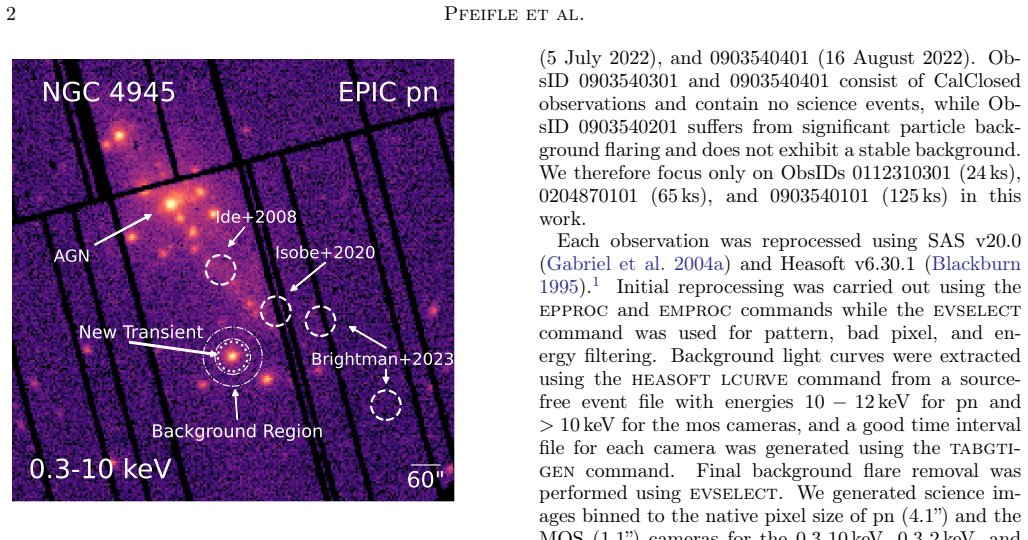
The paper reports the detection of a new X-ray transient, XMM J130514.64-493311.27, located ~5.5 arcmin south of the nucleus of NGC 4945, in a 125 ks XMM-Newton observation from July 2022. The source is not detected in any prior XMM-Newton (2001, 2004) or Chandra (2000–2021, including a deep stacked mosaic) imaging, but it appears in Swift-XRT data from 2008, 2019, and five times between May and August 2022. The X-ray spectrum is best fit by a multicolor disk plus power law (Γ = 3.48, T_in = 0.66 keV) or by a multicolor disk plus thermal plasma, both giving a 0.3–10 keV luminosity of ~2.2–2.3×10^38 erg/s. Interpreting the inner disk radius (86–114 km, depending on model) as the ISCO of a non
What carries the argument
The key analysis is X-ray spectroscopy of the new source using XMM-Newton EPIC (pn, MOS1, MOS2) data. The favored model is a multicolor disk plus power law (tbabs×[diskbb+pl]), with the multicolor disk representing thermal emission from the accretion disk and the power law representing Compton upscattering in a corona. From the diskbb normalization and the assumption that the inner disk radius equals the innermost stable circular orbit (ISCO) of a non-spinning black hole (R_in = 3R_S = 6GM/c²), the authors derive a mass of ~9.8 cos^(-1/2)(i) M_sun. The alternative model, multicolor disk plus apec thermal plasma, gives a similar mass (~12.9 M_sun). The archival Swift-XRT light curve and upper
Load-bearing premise
The source is assumed to be a member of NGC 4945 at a distance of 3.6 Mpc; every derived luminosity, inner disk radius, and black hole mass scales with the square of this distance, and if the source is actually a background AGN, the X-ray binary conclusion fails (the authors argue against this based on the lack of an optical counterpart, but cannot rule it out).
What would settle it
A single Chandra or XMM-Newton observation during a future outburst, combined with a measurement of the source's parallax or a tight constraint on its optical counterpart (e.g., via 30-m class spectroscopy) could determine whether the source is in NGC 4945 or at cosmological distance. Alternatively, a well-sampled X-ray light curve covering a full outburst, including the rise and decay, would test the XRB interpretation by revealing the canonical fast-rise/exponential-decay shape and a spectral softening during decay, which would be difficult to explain for an AGN.
If this is right
- If confirmed as a black hole XRB, XMM J130514.64-493311.27 would be one of the few off-nuclear black hole X-ray binaries known in NGC 4945, a galaxy already known to host many neutron star XRBs.
- The source's long periods of X-ray quiescence (years) followed by short outbursts (weeks-months) suggest a very low duty cycle, typical of transient LMXBs, and imply that many more such sources may be hiding undetected in nearby galaxies.
- The derived black hole mass (~10–15 M_sun) falls in the upper range of known stellar-mass black holes in our Galaxy, providing a rare extragalactic mass estimate from X-ray spectroscopy alone.
- The potential association with the southeast iron Kα nebula and the H I halo extension suggests the XRB may be interacting with the local environment, offering a chance to study feedback from a compact object.
- Swift-XRT detections in 2008, 2019, and 2022, with non-detections in between, establish a recurrence timescale that can be used to predict and plan future simultaneous X-ray and mid-IR observations.
Where Pith is reading between the lines
- The absence of an optical counterpart, despite deep HST and DSS coverage, may indicate that the system is a low-mass X-ray binary with a faint K/M-dwarf companion, or that the outburst is not accompanied by significant optical brightening, consistent with some failed-transition outbursts.
- The mid-IR variability seen in NEOWISE from 2015–2023, without simultaneous X-ray activity, could be evidence of repeated failed outbursts or of a different emission mechanism (e.g., a jet) that operates independently of the X-ray bright state; if so, the source may be a candidate for testing the disk-jet coupling in LMXBs.
- If the distance to NGC 4945 is overestimated, the source would be a sub-Eddington neutron star rather than a black hole; conversely, if the distance is underestimated, the source could be a ULX. A trigonometric or tip-of-the-red-giant distance to NGC 4945 would directly test the mass estimate.
- The source's soft spectrum and steep power law (Γ≈3.5) resemble the ultrasoft state of XTE J1550-564, but with a lower luminosity; this could indicate a slim disk (T ∝ r^-0.5) rather than the standard Shakura-Sunyaev disk, which would affect the mass measurement.
Editorial analysis
A structured set of objections, weighed in public.
Referee Report
Summary. The paper reports the discovery of a new off-nuclear X-ray transient, XMM J130514.64-493311.27, in the direction of NGC 4945, found in a deep 2022 XMM-Newton observation and not seen in earlier XMM-Newton or Chandra imaging. Archival Swift-XRT data show detections in 2008, 2019, and 2022, with the 2022 activity contemporaneous with the XMM detection. The X-ray spectrum is soft (Γ ≈ 3) and is best characterized by a multicolor disk plus power-law model, with an alternative disk plus thermal plasma model also fitting well; the 0.3–10 keV luminosity is ~2.2–2.3 × 10^38 erg/s. No optical/NIR/UV/radio counterpart is found, but a candidate mid-IR counterpart appears in NEOWISE light curves. The authors propose that the source is an X-ray binary in NGC 4945, likely containing a ~10 solar-mass black hole, while cautioning that a neutron star with a truncated disk cannot be excluded.
Significance. If confirmed, this is a valuable addition to the growing population of X-ray transients and candidate black-hole X-ray binaries in NGC 4945, a galaxy already known for ULX and transient activity. The strength of the paper lies in the robust detection itself: the source appears in independent XMM-Newton and Swift XRT observations, is absent from stacked Chandra data with an upper limit, and is clearly not a persistent source. The authors are transparent about spectral degeneracies and physical caveats (e.g., neutron-star disk truncation, background-AGN possibility). The main scientific payoff — a distance-constrained stellar-mass black-hole candidate — depends critically on the assumed association with NGC 4945, and the current evidence for that association is not fully quantified. With a strengthened association argument, the paper would be a solid observational contribution.
major comments (2)
- [§5 and §2] The host-galaxy association is load-bearing for all physical conclusions (luminosity, disk radius, black-hole mass), yet the argument against a background AGN is only qualitative: 'the lack of an obvious multiwavelength counterpart... argues against a background object such as an AGN.' No limiting magnitudes, image depths, or sky coverage are given for the DSS/HST/2MASS/GALEX data at this position (5.5' south of the nucleus), and the source's soft spectrum and low column density are consistent with a background AGN seen through the galaxy's outer halo. Please add a quantitative background-AGN probability (e.g., log N–log S estimate within the X-ray error circle, or Bayesian odds) or explicitly recast the conclusion as 'an X-ray transient in the field of NGC 4945, likely but not securely associated with the galaxy.'
- [§3.2, Table 1] The claimed black-hole mass is not robust across physically motivated spectral models. The favored diskbb+pl model gives R_in cos^(1/2)i = 86 km, while the alternative diskbb+apec model gives 114 km; the thcomp×diskbb model, introduced precisely because the power-law index is unusually steep, returns an unconstrained diskbb normalization and an implausibly large radius (~4500 km). While the authors note this instability, they still summarize the mass as ~10 M_sun (or 13.9 M_sun at i=60°) and state that all diskbb models yield similar masses. The discrepancy with the thcomp model and the broad spread should be presented more prominently, or the mass claim should be softened to 'a few to ~15 M_sun under the assumption that the inner disk reaches the ISCO.'
minor comments (5)
- [Fig. 5, §4.1] The luminosity axis in the Swift light-curve figure assumes a distance of 3.7 Mpc, while the text and Section 2 adopt 3.6 Mpc. Please use a consistent distance.
- [Table 1] The column headers and several entries are garbled (e.g., the thcomp row appears to merge values across columns, and the normalizations/errors are not cleanly separated). The table needs a careful reformatting to be readable.
- [§3.2] The bolometric luminosity expression is given as 'erg s −2'; this should be 'erg s −1'.
- [§2] The sentence 'despite having sufficient depth to detect this source at its observed luminosity... no prior XMM-Newton or Chandra observations detected this source' is ambiguous: it is unclear whether 'sufficient depth' refers to the prior observations. Rewrite for clarity.
- [Keywords] The keywords are placeholder text ('keyword — keyword — keyword') and should be filled in.
Circularity Check
No significant circularity: the detection and physical parameters are derived from the X-ray data via standard spectral fits and published formulas; self-citations are contextual, not load-bearing.
full rationale
The paper's central result is an observational discovery—the detection and characterization of a new X-ray transient in NGC 4945. The luminosity, inner-disk radius, and black-hole mass are obtained by fitting XMM-Newton and Swift spectra with standard models (diskbb, power law, apec, thcomp) and then applying published relations: the diskbb normalization gives r_in via norm = (r_in/D10)^2 cos(i); the luminosity follows from the fitted flux and the adopted distance; the mass follows from R_in = 3R_s = 6GM/c^2. No step in this chain takes the derived quantity as an input. The assumed distance of 3.6 Mpc is an external astrophysical assumption (Karachentsev et al. 2002); if the source is actually a background AGN, the luminosities and masses would be incorrect, but that is an association/accuracy risk, not a circular derivation. The paper explicitly acknowledges this uncertainty and argues rather than assumes against a background origin. Self-citations to Weaver et al. 2024 and Brightman et al. 2023 appear only in contextual statements (the iron K-alpha nebula geometry and the previously estimated transient rate); they are not used to force the source classification or to supply any fitted parameter. The Chandra non-detection and Swift light curve are independent archival data products. There is no self-definitional step, no fitted parameter renamed as a prediction, and no uniqueness or ansatz imported solely from the authors' prior work. The derivation chain is therefore self-contained with respect to the quoted equations and external data, and the physical interpretation, while uncertain, is not circular.
Axiom & Free-Parameter Ledger
free parameters (3)
- diskbb normalization =
norm ≈ 4.07×10^-2 (diskbb+pl)
- Inner disk temperature T_in =
0.66 keV (diskbb+pl)
- Power law photon index Γ =
3.48 (diskbb+pl)
axioms (5)
- domain assumption NGC 4945 is at a distance of 3.6 Mpc
- domain assumption The inner disk radius equals the ISCO (R_in = 6GM/c^2) for a non-spinning black hole
- domain assumption Spectral hardening factor κ=1.7 and inner boundary correction ξ=0.412
- domain assumption Galactic column density toward the source is N_H = 2.2×10^21 cm^-2
- domain assumption The source is physically associated with NGC 4945
read the original abstract
NGC 4945 hosts a Compton-thick, low luminosity AGN and a nuclear starburst in its core and has been the subject of many previous X-ray investigations of the AGN emission structure, nuclear starburst properties, and ultraluminous X-ray (ULX) source populations. Indeed, NGC 4945 has proven to be a rich system for ULX and X-ray transients, with at least four X-ray transients being reported over the last 15 years. Here we report the detection of an X-ray transient source, XMM J130514.64-493311.27, in NGC 4945 in the latest and deepest XMM-Newton observation of NGC 4945 to-date. The source lies $\sim5.5'$ south of the nucleus and was not detected in any previous XMM-Newton or Chandra imaging, but the source was detected by Swift-XRT in 2008, 2019, and in 2022, the latter of which coincides roughly with our new XMM-Newton imaging; we are therefore tracing the most recent outburst of this object with XMM-Newton. The source is soft with $\Gamma\approx3$, and our spectroscopic analysis suggests the source is best characterized by a multicolor disk + power law model or, alternatively, a multicolor disk + thermal plasma model, with a 0.3-10 keV X-ray luminosity of $\sim2.2-2.3\times10^{38}$. We find no evidence for a counterpart in the optical, near-infrared, ultraviolet, or in the radio, but we identify a candidate counterpart in NEOWISE mid-IR light curves. We propose that this X-ray source is an X-ray binary within NGC 4945 caught during its most recent active phase.
Figures


Reference graph
Works this paper leans on
-
[1]
Compton thick active galactic nuclei in Chandra surveys. , keywords =. doi:10.1093/mnras/stu1175 , archivePrefix =. 1406.4502 , primaryClass =
-
[2]
Astronomical Data Analysis Software and Systems IV , year = 1995, editor =
FTOOLS: A FITS Data Processing and Analysis Software Package. Astronomical Data Analysis Software and Systems IV , year = 1995, editor =
1995
-
[3]
Measuring a Truncated Disk in Aquila X-1. , keywords =. doi:10.3847/2041-8205/819/2/L29 , archivePrefix =. 1602.07664 , primaryClass =
Pith/arXiv arXiv 2041
-
[4]
The Three Spectral Regimes Found in the Stellar Black Hole XTE J1550-564 in Its High/Soft State. , keywords =. doi:10.1086/380433 , archivePrefix =. astro-ph/0310085 , primaryClass =
-
[5]
Observational appearance
Black holes in binary systems. Observational appearance. , year = 1973, month = jan, volume =
1973
-
[6]
Detailed Spectral Study of an Ultra-Luminous Compact X-Ray Source, M81 X-9, in the Disk-Dominated State. , keywords =. doi:10.1093/pasj/58.6.1081 , archivePrefix =. astro-ph/0610495 , primaryClass =
-
[8]
The accretion flow to the intermittent accreting millisecond pulsar, HETE J1900.1-2455, as observed by XMM-Newton and RXTE. , keywords =. doi:10.1093/mnras/sts605 , archivePrefix =. 1212.2532 , primaryClass =
-
[9]
Everything you always wanted to know about accretion but were afraid to ask
Modelling the behaviour of accretion flows in X-ray binaries. Everything you always wanted to know about accretion but were afraid to ask. , keywords =. doi:10.1007/s00159-007-0006-1 , archivePrefix =. 0708.0148 , primaryClass =
-
[10]
Suzaku Observations of SGR1900+14 and SGR1806-20. , keywords =. doi:10.1093/pasj/61.sp1.S387 , archivePrefix =. 0808.3846 , primaryClass =
-
[11]
Spectral analysis of the dipping LMXB system XB 1916-053. , keywords =. doi:10.1051/0004-6361/201832984 , archivePrefix =. 1904.05770 , primaryClass =
Pith/arXiv arXiv 1916
-
[14]
PSR J0030+0451 Mass and Radius from NICER Data and Implications for the Properties of Neutron Star Matter. , keywords =. doi:10.3847/2041-8213/ab50c5 , archivePrefix =. 1912.05705 , primaryClass =
Pith/arXiv arXiv 2041
-
[15]
A NICER View of PSR J0030+0451: Millisecond Pulsar Parameter Estimation. , keywords =. doi:10.3847/2041-8213/ab481c , archivePrefix =. 1912.05702 , primaryClass =
Pith/arXiv arXiv 2041
-
[16]
, keywords =
Energy spectra of low-mass binary X-ray sources observed from Tenma. , keywords =
-
[17]
Suzaku Observation of the Anomalous X-Ray Pulsar 1E 1841-045. , keywords =. doi:10.1093/pasj/62.5.1249 , archivePrefix =. 1009.0341 , primaryClass =
-
[18]
Summary of the content and survey properties
Gaia Data Release 3. Summary of the content and survey properties. , keywords =. doi:10.1051/0004-6361/202243940 , archivePrefix =. 2208.00211 , primaryClass =
-
[19]
The Gaia mission. , keywords =. doi:10.1051/0004-6361/201629272 , archivePrefix =. 1609.04153 , primaryClass =
-
[20]
The Chandra Source Catalog Release 2 Series. , keywords =. doi:10.3847/1538-4365/ad6319 , archivePrefix =. 2407.10799 , primaryClass =
-
[21]
Astronomical Data Analysis Software and Systems (ADASS) XIII , year = 2004, editor =
The XMM-Newton SAS - Distributed Development and Maintenance of a Large Science Analysis System: A Critical Analysis. Astronomical Data Analysis Software and Systems (ADASS) XIII , year = 2004, editor =
2004
-
[22]
The Swift Gamma-Ray Burst Mission. , keywords =. doi:10.1086/422091 , archivePrefix =. astro-ph/0405233 , primaryClass =
-
[23]
An online repository of Swift/XRT light curves of -ray bursts. , keywords =. doi:10.1051/0004-6361:20077530 , archivePrefix =. 0704.0128 , primaryClass =
-
[24]
Calibration of X-ray absorption in our Galaxy. , keywords =. doi:10.1093/mnras/stt175 , archivePrefix =. 1303.0843 , primaryClass =
-
[28]
X-ray spectral properties of active galactic nuclei in the Chandra Deep Field South. , keywords =. doi:10.1051/0004-6361:20042592 , archivePrefix =. astro-ph/0602127 , primaryClass =
-
[29]
, archivePrefix = "arXiv", eprint =
The Seventh Data Release of the Sloan Digital Sky Survey. , archivePrefix = "arXiv", eprint =. doi:10.1088/0067-0049/182/2/543 , adsurl =
-
[30]
[Ne V] Emission in Optically Classified Starbursts. , keywords =. doi:10.1086/529013 , archivePrefix =. 0801.2766 , primaryClass =
-
[31]
The MAPPINGS III Library of Fast Radiative Shock Models. , keywords =. doi:10.1086/589652 , archivePrefix =. 0805.0204 , primaryClass =
-
[32]
NuSTAR observations of four nearby X-ray faint AGNs: low luminosity or heavy obscuration?. , keywords =. doi:10.1093/mnras/staa1820 , archivePrefix =. 2006.13583 , primaryClass =
Pith/arXiv arXiv 2006
-
[33]
The mid-infrared-X-ray correlation
The subarcsecond mid-infrared view of local active galactic nuclei - II. The mid-infrared-X-ray correlation. , keywords =. doi:10.1093/mnras/stv1950 , archivePrefix =. 1508.05065 , primaryClass =
-
[34]
Mid-infrared Selection of Active Galactic Nuclei with the Wide-field Infrared Survey Explorer. II. Properties of WISE-selected Active Galactic Nuclei in the NDWFS Bo \"o tes Field. , keywords =. doi:10.1088/0004-637X/772/1/26 , archivePrefix =. 1209.6055 , primaryClass =
-
[35]
New Spectral Model for Constraining Torus Covering Factors from Broadband X-Ray Spectra of Active Galactic Nuclei. , keywords =. doi:10.3847/1538-4357/aaa7eb , archivePrefix =. 1801.04938 , primaryClass =
-
[36]
Classification parameters for the emission-line spectra of extragalactic objects. , keywords =. doi:10.1086/130766 , adsurl =
-
[37]
Transformations of Galaxies. II. Gasdynamics in Merging Disk Galaxies. , keywords =. doi:10.1086/177957 , adsurl =
-
[38]
Fueling Starburst Galaxies with Gas-rich Mergers. , keywords =. doi:10.1086/185978 , adsurl =
-
[39]
Unravelling the nature of the dual AGN in the galaxy pair system IRAS 05589+2828 and 2MASX J06021107 + 2828382. , keywords =. doi:10.1093/mnras/stac2244 , archivePrefix =. 2208.06451 , primaryClass =
-
[41]
The power of infrared AGN selection in mergers: a theoretical study. , keywords =. doi:10.1093/mnras/sty1274 , archivePrefix =. 1711.02094 , primaryClass =
-
[42]
Arp 299: A Second Merging System with Two Active Nuclei?. , keywords =. doi:10.1086/379887 , archivePrefix =. astro-ph/0306436 , primaryClass =
-
[43]
The Discovery of a Hidden Broad-line AGN in a Bulgeless Galaxy: Keck NIR Spectroscopic Observations of SDSS J085153.64+392611.76. , keywords =. doi:10.3847/1538-4357/aba52c , archivePrefix =. 2007.08525 , primaryClass =
Pith/arXiv arXiv 2007
-
[45]
Growth and activity of black holes in galaxy mergers with varying mass ratios. , keywords =. doi:10.1093/mnras/stu2500 , archivePrefix =. 1409.0004 , primaryClass =
-
[46]
A survey of dual active galactic nuclei in simulations of galaxy mergers: frequency and properties. , keywords =. doi:10.1093/mnras/stx1067 , archivePrefix =. 1611.09244 , primaryClass =
-
[47]
X-ray spectral survey with XMM-Newton of a complete sample of nearby Seyfert galaxies. , keywords =. doi:10.1051/0004-6361:20053893 , archivePrefix =. astro-ph/0509584 , primaryClass =
-
[48]
Chandra Observations of a 1.9 kpc Separation Double X-Ray Source in a Candidate Dual Active Galactic Nucleus Galaxy at z = 0.16. , keywords =. doi:10.1088/2041-8205/737/1/L19 , archivePrefix =. 1106.0746 , primaryClass =
Pith/arXiv arXiv 2041
-
[49]
Kiloparsec-scale Spatial Offsets in Double-peaked Narrow-line Active Galactic Nuclei. I. Markers for Selection of Compelling Dual Active Galactic Nucleus Candidates. , keywords =. doi:10.1088/0004-637X/753/1/42 , archivePrefix =. 1111.2862 , primaryClass =
-
[50]
Merger-driven Fueling of Active Galactic Nuclei: Six Dual and Offset AGNs Discovered with Chandra and Hubble Space Telescope Observations. , keywords =. doi:10.1088/0004-637X/806/2/219 , archivePrefix =. 1504.01391 , primaryClass =
-
[52]
Disclosing the properties of low-redshift dual AGN through XMM-Newton and SDSS spectroscopy. , keywords =. doi:10.1093/mnras/sty1867 , archivePrefix =. 1807.03085 , primaryClass =
-
[53]
Simultaneous Chandra and Rossi X-Ray Timing Explorer Observations of the Nearby Bright Seyfert 2 Galaxy NGC 4945. , keywords =. doi:10.1086/374332 , archivePrefix =. astro-ph/0301383 , primaryClass =
-
[54]
Interactions trigger active galactic nuclei
Galaxy pairs in the Sloan Digital Sky Survey - IV. Interactions trigger active galactic nuclei. , keywords =. doi:10.1111/j.1365-2966.2011.19624.x , archivePrefix =. 1108.2711 , primaryClass =
arXiv 2011
-
[55]
Discovery of a dual active galactic nucleus with 8 kpc separation. , keywords =. doi:10.1093/mnrasl/slx076 , archivePrefix =. 1705.05465 , primaryClass =
-
[56]
Galaxy Pairs in the Sloan Digital Sky Survey. I. Star Formation, Active Galactic Nucleus Fraction, and the Mass-Metallicity Relation. , keywords =. doi:10.1088/0004-6256/135/5/1877 , archivePrefix =. 0803.0161 , primaryClass =
-
[57]
Super Star Clusters in the Central Starburst of NGC 4945. , keywords =. doi:10.3847/1538-4357/abb67d , archivePrefix =. 2009.05154 , primaryClass =
Pith/arXiv arXiv 2009
-
[59]
A Fundamental Relation between Supermassive Black Holes and Their Host Galaxies. , keywords =. doi:10.1086/312838 , archivePrefix =. astro-ph/0006053 , primaryClass =
-
[60]
A Relationship between Nuclear Black Hole Mass and Galaxy Velocity Dispersion. , keywords =. doi:10.1086/312840 , archivePrefix =. astro-ph/0006289 , primaryClass =
-
[61]
The early stage of a cosmic collision? XMM-Newton unveils two obscured AGN in the galaxy pair ESO509-IG066. , keywords =. doi:10.1051/0004-6361:200400104 , archivePrefix =. astro-ph/0411435 , primaryClass =
-
[62]
An XMM-Newton study of active-inactive galaxy pairs. , keywords =. doi:10.1093/mnras/stab808 , archivePrefix =. 2103.09218 , primaryClass =
-
[63]
The M- and M-L Relations in Galactic Bulges, and Determinations of Their Intrinsic Scatter. , keywords =. doi:10.1088/0004-637X/698/1/198 , archivePrefix =. 0903.4897 , primaryClass =
-
[64]
The Nuclear Spectroscopic Telescope Array (NuSTAR) High-energy X-Ray Mission. , keywords =. doi:10.1088/0004-637X/770/2/103 , archivePrefix =. 1301.7307 , primaryClass =
-
[65]
X-ray spectroscopy of the candidate AGNs in Henize 2-10 and NGC 4178: likely supernova remnants. , keywords =. doi:10.1093/mnras/stz553 , archivePrefix =. 1902.08293 , primaryClass =
Pith/arXiv arXiv 1902
-
[66]
HEAsoft: Unified Release of FTOOLS and XANADU
-
[67]
A Unified, Merger-driven Model of the Origin of Starbursts, Quasars, the Cosmic X-Ray Background, Supermassive Black Holes, and Galaxy Spheroids. , keywords =. doi:10.1086/499298 , archivePrefix =. astro-ph/0506398 , primaryClass =
-
[68]
A Cosmological Framework for the Co-Evolution of Quasars, Supermassive Black Holes, and Elliptical Galaxies. I. Galaxy Mergers and Quasar Activity. , keywords =. doi:10.1086/524362 , archivePrefix =. 0706.1243 , primaryClass =
-
[69]
Active Galactic Nucleus Pairs from the Sloan Digital Sky Survey. III. Chandra X-Ray Observations Unveil Obscured Double Nuclei. , keywords =. doi:10.3847/1538-4357/ab3225 , archivePrefix =. 1904.12998 , primaryClass =
Pith/arXiv arXiv 1904
-
[70]
NOEMA Detection of Circumnuclear Molecular Gas in X-Ray Weak Dual Active Galactic Nuclei: No Evidence for Heavy Obscuration. , keywords =. doi:10.3847/1538-4357/acaaf9 , archivePrefix =. 2212.06399 , primaryClass =
-
[71]
The extended H I halo of NGC 4945 as seen by MeerKAT. , keywords =. doi:10.1093/mnras/stac936 , archivePrefix =. 2204.00637 , primaryClass =
-
[72]
The Complete Infrared View of Active Galactic Nuclei from the 70 Month Swift/BAT Catalog. , keywords =. doi:10.3847/1538-4357/835/1/74 , archivePrefix =. 1611.09858 , primaryClass =
-
[73]
BAT AGN Spectroscopic Survey. XI. The Covering Factor of Dust and Gas in Swift/BAT Active Galactic Nuclei. , keywords =. doi:10.3847/1538-4357/aaef8f , archivePrefix =. 1811.02568 , primaryClass =
-
[74]
Broadband X-Ray Spectral Analysis of the Dual AGN System Mrk 739. , keywords =. doi:10.3847/1538-4357/ac97ec , archivePrefix =. 2210.08791 , primaryClass =
-
[75]
Testing a double AGN hypothesis for Mrk 273. , keywords =. doi:10.1051/0004-6361/201731662 , archivePrefix =. 1711.01750 , primaryClass =
-
[76]
A Compton-thick nucleus in the dual active galactic nuclei of Mrk 266. , keywords =. doi:10.1051/0004-6361/202038513 , archivePrefix =. 2007.03258 , primaryClass =
Pith/arXiv arXiv 2007
-
[77]
The Spitzer-WISE Survey of the Ecliptic Poles. , keywords =. doi:10.1088/0004-637X/735/2/112 , adsurl =
-
[79]
Theoretical Modeling of Starburst Galaxies. , keywords =. doi:10.1086/321545 , archivePrefix =. astro-ph/0106324 , primaryClass =
-
[80]
The host galaxies of active galactic nuclei. , keywords =. doi:10.1111/j.1365-2966.2003.07154.x , archivePrefix =. astro-ph/0304239 , primaryClass =
arXiv 2003
-
[81]
Discovery of a Binary Active Galactic Nucleus in the Ultraluminous Infrared Galaxy NGC 6240 Using Chandra. , keywords =. doi:10.1086/346145 , archivePrefix =. astro-ph/0212099 , primaryClass =
-
[82]
The Progenitor of SN 2011ja: Clues from Circumstellar Interaction. , keywords =. doi:10.1088/0004-637X/774/1/30 , archivePrefix =. 1302.7067 , primaryClass =
-
[83]
Central Bureau Electronic Telegrams , year = 2011, month = dec, volume =
Supernova 2011ja in NGC 4945 = Psn J13051112-4931270. Central Bureau Electronic Telegrams , year = 2011, month = dec, volume =
2011
-
[84]
X-Ray Sources in the Star-Forming Galaxies NGC 4194 and NGC 7541. , keywords =. doi:10.1086/589764 , archivePrefix =. 0805.0683 , primaryClass =
-
[85]
Old and Young X-Ray Point Source Populations in Nearby Galaxies. , keywords =. doi:10.1086/380899 , archivePrefix =. astro-ph/0305476 , primaryClass =
-
[86]
The Ultraluminous X-Ray Source Population from the Chandra Archive of Galaxies. , keywords =. doi:10.1086/422842 , archivePrefix =. astro-ph/0405498 , primaryClass =
-
[87]
Investigating the Evolution of the Dual AGN System ESO 509-IG066. , keywords =. doi:10.3847/1538-4357/aa932e , archivePrefix =. 1710.03233 , primaryClass =
-
[88]
Are Compton-thick AGNs the Missing Link between Mergers and Black Hole Growth?. , keywords =. doi:10.1088/0004-637X/814/2/104 , archivePrefix =. 1509.03629 , primaryClass =
-
[89]
Understanding Dual Active Galactic Nucleus Activation in the nearby Universe. , keywords =. doi:10.1088/2041-8205/746/2/L22 , archivePrefix =. 1201.2944 , primaryClass =
Pith/arXiv arXiv 2041
-
[90]
NuSTAR Resolves the First Dual AGN above 10 keV in SWIFT J2028.5+2543. , keywords =. doi:10.3847/2041-8205/824/1/L4 , archivePrefix =. 1708.06762 , primaryClass =
Pith/arXiv arXiv 2041
-
[91]
A population of luminous accreting black holes with hidden mergers. , keywords =. doi:10.1038/s41586-018-0652-7 , archivePrefix =. 1811.03641 , primaryClass =
discussion (0)
Sign in with ORCID, Apple, or X to comment. Anyone can read and Pith papers without signing in.