REVIEW 3 major objections 6 minor 34 references
CoordFlow: Coordinate Flow for Pixel-wise Neural Video Representation
T0 review · 3 major / 6 minor · reviewed 2026-08-10 · deepseek-v4-flash
Pith's one-line read CoordFlow claims to be the first pixel-wise neural video representation to outperform frame-wise INRs, by splitting the video into motion-compensated layers with a similarity transform per layer before color reconstruction.
desk verdict CoordFlow has a solid pixel-wise INR design and strong PSNR numbers, but its compression claims rest on an apples-to-oranges BPP comparison and an overbroad 'first to beat frame-wise' statement. read the letter →
The pith
A machine-rendered reading of the paper's core claim, the machinery that carries it, and where it could break.
The reading
What carries the argument
The central object is the CoordFlow layer: a flow network that reads only the time coordinate $t$ and outputs a similarity-transformation matrix, and a color network that evaluates RGB$\alpha$ at the transformed coordinates. The matrix is restricted to scale, rotation, and translation so that each layer represents one coherent motion per frame; with two or more layers in parallel, a softmax over $\alpha$ values lets the model split the video into regions whose motions are separately aligned. The mechanism's work is to create a canonical space in which the color network sees nearly static content, so its capacity goes into appearance instead of memorizing frame-to-frame displacement. A layer-specific loss, multiplied by the layer's softmax $\alpha$, drives the segmentation to converge so that the layer best able to stabilize a region takes responsibility for it.
What would settle it
Train CoordFlow on a synthetic scene with two independent non-rigid motions, such as a waving flag in front of a slowly panning background, at a fixed parameter count, and compare PSNR against the same model trained on a rigid two-motion scene. If the non-rigid version's advantage over a single-layer color-only baseline shrinks to near zero, the similarity-flow layer is not carrying the compression gain; if the per-layer flow matrices fail to align the moving regions, the layered-motion premise fails.
Extended reading notes
Core claim
The paper proposes that a video's temporal redundancy can be removed by a per-layer similarity transform before a color network sees any coordinates. Each CoordFlow layer computes a $2\times 3$ matrix from the time coordinate $t$, with entries built from scale $s$, rotation $\theta$, and translation $(\Delta x,\Delta y)$; this matrix realigns $(x,y)$ into a canonical space, and a separate color network outputs RGB and $\alpha$ for the stabilized coordinates while still receiving $t$ to absorb residual appearance changes. A softmax over the layers' $\alpha$ values blends their outputs, so training discovers an unsupervised foreground/background segmentation, and a per-layer loss weighted by $\alpha$ pushes each layer to specialize on the motion it can actually stabilize. The authors report that with two layers, CoordFlow's small, medium, and large versions all outperform every pixel-wise INR they compared with and all frame-wise INRs except HiNeRV in average PSNR on UVG-HD at comparable parameter counts; after 8-bit quantization of the color network, the large model reaches 36.19 dB at 0.07 bpp. The conclusion drawn is that CoordFlow is the first pixel-wise method to outperform frame-wise INRs.
Load-bearing premise
The method assumes a video can be split into a few layers, each moving under a single global similarity transform per frame; non-rigid motion, occlusions, and perspective changes violate this, forcing the color network to memorize the residuals and raising the bitrate.
Editorial extensions
If this is right
- On UVG-HD, CoordFlow's large model scores 36.54 dB average PSNR at 12.68M parameters, above the 136M-parameter NVP baseline (35.83 dB) and above every frame-wise model tested except HiNeRV (38.02 dB).
- Quantizing only the color network to 8-bit integers, CoordFlow L still delivers 36.19 dB at 0.07 bpp, a markedly lower bitrate than the uncompressed pixel-wise baselines reported for NVP.
- On the Boat video, CoordFlow with 1.56M parameters reaches 32.67 dB PSNR, exceeding HiNeRV's 31.25 dB at 3.08M parameters.
- The representation's explicit flow matrices enable video stabilization by temporal smoothing of the transformation matrices, unsupervised segmentation from the alpha maps, and inpainting by reading the background-only layer.
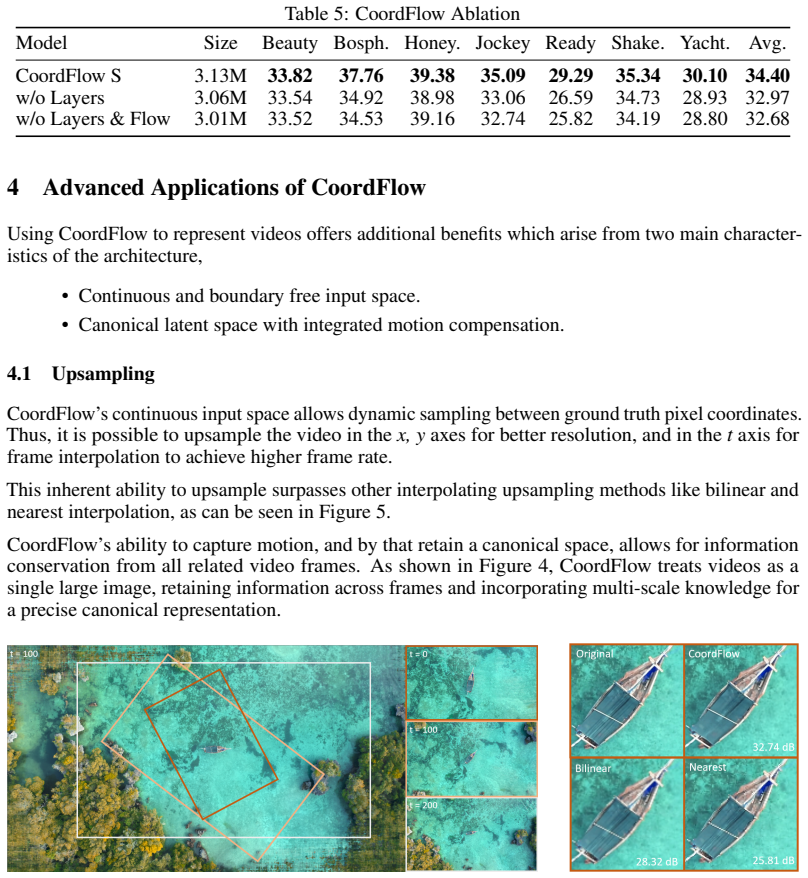
- Because the input space is continuous, a single trained CoordFlow model can be sampled at new spatial positions and new times, giving upsampling and frame interpolation from one set of weights.
Reading between the lines
- [Editorial inference] If the layered-similarity hypothesis is the real source of gain, extending the flow network to output an affine or homography matrix per layer per frame should further improve rate-distortion on scenes with perspective change; this is a testable extension the paper does not run.
- [Editorial inference] The alpha maps produced by a two-layer CoordFlow could serve as a self-supervised object-discovery signal for other video tasks, since the segmentation emerges without any flow supervision or mask labels.
- [Editorial inference] The denoising and stabilization behaviors suggest a practical self-supervised cleanup recipe: train CoordFlow on a noisy or shaky video, then decode with smoothed flow matrices and high-frequency-free sampling rather than training a separate filter.
- [Editorial inference] The 'one motion per frame per layer' restriction means performance on complex scenes should degrade as non-rigid content grows; a natural stress test is measuring how average PSNR per parameter drops as the number of independent moving objects grows beyond the layer count.
Editorial analysis
A structured set of objections, weighed in public.
Referee Report
Summary. The paper proposes CoordFlow, a pixel-wise implicit neural representation (INR) for video compression. The architecture is composed of multiple CoordFlow layers, each pairing a flow network that predicts a per-frame similarity transform (scale, rotation, translation) with a color network that maps transformed (x,y,t) coordinates to RGBA values; the layers are combined through softmax-weighted alpha blending. The method is evaluated on the UVG and Boat datasets, with PSNR comparisons against frame-wise and pixel-wise INRs, a BPP/PSNR comparison, an ablation study, and qualitative demonstrations of video upsampling, unsupervised segmentation, inpainting, stabilization, and denoising. The paper claims state-of-the-art performance among pixel-wise INRs, superiority over NVP in both BPP and PSNR, and that CoordFlow is the first pixel-wise method to outperform frame-wise INRs.
Significance. If the empirical claims are confirmed, CoordFlow would be a meaningful advance: it offers a simple and interpretable way to inject global motion compensation into pixel-wise INRs, produces unsupervised layer segmentation as a byproduct, and reaches PSNR levels close to strong frame-wise methods. The ablation study in Section 3.3 is encouraging because it isolates the contribution of the multi-layer structure and the flow network. However, the rate-distortion comparison contains a serious protocol inconsistency, the training budgets are unequal, and the headline claim is broader than the data support. The significance is therefore conditional on a re-run of the comparison under a common and fully documented compression pipeline.
major comments (3)
- [Section 3.1, Tables 3 and 4; Section 3.2] The BPP/PSNR comparison is not rate-distortion controlled and is internally inconsistent. Table 3 is described as reporting results with "no quantization", yet it lists BPP values; CoordFlow S appears there with PSNR 34.23, whereas Table 1 reports 34.40 for the same raw model. Table 4 then reports lower BPP values after quantizing only the color network (about 98.3% of weights) to 8-bit, leaving the flow network and any side information out of the reported bit budget. The baselines' BPP values are taken from [13, 18], which use their own full quantization and entropy-coding pipelines. The claimed superiority over NVP in both BPP and PSNR is therefore not established. Please report CoordFlow's BPP under the same full-model quantization and entropy-coding protocol as the baselines, including all weights and side information, or explicitly state that the comparison is not a controlled rate-distortion comparison.
- [Section 3, training details, and Table 1] The headline PSNR comparison in Table 1 is confounded by unequal training budgets. The text states that all CoordFlow models were trained for 53 epochs, while the table caption says frame-wise models were tested after 300 training epochs and the baseline numbers are imported from other papers. Since INR quality is strongly dependent on training length and optimization details, a comparison at 53 versus 300 epochs does not establish that CoordFlow is better at equal training effort. In addition, single runs with no error bars or multiple seeds make it impossible to assess the stability of the reported PSNR values. Please provide convergence curves, or retrain all compared methods under the same epoch and seed protocol.
- [Section 5, Conclusion; Table 1; Appendix Table 8] The claim that CoordFlow is "the first pixel-wise method to outperform frame-wise INRs" is not supported by the paper's own tables. Table 1 and Appendix Table 8 show HiNeRV, a frame-wise method, outperforming CoordFlow at every size on the UVG average (e.g., S: 35.27 vs 34.40; M: 36.71 vs 35.33; L: 38.02 vs 36.54). The supported statement is that CoordFlow outperforms the NeRV-family baselines considered here, not all frame-wise INRs. Please qualify the claim to match the evidence, for example by saying it outperforms the tested NeRV-family baselines and is competitive with the leading frame-wise method HiNeRV.
minor comments (6)
- [General] The manuscript contains numerous grammatical and typographical errors, including "it's" for "its", "out preforming" for "outperforming", "secures it's competitiveness" for "secures its competitiveness", and "tree different model sizes" for "three different model sizes"; a careful proofreading pass is needed.
- [Section 2.3, Equation (5)] The combined loss is written as w * (||δ||₁ + λ||δ||₂), which mixes an L1 norm with an unsquared L2 norm; the text refers to the second term as an L2 loss. Please clarify whether the L2 term is squared, since this changes the effective balance between the two terms and affects reproducibility.
- [Section 2.3] The per-pixel loss weight w is described only qualitatively in terms of Laplacian magnitude, Canny edge prominence, and temporal variance, but no explicit formula is given. Please provide the exact definition so that the training loss is reproducible.
- [Section 4.2 and Appendix B] The flow model assumes a per-layer global similarity transform, and Appendix B explicitly states that a single layer is "not designed for capturing intricate real-world motions". The paper should state more clearly how the two-layer version handles non-rigid motion, occlusions, or perspective changes, and discuss the extent to which the color network must memorize residuals in such cases, since this affects the compression-efficiency claim.
- [Figure 3] Figure 3 mixes results from several sources ([17, 15, 13, 18]) without stating which quantization or entropy-coding protocol each curve uses, and the axes are not self-explanatory in the current caption. Please specify the protocol for each curve and label the axes clearly.
- [Appendix D] Table 6 reports training duration per epoch, but the actual total training time depends on the number of epochs (53 in the main experiments) and on the video length; please report total encoding time so the reader can assess the practical cost.
Circularity Check
No circular derivation chain; CoordFlow's central claims are empirical benchmark results, with only a minor non-load-bearing self-citation.
full rationale
CoordFlow is an empirical neural video representation paper. The central claims are benchmark comparisons in Section 3.1 and the conclusion: CoordFlow achieves state-of-the-art PSNR among pixel-wise INRs and outperforms some frame-wise INRs. These claims rest on measured PSNR values in Tables 1, 3, 4, and 8, not on a mathematical derivation whose output equals its input. The reconstruction objective in Eq. 5 is an L1/L2 loss, and PSNR is computed from the reconstruction of the same video; this is standard INR fitting evaluation, not a fitted parameter renamed as a prediction. The flow/color decomposition in Eqs. 1 and 2 is a stated modeling ansatz, and the ablation in Table 5 empirically tests its contribution rather than assuming it. The paper's only self-citation is [23] in the Conclusion, used as a pointer to the authors' related video-editing work; it is not load-bearing for the compression or performance claims. The possible mismatch in BPP comparison protocols between CoordFlow and NVP in Table 3 is a benchmarking correctness concern, not circularity. Appendix B explicitly acknowledges that a single CoordFlow layer is not designed for intricate real-world motions, confirming that the similarity-transform restriction is a disclosed assumption rather than a hidden circular premise.
Assumptions & free parameters
free parameters (5)
- per-pixel loss weighting w =
not specified
- lambda (L2 term) =
0.25
- gamma (layer loss weight) =
0.1
- number of CoordFlow layers =
2 (default)
- learning rate =
0.0005
assumptions (5)
- domain assumption Natural videos can be decomposed into a small number of layers, each undergoing a single similarity transformation (scale, rotation, translation) over time.
- domain assumption The softmax-normalized alpha weights produce a valid composition and unsupervised segmentation.
- domain assumption The color network can absorb residual per-pixel variation not explained by the similarity flow, while remaining compact.
- domain assumption Baseline PSNR/BPP numbers cited from HiNeRV [15] and NVP [13] are accurate and comparable under the same protocol.
- domain assumption A single training run (no seeds) is representative.
Cite this review
Pith. "Pith review of CoordFlow: Coordinate Flow for Pixel-wise Neural Video Representation." pith.science (2026). https://pith.science/paper/FP5W3W6I
@misc{pith2026250100975,
  author       = {Pith},
  title        = {Pith review of: CoordFlow: Coordinate Flow for Pixel-wise Neural Video Representation},
  year         = {2026},
  howpublished = {\url{https://pith.science/paper/FP5W3W6I}},
  note         = {Machine review of arXiv:2501.00975}
}
read the original abstract
In the field of video compression, the pursuit for better quality at lower bit rates remains a long-lasting goal. Recent developments have demonstrated the potential of Implicit Neural Representation (INR) as a promising alternative to traditional transform-based methodologies. Video INRs can be roughly divided into frame-wise and pixel-wise methods according to the structure the network outputs. While the pixel-based methods are better for upsampling and parallelization, frame-wise methods demonstrated better performance. We introduce CoordFlow, a novel pixel-wise INR for video compression. It yields state-of-the-art results compared to other pixel-wise INRs and on-par performance compared to leading frame-wise techniques. The method is based on the separation of the visual information into visually consistent layers, each represented by a dedicated network that compensates for the layer's motion. When integrated, a byproduct is an unsupervised segmentation of video sequence. Objects motion trajectories are implicitly utilized to compensate for visual-temporal redundancies. Additionally, the proposed method provides inherent video upsampling, stabilization, inpainting, and denoising capabilities.
Figures


Figures from the paper (5 more)


Reference graph
Works this paper leans on
-
[1]
arXiv preprint arXiv:2212.13554 (2022)
Ashkenazi, M., Rimon, Z., Vainshtein, R., Levi, S., Richardson, E., Mintz, P., Treister, E.: Nern–learning neural representations for neural networks. arXiv preprint arXiv:2212.13554 (2022)
arXiv 2022
-
[2]
In: 2023 IEEE International Conference on Image Processing (ICIP)
Bai, Y ., Dong, C., Wang, C., Yuan, C.: Ps-nerv: Patch-wise stylized neural representations for videos. In: 2023 IEEE International Conference on Image Processing (ICIP). pp. 41–45. IEEE (2023)
work page 2023
-
[3]
IEEE Transactions on pattern analysis and machine intelligence (6), 679–698 (1986)
Canny, J.: A computational approach to edge detection. IEEE Transactions on pattern analysis and machine intelligence (6), 679–698 (1986)
1986
-
[4]
arXiv preprint arXiv:2301.09060 (2023)
Caruso, B., Mahendrakar, T., Nguyen, V .M., White, R.T., Steffen, T.: 3d reconstruction of non-cooperative resident space objects using instant ngp-accelerated nerf and d-nerf. arXiv preprint arXiv:2301.09060 (2023)
arXiv 2023
-
[5]
CNeRV: Content-adaptive Neural Representation for Visual Data
Chen, H., Gwilliam, M., He, B., Lim, S.N., Shrivastava, A.: Cnerv: Content-adaptive neural representation for visual data. arXiv preprint arXiv:2211.10421 (2022)
work page Pith review arXiv 2022
-
[6]
In: Proceedings of the IEEE/CVF Conference on Computer Vision and Pattern Recognition
Chen, H., Gwilliam, M., Lim, S.N., Shrivastava, A.: Hnerv: A hybrid neural representation for videos. In: Proceedings of the IEEE/CVF Conference on Computer Vision and Pattern Recognition. pp. 10270–10279 (2023)
work page 2023
-
[7]
Advances in Neural Information Processing Systems 34, 21557–21568 (2021)
Chen, H., He, B., Wang, H., Ren, Y ., Lim, S.N., Shrivastava, A.: Nerv: Neural representations for videos. Advances in Neural Information Processing Systems 34, 21557–21568 (2021)
work page 2021
-
[8]
In: Proceedings of the IEEE/CVF conference on computer vision and pattern recognition
Chen, Y ., Liu, S., Wang, X.: Learning continuous image representation with local implicit image function. In: Proceedings of the IEEE/CVF conference on computer vision and pattern recognition. pp. 8628–8638 (2021)
work page 2021
Show all 34 references
-
[9]
Elliot, T.: Top view of a wooden boat on beach shore (2020), https://www.pexels.com/video/ top-view-of-a-wooden-boat-on-beach-shore-6003440
2020
-
[10]
In: Proceedings of the IEEE/CVF International Conference on Computer Vision
Girish, S., Shrivastava, A., Gupta, K.: Shacira: Scalable hash-grid compression for implicit neural representations. In: Proceedings of the IEEE/CVF International Conference on Computer Vision. pp. 17513–17524 (2023) 9
2023
-
[11]
Signal Processing: Image Communication 7(4-6), 529–552 (1995)
Irani, M., Hsu, S., Anandan, P.: Video compression using mosaic representations. Signal Processing: Image Communication 7(4-6), 529–552 (1995)
1995
-
[12]
ACM Transactions on Graphics (TOG) 40(6), 1–12 (2021)
Kasten, Y ., Ofri, D., Wang, O., Dekel, T.: Layered neural atlases for consistent video editing. ACM Transactions on Graphics (TOG) 40(6), 1–12 (2021)
2021
-
[13]
Advances in Neural Information Processing Systems 35, 12718–12731 (2022)
Kim, S., Yu, S., Lee, J., Shin, J.: Scalable neural video representations with learnable positional features. Advances in Neural Information Processing Systems 35, 12718–12731 (2022)
2022
-
[14]
Interna- tional Journal of Computer Vision 53, 225–243 (2003)
Kimmel, R., Bruckstein, A.M.: Regularized laplacian zero crossings as optimal edge integrators. Interna- tional Journal of Computer Vision 53, 225–243 (2003)
2003
-
[15]
Advances in Neural Information Processing Systems 36 (2024)
Kwan, H.M., Gao, G., Zhang, F., Gower, A., Bull, D.: Hinerv: Video compression with hierarchical encoding-based neural representation. Advances in Neural Information Processing Systems 36 (2024)
2024
-
[16]
Communications of the ACM 34(4), 46–58 (1991)
Le Gall, D.: Mpeg: A video compression standard for multimedia applications. Communications of the ACM 34(4), 46–58 (1991)
1991
-
[17]
In: Proceedings of the 31st ACM International Conference on Multimedia
Lee, J.C., Rho, D., Ko, J.H., Park, E.: Ffnerv: Flow-guided frame-wise neural representations for videos. In: Proceedings of the 31st ACM International Conference on Multimedia. pp. 7859–7870 (2023)
2023
-
[18]
In: Proceedings of the IEEE/CVF Conference on Computer Vision and Pattern Recognition
Maiya, S.R., Girish, S., Ehrlich, M., Wang, H., Lee, K.S., Poirson, P., Wu, P., Wang, C., Shrivastava, A.: Nirvana: Neural implicit representations of videos with adaptive networks and autoregressive patch-wise modeling. In: Proceedings of the IEEE/CVF Conference on Computer V...
2023
-
[19]
In: Proceedings of the 11th ACM Multimedia Systems Conference
Mercat, A., Viitanen, M., Vanne, J.: Uvg dataset: 50/120fps 4k sequences for video codec analysis and development. In: Proceedings of the 11th ACM Multimedia Systems Conference. pp. 297–302 (2020)
2020
-
[20]
Communications of the ACM 65(1), 99–106 (2021)
Mildenhall, B., Srinivasan, P.P., Tancik, M., Barron, J.T., Ramamoorthi, R., Ng, R.: Nerf: Representing scenes as neural radiance fields for view synthesis. Communications of the ACM 65(1), 99–106 (2021)
2021
-
[21]
IEEE Transactions on circuits and systems for video technology 7(1), 158–171 (1997)
Neff, R., Zakhor, A.: Very low bit-rate video coding based on matching pursuits. IEEE Transactions on circuits and systems for video technology 7(1), 158–171 (1997)
1997
-
[22]
In: Proceedings of the IEEE/CVF conference on computer vision and pattern recognition
Park, J.J., Florence, P., Straub, J., Newcombe, R., Lovegrove, S.: Deepsdf: Learning continuous signed distance functions for shape representation. In: Proceedings of the IEEE/CVF conference on computer vision and pattern recognition. pp. 165–174 (2019)
2019
-
[23]
arXiv preprint arXiv:2411.16819 (2024)
Rotstein, N., Yona, G., Silver, D., Velich, R., Bensaïd, D., Kimmel, R.: Pathways on the image manifold: Image editing via video generation. arXiv preprint arXiv:2411.16819 (2024)
2024 arXiv
-
[24]
IEEE Transactions on signal processing 41(12), 3445–3462 (1993)
Shapiro, J.M.: Embedded image coding using zerotrees of wavelet coefficients. IEEE Transactions on signal processing 41(12), 3445–3462 (1993)
1993
-
[25]
Advances in neural information processing systems 33, 7462–7473 (2020)
Sitzmann, V ., Martel, J., Bergman, A., Lindell, D., Wetzstein, G.: Implicit neural representations with periodic activation functions. Advances in neural information processing systems 33, 7462–7473 (2020)
2020
-
[26]
IEEE Signal processing magazine 18(5), 36–58 (2001)
Skodras, A., Christopoulos, C., Ebrahimi, T.: The jpeg 2000 still image compression standard. IEEE Signal processing magazine 18(5), 36–58 (2001)
2001
-
[27]
IEEE Transactions on circuits and systems for video technology 22(12), 1649–1668 (2012)
Sullivan, G.J., Ohm, J.R., Han, W.J., Wiegand, T.: Overview of the high efficiency video coding (hevc) standard. IEEE Transactions on circuits and systems for video technology 22(12), 1649–1668 (2012)
2012
-
[28]
Advances in Neural Information Processing Systems 33, 7537–7547 (2020)
Tancik, M., Srinivasan, P., Mildenhall, B., Fridovich-Keil, S., Raghavan, N., Singhal, U., Ramamoorthi, R., Barron, J., Ng, R.: Fourier features let networks learn high frequency functions in low dimensional domains. Advances in Neural Information Processing Systems 33, 7537–7...
2020
-
[29]
Advances in neural information processing systems 30 (2017)
Vaswani, A., Shazeer, N., Parmar, N., Uszkoreit, J., Jones, L., Gomez, A.N., Kaiser, Ł., Polosukhin, I.: Attention is all you need. Advances in neural information processing systems 30 (2017)
2017
-
[30]
Communications of the ACM 34(4), 30–44 (1991)
Wallace, G.K.: The jpeg still picture compression standard. Communications of the ACM 34(4), 30–44 (1991)
1991
-
[31]
IEEE transactions on image processing 13(4), 600–612 (2004)
Wang, Z., Bovik, A.C., Sheikh, H.R., Simoncelli, E.P.: Image quality assessment: from error visibility to structural similarity. IEEE transactions on image processing 13(4), 600–612 (2004)
2004
-
[32]
Mathematica journal 4(1), 81 (1994)
Watson, A.B., et al.: Image compression using the discrete cosine transform. Mathematica journal 4(1), 81 (1994)
1994
-
[33]
one movement per frame
Wiegand, T., Sullivan, G.J., Bjontegaard, G., Luthra, A.: Overview of the h. 264/avc video coding standard. IEEE Transactions on circuits and systems for video technology 13(7), 560–576 (2003) 10 Supplemental Material A Supplementary Videos A.1 Canonical Space Visualization Li...
2003
-
[34]
Big Buck Bunny
This inefficiency causes the network to expend resources correcting these distortions rather than focusing on accurate representation. By restricting transformations to a per-frame basis, these issues are mitigated, leading to a more stable and efficient learning process. Figu...
Reviewed August 10, 2026 · model on record in the stance chip above.
Discussion (0). Continue with ORCID to comment.