From QCD sum rules to HQET sum rules: Heavy-quark limit of four-quark operator matrix elements
Pith reviewed 2026-06-27 16:33 UTC · model grok-4.3
The pith
Heavy-quark limit of four-quark operator matrix elements produces consistent results from QCD and HQET sum rules.
A machine-rendered reading of the paper's core claim, the machinery that carries it, and where it could break.
Core claim
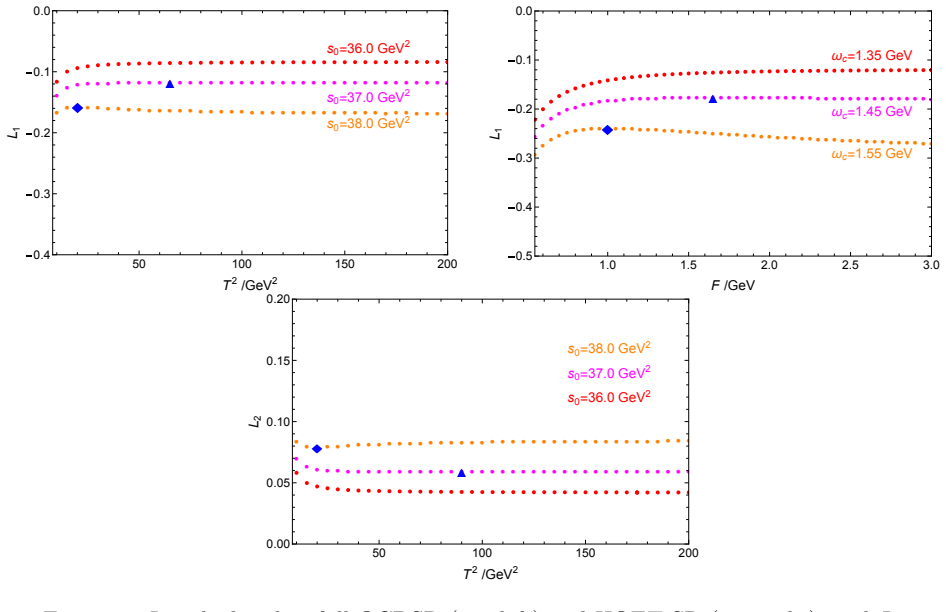
We calculate these matrix elements at leading order using full QCD sum rules, with particular emphasis on deriving the corresponding HQET sum rules by taking the heavy-quark limit. While this limit is straightforward for most contributions, it turns out to be rather nontrivial for certain ones. Numerical analyses show that the results obtained from the two approaches are consistent with each other. We further clarify the origin of the large discrepancies reported in the literature between full QCD sum rule and HQET sum rule results.
What carries the argument
The heavy-quark limit applied to the sum-rule expressions for four-quark operator matrix elements, with special handling of the nontrivial contributions.
If this is right
- The two sum-rule techniques can be used interchangeably for these matrix elements once the heavy-quark limit is imposed.
- Lifetime differences among heavy-flavor hadrons can be computed with either method without method-dependent discrepancies at leading order.
- Previous literature discrepancies are resolved by proper implementation of the limit on the nontrivial terms.
- Applications of QCD and HQET sum rules to other heavy-flavor observables become more reliable through this clarified relationship.
Where Pith is reading between the lines
- The demonstrated consistency may allow cross-checks between sum-rule results and lattice calculations of the same matrix elements.
- The nontrivial limit procedure identified here could be extended to higher-dimensional operators or to subleading orders in the heavy-quark expansion.
- If the same limit works for other four-quark operators, predictions for specific decay channels such as those involving B and D mesons could be refined without switching frameworks.
Load-bearing premise
The heavy-quark limit can be taken correctly for the nontrivial contributions without introducing uncontrolled errors that would invalidate the claimed numerical consistency between the two sum-rule methods.
What would settle it
A numerical evaluation in which the full-QCD sum-rule values for the matrix elements fail to approach the HQET values within quoted uncertainties as the heavy-quark mass is increased toward infinity.
Figures

read the original abstract
Heavy quark expansion theory provides the standard theoretical framework for understanding the lifetimes of weakly decaying heavy-flavor hadrons. Within this framework, the matrix elements of four-quark operators play a crucial role in explaining the lifetime differences among hadrons containing the same heavy quark. In this work, we calculate these matrix elements at leading order using full QCD sum rules, with particular emphasis on deriving the corresponding HQET sum rules by taking the heavy-quark limit. While this limit is straightforward for most contributions, it turns out to be rather nontrivial for certain ones. Numerical analyses show that the results obtained from the two approaches are consistent with each other. We further clarify the origin of the large discrepancies reported in the literature between full QCD sum rule and HQET sum rule results. This work contributes to a deeper understanding of the relationship between the two sum-rule approaches and is expected to facilitate future applications of QCD and HQET sum rules in the study of heavy-flavor hadrons. The findings presented here may be of interest to both practitioners of QCD sum rules and researchers working on effective field theories.
Editorial analysis
A structured set of objections, weighed in public.
Referee Report
Summary. The paper calculates the matrix elements of four-quark operators at leading order in full QCD sum rules for heavy-flavor hadrons, derives the corresponding HQET sum rules by explicitly taking the heavy-quark limit (noting that this limit is nontrivial for certain contributions), performs numerical analyses to demonstrate consistency between the QCD and HQET results, and identifies the origin of previously reported large discrepancies between the two approaches in the literature.
Significance. If the heavy-quark limit is correctly implemented for the nontrivial terms and the numerical consistency holds, the work establishes a direct bridge between full QCD and HQET sum-rule methods for four-quark matrix elements, which are central to lifetime differences in the heavy-quark expansion. This could resolve methodological tensions in the literature and support more reliable applications to heavy-flavor phenomenology. The explicit limit-taking procedure itself is a methodological strength.
major comments (2)
- [Abstract and the section deriving the HQET limit for nontrivial contributions] The central claim of numerical consistency between full QCD and HQET sum rules rests on the correct handling of the 'rather nontrivial' contributions in the heavy-quark limit (as flagged in the abstract). The manuscript must demonstrate explicitly, with intermediate expressions, that the limiting procedure for these terms does not introduce uncontrolled errors (e.g., via interchange of limits with integrals or specific condensate assumptions), as any such issue would undermine the resolution of literature discrepancies.
- [Numerical analyses section] Numerical analyses section: the reported agreement requires explicit documentation of the condensate values, Borel windows, error estimates, and stability criteria used for both the full QCD and HQET sum rules; without these, the consistency cannot be independently verified and the clarification of discrepancies remains unquantified.
minor comments (2)
- [Introduction] Clarify the notation for the four-quark operators and their matrix elements early in the introduction to aid readers unfamiliar with the specific basis used.
- [Introduction] Ensure all references to prior literature discrepancies include precise citations to the specific results being compared.
Simulated Author's Rebuttal
We thank the referee for the positive summary and constructive major comments. We address each point below and will revise the manuscript to incorporate the requested clarifications.
read point-by-point responses
-
Referee: [Abstract and the section deriving the HQET limit for nontrivial contributions] The central claim of numerical consistency between full QCD and HQET sum rules rests on the correct handling of the 'rather nontrivial' contributions in the heavy-quark limit (as flagged in the abstract). The manuscript must demonstrate explicitly, with intermediate expressions, that the limiting procedure for these terms does not introduce uncontrolled errors (e.g., via interchange of limits with integrals or specific condensate assumptions), as any such issue would undermine the resolution of literature discrepancies.
Authors: The manuscript already performs the heavy-quark limit explicitly for the nontrivial contributions in the dedicated HQET derivation section, with the abstract noting the nontrivial nature. To strengthen the demonstration, we will insert additional intermediate expressions in the revised version that walk through the limit-taking step by step, explicitly confirming that no uncontrolled interchange of limits or condensate assumptions occurs. This addition directly addresses the concern without altering the existing results. revision: yes
-
Referee: [Numerical analyses section] Numerical analyses section: the reported agreement requires explicit documentation of the condensate values, Borel windows, error estimates, and stability criteria used for both the full QCD and HQET sum rules; without these, the consistency cannot be independently verified and the clarification of discrepancies remains unquantified.
Authors: We agree that full documentation of the numerical inputs and criteria is essential for independent verification. The current numerical analyses section reports the consistency and identifies the source of literature discrepancies, but we will expand it in the revision to include explicit tables listing the condensate values, Borel windows, error estimates, and stability criteria applied to both the full QCD and HQET sum rules. revision: yes
Circularity Check
No circularity: explicit limit-taking calculation yields independent numerical consistency check
full rationale
The paper computes four-quark operator matrix elements at leading order in full QCD sum rules, then derives the corresponding HQET expressions by explicitly taking the heavy-quark limit (noting that the procedure is nontrivial for some contributions). Numerical results from the two methods are compared after the limit is performed, and literature discrepancies are addressed by reference to the limiting procedure itself. No equation or step reduces a claimed result to a fitted parameter, self-definition, or load-bearing self-citation chain; the consistency is presented as an outcome of the calculation rather than an input. The work is therefore self-contained against external benchmarks.
Axiom & Free-Parameter Ledger
Reference graph
Works this paper leans on
-
[1]
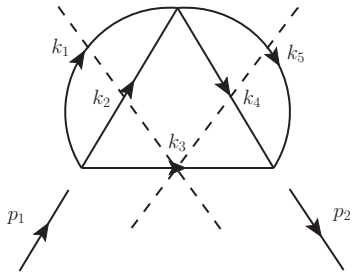
The cutting rules method is illustrated in Fig
, (28) and the spectral density functions ρAi(s1, s2, q2) are evaluated using the Cutkosky cutting rules. The cutting rules method is illustrated in Fig. 1. 8 k1 k2 k3 k4 k5 p1 p2 Figure 1: Perturbation diagram for the three-point correlation function, where the cutting rules are also indicated. The sum rules are constructed by equating Eq. (24) and Eq. (...
-
[2]
(32) Then, to leading power in mb, Eq
(31) We introduce the following variable replacements: M± = (mb + ∆±), p 2 1(2) = (mb + ω1(2))2, s 1(2) = (mb + σ1(2))2, s 0 = (mb + ωc)2. (32) Then, to leading power in mb, Eq. (31) can be rewritten as λ2 +a++ 1 (∆+ − ω1)(∆+ − ω2) = ∫ ωc dσ1 ∫ ωc dσ2 ρHQL(σ1, σ2) 1 (σ1 − ω1)(σ2 − ω2) , (33) where ρHQL(σ1, σ2) denotes the leading-power term in mb of {M 2 ...
2000
-
[3]
Measurement of the $\Omega_c^0$ baryon lifetime
R. Aaij et al. [LHCb], Phys. Rev. Lett. 121, no.9, 092003 (2018) doi:10.1103/PhysRevLett.121.092003 [arXiv:1807.02024 [hep-ex]]
work page internal anchor Pith review Pith/arXiv arXiv doi:10.1103/physrevlett.121.092003 2018
-
[4]
M. Tanabashi et al. [Particle Data Group], Phys. Rev. D 98, no.3, 030001 (2018) doi:10.1103/PhysRevD.98.030001
-
[5]
R. Aaij et al. [LHCb], Sci. Bull. 67, no.5, 479-487 (2022) doi:10.1016/j.scib.2021.11.022 [arXiv:2109.01334 [hep-ex]]
-
[6]
F. J. Abudinen et al. [Belle-II], Phys. Rev. D 107, no.3, L031103 (2023) doi:10.1103/PhysRevD.107.L031103 [arXiv:2208.08573 [hep-ex]]
-
[7]
H. Y. Cheng, JHEP 11, 014 (2018) doi:10.1007/JHEP11(2018)014 [arXiv:1807.00916 [hep- ph]]
work page internal anchor Pith review Pith/arXiv arXiv doi:10.1007/jhep11(2018)014 2018
-
[8]
J. Gratrex, B. Melić and I. Nišandžić, JHEP 07, 058 (2022) doi:10.1007/JHEP07(2022)058 [arXiv:2204.11935 [hep-ph]]
-
[9]
H. Y. Cheng and C. W. Liu, JHEP 07, 114 (2023) doi:10.1007/JHEP07(2023)114 [arXiv:2305.00665 [hep-ph]]
-
[10]
Z. X. Zhao, X. Y. Sun, F. W. Zhang and Z. P. Xing, Eur. Phys. J. C 84, no.1, 48 (2024) doi:10.1140/epjc/s10052-023-12299-9 [arXiv:2101.11874 [hep-ph]]
-
[12]
Y. J. Shi, W. Wang and Z. X. Zhao, Eur. Phys. J. C 80, no.6, 568 (2020) doi:10.1140/epjc/s10052-020-8096-2 [arXiv:1902.01092 [hep-ph]]
-
[13]
Z. X. Zhao, R. H. Li, Y. L. Shen, Y. J. Shi and Y. S. Yang, Eur. Phys. J. C 80, no.12, 1181 (2020) doi:10.1140/epjc/s10052-020-08767-1 [arXiv:2010.07150 [hep-ph]]. 18
-
[14]
Z. X. Zhao, X. Y. Sun, F. W. Zhang, Y. P. Xing and Y. T. Yang, Phys. Rev. D 108, no.11, 116008 (2023) doi:10.1103/PhysRevD.108.116008 [arXiv:2103.09436 [hep-ph]]
-
[15]
Z. P. Xing and Z. X. Zhao, Eur. Phys. J. C 81, no.12, 1111 (2021) doi:10.1140/epjc/s10052- 021-09902-2 [arXiv:2109.00216 [hep-ph]]
-
[16]
S. Q. Zhang and C. F. Qiao, Phys. Rev. D 108, no.7, 074017 (2023) doi:10.1103/PhysRevD.108.074017 [arXiv:2307.05019 [hep-ph]]
-
[17]
S. Q. Zhang, X. H. Zhang and C. F. Qiao, JHEP 06, 122 (2024) doi:10.1007/JHEP06(2024)122 [arXiv:2402.15088 [hep-ph]]
-
[18]
S. Q. Zhang and C. F. Qiao, Phys. Rev. D 110, no.11, 114040 (2024) doi:10.1103/PhysRevD.110.114040 [arXiv:2411.15857 [hep-ph]]
-
[19]
J. Lu, G. L. Yu, D. Y. Chen, Z. G. Wang and B. Wu, Eur. Phys. J. C 85, no.12, 1382 (2025) doi:10.1140/epjc/s10052-025-15110-z [arXiv:2508.11900 [hep-ph]]
work page internal anchor Pith review Pith/arXiv arXiv doi:10.1140/epjc/s10052-025-15110-z 2025
-
[20]
G. L. Yu, Z. G. Wang, J. Lu, B. Wu, P. Yang and Z. Zhou, Phys. Rev. D 113, no.7, 076013 (2026) doi:10.1103/ghm9-2lmd [arXiv:2601.06427 [hep-ph]]
work page internal anchor Pith review Pith/arXiv arXiv doi:10.1103/ghm9-2lmd 2026
-
[21]
M. Black, M. Lang, A. Lenz and Z. Wüthrich, JHEP 04, 081 (2025) doi:10.1007/JHEP04(2025)081 [arXiv:2412.13270 [hep-ph]]
-
[22]
E. V. Shuryak, Nucl. Phys. B 198, 83-101 (1982) doi:10.1016/0550-3213(82)90546-6
-
[23]
On the $b-$ Quark Kinetic Energy in the $\Lambda_b$
P. Colangelo, C. A. Dominguez, G. Nardulli and N. Paver, Phys. Rev. D 54, 4622-4628 (1996) doi:10.1103/PhysRevD.54.4622 [arXiv:hep-ph/9512334 [hep-ph]]
work page internal anchor Pith review Pith/arXiv arXiv doi:10.1103/physrevd.54.4622 1996
-
[24]
H. n. Li and H. Umeeda, Phys. Rev. D 102, 114014 (2020) doi:10.1103/PhysRevD.102.114014 [arXiv:2006.16593 [hep-ph]]
-
[25]
A. S. Xiong, F. S. Yu, Y. Zheng and T. Wei, [arXiv:2211.13753 [hep-th]]
-
[26]
Z. X. Zhao, Y. P. Xing and R. H. Li, Eur. Phys. J. C 84, no.10, 1105 (2024) doi:10.1140/epjc/s10052-024-13452-8 [arXiv:2407.09819 [hep-ph]]
-
[27]
V. A. Khoze and M. A. Shifman, Sov. Phys. Usp. 26, 387 (1983) doi:10.1070/PU1983v026n05ABEH004398
-
[28]
I. I. Y. Bigi and N. G. Uraltsev, Phys. Lett. B 280, 271-280 (1992) doi:10.1016/0370- 2693(92)90066-D
-
[29]
I. I. Y. Bigi, N. G. Uraltsev and A. I. Vainshtein, Phys. Lett. B 293, 430-436 (1992) [erratum: Phys. Lett. B 297, 477-477 (1992)] doi:10.1016/0370-2693(92)90908-M [arXiv:hep-ph/9207214 [hep-ph]]. 19
work page internal anchor Pith review Pith/arXiv arXiv doi:10.1016/0370-2693(92)90908-m 1992
-
[31]
The Rule of Discarding $1/N_c$ in Inclusive Weak Decays. II
B. Blok and M. A. Shifman, Nucl. Phys. B 399, 459-476 (1993) doi:10.1016/0550- 3213(93)90505-J [arXiv:hep-ph/9209289 [hep-ph]]
work page internal anchor Pith review Pith/arXiv arXiv doi:10.1016/0550- 1993
-
[32]
B Decays and the Heavy-Quark Expansion
M. Neubert, Adv. Ser. Direct. High Energy Phys. 15, 239-293 (1998) doi:10.1142/9789812812667_0003 [arXiv:hep-ph/9702375 [hep-ph]]
work page internal anchor Pith review Pith/arXiv arXiv doi:10.1142/9789812812667_0003 1998
-
[33]
Heavy quark expansion in beauty and its decays
N. Uraltsev, Proc. Int. Sch. Phys. Fermi 137, 329-409 (1998) doi:10.3254/978-1-61499-222-6- 329 [arXiv:hep-ph/9804275 [hep-ph]]
work page internal anchor Pith review Pith/arXiv arXiv doi:10.3254/978-1-61499-222-6- 1998
-
[34]
I. I. Y. Bigi, [arXiv:hep-ph/9508408 [hep-ph]]
-
[35]
A. Lenz, Int. J. Mod. Phys. A 30, no.10, 1543005 (2015) doi:10.1142/S0217751X15430058 [arXiv:1405.3601 [hep-ph]]
-
[36]
Z. G. Wang, Eur. Phys. J. C 68, 479-486 (2010) doi:10.1140/epjc/s10052-010-1365-8 [arXiv:1001.1652 [hep-ph]]
work page internal anchor Pith review Pith/arXiv arXiv doi:10.1140/epjc/s10052-010-1365-8 2010
-
[37]
A. A. Penin and A. A. Pivovarov, Nucl. Phys. B 549, 217-241 (1999) doi:10.1016/S0550- 3213(99)00182-0 [arXiv:hep-ph/9807421 [hep-ph]]
work page internal anchor Pith review Pith/arXiv arXiv doi:10.1016/s0550- 1999
-
[38]
QCD Sum Rules, a Modern Perspective
P. Colangelo and A. Khodjamirian, doi:10.1142/9789812810458_0033 [arXiv:hep-ph/0010175 [hep-ph]]
work page internal anchor Pith review Pith/arXiv arXiv doi:10.1142/9789812810458_0033
-
[39]
S. Navas et al. [Particle Data Group], Phys. Rev. D 110, no.3, 030001 (2024) doi:10.1103/PhysRevD.110.030001 20
discussion (0)
Sign in with ORCID, Apple, or X to comment. Anyone can read and Pith papers without signing in.