Influence of excited state decay and dephasing on phonon quantum state preparation
Pith reviewed 2026-05-24 20:43 UTC · model grok-4.3
The pith
Decay preserves phonon interference for ground-state storage
A machine-rendered reading of the paper's core claim, the machinery that carries it, and where it could break.
Core claim
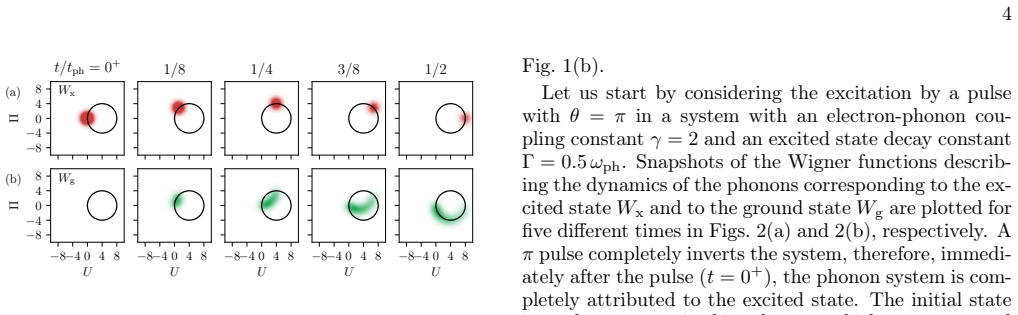
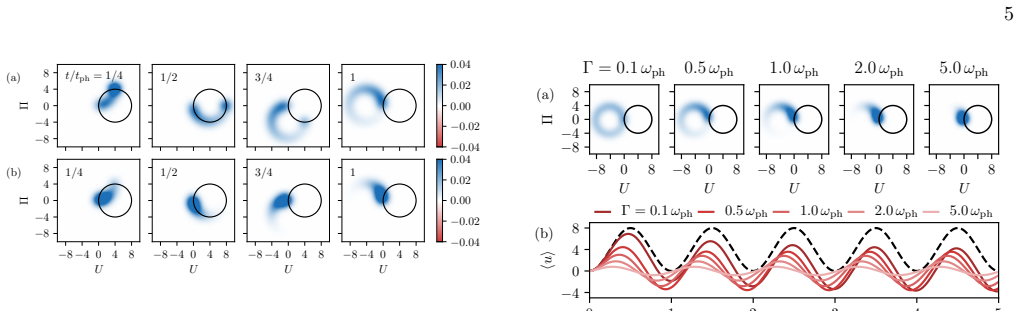
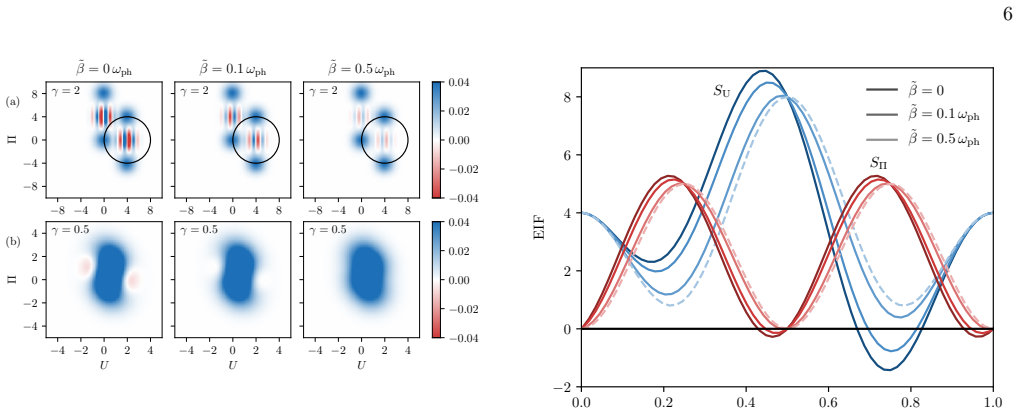
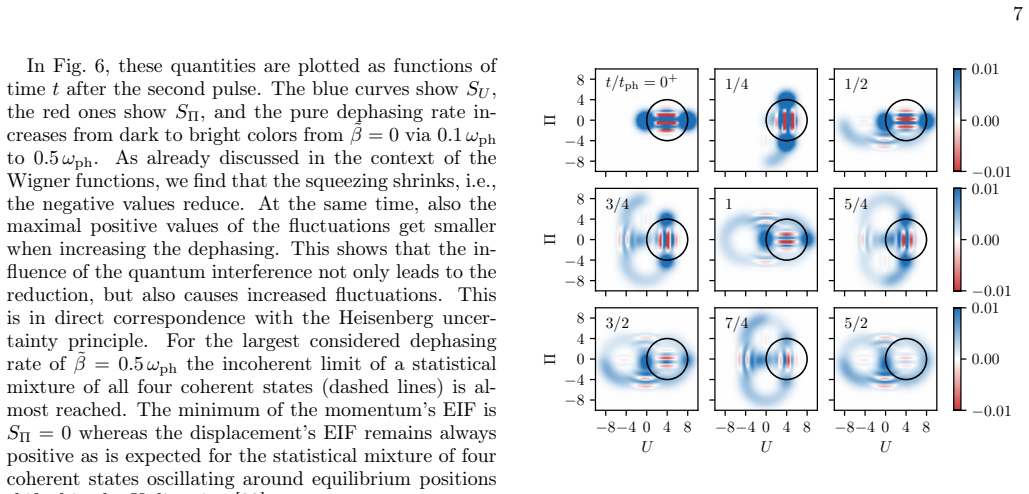
Using the independent boson model, tailored optical driving generates coherent phonon states and Schrödinger cat states. Decay of the two-level system transforms the coherent state into a circular distribution in phase space. Although dephasing between two exciting laser pulses reduces interference in the phonon system, decay conserves the interference ability during the transition into the ground state. This allows storage of the phonon quantum state properties in the ground state of the single-photon emitter.
What carries the argument
The independent boson model for the coupling between the optically driven two-level system and the discrete phonon mode, which tracks how decay and dephasing alter prepared phonon states.
If this is right
- Coherent phonon states become circular distributions in phase space due to decay.
- Dephasing between laser pulses reduces interference ability in the phonon system.
- Decay conserves interference properties during the transition to the ground state.
- Phonon quantum state properties can be stored in the ground state of the single-photon emitter.
Where Pith is reading between the lines
- The storage route could support hybrid systems that combine optical control with long-lived acoustic modes for quantum information.
- Similar decay dynamics might allow state preservation in other discrete bosonic environments if the coupling structure matches.
- An experiment could test the prediction by preparing a cat state, letting the emitter decay, and then probing the remaining phonon coherence.
- keywords:[
- phonon quantum states
- independent boson model
- single-photon emitters
- decay and dephasing
Load-bearing premise
The independent boson model accurately describes the coupling between the optically driven two-level system and the discrete phonon mode without additional interactions or effects.
What would settle it
Direct measurement of phonon phase-space distributions after the two-level system has decayed to its ground state, checking whether interference visibility remains intact or is lost.
Figures



read the original abstract
The coupling between single-photon emitters and phonons opens many possibilities to store and transmit quantum properties. In this paper we apply the independent boson model to describe the coupling between an optically driven two-level system and a discrete phonon mode. Tailored optical driving allows not only to generate coherent phonon states, but also to generate coherent superpositions in the form of Schr\"odinger cat states in the phonon system. We analyze the influence of decay and dephasing of the two-level system on these phonon preparation protocols. We find that the decay transforms the coherent phonon state into a circular distribution in phase space. Although the dephasing between two exciting laser pulses leads to a reduction of the interference ability in the phonon system, the decay conserves it during the transition into the ground state. This allows to store the phonon quantum state properties in the ground state of the single-photon emitter.
Editorial analysis
A structured set of objections, weighed in public.
Referee Report
Summary. The paper applies the independent boson model to an optically driven two-level system coupled to a discrete phonon mode. Tailored laser pulses are used to prepare coherent phonon states and Schrödinger cat states. The effects of decay and dephasing (modeled via Lindblad terms) are analyzed in phase space: decay converts coherent states to circular distributions while preserving cat-state interference during relaxation to the ground state, whereas inter-pulse dephasing reduces interference visibility. The central claim is that this enables storage of phonon quantum-state properties in the emitter ground state.
Significance. If the derivations hold, the result identifies a concrete mechanism by which decay can protect rather than destroy phonon interference, offering a route to phonon-based quantum memory in solid-state emitters. The work builds directly on the standard independent-boson Hamiltonian plus Markovian dissipators, so any analytic or numerical results are in principle reproducible and falsifiable against extensions of the model.
major comments (1)
- [Model and Results sections (implicit in abstract and § on numerical results)] The central claim that decay conserves interference ability rests on the independent-boson Hamiltonian plus separate Lindblad operators for decay and dephasing. No robustness analysis against multi-mode coupling, anharmonic phonon terms, or non-Markovian relaxation is presented; if such extensions modify the conditional displacement or the jump operators, the reported conservation would not survive. This is load-bearing for the storage protocol.
Simulated Author's Rebuttal
We thank the referee for their detailed review and for highlighting the importance of model assumptions in our work. We address the major comment below and indicate the revisions we will make to strengthen the manuscript.
read point-by-point responses
-
Referee: [Model and Results sections (implicit in abstract and § on numerical results)] The central claim that decay conserves interference ability rests on the independent-boson Hamiltonian plus separate Lindblad operators for decay and dephasing. No robustness analysis against multi-mode coupling, anharmonic phonon terms, or non-Markovian relaxation is presented; if such extensions modify the conditional displacement or the jump operators, the reported conservation would not survive. This is load-bearing for the storage protocol.
Authors: We agree that the reported conservation of interference under decay is specific to the independent-boson model with a single discrete phonon mode and Markovian Lindblad operators for spontaneous emission and pure dephasing. This framework is the standard description for the electron-phonon interaction in self-assembled quantum dots (as referenced in the manuscript), where the phonon mode is treated as harmonic and the bath as memoryless on the relevant timescales. Extensions involving multiple modes, phonon anharmonicity, or non-Markovian dynamics would generally require a different Hamiltonian and/or dissipator structure and could indeed modify the conditional displacement or the form of the jump operators. Our manuscript does not claim universality beyond this model. To address the concern we will add a new paragraph in the Discussion section that (i) explicitly lists the model assumptions, (ii) states that the interference preservation is a consequence of the particular form of the Lindblad operators within this model, and (iii) notes that robustness against the listed extensions is an open question left for future investigation. This revision clarifies the scope without altering the technical results. revision: partial
Circularity Check
No significant circularity; derivation follows from standard independent boson model dynamics
full rationale
The paper applies the established independent boson model (with added phenomenological Lindblad terms for decay and dephasing) to derive the influence on phonon states. No steps reduce by construction to fitted parameters, self-definitions, or self-citation chains; the claims about decay conserving interference while dephasing reduces it emerge from solving the time evolution under the model Hamiltonian, which is independent of the reported outcomes. The model is treated as an input assumption rather than derived within the paper.
Axiom & Free-Parameter Ledger
Lean theorems connected to this paper
-
IndisputableMonolith/Cost/FunctionalEquation.leanwashburn_uniqueness_aczel unclear?
unclearRelation between the paper passage and the cited Recognition theorem.
We apply the independent boson model to describe the coupling between an optically driven two-level system and a discrete phonon mode... Lindblad dissipators Di(ρ)=ηi[(AiρA†i)−1/2{A†iAi,ρ}] with Axd=|g⟩⟨x|, ηxd=Γ and Apd=|x⟩⟨x|, ηpd=2β̃.
-
IndisputableMonolith/Foundation/RealityFromDistinction.leanreality_from_one_distinction unclear?
unclearRelation between the paper passage and the cited Recognition theorem.
the phonon function F is only driven by the excited state occupation C... the decay conserves it during the transition into the ground state.
What do these tags mean?
- matches
- The paper's claim is directly supported by a theorem in the formal canon.
- supports
- The theorem supports part of the paper's argument, but the paper may add assumptions or extra steps.
- extends
- The paper goes beyond the formal theorem; the theorem is a base layer rather than the whole result.
- uses
- The paper appears to rely on the theorem as machinery.
- contradicts
- The paper's claim conflicts with a theorem or certificate in the canon.
- unclear
- Pith found a possible connection, but the passage is too broad, indirect, or ambiguous to say the theorem truly supports the claim.
Reference graph
Works this paper leans on
-
[1]
(8) and (16), we know that the phonon state is only driven by the excited state occupation
Pure dephasing From Eqs. (8) and (16), we know that the phonon state is only driven by the excited state occupation. Therefore, inasingle-pulseexcitationthedephasinghasnoinfluence on the phonon state. The same holds for phaseφ of the laser pulse, which does not enter in Eq. (14) after a sin- gle pulse. However, in Ref. [15], it was shown that by an excitat...
-
[2]
Influence of excited state decay on cat state dynamics The considered generation mechanism of phonon cat states, in general, leads to a state which is partly at- tributed to the ground state|g⟩ and partly to the excited state|x⟩. The phonon state attributed to the ground state oscillates stable in shape because it is not affected by decay and dephasing. The...
-
[3]
Cat state generation with excited state decay and dephasing Finally we go a step further and study the influence of a nonvanishing decay rateΓ also during the generation process of the phononic Schrödinger cat states. We do not consider an additional pure dephasing as the decay already has a dephasing influence on the coherence func- tion withβ = Γ/2. With ...
-
[4]
Dephasing in quantum dots: Quadratic coupling to acoustic phonons,
E. A. Muljarov and R. Zimmermann, “Dephasing in quantum dots: Quadratic coupling to acoustic phonons,” Phys. Rev. Lett.93, 237401 (2004)
work page 2004
-
[5]
Change of decoherence scenario and appearance of localization due to reservoir anharmonic- ity,
P. Machnikowski, “Change of decoherence scenario and appearance of localization due to reservoir anharmonic- ity,” Phys. Rev. Lett.96, 140405 (2006)
work page 2006
-
[6]
Surface-acoustic-wave-induced transport in a double quantum dot,
W. J. M. Naber, T. Fujisawa, H. W. Liu, and W. G. van der Wiel, “Surface-acoustic-wave-induced transport in a double quantum dot,” Phys. Rev. Lett.96, 136807 (2006)
work page 2006
-
[7]
Modulation of single quantum dot en- ergy levels by a surface-acoustic-wave,
J. R. Gell, M. B. Ward, R. J. Young, R. M. Stevenson, P. Atkinson, D. Anderson, G. A. C. Jones, D. A. Ritchie, and A. J. Shields, “Modulation of single quantum dot en- ergy levels by a surface-acoustic-wave,” Appl. Phys. Lett. 93, 081115 (2008)
work page 2008
-
[8]
Photon anti- bunching in acoustically pumped quantum dots,
O. D. D. Couto Jr., S. Lazić, F. Iikawa, J. A. H. Stotz, U. Jahn, R. Hey, and P. V. Santos, “Photon anti- bunching in acoustically pumped quantum dots,” Nat. Photonics 3, 645 (2009)
work page 2009
-
[9]
Fourier synthesis of radiofrequency nanomechani- cal pulses with different shapes,
F. J. R. Schülein, E. Zallo, P. Atkinson, O. G. Schmidt, R. Trotta, A. Rastelli, A. Wixforth, and H. J. Kren- ner, “Fourier synthesis of radiofrequency nanomechani- cal pulses with different shapes,” Nature Nanotechnol. 10, 512 (2015)
work page 2015
-
[10]
Laser mode feeding by shaking quantum dots in a planar microcavity,
C. Brüggemann, A. V. Akimov, A. V. Scherbakov, M. Bombeck, C. Schneider, S. Höfling, A. Forchel, D. R. Yakovlev, and M. Bayer, “Laser mode feeding by shaking quantum dots in a planar microcavity,” Nat. Photonics 6, 30 (2012)
work page 2012
-
[11]
Optomechanical quantum control of a nitrogen-vacancy center in diamond,
D. A. Golter, T. Oo, M. Amezcua, K. A. Stewart, and H. Wang, “Optomechanical quantum control of a nitrogen-vacancy center in diamond,” Phys. Rev. Lett. 116, 143602 (2016)
work page 2016
-
[12]
Lasing from active optomechanical resonators,
T. Czerniuk, C. Brüggemann, J. Tepper, S. Brodbeck, C. Schneider, M. Kamp, S. Höfling, B. A. Glavin, D. R. Yakovlev, A. V. Akimov, and M. Bayer, “Lasing from active optomechanical resonators,” Nature Commun.5, 4038 (2014)
work page 2014
-
[13]
D. Wigger, T. Czerniuk, D. E. Reiter, M. Bayer, and T. Kuhn, “Systematic study of the influence of coherent phonon wave packets on the lasing properties of a quan- tum dot ensemble,” New. J. Phys.19, 073001 (2017)
work page 2017
-
[14]
G. D. Mahan,Many-Particle Physics (Springer, Berlin, 2013)
work page 2013
-
[15]
B. Krummheuer, V. M. Axt, T. Kuhn, I. D’Amico, and F. Rossi, “Pure dephasing and phonon dynamics in GaAs- and GaN-based quantum dot structures: Inter- play between material parameters and geometry,” Phys. Rev. B 71, 235329 (2005)
work page 2005
-
[16]
Quantum control of polaron states in semiconductor quantum dots,
U. Hohenester, “Quantum control of polaron states in semiconductor quantum dots,” J. Phys. B: At., Mol. Opt. Phys. 40, S315 (2007)
work page 2007
-
[17]
D. Wigger, S. Lüker, D. E. Reiter, V. M. Axt, P. Mach- nikowski, andT.Kuhn,“Energytransportandcoherence properties of acoustic phonons generated by optical exci- tation of a quantum dot,” J. Phys.: Condens. Matter26, 355802 (2014)
work page 2014
-
[18]
Gen- eration and dynamics of phononic cat states after optical excitation of a quantum dot,
D. E. Reiter, D. Wigger, V. M. Axt, and T. Kuhn, “Gen- eration and dynamics of phononic cat states after optical excitation of a quantum dot,” Phys. Rev. B84, 195327 (2011)
work page 2011
-
[19]
InAs/GaAs pyramidal quantum dots: Strain distribution, optical phonons, and electronic structure,
M. Grundmann, O. Stier, and D. Bimberg, “InAs/GaAs pyramidal quantum dots: Strain distribution, optical phonons, and electronic structure,” Phys. Rev. B 52, 11969 (1995)
work page 1995
-
[20]
Phonon-assisted emis- sion and absorption of individual color centers in hexag- onal boron nitride,
D. Wigger, R. Schmidt, O. Del Pozo-Zamudio, J. A. Preuß, P. Tonndorf, R. Schneider, P. Steeger, J. Kern, Y. Khodaei, J. Sperling, S. Michaelis de Vasconcellos, R. Bratschitsch, and T. Kuhn, “Phonon-assisted emis- sion and absorption of individual color centers in hexag- onal boron nitride,” 2D Mater.6, 035006 (2019)
work page 2019
-
[21]
Cavity optomechan- 11 ics: back-action at the mesoscale,
T. J. Kippenberg and K. J. Vahala, “Cavity optomechan- 11 ics: back-action at the mesoscale,” Science 321, 1172– 1176 (2008)
work page 2008
-
[22]
M. Aspelmeyer, T. J. Kippenberg, and F. Marquardt, “Cavity optomechanics,” Rev. Mod. Phys. 86, 1391 (2014)
work page 2014
-
[23]
Universal transduction scheme for nanomechanical sys- tems based on dielectric forces,
Q. P. Unterreithmeier, E. M. Weig, and J. P. Kotthaus, “Universal transduction scheme for nanomechanical sys- tems based on dielectric forces,” Nature (London)458, 1001 (2009)
work page 2009
-
[24]
Quantumgroundstateandsingle-phonon controlofamechanicalresonator,
A. D. O’Connell, M. Hofheinz, M. Ansmann, R. C. Bial- czak, M. Lenander, E. Lucero, M. Neeley, D. Sank, H. Wang, M. Weides, J. Wenner, J. M. Martinis, and A.N.Cleland,“Quantumgroundstateandsingle-phonon controlofamechanicalresonator,” Nature(London) 464, 697 (2010)
work page 2010
-
[25]
Sideband cooling of micromechanical motion to the quantum ground state,
J. D. Teufel, T. Donner, D. Li, J. W. Harlow, M. S. Allman, K. Cicak, A. J. Sirois, J. D. Whittaker, K. W. Lehnert, and R. W. Simmonds, “Sideband cooling of micromechanical motion to the quantum ground state,” Nature (London) 475, 359 (2011)
work page 2011
-
[26]
Resonant driving of a single photon emitter embedded in a me- chanical oscillator,
M.Munsch, A.V.Kuhlmann, D.Cadeddu, J.-M.Gérard, J. Claudon, M. Poggio, and R. J. Warburton, “Resonant driving of a single photon emitter embedded in a me- chanical oscillator,” Nature Commun.8, 76 (2017)
work page 2017
-
[27]
Laser cool- ing of a nanomechanical resonator mode to its quantum ground state,
I. Wilson-Rae, P. Zoller, and A. Imamo¯ glu, “Laser cool- ing of a nanomechanical resonator mode to its quantum ground state,” Phys. Rev. Lett.92, 075507 (2004)
work page 2004
-
[28]
Theory of ground state cooling of a mechanical oscillator using dynamical backaction,
I. Wilson-Rae, N. Nooshi, W. Zwerger, and T. J. Kip- penberg, “Theory of ground state cooling of a mechanical oscillator using dynamical backaction,” Phys. Rev. Lett. 99, 093901 (2007)
work page 2007
-
[29]
Strain coupling of a mechanical resonator to a single quantum emitter in diamond,
K. W. Lee, D. Lee, P. Ovartchaiyapong, J. Minguzzi, J. R. Maze, and A. C. B. Jayich, “Strain coupling of a mechanical resonator to a single quantum emitter in diamond,” Phys. Rev. Appl.6, 034005 (2016)
work page 2016
-
[30]
H.-P. Breuer and F. Petruccione,The Theory of Open Quantum Systems (Oxford University Press, Oxford, 2002)
work page 2002
-
[31]
Coherent control of phonon quantum beats,
V. M. Axt, M. Herbst, and T. Kuhn, “Coherent control of phonon quantum beats,” Superlat. Microstruct. 26, 117 (1999)
work page 1999
-
[32]
A. Vagov, V. M. Axt, and T. Kuhn, “Electron-phonon dynamics in optically excited quantum dots: Exact so- lution for multiple ultrashort laser pulses,” Phys. Rev. B 66, 165312 (2002)
work page 2002
-
[33]
Quantum dynamics of optical phonons gener- ated by optical excitation of a quantum dot,
D. Wigger, H. Gehring, V. M. Axt, D. E. Reiter, and T. Kuhn, “Quantum dynamics of optical phonons gener- ated by optical excitation of a quantum dot,” J. Comput. Electron. 15, 1158–1169 (2016)
work page 2016
-
[34]
S. Sauer, J. M. Daniels, D. E. Reiter, T. Kuhn, A. Vagov, and V. M. Axt, “Lattice fluctuations at a double phonon frequency with and without squeezing: an exactly solv- able model of an optically excited quantum dot,” Phys. Rev. Lett. 105, 157401 (2010)
work page 2010
-
[35]
Fluctuation prop- ertiesofphononsgeneratedbyultrafastopticalexcitation of a quantum dot,
D. E. Reiter, D. Wigger, J. M. Daniels, T. Papenkort, A. Vagov, V. M. Axt, and T. Kuhn, “Fluctuation prop- ertiesofphononsgeneratedbyultrafastopticalexcitation of a quantum dot,” Phys. Status Solidi B248, 825–828 (2011)
work page 2011
discussion (0)
Sign in with ORCID, Apple, or X to comment. Anyone can read and Pith papers without signing in.