Strong First-Order Electroweak Phase Transition and Gravitational Waves in a mathbb{Z}₄ Fermion-Scalar Dark Matter Model
Pith reviewed 2026-06-27 09:30 UTC · model grok-4.3
The pith
A Z4 fermion-scalar model permits strong first-order electroweak phase transition only in two dark matter regimes after constraints.
A machine-rendered reading of the paper's core claim, the machinery that carries it, and where it could break.
Core claim
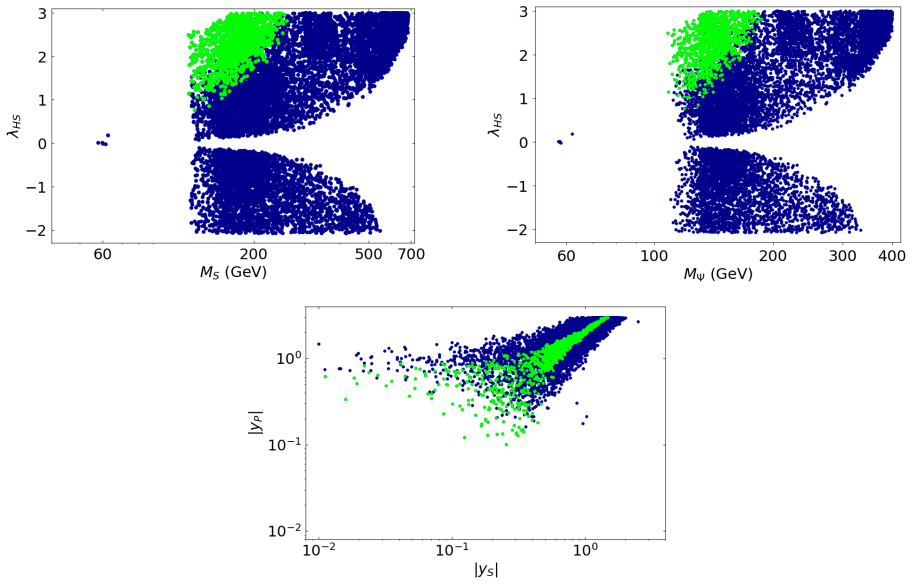
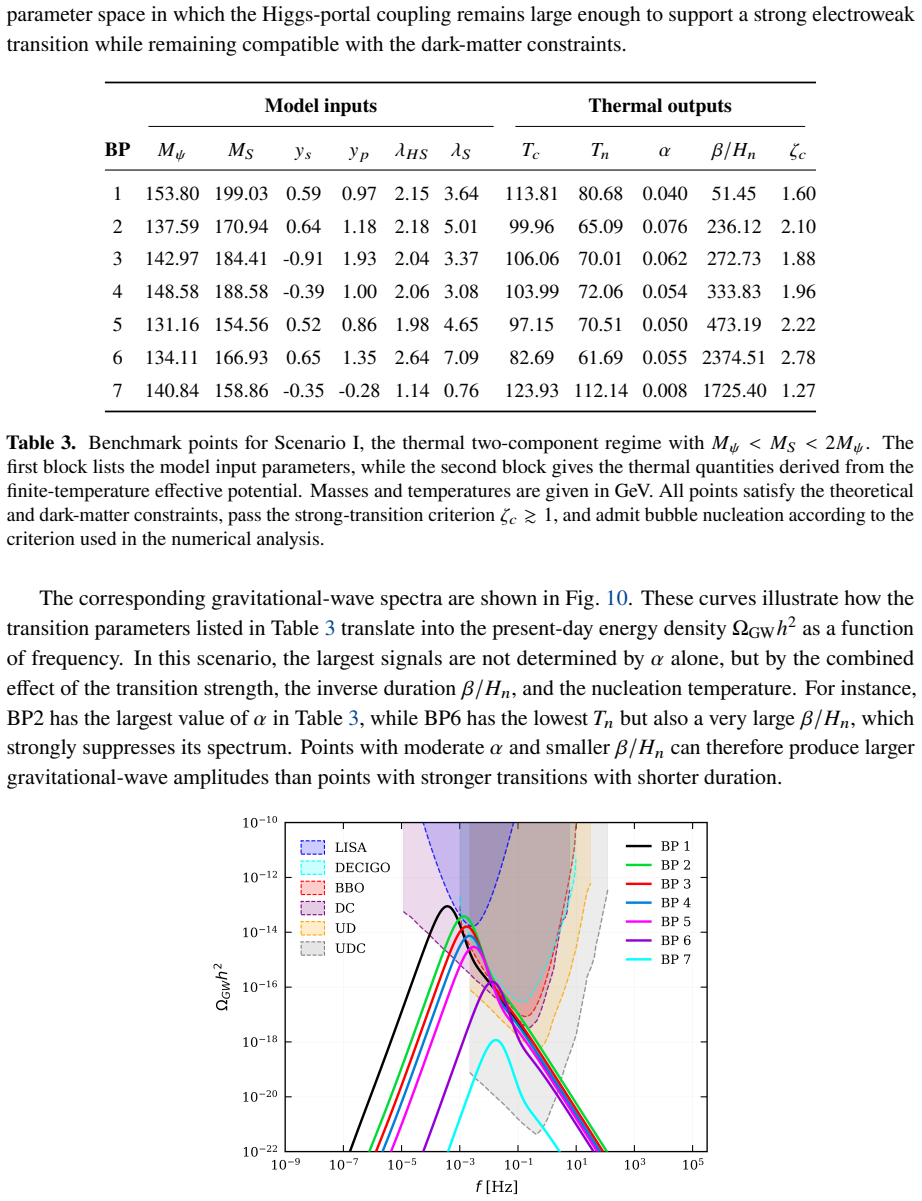
After current dark-matter constraints are imposed, the strong-transition criterion along the Higgs direction is satisfied only in two viable regimes: the thermal two-component case with M_ψ < M_S < 2M_ψ and the decay-driven WIMP-FIMP case with M_S > 2M_ψ. The successful transitions typically proceed through an intermediate singlet-like phase. For representative nucleating benchmark points, gravitational-wave spectra from sound waves and turbulence are computed, with some entering the projected reach of future space-based interferometers.
What carries the argument
Finite-temperature effective potential along the Higgs direction together with the nucleation criterion for strong first-order transitions, applied only to points that already satisfy all dark matter and theoretical bounds.
If this is right
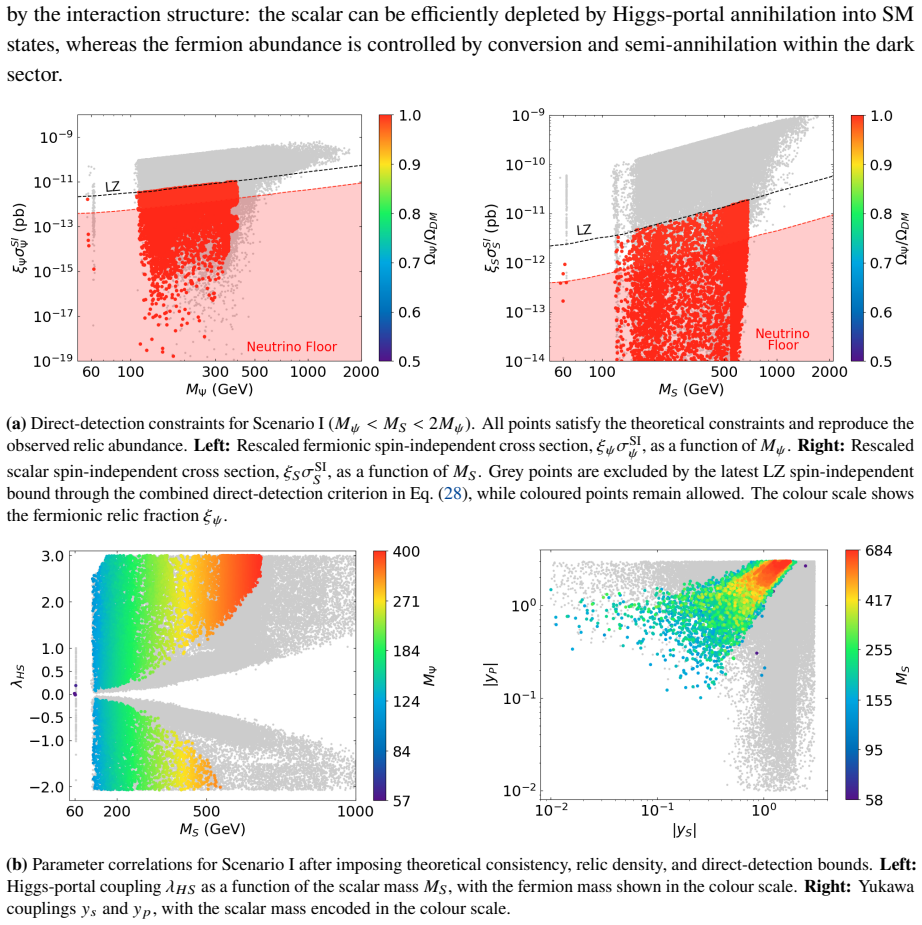
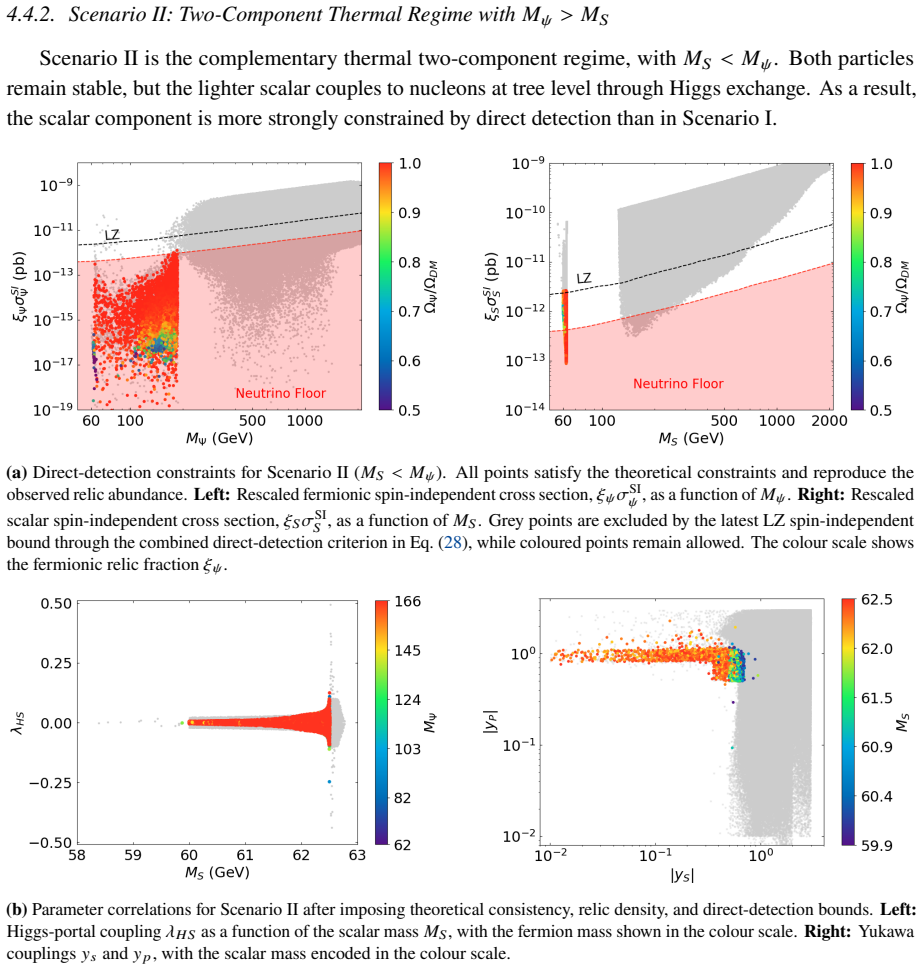
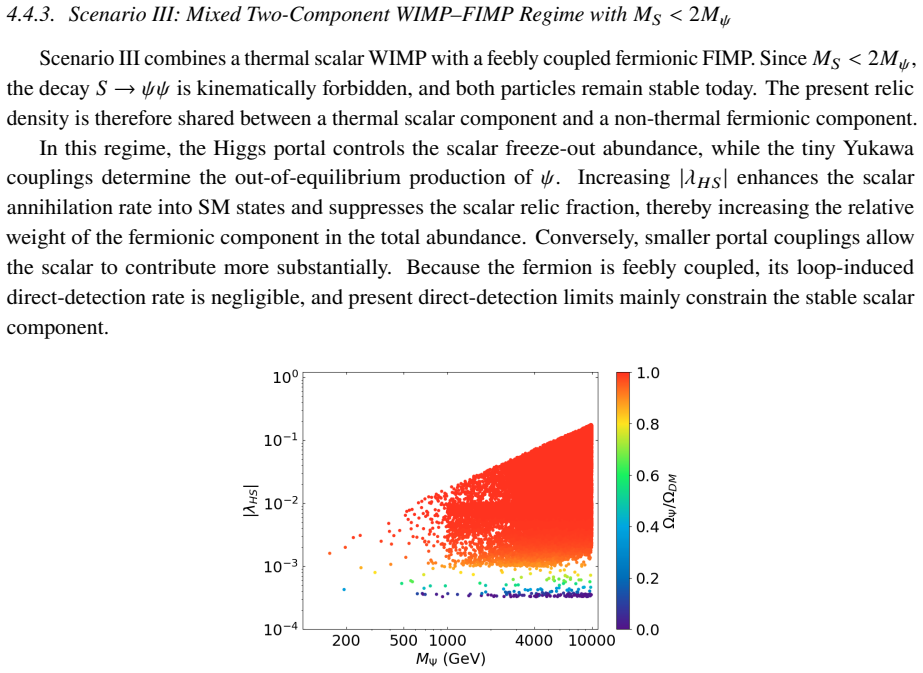
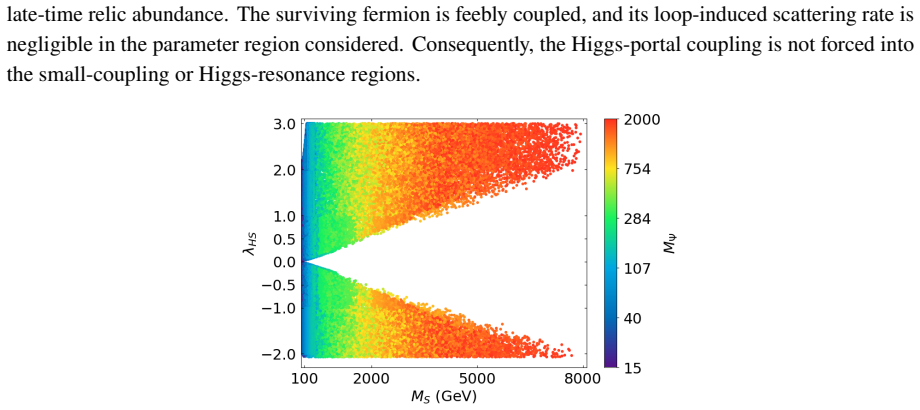
- The thermal regime with M_S < M_ψ and the stable mixed WIMP-FIMP scenario with M_S < 2M_ψ largely fail to produce strong transitions.
- Successful points require a sufficiently active Higgs portal in combination with the scalar mass and remaining dark sector parameters.
- Gravitational wave spectra computed for benchmark points in the viable regions arise from sound waves and turbulence.
- Detectable signals appear only in selected dark-matter-compatible regions.
- The model accommodates thermal two-component dark matter, mixed WIMP-FIMP histories, and an effectively fermionic relic abundance generated by scalar decays.
Where Pith is reading between the lines
- The sharp selectivity after dark matter cuts implies that similar singlet-fermion extensions will face comparable restrictions when both requirements are imposed simultaneously.
- Future gravitational wave detectors could provide an independent test that further narrows or eliminates the two surviving regimes.
- The need for an intermediate singlet phase may recur in other models that add a real scalar to the Standard Model.
- The correlation between an active Higgs portal and the scalar mass could be probed by combining collider measurements with relic density data.
Load-bearing premise
The finite-temperature effective potential calculation and the nucleation criterion used to identify a strong first-order transition are reliable for the scanned parameter space.
What would settle it
A computation of the effective potential for the identified mass regimes that shows either no barrier or a transition strength below the nucleation threshold would falsify the claim that these regimes support strong transitions.
Figures



read the original abstract
We investigate whether a minimal $\mathbb{Z}_4$-symmetric fermion-scalar extension of the Standard Model can simultaneously realise viable dark matter, a strong electroweak phase transition, and a stochastic gravitational-wave signal. The model contains a real scalar singlet and a Dirac fermion, allowing thermal two-component dark matter, mixed WIMP-FIMP histories, and an effectively fermionic relic abundance generated by scalar decays. We impose theoretical consistency, the correct electroweak vacuum, and dark-matter constraints from relic density, direct detection, and invisible Higgs decays before using the surviving points as input for the finite-temperature analysis. This reveals that the compatibility between dark matter and a strong first-order electroweak phase transition is highly selective. After current dark-matter constraints are imposed, the strong-transition criterion along the Higgs direction is satisfied only in two viable regimes: the thermal two-component case with $M_\psi<M_S<2M_\psi$ and the decay-driven WIMP-FIMP case with $M_S>2M_\psi$. By contrast, the thermal regime with $M_S<M_\psi$ and the stable mixed WIMP-FIMP scenario with $M_S<2M_\psi$ are largely concentrated at small portal couplings or near the Higgs-resonance region, and do not yield a strong transition in the parameter space considered. The successful transitions typically proceed through an intermediate singlet-like phase. For representative nucleating benchmark points in the viable strong-transition regions, we compute the gravitational-wave spectra from sound waves and turbulence. Some spectra enter the projected reach of future space-based interferometers, showing that detectable signals arise only in selected dark-matter-compatible regions where a sufficiently active Higgs portal appears in correlated combination with the scalar mass and the remaining dark sector parameters.
Editorial analysis
A structured set of objections, weighed in public.
Referee Report
Summary. The paper studies a minimal Z_4-symmetric SM extension containing a real scalar singlet S and a Dirac fermion ψ. It imposes theoretical consistency, correct electroweak vacuum, and dark-matter constraints (relic density, direct detection, invisible Higgs decays) on the parameters (M_ψ, M_S, portal couplings), then performs a finite-temperature analysis on the surviving points. The central claim is that a strong first-order electroweak phase transition (FOPT) along the Higgs direction occurs only in two regimes: the thermal two-component case with M_ψ < M_S < 2M_ψ and the decay-driven WIMP-FIMP case with M_S > 2M_ψ. Successful transitions typically proceed via an intermediate singlet-like vacuum; gravitational-wave spectra from sound waves and turbulence are computed for benchmark points in these regimes, with some entering the projected sensitivity of future interferometers.
Significance. If the finite-temperature results hold, the work establishes a concrete selectivity: after current DM constraints, strong FOPT is viable only in two narrow regimes of this Z_4 model, while other DM-compatible regions (M_S < M_ψ thermal and stable mixed WIMP-FIMP with M_S < 2M_ψ) do not produce strong transitions. The explicit mapping of viable points to GW spectra provides falsifiable predictions for space-based detectors and illustrates how DM requirements can restrict the parameter space available for detectable gravitational waves.
major comments (3)
- [§4] §4 (finite-temperature effective potential): the manuscript does not specify the explicit one-loop form (tree-level + Coleman-Weinberg + thermal integrals) or the daisy-resummation scheme (Parwani vs. Arnold-Espinosa) used for the thermal masses; without this, it is impossible to verify whether the reported selectivity of the two regimes survives changes in the resummation prescription or the treatment of the multi-field potential when an intermediate singlet-like vacuum appears.
- [§5] §5 (nucleation criterion): the definition of 'strong' transition is not stated (e.g., v_c/T_c > 1 at the critical temperature versus S_3/T ≈ 140 at the nucleation temperature); the central claim that only the two cited regimes survive therefore rests on an unspecified numerical threshold whose variation could alter the viability map.
- [Table 2 / Figure 5] Table 2 / Figure 5 (benchmark points): the reported GW spectra are computed only for points already selected by the unspecified FOPT criterion; no scan-variation or error-band analysis is shown to demonstrate that the 'highly selective' conclusion is robust against reasonable changes in the thermal-potential implementation.
minor comments (3)
- [§2] Notation for the portal couplings λ_HS and λ_ψS is introduced without an explicit Lagrangian term in the model-definition section.
- [Figure 3] The caption of Figure 3 does not indicate whether the plotted points include the full thermal history or only the zero-temperature relic-density slice.
- [§5] A reference to the numerical package or custom code used for the multi-field minimization and bounce-action calculation is missing.
Simulated Author's Rebuttal
We thank the referee for the careful reading and constructive comments, which help improve the clarity and technical transparency of the manuscript. We address each major comment point-by-point below and will revise the text to incorporate the requested details.
read point-by-point responses
-
Referee: [§4] §4 (finite-temperature effective potential): the manuscript does not specify the explicit one-loop form (tree-level + Coleman-Weinberg + thermal integrals) or the daisy-resummation scheme (Parwani vs. Arnold-Espinosa) used for the thermal masses; without this, it is impossible to verify whether the reported selectivity of the two regimes survives changes in the resummation prescription or the treatment of the multi-field potential when an intermediate singlet-like vacuum appears.
Authors: We agree that the explicit implementation details were omitted. The effective potential follows the standard one-loop form with Coleman-Weinberg corrections and thermal integrals evaluated via the high-temperature expansion; daisy resummation is performed in the Parwani scheme for the thermal masses of the Higgs and singlet fields. The multi-field potential is minimized numerically along the Higgs direction after accounting for the intermediate singlet vacuum. We will add a dedicated subsection (or appendix) with the explicit expressions for V_eff, the thermal mass corrections, and the resummation prescription. While a full cross-check against the Arnold-Espinosa scheme lies outside the present scope, the selectivity is driven primarily by the interplay of tree-level barriers, DM relic constraints, and the requirement of a sufficiently deep electroweak minimum; we will note this limitation explicitly. revision: yes
-
Referee: [§5] §5 (nucleation criterion): the definition of 'strong' transition is not stated (e.g., v_c/T_c > 1 at the critical temperature versus S_3/T ≈ 140 at the nucleation temperature); the central claim that only the two cited regimes survive therefore rests on an unspecified numerical threshold whose variation could alter the viability map.
Authors: The strong-transition criterion is the standard nucleation condition S_3(T_n)/T_n ≈ 140, where T_n is determined by solving the bounce equation for the three-dimensional Euclidean action; v_c/T_c > 1 is used only as a preliminary filter at the critical temperature. We will state this definition explicitly in §5, including the numerical procedure for locating T_n and the bounce action, and will clarify that the final viability map is based on the nucleation threshold rather than the critical-temperature ratio alone. revision: yes
-
Referee: [Table 2 / Figure 5] Table 2 / Figure 5 (benchmark points): the reported GW spectra are computed only for points already selected by the unspecified FOPT criterion; no scan-variation or error-band analysis is shown to demonstrate that the 'highly selective' conclusion is robust against reasonable changes in the thermal-potential implementation.
Authors: The benchmark points are representative nucleating solutions drawn from the two viable regimes after all DM and theoretical constraints. We acknowledge that a systematic variation over resummation schemes or a full error-band scan would strengthen the robustness claim. We will expand the discussion around Table 2 and Figure 5 to emphasize that the GW spectra are illustrative and to note the dependence on the chosen potential implementation; a comprehensive parameter-variation study is beyond the scope of the present work but could be addressed in follow-up analyses. revision: partial
Circularity Check
No circularity; DM constraints applied first, PT checked sequentially on survivors
full rationale
The derivation applies relic-density, direct-detection and invisible-Higgs constraints first, then feeds only the surviving points into the finite-temperature analysis. No equation equates a derived quantity to its own input by construction, no parameter is fitted to a subset and then relabeled a prediction, and no load-bearing premise rests on a self-citation whose content is itself unverified. The reported selectivity (strong FOPT only for M_ψ < M_S < 2M_ψ and M_S > 2M_ψ) is therefore an output of independent external constraints rather than a definitional or self-referential step. The paper is self-contained against external benchmarks for the purpose of this circularity check.
Axiom & Free-Parameter Ledger
free parameters (1)
- M_ψ, M_S and portal couplings
axioms (1)
- domain assumption Z4 symmetry protects the dark matter candidates from decay
invented entities (1)
-
Z4-protected scalar singlet and Dirac fermion
no independent evidence
Reference graph
Works this paper leans on
-
[1]
Planck 2018 results. VI. Cosmological parameters
N. Aghanim et al. “Planck 2018 results. VI. Cosmological parameters”.Astron. Astrophys.641 (2020), A6.doi:10.1051/0004-6361/201833910. arXiv:1807.06209 [astro-ph.CO]
work page internal anchor Pith review Pith/arXiv arXiv doi:10.1051/0004-6361/201833910 2018
-
[2]
David E. Morrissey and Michael J. Ramsey-Musolf. “Electroweak baryogenesis”.New J. Phys.14 (2012), p. 125003.doi:10.1088/1367-2630/14/12/125003. arXiv:1206.2942 [hep-ph]
work page internal anchor Pith review Pith/arXiv arXiv doi:10.1088/1367-2630/14/12/125003 2012
-
[3]
Mariano Quiros.Finite temperature field theory and phase transitions. 1999. arXiv:hep- ph/ 9901312 [hep-ph]
1999
-
[4]
Review of cosmic phase transitions: their significance and signatures
Anupam Mazumdar and Graham White. “Review of cosmic phase transitions: their significance and signatures”.Rept. Prog. Phys.82(July 2019), p. 076901.doi:10.1088/1361-6633/ab1f55. arXiv:1811.01948 [hep-ph]
-
[5]
Detecting gravitational waves from cosmological phase transitions with LISA: an update
Chiara Caprini et al. “Detecting gravitational waves from cosmological phase transitions with LISA: an update”.JCAP03(2020), p. 024.doi:10.1088/1475-7516/2020/03/024 . arXiv: 1910.13125 [astro-ph.CO]
work page internal anchor Pith review Pith/arXiv arXiv doi:10.1088/1475-7516/2020/03/024 2020
-
[6]
Pau Amaro-Seoane et al.Laser Interferometer Space Antenna. 2017. arXiv: 1702 . 00786 [astro-ph.IM]
2017
-
[7]
Current status of space gravitational wave antenna DECIGO and B-DECIGO
Seiji Kawamura et al. “Current status of space gravitational wave antenna DECIGO and B- DECIGO”.Prog. Theor. Exp. Phys.2021, 5 (2021), 05A105.doi:10.1093/ptep/ptab019 . arXiv:2006.13545 [gr-qc]
work page internal anchor Pith review Pith/arXiv arXiv doi:10.1093/ptep/ptab019 2021
-
[8]
Beyond LISA: Exploring Future Gravitational Wave Missions
Jeff Crowder and Neil J. Cornish. “Beyond LISA: Exploring future gravitational wave missions”. Phys.Rev.D72(2005),p.083005.doi: 10.1103/PhysRevD.72.083005.arXiv: gr-qc/0506015
work page internal anchor Pith review Pith/arXiv arXiv doi:10.1103/physrevd.72.083005.arxiv: 2005
-
[9]
New Sensitivity Curves for Gravitational-Wave Signals from Cosmological Phase Transitions
Kai Schmitz. “New sensitivity curves for gravitational-wave signals from cosmological phase transitions”.JHEP01(2021), p. 097.doi: 10.1007/JHEP01(2021)097 . arXiv:2002.04615 [hep-ph]
work page internal anchor Pith review Pith/arXiv arXiv doi:10.1007/jhep01(2021)097 2021
-
[10]
Complex Scalar Singlet Dark Matter: Vacuum Stability and Phenomenology
Matthew Gonderinger, Hyungjun Lim, and Michael J. Ramsey-Musolf. “Complex scalar singlet dark matter: Vacuum stability and phenomenology”.Phys. Rev. D86(Aug. 2012), p. 043511.doi: 10.1103/PhysRevD.86.043511. arXiv:1202.1316 [hep-ph]. 34
work page internal anchor Pith review Pith/arXiv arXiv doi:10.1103/physrevd.86.043511 2012
-
[11]
Update on scalar singlet dark matter
James M. Cline, Kimmo Kainulainen, Pat Scott, and Christoph Weniger. “Update on scalar singlet dark matter”.Phys. Rev. D88(2013). [Erratum: Phys. Rev. D 92, 039906 (2015)], p. 055025.doi: 10.1103/PhysRevD.88.055025. arXiv:1306.4710 [hep-ph]
work page internal anchor Pith review Pith/arXiv arXiv doi:10.1103/physrevd.88.055025 2013
-
[12]
P. Athron, C. Balázs, T. Bringmann, A. Buckley, M. Chrzaszcz, J. Conrad, et al. “Status of the scalar singlet dark matter model”.Eur. Phys. J. C77(2017), p. 568.doi:10.1140/epjc/s10052- 017-5113-1. arXiv:1705.07931 [hep-ph]
-
[13]
Revisiting electroweak phase transition in the standard model with a real singlet scalar
Cheng-Wei Chiang, Yen-Ting Li, and Eibun Senaha. “Revisiting electroweak phase transition in the standard model with a real singlet scalar”.Phys. Lett. B789(2019), pp. 154–159.doi: 10.1016/j.physletb.2018.12.017. arXiv:1808.01098 [hep-ph]
work page internal anchor Pith review Pith/arXiv arXiv doi:10.1016/j.physletb.2018.12.017 2019
-
[14]
Electroweakbaryogenesisandgravitationalwavesfromarealscalarsinglet
VilleVaskonen.“Electroweakbaryogenesisandgravitationalwavesfromarealscalarsinglet”.Phys. Rev. D95, 12 (2017), p. 123515.doi:10.1103/PhysRevD.95.123515 . arXiv:1611.02073 [hep-ph]
-
[15]
V. K. Oikonomou and Apostolos Giovanakis. “Electroweak phase transition in singlet extensions of the standard model with dimension-six operators”.Phys. Rev. D109, 5 (2024), p. 055044.doi: 10.1103/PhysRevD.109.055044. arXiv:2403.01591 [hep-ph]
-
[16]
Semi-annihilation of Dark Matter
Francesco D’Eramo and Jesse Thaler. “Semi-annihilation of Dark Matter”.JHEP06(2010), p. 109. doi:10.1007/JHEP06(2010)109. arXiv:1003.5912 [hep-ph]
work page internal anchor Pith review Pith/arXiv arXiv doi:10.1007/jhep06(2010)109 2010
-
[17]
Freeze-In Production of FIMP Dark Matter
Lawrence J. Hall, Karsten Jedamzik, John March-Russell, and Stephen M. West. “Freeze-in production of FIMP dark matter”.JHEP03(2010), p. 080.doi:10.1007/JHEP03(2010)080. arXiv:0911.1120 [hep-ph]
work page internal anchor Pith review Pith/arXiv arXiv doi:10.1007/jhep03(2010)080 2010
-
[18]
SuperWIMP Dark Matter Signals from the Early Universe
Jonathan L. Feng, Arvind Rajaraman, and Fumihiro Takayama. “Superweakly interacting massive particle dark matter signals from the early Universe”.Phys. Rev. D68(2003), p. 063504.doi: 10.1103/PhysRevD.68.063504. arXiv:hep-ph/0306024
work page internal anchor Pith review Pith/arXiv arXiv doi:10.1103/physrevd.68.063504 2003
-
[19]
Superweakly Interacting Massive Particles
Jonathan L. Feng, Arvind Rajaraman, and Fumihiro Takayama. “Superweakly Interacting Massive Particles”.Phys.Rev.Lett.91(2003),p.011302.doi: 10.1103/PhysRevLett.91.011302.arXiv: hep-ph/0302215
work page internal anchor Pith review Pith/arXiv arXiv doi:10.1103/physrevlett.91.011302.arxiv: 2003
-
[20]
Fermion and scalar two-component dark matter from a𝑍4 symmetry
Carlos E. Yaguna and Óscar Zapata. “Fermion and scalar two-component dark matter from a𝑍4 symmetry”.Phys. Rev. D105(May 2022), p. 095026.doi:10.1103/PhysRevD.105.095026. arXiv:2112.07020 [hep-ph]
-
[21]
Minimal model of fermion FIMP dark matter
Carlos E. Yaguna and Óscar Zapata. “Minimal model of fermion FIMP dark matter”.Phys. Rev. D109(Jan. 2024), p. 015002.doi: 10.1103/PhysRevD.109.015002 . arXiv: 2308.05249 [hep-ph]
-
[22]
Theoretical and experimental constraints onZ2𝑛 multi-component dark matter models
J. P. Carvalho-Corrêa, I. M. Pereira, B. L. Sánchez-Vega, and A. C. D. Viglioni. “Theoretical and experimental constraints onZ2𝑛 multi-component dark matter models”.Eur. Phys. J. C85(2025), p. 1353.doi:10.1140/epjc/s10052-025-15042-8. arXiv:2502.19489
-
[23]
Dark Matter Search Results from 4.2 Tonne-Years of Exposure of the LUX-ZEPLIN (LZ) Experiment
LZ Collaboration. “Dark Matter Search Results from 4.2 Tonne-Years of Exposure of the LUX- ZEPLIN (LZ) Experiment”.Phys. Rev. Lett.135(2025), p. 011802.doi:10.1103/4dyc-z8zf. arXiv:2410.17036 [hep-ex]
work page internal anchor Pith review Pith/arXiv arXiv doi:10.1103/4dyc-z8zf 2025
-
[24]
Vacuum Stability Conditions From Copositivity Criteria
Kristjan Kannike. “Vacuum stability conditions from copositivity criteria”.Eur. Phys. J. C72 (2012), p. 2093.doi:10.1140/epjc/s10052-012-2093-z. arXiv:1205.3781 [hep-ph]
work page internal anchor Pith review Pith/arXiv arXiv doi:10.1140/epjc/s10052-012-2093-z 2012
-
[25]
Weak interactions at very high energies: The role of the Higgs-boson mass
Benjamin W. Lee, C. Quigg, and H. B. Thacker. “Weak interactions at very high energies: The role of the Higgs-boson mass”.Phys. Rev. D16(1977), p. 1519.doi:10.1103/PhysRevD.16.1519. 35
-
[26]
Strength of Weak Interactions at Very High- Energies and the Higgs Boson Mass
Benjamin W. Lee, C. Quigg, and H. B. Thacker. “Strength of Weak Interactions at Very High- Energies and the Higgs Boson Mass”.Phys. Rev. Lett.38(1977), pp. 883–885.doi:10.1103/ PhysRevLett.38.883
1977
-
[27]
Logan.Lectures on perturbative unitarity and decoupling in Higgs physics
Heather E. Logan.Lectures on perturbative unitarity and decoupling in Higgs physics. July 2022. arXiv:2207.01064 [hep-ph]
arXiv 2022
-
[28]
Unitarity constraints on general scalar couplings with SARAH
M. D. Goodsell and F. Staub. “Unitarity constraints on general scalar couplings with SARAH”.Eur. Phys. J. C78, 8 (2018), p. 649.doi:10.1140/epjc/s10052-018-6127-z. arXiv:1805.07306
work page internal anchor Pith review Pith/arXiv arXiv doi:10.1140/epjc/s10052-018-6127-z 2018
-
[29]
micrOMEGAs 6.0: N-component dark matter
G. Alguero, G. Belanger, F. Boudjema, S. Chakraborti, A. Goudelis, S. Kraml, A. Mjallal, and A. Pukhov. “micrOMEGAs 6.0: N-component dark matter”.Comput. Phys. Commun.299(2024), p. 109133.doi:10.1016/j.cpc.2024.109133. arXiv:2312.14894 [hep-ph]
-
[30]
ATLAS Collaboration. “Combination of searches for invisible decays of the Higgs boson using 139 fb−1 of proton-proton collision data at√𝑠=13 TeV collected with the ATLAS experiment”.Phys. Lett. B842(2023), p. 137963.doi:10.1016/j.physletb.2023.137963. arXiv:2301.10731
-
[31]
Dark Matter
Particle Data Group.Review of Particle Physics: Dark Matter. PDG Review. See PDG review “Dark Matter”. 2023
2023
-
[32]
How arbitrary are perturbative calculations of the electroweak phase transition?
Peter Athron, Csaba Balazs, Andrew Fowlie, Lachlan Morris, Graham White, and Yang Zhang. “How arbitrary are perturbative calculations of the electroweak phase transition?”JHEP01(2023), p. 050.doi:10.1007/JHEP01(2023)050. arXiv:2208.01319 [hep-ph]
-
[33]
Theo- retical uncertainties for cosmological first-order phase transitions
Djuna Croon, Oliver Gould, Philipp Schicho, Tuomas V. I. Tenkanen, and Graham White. “Theo- retical uncertainties for cosmological first-order phase transitions”.JHEP04(2021), p. 055.doi: 10.1007/JHEP04(2021)055. arXiv:2009.10080 [hep-ph]
-
[34]
Oliver Gould and Tuomas V. I. Tenkanen. “On the perturbative expansion at high temperature and implications for cosmological phase transitions”.JHEP06(2021), p. 069.doi:10.1007/ JHEP06(2021)069. arXiv:2104.04399 [hep-ph]
arXiv 2021
-
[35]
Resummation in a Hot Scalar Field Theory
Rajesh R. Parwani. “Resummation in a hot scalar field theory”.Phys. Rev. D45(1992), pp. 4695– 4705.doi:10.1103/PhysRevD.45.4695. arXiv:hep-ph/9204216 [hep-ph]
work page internal anchor Pith review Pith/arXiv arXiv doi:10.1103/physrevd.45.4695 1992
-
[36]
Symmetry Restoration and Breaking at Finite Temperature: An Introductory Review
Eibun Senaha. “Symmetry Restoration and Breaking at Finite Temperature: An Introductory Review”.Symmetry12, 5 (2020), p. 733.doi:10.3390/sym12050733
-
[37]
Self consistent thermal resummation: a case studyofthephasetransitionin2HDM
Pedro Bittar, Subhojit Roy, and Carlos E. M. Wagner. “Self consistent thermal resummation: a case studyofthephasetransitionin2HDM”.JHEP12(2025),p.021.doi: 10.1007/JHEP12(2025)021. arXiv:2504.02024 [hep-ph]
-
[38]
Baryon Washout, Electroweak Phase Transition, and Perturbation Theory
Hiren H. Patel and Michael J. Ramsey-Musolf. “Baryon washout, electroweak phase transition, and perturbation theory”.JHEP07(2011), p. 029.doi: 10.1007/JHEP07(2011)029 . arXiv: 1101.4665 [hep-ph]
work page internal anchor Pith review Pith/arXiv arXiv doi:10.1007/jhep07(2011)029 2011
-
[39]
What is the Criterion for a Strong First Order Electroweak Phase Transition in Singlet Models?
Amine Ahriche. “What is the criterion for a strong first order electroweak phase transition in singlet models?”Phys. Rev. D75(8 2007), p. 083522.doi:10.1103/PhysRevD.75.083522 . arXiv: hep-ph/0701192 [hep-ph]
work page internal anchor Pith review Pith/arXiv arXiv doi:10.1103/physrevd.75.083522 2007
-
[40]
Singlet Higgs Phenomenology and the Electroweak Phase Transition
StefanoProfumo,MichaelJRamsey-Musolf,andGabeShaughnessy.“SingletHiggsphenomenology and the electroweak phase transition”.JHEP2007, 08 (2007), pp. 010–010.doi:10.1088/1126- 6708/2007/08/010. arXiv:0705.2425 [hep-ph]. 36
work page internal anchor Pith review Pith/arXiv arXiv doi:10.1088/1126- 2007
-
[41]
PhaseTracer2: from the effective potential to gravitational waves
Peter Athron, Csaba Balázs, Andrew Fowlie, Lachlan Morris, William Searle, Yang Xiao, and Yang Zhang. “PhaseTracer2: from the effective potential to gravitational waves”.Eur. Phys. J. C85, 5 (2025), p. 559.doi: 10 . 1140 / epjc / s10052 - 025 - 14258 - y. arXiv: 2412 . 04881 [astro-ph.CO]
2025
-
[42]
Fate of the false vacuum: Semiclassical theory
Sidney R. Coleman. “Fate of the false vacuum: Semiclassical theory”.Phys. Rev. D15(1977). [Erratum: Phys. Rev. D 16, 1248 (1977)], pp. 2929–2936.doi:10.1103/PhysRevD.15.2929
-
[43]
Fate of the false vacuum. II. First quantum corrections
Curtis G. Callan and Sidney R. Coleman. “Fate of the false vacuum. II. First quantum corrections”. Phys. Rev. D16(1977), pp. 1762–1768.doi:10.1103/PhysRevD.16.1762
-
[44]
Decay of the false vacuum at finite temperature
Andrei D. Linde. “Decay of the false vacuum at finite temperature”.Nucl. Phys. B216(1983). [Erratum: Nucl. Phys. B 223, 544 (1983)], p. 421.doi:10.1016/0550-3213(83)90072-X
-
[45]
Fate of the false vacuum at finite temperature: Theory and applications
Andrei D. Linde. “Fate of the false vacuum at finite temperature: Theory and applications”.Phys. Lett. B100(1981), pp. 37–40.doi:10.1016/0370-2693(81)90281-1
-
[46]
Cosmological phase transitions from the functional measure
Bruno Berganholi, Gláuber C. Dorsch, Iberê Kuntz, Beatriz M. D. Sena, and Giovanna F. do Valle. “Cosmological phase transitions from the functional measure”.JHEP07(2025), p. 129.doi: 10.1007/JHEP07(2025)129. arXiv:2502.09593 [hep-ph]
-
[47]
How fast can the wall move? A study of the electroweak phase transition dynamics
GuyD.MooreandTomislavProkopec.“Howfastcanthewallmove?Astudyoftheelectroweakphase transitiondynamics”.Phys.Rev.D52(1995),pp.7182–7204.doi: 10.1103/PhysRevD.52.7182. arXiv:hep-ph/9506475
work page internal anchor Pith review Pith/arXiv arXiv doi:10.1103/physrevd.52.7182 1995
-
[48]
Bubble wall dynamics at the electroweak phase transition
Stefania De Curtis, Luigi Delle Rose, Andrea Guiggiani, Ángel Gil Muyor, and Giuliano Panico. “Bubble wall dynamics at the electroweak phase transition”.JHEP03(2022), p. 163.doi: 10.1007/JHEP03(2022)163. arXiv:2201.08220 [hep-ph]
-
[49]
Supercool subtleties of cosmological phase transitions
Peter Athron, Csaba Balázs, and Lachlan Morris. “Supercool subtleties of cosmological phase transitions”.JCAP03(2023), p. 006.doi: 10 . 1088 / 1475 - 7516 / 2023 / 03 / 006. arXiv: 2212.07559 [hep-ph]
arXiv 2023
-
[50]
Xiao Wang, Fa Peng Huang, and Xinmin Zhang. “Phase transition dynamics and gravitational wave spectra of strong first-order phase transition in supercooled universe”.JCAP05(2020), p. 045.doi: 10.1088/1475-7516/2020/05/045. arXiv:2003.08892 [hep-ph]
-
[51]
Di-Higgs production in the 4b channel and gravitational wave complementarity
Alexandre Alves, Dorival Gonçalves, Tathagata Ghosh, Huai-Ke Guo, and Kuver Sinha. “Di-Higgs production in the 4b channel and gravitational wave complementarity”.JHEP2020, 3 (2020), p. 53. doi:10.1007/JHEP03(2020)053. arXiv:1909.05268v2 [hep-ph]
-
[52]
Detector configuration of DECIGO/BBO and identification of cosmological neutron-star binaries
Kent Yagi and Naoki Seto. “Detector configuration of DECIGO/BBO and identification of cosmological neutron-star binaries”.Phys. Rev. D83(2011), p. 044011.doi:10.1103/PhysRevD. 83.044011. arXiv:1101.3940 [astro-ph.CO]
work page internal anchor Pith review Pith/arXiv arXiv doi:10.1103/physrevd 2011
-
[53]
Gravitational Wave Background and Non-Gaussianity as a Probe of the Curvaton Scenario
Kazunori Nakayama and Jun’ichi Yokoyama. “Gravitational wave background and non-Gaussianity as a probe of the curvaton scenario”.JCAP01(2010), p. 010.doi:10.1088/1475-7516/2010/ 01/010. arXiv:0910.0715 [astro-ph.CO]
work page internal anchor Pith review Pith/arXiv arXiv doi:10.1088/1475-7516/2010/ 2010
-
[54]
Mark Hindmarsh, Stephan J Huber, Kari Rummukainen, and David J Weir. “Numerical simulations of acoustically generated gravitational waves at a first order phase transition”.Phys. Rev. D92, 12 (2015), p. 123009.doi:10.1103/PhysRevD.92.123009. arXiv:1504.03291 [astro-ph.CO]
work page internal anchor Pith review Pith/arXiv arXiv doi:10.1103/physrevd.92.123009 2015
-
[55]
Mark Hindmarsh, Stephan J Huber, Kari Rummukainen, and David J Weir. “Erratum: Shape of the acoustic gravitational wave power spectrum from a first order phase transition [Phys. Rev. D 96, 103520 (2017)]”.Physical Review D101, 8 (2020), p. 089902.doi:10.1103/PhysRevD.101. 089902. 37
-
[56]
ChiaraCaprini,RuthDurrer,andGeraldineServant.“Thestochasticgravitationalwavebackground from turbulence and magnetic fields generated by a first-order phase transition”.JCAP2009, 12 (2009), pp. 024–024.doi:10.1088/1475-7516/2009/12/024. arXiv:0909.0622 [hep-ph]
work page internal anchor Pith review Pith/arXiv arXiv doi:10.1088/1475-7516/2009/12/024 2009
-
[57]
Pierre Binetruy, Alejandro Bohe, Chiara Caprini, and Jean-Francois Dufaux. “Cosmological backgrounds of gravitational waves and eLISA/NGO: phase transitions, cosmic strings and other sources”.JCAP2012, 06 (2012), pp. 027–027.doi:10.1088/1475-7516/2012/06/027. arXiv: 1201.0983 [gr-qc]
work page internal anchor Pith review Pith/arXiv arXiv doi:10.1088/1475-7516/2012/06/027 2012
-
[58]
Energy budget of cosmological first-order phase transitions
Jose R Espinosa, Thomas Konstandin, Jose M No, and Geraldine Servant. “Energy budget of cosmological first-order phase transitions”.JCAP2010, 06 (2010), pp. 028–028.doi:10.1088/ 1475-7516/2010/06/028. arXiv:1004.4187 [hep-ph]. 38
Pith/arXiv arXiv 2010
discussion (0)
Sign in with ORCID, Apple, or X to comment. Anyone can read and Pith papers without signing in.