REVIEW 2 major objections 6 minor 58 references
Self-Adapted Josephson Oscillation of Dark-Bright Solitons under Constant Forces
T0 review · 2 major / 6 minor · reviewed 2026-08-10 · deepseek-v4-flash
Pith's one-line read Under a constant force, a dark-bright soliton in a two-component Bose-Einstein condensate obeys a Josephson equation whose critical current and voltage adapt to the soliton's own motion, producing skewed nonsinusoidal oscillations.
desk verdict Solid variational result and honest GPE comparisons, but the supplement's explicit Ic and U formulas are internally inconsistent and the oscillation/diffusion boundary needs stronger stability backing. read the letter →
The pith
A machine-rendered reading of the paper's core claim, the machinery that carries it, and where it could break.
The reading
What carries the argument
The central object is the self-adapted Josephson equation (SAJE), defined by the pair $I=I_c(\phi)\sin\phi$ and $\dot\phi=U(\phi)N_B$, with $I_c$ and $U$ explicit functions of the phase jump $\phi$ through the soliton width $w(\phi)=\frac{g_{12}N_B+\sqrt{g_{12}^2N_B^2+16g_{22}p^2}}{4g_{22}p^2}$. The mechanism that makes the equations 'self-adapted' is the function $\lambda(\phi)=N_B\dot x_c+\sin\phi$: it couples the barrier motion back into the phase dynamics, so the critical current and voltage change within each period rather than staying constant.
What would settle it
A Bogoliubov–de Gennes linear-stability calculation for the moving bright-soliton barrier, or a Gross–Pitaevskii run seeded with a small density perturbation, would reveal whether an unstable mode grows exactly when $s(t)$ changes sign; a mismatch in that timing would refute the predicted oscillation-diffusion boundary $g_{12}^2=g_{11}g_{22}$.
Extended reading notes
Core claim
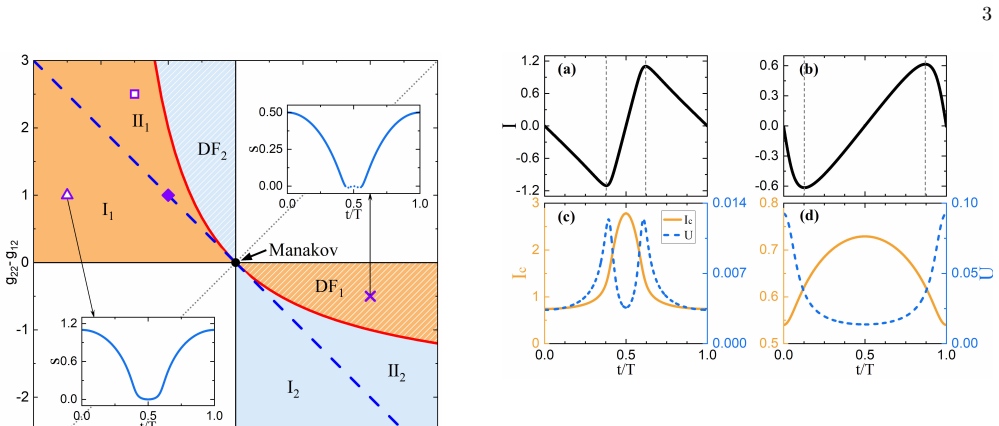
Within the region $(g_{11}-g_{12})(g_{22}-g_{12})<0$, where exact dark-bright soliton solutions exist for arbitrary nonlinear coefficients, the constant-force dynamics is fully captured by the self-adapted Josephson equation $I=I_c(\phi)\sin\phi$, $\dot\phi=U(\phi)N_B$, with $I_c=-2g_{22}/\sqrt{g_{12}^2N_B^2+16g_{22}\sin^2(\phi/2)}$ and $U=-FN_B/(1-d\lambda/d\phi)$. Here $\phi$ is the phase jump of the dark component across the bright-soliton barrier and $\lambda=N_B\dot x_c+\sin\phi$ encodes the back-action of the current on the barrier. The period is $T=|2\pi/(FN_B)|$ for any nonlinearity, but the current waveform is generally skewed; two skew directions define phases I and II, separated by the condition $2g_{12}=g_{11}+g_{22}$. A stability coefficient $s(t)$ built from the effective potential felt by the bright soliton yields the diffusion boundary $g_{12}^2=g_{11}g_{22}$, beyond which the soliton spreads irreversibly instead of oscillating. The same framework gives a periodic dispersion relation whose upper and lower branches correspond to negative and positive inertial mass.
Load-bearing premise
The paper assumes that the bright-soliton barrier stays intact exactly while the effective potential it feels is a valley, and breaks apart the moment that potential becomes a hill; this threshold is not checked with a full stability analysis, and if it is off, the predicted boundary between oscillating and spreading is off.
Editorial extensions
If this is right
- Dark-bright soliton oscillations under a constant force persist across a wide region of nonlinear parameters, not just at the Manakov point or under the special constraint $2g_{12}=g_{11}+g_{22}$.
- The current-phase relation is generally nonsinusoidal: the critical current $I_c(\phi)$ and bias voltage $U(\phi)$ vary within each period, so any experiment measuring the soliton velocity over a full cycle should see a skewed waveform.
- The boundary $g_{12}^2=g_{11}g_{22}$ separates oscillating solitons from diffusing ones; at this boundary the barrier loses stability and the soliton spreads irreversibly instead of returning.
- The periodic dispersion relation means the soliton alternates between positive and negative inertial mass in every cycle, with the negative-mass branch dominating in one oscillation phase and the positive-mass branch in the other.
Reading between the lines
- Beyond the paper: the same self-adapted Josephson form is likely to emerge for any vector soliton whose bright component back-acts on the phase jump, for example in three-component or spinor condensates.
- Beyond the paper: a box-trap experiment with Feshbach-tuned interactions could test the diffusion boundary by simply observing whether a displaced soliton returns or spreads.
- Beyond the paper: since the period is universal, stroboscopic imaging at multiples of $T$ would isolate the interaction-dependent waveform and expose the skew directly.
- Beyond the paper: if a full Bogoliubov analysis invalidates the $s(t)$ criterion, the diffusion boundary would move, but the SAJE equations themselves would still describe the oscillating regime.
Editorial analysis
A structured set of objections, weighed in public.
Referee Report
Summary. The manuscript studies quasi-1D two-component Bose-Einstein condensates with general nonlinear coefficients in the exact-soliton regime (g11-g12)(g22-g12)<0. It derives a 'self-adapted Josephson equation' for a dark-bright soliton under a constant force using a Lagrangian variational ansatz with a common time-dependent width, rewriting the equations of motion as I=Ic(phi)sin(phi) and phi_dot=U(phi)NB with phase-dependent critical current and bias voltage. The paper then builds a dynamical phase diagram in the (g11-g12)-(g22-g12) plane, distinguishing skewed oscillation phases I1,I2,II1,II2 from diffusion phases DF1,DF2, with an analytic boundary g12^2=g11g22, and supports the picture with direct GPE simulations for representative parameter points, including density evolutions and periodic dispersion relations related to positive/negative inertial mass.
Significance. If the derivation and phase diagram are correct, the paper provides a useful general framework for soliton Josephson dynamics beyond the Manakov integrable limit: it gives an explicit current-phase relation, a falsifiable oscillation/diffusion boundary, and a classification of skewed oscillations. The strengths are the transparent variational derivation with no free parameters, the direct comparison with GPE numerics for several representative parameter sets, and the crisp analytic prediction for the diffusion boundary. These features make the paper potentially valuable to the cold-atom and nonlinear-wave communities, provided the explicit formulas and the stability criterion are corrected and justified.
major comments (2)
- [Supplemental Material, Eqs. (27)-(28); main text Eqs. (5)-(6)] The printed closed-form expressions for Ic and U do not follow from the paper's own variational equations. From Supplement Eq. (21), I=-xc_dot=2g22 sin(phi)/(g12 NB + sqrt(g12^2 NB^2 + 16 g22 sin^2(phi/2))), so the coefficient Ic(phi) is +2g22/(g12 NB + sqrt(...)), not -2g22/sqrt(...). The supplement's expression has the wrong sign for the coefficient and omits the g12 NB term in the denominator; for the triangle parameters used in Fig. 2 at phi=-pi/2, the correct value is Ic≈+0.984 while the printed formula gives ≈-1.196. Similarly, main-text Eq. (6) defines phi_dot ≡ U(phi) NB with phi_dot=-F NB/(1-dlambda/dphi), so U(phi)=-F/(1-dlambda/dphi), whereas the supplement states U(phi)=-F NB/(1-dlambda/dphi), an extra factor NB. These explicit formulas are advertised as central results, so they must be corrected and the main text and supplement must use the same convention.
- [Supplemental Material, Eqs. (29)-(30); Fig. 1] The oscillation/diffusion phase boundary rests entirely on the local criterion s(t)=g12 sin^2(phi/2)-g11 NB/(2w), with instability declared when s(t)<0, i.e., when the interaction-induced potential at the bright-soliton center changes from a dip into a hump. No Bogoliubov or other linear stability analysis of the moving bright-soliton barrier is provided, and it is not self-evident that the sign of this local potential coefficient is equivalent to dynamical stability for a localized mode in a time-dependent background. Because the diffusion regions and the analytic boundary g12^2=g11g22 are headline results, this criterion needs direct support, for example a Bogoliubov spectrum analysis of the variational background or systematic GPE scans along the boundary rather than only four representative points.
minor comments (6)
- [Fig. 5 caption] The caption says 'g2 = 4.5' but should read 'g22 = 4.5'.
- [Various places] There are typos: 'Unpon' in the Note added should be 'Upon', 'evlolve' in the Conclusion should be 'evolve', 'soiton' in the Fig. 4 caption should be 'soliton', 'Makanov' should be 'Manakov' in the phase-diagram discussion, and 'consisting with' in the Note added should be 'consistent with'.
- [Dynamical phase diagram section] The statement that 'the Makanov point locates on the phase boundary, which does not support soliton oscillation' is surprising because dark-bright solitons are known to exist at the Manakov point; please clarify in what precise sense the Manakov point does not support the oscillation described here.
- [Main text, Eqs. (5)-(6) and abstract] The abstract and introduction say that explicit analytic expressions for Ic and U are derived, but the main text only defines them through the implicit factor lambda(phi); the explicit closed forms appear only in the supplement. Please either display the explicit forms in the main text or adjust the wording so the reader knows where the formulas are.
- [GPE numerics] The paper does not report numerical details for the GPE simulations, such as grid spacing, time step, or checks of particle-number conservation and convergence. A sentence in the supplement would strengthen the numerical evidence.
- [Introduction and Fig. 3] The claim that the dynamics is 'fully captured' by the SAJE is stronger than what Fig. 3(b) and 3(d) show, where the authors themselves note profile deformation, particle loss, and drift; the wording should be qualified to 'captured while the sech/tanh ansatz and the stable-barrier condition hold'.
Circularity Check
No material circularity: the SAJE form is a definitional repackaging of the variational equations, but the explicit coefficients, phase diagram, and GPE comparisons carry independent content. Printed closed-form typos are a correctness issue, not circularity.
-
self definitional
[Main text Eqs. (5)-(6); cf. Supplement Eqs. (27)-(28)]
"I = [1/NB − λ(ϕ)/(NB sin(ϕ))] sin(ϕ) ≡ Ic(ϕ) sin(ϕ), (5) ˙ϕ = −F NB/(1−dλ(ϕ)/dϕ) ≡ U(ϕ)NB, (6). The implicit factor λ(ϕ) = NB ˙xc + sin(ϕ) is a function of ϕ and is responsible for the deviations from standard sinusoidal oscillation."
By construction λ is defined as NB ˙xc + sin(ϕ), and the current is defined as I = −n0 ˙xc with n0 = 1. Substituting gives I = (sin ϕ − λ)/NB = [1/NB − λ/(NB sin ϕ)] sin ϕ, which is exactly Eq. (5); similarly Eq. (6) merely defines U so that U(ϕ)NB = ˙ϕ. Thus the compact 'self-adapted Josephson equation' is an algebraic rewriting of the variational equations (21)-(23), not an independent physical law derived from them. The nontrivial content lies in the explicit closed forms for Ic and U and in their GPE-verified consequences. Note that the supplement's printed explicit formulas are internally inconsistent with Eq. (21): the sign and the g12 NB term in Ic, and the extra NB factor in U, do not follow from the paper's own equations.
full rationale
The derivation chain is largely self-contained. Starting from the exact dark-bright soliton ansatz and the coupled GPE Lagrangian, the Euler-Lagrange equations give the equations of motion (3)-(4), and the supplement derives ˙xc and w(t) explicitly in Eqs. (21)-(22) without fitting. The subsequent presentation as I = Ic(ϕ) sin ϕ and ˙ϕ = U(ϕ)NB is a definitional repackaging—λ is introduced so that the identity holds—but the physical predictions (skewed nonsinusoidal oscillations, the phase boundary g12^2 = g11 g22, and the periodic dispersion relation with positive/negative inertial mass) are analytic consequences of the variational equations and are benchmarked against direct GPE numerics in Figs. 3 and 4. Self-citations to Refs. [30], [34], and [42] supply background and input solutions, but they are not the load-bearing justification for the new SAJE claims; the new claims are tested against an independent numerical solution of the governing equations and are qualitatively supported by the independent experiment noted at the end. Two caveats do not change the circularity verdict. First, the supplement's explicit closed-form expressions for Ic and U as printed do not match the paper's own variational result—this is an internal inconsistency and a correctness risk, not a circular reduction. Second, the oscillation/diffusion boundary relies on the local stability coefficient s(t) with no Bogoliubov or linear-stability analysis; this is an unproven modeling assumption and a correctness risk, but it is not circular because it is not obtained by fitting and is checked pointwise against GPE behavior. Overall, no prediction reduces to a fitted parameter and no load-bearing self-citation chain exists; the only circularity-like feature is the formal definitional form of the SAJE, worth a low score of 2.
Assumptions & free parameters
assumptions (4)
- domain assumption Exact dark-bright soliton solution exists whenever (g11-g12)(g22-g12)<0 for any g11, g22, g12.
- ad hoc to paper The moving soliton keeps the sech/tanh profile with a single common width w(t) for both components.
- ad hoc to paper The barrier (bright soliton) is stable if and only if the interaction-induced potential has a dip at the soliton center, measured by s(t)>0.
- domain assumption The external force is weak enough that the potential is approximately constant over the soliton scale.
Cite this review
Pith. "Pith review of Self-Adapted Josephson Oscillation of Dark-Bright Solitons under Constant Forces." pith.science (2026). https://pith.science/paper/FWUVBPEE
@misc{pith2026250115841,
  author       = {Pith},
  title        = {Pith review of: Self-Adapted Josephson Oscillation of Dark-Bright Solitons under Constant Forces},
  year         = {2026},
  howpublished = {\url{https://pith.science/paper/FWUVBPEE}},
  note         = {Machine review of arXiv:2501.15841}
}
read the original abstract
We study the propagation of dark-bright solitons in two-component Bose-Einstein condensates (BECs) with general nonlinear parameters, and explore how nonlinear interactions enrich the soliton dynamics giving rise to nonsinusoidal oscillations under constant forces. Treating the bright soliton as an effective barrier, we reveal that such oscillations are characterized by the Josephson equations with self-adapted critical current and bias voltage, whose explicit analytic expressions are derived using the Lagrangian variational method. The dynamical phase diagram in nonlinear parameter space is presented, identifying oscillation regions with different skewed sinusoidal dependence, and diffusion regions with irreversible soliton spreading due to instability of the barrier. Furthermore, we obtain periodic dispersion relations of the solitons, indicating a switch between positive and negative inertial masses, consistent with the oscillation behaviors. Our results provide a general and comprehensive theoretical framework for soliton oscillation dynamics and pave the way for investigating various nonlinear transports and their potential applications.
Figures


Reference graph
Works this paper leans on
-
[1]
The soliton velocity is v = ˙xc(t) = dxc(t) dt
+ i 2 (ψ∗ 2∂tψ2 − ψ2∂tψ∗ 2)(1 − 1 |ψ2|2 ) − 1 2 |∂xψ1|2 − 1 2 |∂xψ2|2 − g11 2 |ψ1|4 − g22 2 (|ψ2|2 − 1)2 − g12|ψ1|2(|ψ2|2 − 1) + F x|ψ1|2 dx = 2 f 2(t)w1(t)[θ1(t) ˙xc(t) − ˙θ0(t)] − 2p(t) p 1 − p2(t) ˙xc(t) + 2 arcsin[p(t)] ˙xc(t) − f 2(t) 3w1(t) − f 2(t)w1(t)θ2 1(t) − 2p2(t) 3w2(t) − 2g11 3 f 4(t)w1(t) − 2g22 3 p4(t)w2(t) + g12f 2(t)p2(t)Γ(w1, w2) + 2F f...
-
[2]
In the case of the initially static soliton, the initial depth of the dark soliton is p0 = p(0) = 1 and resulting in C = π. 7 Upon setting p(t) = sin[−ϕ(t)/2], the phase difference over the dark soliton can be expressed as ϕ(t) = ϕDS (+∞) − ϕDS (−∞) = −[F NBt − λ(t) + C], (26) where λ(t) = NB ˙xc(t) + sin [ϕ(t)] is introduced for the purpose of highlighti...
-
[3]
B. D. Josephson, Possible new effects in superconductive tunnelling, Phys. Letters 1, 251 (1962), and Coupled Superconductors, Rev. Mod. Phys. 36, 216 (1964), and Supercurrents through barriers, Advan. Phys. 14, 419 (1965)
work page 1962
-
[4]
P. W. Anderson and J. M. Rowell, Probable Observa- tion of the Josephson Superconducting Tunneling Effect, Phys. Rev. Lett. 10, 230 (1963)
work page 1963
-
[5]
S. Backhaus, S. V. Pereverzev, A. Loshak, J. C. Davis, and R. E. Packard, Direct measurement of the current- phase relation of a superfluid 3He-B Weak Link, Science 278, 1435 (1997)
work page 1997
-
[6]
J. C. Wheatley, Experimental properties of superfluid 3He, Rev. Mod. Phys. 47, 415 (1975)
1975
-
[7]
A. J. Leggett, A theoretical description of the new phases of liquid 3He, Rev. Mod. Phys. 47, 331 (1975)
1975
-
[8]
Sukhatme, Y
K. Sukhatme, Y. Mukharsky, T. Chui, and D. Pearson, Observation of the ideal Josephson effect in superfluid 4He, Nature 411, 280 (2001)
2001
Show all 58 references
-
[9]
Hoskinson, R
E. Hoskinson, R. Packard, and T. M. Haard, Quantum whistling in superfluid helium-4, Nature 433, 376 (2005)
2005
-
[10]
Abbarchi, A
M. Abbarchi, A. Amo, V. Sala, D. Solnyshkov, H. Flayac, L. Ferrier, I. Sagnes, E. Galopin, A. Lema ˆ ıtre, G. Malpuech, and J. Bloch, Macroscopic quantum self- trapping and Josephson oscillations of exciton polaritons, Nature Physics 9, 275 (2013)
2013
-
[11]
S. Levy, E. Lahoud, I. Shomroni, and J. Steinhauer, The ac and dc Josephson effects in a Bose-Einstein conden- sate, Nature 449, 579 (2007)
2007
-
[12]
Dalfovo, L
F. Dalfovo, L. Pitaevskii, and S. Stringari, Order param- eter at the boundary of a trapped Bose gas, Phys. Rev. A 54, 4213 (1996)
1996
-
[13]
M. R. Andrews, C. G. Townsend, H.-J. Miesner, D. S. Durfee, D. M. Kurn, and W. Ketterle, Observation of interference between two Bose condensates, Science 275, 637 (1997)
1997
-
[14]
Smerzi, S
A. Smerzi, S. Fantoni, S. Giovanazzi, and S. R. Shenoy, Quantum coherent atomic tunneling between two trapped Bose-Einstein condensates, Phys. Rev. Lett. 79, 4950 (1997)
1997
-
[15]
¨Ohberg and S
P. ¨Ohberg and S. Stenholm, Internal Josephson effect in trapped double condensates, Phys. Rev. A 59, 3890 (1999)
1999
-
[16]
Williams, R
J. Williams, R. Walser, J. Cooper, E. Cornell, and M. Holland, Nonlinear Josephson-type oscillations of a driven, two-component Bose-Einstein condensate, Phys. Rev. A 59, R31 (1999)
1999
-
[17]
Raghavan, A
S. Raghavan, A. Smerzi, S. Fantoni, and S. R. Shenoy, Coherent oscillations between two weakly coupled Bose- Einstein condensates: Josephson effects, π oscillations, and macroscopic quantum self-trapping, Phys. Rev. A 59, 620 (1999)
1999
-
[18]
F. S. Cataliotti, S. Burger, C. Fort, P. Maddaloni, F. Minardi, A. Trombettoni, A. Smerzi, and M. Inguscio, Josephson junction arrays with Bose-Einstein conden- sates, Science 293, 843 (2001)
2001
-
[19]
Zibold, E
T. Zibold, E. Nicklas, C. Gross, and M. K. Oberthaler, Classical bifurcation at the transition from Rabi to Josephson dynamics, Phys. Rev. Lett. 105, 204101 (2010)
2010
-
[20]
J. M. Kreula, G. Valtolina, and P. T¨ orm¨ a, Spinasym- metric Josephson plasma oscillations, Phys. Rev. A 95, 013634 (2017)
2017
-
[21]
Spagnolli, G
G. Spagnolli, G. Semeghini, L. Masi, G. Ferioli, A. Trenkwalder, S. Coop, M. Landini, L. Pezz` e, G. Mod- ugno, M. Inguscio, A. Smerzi, and M. Fattori, Crossing over from attractive to repulsive interactions in a tunnel- ing bosonic Josephson junction, Phys. Rev. Lett. 118, 23...
2017
-
[22]
Burchianti, C
A. Burchianti, C. Fort, and M. Modugno, Josephson plasma oscillations and the Gross-Pitaevskii equation: Bogoliubov approach versus two-mode model, Phys. Rev. A 95, 023627 (2017)
2017
-
[23]
Burchianti, F
A. Burchianti, F. Scazza, A. Amico, G. Valtolina, J. A. Seman, C. Fort, M. Zaccanti, M. Inguscio, and G. Roati, Connecting dissipation and phase slips in a Josephson junction between fermionic superfluids, Phys. Rev. Lett. 120, 025302 (2018)
2018
-
[24]
Valtolina, A
G. Valtolina, A. Burchianti, A. Amico, E. Neri, K. Xhani, J. A. Seman, A. Trombettoni, A. Smerzi, M. Zaccanti, M. Inguscio, and G. Roati, Josephson effect in fermionic superfluids across the BEC-BCS crossover, Science 350, 1505 (2015)
2015
-
[25]
Luick, L
N. Luick, L. Sobirey, M. Bohlen, V. P. Singh, L. Mathey, T. Lompe, and H. Moritz, An ideal Josephson junction in an ultracold two-dimensional Fermi gas, Science 369, 89 (2020)
2020
-
[26]
Mukhopadhyay, X.-W
A. Mukhopadhyay, X.-W. Luo, C. Schimelfenig, M. K. H. 9 Ome, Sean Mossman, C. Zhang, and P. Engels, Observa- tion of momentum space Josephson effects in weakly cou- pled Bose-Einstein condensates, Phys. Rev. Lett. 132, 233403 (2024)
2024
-
[27]
Velkovsky, A
I. Velkovsky, A. Abraham, E. Martello, J. Yu, Y. Singhal, A. Gonzalez, D. Lewis, H. Price, T. Ozawa, and B. Gad- way, Observation of chiral solitary waves in a nonlinear Aharonov-Bohm ring, arXiv:2406.01732 (2024)
2024 arXiv
-
[28]
S. L. Zhu, Z. D. Wang, and K. Yang, Quantum- information processing using Josephson junctions cou- pled through cavities, Phys. Rev. A 68, 034303 (2003)
2003
-
[29]
A. F. Kockum and F. Nori, Quantum bits with Josephson junctions, Fundamentals and Frontiers of the Josephson Effect (Springer, New York, 2019), pp. 703-741
2019
-
[30]
Makhlin, G
Y. Makhlin, G. Sch¨ on, and A. Shnirman, Quantum-state engineering with Josephson-junction devices, Rev. Mod. Phys. 73, 357 (2001)
2001
-
[31]
A. M. Kosevich, V. V. Gann, A. I. Zhukov, and V. P. Voronov, Magnetic soliton motion in a nonuniform mag- netic field, J. Exp. Theor. Phys. 87, 401 (1998)
1998
-
[32]
L.-C. Zhao, W. Wang, Q. Tang, Z.-Y. Yang, W.-L. Yang, and J. Liu, Spin soliton with a negative-positive mass transition, Phys. Rev. A 101, 043621 (2020)
2020
-
[33]
Yu and P
X. Yu and P. B. Blakie, Propagating Ferrodark Solitons in a Superfluid: Exact Solutions and Anomalous Dynam- ics, Phys. Rev. Lett. 128, 125301 (2022)
2022
-
[34]
Bresolin, A
S. Bresolin, A. Roy, G. Ferrari, A. Recati, and N. Pavloff, Oscillating Solitons and ac Josephson Effect in Ferromag- netic Bose-Bose Mixtures, Phys. Rev. Lett. 130, 220403 (2023)
2023
-
[35]
S. V. Manakov, On the theory of two-dimensional sta- tionary self-focusing of electromagnetic waves, Sov. Phys. -JETP 38, 248 (1974)
1974
-
[36]
Mao, and L.-C
N. Mao, and L.-C. Zhao, Exact analytical soliton so- lutions of N -component coupled nonlinear Schr¨ odinger equations with arbitrary nonlinear coefficients, Phys. Rev. E 106, 064206 (2022)
2022
-
[37]
Tiesinga, B
E. Tiesinga, B. J. Verhaar, and H. T. C. Stoof, Thresh- old and resonance phenomena in ultracold ground-state collisions, Phys. Rev. A 47, 4114 (1993)
1993
-
[38]
N. R. Newbury, C. J. Myatt, and C. E. Wieman, s-wave elastic collisions between cold ground-state 87Rb atoms, Phys. Rev. A 51, R2680 (1995)
1995
-
[39]
A. J. Moerdijk, B. J. Verhaar, and A. Axelsson, Reso- nances in ultracold collisions of 6Li, 7Li, and 23Na, Phys. Rev. A 51, 4852 (1995)
1995
-
[40]
H. M. J. M. Boesten, J. M. Vogels, J. G. C. Tempelaars, and B. J. Verhaar, Properties of cold collisions of 39K atoms and of 41K atoms in relation to Bose-Einstein con- densation, Phys. Rev. A 54, R3726 (1996)
1996
-
[41]
J. M. Vogels, C. C. Tsai, R. S. Freeland, S. J. J. M. F. Kokkelmans, B. J. Verhaar, and D. J. Heinzen, Pre- diction of Feshbach resonances in collisions of ultracold rubidium atoms, Phys. Rev. A 56, R1067 (1997)
1997
-
[42]
Inouye, M
S. Inouye, M. R. Andrews, J. Stenger, H.-J. Miesner, D. M. Stamper-Kurn, and W. Ketterle, Observation of Fes- hbach resonances in a Bose-Einstein condensate, Nature 392, 151 (1998)
1998
-
[43]
The supplemental metarial for the paper
-
[44]
Meng, S.-W
L.-Z. Meng, S.-W. Guan, and L.-C. Zhao, Negative mass effects of a spin soliton in Bose-Einstein condensates, Phys. Rev. A 105, 013303 (2022)
2022
-
[45]
Yang, Nonlinear Waves in Integrable and Noninte- grable Systems (SIAM, Philadelphia, 2010)
J. Yang, Nonlinear Waves in Integrable and Noninte- grable Systems (SIAM, Philadelphia, 2010)
2010
-
[46]
Lehtovaara, J
L. Lehtovaara, J. Toivanen and J. Eloranta, Solution of time-independent Schr¨ odinger equation by the imaginary time propagation method, J. Comput. Phys. 221, 148 (2007)
2007
-
[47]
V. A. Brazhnyi, V. V. Konotop, and L. P. Pitaevskii, Dark solitons as quasiparticles in trapped condensates, Phys. Rev. A 73, 053601 (2006)
2006
-
[48]
R. G. Scott, F. Dalfovo, L. P. Pitaevskii, and S. Stringari, Dynamics of dark solitons in a trapped superfluid Fermi Gas, Phys. Rev. Lett. 106, 185301 (2011)
2011
-
[49]
S. S. Shamailov and J. Brand, Quasiparticles of widely tuneable inertial mass: The dispersion relation of atomic Josephson vortices and related solitary waves, SciPost Phys. 4, 018 (2018)
2018
-
[50]
Rabec, G
F. Rabec, G. Chauveau, G. Brochier, S. Nascimbene, J. Dalibard, and J. Beugnon, Bloch Oscillation of a Soliton in a 1D Quantum Fluid, arXiv:2412.04355 (2024)
2024
-
[51]
Y. S. Kivshar, and W. Kr´ olikowski, Lagrangian approach for dark solitons, Opt. Commun. 114, 353 (1995)
1995
-
[52]
Busch and J
Th. Busch and J. R. Anglin, Dark-Bright Solitons in Inhomogeneous Bose-Einstein Condensates, Phys. Rev. Lett. 87, 010401 (2001)
2001
-
[53]
T. P. Meyrath, F. Schreck, J. L. Hanssen, C.-S. Chuu, and M. G. Raizen, Bose-Einstein condensate in a box, Phys. Rev. A 71, 041604(R) (2005)
2005
-
[54]
A. L. Gaunt, T. F. Schmidutz, I. Gotlibovych, R. P. Smith, and Z. Hadzibabic, Bose-Einstein Condensation of Atoms in a Uniform Potential, Phys. Rev. Lett. 110, 200406 (2013)
2013
-
[55]
Chomaz, L
L. Chomaz, L. Corman, T. Bienaim´ e, R. Desbuquois, C. Weitenberg, S. Nascimb` ene, J. Beugnon, and J. Dalibard, Emergence of coherence via transverse condensation in a uniform quasi-two-dimensional Bose gas, Nat. Commun. 6, 6162 (2015)
2015
-
[56]
Navon, A
N. Navon, A. L. Gaunt, R. P. Smith, and Z. Hadzibabic, Critical dynamics of spontaneous symmetry breaking in a homogeneous Bose gas, Science 347, 167 (2015)
2015
-
[57]
S. M. Roccuzzo, S. Stringari, and A. Recati, Supersolid edge and bulk phases of a dipolar quantum gas in a box, Phys. Rev. Research 4, 013086 (2022)
2022
-
[58]
T. Ren, Y. Wang, X. Dai, X. Gao, G. Sun, X. Zhao, K. Gao, Z. Zheng, and W. Zhang, An efficient method to generate near-ideal hollow beams of different shapes for box potential of quantum gases, arXiv:2404.16525
Reviewed August 10, 2026 · model on record in the stance chip above.
Discussion (0). Continue with ORCID to comment.