Zeros of the partition function for 12 flavor QCD
Pith reviewed 2026-07-02 22:11 UTC · model grok-4.3
The pith
Partition function zeros indicate a first-order transition for light quarks in 12-flavor QCD that ends near m_q=0.05.
A machine-rendered reading of the paper's core claim, the machinery that carries it, and where it could break.
Core claim
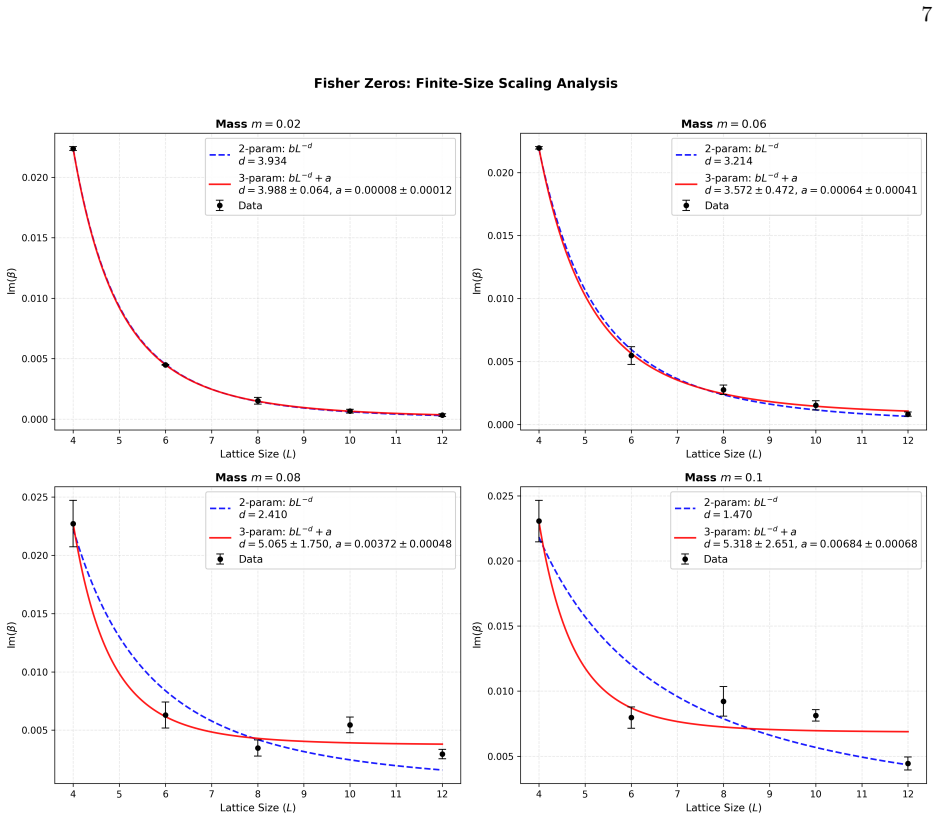
For m_q = 0.02 the L-dependence of the lowest imaginary zero is described by a two-parameter fit with d = 3.98(6) and a statistically compatible with zero, giving strong support for a first-order phase transition. The three larger masses show weaker but consistent indications that they lie above the critical mass m_q^c where the line of first-order transitions ends at a second-order point in the 4D Ising mean-field class. The infinite-volume gap can be parametrized as a ≃ A (m_q - m_q^c)^B with m_q^c ∼ 0.05 and B ∼ 1; combined with spectroscopic results this gap scales roughly like m_σ².
What carries the argument
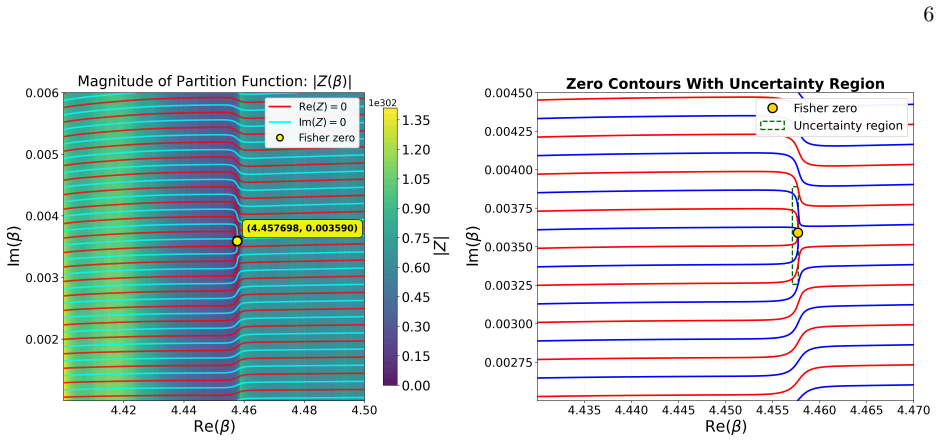
Lowest imaginary part of the partition function zeros in the complex β-plane, whose finite-size scaling is fitted to the forms y = b L^{-d} and y = a + b L^{-d}.
If this is right
- A line of first-order transitions exists in the (m_q, β) plane below m_q^c.
- The endpoint is a second-order transition belonging to the 4D Ising mean-field class.
- The infinite-volume gap a scales as A (m_q - m_q^c)^B with m_q^c ∼ 0.05 and B ∼ 1.
- The gap scales roughly like the square of the 0++ scalar mass m_σ.
- Masses 0.06, 0.08 and 0.1 lie above the critical value.
Where Pith is reading between the lines
- The phase diagram in the (m_q, β) plane contains a critical endpoint separating a first-order region from a crossover region.
- Independent spectroscopic calculations of the lightest scalar can be used to predict the size of the Lee-Yang edge without additional lattice runs.
- Repeating the zero analysis on finer lattices or with improved actions would tighten the constraint on the exponent B.
Load-bearing premise
The second-order endpoint of the first-order transition line belongs to the mean-field universality class of the four-dimensional Ising model, which fixes the expected scaling exponent d near 4.
What would settle it
A statistically significant deviation of the fitted exponent d from 4, or a non-zero infinite-volume intercept a, for m_q = 0.02 on lattices larger than L = 12.
Figures


read the original abstract
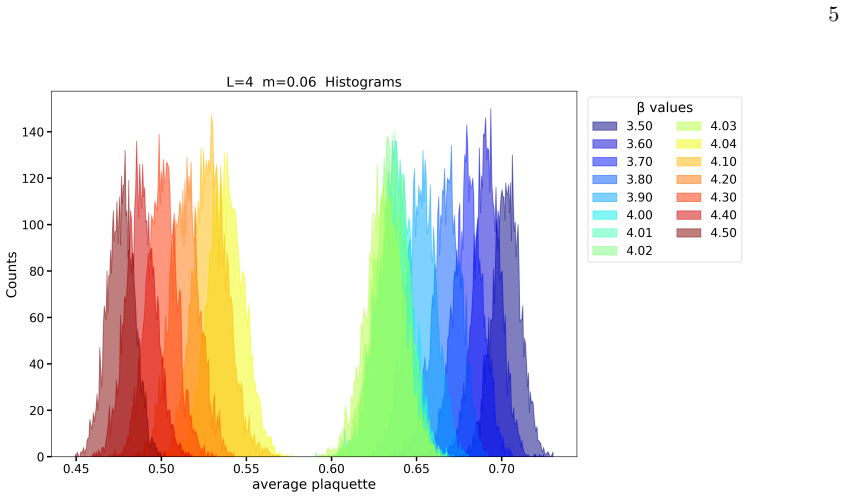
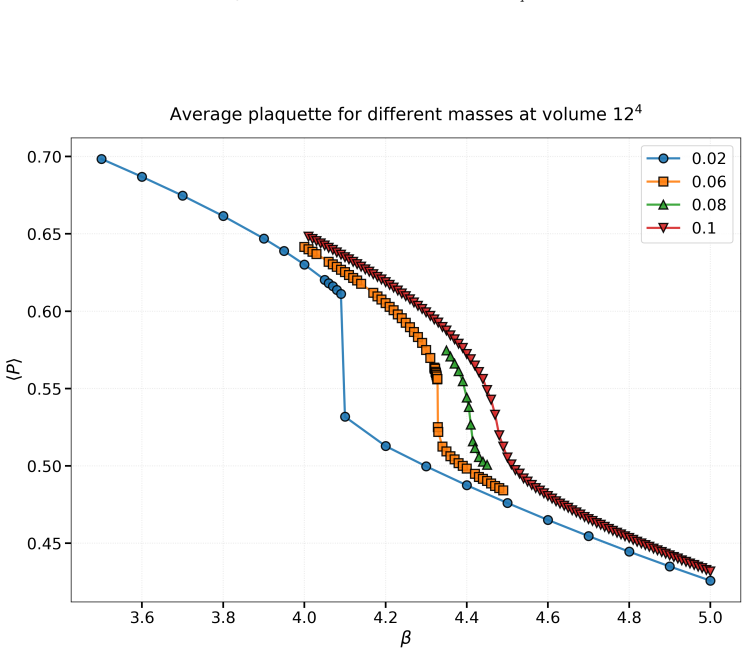
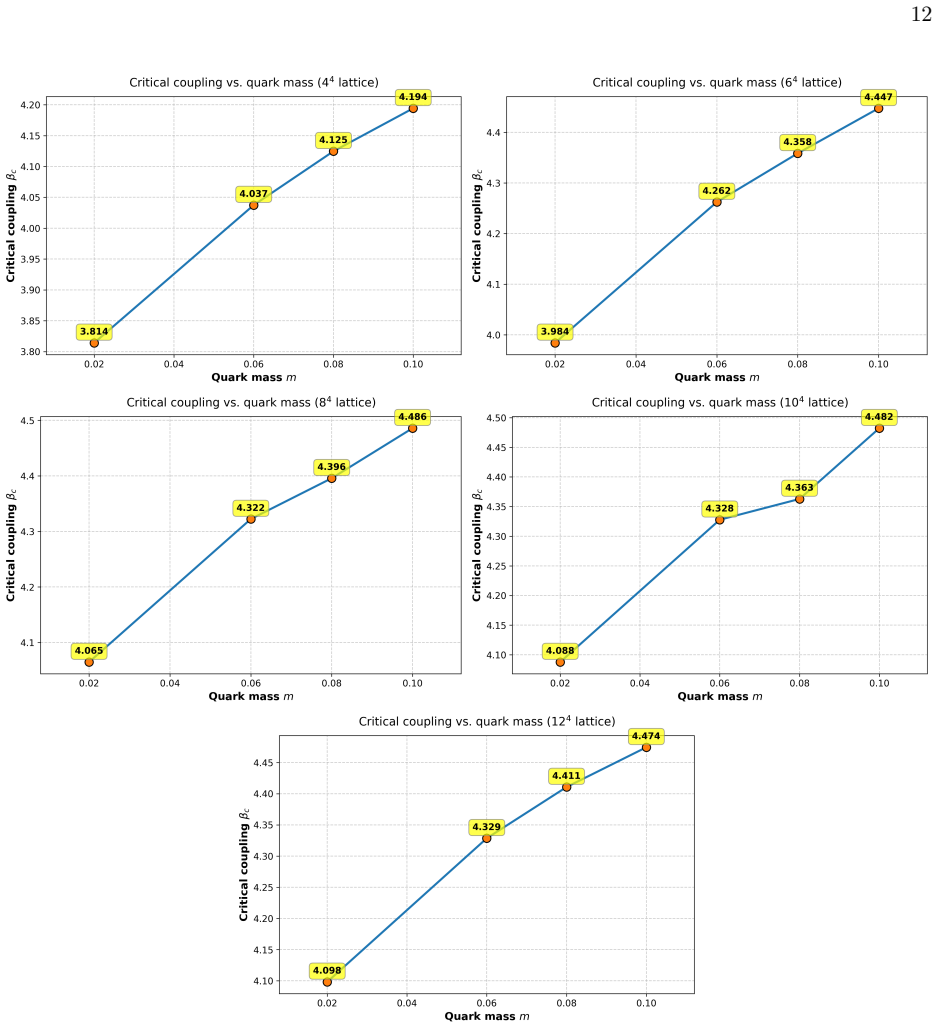
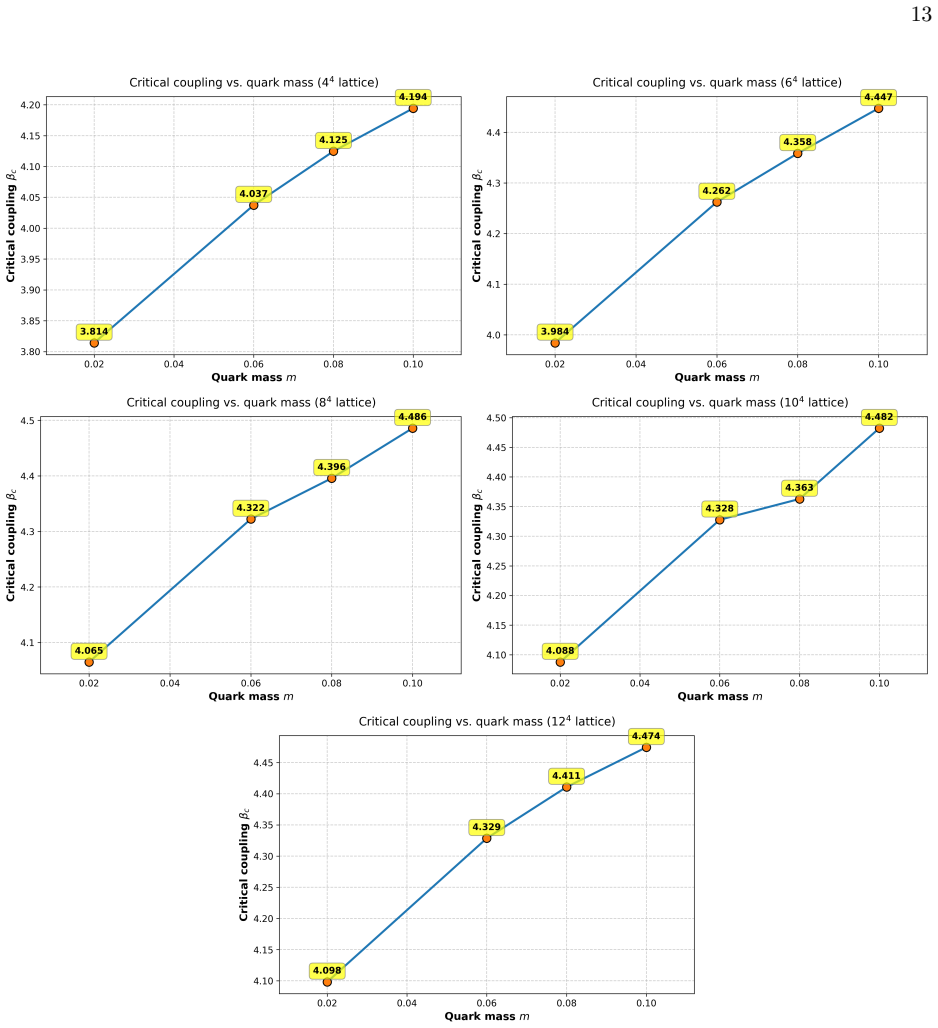
We consider a four dimensional $SU(3)$ lattice gauge theory with 12 staggered fermions having identical masses and an unimproved action. Using sets of plaquette distributions for various inverse bare couplings $\beta$, we reconstruct the density of states with the Ferrenberg -Swendsen method and calculate the zeros of the partition in the complex $\beta$ plane with bare quark masses $m_q$ = 0.02, 0.06, 0.08 and 0.1 for hypercubes of linear size $L$= 4, 6, 8, 10, and 12. Our hypothesis is that there is a line of first order transitions in the $(m_q,\beta)$ plane ending at a second order phase transition. We expect this transition to be in the 4D Ising, mean field, universality class. We fit the $L$ dependence of the zeros with the lowest imaginary part using two ($y = bL^{-d}$) and three ($y = a + bL^{-d}$) parameter fits. For $m_q$ = 0.02 the results provide strong support for a first order phase transition ($d=3.98(6)$, and $a$ statistically compatible with 0). The results also indicate, with less statistical significance for $m_q=0.06$, that the three other masses are above the critical value $m_q^c$. In addition, we suggest that the infinite volume gap for the lowest zero $a$, can be represented as $a\simeq A(m_q-m_q^c)^{B}$ with $m_q^c\sim 0.05$ and $B\sim 1$. Given that there are only three data points with significant error bars, it is difficult to rule out the mean field value $B=3/2$. Combining this result with spectroscopic results by Jin and Mawhinney, indicates that the gap with real axis (Lee-Yang edge) scales roughly like $m_\sigma ^2$, where $m_\sigma $ is the mass of the $0^{++}$ scalar which is also the lowest excitation.
Editorial analysis
A structured set of objections, weighed in public.
Referee Report
Summary. The manuscript examines the phase diagram of four-dimensional SU(3) lattice gauge theory with 12 staggered fermions of equal mass using an unimproved action. Reconstructing the density of states from plaquette histograms via the Ferrenberg-Swendsen method, the authors locate the lowest imaginary zeros of the partition function in the complex β-plane for volumes L=4,6,8,10,12 at m_q=0.02,0.06,0.08,0.1. They perform two- and three-parameter finite-size scaling fits of the form y=bL^{-d} or y=a+bL^{-d}, concluding that m_q=0.02 lies below a critical mass m_q^c≈0.05 (strong support for first-order transition from a≈0 and d=3.98(6)), while the higher masses lie above m_q^c; they additionally fit the infinite-volume gap a as a power law a≃A(m_q-m_q^c)^B with B∼1 and suggest consistency with m_σ² scaling from external spectroscopy.
Significance. If the scaling interpretation and extrapolations hold, the results would supply direct evidence via partition-function zeros for a line of first-order transitions in 12-flavor QCD terminating at a mean-field second-order endpoint, together with a quantitative link between the Lee-Yang edge and the lowest scalar mass. The approach is technically straightforward and the volumes are systematically varied, but the statistical power is limited by the small L range and the small number of mass points.
major comments (3)
- [Abstract] Abstract: the claim that d=3.98(6) together with a statistically compatible with zero constitutes 'strong support for a first order phase transition' at m_q=0.02 is in direct tension with the paper's stated hypothesis that the second-order endpoint belongs to the 4D Ising mean-field universality class (which fixes the expected d near 4 precisely at m_q^c). The same numerical outcome is equally consistent with m_q=0.02 lying at or above m_q^c; in the first-order regime the imaginary part is expected to approach the real axis exponentially (∼exp(−cL^3)) rather than by a power law.
- [Abstract] Abstract (gap scaling paragraph): the representation a≃A(m_q−m_q^c)^B is fitted to only three data points that carry significant error bars; although the text acknowledges the difficulty of ruling out the mean-field value B=3/2, this underconstrained fit is load-bearing for the extracted m_q^c∼0.05, the value B∼1, and the subsequent claim that the gap scales roughly like m_σ².
- [Finite-size scaling analysis] Finite-size scaling analysis: the two- and three-parameter fits to the zero positions for L=4–12 report neither χ²/dof values, covariance information, nor systematic uncertainties arising from the Ferrenberg-Swendsen reweighting or from the choice of histogram bins; these omissions affect the reliability of the central statements that a is compatible with zero and that d=3.98(6) at m_q=0.02.
minor comments (2)
- [Abstract] The abstract states '12 staggered fermions having identical masses' while the title uses '12 flavor QCD'; a brief clarification of the flavor counting would remove ambiguity.
- The comparison with the spectroscopic results of Jin and Mawhinney is stated only qualitatively; a short table or explicit numerical values for m_σ at the simulated masses would strengthen the m_σ² scaling suggestion.
Simulated Author's Rebuttal
We thank the referee for the thorough review and insightful comments on our manuscript concerning the zeros of the partition function in 12-flavor QCD. We address each of the major comments point by point below.
read point-by-point responses
-
Referee: [Abstract] Abstract: the claim that d=3.98(6) together with a statistically compatible with zero constitutes 'strong support for a first order phase transition' at m_q=0.02 is in direct tension with the paper's stated hypothesis that the second-order endpoint belongs to the 4D Ising mean-field universality class (which fixes the expected d near 4 precisely at m_q^c). The same numerical outcome is equally consistent with m_q=0.02 lying at or above m_q^c; in the first-order regime the imaginary part is expected to approach the real axis exponentially (∼exp(−cL^3)) rather than by a power law.
Authors: We acknowledge the referee's point that the power-law scaling with d close to 4 and a consistent with zero could be consistent with the mass being at or above the critical value. Our interpretation relies on the hypothesis that below m_q^c the gap a vanishes while the scaling exponent remains near the mean-field value for the accessible volumes. However, we recognize that an exponential approach is expected in the strict first-order regime for larger L. We will revise the abstract to qualify the 'strong support' claim and add a paragraph discussing the limitations of the power-law ansatz versus exponential behavior in the first-order phase. This will clarify the interpretation without overclaiming. revision: yes
-
Referee: [Abstract] Abstract (gap scaling paragraph): the representation a≃A(m_q−m_q^c)^B is fitted to only three data points that carry significant error bars; although the text acknowledges the difficulty of ruling out the mean-field value B=3/2, this underconstrained fit is load-bearing for the extracted m_q^c∼0.05, the value B∼1, and the subsequent claim that the gap scales roughly like m_σ².
Authors: The manuscript already states that with only three data points it is difficult to rule out B=3/2. We agree that the fit is underconstrained and that m_q^c∼0.05 is an estimate rather than a precise determination. In the revision, we will report the χ²/dof for this fit, present the covariance information, and strengthen the language to indicate that the scaling is suggestive and consistent with m_σ² within the uncertainties, while noting the need for additional mass points in future work. revision: partial
-
Referee: [Finite-size scaling analysis] Finite-size scaling analysis: the two- and three-parameter fits to the zero positions for L=4–12 report neither χ²/dof values, covariance information, nor systematic uncertainties arising from the Ferrenberg-Swendsen reweighting or from the choice of histogram bins; these omissions affect the reliability of the central statements that a is compatible with zero and that d=3.98(6) at m_q=0.02.
Authors: We thank the referee for highlighting these important omissions in the presentation of our fits. In the revised version of the manuscript, we will include the χ²/dof values for the two- and three-parameter fits at each mass, provide the covariance matrices for the fit parameters, and discuss the systematic uncertainties associated with the Ferrenberg-Swendsen reweighting method and the choice of histogram bin sizes. These additions will allow readers to better assess the reliability of the reported values for a and d. revision: yes
Circularity Check
No significant circularity in the derivation chain
full rationale
The paper states its hypothesis upfront (line of first-order transitions terminating at a mean-field 4D Ising second-order point) and then performs independent power-law fits to the L-dependence of the lowest imaginary zero y for each fixed m_q, followed by a separate three-point fit of the extrapolated a(m_q) values; neither step reduces a claimed prediction to its own fitted inputs by construction, nor does any load-bearing premise rely on self-citation. External spectroscopic comparisons are invoked only after the fits and do not close a definitional loop. The derivation remains self-contained with respect to the lattice data and stated assumptions.
Axiom & Free-Parameter Ledger
free parameters (3)
- m_q^c =
~0.05
- B =
~1
- d =
3.98(6)
axioms (2)
- domain assumption The second-order endpoint belongs to the 4D Ising mean-field universality class.
- domain assumption A line of first-order transitions exists in the (m_q, beta) plane and terminates at a second-order point.
Reference graph
Works this paper leans on
-
[1]
Zeros of the partition function for 12 flavor QCD
Our hypothesis is that there is a line of first order transitions in the (m q, β) plane ending at a second order phase transition. We expect this transition to be in the 4D Ising, mean field, universality class. We fit theLdependence of the zeros with the lowest imaginary part using two (y=bL −d) and three (y=a+bL −d) parameter fits. Form q = 0.02 the res...
work page internal anchor Pith review Pith/arXiv arXiv 2026
-
[2]
G. Aadet al.(ATLAS), Observation of a new particle in the search for the Standard Model Higgs boson with the ATLAS detector at the LHC, Phys. Lett. B716, 1 (2012), arXiv:1207.7214 [hep-ex]
work page internal anchor Pith review Pith/arXiv arXiv 2012
-
[3]
Observation of a new boson at a mass of 125 GeV with the CMS experiment at the LHC
S. Chatrchyanet al.(CMS), Observation of a New Boson at a Mass of 125 GeV with the CMS Exper- iment at the LHC, Phys. Lett. B716, 30 (2012), arXiv:1207.7235 [hep-ex]
work page internal anchor Pith review Pith/arXiv arXiv 2012
-
[4]
Naturalness: past, present, and future,
N. Craig, Naturalness: past, present, and future, Eur. Phys. J. C83, 825 (2023), arXiv:2205.05708 [hep-ph]
-
[5]
Lattice QCD with 8 and 12 degenerate quark flavors
X.-Y. Jin and R. D. Mawhinney, Lattice QCD with 8 and 12 degenerate quark flavors, PoSLA T2009, 049 (2009), arXiv:0910.3216 [hep-lat]
work page internal anchor Pith review Pith/arXiv arXiv 2009
-
[6]
Lattice QCD with 12 Degenerate Quark Flavors
X.-Y. Jin and R. D. Mawhinney, Lattice QCD with 12 Degenerate Quark Flavors, PoSLA TTICE2011, 066 (2011), arXiv:1203.5855 [hep-lat]
work page internal anchor Pith review Pith/arXiv arXiv 2011
-
[7]
Twelve massless flavors and three colors below the conformal window
Z. Fodor, K. Holland, J. Kuti, D. Nogradi, C. Schroeder, K. Holland, J. Kuti, D. Nogradi, and C. Schroeder, Twelve massless flavors and three colors below the conformal window, Phys. Lett. B 703, 348 (2011), arXiv:1104.3124 [hep-lat]
work page internal anchor Pith review Pith/arXiv arXiv 2011
-
[8]
Lattice Simulations and Infrared Conformality
T. Appelquist, G. T. Fleming, M. F. Lin, E. T. Neil, and D. A. Schaich, Lattice Simulations and Infrared Conformality, Phys. Rev. D84, 054501 (2011), arXiv:1106.2148 [hep-lat]
work page internal anchor Pith review Pith/arXiv arXiv 2011
-
[9]
Bulk transitions of twelve flavor QCD and $U_A(1)$ symmetry
A. Deuzeman, M. P. Lombardo, T. Nunes da Silva, and E. Pallante, Bulk transitions of twelve flavor QCD andU A(1) symmetry, PoSLA TTICE2011, 321 (2011), arXiv:1111.2590 [hep-lat]
work page internal anchor Pith review Pith/arXiv arXiv 2011
-
[10]
Y. Aoki, T. Aoyama, M. Kurachi, T. Maskawa, K.-i. Nagai, H. Ohki, A. Shibata, K. Yamawaki, and T. Yamazaki, Lattice study of conformality in twelve-flavor QCD, Phys. Rev. D86, 054506 (2012), arXiv:1207.3060 [hep-lat]
work page internal anchor Pith review Pith/arXiv arXiv 2012
-
[11]
Kuti, The Higgs particle and the lattice, PoSLA TTICE2013, 004 (2014)
J. Kuti, The Higgs particle and the lattice, PoSLA TTICE2013, 004 (2014)
2014
-
[12]
Lattice tests of beyond Standard Model dynamics
T. DeGrand, Lattice tests of beyond Standard Model dynamics, Rev. Mod. Phys.88, 015001 (2016), arXiv:1510.05018 [hep-ph]
work page internal anchor Pith review Pith/arXiv arXiv 2016
-
[13]
A. Hasenfratz and C. T. Peterson, Infrared fixed point in the massless twelve-flavor SU(3) gauge-fermion system, Phys. Rev. D109, 114507 (2024), arXiv:2402.18038 [hep-lat]
- [14]
-
[15]
Extended investigation of the twelve-flavor $\beta$-function
Z. Fodor, K. Holland, J. Kuti, D. Nogradi, and C. H. Wong, Extended investigation of the twelve-flavor β-function, Phys. Lett. B779, 230 (2018), arXiv:1710.09262 [hep-lat]
work page internal anchor Pith review Pith/arXiv arXiv 2018
- [16]
-
[17]
Novel phase in SU(3) lattice gauge theory with 12 light fermions
A. Cheng, A. Hasenfratz, and D. Schaich, Novel phase in SU(3) lattice gauge theory with 12 light fermions, Phys. Rev. D85, 094509 (2012), arXiv:1111.2317 [hep-lat]
work page internal anchor Pith review Pith/arXiv arXiv 2012
-
[18]
Lattice QCD with 12 Quark Flavors: A Careful Scrutiny
X.-Y. Jin and R. D. Mawhinney, Lattice QCD with 12 Quark Flavors: A Careful Scrutiny, inKMI- GCOE Workshop on Strong Coupling Gauge Theories in the LHC Perspective(2014) pp. 96–102, arXiv:1304.0312 [hep-lat]
work page internal anchor Pith review Pith/arXiv arXiv 2014
-
[19]
Y. Aoki, T. Aoyama, M. Kurachi, T. Maskawa, K.-i. Nagai, H. Ohki, E. Rinaldi, A. Shibata, K. Ya- mawaki, and T. Yamazaki (LatKMI), Light composite scalar in twelve-flavor QCD on the lattice, Phys. Rev. Lett.111, 162001 (2013), arXiv:1305.6006 [hep-lat]
work page internal anchor Pith review Pith/arXiv arXiv 2013
-
[20]
Rosenzweig, J
C. Rosenzweig, J. Schechter, and C. G. Trahern, Is the effective lagrangian for quantum chromody- namics aσmodel?, Phys. Rev. D21, 3388 (1980)
1980
-
[21]
Kawarabayashi and N
K. Kawarabayashi and N. Ohta, The eta problem in the large-n limit, Nucl. Phys., B175, 477–492 (1980)
1980
-
[22]
Meurice, Breaking the Axial U(1) Does Not Enhance Second Class Decays, Mod
Y. Meurice, Breaking the Axial U(1) Does Not Enhance Second Class Decays, Mod. Phys. Lett.A2, 699 (1987)
1987
-
[23]
A linear sigma model for multiflavor gauge theories
Y. Meurice, Linear sigma model for multiflavor gauge theories, Phys. Rev. D96, 114507 (2017), arXiv:1709.09264 [hep-lat]
work page internal anchor Pith review Pith/arXiv arXiv 2017
-
[24]
Floor, E
D. Floor, E. Gustafson, and Y. Meurice, Phase structure of multiflavor gauge theories: Critical expo- nents of Fisher zeros near the endpoint, PoSLA TTICE2018, 206 (2018)
2018
-
[25]
Fisher zeros and RG flows for $SU(3)$ with $N_f$ flavors
Z. Gelzer, Y. Liu, Y. Meurice, and D. Sinclair, Fisher zeros and rg flows forsu(3) withn f flavors (2013), arXiv:1312.3906 [hep-lat]
work page internal anchor Pith review Pith/arXiv arXiv 2013
-
[26]
Exploring the phase structure of 12-flavor $SU(3)$
Z. Gelzer, Y. Liu, and Y. Meurice, Exploring the phase structure of 12-flavorsu(3) (2014), 15 arXiv:1411.3360 [hep-lat]
work page internal anchor Pith review Pith/arXiv arXiv 2014
-
[27]
D. d. F. e Silva,Critical behavior of multiflavor gauge theories, Ph.D. thesis, The University of Iowa (2018)
2018
-
[28]
The Strength of First and Second Order Phase Transitions from Partition Function Zeroes
W. Janke and R. Kenna, The Strength of first and second order phase transitions from partition function zeroes, J. Statist. Phys.102, 1211 (2001), arXiv:cond-mat/0012026
work page internal anchor Pith review Pith/arXiv arXiv 2001
-
[29]
Itzykson, R
C. Itzykson, R. B. Pearson, and J. B. Zuber, Distribution of Zeros in Ising and Gauge Models, Nucl. Phys. B220, 415 (1983)
1983
-
[30]
T. D. Lee and C. N. Yang, Statistical theory of equations of state and phase transitions. ii. lattice gas and ising model, Phys. Rev.87, 410 (1952)
1952
-
[31]
Kogut and L
J. Kogut and L. Susskind, Hamiltonian formulation of wilson’s lattice gauge theories, Phys. Rev. D11, 395 (1975)
1975
-
[32]
A. M. Ferrenberg and R. H. Swendsen, Optimized monte carlo data analysis, Phys. Rev. Lett.63, 1195 (1989)
1989
-
[33]
M. E. Fisher, Yang-Lee Edge Singularity and phi**3 Field Theory, Phys. Rev. Lett.40, 1610 (1978)
1978
-
[34]
Wolff, A
U. Wolff, A. Collaboration,et al., Monte carlo errors with less errors, Computer Physics Communica- tions156, 143 (2004)
2004
-
[35]
W. E. Lorensen and H. E. Cline, Marching cubes: A high resolution 3d surface construction algorithm, inSeminal graphics: pioneering efforts that shaped the field(1998) pp. 347–353
1998
-
[36]
J. L. Bentley, Multidimensional binary search trees used for associative searching, Communications of the ACM18, 509 (1975)
1975
discussion (0)
Sign in with ORCID, Apple, or X to comment. Anyone can read and Pith papers without signing in.