REVIEW 4 major objections 6 minor 1 cited by
Agent-as-a-Service based on Agent Network
T0 review · 4 major / 6 minor · reviewed 2026-08-15 · deepseek-v4-flash
Pith's one-line read Treating AI agents as plug-and-play network services improves multi-agent quality and cuts token cost.
desk verdict A genuinely integrated service-oriented agent network with a large deployment, but the architecture's performance gains are undercut by an unablated reflection mechanism. read the letter →
The pith
A machine-rendered reading of the paper's core claim, the machinery that carries it, and where it could break.
The reading
What carries the argument
The load-bearing mechanism is the Agent Network composed with service-oriented agents and the Execution Graph. The network makes agents and groups into addressable vertices whose edges are routes; the structured role knowledge—name, description, system prompt, typed input and output parameters, and logic code—gives every vertex a service contract. Route types HARD, SOFT, and EXT decide when collaboration is a fixed sequence, a dynamic organization within a group, or a proactive discovery across groups. The Service Scheduler maintains the Execution Graph, which carries context storage, context isolation, and runtime task state during distributed execution. This combination is what the paper credits for both quality gains and token savings.
What would settle it
Run the same code-generation tasks with the self-coordination reflection mechanism disabled while keeping the Agent Network and Execution Graph; if quality falls back to baseline levels, the reflective trigger—not the service network—carries the reported gains. Conversely, replace the Execution Graph with a flat shared message pool while keeping prompts and reflection fixed; if token savings vanish, the graph is what saves tokens.
Extended reading notes
Core claim
At the paper's core is a claim about how multi-agent systems should be built: instead of hard-wiring conversational workflows between agents, the system models roles, goals, processes, and services as explicit knowledge. Every agent carries a role definition with a name, description, system prompt, structured input and output parameters, and logic code; agents are grouped by goals, and groups can nest. Collaboration happens over three route types—hard routes for fixed sequences, soft routes for flexible intra-group organization, and extended routes for cross-group discovery. The Service Scheduler then runs tasks on an Execution Graph that tracks progress and isolates contexts. The paper reports empirical support: on mathematical reasoning (504 problems sampled from MATH) AaaS-AN reaches 63.62% accuracy against 57.85% and 57.52% for the two strongest tested frameworks, with comparable token cost and time; on the two code-generation benchmarks it reaches quality scores up to 0.900 and cuts token use to roughly half of the chat-based baseline. The authors interpret these results as evidence that structured service contracts reduce redundant dialogue and that a self-coordination mechanism, which triggers reflective reasoning when generated code stops changing, suppresses unproductive generation attempts.
Load-bearing premise
The comparisons assume the quality and token gains come from the network-plus-execution-graph architecture, rather than from the reflective self-coordination trigger or from richer prompts that a baseline reimplementation would also inherit.
Editorial extensions
If this is right
- If accurate, multi-agent systems can be assembled by registering and discovering agents rather than by hand-coding dialogue flows, so adding a new capability means adding a service vertex and routes.
- Structured input and output contracts would let heterogeneous agents, including non-LLM services such as Robotic Process Automation flows, interoperate through one scheduler—demonstrated by the paper's deployment of over 100 agent services.
- Reduced token use on code generation implies the approach can lower the cost of long-horizon agent runs, making iterative review-and-test loops more affordable in practice.
- The released 10,000-workflow dataset could serve as a training or evaluation ground for learning reusable hard routes from successful execution traces.
- The mathematical reasoning result suggests the architecture generalizes beyond software tasks to domains requiring multi-step reasoning, at roughly the token cost of previous systems.
Reading between the lines
- I infer that the reflective self-coordination trigger may be doing more of the quality work than the network topology itself; an ablation separating those two components would reveal which part carries the reported gains.
- The same service-contract idea could be layered on top of protocols like Model Context Protocol and Agent2Agent, letting AaaS-AN act as an orchestration layer over heterogeneous agents—a direction the paper motivates but does not implement.
- A testable extension is to learn hard routes automatically from the released workflow logs by measuring which trace patterns correlate with task success, which the paper mentions as a possibility but does not evaluate.
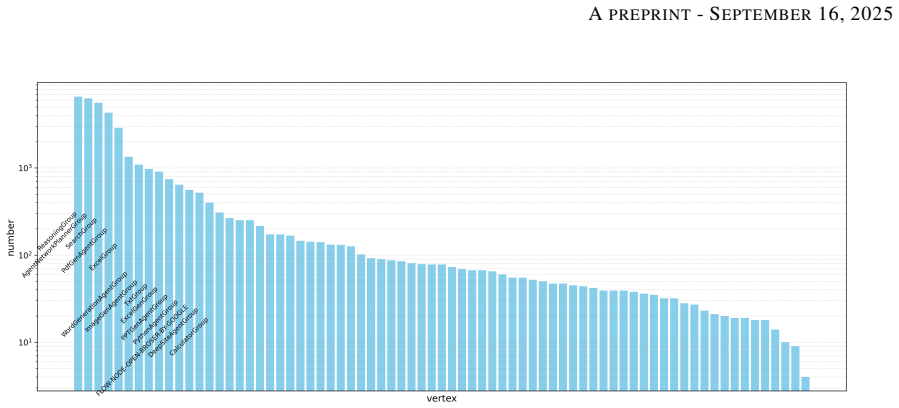
- The reported long-tail distribution of service vertices suggests that rare specialized services may matter disproportionately for task coverage; one could measure the marginal quality gain from adding each rare vertex to test that hypothesis.
Signed reviews
Editorial analysis
A structured set of objections, weighed in public.
Referee Report
Summary. The paper proposes AaaS-AN, a service-oriented multi-agent framework built on the RGPS standard. Agents and agent groups are modeled as vertexes in a dynamic Agent Network, connected by HARD, SOFT, and EXT routes, while service-oriented agents provide registration, discovery, and interoperability. A Service Scheduler uses an Execution Graph for context tracking and task management. The authors claim that AaaS-AN unifies the agent lifecycle and outperforms state-of-the-art baselines on mathematical reasoning and application-level code generation. They report 63.62% accuracy on a 504-problem MATH sample versus 57.85% for AutoGen, and higher Quality scores on SRDD and ProgramDev than ChatDev with lower token costs. They also report a deployment of over 100 agent services and release a dataset of supposedly 10,000 long-horizon multi-agent workflows.
Significance. If the claims are validated, AaaS-AN would make a useful contribution to standardized, service-oriented multi-agent coordination, particularly in connecting MCP-style tools with agent-level collaboration and in supporting long-chain workflows. The strengths of the paper are its concrete framework proposal, the reported large-scale deployment with RPA and MCP services, and the intention to release a long-horizon workflow dataset. These are valuable empirical resources for the community. However, the paper's empirical evidence does not yet support the causal claim that the proposed architecture, rather than auxiliary mechanisms such as the reflection heuristic or prompt design, is responsible for the reported gains. The lack of ablations, missing baseline data, and internal inconsistencies in the dataset statistics are significant gaps that need to be addressed before the central claims can be accepted.
major comments (4)
- [Section 4.2, Tables 1-2] The central claim that the proposed Agent Network and Execution Graph drive the reported performance gains is not supported because no ablation isolates the new components. In Section 4.2, the code-generation advantage is explicitly attributed to a 'self-coordination mechanism that proactively initiates reflective reasoning' that is not described in the Section 3 architecture and is not separately ablated. This mechanism, together with differences in prompts and stopping criteria, is a plausible alternative explanation for the observed quality and token improvements. The authors should add ablations that toggle the Agent Network/Execution Graph, the structured-context service layer, and the reflection heuristic independently, and report the contribution of each component.
- [Table 2] The comparison against GPTSwarm, presented as a state-of-the-art baseline, is not actually reported: all GPTSwarm rows in Table 2 are empty for both SRDD and ProgramDev. As a result, the only multi-agent code-generation baselines with data are ChatDev variants. Moreover, no table reports variance, confidence intervals, or significance tests; the MATH result is based on one 504-problem sample and the ProgramDev result on 30 tasks. At minimum, the authors should fill in or remove the GPTSwarm rows and provide multiple runs or a statistical assessment so that the headline improvement of 5.77 percentage points can be evaluated.
- [Section 4.1] The MATH evaluation uses an LLM judge asked to return only 'True' or 'False', but no validation of this judge against human labels is provided. Without a human-agreement study or a format-neutral check, the 5.77 percentage-point advantage over AutoGen could reflect judge bias toward the output structure of AaaS-AN rather than mathematical correctness. The authors should report judge accuracy on a labeled subsample and, if feasible, exact-match accuracy as a complement.
- [Section 4.3 and Abstract] There is a numerical inconsistency in the dataset claim. The abstract and Section 5 state that the released dataset contains 10,000 workflows, but Table 3 reports 919 + 363 + 4,518 + 2,620 = 8,420 tasks. The authors must reconcile this discrepancy and clarify whether Table 3 covers only a subset of the released data or whether the release contains additional workflows not counted in the table.
minor comments (6)
- [Section 4.1] The text says 'The experimental results are shown in Table label,' which should read 'Table 1.'
- [Table 1 caption] The caption mentions 'the second-highest underlined in Quality,' but the table reports accuracy, and the underlining is not visible in the submitted text. The caption and table formatting should be aligned.
- [Section 2.1 / References [3] and [4]] Reference [4] is cited for the Agent2Agent (A2A) protocol, but [4] is the same 'Model context protocol (MCP)' paper as [3]. The A2A citation should be corrected or a distinct reference added.
- [Table 2] The columns 'Cost' and 'Time' lack definitions of the underlying API pricing and hardware/network conditions; without this, the cross-model cost comparisons are hard to interpret. Also, the units and rounding conventions should be stated.
- [Section 3.2.3] The HARD, SOFT, and EXT route types are described only conceptually. A formal specification or an algorithm for route selection and dynamic reconfiguration would materially improve reproducibility.
- [Section 4.3.3] The 'contribution of a service' is defined as the average similarity between its input and the final task output, but this quantity is not reported or used in the analysis. It should either be presented or moved to future work.
Circularity Check
No circularity: the empirical claims are tested against external benchmarks and no fitted parameter is relabeled as a prediction.
full rationale
No circular derivation chain was found. AaaS-AN is an architecture proposal whose performance claims are supported by comparisons to external baselines on the MATH sample, SRDD, and ProgramDev, with no parameters fitted from the evaluation data and no prediction that is equivalent to an input by construction. The only relevant self-citation is the RGPS standard [5], whose first author overlaps with the present paper's corresponding author; however, RGPS is used as modeling inspiration for role/goal/process/service concepts and is not invoked as evidence for the empirical results, so it is not load-bearing. The reflection/stopping mechanism credited in Section 4.2 is not ablated, which weakens the causal attribution of the gains to the Agent Network and Execution Graph, but that is a correctness or experimental-design concern, not circularity. The discrepancy between the 10,000-workflow claim and the sum of Table 3 is an internal consistency issue, not a circular one. Because the central claims are validated against independent, externally defined benchmarks and no fitted value is renamed as a prediction, the circularity score is 0.
Assumptions & free parameters
assumptions (5)
- domain assumption RGPS meta-model is an appropriate and sufficient foundation for modeling agent roles, goals, processes, and services.
- domain assumption LLM agents and agent groups will reliably follow role prompts, structured input/output schemas, and scheduler-directed routes.
- domain assumption An LLM judge's True/False ratings on MATH answers are valid correctness labels.
- domain assumption Quality, defined as the product of task success rate, code completion rate, and executability, is a valid measure of code-generation quality.
- domain assumption API call variability and LLM nondeterminism do not systematically favor AaaS-AN over the baselines.
invented entities (3)
-
Agent Network (agents and agent groups as vertexes connected by routes)
-
HARD, SOFT, and EXT route types
-
Execution Graph
Cite this review
Pith. "Pith review of Agent-as-a-Service based on Agent Network." pith.science (2026). https://pith.science/paper/G3WB23NV
@misc{pith2026250508446,
  author       = {Pith},
  title        = {Pith review of: Agent-as-a-Service based on Agent Network},
  year         = {2026},
  howpublished = {\url{https://pith.science/paper/G3WB23NV}},
  note         = {Machine review of arXiv:2505.08446}
}
read the original abstract
The rise of large model-based AI agents has spurred interest in Multi-Agent Systems (MAS) for their capabilities in decision-making, collaboration, and adaptability. While the Model Context Protocol (MCP) addresses tool invocation and data exchange challenges via a unified protocol, it lacks support for organizing agent-level collaboration. To bridge this gap, we propose Agent-as-a-Service based on Agent Network (AaaS-AN), a service-oriented paradigm grounded in the Role-Goal-Process-Service (RGPS) standard. AaaS-AN unifies the entire agent lifecycle, including construction, integration, interoperability, and networked collaboration, through two core components: (1) a dynamic Agent Network, which models agents and agent groups as vertexes that self-organize within the network based on task and role dependencies; (2) service-oriented agents, incorporating service discovery, registration, and interoperability protocols. These are orchestrated by a Service Scheduler, which leverages an Execution Graph to enable distributed coordination, context tracking, and runtime task management. We validate AaaS-AN on mathematical reasoning and application-level code generation tasks, which outperforms state-of-the-art baselines. Notably, we constructed a MAS based on AaaS-AN containing agent groups, Robotic Process Automation (RPA) workflows, and MCP servers over 100 agent services. We also release a dataset containing 10,000 long-horizon multi-agent workflows to facilitate future research on long-chain collaboration in MAS.
Figures

Forward citations
Cited by 1 Pith paper
-
Agentic Metaverse Services: A New As-a-Service Paradigm
Agent capabilities can be delivered as Meta-AaaS so that autonomous, embodied agents become the unit of service in metaverse business processes.
Reference graph
Works this paper leans on
-
[1]
Weiqiang Jin, Hongyang Du, Biao Zhao, Xingwu Tian, Bohang Shi, and Guang Yang. A comprehensive survey on multi-agent cooperative decision-making: Scenarios, approaches, challenges and perspectives.CoRR, abs/2503.13415, 2025
arXiv 2025
-
[2]
Hung Du, Srikanth Thudumu, Rajesh Vasa, and Kon Mouzakis. A survey on context-aware multi-agent systems: Techniques, challenges and future directions.CoRR, abs/2402.01968, 2024
arXiv 2024
-
[3]
Xinyi Hou, Yanjie Zhao, Shenao Wang, and Haoyu Wang. Model context protocol (MCP): landscape, security threats, and future research directions.CoRR, abs/2503.23278, 2025
arXiv 2025
-
[4]
Model context protocol (mcp): Landscape, security threats, and future research directions, 2025
Xinyi Hou, Yanjie Zhao, Shenao Wang, and Haoyu Wang. Model context protocol (mcp): Landscape, security threats, and future research directions, 2025
work page 2025
-
[5]
Jian Wang, Zaiwen Feng, Jia Zhang, Patrick C. K. Hung, Keqing He, and Liang-Jie Zhang. A unified rgps-based approach supporting service-oriented process customization. InWeb Services Foundations, pages 657–682. Springer, 2014. 9 APREPRINT- SEPTEMBER16, 2025
work page 2014
-
[6]
Izzeddin Gur, Hiroki Furuta, Austin Huang, Mustafa Safdari, Yutaka Matsuo, Douglas Eck, and Aleksandra Faust. A real-world webagent with planning, long context understanding, and program synthesis.arXiv preprint arXiv:2307.12856, 2023
arXiv 2023
-
[7]
Generative agents: Interactive simulacra of human behavior
Joon Sung Park, Joseph O’Brien, Carrie Jun Cai, Meredith Ringel Morris, Percy Liang, and Michael S Bernstein. Generative agents: Interactive simulacra of human behavior. InProceedings of the 36th annual acm symposium on user interface software and technology, pages 1–22, 2023
2023
-
[8]
Grutopia: Dream general robots in a city at scale.arXiv preprint arXiv:2407.10943, 2024
Hanqing Wang, Jiahe Chen, Wensi Huang, Qingwei Ben, Tai Wang, Boyu Mi, Tao Huang, Siheng Zhao, Yilun Chen, Sizhe Yang, et al. Grutopia: Dream general robots in a city at scale.arXiv preprint arXiv:2407.10943, 2024
arXiv 2024
Show all 26 references
-
[9]
Caven: an embodied conversational agent for efficient audio-visual navigation in noisy environments
Xiulong Liu, Sudipta Paul, Moitreya Chatterjee, and Anoop Cherian. Caven: an embodied conversational agent for efficient audio-visual navigation in noisy environments. InProceedings of the AAAI Conference on Artificial Intelligence, volume 38, pages 3765–3773, 2024
2024
-
[10]
Communicative agents for software development.arXiv preprint arXiv:2307.07924, 6(3), 2023
Chen Qian, Xin Cong, Cheng Yang, Weize Chen, Yusheng Su, Juyuan Xu, Zhiyuan Liu, and Maosong Sun. Communicative agents for software development.arXiv preprint arXiv:2307.07924, 6(3), 2023
2023 arXiv
-
[11]
Internet of agents: Weaving a web of heterogeneous agents for collaborative intelligence
Weize Chen, Ziming You, Ran Li, Yitong Guan, Chen Qian, Chenyang Zhao, Cheng Yang, Ruobing Xie, Zhiyuan Liu, and Maosong Sun. Internet of agents: Weaving a web of heterogeneous agents for collaborative intelligence. arXiv preprint arXiv:2407.07061, 2024
2024 arXiv
-
[12]
User behavior simulation with large language model-based agents.ACM Transactions on Information Systems, 43(2):1–37, 2025
Lei Wang, Jingsen Zhang, Hao Yang, Zhi-Yuan Chen, Jiakai Tang, Zeyu Zhang, Xu Chen, Yankai Lin, Hao Sun, Ruihua Song, et al. User behavior simulation with large language model-based agents.ACM Transactions on Information Systems, 43(2):1–37, 2025
2025
-
[13]
Alpacafarm: A simulation framework for methods that learn from human feedback.Advances in Neural Information Processing Systems, 36:30039–30069, 2023
Yann Dubois, Chen Xuechen Li, Rohan Taori, Tianyi Zhang, Ishaan Gulrajani, Jimmy Ba, Carlos Guestrin, Percy S Liang, and Tatsunori B Hashimoto. Alpacafarm: A simulation framework for methods that learn from human feedback.Advances in Neural Information Processing Systems, 36:3...
2023
-
[14]
Agents4plc: Automating closed-loop plc code generation and verification in industrial control systems using llm-based agents.arXiv preprint arXiv:2410.14209, 2024
Zihan Liu, Ruinan Zeng, Dongxia Wang, Gengyun Peng, Jingyi Wang, Qiang Liu, Peiyu Liu, and Wenhai Wang. Agents4plc: Automating closed-loop plc code generation and verification in industrial control systems using llm-based agents.arXiv preprint arXiv:2410.14209, 2024
-
[15]
Metagpt: Meta programming for multi-agent collaborative framework.arXiv preprint arXiv:2308.00352, 3(4):6, 2023
Sirui Hong, Xiawu Zheng, Jonathan Chen, Yuheng Cheng, Jinlin Wang, Ceyao Zhang, Zili Wang, Steven Ka Shing Yau, Zijuan Lin, Liyang Zhou, et al. Metagpt: Meta programming for multi-agent collaborative framework.arXiv preprint arXiv:2308.00352, 3(4):6, 2023
2023 arXiv
-
[16]
Plan-and- solve prompting: Improving zero-shot chain-of-thought reasoning by large language models.arXiv preprint arXiv:2305.04091, 2023
Lei Wang, Wanyu Xu, Yihuai Lan, Zhiqiang Hu, Yunshi Lan, Roy Ka-Wei Lee, and Ee-Peng Lim. Plan-and- solve prompting: Improving zero-shot chain-of-thought reasoning by large language models.arXiv preprint arXiv:2305.04091, 2023
2023 arXiv
-
[17]
Unleashing the emergent cognitive synergy in large language models: A task-solving agent through multi-persona self-collaboration.arXiv preprint arXiv:2307.05300, 2023
Zhenhailong Wang, Shaoguang Mao, Wenshan Wu, Tao Ge, Furu Wei, and Heng Ji. Unleashing the emergent cognitive synergy in large language models: A task-solving agent through multi-persona self-collaboration.arXiv preprint arXiv:2307.05300, 2023
2023 arXiv
-
[18]
Toolllm: Facilitating large language models to master 16000+ real-world apis.arXiv preprint arXiv:2307.16789, 2023
Yujia Qin, Shihao Liang, Yining Ye, Kunlun Zhu, Lan Yan, Yaxi Lu, Yankai Lin, Xin Cong, Xiangru Tang, Bill Qian, et al. Toolllm: Facilitating large language models to master 16000+ real-world apis.arXiv preprint arXiv:2307.16789, 2023
2023 arXiv
-
[19]
Chain-of-thought prompting elicits reasoning in large language models.Advances in neural information processing systems, 35:24824–24837, 2022
Jason Wei, Xuezhi Wang, Dale Schuurmans, Maarten Bosma, Fei Xia, Ed Chi, Quoc V Le, Denny Zhou, et al. Chain-of-thought prompting elicits reasoning in large language models.Advances in neural information processing systems, 35:24824–24837, 2022
2022
-
[20]
Self-consistency improves chain of thought reasoning in language models.arXiv preprint arXiv:2203.11171, 2022
Xuezhi Wang, Jason Wei, Dale Schuurmans, Quoc Le, Ed Chi, Sharan Narang, Aakanksha Chowdhery, and Denny Zhou. Self-consistency improves chain of thought reasoning in language models.arXiv preprint arXiv:2203.11171, 2022
2022 arXiv
-
[21]
React: Synergizing reasoning and acting in language models
Shunyu Yao, Jeffrey Zhao, Dian Yu, Nan Du, Izhak Shafran, Karthik Narasimhan, and Yuan Cao. React: Synergizing reasoning and acting in language models. InInternational Conference on Learning Representations (ICLR), 2023
2023
-
[22]
Reflexion: Language agents with verbal reinforcement learning.Advances in Neural Information Processing Systems, 36:8634–8652, 2023
Noah Shinn, Federico Cassano, Ashwin Gopinath, Karthik Narasimhan, and Shunyu Yao. Reflexion: Language agents with verbal reinforcement learning.Advances in Neural Information Processing Systems, 36:8634–8652, 2023
2023
-
[23]
Hugginggpt: Solving ai tasks with chatgpt and its friends in hugging face.Advances in Neural Information Processing Systems, 36:38154–38180, 2023
Yongliang Shen, Kaitao Song, Xu Tan, Dongsheng Li, Weiming Lu, and Yueting Zhuang. Hugginggpt: Solving ai tasks with chatgpt and its friends in hugging face.Advances in Neural Information Processing Systems, 36:38154–38180, 2023. 10 APREPRINT- SEPTEMBER16, 2025
2023
-
[24]
Self-contrast: Better reflection through inconsistent solving perspectives
Standard Self-Reflection. Self-contrast: Better reflection through inconsistent solving perspectives
-
[25]
Chatdev: Communicative agents for software development
Chen Qian, Wei Liu, Hongzhang Liu, Nuo Chen, Yufan Dang, Jiahao Li, Cheng Yang, Weize Chen, Yusheng Su, Xin Cong, Juyuan Xu, Dahai Li, Zhiyuan Liu, and Maosong Sun. Chatdev: Communicative agents for software development. InProceedings of the 62nd Annual Meeting of the Associat...
2024
-
[26]
Gptswarm: Language agents as optimizable graphs
Mingchen Zhuge, Wenyi Wang, Louis Kirsch, Francesco Faccio, Dmitrii Khizbullin, and Jürgen Schmidhuber. Gptswarm: Language agents as optimizable graphs. InForty-first International Conference on Machine Learning, ICML 2024, Vienna, Austria, July 21-27, 2024, 2024. 11
2024
Reviewed August 15, 2026 · model on record in the stance chip above.
Discussion (0). Continue with ORCID to comment.