REVIEW 3 major objections 4 minor 6 references
Fast-SAM3D: 3Dfy Anything in Images but Faster
T0 review · 3 major / 4 minor · reviewed 2026-08-03 · deepseek-v4-flash
Pith's one-line read Fast-SAM3D claims that SAM3D's inference can be accelerated 2.67x end-to-end by allocating compute non-uniformly across stages, tokens, and instances, while preserving fidelity.
desk verdict Real 2-2.7× speedups on SAM3D, but the token-carving saliency is underspecified and the headline numbers are fitted; still worth refereeing. read the letter →
The pith
A machine-rendered reading of the paper's core claim, the machinery that carries it, and where it could break.
The reading
What carries the argument
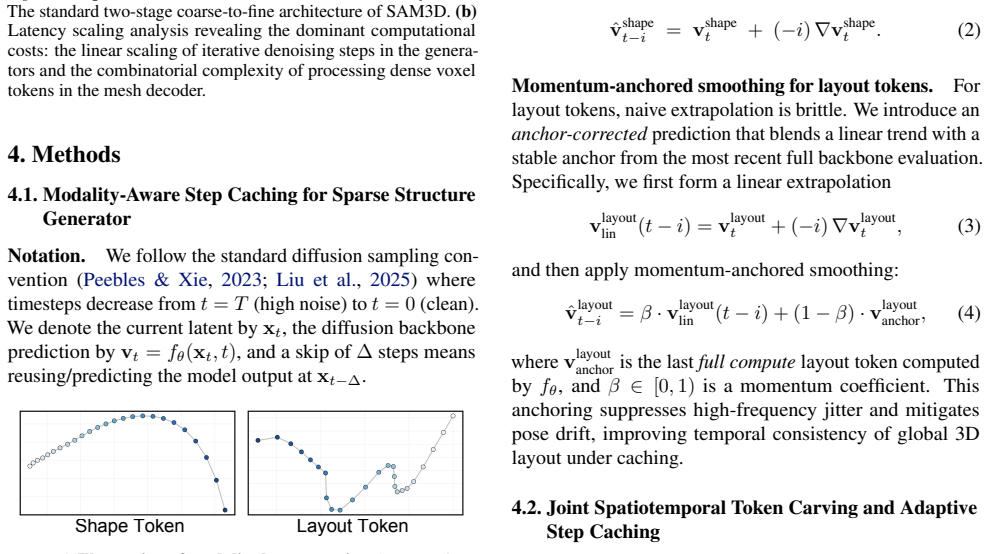
Three hand-designed modules carry the argument. Modality-Aware Step Caching splits diffusion tokens into shape and layout, extrapolating shape with a first-order finite difference while anchoring layout with momentum smoothing to prevent pose drift. Joint Spatiotemporal Token Carving computes a per-token saliency potential from temporal change and FFT spatial frequency, keeping only the top 10% of tokens each denoising step, and optionally skipping steps when a curvature proxy stays below a threshold. Spectral-Aware Token Aggregation computes a high-frequency energy ratio from the 2D mask and 3D voxel grid, then adaptively quantizes token coordinates (factor S) and max-pools the bins.
What would settle it
Compute the correlation between Ji(t) and the actual next-step token update magnitude across a diverse shape set; if the correlation is low on complex objects, the carving target is wrong and fidelity could fail. A simpler falsifier: run Fast-SAM3D with the carving mask inverted (prune the most-salient tokens, keep the least) at the same 10% ratio; if F1/vIoU do not drop substantially, saliency is not the reason fidelity is preserved.
Extended reading notes
Core claim
The paper's central claim is that SAM3D's prohibitive latency can be reduced by up to 2.67x without retraining by matching compute to the instantaneous complexity of generation. The authors identify three sources of redundancy: smooth shape-token evolution, sparse high-entropy refinement in the latent stage, and low-frequency-dominated simple objects in mesh decoding. Fast-SAM3D therefore learns nothing—it uses three hand-designed mechanisms to dynamically decide which steps, which tokens, and which grid resolutions to compute. The combination reportedly lifts F1@0.05 from 92.34 to 92.59 and vIoU from 0.543 to 0.552 while cutting scene time to 229.7s and object time to 11.60s.
Load-bearing premise
The paper's fidelity guarantee rests on the assumption that the hand-weighted saliency score Ji(t)—a mix of token update magnitude, abruptness, and FFT spatial frequency—accurately predicts which tokens will change in upcoming denoising steps, so carving away the bottom 10% each step costs nothing; the only evidence offered is qualitative, not a quantitative correlation.
Editorial extensions
If this is right
- Object-level inference time drops from 31.04s to 11.60s and scene-level from 462.3s to 229.7s, bringing single-view 3D reconstruction closer to interactive use.
- Fidelity is not traded away: F1@0.05 and vIoU improve slightly, suggesting saliency-based pruning can act as a denoiser rather than a lossy shortcut.
- Generic accelerators (uniform step skipping, random token drop, multi-view cache) underperform here, so stage- and instance-adaptive allocation appears necessary for single-view 3D diffusion.
- The three modules are complementary; the spectral aggregation stage alone contributes the largest single latency cut (462s to 320s).
- The training-free design means the speedup transfers directly to any deployment of the base model without fine-tuning.
Reading between the lines
- The heterogeneity principle likely transfers to other multi-stage 3D diffusion and video-diffusion pipelines with similar layout-versus-content token splits; the paper only demonstrates it on SAM3D.
- The 'denoising effect' suggests a testable extension: aggressively carving low-saliency tokens on noisy inputs may regularize outputs, potentially improving robustness beyond speed.
- Because the saliency potential is hand-weighted with a fixed 10% carving rate, a self-calibrating variant could set both from online trajectory curvature and token entropy, removing manual hyperparameters.
Editorial analysis
A structured set of objections, weighed in public.
Referee Report
Summary. The paper proposes Fast-SAM3D, a training-free acceleration framework for the SAM3D single-view 3D reconstruction pipeline. It combines three modules: modality-aware step caching for the sparse structure generator (Eqs. 1-4), joint spatiotemporal token carving with adaptive step caching for the sparse latent generator (Eqs. 5-12), and spectral-aware token aggregation for mesh decoding (Eqs. 13-18). Experiments on Toys4K, ADT, and ISO3D report up to 2.67x object-level and 2.01x scene-level speedups, with F1@0.05 and vIoU slightly improving, while the Uni3D perceptual score drops from 0.369 to 0.350. Ablations are provided for each module and for the main hyperparameters (k, β, E, γ, K, τ, w).
Significance. If the fidelity claims hold, this would be a practically valuable contribution: it is training-free, addresses a real deployment bottleneck in a recent open-world 3D reconstruction model, and provides a system-level view of where SAM3D spends its inference time. The paper ships code and includes detailed profiling and ablations, which is commendable. However, the central token-carving signal is underspecified and the evaluation protocol raises concerns about benchmark overfitting and statistical reliability. These issues must be resolved before the headline claims can be accepted as stated.
major comments (3)
- [Sec. 4.2.1, Eq. (6)] The spatial saliency term S_freq(i) is never defined. The text only says it is a 'lightweight frequency-based complexity score' computed via 'FFT statistics'. Since S_freq carries a fixed 0.5 weight in every pruning decision, the behavior of the unified importance potential J_i(t) cannot be independently checked or reproduced from the manuscript. Fig. 9 provides only qualitative side-by-side visualization, with no correlation coefficient, rank correlation, or top-K recall against the oracle next-step change ||v_t - v_{t-1}||. This is load-bearing because Table 7 shows the carving percentage materially changes F1 (92.59 at 10% vs. 90.25 at 20%). Please provide the exact formula for S_freq (including the input signal, FFT window/normalization, and frequency weighting) and quantitative validation of the saliency proxy against the oracle over a sample of instances.
- [Sec. 5, Tables 2-10] The headline results are obtained with hyperparameters selected via ablations on the same small test sets used for the final table: 600 Toys4K views, 16 ADT views, and 101 ISO3D views. The sweep covers β, k, E, γ, K, τ_low/τ_high, and w, all tuned on the exact benchmarks reported. This makes the 'best' fidelity numbers partly a product of benchmark selection, and no error bars or repeated runs are provided. For the central claim of 'negligible fidelity loss,' please report standard deviations or per-instance statistics, and use either a validation split for hyperparameter selection or a held-out test split. The ADT layout conclusions in particular rest on only 16 views, which is very small for claims about scene-level speed and layout accuracy.
- [Table 2 / Abstract] The 'negligible fidelity loss' claim is not supported across all reported metrics. The Uni3D perceptual score drops from 0.369 (SAM3D) to 0.350 (Fast-SAM3D), a relative decrease of about 5%, while the text highlights only the improvements in F1@0.05 and vIoU. If this drop is within expected noise, that must be demonstrated with error bars; otherwise the abstract and conclusion should be revised to report a fidelity trade-off rather than negligible loss. This concern directly affects the central claim of the paper.
minor comments (4)
- [Sec. 4.2.1 / Eq. (12) / Table 7] The meaning of 'top-K' is inconsistent. Section 4.2.1 says 'keep only the top-K tokens' (i.e., K is the number of active tokens), but Table 7 and Appendix C.2 describe K as the 'ratio of tokens pruned per step.' Appendix A.3 says 'cache top 0.1× tokens,' which is ambiguous. Please unify the notation and clarify whether the default keeps 10% or prunes 10% of tokens.
- [Eq. (13)] F3D = FFT(V3D) should be written as a 3D FFT (e.g., FFT3) for consistency with F2D = FFT2(M2D).
- [Table 1 / Appendix A.3] There are small typographical issues: 'V olumetric IoU' in Table 1, 'NVIDIA-A800' should be 'NVIDIA A800', and 'Random Drop' in the caption of Fig. 7 is missing a space. These are cosmetic but should be fixed.
- [Appendix A.3] The sentence 'we cache top 0.1× tokens for spatiotemporal carving' should be rephrased to be consistent with the pruning ratio used in the method, e.g., 'we carve 10% of tokens per step.'
Circularity Check
No circularity found: the speedup/fidelity claims are empirical measurements against external benchmarks; the underspecified S_freq term is a reproducibility weakness, not a circular reduction.
full rationale
The central claim (up to 2.67× speedup with negligible fidelity loss) is an empirical timing/quality measurement on Toys4K, ADT, and ISO3D relative to the unmodified SAM3D backbone; it is not derived from the method's equations, so it cannot reduce to its inputs by construction. The three modules are engineering heuristics: Eq. (1)-(4) is finite-difference extrapolation with anchor smoothing and an error-bounded refresh rule Eq. (10)-(12); Eq. (6) defines a saliency score used to choose tokens; Eq. (13)-(18) computes an HFER-based grid schedule. None of these modules takes the reported fidelity metrics as an input or fits a parameter so that a headline number is mathematically forced. The saliency 'prediction' is only validated qualitatively (Fig. 9) and S_freq(i) is never given a closed form, so the carving mechanism is underspecified and the fidelity claim is not fully independently checkable from the paper text; this is a missing specification/evaluation-integrity issue, not circularity. Hyperparameters (β, k, E, γ, K, τ, w) are ablated on the same datasets used for the main tables (Tabs 4-10), which risks selecting numbers on the evaluation set; this is an overfitting/benchmark-integrity limitation and should be addressed, but the headline remains an empirical result rather than a prediction forced by construction. Self-citations (Feng et al. 2025a-e) appear only in related-work background and are not load-bearing for any derivation. No uniqueness theorem or ansatz is imported from the authors' prior work. Therefore no circular step meets the evidentiary bar in the instructions.
Assumptions & free parameters
free parameters (8)
- cache stride k =
3
- momentum factor β =
0.5
- switching threshold E =
1.5
- carving factor γ =
0.7
- top-K carving ratio =
10%
- merging thresholds τ_low/τ_high =
{0.5, 0.7}
- complexity weight w =
0.9
- warmup steps =
2
assumptions (7)
- domain assumption Shape and layout token trajectories exhibit the heterogeneity claimed by the paper (smooth vs volatile).
- domain assumption First-order Taylor/finite-difference extrapolation of shape tokens is valid over the cache stride k=3.
- domain assumption The unified saliency potential Ji(t) in Eq. 6 predicts future per-token update magnitude.
- domain assumption Diffusion trajectory contains quasi-linear regimes where tangent update reuse (∆i) is stable.
- domain assumption High-frequency energy ratio of 2D mask and coarse 3D voxel grid correlates with per-instance mesh decoding complexity.
- domain assumption Max-pooling over quantized coordinate bins preserves features needed by the downstream mesh decoder.
- standard math FFT-based spectral energy decomposition (DFT) is applied as standard signal processing.
Cite this review
Pith. "Pith review of Fast-SAM3D: 3Dfy Anything in Images but Faster." pith.science (2026). https://pith.science/paper/G4VUWEEK
@misc{pith2026260205293,
  author       = {Pith},
  title        = {Pith review of: Fast-SAM3D: 3Dfy Anything in Images but Faster},
  year         = {2026},
  howpublished = {\url{https://pith.science/paper/G4VUWEEK}},
  note         = {Machine review of arXiv:2602.05293}
}
abstract
SAM3D enables scalable, open-world 3D reconstruction from complex scenes, yet its deployment is hindered by prohibitive inference latency. In this work, we conduct the \textbf{first systematic investigation} into its inference dynamics, revealing that generic acceleration strategies are brittle in this context. We demonstrate that these failures stem from neglecting the pipeline's inherent multi-level \textbf{heterogeneity}: the kinematic distinctiveness between shape and layout, the intrinsic sparsity of texture refinement, and the spectral variance across geometries. To address this, we present \textbf{Fast-SAM3D}, a training-free framework that dynamically aligns computation with instantaneous generation complexity. Our approach integrates three heterogeneity-aware mechanisms: (1) \textit{Modality-Aware Step Caching} to decouple structural evolution from sensitive layout updates; (2) \textit{Joint Spatiotemporal Token Carving} to concentrate refinement on high-entropy regions; and (3) \textit{Spectral-Aware Token Aggregation} to adapt decoding resolution. Extensive experiments demonstrate that Fast-SAM3D delivers up to \textbf{2.67$\times$} end-to-end speedup with negligible fidelity loss, establishing a new Pareto frontier for efficient single-view 3D generation. Our code is released in https://github.com/wlfeng0509/Fast-SAM3D.
Figures


Figures from the paper (9 more)


Reference graph
Works this paper leans on
-
[2]
2 Liu, J., Zou, C., Lyu, Y ., Chen, J., and Zhang, L. From reusing to forecasting: Accelerating diffusion models with taylorseers.arXiv preprint arXiv:2503.06923, 2025. 2, 4, 7, 8, 13 Liu, M., Xu, C., Jin, H., Chen, L., Varma T, M., Xu, Z., and Su, H. One-2-3-45: Any single image to 3d mesh in 45 seconds without per-shape optimization.Advances in Neural I...
arXiv 2025
-
[4]
3 Pan, X., Charron, N., Yang, Y ., Peters, S., Whelan, T., Kong, C., Parkhi, O., Newcombe, R., and Ren, Y . C. Aria digital twin: A new benchmark dataset for egocentric 3d machine perception. InProceedings of the IEEE/CVF International Conference on Computer Vision, pp. 20133– 20143, 2023. 7, 12 Peebles, W. and Xie, S. Scalable diffusion models with trans...
2023
-
[5]
4 Shen, Y ., Zhang, Z., Qu, Y ., and Cao, L. Fastvggt: Training- free acceleration of visual geometry transformer.arXiv preprint arXiv:2509.02560, 2025. 3 Stojanov, S., Thai, A., and Rehg, J. M. Using shape to categorize: Low-shot learning with an explicit shape bias. InProceedings of the IEEE/CVF conference on computer vision and pattern recognition, pp....
arXiv 2025
-
[111]
Springer, 1981. 5 Oquab, M., Darcet, T., Moutakanni, T., V o, H., Szafraniec, M., Khalidov, V ., Fernandez, P., Haziza, D., Massa, F., El- Nouby, A., et al. Dinov2: Learning robust visual features without supervision.arXiv preprint arXiv:2304.07193,
arXiv 1981
-
[2023]
J., Sax, A., Tang, H., Wang, W., Guo, M., Hardin, T., Li, X., et al
2, 6 Chen, X., Chu, F.-J., Gleize, P., Liang, K. J., Sax, A., Tang, H., Wang, W., Guo, M., Hardin, T., Li, X., et al. Sam 3d: 3dfy anything in images.arXiv preprint arXiv:2511.16624, 2025. 1, 2, 3, 6, 7, 18 Dao, T., Nguyen, T. H., Le, T., Vu, D., Nguyen, K., Pham, C., and Tran, A. Swiftbrush v2: Make your one-step diffusion model better than its teacher. ...
arXiv 2025
-
[2024]
2 Xiang, J., Chen, X., Xu, S., Wang, R., Lv, Z., Deng, Y ., Zhu, H., Dong, Y ., Zhao, H., Yuan, N. J., et al. Native and compact structured latents for 3d generation.arXiv preprint arXiv:2512.14692, 2025a. 2 Xiang, J., Lv, Z., Xu, S., Deng, Y ., Wang, R., Zhang, B., Chen, D., Tong, X., and Yang, J. Structured 3d latents for scalable and versatile 3d gener...
arXiv 2019
Reviewed August 3, 2026 · model on record in the stance chip above.
Discussion (0). Sign in to comment.