REVIEW 3 major objections 4 minor 48 references
RAGOCR: Optical Compression of Retrieval-Augmented Text via Visual Representation
T0 review · 3 major / 4 minor · reviewed 2026-08-05 · deepseek-v4-flash
Pith's one-line read Rendering retrieved documents as images and compressing each according to query relevance gives RAG higher accuracy with one-eighth the tokens, and the compression ratios themselves rank passages.
desk verdict Interesting idea (query-aware optical compression with GRPO, ratio-as-reranker), but the reported numbers don't add up and the manuscript text is corrupted; it needs a full redo before it can be taken seriously. read the letter →
The pith
A machine-rendered reading of the paper's core claim, the machinery that carries it, and where it could break.
The reading
What carries the argument
The central object is the query-aware optical compressor: a lightweight vision-language model that sees the question and every rendered document image in one forward pass and emits a compression factor per image. GRPO (Group Relative Policy Optimization) trains it with a reward that is positive only when the frozen generator gives the correct answer, plus a compression bonus that is sparse and active only on correct answers. Each factor rescales the image, reducing visual tokens by the factor; the inverse of the factor doubles as a relevance score, so the same model compresses and reranks.
What would settle it
Use the trained compressor with a different fixed vision-language generator at inference time, no retraining, on the same five benchmarks; if the accuracy advantage over naive RAG disappears, the gains come from the generator's image-reading ability rather than from the query-aware allocation itself.
Extended reading notes
Core claim
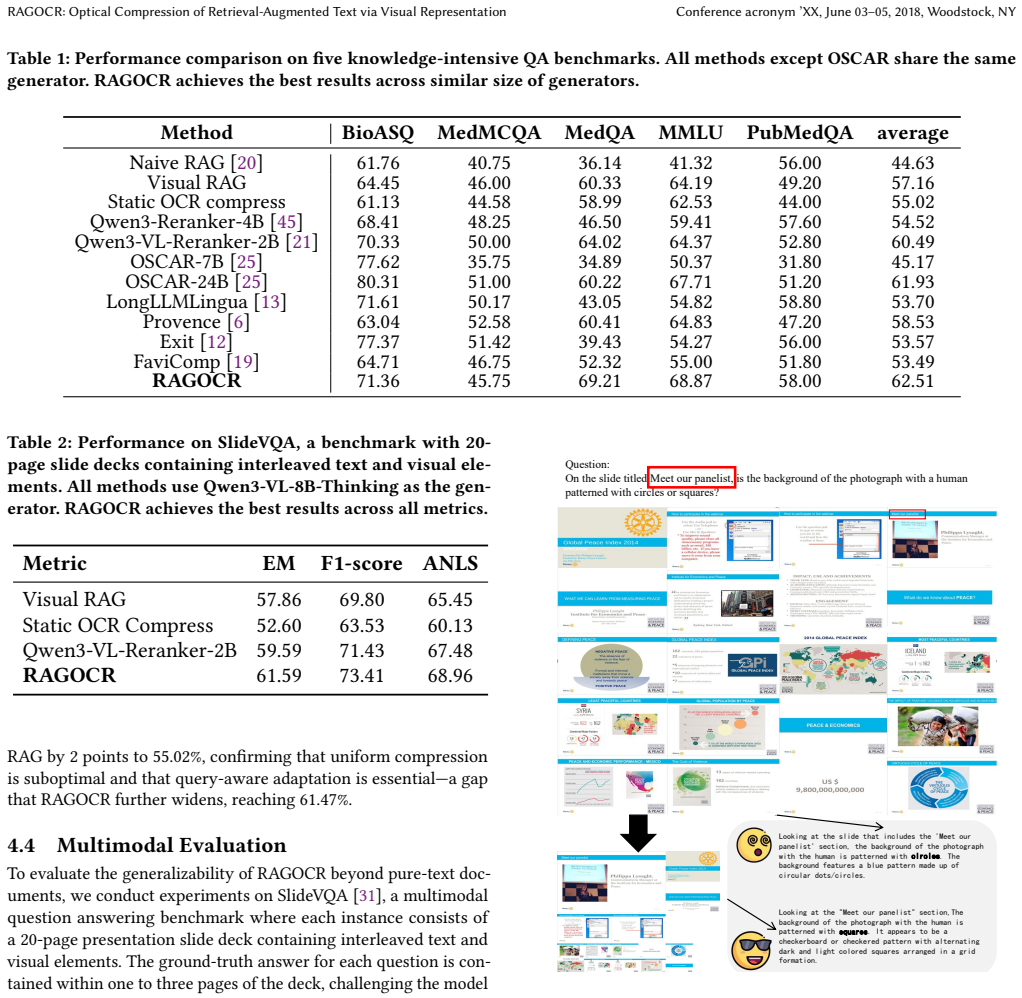
Central claim: rendering retrieved documents as images and shrinking each by a query-dependent factor compresses RAG context while improving accuracy. A small vision-language compressor, trained with GRPO, outputs one compression factor per document; a reward checks whether a frozen generator answers correctly from the compressed images, so the policy learns to keep resolution where the answer lives. On five medical QA benchmarks over MedOmniKB, the paper reports 61.47% average accuracy with 2,284 RAG tokens per case versus 44.63% with 17,914 tokens for naive RAG. The same factors rank documents: inverse compression beats a dedicated 4B reranker, and combining them improves further. On slide
Load-bearing premise
The load-bearing premise is that the compressor's resolution choices, learned from answer-correctness rewards with a sparse compression bonus, transfer across datasets and generators instead of overfitting to the pattern of correct answers in the training splits.
Editorial extensions
If this is right
- Retrieval depth stops being the main cost driver: a RAG system can take in many more documents than before because each one is cheap in visual tokens, and the compressor decides what deserves detail.
- A compressor and a reranker can be merged into one model; the paper shows the compression ratios rank passages better than a pointwise reranker and combine additively with it.
- Uniform compression hurts accuracy, so resolution allocation is the active ingredient: the paper reports 55.02% accuracy for static compression versus 61.47% for the query-aware version.
- The approach extends past plain text to slide decks and other image-rich documents, improving exact match and F1 over full-resolution visual input.
- Because rendering is deterministic and independent of the query, it can be precomputed, so the only per-query overhead is one lightweight compressor pass before the generator.
Reading between the lines
- If the listwise ranking signal generalizes, a single model could serve as both compressor and reranker for any text-first RAG pipeline, since the exact same forward pass provides both functions.
- The same resolution-allocation policy could in principle be applied to documents that have no clean text tokenization—tables, charts, scans, or mixed-media pages—where text-level compression has no direct analogue.
- A direct test of the reward design's stability would be to retrain the compressor on a different corpus or with a smaller generator and check whether the per-document ratios remain interpretable as relevance scores.
Editorial analysis
A structured set of objections, weighed in public.
Referee Report
Summary. The paper proposes RAGOCR, a framework that renders retrieved documents as images and trains a lightweight vision-language compressor via GRPO to assign query-dependent compression ratios, so that relevant passages are preserved at higher resolution and peripheral passages are aggressively downscaled. The compressed images are fed to a frozen VLM generator. The authors claim that RAGOCR surpasses naive RAG by over 15% in accuracy while using roughly one-eighth of the input tokens, that it consistently outperforms hard and soft compression baselines, that it generalizes to multimodal slide decks, and that the learned compression ratios can serve as an effective reranking signal. The submission includes experiments on five medical QA benchmarks using the MedOmniKB retrieval corpus and on SlideVQA.
Significance. If the reported results were reliable, the core idea would be valuable: using visual rendering as a high-density compression channel for RAG, conditioning the compression on the query, and obtaining a relevance ranking as a by-product. The paper does not release code or data, however, and the central quantitative claims are not internally consistent: the paper's own tables and text report mutually incompatible averages. Because the headline contributions rest entirely on these numbers, the significance of the work cannot be assessed from the submitted evidence. The conceptual contribution is interesting, but the evaluation as presented is not trustworthy.
major comments (3)
- [§4.3, Table 1, §4.5, Table 3, Table 4] The reported accuracy averages are internally inconsistent. Table 1 lists RAGOCR per-benchmark accuracies (71.36, 45.75, 69.21, 68.87, 58.00) whose arithmetic mean is 62.64, while the table prints 62.51 and the text repeatedly cites 61.47 (§4.3, and also in §4.6 for the w=800 configuration). In §4.5, 'R&R' is said to achieve 63.60%, but Table 3's row (73.7, 51.3, 67.6, 70.8, 61.6) averages 65.00; 'As Reranker' is said to achieve 59.15% but its row averages 59.06; 'compress' is said to achieve 60.10% but its row averages 58.74. Table 4's text values (59.85, 61.47, 62.74) also do not match the arithmetic means of the corresponding rows (60.24, 62.64, 64.08). Since these numbers are the basis for the 'over 15% over naive RAG' and 'consistent outperformance' claims, the evaluation cannot be considered reliable as submitted.
- [Abstract, §4.3, Table 1] The abstract and conclusion state that RAGOCR 'consistently outperforms' hard and soft compression baselines. Table 1 directly contradicts this: OSCAR-24B exceeds RAGOCR on BioASQ (80.31 vs 71.36) and MedMCQA (51.00 vs 45.75). The §4.3 discussion narrows the claim to 'methods that share the same generator backbone,' but that qualification is absent from the abstract, the introduction, and the conclusion. The paper should either remove the unqualified claim or present a comparison that is controlled for generator capacity and training setup.
- [§3.4, Eq. (13); §3.5; §4.5] The claim that the compressor's inverse compression ratios 'naturally' serve as relevance scores and outperform dedicated rerankers is not established by the training objective. In Eq. (13), the compression reward is nonzero only when r_task = 1, and it is an aggregate reward over all documents; there is no per-passage relevance supervision. The policy can increase the objective by preserving exactly the passages needed for a correct answer on the training questions, without learning a general notion of passage relevance. To support the emergent-reranker claim, the paper needs a direct analysis or ablation, for example correlation of inverse ratios with human relevance judgments, comparison against random compression-ratio assignment, or a per-passage supervised baseline. As written, the evidence is consistent with the compressor having overfit to answer patterns rather than learned a ge
minor comments (4)
- [§4.2] 'These two methods remain top-k=5 documents' should read 'retain the top-5 documents'.
- [Tables 3 and 4] The tables report 'weighted average' accuracy, but no weights are specified anywhere in the text. Without the weights, the reader cannot verify the reported averages, especially given the arithmetic inconsistencies noted above.
- [§4.4] The SlideVQA training details are incomplete: no training-set size, number of GRPO steps, or hyperparameters are given. The claim in Figure 3 that RAGOCR 'precisely preserved the resolution of this image almost unchanged' is not quantified.
- [Front matter] The manuscript's full text contains a long medical retrieval passage and the phrase 'LOST IN MIDDLELLM' before the title. If this text is not intended content, it should be removed before any resubmission.
Circularity Check
Compressor-as-reranker claim is partly by construction (reward directly optimizes answer correctness), but the main compression-efficiency result is self-contained.
-
fitted input called prediction
[§3.4 Eq. (13) and §3.5 'Compressor as reranker'; evaluated in §4.5]
"r_comp = (1/N Σ log c_i, if r_task=1, 0 otherwise). This design prevents the model from trivially maximizing compression at the expense of task performance. ... Since the compressor learns to assign lower compression ratios to more query-relevant passages, the inverse of the compression factor s_i = 1/c_i naturally serves as a relevance score."
The only link between the compressor's per-image ratios and passage relevance is the training reward: r_task=1 iff the fixed generator answers correctly from the compressed images, and the compression bonus is nonzero only when r_task=1. Thus the policy is optimized, by construction, to give more visual budget to passages whose preservation makes the correct answer more likely. Presenting 1/c_i as an 'emergent' relevance signal that 'surprisingly' outperforms a reranker is therefore a fitted input called a prediction: the ranking is a direct product of the answer-correctness reward, not an independent discovery. The main compression accuracy/efficiency comparison is empirical and not circular, which is why the overall score is moderate.
full rationale
The core RAGOCR pipeline is self-contained: a GRPO-trained compressor is rewarded for preserving enough detail for a fixed generator to answer correctly, and the resulting accuracy/token trade-off is measured against external baselines on held-out benchmarks. That central claim is not circular. However, the paper's secondary but prominent claim that compression ratios 'inherently encode passage relevance' and can serve as a reranker is substantially by construction: Eq. (13) activates the compression reward only when r_task=1, i.e., only when the compressed images already enabled a correct answer, so the learned ratios are explicitly fitted to answer correctness. Calling this an 'emergent' or 'surprisingly effective' reranking signal overstates what the training objective already encodes. I did not find load-bearing self-citation, imported uniqueness theorems, or ansatz-smuggling via citation. Separately, the reported numbers contain internal inconsistencies (Table 1 row average 62.51 vs §4.3's 61.47; OSCAR-24B beats RAGOCR on BioASQ and MedMCQA, contradicting the abstract's 'consistently outperforms'), but those are correctness/consistency issues, not circularity, and I have not counted them in the circularity score.
Assumptions & free parameters
free parameters (5)
- Maximum canvas width w =
800 (or 1600 in ablation; Table 1 uses 800x918 per Section 4.6)
- Font size f =
12
- Compression reward weight lambda =
Not disclosed
- Format reward weight alpha =
Not disclosed
- Sparse injection schedule for compression reward =
Not specified
assumptions (4)
- domain assumption Visual tokens carry higher information density than text tokens.
- domain assumption The fixed generator Qwen3-VL-8B-Thinking can answer correctly from compressed images.
- domain assumption The MedOmniKB retrieval corpus returns documents whose relevance is well captured by the learned compression ratios.
- standard math GRPO with the stated reward design is a valid and stable optimizer for the compressor.
Cite this review
Pith. "Pith review of RAGOCR: Optical Compression of Retrieval-Augmented Text via Visual Representation." pith.science (2026). https://pith.science/paper/G5LAUIJF
@misc{pith2026260800765,
  author       = {Pith},
  title        = {Pith review of: RAGOCR: Optical Compression of Retrieval-Augmented Text via Visual Representation},
  year         = {2026},
  howpublished = {\url{https://pith.science/paper/G5LAUIJF}},
  note         = {Machine review of arXiv:2608.00765}
}
read the original abstract
Retrieval-Augmented Generation (RAG) has become essential for knowledge-intensive question answering, yet scaling RAG pipelines remains challenging due to the prohibitive computational cost of processing lengthy retrieved contexts. Existing compression approaches face a fundamental trade-off: hard compression methods operate online in a query-aware fashion but achieve only modest compression rates and typically require fine-tuning the generative model, while soft compression methods attain higher ratios but rely on costly offline encoding that is entirely agnostic to the input query. To bridge this gap, we introduce RAGOCR, a novel framework that compresses retrieved documents into compact visual representations conditioned on the input query. To further balance compression rate and information fidelity, we introduce a query-aware dynamic resolution mechanism that adaptively allocates visual granularity based on each document's estimated relevance and complexity: highly relevant passages are rendered at higher resolution to preserve fine-grained details, while peripheral documents are aggressively compressed at lower resolution. Experiments on five QA benchmarks using the MedOmniKB retrieval corpus demonstrate that RAGOCR surpasses naive RAG by over 15\% in accuracy while requiring only one-eighth the number of input tokens, and consistently outperforms both hard and soft compression baselines across varying retrieval depths.
Figures


Reference graph
Works this paper leans on
-
[1]
Jinze Bai, Shuai Bai, Shusheng Yang, Shijie Wang, Sinan Tan, Peng Wang, Junyang Lin, Chang Zhou, and Jingren Zhou. 2023. Qwen-VL: A Versatile Vision-Language Model for Understanding, Localization, Text Reading, and Beyond.arXiv preprint arXiv:2308.12966(2023)
arXiv 2023
-
[2]
Shuai Bai, Keqin Chen, Xuejing Liu, Jialin Wang, Wenbin Ge, Sibo Song, Kai Dang, Peng Wang, Shijie Wang, Jun Tang, Humen Zhong, Yuanzhi Zhu, Mingkun Yang, Zhaohai Li, Jianqiang Wan, Pengfei Wang, Wei Ding, Zheren Fu, Yiheng Xu, Jiabo Ye, Xi Zhang, Tianbao Xie, Zesen Cheng, Hang Zhang, Zhibo Yang, Haiyang Xu, and Junyang Lin. 2025. Qwen2.5-VL Technical Rep...
arXiv 2025
-
[3]
Zhe Chen, Yusheng Liao, Shuyang Jiang, Pingjie Wang, Yiqiu Guo, Yanfeng Wang, and Yu Wang. 2025. Towards omni-rag: Comprehensive retrieval-augmented generation for large language models in medical applications. InProceedings of the 63rd Annual Meeting of the Association for Computational Linguistics (Volume 1: Long Papers). 15285–15309
work page 2025
-
[4]
Jiale Cheng, Yusen Liu, Xinyu Zhang, Yulin Fei, Wenyi Hong, Ruiliang Lyu, Weihan Wang, Zhe Su, Xiaotao Gu, Xiao Liu, et al. 2025. Glyph: Scaling context windows via visual-text compression.arXiv preprint arXiv:2510.17800(2025)
arXiv 2025
-
[5]
Xin Cheng, Xun Wang, Xingxing Zhang, Tao Ge, Si-Qing Chen, Furu Wei, Huishuai Zhang, and Dongyan Zhao. 2024. xrag: Extreme context compres- sion for retrieval-augmented generation with one token.Advances in Neural Information Processing Systems37 (2024), 109487–109516
2024
-
[6]
Nadezhda Chirkova, Thibault Formal, Vassilina Nikoulina, and Stéphane Clin- chant. 2025. Provence: efficient and robust context pruning for retrieval- augmented generation.arXiv preprint arXiv:2501.16214(2025)
arXiv 2025
-
[7]
Yufeng Du, Minyang Tian, Srikanth Ronanki, Subendhu Rongali, Sravan Bodapati, Aram Galstyan, Azton Wells, Roy Schwartz, Eliu A Huerta, and Hao Peng. 2025. Context length alone hurts LLM performance despite perfect retrieval.arXiv preprint arXiv:2510.05381(2025)
arXiv 2025
-
[8]
Kelvin Guu, Kenton Lee, Zora Tung, Panupong Pasupat, and Mingwei Chang. 2020. Retrieval augmented language model pre-training. InInternational conference on machine learning. PMLR, 3929–3938
2020
Show all 48 references
-
[9]
Dan Hendrycks, Collin Burns, Steven Basart, Andrew Critch, Jerry Li, Dawn Song, and Jacob Steinhardt. 2021. Aligning AI With Shared Human Values.Proceedings of the International Conference on Learning Representations (ICLR)(2021)
2021
-
[10]
Dan Hendrycks, Collin Burns, Steven Basart, Andy Zou, Mantas Mazeika, Dawn Song, and Jacob Steinhardt. 2021. Measuring Massive Multitask Language Under- standing.Proceedings of the International Conference on Learning Representations (ICLR)(2021)
2021
-
[11]
Jerry Huang, Siddarth Madala, Risham Sidhu, Cheng Niu, Hao Peng, Julia Hocken- maier, and Tong Zhang. 2025. Rag-rl: Advancing retrieval-augmented generation via rl and curriculum learning.arXiv preprint arXiv:2503.12759(2025)
2025 arXiv
-
[12]
Taeho Hwang, Sukmin Cho, Soyeong Jeong, Hoyun Song, SeungYoon Han, and Jong C Park. 2025. Exit: Context-aware extractive compression for enhancing retrieval-augmented generation. InFindings of the Association for Computational Linguistics: ACL 2025. 4895–4924
2025
-
[13]
Huiqiang Jiang, Qianhui Wu, , Xufang Luo, Dongsheng Li, Chin-Yew Lin, Yuqing Yang, and Lili Qiu. 2024. LongLLMLingua: Accelerating and Enhancing LLMs in Long Context Scenarios via Prompt Compression. InProceedings of the 62nd Annual Meeting of the Association for Computational...
2024
-
[14]
Huiqiang Jiang, Qianhui Wu, Chin-Yew Lin, Yuqing Yang, and Lili Qiu. 2023. LLM- Lingua: Compressing Prompts for Accelerated Inference of Large Language Mod- els. InProceedings of the 2023 Conference on Empirical Methods in Natural Language Processing, Houda Bouamor, Juan Pino,...
2023 doi
-
[15]
Huiqiang Jiang, Qianhui Wu, Xufang Luo, Dongsheng Li, Chin-Yew Lin, Yuqing Yang, and Lili Qiu. 2024. Longllmlingua: Accelerating and enhancing llms in long context scenarios via prompt compression. InProceedings of the 62nd Annual Meeting of the Association for Computational L...
2024
-
[16]
Bowen Jin, Hansi Zeng, Zhenrui Yue, Jinsung Yoon, Sercan Arik, Dong Wang, Hamed Zamani, and Jiawei Han. 2025. Search-r1: Training llms to reason and leverage search engines with reinforcement learning.arXiv preprint arXiv:2503.09516(2025)
2025 arXiv
-
[17]
Di Jin, Eileen Pan, Nassim Oufattole, Wei-Hung Weng, Hanyi Fang, and Peter Szolovits. 2021. What disease does this patient have? a large-scale open domain question answering dataset from medical exams.Applied Sciences11, 14 (2021), 6421
2021
-
[18]
Qiao Jin, Bhuwan Dhingra, Zhengping Liu, William Cohen, and Xinghua Lu
-
[19]
Dongwon Jung, Qin Liu, Tenghao Huang, Ben Zhou, and Muhao Chen. 2024. Familiarity-aware evidence compression for retrieval-augmented generation. arXiv preprint arXiv:2409.12468(2024)
2024
-
[20]
Patrick Lewis, Ethan Perez, Aleksandra Piktus, Fabio Petroni, Vladimir Karpukhin, Naman Goyal, Heinrich Küttler, Mike Lewis, Wen-tau Yih, Tim Rocktäschel, et al. 2020. Retrieval-augmented generation for knowledge-intensive nlp tasks. Advances in neural information processing s...
2020
-
[21]
Mingxin Li, Yanzhao Zhang, Dingkun Long, Chen Keqin, Sibo Song, Shuai Bai, Zhibo Yang, Pengjun Xie, An Yang, Dayiheng Liu, Jingren Zhou, and Junyang Lin. 2026. Qwen3-VL-Embedding and Qwen3-VL-Reranker: A Unified Frame- work for State-of-the-Art Multimodal Retrieval and Ranking...
2026 arXiv
-
[22]
Abdi, Yuqing Yang, and Lili Qiu
Yucheng Li, Surin Ahn, Huiqiang Jiang, Amir H. Abdi, Yuqing Yang, and Lili Qiu
-
[23]
Nelson F Liu, Kevin Lin, John Hewitt, Ashwin Paranjape, Michele Bevilacqua, Fabio Petroni, and Percy Liang. 2024. Lost in the middle: How language models use long contexts.Transactions of the association for computational linguistics12 (2024), 157–173
2024
-
[24]
Maxime Louis, Hervé Déjean, and Stéphane Clinchant. 2025. Pisco: Pretty simple compression for retrieval-augmented generation. InFindings of the Association for Computational Linguistics: ACL 2025. 15506–15521
2025
-
[25]
Maxime Louis, Thibault Formal, Hervé Dejean, and Stéphane Clinchant. 2025. Oscar: Online soft compression and reranking.arXiv preprint arXiv:2504.07109 (2025)
2025
-
[26]
Ankit Pal, Logesh Kumar Umapathi, and Malaikannan Sankarasubbu. 2022. Medmcqa: A large-scale multi-subject multi-choice dataset for medical domain question answering. InConference on health, inference, and learning. PMLR, 248– 260
2022
-
[27]
Zhuoshi Pan, Qianhui Wu, Huiqiang Jiang, Menglin Xia, Xufang Luo, Jue Zhang, Qingwei Lin, Victor Rühle, Yuqing Yang, Chin-Yew Lin, et al. 2024. Llmlingua-2: Data distillation for efficient and faithful task-agnostic prompt compression. In Findings of the Association for Comput...
2024
-
[28]
Vicky Zhao, Lili Qiu, and Dongmei Zhang
Zhuoshi Pan, Qianhui Wu, Huiqiang Jiang, Menglin Xia, Xufang Luo, Jue Zhang, Qingwei Lin, Victor Ruhle, Yuqing Yang, Chin-Yew Lin, H. Vicky Zhao, Lili Qiu, and Dongmei Zhang. 2024. LLMLingua-2: Data Distillation for Efficient and Faithful Task-Agnostic Prompt Compression. InFi...
2024
-
[29]
Zhihong Shao, Peiyi Wang, Qihao Zhu, Runxin Xu, Junxiao Song, Xiao Bi, Haowei Zhang, Mingchuan Zhang, YK Li, Yang Wu, et al. 2024. Deepseekmath: Pushing the limits of mathematical reasoning in open language models.arXiv preprint arXiv:2402.03300(2024)
2024 arXiv
-
[30]
Weijia Shi, Sewon Min, Michihiro Yasunaga, Minjoon Seo, Richard James, Mike Lewis, Luke Zettlemoyer, and Wen-tau Yih. 2024. Replug: Retrieval-augmented black-box language models. InProceedings of the 2024 Conference of the North American Chapter of the Association for Computat...
2024
-
[31]
Ryota Tanaka, Kyosuke Nishida, Kosuke Nishida, Taku Hasegawa, Itsumi Saito, and Kuniko Saito. 2023. Slidevqa: A dataset for document visual question an- swering on multiple images. InProceedings of the AAAI Conference on Artificial Intelligence, Vol. 37. 13636–13645
2023
-
[32]
Qwen Team. 2025. Qwen3 Technical Report. arXiv:2505.09388 [cs.CL] https: //arxiv.org/abs/2505.09388
2025 arXiv
-
[33]
George Tsatsaronis, Georgios Balikas, Prodromos Malakasiotis, Ioannis Partalas, Matthias Zschunke, Michael R Alvers, Dirk Weissenborn, Anastasia Krithara, Ser- gios Petridis, Dimitris Polychronopoulos, et al. 2015. An overview of the BIOASQ large-scale biomedical semantic inde...
2015
-
[34]
Peng Wang, Shuai Bai, Sinan Tan, Shijie Wang, Zhihao Fan, Jinze Bai, Keqin Chen, Xuejing Liu, Jialin Wang, Wenbin Ge, Yang Fan, Kai Dang, Mengfei Du, Xuancheng Ren, Rui Men, Dayiheng Liu, Chang Zhou, Jingren Zhou, and Junyang Lin. 2024. Qwen2-VL: Enhancing Vision-Language Mode...
2024 arXiv
-
[35]
Zhengren Wang, Jiayang Yu, Dongsheng Ma, Zhe Chen, Yu Wang, Zhiyu Li, Feiyu Xiong, Yanfeng Wang, Linpeng Tang, Wentao Zhang, et al. 2025. Rare: Retrieval-augmented reasoning modeling.arXiv preprint arXiv:2503.23513(2025)
2025 arXiv
-
[36]
Haoran Wei, Yaofeng Sun, and Yukun Li. 2025. Deepseek-ocr: Contexts optical compression.arXiv preprint arXiv:2510.18234(2025)
2025 arXiv
-
[37]
Haoran Wei, Yaofeng Sun, and Yukun Li. 2026. DeepSeek-OCR 2: Visual Causal Flow.arXiv preprint arXiv:2601.20552(2026)
2026
-
[38]
Ling Xing, Alex Jinpeng Wang, Rui Yan, Xiangbo Shu, and Jinhui Tang. 2025. Vision-centric token compression in large language model.arXiv preprint arXiv:2502.00791(2025)
2025
-
[39]
Fangyuan Xu, Weijia Shi, and Eunsol Choi. 2023. Recomp: Improving retrieval- augmented lms with compression and selective augmentation.arXiv preprint arXiv:2310.04408(2023)
2023 arXiv
-
[40]
RenYe Yan, Jikang Cheng, Yaozhong Gan, Shikun Sun, You Wu, Yunfan Yang, Liang Ling, Jinlong Lin, Yeshuang Zhu, Jie Zhou, et al. 2025. Entropy-Adaptive Diffusion Policy Optimization with Dynamic Step Alignment. InProceedings of the IEEE/CVF International Conference on Computer ...
2025
-
[41]
Renye Yan, Jikang Cheng, Shikun Sun, Yi Sun, Wei Peng, Yaozhong Gan, You Wu, Ling Liang, Junliang Xing, and Yimao Cai. [n. d.]. MultiTune: Phase-Aware Multi-Objective Optimization for Diffusion Models. ([n. d.])
-
[42]
Renye Yan, Jikang Cheng, Shikun Sun, Yi Sun, You Wu, Wei Peng, Zongwei Wang, Ling Liang, Junliang Xing, and Yimao Cai. 2026. Do Less, Achieve More: Do We Need Every-Step Optimization for RL Fine-tuning of Diffusion Models?arXiv preprint arXiv:2605.15855(2026)
2026 arXiv
-
[43]
Renye Yan, Jikang Cheng, You Wu, Ling Liang, Wei Peng, Athanasios V Vasilakos, Qingyu Zhao, Yu Zhang, Ehsan Adeli, Kilian M Pohl, et al . 2026. Pixel-Space Diffusion Transformers.arXiv preprint arXiv:2607.17585(2026)
2026 arXiv
-
[44]
Le Zhang, Bo Wang, Xipeng Qiu, Siva Reddy, and Aishwarya Agrawal. 2025. Rearank: Reasoning re-ranking agent via reinforcement learning. InProceedings of the 2025 Conference on Empirical Methods in Natural Language Processing. 2458–2471
2025
-
[45]
Yanzhao Zhang, Mingxin Li, Dingkun Long, Xin Zhang, Huan Lin, Baosong Yang, Pengjun Xie, An Yang, Dayiheng Liu, Junyang Lin, Fei Huang, and Jingren Zhou
-
[48]
Qwen3 Embedding: Advancing Text Embedding and Reranking Through Foundation Models.arXiv preprint arXiv:2506.05176(2025)
2025 arXiv
-
[2019]
In Proceedings of the 2019 Conference on Empirical Methods in Natural Language Pro- cessing and the 9th International Joint Conference on Natural Language Processing (EMNLP-IJCNLP)
PubMedQA: A Dataset for Biomedical Research Question Answering. In Proceedings of the 2019 Conference on Empirical Methods in Natural Language Pro- cessing and the 9th International Joint Conference on Natural Language Processing (EMNLP-IJCNLP). 2567–2577
2019
-
[2025]
InSecond Conference on Language Modeling
SecurityLingua: Efficient Defense of LLM Jailbreak Attacks via Security- Aware Prompt Compression. InSecond Conference on Language Modeling. https: //openreview.net/forum?id=tybbSo6wba
Reviewed August 5, 2026 · model on record in the stance chip above.
Discussion (0). Sign in to comment.