REVIEW 3 major objections 5 minor 1 cited by
Perturbative QCD reveals the softening of matter in the cores of massive neutron stars
T0 review · 3 major / 5 minor · reviewed 2026-08-07 · deepseek-v4-flash
Pith's one-line read pQCD forces neutron-star cores to soften
desk verdict The analytic pQCD constraint propagation is the real contribution; the 'softening in massive NS cores' headline is real but conditional on how the EoS is modeled above the TOV density, and the abstract overstates it. read the letter →
The pith
A machine-rendered reading of the paper's core claim, the machinery that carries it, and where it could break.
The reading
What carries the argument
The load-bearing object is the set of integral constraints in the chemical-potential, density, and pressure space derived from three thermodynamic conditions: stability (the baryon density is a monotonically increasing function of chemical potential), causality (the squared speed of sound is at most one), and consistency (the pressure difference between the low- and high-density limits is fixed by the area under the density curve). With chiral effective field theory at roughly nuclear saturation density as the low-density limit and perturbative QCD at a chemical potential of 2.6 GeV (around 40 times nuclear saturation density) as the high-density limit, these conditions produce explicit allowed regions in the energy-density and pressure plane, plus a simple binary check for any equation of state terminated at some density. The Gaussian-process ensemble uses a transformed speed of sound as the regression variable, and the QCD likelihood is built by averaging or marginalizing over the renormalization scale and missing higher-order terms. This machinery converts a first-principles high-density calculation into a low-density constraint without any interpolation function.
What would settle it
Produce a single microphysical or phenomenological equation of state that satisfies all current astrophysical constraints, keeps the squared speed of sound above one third beyond the maximum stable density up to ten times nuclear saturation density, and still passes the consistency check against the perturbative QCD limit at a chemical potential of 2.6 GeV for any renormalization scale in the standard range; the paper predicts no such equation of state exists. Alternatively, a future precise measurement of the radius or tidal deformability of a roughly two-solar-mass neutron star that requires a stiff equation of state with a speed of sound above the conformal value at five times nuclear saturation density would conflict with the predicted softening.
Extended reading notes
Core claim
The central claim is that the equation of state of cold dense matter is not free to wander between the chiral effective field theory limit and the perturbative QCD limit: thermodynamics fixes absolute bounds on pressure and energy density at every intermediate density. The paper derives these bounds analytically from monotonicity (stability), causality (the speed of sound cannot exceed the speed of light), and the requirement that the integral of the baryon density between the two limits equals the known pressure difference (consistency), without assuming any particular interpolation. It then uses the bound at a termination density as a likelihood in a Bayesian inference with Gaussian-process priors, and finds that the perturbative QCD input excludes a large fraction of the astrophysically allowed ensemble and forces the speed of sound to drop toward the conformal value at densities above roughly 750 MeV per cubic femtometer. The paper concludes that the peak-and-softening structure of the speed of sound is a genuine prediction of QCD rather than an artifact of interpolation, and that it points to either a crossover to quark matter or a destabilizing first-order phase transition in the cores of the most massive neutron stars.
Load-bearing premise
The strength of the result depends on how the equation of state is modeled above the maximum stable density: the strong softening appears when the QCD condition is imposed at ten times nuclear saturation density or when extreme behaviors above that density are penalized by marginalizing over extensions, whereas the conservative check applied exactly at the maximum stable density gives a much weaker softening.
Editorial extensions
If this is right
- The perturbative QCD input alone removes 32%, 75%, and 93.5% of the otherwise allowed pressure-energy-density area at fixed densities of 3, 5, and 10 times nuclear saturation density.
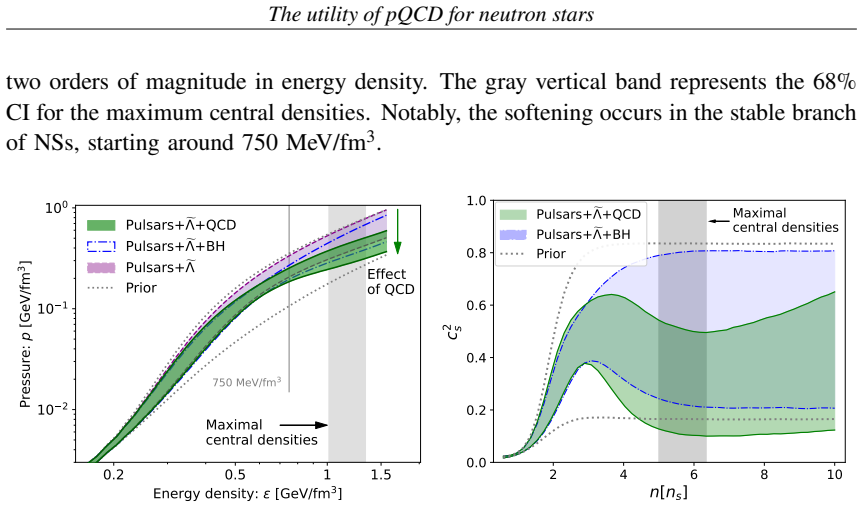
- The speed-of-sound peak near 2-3 times nuclear saturation density followed by a drop toward the conformal value above roughly 750 MeV per cubic femtometer becomes a robust QCD prediction rather than an interpolation artifact.
- The maximal stable mass is pushed down relative to astrophysics-only inference, and the posterior probability of black-hole formation in the 2017 binary neutron star merger and in future mergers with chirp mass above about 1.2 solar masses exceeds 95%.
- Matter in the cores of the most massive neutron stars is found to be near-conformal, with an effective number of active degrees of freedom consistent with weakly coupled quark matter.
- Current data cannot distinguish a crossover from a first-order phase transition, but the Bayes factor slightly favors some non-trivial phase change occurring in the cores of the most massive neutron stars.
Reading between the lines
- If the predicted softening is real, next-generation gravitational-wave observations of post-merger remnants, which reach densities above the stable maximum, could directly test the low sound speed near the Tolman-Oppenheimer-Volkoff density.
- The strong dependence on termination density suggests the most testable output is not the precise posterior but the exclusion: equations of state that remain stiff up to ten times nuclear saturation density are ruled out, a sharp statement any future microphysical model can be checked against.
- The same thermodynamic consistency argument could be applied to other two-point constraints, such as future finite-density lattice QCD results if the sign problem is overcome, propagating first-principles information across gaps where no direct calculation exists.
- The paper's own analysis of hypothetical single mass-radius measurements indicates that a single decisive observation will not settle the crossover-versus-first-order question; a combination of several precise radii or a post-merger signal is needed.
Editorial analysis
A structured set of objections, weighed in public.
Referee Report
Summary. The thesis compiles six previously published papers into a monograph arguing that perturbative QCD (pQCD) calculations at asymptotically high densities impose nontrivial constraints on the neutron-star equation of state (EoS) at densities reached in stable stars. The analytic core (Chapter 2, Section 2.1) derives global bounds on the EoS from thermodynamic stability, causality, and consistency between a low-density cEFT limit and a high-density pQCD limit, expressed in eqs. (2.17)-(2.19). These constraints are then fed into a Gaussian-process Bayesian inference with astrophysical likelihoods (Section 2.2), with detailed studies of perturbative uncertainty quantification (Section 2.3) and of the dependence on the EoS termination density (Section 2.4). The central physical claim is that the pQCD input forces the EoS to soften at the maximum densities of stable neutron stars, which is interpreted as evidence for approximate conformal symmetry, quark-matter cores, or a first-order phase transition, with a Bayes factor of about 2.5 for some phase transition (Section 3.2).
Significance. If the central claim is sustained, the analytic constraints of Section 2.1 are a valuable, parameter-free tool: they are derived from first principles, are machine-checkable in structure, and have already been taken up by other groups through public codes and re-analyses, as the thesis documents. The Bayesian uncertainty quantification in Section 2.3, including scale marginalization and missing-higher-order estimates, is a careful and reproducible treatment. The main risk to the significance of the paper is that the headline claim - that pQCD alone forces softening in the stable branch - is not established by the conservative version of the same framework. The thesis itself shows in Section 2.4 that the conservative n_term = n_TOV check removes only about 20% of the astrophysical posterior and produces no significant softening in the 68% credible interval (Fig. 5.5). The pronounced softening appears only when the QCD condition is imposed at 10 n_sat or when a GP-based marginalized likelihood penalizes EoS extensions above n_TOV. These choices are model-dependent.
major comments (3)
- [Section 2.4, Fig. 5.5, Abstract] The conservative QCD check at n_term = n_TOV (eqs. 2.17-2.19) excludes only about 20% of the astrophysical posterior (Fig. 2.22, left panel) and yields no significant softening in the 68% credible interval for c_s^2 (Fig. 5.5, upper left panel). Yet the Abstract and the summary of Section 2.2 claim that the QCD input 'forces the EoS to soften at the maximum densities of stable neutron stars.' The pronounced softening emerges only when the QCD likelihood is imposed at n_term = 10 n_sat (Fig. 2.11) or when the marginalized likelihood (Figs. 2.29-2.31) penalizes the extreme extensions above n_TOV that are required to reconcile stiff EoSs with the pQCD limit. Because the unstable branch is not constrained by astrophysical observations, this part of the central claim is prior-dependent. The Abstract should be qualified, or the conservative n_term = n_TOV result should be presented as the primary, robust finding.
- [Section 2.4(c), eq. (2.73)] The 'marginalized QCD likelihood' is constructed from GP extensions with hyperparameters l ~ U(1,20) n_sat and mean c_s^2 ~ N(0.3, 0.3^2). These hyperparameters are not derived from pQCD; they encode a prior preference for smooth, conformal extensions and strongly penalize the FOPT-with-c_s^2=1 extension shown in Fig. 2.26. The text concedes that this likelihood remains sensitive to the termination density (Section 2.4(c), Figs. 2.30-2.31). Consequently, the Abstract's statement that the constraints are 'based solely on thermodynamical causality, stability, and consistency' is not accurate for the softening claim: it also rests on a particular GP prior for the EoS above n_TOV. This should be acknowledged as an explicit additional assumption whenever the softening claim is stated.
- [Section 3.2, Table 3.3 and eq. (3.6)] The reported Bayes factor B_PT/noPT = 2.5 is presented as slight evidence for a phase transition, but this factor assigns equal prior probability to 'with phase transition' and 'without phase transition' models by construction, and the individual FOPT Bayes factors in Table 3.3 are all near unity (B_destab/noFOPT = 1.5 with the marginalized QCD input and 0.8 conservatively; B_inside/noFOPT = 0.7-1.0). The evidence for a phase transition therefore comes almost entirely from the crossover-to-quark-matter scenario rather than from first-order transitions. The crossover probability itself changes from 75% with n_term = 10 n_sat to 64% with the marginalized QCD likelihood (Section 3.2(d)). The Abstract's 'slightly favor' should be accompanied by this decomposition and by a statement of the prior dependence.
minor comments (5)
- [Section 3.2(c)] The text refers to 'PSR J040 + 6620'; this should be 'PSR J0740+6620'.
- [Fig. 5.5 caption] The caption says 'GW170818 data' but the event analyzed is GW170817; please correct.
- [Section 2.2(a)] The text contains a duplicated phrase: 'the expression the expression provided in eq. (2.22)'; please remove one instance.
- [Section 3.2 summary] The summary box for Section 3.2 is labeled 'Summary of section 3.1'; it should be labeled 'Summary of section 3.2'.
- [Section 2.4(b), Fig. 2.26] The phrase 'well-convergent series for the sound speed' would benefit from a reference to the specific pQCD calculation being used for c_s^2, since Sections 2.3 and the appendix show the convergence properties explicitly.
Circularity Check
No significant circularity: the pQCD input is external and the softening claim, though prior-sensitive, is a posterior output.
full rationale
The derivation chain begins with pQCD calculations at fixed chemical potential μ=2.6 GeV (refs [68,69]), parameter-free perturbative inputs that do not encode neutron-star softening. The analytic constraints of Sec. 2.1 are derived solely from thermodynamic stability, causality, and the consistency condition Δp = ∫ n dμ (eqs. 2.2–2.18); no target result is used as an input. The GP ensemble is an unconstrained prior, and the QCD likelihood (eq. 2.43) is an indicator function testing the endpoint against the analytic bounds, so the softening of c_s^2 at high densities is a posterior output, not a fitted parameter. The termination-density sensitivity documented in Sec. 2.4 and Fig. 5.5 is an acknowledged prior-dependence: with the conservative nterm = n_TOV check, the QCD input excludes only ~20% of the astrophysical posterior and produces no significant softening, whereas the pronounced softening appears only when the constraint is imposed at 10 n_sat or when extreme extensions above TOV are penalized. This makes the headline claim stronger than the most conservative analysis supports, but it is a model-dependence/correctness caveat, not circularity: the QCD constraints themselves do not assume softening. The marginalized-extension likelihood uses a GP prior with mean c_s^2≈0.3 above TOV, but the paper explicitly identifies this as an additional model assumption. The quark-matter interpretation (d_c<0.2, p/p_free≈0.4) is a separate physical inference from the softened posterior, not a premise of the derivation. Self-citations to the author's papers reproduce the derivations in the thesis, and the central pQCD calculation is external, so no load-bearing step reduces to its own input.
Assumptions & free parameters
free parameters (5)
- GP length scale l and variance sigma (eq. 2.29) =
l ~ N(1.0 n_s, (0.25 n_s)^2); sigma ~ N(1.25, 0.2^2)
- GP mean sound speed prior (eq. 2.29 and 2.73) =
c_s^2 mean ~ N(0.5, 0.25^2) for NS prior; N(0.3, 0.3^2) for high-density extensions
- Conformality cutoff d_c < 0.2 (eq. 3.3) =
0.2
- EoS termination density n_term =
10 n_sat (main results) or n_TOV (conservative case)
- Renormalization scale range X in [1/2, 2] (eq. 1.9) =
[1/2, 2]
assumptions (4)
- domain assumption The EoS of cold neutron-star matter is a single, monotonic, single-valued function n(mu) in beta equilibrium (thermodynamic stability).
- domain assumption The low-density anchor is the cEFT band at 1.1 n_sat (soft/stiff from Hebeler et al. 2013), and the high-density anchor is pQCD at mu = 2.6 GeV from the same collaboration's N3LO* calculation.
- domain assumption Color-superconducting contributions of order Delta^2 mu^2 are neglected in the pQCD pressure.
- ad hoc to paper The Gaussian process prior with the chosen kernels is an adequate representation of all possible EoSs between cEFT and the termination density.
Cite this review
Pith. "Pith review of Perturbative QCD reveals the softening of matter in the cores of massive neutron stars." pith.science (2026). https://pith.science/paper/G6CTIW7D
@misc{pith2026250606465,
  author       = {Pith},
  title        = {Pith review of: Perturbative QCD reveals the softening of matter in the cores of massive neutron stars},
  year         = {2026},
  howpublished = {\url{https://pith.science/paper/G6CTIW7D}},
  note         = {Machine review of arXiv:2506.06465}
}
read the original abstract
The cores of neutron stars (NSs) contain the densest matter in the universe. Rapid advancements in neutron-star observations allow unprecedented empirical access to cold, ultra-dense Quantum Chromodynamics (QCD) matter. The combination of these observations with theoretical calculations has revealed previously inaccessible features of the equation of state (EoS) and the QCD phase diagram. In this thesis, I demonstrate how perturbative-QCD calculations at asymptotically high baryon densities provide robust constraints on the EoS at neutron-star densities. The method for constraint propagation is based solely on thermodynamical causality, stability, and consistency of the EoS. By constructing a large ensemble of EoSs using Gaussian processes regression and incorporating it into a Bayesian inference of EoS, I demonstrate that the novel pQCD constraints go beyond those obtained from current astrophysical observations alone, forcing the EoS to soften at the maximum densities of stable neutron stars. This softening of the EoS can be interpreted as an indication of approximate conformal symmetry restoration, a sign of a first-order phase transition (FOPT), or potentially both. I show that the conformal symmetry restoration is consistent with the hypothesis of quark matter cores inside the most massive NSs. Although current astrophysical data and theoretical inputs cannot definitively distinguish between the two scenarios, they slightly favor the occurrence of a phase transition of some kind - whether a crossover to quark matter or a destabilizing FOPT - in the cores of the most massive neutron stars.
Figures


Figures from the paper (44 more)




Forward citations
Cited by 1 Pith paper
-
From Nuclear Matter with Quenched $g_A$ to Compact-Star Matter with a Signal for Emergent Hidden Scale Symmetry
The paper argues that quenched g_A ≈ 1 in nuclei and the pseudo-conformal sound speed v_s^2/c^2 ≈ 1/3 in compact stars are parallel signals of one emergent hidden scale symmetry.
Reference graph
Works this paper leans on
-
[1]
Bounding the QCD Equation of State with the Lattice
169G. D. Moore and T. Gorda, “Bounding the QCD Equation of State with the Lattice”, JHEP 12, 133 (2023), arXiv: 2309.15149. 170M. Evans et al., “A Horizon Study for Cosmic Explorer: Science, Observatories, and Community”, arXiv e-prints, arXiv:2109.09882, arXiv:2109.09882 (2021), arXiv: 2109.09882. 171M Punturo et al., “The third generation of gravitation...
arXiv 2023
Reviewed August 7, 2026 · model on record in the stance chip above.
Discussion (0). Sign in to comment.