Efficient and Expressive Boundary Conditions in Quantum Lattice Boltzmann Methods
Pith reviewed 2026-06-28 16:32 UTC · model grok-4.3
The pith
A single coherent quantum operation on the entire boundary replaces domain segmentation in QLBM boundary conditions.
A machine-rendered reading of the paper's core claim, the machinery that carries it, and where it could break.
Core claim
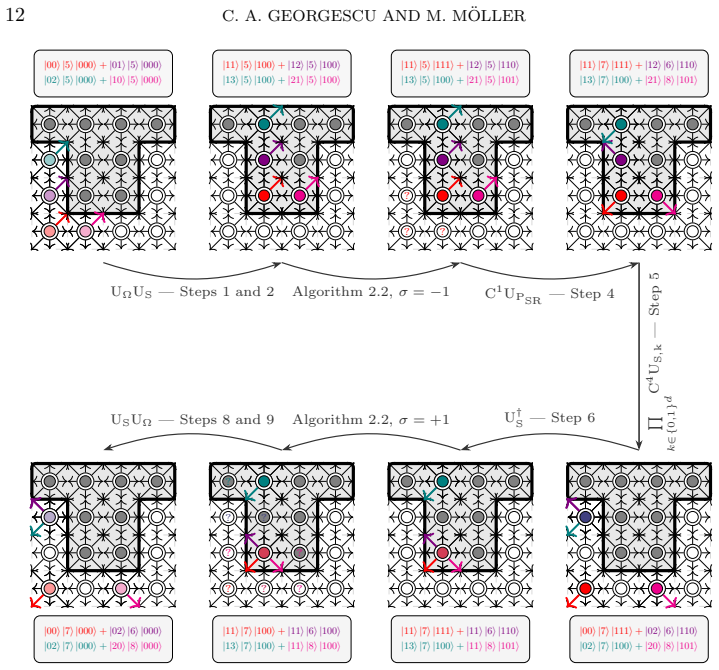
The method forgoes partitioning the solid domain into segments and instead applies a single, coherent operation on the entire boundary, requiring fewer resources both asymptotically and practically for bounce-back and specular reflection boundary conditions.
What carries the argument
A single coherent quantum operation applied uniformly to the entire boundary domain.
If this is right
- Bounce-back and specular reflection conditions become implementable with lower asymptotic resource scaling.
- Practical circuit depth and qubit count decrease for standard boundary conditions in QLBM.
- The solid domain no longer needs explicit segmentation before applying boundary rules.
- The approach opens the door to more expressive boundary conditions without proportional growth in implementation cost.
Where Pith is reading between the lines
- The method might combine with other QLBM optimizations to push the size of simulatable flows higher on near-term hardware.
- If the uniform operation generalizes cleanly, similar single-step handling could apply to moving or curved boundaries.
- Resource savings could be measured directly by comparing transpiled gate counts on the same backend for segmented versus unified circuits.
Load-bearing premise
A single coherent quantum operation can be applied to the entire boundary while preserving the correctness of the QLBM evolution and without hidden costs from circuit implementation or error accumulation.
What would settle it
A circuit-level resource count or simulation run on a quantum emulator that shows the new method uses equal or greater qubits, gates, or depth than a segmented approach for the same bounce-back or specular reflection conditions.
Figures


read the original abstract
Quantum Lattice Boltzmann Methods (QLBM) have emerged as a promising candidate for quantum realizations of computational fluid dynamics solvers. However, despite intensive research into the QLBM in recent years, methods for imposing boundary conditions remain limited both in terms of efficiency and expressivity. In this work, we introduce a new method for imposing simple boundary conditions on QLBM that overcomes several limitations of current approaches. Our method forgoes the partitioning of the solid domain into segments and instead applies a single, coherent operation on the entire boundary. We show that our method requires fewer resources both asymptotically and practically for bounce-back and specular reflection boundary conditions.
Editorial analysis
A structured set of objections, weighed in public.
Referee Report
Summary. The manuscript introduces a boundary-condition method for quantum lattice Boltzmann methods (QLBM) that replaces domain partitioning with a single coherent unitary applied to the entire boundary. The authors claim this construction yields both asymptotic and practical resource savings for the standard bounce-back and specular-reflection conditions while preserving the correctness of the QLBM evolution.
Significance. If the resource claims are substantiated by explicit circuit constructions and gate-count analyses, the approach could materially reduce the overhead of boundary handling in QLBM simulations, a recognized bottleneck in current quantum fluid-dynamics proposals. The work would then constitute a concrete algorithmic improvement with direct implications for near-term quantum implementations of lattice-based solvers.
major comments (2)
- [Abstract, §3] Abstract and §3: the claim that the single coherent boundary operation 'requires fewer resources both asymptotically and practically' is stated without any accompanying circuit decomposition, two-qubit gate count, or depth scaling relative to the partitioned baseline. No explicit construction or oracle-cost analysis is supplied, so the asymptotic saving cannot be verified.
- [§4] §4 (resource comparison): the manuscript asserts practical savings but supplies neither concrete gate counts for the coherent operator on representative boundary geometries nor a comparison table against the segmented approach. Without these data the practical-advantage claim remains unsupported.
minor comments (2)
- [§3] Notation for the boundary unitary (e.g., its action on the position and velocity registers) should be defined explicitly before the resource discussion.
- [Figures] Figure captions should state the lattice size and boundary length used for any timing or gate-count plots.
Simulated Author's Rebuttal
We thank the referee for the careful review and the constructive comments on resource analysis. We agree that the original submission lacked the explicit circuit constructions and quantitative comparisons needed to fully substantiate the claims. We will revise the manuscript to include these elements.
read point-by-point responses
-
Referee: [Abstract, §3] Abstract and §3: the claim that the single coherent boundary operation 'requires fewer resources both asymptotically and practically' is stated without any accompanying circuit decomposition, two-qubit gate count, or depth scaling relative to the partitioned baseline. No explicit construction or oracle-cost analysis is supplied, so the asymptotic saving cannot be verified.
Authors: We acknowledge that the manuscript did not supply explicit circuit decompositions, two-qubit gate counts, or depth scalings. The resource-saving claim was motivated by the replacement of multiple partitioned unitaries with a single coherent operator, but without a formal complexity analysis this could not be verified. In the revised version we will add a complete circuit construction for the coherent boundary operator together with its asymptotic two-qubit gate count and depth scaling relative to the segmented baseline. revision: yes
-
Referee: [§4] §4 (resource comparison): the manuscript asserts practical savings but supplies neither concrete gate counts for the coherent operator on representative boundary geometries nor a comparison table against the segmented approach. Without these data the practical-advantage claim remains unsupported.
Authors: We agree that concrete gate counts on representative geometries and a direct comparison table are required to support the practical-advantage claim. The revised manuscript will include explicit two-qubit gate counts for the coherent operator on standard boundary geometries (straight walls, corners) and a side-by-side table comparing these counts with the corresponding partitioned implementation. revision: yes
Circularity Check
No circularity detected; new boundary operator construction presented without self-referential reductions or fitted predictions.
full rationale
The provided abstract and context describe a novel method that applies a single coherent operation to the full boundary instead of partitioned segments. No equations, fitting procedures, self-citations, or derivation steps are shown that reduce a claimed prediction or result back to its own inputs by construction. The central claim is framed as an independent construction whose resource savings are asserted to be shown, but without any load-bearing steps that match the enumerated circularity patterns. This is the normal case of a self-contained proposal against external benchmarks.
Axiom & Free-Parameter Ledger
Reference graph
Works this paper leans on
-
[1]
Proceedings of the Royal Society of London
Rapid solution of problems by quantum computation , author=. Proceedings of the Royal Society of London. Series A: Mathematical and Physical Sciences , volume=. 1992 , publisher=
1992
-
[2]
SIAM review , volume=
Polynomial-time algorithms for prime factorization and discrete logarithms on a quantum computer , author=. SIAM review , volume=. 1999 , publisher=
1999
-
[3]
Proceedings of the twenty-fifth annual ACM symposium on Theory of computing , pages=
Quantum complexity theory , author=. Proceedings of the twenty-fifth annual ACM symposium on Theory of computing , pages=
-
[4]
Proceedings of the twenty-eighth annual ACM symposium on Theory of computing , pages=
A fast quantum mechanical algorithm for database search , author=. Proceedings of the twenty-eighth annual ACM symposium on Theory of computing , pages=
-
[5]
Physical review letters , volume=
Quantum mechanics helps in searching for a needle in a haystack , author=. Physical review letters , volume=. 1997 , publisher=
1997
-
[6]
arXiv preprint quant-ph/0005055 , year=
Quantum amplitude amplification and estimation , author=. arXiv preprint quant-ph/0005055 , year=
-
[7]
Physical Review X , volume=
Scalable quantum simulation of molecular energies , author=. Physical Review X , volume=. 2016 , publisher=
2016
-
[8]
Physical Review X , volume=
Quantum chemistry calculations on a trapped-ion quantum simulator , author=. Physical Review X , volume=. 2018 , publisher=
2018
-
[9]
Chemical reviews , volume=
Quantum chemistry in the age of quantum computing , author=. Chemical reviews , volume=. 2019 , publisher=
2019
-
[10]
Quantum Information Processing , volume=
The quest for a quantum neural network , author=. Quantum Information Processing , volume=. 2014 , publisher=
2014
-
[11]
Archives of Computational Methods in Engineering , volume=
Recent developments and applications in quantum neural network: A review , author=. Archives of Computational Methods in Engineering , volume=. 2019 , publisher=
2019
-
[12]
Physical review letters , volume=
Quantum support vector machine for big data classification , author=. Physical review letters , volume=. 2014 , publisher=
2014
-
[13]
Nature physics , volume=
Quantum principal component analysis , author=. Nature physics , volume=. 2014 , publisher=
2014
-
[14]
Reviews in Physics , volume=
Quantum computing for finance: Overview and prospects , author=. Reviews in Physics , volume=. 2019 , publisher=
2019
-
[15]
Physical review letters , volume=
Quantum algorithm for linear systems of equations , author=. Physical review letters , volume=. 2009 , publisher=
2009
-
[16]
Physical Review A , volume=
Quantum algorithms and the finite element method , author=. Physical Review A , volume=. 2016 , publisher=
2016
-
[17]
New Journal of Physics , volume=
Quantum algorithm and circuit design solving the Poisson equation , author=. New Journal of Physics , volume=. 2013 , publisher=
2013
-
[18]
2025 IEEE International Conference on Quantum Computing and Engineering (QCE) , volume=
Algorithmic advances towards a realizable quantum lattice Boltzmann method , author=. 2025 IEEE International Conference on Quantum Computing and Engineering (QCE) , volume=. 2025 , organization=
2025
-
[19]
Physical Review E , volume=
Improved quantum lattice Boltzmann method for advection-diffusion equations with a linear collision model , author=. Physical Review E , volume=. 2025 , publisher=
2025
-
[20]
arXiv preprint arXiv:2502.02131 , year=
Dynamic Circuits for the Quantum Lattice-Boltzmann Method , author=. arXiv preprint arXiv:2502.02131 , year=
-
[21]
Quantum collision circuit, quantum invariants and quantum phase estimation procedure for fluid dynamic lattice gas automata , journal =
Niccolò Fonio and Pierre Sagaut and Giuseppe. Quantum collision circuit, quantum invariants and quantum phase estimation procedure for fluid dynamic lattice gas automata , journal =. 2025 , issn =
2025
-
[22]
Quantum Information Processing , volume=
Quantum approach to accelerate finite volume method on steady computational fluid dynamics problems , author=. Quantum Information Processing , volume=. 2022 , publisher=
2022
-
[23]
Nature Physics , volume=
Read the fine print , author=. Nature Physics , volume=. 2015 , publisher=
2015
-
[24]
arXiv preprint arXiv:1010.4458 , year=
Variable time amplitude amplification and a faster quantum algorithm for solving systems of linear equations , author=. arXiv preprint arXiv:1010.4458 , year=
-
[25]
Physical review letters , volume=
Preconditioned quantum linear system algorithm , author=. Physical review letters , volume=. 2013 , publisher=
2013
-
[26]
SIAM Journal on Computing , volume=
Quantum algorithm for systems of linear equations with exponentially improved dependence on precision , author=. SIAM Journal on Computing , volume=. 2017 , publisher=
2017
-
[27]
arXiv preprint arXiv:2308.01827 , year=
Physics-Informed Quantum Machine Learning: Solving nonlinear differential equations in latent spaces without costly grid evaluations , author=. arXiv preprint arXiv:2308.01827 , year=
-
[28]
Physical Review A , volume=
Solving nonlinear differential equations with differentiable quantum circuits , author=. Physical Review A , volume=. 2021 , publisher=
2021
-
[29]
Physical Review A , volume=
Quantum kernel methods for solving regression problems and differential equations , author=. Physical Review A , volume=. 2023 , publisher=
2023
-
[30]
Quantum Information Processing , volume=
Variational quantum solutions to the advection--diffusion equation for applications in fluid dynamics , author=. Quantum Information Processing , volume=. 2022 , publisher=
2022
-
[31]
Physical Review A , volume=
Variational quantum algorithm based on the minimum potential energy for solving the Poisson equation , author=. Physical Review A , volume=. 2021 , publisher=
2021
-
[32]
Physical review letters , volume=
Quantum machine learning in feature hilbert spaces , author=. Physical review letters , volume=. 2019 , publisher=
2019
-
[33]
IEEE spectrum , volume=
Moore's law: past, present and future , author=. IEEE spectrum , volume=. 1997 , publisher=
1997
-
[34]
AIAA Journal , volume=
Quantum speedup for aeroscience and engineering , author=. AIAA Journal , volume=. 2020 , publisher=
2020
-
[35]
Ocean Engineering , volume=
A variational quantum algorithm-based numerical method for solving potential and Stokes flows , author=. Ocean Engineering , volume=. 2024 , publisher=
2024
-
[36]
Quantum , volume=
Variational quantum linear solver , author=. Quantum , volume=. 2023 , publisher=
2023
-
[37]
Physical Review A , volume=
Variational quantum linear solver with a dynamic ansatz , author=. Physical Review A , volume=. 2022 , publisher=
2022
-
[38]
Physics of Fluids , volume=
Application of a variational hybrid quantum-classical algorithm to heat conduction equation and analysis of time complexity , author=. Physics of Fluids , volume=. 2022 , publisher=
2022
-
[39]
2010 , publisher=
Quantum computation and quantum information , author=. 2010 , publisher=
2010
-
[40]
Quantum , volume=
Quantum computing in the NISQ era and beyond , author=. Quantum , volume=. 2018 , publisher=
2018
-
[41]
Quantum , volume=
Qulacs: a fast and versatile quantum circuit simulator for research purpose , author=. Quantum , volume=. 2021 , publisher=
2021
-
[42]
Javadi-Abhari, Ali and Treinish, Matthew and Krsulich, Kevin and Wood, Christopher J. and Lishman, Jake and Gacon, Julien and Martiel, Simon and Nation, Paul D. and Bishop, Lev S. and Cross, Andrew W. and Johnson, Blake R. and Gambetta, Jay M. , year=. Quantum computing with. doi:10.48550/arXiv.2405.08810 , eprint=
work page internal anchor Pith review Pith/arXiv arXiv doi:10.48550/arxiv.2405.08810
-
[43]
ACM Transactions on Quantum Computing , volume=
OpenQASM 3: A broader and deeper quantum assembly language , author=. ACM Transactions on Quantum Computing , volume=. 2022 , publisher=
2022
-
[44]
Quantum , volume=
ProjectQ: an open source software framework for quantum computing , author=. Quantum , volume=. 2018 , publisher=
2018
-
[45]
Zenodo , doi =
Cirq Developers , title =. Zenodo , doi =
-
[46]
Proceedings of the 34th ACM SIGPLAN conference on Programming language design and implementation , pages=
Quipper: a scalable quantum programming language , author=. Proceedings of the 34th ACM SIGPLAN conference on Programming language design and implementation , pages=
-
[47]
ACM Transactions on Quantum Computing , volume=
Arqtic: A full-stack software package for simulating materials on quantum computers , author=. ACM Transactions on Quantum Computing , volume=. 2022 , publisher=
2022
-
[48]
arXiv preprint arXiv:1811.04968 , year=
Pennylane: Automatic differentiation of hybrid quantum-classical computations , author=. arXiv preprint arXiv:1811.04968 , year=
-
[49]
Quantum Science and Technology , volume=
tket: a retargetable compiler for NISQ devices , author=. Quantum Science and Technology , volume=. 2020 , publisher=
2020
-
[50]
arXiv preprint arXiv:2003.02989 , year=
Tensorflow quantum: A software framework for quantum machine learning , author=. arXiv preprint arXiv:2003.02989 , year=
arXiv 2003
-
[51]
arXiv preprint arXiv:2405.13196 , year=
Practical and efficient quantum circuit synthesis and transpiling with Reinforcement Learning , author=. arXiv preprint arXiv:2405.13196 , year=
-
[52]
A model for collision processes in gases. I. Small amplitude processes in charged and neutral one-component systems , author=. Physical review , volume=. 1954 , publisher=
1954
-
[53]
Springer International Publishing , volume=
The lattice Boltzmann method , author=. Springer International Publishing , volume=. 2017 , publisher=
2017
-
[54]
Computers & Mathematics with Applications , volume=
OpenLB—Open source lattice Boltzmann code , author=. Computers & Mathematics with Applications , volume=. 2021 , publisher=
2021
-
[55]
Computer Physics Communications , volume=
HemeLB: A high performance parallel lattice-Boltzmann code for large scale fluid flow in complex geometries , author=. Computer Physics Communications , volume=. 2008 , publisher=
2008
-
[56]
Computers & Mathematics with Applications , volume=
Palabos: parallel lattice Boltzmann solver , author=. Computers & Mathematics with Applications , volume=. 2021 , publisher=
2021
-
[57]
Computers & Mathematics with Applications , volume=
waLBerla: A block-structured high-performance framework for multiphysics simulations , author=. Computers & Mathematics with Applications , volume=. 2021 , publisher=
2021
-
[58]
Journal of Computational Science , volume=
lbmpy: Automatic code generation for efficient parallel lattice Boltzmann methods , author=. Journal of Computational Science , volume=. 2021 , publisher=
2021
-
[59]
, year =
Pylbm: an all-in-one package for numerical simulations using Lattice Boltzmann solvers. , year =
-
[60]
Applied mathematical modelling , volume=
A novel lattice Boltzmann model for the Poisson equation , author=. Applied mathematical modelling , volume=. 2008 , publisher=
2008
-
[61]
Journal of Scientific Computing , volume=
Lattice Boltzmann model based on the rebuilding-divergency method for the Laplace equation and the Poisson equation , author=. Journal of Scientific Computing , volume=. 2011 , publisher=
2011
-
[62]
The Journal of chemical physics , volume=
A lattice Boltzmann algorithm for electro-osmotic flows in microfluidic devices , author=. The Journal of chemical physics , volume=. 2005 , publisher=
2005
-
[63]
Physical Review E—Statistical, Nonlinear, and Soft Matter Physics , volume=
Lattice Boltzmann model for the convection-diffusion equation , author=. Physical Review E—Statistical, Nonlinear, and Soft Matter Physics , volume=. 2013 , publisher=
2013
-
[64]
Physical Review E , volume=
Quantum lattice-gas model for computational fluid dynamics , author=. Physical Review E , volume=. 2001 , publisher=
2001
-
[65]
An efficient and accurate quantum lattice-gas model for the many-body Schr
Yepez, Jeffrey and Boghosian, Bruce , journal=. An efficient and accurate quantum lattice-gas model for the many-body Schr. 2002 , publisher=
2002
-
[66]
Journal of Statistical Physics , volume=
Quantum lattice-gas model for the Burgers equation , author=. Journal of Statistical Physics , volume=. 2002 , publisher=
2002
-
[67]
International Journal of Modern Physics C , volume=
Lattice-gas quantum computation , author=. International Journal of Modern Physics C , volume=. 1998 , publisher=
1998
-
[68]
International Journal of Modern Physics C , volume=
Quantum lattice-gas model for the diffusion equation , author=. International Journal of Modern Physics C , volume=. 2001 , publisher=
2001
-
[69]
Quantum Information Processing , volume=
Experimental demonstration of quantum lattice gas computation , author=. Quantum Information Processing , volume=. 2003 , publisher=
2003
-
[70]
Journal of Computational Physics , volume=
Quantum algorithm for the collisionless Boltzmann equation , author=. Journal of Computational Physics , volume=. 2020 , publisher=
2020
-
[71]
Journal of Computational Physics , volume=
Efficient and fail-safe quantum algorithm for the transport equation , author=. Journal of Computational Physics , volume=. 2024 , publisher=
2024
-
[72]
Quantum computing and communications , year=
Quantum algorithms for nonlinear equations in fluid mechanics , author=. Quantum computing and communications , year=
-
[73]
Frontiers in Mechanical Engineering , volume=
Investigating hardware acceleration for simulation of CFD quantum circuits , author=. Frontiers in Mechanical Engineering , volume=. 2022 , publisher=
2022
-
[74]
2023 , eprint=
Quantum Algorithm for Lattice Boltzmann (QALB) Simulation of Incompressible Fluids with a Nonlinear Collision Term , author=. 2023 , eprint=
2023
-
[75]
2025 , eprint=
Carleman-lattice-Boltzmann quantum circuit with matrix access oracles , author=. 2025 , eprint=
2025
-
[76]
Europhysics Letters , volume=
Decomposition of nonlinear collision operator in quantum Lattice Boltzmann algorithm , author=. Europhysics Letters , volume=. 2024 , publisher=
2024
-
[77]
AVS Quantum Science , volume=
Lattice Boltzmann--Carleman quantum algorithm and circuit for fluid flows at moderate Reynolds number , author=. AVS Quantum Science , volume=. 2024 , publisher=
2024
-
[78]
Fluids , volume=
Analysis of Carleman linearization of lattice Boltzmann , author=. Fluids , volume=. 2022 , publisher=
2022
-
[79]
Quantum Information Processing , volume=
Quantum algorithm for the advection--diffusion equation simulated with the lattice Boltzmann method , author=. Quantum Information Processing , volume=. 2021 , publisher=
2021
-
[80]
International Journal of Quantum Information , volume=
Quantum algorithm for the Navier--Stokes equations by using the streamfunction-vorticity formulation and the lattice Boltzmann method , author=. International Journal of Quantum Information , volume=. 2022 , publisher=
2022
discussion (0)
Sign in with ORCID, Apple, or X to comment. Anyone can read and Pith papers without signing in.