REVIEW 8 minor 89 references
Post-Generation Curation of Synthetic Images via Homogeneous-Heterogeneous Splitting
T0 review · 0 major / 8 minor · reviewed 2026-07-12 · grok-4.5
Pith's one-line read Selecting from a fixed synthetic image pool can match real-data performance with up to 40% fewer samples by countering generators' bias toward canonical modes.
desk verdict Clean generator-agnostic post-filter that actually moves the needle on synthetic-image utility; the HO-HE 1-NN idea plus partition-wise scoring is new enough and the multi-setting evidence is solid. read the letter →
The pith
A machine-rendered reading of the paper's core claim, the machinery that carries it, and where it could break.
The reading
What carries the argument
The Homogeneous-Heterogeneous (HO-HE) split of real classes via the directed 1-nearest-neighbor graph, together with the partition-wise fidelity-diversity score that rewards semantic alignment to each subset while penalizing drift toward canonical anchors.
What would settle it
On a held-out class or dataset where a strong pretrained encoder yields an HO set that does not preserve nearest-neighbor reconstruction cost, or where synthetic samples are no more similar to HO than to HE, the fidelity-diversity ranking should stop outperforming random or pure-fidelity selection under the same budget.
Extended reading notes
Core claim
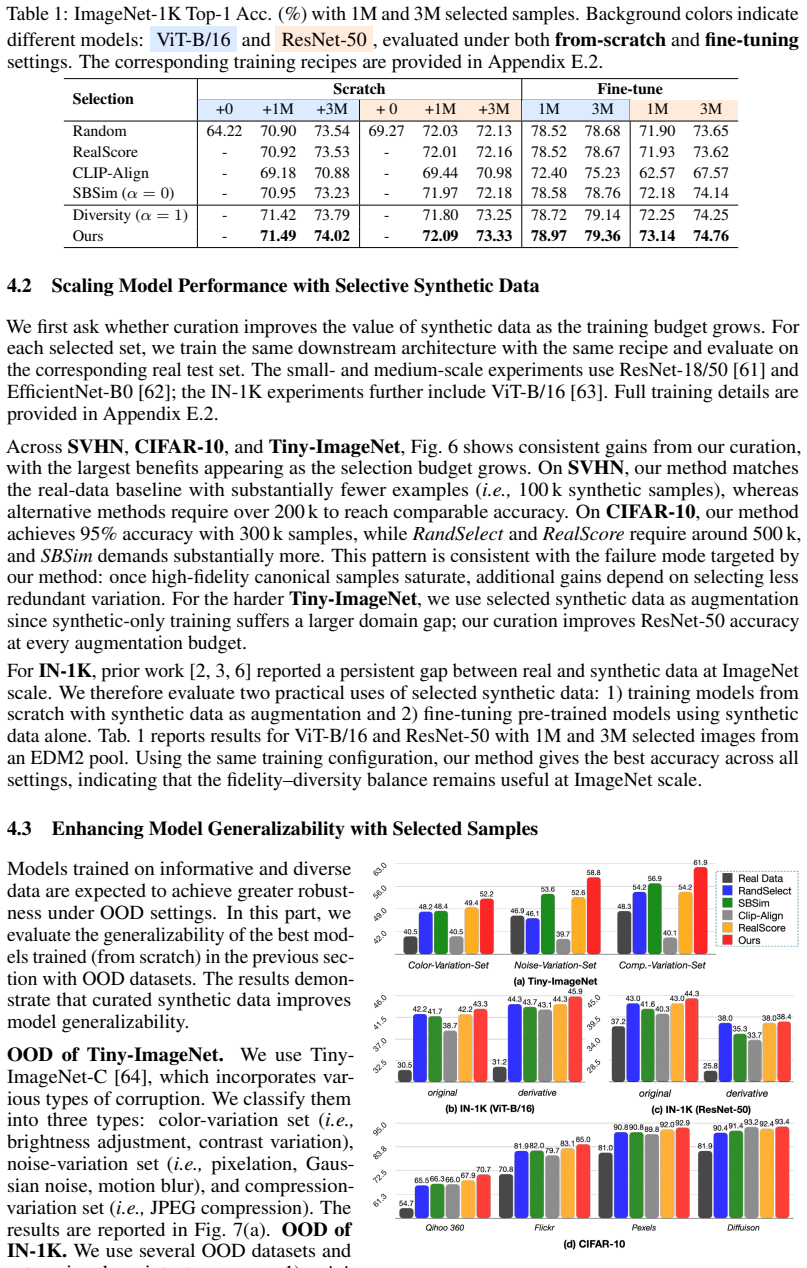
Given only a fixed pool of synthetic images and a real reference set, a partition-conditioned fidelity-diversity score that treats Homogeneous (canonical) and Heterogeneous (non-redundant) real subsets separately produces training subsets that consistently outperform existing selection methods and can match real-data performance with up to 40% fewer synthetic samples; the same criterion remains useful as a plug-in after task-tuned generators.
Load-bearing premise
That a generic pretrained feature encoder produces a nearest-neighbor graph whose Homogeneous set is a faithful minimal cover of each real class, and that generators systematically over-produce those canonical modes relative to the Heterogeneous set.
Editorial analysis
A structured set of objections, weighed in public.
Referee Report
Summary. The paper studies post-generation curation of a fixed synthetic image pool for downstream utility. It argues that modern generators over-produce canonical class modes and under-represent intra-class variation, and therefore partitions each real class into a Homogeneous (HO) set of local nearest-neighbor representatives and a Heterogeneous (HE) complement via the directed 1-NN graph (Prop. 1, Sec. 3.1). Synthetic candidates are then scored with a partition-conditioned fidelity–diversity criterion (Eqs. 4–6, Alg. 1) that rewards semantic alignment while penalizing collapse toward canonical anchors. The method is generator-agnostic and requires no generator retraining. Empirically, on SVHN, CIFAR-10, Tiny-ImageNet, and ImageNet-1K, and across ResNet/EfficientNet/ViT backbones, the selected subsets outperform random, CLIP-Align, RealScore, and SBSim baselines, match real-data accuracy with substantially fewer samples (up to ~40% reduction in the plug-in setting), improve OOD robustness, and remain useful as a plug-in after inference-time intervention and JoDiffusion fine-tuning for classification and segmentation.
Significance. If the empirical claims hold, the work supplies a practical, complementary lever for synthetic-data pipelines: quality control after generation rather than only during it. The HO–HE construction is elementary but well-motivated (Prop. 1 is a clean minimal nearest-neighbor cover; the diversity score has a clear geometric reading), the evaluation is broad (four in-domain benchmarks, multiple OOD suites, two architecture families, two plug-in generator interventions, ablations on α, encoder, and budget), and the method is immediately usable on any fixed pool. Strengths that should be credited include the explicit graph-theoretic guarantee, the multi-setting plug-in results (Tabs. 2–3), and the transparent reporting of means over repeated runs. The contribution is incremental rather than foundational, but it is useful and well-supported for a data-centric ML venue.
minor comments (8)
- Abstract and opening paragraph: “scalable training training data” is a duplicated word; fix throughout the front matter.
- Fig. 1 caption and surrounding text: the figure is helpful, but the notation ℱ_HO / ℱ_HE / ℱ_syn is not defined in the caption; align with the F_HO, F_HE, F_syn used in Alg. 1 and Sec. 3.2.
- Alg. 1, line 8 and Eq. (5): Sp_div is written as −cos(Rp − Fp, Fsyn − Fp). Clarify whether this is evaluated against every real anchor in the partition and then aggregated (max/mean), or only against a matched nearest real; the prose and the appendix code listings are slightly inconsistent on the aggregation.
- Sec. 3.1 / Prop. 1: the unique-nearest-neighbor assumption is stated but not discussed under ties or near-ties in high-d feature space; a one-sentence note on how ties are broken (or that they are rare after ℓ2-normalization) would help.
- Fig. 6 and Tabs. 10–12: CLIP-Align is omitted from the main figure “for readability” but is the weakest baseline; either include a compact panel or explicitly point readers to the appendix tables in the figure caption.
- Sec. 5 / Tab. 5: feature-extraction time dominates and is shared with other selection methods; stating wall-clock on a named GPU and batch size would make the “negligible overhead” claim easier to reproduce.
- Appendix G code listings: the diversity term is implemented as fidelity − diversity rather than the α-weighted form of Eq. (6); note that the listings are illustrative of the unweighted case or update them to match the main equation.
- Related work: a short pointer to classical coreset / facility-location selection and to semantic deduplication (already cited as [17]) would better situate the 1-NN cover relative to existing data-pruning literature.
Circularity Check
No significant circularity: method definitions and Prop. 1 are independent of the downstream accuracy claims they later support.
full rationale
The paper's central claim is an empirical one: a post-generation selection rule (HO-HE 1-NN partition of real features + partition-conditioned fidelity-diversity score in Eqs. 4-6 / Alg. 1) improves downstream classifiers and segmentors relative to external baselines on held-out real test sets, and remains useful as a plug-in after task-tuned generators. Prop. 1 is a self-contained graph-theoretic statement (IHO is the unique inclusion-minimal nearest-neighbor cover under the unique-NN assumption) whose short proof appears in Appendix B.3 and does not reference any downstream accuracy number. The scoring equations are defined solely from cosine similarities to the fixed real partitions and do not embed or optimize the later-reported test accuracies; alpha is an explicit hyper-parameter that is ablated rather than fitted to the target metric. Generator HO-bias (Fig. 4) and encoder sensitivity (Fig. 9) are presented as empirical observations that motivate the design, not as premises that force the accuracy gains by construction. Self-citations are limited to public generators (EDM/EDM2), standard training recipes (timm, etc.), and ordinary baselines; none supply a uniqueness theorem or ansatz that the present results merely rename. Consequently the derivation chain does not reduce any claimed prediction or first-principles result to its own inputs.
Assumptions & free parameters
free parameters (3)
- alpha (fidelity-diversity trade-off) =
0.5 (default)
- selection budget k / top-k per partition
- feature-extractor choice =
MoCo v3 (main), SigLIP best in ablation
assumptions (3)
- domain assumption Every sample has a unique within-class nearest neighbor (used for Prop. 1 uniqueness).
- domain assumption Cosine distance on l2-normalized pretrained features is a suitable metric for semantic nearest neighbors and fidelity.
- ad hoc to paper Generators systematically over-produce IHO modes relative to IHE (Fig. 4).
invented entities (2)
-
Homogeneous (HO) / Heterogeneous (HE) partition via directed 1-NN in-degree
-
Partition-conditioned diversity score Sp_div = -cos(Rp - Fp, Fsyn - Fp)
Cite this review
Pith. "Pith review of Post-Generation Curation of Synthetic Images via Homogeneous-Heterogeneous Splitting." pith.science (2026). https://pith.science/paper/G7ZLI73Z
@misc{pith2026260702637,
  author       = {Pith},
  title        = {Pith review of: Post-Generation Curation of Synthetic Images via Homogeneous-Heterogeneous Splitting},
  year         = {2026},
  howpublished = {\url{https://pith.science/paper/G7ZLI73Z}},
  note         = {Machine review of arXiv:2607.02637}
}
read the original abstract
Recent generative models can produce high-quality synthetic images, offering scalable training training data for data-hungry models. Existing approaches to exploiting this potential typically involve 1) training or fine-tuning generators, or 2) using lightweight post-hoc adaptation like prompt engineering or inference-time guidance, making them generator-specific and expertise-intensive. We study a complementary question: given a fixed pool of generated images, can downstream utility be improved purely by selecting an informative subset? The answer is yes. We show that effective selection must counter a structural bias of modern generators: they tend to over-produce canonical modes of each class while underrepresenting intra-class variation. Building on this insight, we split each real class into a canonical Homogeneous (HO) subset and a non-redundant Heterogeneous (HE) subset, then score synthetic images by a fidelity-diversity criterion that rewards semantic alignment while penalizing canonical redundancy. The method is generator-agnostic and requires no retraining. Across multiple benchmarks, it consistently outperforms state-of-the-art data selection baselines and matches the real-data performance with up to 40% fewer synthetic samples. The same criterion remains effective when applied on top of stronger task-tuned generators, with gains on both classification and segmentation tasks. Post-generation selection is therefore not a substitute for better generators, but a complementary mechanism for improving the utility of synthetic data.
Figures


Figures from the paper (15 more)




Reference graph
Works this paper leans on
-
[1]
Toward understanding generative data augmentation
Chenyu Zheng, Guoqiang Wu, and Chongxuan Li. Toward understanding generative data augmentation. InThirty-seventh Conference on Neural Information Processing Systems, 2023. URLhttps://openreview.net/forum?id=W5Clq1bSrR
2023
-
[2]
Fake it till you make it: Learning transferable representations from synthetic imagenet clones
Mert Bulent Sariyildiz, Karteek Alahari, Diane Larlus, and Yannis Kalantidis. Fake it till you make it: Learning transferable representations from synthetic imagenet clones. InProceedings of the IEEE/CVF Conference on Computer Vision and Pattern Recognition (CVPR), pages 8011–8021, 2023
2023
-
[3]
Shekoofeh Azizi, Simon Kornblith, Chitwan Saharia, Mohammad Norouzi, and David J. Fleet. Synthetic data from diffusion models improves imagenet classification.Transactions on Machine Learning Research, 2023. ISSN 2835-8856. URL https://openreview.net/forum?id= DlRsoxjyPm
2023
-
[4]
Is synthetic data from generative models ready for image recognition? In The Eleventh International Conference on Learning Representations, 2023
Ruifei He, Shuyang Sun, Xin Yu, Chuhui Xue, Wenqing Zhang, Philip Torr, Song Bai, and Xiaojuan Qi. Is synthetic data from generative models ready for image recognition? In The Eleventh International Conference on Learning Representations, 2023. URL https: //openreview.net/forum?id=nUmCcZ5RKF
2023
-
[5]
IS SYNTHETIC DATA USEFUL FOR TRANSFER LEARNING? AN INVESTI- GATION INTO DATA GENERATION, VOLUME, AND UTILIZATION, 2024
Yuhang Li, Xin Dong, Chen Chen, Jingtao Li, Yuxin Wen, Michael Spranger, and Lingjuan Lyu. IS SYNTHETIC DATA USEFUL FOR TRANSFER LEARNING? AN INVESTI- GATION INTO DATA GENERATION, VOLUME, AND UTILIZATION, 2024. URL https://openreview.net/forum?id=CjPt1AC6w0
2024
-
[6]
Scaling laws of synthetic images for model training
Lijie Fan, Kaifeng Chen, Dilip Krishnan, Dina Katabi, Phillip Isola, and Yonglong Tian. Scaling laws of synthetic images for model training ... for now. InCVPR, pages 7382–7392, 2024. URL https://doi.org/10.1109/CVPR52733.2024.00705
-
[7]
Datadream: Few-shot guided dataset generation
Jae Myung Kim, Jessica Bader, Stephan Alaniz, Cordelia Schmid, and Zeynep Akata. Datadream: Few-shot guided dataset generation. InEuropean Conference on Computer Vision, pages 252–268. Springer, 2024
2024
-
[8]
Real-fake: Effective training data synthesis through distribution matching, 2024
Jianhao Yuan, Jie Zhang, Shuyang Sun, Philip Torr, and Bo Zhao. Real-fake: Effective training data synthesis through distribution matching, 2024. URL https://arxiv.org/abs/2310. 10402
2024
Show all 89 references
-
[9]
Test-time alignment of diffusion models without reward over-optimization.arXiv preprint arXiv:2501.05803, 2025
Sunwoo Kim, Minkyu Kim, and Dongmin Park. Test-time alignment of diffusion models without reward over-optimization.arXiv preprint arXiv:2501.05803, 2025
2025 arXiv
-
[10]
Diffusion curriculum: Synthetic-to-real data curriculum via image-guided diffusion
Yijun Liang, Shweta Bhardwaj, and Tianyi Zhou. Diffusion curriculum: Synthetic-to-real data curriculum via image-guided diffusion. InProceedings of the IEEE/CVF International Conference on Computer Vision, pages 1697–1707, 2025
2025
-
[11]
Increasing the utility of synthetic images through chamfer guidance.arXiv preprint arXiv:2508.10631, 2025
Nicola Dall’Asen, Xiaofeng Zhang, Reyhane Askari Hemmat, Melissa Hall, Jakob Verbeek, Adriana Romero-Soriano, and Michal Drozdzal. Increasing the utility of synthetic images through chamfer guidance.arXiv preprint arXiv:2508.10631, 2025
2025
-
[12]
Shielded diffusion: Generating novel and diverse images using sparse repellency.arXiv preprint arXiv:2410.06025, 2024
Michael Kirchhof, James Thornton, Louis Béthune, Pierre Ablin, Eugene Ndiaye, and Marco Cuturi. Shielded diffusion: Generating novel and diverse images using sparse repellency.arXiv preprint arXiv:2410.06025, 2024
2024 arXiv
-
[13]
Diversity is definitely needed: Improving model-agnostic zero-shot classification via stable diffusion
Jordan Shipard, Arnold Wiliem, Kien Nguyen Thanh, Wei Xiang, and Clinton Fookes. Diversity is definitely needed: Improving model-agnostic zero-shot classification via stable diffusion. In 2023 IEEE/CVF Conference on Computer Vision and Pattern Recognition Workshops (CVPRW), pa...
2023 doi
-
[14]
Data augmentation for image classification using generative ai
Fazle Rahat, M Shifat Hossain, Md Rubel Ahmed, Sumit Kumar Jha, and Rickard Ewetz. Data augmentation for image classification using generative ai. In2025 IEEE/CVF Winter Conference on Applications of Computer Vision (WACV), pages 4173–4182. IEEE, 2025. 10
2025
-
[15]
Gonzalez, and Trevor Darrell
Lisa Dunlap, Alyssa Umino, Han Zhang, Jiezhi Yang, Joseph E. Gonzalez, and Trevor Darrell. Diversify your vision datasets with automatic diffusion-based augmentation. InThirty-seventh Conference on Neural Information Processing Systems, 2023. URL https://openreview. net/forum?...
2023
-
[16]
Datacomp: In search of the next generation of multimodal datasets
Samir Yitzhak Gadre, Gabriel Ilharco, Alex Fang, Jonathan Hayase, Georgios Smyrnis, Thao Nguyen, Ryan Marten, Mitchell Wortsman, Dhruba Ghosh, Jieyu Zhang, Eyal Orgad, Rahim Entezari, Giannis Daras, Sarah M Pratt, Vivek Ramanujan, Yonatan Bitton, Kalyani Marathe, Stephen Mussm...
2023
-
[17]
Semd- edup: Data-efficient learning at web-scale through semantic deduplication.arXiv preprint arXiv:2303.09540, 2023
Amro Abbas, Kushal Tirumala, Dániel Simig, Surya Ganguli, and Ari S Morcos. Semd- edup: Data-efficient learning at web-scale through semantic deduplication.arXiv preprint arXiv:2303.09540, 2023
2023 arXiv
-
[18]
Effective audio classification network based on paired inverse pyramid structure and dense mlp block
Yunhao Chen, Yunjie Zhu, Zihui Yan, Zhen Ren, Yifan Huang, Jianlu Shen, and Lifang Chen. Effective audio classification network based on paired inverse pyramid structure and dense mlp block. InInternational Conference on Intelligent Computing, pages 70–84. Springer, 2023
2023
-
[19]
Datasetgan: Efficient labeled data factory with minimal human effort
Yuxuan Zhang, Huan Ling, Jun Gao, Kangxue Yin, Jean-Francois Lafleche, Adela Barriuso, Antonio Torralba, and Sanja Fidler. Datasetgan: Efficient labeled data factory with minimal human effort. InProceedings of the IEEE/CVF Conference on Computer Vision and Pattern Recognition,...
2021
-
[20]
Improved precision and recall metric for assessing generative models
Tuomas Kynkäänniemi, Tero Karras, Samuli Laine, Jaakko Lehtinen, and Timo Aila. Improved precision and recall metric for assessing generative models. In H. Wal- lach, H. Larochelle, A. Beygelzimer, F. d'Alché-Buc, E. Fox, and R. Garnett, edi- tors,Advances in Neural Informatio...
2019
-
[21]
Explore the power of synthetic data on few-shot object detection
Shaobo Lin, Kun Wang, Xingyu Zeng, and Rui Zhao. Explore the power of synthetic data on few-shot object detection. InProceedings of the IEEE/CVF conference on computer vision and pattern recognition, pages 638–647, 2023
2023
-
[22]
Aerogen: Enhancing remote sensing object detection with diffusion-driven data generation
Datao Tang, Xiangyong Cao, Xuan Wu, Jialin Li, Jing Yao, Xueru Bai, Dongsheng Jiang, Yin Li, and Deyu Meng. Aerogen: Enhancing remote sensing object detection with diffusion-driven data generation. InProceedings of the Computer Vision and Pattern Recognition Conference, pages ...
2025
-
[23]
Noise-consistent siamese-diffusion for medical image synthesis and segmentation
Kunpeng Qiu, Zhiqiang Gao, Zhiying Zhou, Mingjie Sun, and Yongxin Guo. Noise-consistent siamese-diffusion for medical image synthesis and segmentation. InProceedings of the Com- puter Vision and Pattern Recognition Conference, pages 15672–15681, 2025
2025
-
[24]
Domain gap embeddings for generative dataset augmentation
Yinong Oliver Wang, Younjoon Chung, Chen Henry Wu, and Fernando De la Torre. Domain gap embeddings for generative dataset augmentation. InProceedings of the IEEE/CVF Conference on Computer Vision and Pattern Recognition, pages 28684–28694, 2024
2024
-
[25]
Training on thin air: Improve image classifica- tion with generated data, 2023
Yongchao Zhou, Hshmat Sahak, and Jimmy Ba. Training on thin air: Improve image classifica- tion with generated data, 2023. URLhttps://arxiv.org/abs/2305.15316
2023 arXiv
-
[26]
Stablerep: Synthetic images from text-to-image models make strong visual representation learners, 2023
Yonglong Tian, Lijie Fan, Phillip Isola, Huiwen Chang, and Dilip Krishnan. Stablerep: Synthetic images from text-to-image models make strong visual representation learners, 2023. URL https://arxiv.org/abs/2306.00984
2023 arXiv
-
[27]
Synthclip: Are we ready for a fully synthetic clip training?, 2024
Hasan Abed Al Kader Hammoud, Hani Itani, Fabio Pizzati, Philip Torr, Adel Bibi, and Bernard Ghanem. Synthclip: Are we ready for a fully synthetic clip training?, 2024. URL https: //arxiv.org/abs/2402.01832. 11
2024 arXiv
-
[28]
Learning vision from models rivals learning vision from data, 2023
Yonglong Tian, Lijie Fan, Kaifeng Chen, Dina Katabi, Dilip Krishnan, and Phillip Isola. Learning vision from models rivals learning vision from data, 2023. URL https://arxiv. org/abs/2312.17742
2023 arXiv
-
[29]
Contrastive learning with synthetic positives, 2025
Dewen Zeng, Yawen Wu, Xinrong Hu, Xiaowei Xu, and Yiyu Shi. Contrastive learning with synthetic positives, 2025. URLhttps://arxiv.org/abs/2408.16965
2025 arXiv
-
[30]
Maan Qraitem, Kate Saenko, and Bryan A. Plummer. From fake to real: Pretraining on balanced synthetic images to prevent spurious correlations in image recognition, 2024. URL https://arxiv.org/abs/2308.04553
2024 arXiv
-
[31]
Will large-scale generative models corrupt future datasets? In2023 IEEE/CVF International Conference on Computer Vision (ICCV), page 20498–20508
Ryuichiro Hataya, Han Bao, and Hiromi Arai. Will large-scale generative models corrupt future datasets? In2023 IEEE/CVF International Conference on Computer Vision (ICCV), page 20498–20508. IEEE, October 2023. doi: 10.1109/iccv51070.2023.01879. URL http: //dx.doi.org/10.1109/I...
2023 doi
-
[32]
Do generated data always help contrastive learning?,
Yifei Wang, Jizhe Zhang, and Yisen Wang. Do generated data always help contrastive learning?,
-
[33]
URLhttps://arxiv.org/abs/2403.12448
-
[34]
Utilgen: Utility-centric generative data augmentation with dual-level task adaptation
Jiyu Guo, Shuo Yang, Yiming Huang, Yancheng Long, Xiaobo Xia, Xiu Su, Bo Zhao, Zeke Xie, and Liqiang Nie. Utilgen: Utility-centric generative data augmentation with dual-level task adaptation. InThe Thirty-ninth Annual Conference on Neural Information Processing Systems,
-
[35]
URLhttps://openreview.net/forum?id=tBQEPRFT60
-
[36]
Effective pruning of web-scale datasets based on complexity of concept clusters
Amro Abbas, Evgenia Rusak, Kushal Tirumala, Wieland Brendel, Kamalika Chaudhuri, and Ari S Morcos. Effective pruning of web-scale datasets based on complexity of concept clusters. arXiv preprint arXiv:2401.04578, 2024
2024 arXiv
-
[37]
Learning what matters: Prioritized concept learning via relative error-driven sample selection.arXiv preprint arXiv:2506.01085, 2025
Shivam Chandhok, Qian Yang, Oscar Mañas, Kanishk Jain, Leonid Sigal, and Aishwarya Agrawal. Learning what matters: Prioritized concept learning via relative error-driven sample selection.arXiv preprint arXiv:2506.01085, 2025
2025
-
[38]
Sampling strategies for gan synthetic data
Binod Bhattarai, Seungryul Baek, Rumeysa Bodur, and Tae-Kyun Kim. Sampling strategies for gan synthetic data. InICASSP 2020 - 2020 IEEE International Conference on Acoustics, Speech and Signal Processing (ICASSP), page 2303–2307. IEEE, May 2020. doi: 10.1109/icassp40776. 2020....
2020 doi
-
[39]
Datasetgan: Efficient labeled data factory with minimal human effort
Yuxuan Zhang, Huan Ling, Jun Gao, Kangxue Yin, Jean-Francois Lafleche, Adela Barriuso, Antonio Torralba, and Sanja Fidler. Datasetgan: Efficient labeled data factory with minimal human effort. In2021 IEEE/CVF Conference on Computer Vision and Pattern Recognition (CVPR), page 1...
2021 doi
-
[40]
Data aug- mentation for environmental sound classification using diffusion probabilistic model with top-k selection discriminator
Yunhao Chen, Zihui Yan, Yunjie Zhu, Zhen Ren, Jianlu Shen, and Yifan Huang. Data aug- mentation for environmental sound classification using diffusion probabilistic model with top-k selection discriminator. InInternational Conference on Intelligent Computing, pages 283–295. Sp...
2023
-
[41]
Strata: Self-training with task augmentation for better few-shot learning
Tu Vu, Minh-Thang Luong, Quoc Le, Grady Simon, and Mohit Iyyer. Strata: Self-training with task augmentation for better few-shot learning. InProceedings of the 2021 Conference on Empirical Methods in Natural Language Processing. Association for Computational Linguistics,
2021
-
[42]
URL http://dx.doi.org/10.18653/v1/ 2021.emnlp-main.462
doi: 10.18653/v1/2021.emnlp-main.462. URL http://dx.doi.org/10.18653/v1/ 2021.emnlp-main.462
2021 doi
-
[43]
Learning transferable visual models from natural language supervision
Alec Radford, Jong Wook Kim, Chris Hallacy, Aditya Ramesh, Gabriel Goh, Sandhini Agar- wal, Girish Sastry, Amanda Askell, Pamela Mishkin, Jack Clark, Gretchen Krueger, and Ilya Sutskever. Learning transferable visual models from natural language supervision. In Marina Meila an...
2021
-
[44]
A training-free synthetic data selection method for semantic segmentation, 2025
Hao Tang, Siyue Yu, Jian Pang, and Bingfeng Zhang. A training-free synthetic data selection method for semantic segmentation, 2025. URLhttps://arxiv.org/abs/2501.15201. 12
2025 arXiv
-
[45]
Reliable fidelity and diversity metrics for generative models, 2020
Muhammad Ferjad Naeem, Seong Joon Oh, Youngjung Uh, Yunjey Choi, and Jaejun Yoo. Reliable fidelity and diversity metrics for generative models, 2020
2020
-
[46]
Deep data augmentation for weed recognition enhancement: A diffusion probabilistic model and transfer learning based approach
Dong Chen, Xinda Qi, Yu Zheng, Yuzhen Lu, Yanbo Huang, and Zhaojian Li. Deep data augmentation for weed recognition enhancement: A diffusion probabilistic model and transfer learning based approach. In2023 ASABE Annual International Meeting, page 1. American Society of Agricul...
2023
-
[47]
Diversified in-domain synthesis with efficient fine-tuning for few-shot classification.arXiv preprint arXiv:2312.03046, 2023
Victor G Turrisi da Costa, Nicola Dall’Asen, Yiming Wang, Nicu Sebe, and Elisa Ricci. Diversified in-domain synthesis with efficient fine-tuning for few-shot classification.arXiv preprint arXiv:2312.03046, 2023
2023 arXiv
-
[48]
Effective data augmentation with diffusion models
Brandon Trabucco, Kyle Doherty, Max A Gurinas, and Ruslan Salakhutdinov. Effective data augmentation with diffusion models. InThe Twelfth International Conference on Learning Representations, 2024. URLhttps://openreview.net/forum?id=ZWzUA9zeAg
2024
-
[49]
Feedback-guided data synthesis for imbalanced classification, 2024
Reyhane Askari Hemmat, Mohammad Pezeshki, Florian Bordes, Michal Drozdzal, and Adriana Romero-Soriano. Feedback-guided data synthesis for imbalanced classification, 2024. URL https://arxiv.org/abs/2310.00158
2024 arXiv
-
[50]
An empirical study of training self-supervised vision transformers.arXiv preprint arXiv:2104.02057, 2021
Xinlei Chen*, Saining Xie*, and Kaiming He. An empirical study of training self-supervised vision transformers.arXiv preprint arXiv:2104.02057, 2021
2021 arXiv
-
[51]
Yuval Netzer, Tao Wang, Adam Coates, Alessandro Bissacco, Bo Wu, and Andrew Y . Ng. Reading digits in natural images with unsupervised feature learning. InNIPS Workshop on Deep Learning and Unsupervised Feature Learning 2011, 2011. URL http://ufldl.stanford. edu/housenumbers/n...
2011
-
[52]
Cifar-10 (canadian institute for advanced research).URL http://www
Alex Krizhevsky, Vinod Nair, and Geoffrey Hinton. Cifar-10 (canadian institute for advanced research).URL http://www. cs. toronto. edu/kriz/cifar. html, 5(4):1, 2010
2010
-
[53]
Ya Le and Xuan S. Yang. Tiny imagenet visual recognition challenge. 2015. URL https: //api.semanticscholar.org/CorpusID:16664790
2015
-
[54]
Better diffusion models further improve adversarial training
Zekai Wang, Tianyu Pang, Chao Du, Min Lin, Weiwei Liu, and Shuicheng Yan. Better diffusion models further improve adversarial training. InInternational Conference on Machine Learning (ICML), 2023
2023
-
[55]
Analyzing and improving the training dynamics of diffusion models
Tero Karras, Miika Aittala, Jaakko Lehtinen, Janne Hellsten, Timo Aila, and Samuli Laine. Analyzing and improving the training dynamics of diffusion models. InProc. CVPR, 2024
2024
-
[56]
Guiding a diffusion model with a bad version of itself
Tero Karras, Miika Aittala, Tuomas Kynkäänniemi, Jaakko Lehtinen, Timo Aila, and Samuli Laine. Guiding a diffusion model with a bad version of itself. InProc. NeurIPS, 2024
2024
-
[57]
Contrastive multiview coding
Yonglong Tian, Dilip Krishnan, and Phillip Isola. Contrastive multiview coding. InEuropean conference on computer vision, pages 776–794. Springer, 2020
2020
-
[58]
Mark Everingham, S. M. Ali Eslami, Luc Van Gool, Christopher K. I. Williams, John Winn, and Andrew Zisserman. The pascal visual object classes challenge: A retrospective.International Journal of Computer Vision, 111(1):98–136, 2015
2015
-
[59]
Cashman, and Jamie Shotton
Erroll Wood, Tadas Baltrušaitis, Charlie Hewitt, Sebastian Dziadzio, Matthew Johnson, Virginia Estellers, Thomas J. Cashman, and Jamie Shotton. Fake it till you make it: Face analysis in the wild using synthetic data alone, 2021. URLhttps://arxiv.org/abs/2109.15102
2021 arXiv
-
[60]
Extracting training data from diffusion models
Nicolas Carlini, Jamie Hayes, Milad Nasr, Matthew Jagielski, Vikash Sehwag, Florian Tramer, Borja Balle, Daphne Ippolito, and Eric Wallace. Extracting training data from diffusion models. In32nd USENIX Security Symposium (USENIX Security 23), pages 5253–5270, 2023
2023
-
[61]
Dcface: Synthetic face generation with dual condition diffusion model
Minchul Kim, Feng Liu, Anil Jain, and Xiaoming Liu. Dcface: Synthetic face generation with dual condition diffusion model. InProceedings of the ieee/cvf conference on computer vision and pattern recognition, pages 12715–12725, 2023. 13
2023
-
[62]
Improving geo-diversity of generated images with contextualized vendi score guidance
Reyhane Askari Hemmat, Melissa Hall, Alicia Sun, Candace Ross, Michal Drozdzal, and Adriana Romero-Soriano. Improving geo-diversity of generated images with contextualized vendi score guidance. InEuropean Conference on Computer Vision, pages 213–229. Springer, 2024
2024
-
[63]
Jodiffusion: Jointly diffusing image with pixel-level annotations for semantic segmentation promotion
Haoyu Wang, Lei Zhang, Wenrui Liu, Dengyang Jiang, Wei Wei, and Chen Ding. Jodiffusion: Jointly diffusing image with pixel-level annotations for semantic segmentation promotion. In Proceedings of the AAAI Conference on Artificial Intelligence, volume 40, pages 9775–9783, 2026
2026
-
[64]
Deep residual learning for image recognition
Kaiming He, Xiangyu Zhang, Shaoqing Ren, and Jian Sun. Deep residual learning for image recognition. InProceedings of the IEEE conference on computer vision and pattern recognition, pages 770–778, 2016
2016
-
[65]
Efficientnet: Rethinking model scaling for convolutional neural networks
Mingxing Tan and Quoc Le. Efficientnet: Rethinking model scaling for convolutional neural networks. InInternational conference on machine learning, pages 6105–6114. PMLR, 2019
2019
-
[66]
Visual transformers: Token-based image representation and processing for computer vision, 2020
Bichen Wu, Chenfeng Xu, Xiaoliang Dai, Alvin Wan, Peizhao Zhang, Zhicheng Yan, Masayoshi Tomizuka, Joseph Gonzalez, Kurt Keutzer, and Peter Vajda. Visual transformers: Token-based image representation and processing for computer vision, 2020
2020
-
[67]
Benchmarking neural network robustness to common corruptions and perturbations
Dan Hendrycks and Thomas Dietterich. Benchmarking neural network robustness to common corruptions and perturbations. InInternational Conference on Learning Representations, 2019. URLhttps://openreview.net/forum?id=HJz6tiCqYm
2019
-
[68]
Do imagenet classifiers generalize to imagenet?, 2019
Benjamin Recht, Rebecca Roelofs, Ludwig Schmidt, and Vaishaal Shankar. Do imagenet classifiers generalize to imagenet?, 2019. URLhttps://arxiv.org/abs/1902.10811
2019 arXiv
-
[69]
Learning robust global represen- tations by penalizing local predictive power
Haohan Wang, Songwei Ge, Zachary Lipton, and Eric P Xing. Learning robust global represen- tations by penalizing local predictive power. InAdvances in Neural Information Processing Systems, pages 10506–10518, 2019
2019
-
[70]
Benchmarking neural network robustness to common corruptions and perturbations.Proceedings of the International Conference on Learning Representations, 2019
Dan Hendrycks and Thomas Dietterich. Benchmarking neural network robustness to common corruptions and perturbations.Proceedings of the International Conference on Learning Representations, 2019
2019
-
[71]
Imagenet-cartoon and imagenet-drawing: two domain shift datasets for imagenet
Tiago Salvador and Adam M Oberman. Imagenet-cartoon and imagenet-drawing: two domain shift datasets for imagenet. InICML 2022 Shift Happens Workshop, 2022. URL https: //openreview.net/forum?id=YlAUXhjwaQt
2022
-
[72]
Cifar- 10-warehouse: Broad and more realistic testbeds in model generalization analysis
Xiaoxiao Sun, Xingjian Leng, Zijian Wang, Yang Yang, Zi Huang, and Liang Zheng. Cifar- 10-warehouse: Broad and more realistic testbeds in model generalization analysis. InICLR, 2024
2024
-
[73]
Encoder-decoder with atrous separable convolution for semantic image segmentation
Liang-Chieh Chen, Yukun Zhu, George Papandreou, Florian Schroff, and Hartwig Adam. Encoder-decoder with atrous separable convolution for semantic image segmentation. In Proceedings of the European conference on computer vision (ECCV), pages 801–818, 2018
2018
-
[74]
Training generative adversarial networks with limited data
Tero Karras, Miika Aittala, Janne Hellsten, Samuli Laine, Jaakko Lehtinen, and Timo Aila. Training generative adversarial networks with limited data. InProc. NeurIPS, 2020
2020
-
[75]
Elucidating the design space of diffusion-based generative models
Tero Karras, Miika Aittala, Timo Aila, and Samuli Laine. Elucidating the design space of diffusion-based generative models. InProc. NeurIPS, 2022
2022
-
[76]
Sigmoid loss for language image pre-training, 2023
Xiaohua Zhai, Basil Mustafa, Alexander Kolesnikov, and Lucas Beyer. Sigmoid loss for language image pre-training, 2023
2023
-
[77]
Oriane Siméoni, Huy V . V o, Maximilian Seitzer, Federico Baldassarre, Maxime Oquab, Cijo Jose, Vasil Khalidov, Marc Szafraniec, Seungeun Yi, Michaël Ramamonjisoa, Francisco Massa, Daniel Haziza, Luca Wehrstedt, Jianyuan Wang, Timothée Darcet, Théo Moutakanni, Leonel Sentana, ...
2025
-
[78]
near” set contains canonical patterns, while the “far
Ross Wightman. Pytorch image models. https://github.com/rwightman/ pytorch-image-models, 2019. 14 Appendix The supplementary material is organized by the role each section plays in supporting the main paper. Appendix A first gives visual examples and intra-class statistics tha...
2019
-
[79]
Such property implies that learning the pattern in HO, and then we can reconstruct the whole original feature space with the smallest cost
To reach any node b in the graph, starting from a node in HO(different from b) consistently yields the minimal cost. Such property implies that learning the pattern in HO, and then we can reconstruct the whole original feature space with the smallest cost
-
[80]
$NUM_GPU
Suppose, in the original graph, each node has a single nearest neighbor. Then, theoretically, HOis a minimal subset of nodes such that every node in the graph can be reached from some node in HOwith minimal cost. Training downstream models on a given dataset can be interpreted...
-
[81]
ImageNet-V2 [65] is constructed to closely match the distribution of the original ImageNet-1K, containing 50,000 images across the same 1,000 classes as the original validation set
-
[82]
ImageNet-Sketch [66] consists of black-and-white sketches covering all ImageNet-1K classes, with 50 images per class
-
[83]
ImageNet-C [67] evaluates model robustness to common corruptions such as noise, blur, weather effects, and digital distortions by applying perturbations with severity levels from 1 to 5 to the original ImageNet validation images. 24
-
[84]
ImageNet-Drawing [68] is derived from the ImageNet validation set, where images are transformed into drawing styles using generative adversarial networks and image processing techniques
-
[85]
common_image
ImageNet-Cartoon [ 68] is also derived from the ImageNet validation set, where images are transformed into cartoon styles. We categorize them into two main groups based on the sources of image. 1) Original OOD: ImageNet- V2 and ImageNet-Sketch; 2) Derivative OOD: ImageNet-C, I...
-
[86]
Dependence on generator quality.Our method operates as a post-generation curation strategy4 built on top of off-the-shelf generators, without intervening in or steering the generation process itself.5 As a result, the upper bound of synthetic data utility is inherently constra...
-
[87]
As vision-language models continue to advance,13 synthetic datasets that support multimodal training are becoming increasingly important
Limited to unimodal image settings.Our current method focuses on curating synthetic image12 data and does not extend to multimodal settings. As vision-language models continue to advance,13 synthetic datasets that support multimodal training are becoming increasingly important...
-
[88]
In practice, however, only a small19 reference set is often sufficient, since the partition depends more on relative intra-class similarity than20 on absolute data scale.21
Reliance on real reference data.Our method requires a real reference set to construct the18 IHO /IHE partition, which is standard in reference-based curation. In practice, however, only a small19 reference set is often sufficient, since the partition depends more on relative i...
-
[89]
Although Fig
Dependence on pretrained feature extractors.Our scoring procedure relies on pretrained feature22 extractors. Although Fig. 9 shows that the method is only modestly sensitive to the choice of encoder,23 a severely domain-mismatched feature extractor may still degrade partition ...
Reviewed July 12, 2026 · model on record in the stance chip above.
Discussion (0). Sign in to comment.