REVIEW 4 major objections 5 minor 2 cited by
Adaptive Routing of Text-to-Image Generation Requests Between Large Cloud Model and Light-Weight Edge Model
T0 review · 4 major / 5 minor · reviewed 2026-08-12 · deepseek-v4-flash
Pith's one-line read RouteT2I predicts which text-to-image model will produce a better image, and routes only the hard prompts to the expensive cloud model, capturing 83.97% of the cloud's quality advantage at a 50% routing rate.
desk verdict Novel, useful T2I routing system with broad experiments, but the headline DeltaP numbers don't match the stated formula; fix that and it's a solid systems paper. read the letter →
The pith
A machine-rendered reading of the paper's core claim, the machinery that carries it, and where it could break.
The reading
What carries the argument
The central object is the Pareto relative superiority (PRS) score, a weighted sum over ten quality metrics of normalized sigmoid distances between edge and cloud image qualities, where the quality of an image on metric $i$ is $q(I, m_i) = \sigma(\mathrm{CLIP}(I, m_i^+) - \mathrm{CLIP}(I, m_i^-))$, the contrast between CLIP similarities to positive and negative text. This score turns an unobservable multi-metric quality comparison into a scalar regression target that can be computed before generation. The router is a Transformer whose linear layers are replaced by a dual-gate token-selection MoE: a positive gate and a negative gate each select the top-$K$ tokens most relevant to each quality metric, expert projections factor into positive and negative low-rank matrices sharing one score matrix, and the contrast $\sigma(T^+[t] - T^-[t])$ decides each token's predominant influence. Multiple prediction heads then output per-metric quality predictions, and the routing strategy thresholds the predicted superiority at a rate set by the cost budget.
What would settle it
A direct test would take a held-out prompt set, ask human raters (or a strong human-preference model) which of the edge and cloud images is better, and compare that with the router's assignment at the 50% routing rate; the cost-saving claim holds only if per-prompt agreement stays well above chance, and it collapses if prompt-level agreement with human preference is near random while the paper's own score is satisfied.
Extended reading notes
Core claim
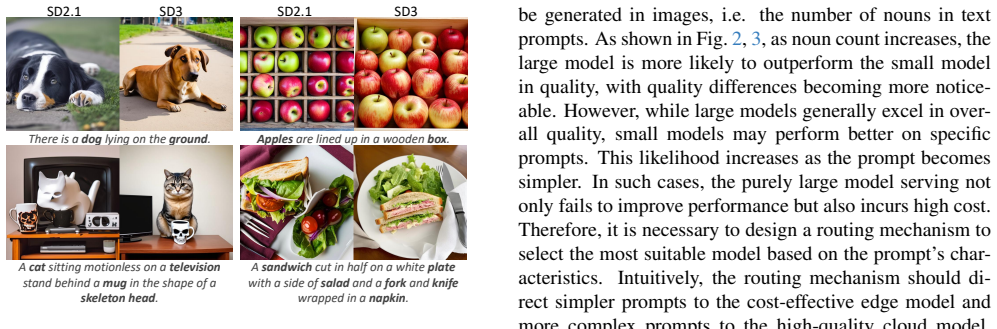
RouteT2I treats text-to-image routing as a prediction problem: from a user prompt, predict whether the edge model's image would be as good as or better than the cloud model's, and only send to the cloud when the predicted gap is large. The prediction target is the Pareto relative superiority between edge and cloud outputs, built from a ten-metric quality vector in which each metric is the sigmoid of the difference between CLIP similarity to a positive text and a negative text. A Transformer-based router with a dual-gate token-selection mixture-of-experts architecture — a set of specialized submodules, each aligned to a quality metric, that select the tokens most relevant to them — identifies prompt tokens with strong positive or negative influence on each quality metric and contrasts the two influences to form a per-token signal. Under a preset cloud routing rate, the routing strategy thresholds the predicted superiority so that only prompts where the cloud clearly wins are routed upward. The paper reports that at a 50% routing rate the routed images capture 83.97% of the cloud model's quality improvement over the edge model, and that reaching 50% of that improvement requires 70.24% fewer cloud calls than random routing, with results across 18 model pairs on COCO 2014 and a LAION subset.
Load-bearing premise
The load-bearing premise is that the ten hand-written positive and negative text pairs, compared through CLIP, measure the image quality users actually care about, since the router is trained on this score and the headline cost-saving results are measured with the same score.
Editorial extensions
If this is right
- At a fixed 50% routing rate, RouteT2I attains 83.97% of the quality gain that fully using the cloud model would give over the edge model, surpassing adapted LLM-routing baselines by at least 6 percentage points.
- To reach 50% of the cloud model's quality improvement, RouteT2I needs 70.24% fewer cloud calls than random routing, and savings stay above 50% for the other tested quality targets.
- Routing decisions are made before generation, so the unselected model is never invoked, keeping edge-device routing overhead to roughly 64.5 ms on a Jetson TX2 and 131.3 ms on a Jetson Nano.
- The method transfers across diffusion, diffusion-Transformer, and autoregressive architectures and across CLIP, OpenCLIP, and T5 text encoders, with the largest gains on model pairs with large quality gaps.
- For some edge-cloud pairs the relative performance improvement exceeds 100%, meaning the routed mixture can outperform full cloud usage on the multi-metric score.
Reading between the lines
- A direct extension would retrain the router on a human-preference-aligned reward instead of the ten hand-chosen CLIP-contrast metrics; if those metrics understate what users prefer for certain prompt classes, the routing decisions and reported savings would shift accordingly.
- The same dual-gate token-selection mechanism could apply to other generation tasks with large output spaces, such as text-to-video or text-to-3D, where a predicted-quality threshold would decide between a local and a remote model.
- Because the paper reports routing gains only in aggregate, a per-prompt calibration test would be informative: check whether the prompts the router sends to the cloud at the 50% rate are the same ones a human panel rates as substantially better from the cloud, since systematic disagreement would reveal prompt classes where routing is misdirected.
- The cost-quality evaluation is presented at fixed routing-rate targets; a natural operational extension is to price the two models and solve the Lagrangian form of the budget-constrained objective, yielding one routing threshold per price ratio.
Signed reviews
Editorial analysis
A structured set of objections, weighed in public.
Referee Report
Summary. The paper proposes RouteT2I, a routing framework that decides, for each text-to-image generation request, whether to invoke a large cloud model or a lightweight edge model. It defines a multi-dimensional contrastive quality metric Q based on CLIP similarity to hand-chosen positive/negative text pairs, introduces Pareto relative superiority (PRS) to quantify the quality gap between edge and cloud outputs, and trains a dual-gate token-selection mixture-of-experts model to predict PRS from the prompt text. A threshold on predicted PRS is then used to route prompts under cloud-rate constraints. Experiments on COCO 2014 with 18 model pairs report that at a 50% routing rate RouteT2I achieves 83.97% of the cloud model's average quality improvement over the edge model, and that it reduces cloud calls by 70.24% compared to random routing at a 40% relative improvement target. The appendix includes additional model-pair results, a LAION dataset check, and an external alignment check using HPSv2 and MPS.
Significance. If the results hold, RouteT2I addresses a timely and practically important problem: cutting the serving cost of text-to-image models without sacrificing perceived quality. The core idea of predicting a multi-metric quality gap from the prompt is coherent, and the paper's contribution includes a purpose-built router architecture, a routing strategy, and a fairly broad evaluation across 18 model pairs. The appendix's use of independent preference scorers (HPSv2, MPS) is a genuine step toward validating the quality proxy, and the reported training/inference overhead (58M parameters, 64.5ms on Jetson TX2) strengthens the practical case. The main reservations concern the semantics of the headline relative-improvement metric, the limited scope of the external validation, and missing reproducibility details.
major comments (4)
- [Section 6.2 / Appendix D] The primary evidence for the central claim that routing maintains generation quality is circular in a narrow sense: the router is trained to predict PRS, which is derived from the same contrastive quality metric Q used to report the main results in Tables 2-4. The only external check is Appendix D, which uses HPSv2 and MPS on a single model pair (SD3 vs SD2.1) at a single routing rate. This is insufficient to establish that routing decisions generalize to human-perceived quality, especially because Section 6.2 states that "Human evaluation ... [is] provided in Appendix" but the appendix does not contain a study with human raters, only automated preference models. I recommend either adding a genuine human evaluation or clearly rephrasing the claim to "automated preference-model evaluation."
- [Equation (18) / Tables 2 and 4] The definition of ΔP in Eq. (18), with an absolute value in the denominator, does not measure "the proportion of the quality improvement ... relative to the total possible improvement brought by fully using the cloud model" when the cloud is worse than the edge on a metric. For the Harmony metric in Table 2, the cloud average (0.5930) is below the edge average (0.5949), so the denominator is the absolute value of a negative cloud-vs-edge difference. The router's harmony value (0.5975) then yields a positive ratio of 1.37, whereas a signed denominator would yield -1.37. Consequently, the reported 83.97% would fall to about 56.8% under a signed denominator, and random routing would yield roughly 50% instead of the reported 40%. The metric should either use a signed denominator with careful handling of negative improvements, or the text should explicitly acknowledge that ΔP is not a strict fraction of the cloud's advantage when the two models are not ordered per-metric.
- [Sections 5.1-5.2 and 6.1] The paper omits key details needed to reproduce the routing model and strategy: the training loss used to optimize the PRS prediction, the number of experts and top-K value in the token-selection gate, the temperature Γ in Eq. (5), the metric weights w_i, and the procedure for setting the threshold α given a routing rate. Section 6.1 gives only the optimizer, learning rate, batch size, and epochs. The routing-strategy expression in Eq. (14) is also malformed: "max_{α≤1/2} P {P RS(Ie, Ic) < α | Ie, Ic ∈ Ie, Ic} ≤ ρr" reads as a constraint on a conditional probability whose conditioning event is unclear, and the optimization objective is missing. These gaps make it impossible to verify or build on the proposed approach from the manuscript alone.
- [Section 5.2] The routing rule has a directional subtlety that should be clarified. The text states that prompts with PRS above the threshold are better handled by the edge model, and Eq. (14) routes to the cloud when predicted PRS < α with α ≤ 1/2. Because PRS is defined as the edge advantage over the cloud, this ordering is correct, but the presentation is confusing: the threshold α is described as if it directly separates "edge-better" from "cloud-better," yet the boundary is at 0.5, not at α. Please state explicitly that the routing rule is: route to cloud if predicted PRS is below α (with α < 0.5), and explain how α is selected to meet the routing-rate constraint without solving an ill-posed optimization problem.
minor comments (5)
- [Section 5.2 / Eq. (14)] The notation Ie and Ic is used both for the edge/cloud image sets and for individual images (e.g., in the condition "Ie, Ic ∈ Ie, Ic"); please use different symbols for sets and elements.
- [Appendix B] The sentence "the output image space is at least e^{4×10^6} times larger than the input text space" appears to mix logarithmic and linear scales; the preceding calculation gives a log-scale ratio of about 4.36 million, so the factor should be e^{4.36×10^6} or the text should be rephrased.
- [Section 6.2] The phrase "Human evaluation, cost analysis, visual results, and more T2I pair results are provided in Appendix" is inaccurate because the appendix contains automated preference scores, not human evaluation, and I could not locate a separate cost analysis beyond the training/inference cost in Appendix E. Please correct the pointer.
- [Section 6.1] The baselines are adapted from LLM routing by "replacing their optimization goal with the average image quality across metrics," but it is not specified whether the adapted baselines use the same multi-dimensional Q or a scalar average; this matters for interpreting Table 2's per-metric values.
- [Throughout] The symbol σ is used for the sigmoid function in Eq. (3) and Eq. (13), and the text in Section 5.2 uses "P {P RS...}" with an extra opening brace; these are minor typographical issues that should be cleaned up.
Circularity Check
No significant circularity: the routing model is trained and evaluated on the same CLIP-contrastive quality family, but Appendix D provides external human-preference validation, so the central claim is not a derivation-by-construction loop.
full rationale
The paper's derivation chain is not circular in the load-bearing sense. RouteT2I trains a transformer-based router to predict PRS, a quantity defined from the CLIP-contrastive quality vector Q (Eqs. 3-6), and then reports ΔP (Eq. 18) computed from the same Q. This is supervised learning on the evaluation metric rather than an identity: the router must generalize from prompt tokens to the quality gap, and the paper supplies independent evidence in Appendix D, where the same router improves over random routing by 19.50% (HPSv2) and 7.57% (MPS) in ΔP, using external human-preference scorers. No load-bearing self-citations or imported uniqueness theorems appear; the MoE architecture is presented as a design, not as a forced consequence of prior work. A separate, non-circular correctness concern is that the headline 83.97% ΔP in Table 2 is not reproducible from Eq. (18) as printed: with the signed numerator and absolute-value denominator, the RouteT2I row sums to about 56.8%, and the printed value requires an unstated absolute value in the numerator. This affects the numeric headline and the derived cost-saving γ, but it is an arithmetic/definitional inconsistency rather than a circular argument.
Assumptions & free parameters
free parameters (5)
- Temperature Gamma in PRS distance =
unstated
- Metric weights w_i =
unstated (likely uniform)
- Routing threshold alpha =
tuned to meet routing rate rho_r
- Top-K token selection count =
unstated
- 10 positive/negative metric prompt pairs =
hand-crafted
assumptions (4)
- domain assumption CLIP similarity between an image and a text prompt reflects how well the image exhibits the property described by the prompt
- domain assumption Image quality is adequately captured by the 10 fixed contrastive metrics
- domain assumption A single generated image per model per prompt is a sufficient sample to estimate the quality gap
- domain assumption The routing decision can be made from the prompt alone, without seeing generated images
invented entities (1)
-
Pareto relative superiority (PRS)
Cite this review
Pith. "Pith review of Adaptive Routing of Text-to-Image Generation Requests Between Large Cloud Model and Light-Weight Edge Model." pith.science (2026). https://pith.science/paper/GAVLWFCC
@misc{pith2026241113787,
  author       = {Pith},
  title        = {Pith review of: Adaptive Routing of Text-to-Image Generation Requests Between Large Cloud Model and Light-Weight Edge Model},
  year         = {2026},
  howpublished = {\url{https://pith.science/paper/GAVLWFCC}},
  note         = {Machine review of arXiv:2411.13787}
}
read the original abstract
Large text-to-image models demonstrate impressive generation capabilities; however, their substantial size necessitates expensive cloud servers for deployment. Conversely, light-weight models can be deployed on edge devices at lower cost but often with inferior generation quality for complex user prompts. To strike a balance between performance and cost, we propose a routing framework, called RouteT2I, which dynamically selects either the large cloud model or the light-weight edge model for each user prompt. Since generated image quality is challenging to measure and compare directly, RouteT2I establishes multi-dimensional quality metrics, particularly, by evaluating the similarity between the generated images and both positive and negative texts that describe each specific quality metric. RouteT2I then predicts the expected quality of the generated images by identifying key tokens in the prompt and comparing their impact on the quality. RouteT2I further introduces the Pareto relative superiority to compare the multi-metric quality of the generated images. Based on this comparison and predefined cost constraints, RouteT2I allocates prompts to either the edge or the cloud. Evaluation reveals that RouteT2I significantly reduces the number of requesting large cloud model while maintaining high-quality image generation.
Figures


Figures from the paper (3 more)


Forward citations
Cited by 2 Pith papers
-
Collaborative Inference and Learning between Edge SLMs and Cloud LLMs: A Survey of Algorithms, Execution, and Open Challenges
A survey that builds a taxonomy of edge-cloud LLM-SLM collaboration for inference and training, claiming to be the first to unify both phases.
-
Collaborative Learning of On-Device Small Model and Cloud-Based Large Model: Advances and Future Directions
A broad survey of device-cloud collaborative learning that classifies collaboration algorithms into data-based, feature-based, and parameter-based families and catalogs systems, datasets, metrics, and industrial deployments.
Reference graph
Works this paper leans on
-
[1]
stabilityai/stable-diffusion-3.5-large · Hugging Face — huggingface.co. https : / / huggingface . co / stabilityai/stable-diffusion-3.5-large . 1
-
[2]
Mixture of tokens: Continuous moe through cross-example aggregation
Szymon Antoniak, Michał Krutul, Maciej Pi ´oro, Jakub Kra- jewski, Jan Ludziejewski, Kamil Ciebiera, Krystian Kr ´ol, Tomasz Odrzyg´o´zd´z, Marek Cygan, and Sebastian Jaszczur. Mixture of tokens: Continuous moe through cross-example aggregation. Advances in Neural Information Processing Systems, 37:103873–103896, 2025. 2
work page 2025
- [3]
-
[4]
Ld-pruner: Efficient pruning of latent diffu- sion models using task-agnostic insights
Thibault Castells, Hyoung-Kyu Song, Bo-Kyeong Kim, and Shinkook Choi. Ld-pruner: Efficient pruning of latent diffu- sion models using task-agnostic insights. In Proceedings of the IEEE/CVF Conference on Computer Vision and Pattern Recognition (CVPR) Workshops, pages 821–830, 2024. 1
work page 2024
-
[5]
Pixart- α: Fast training of diffusion transformer for photorealistic text-to-image synthesis
Junsong Chen, Jincheng Yu, Chongjian Ge, Lewei Yao, Enze Xie, Yue Wu, Zhongdao Wang, James Kwok, Ping Luo, Huchuan Lu, et al. Pixart- α: Fast training of diffusion transformer for photorealistic text-to-image synthesis. arXiv preprint arXiv:2310.00426, 2023. 6
-
[6]
Frugalgpt: How to use large language models while reducing cost and improving performance
Lingjiao Chen, Matei Zaharia, and James Zou. Frugalgpt: How to use large language models while reducing cost and improving performance. arXiv preprint arXiv:2305.05176 ,
-
[7]
Reproducible scal- ing laws for contrastive language-image learning
Mehdi Cherti, Romain Beaumont, Ross Wightman, Mitchell Wortsman, Gabriel Ilharco, Cade Gordon, Christoph Schuh- mann, Ludwig Schmidt, and Jenia Jitsev. Reproducible scal- ing laws for contrastive language-image learning. In Pro- ceedings of the IEEE/CVF conference on computer vision and pattern recognition, pages 2818–2829, 2023. 6
work page 2023
-
[8]
Hybrid llm: Cost- efficient and quality-aware query routing
Dujian Ding, Ankur Mallick, Chi Wang, Robert Sim, Subhabrata Mukherjee, Victor Ruhle, Laks VS Laksh- manan, and Ahmed Hassan Awadallah. Hybrid llm: Cost- efficient and quality-aware query routing. arXiv preprint arXiv:2404.14618, 2024. 1, 2, 7, 8, 3, 4
arXiv 2024
Show all 45 references
-
[9]
Scaling recti- fied flow transformers for high-resolution image synthesis
Patrick Esser, Sumith Kulal, Andreas Blattmann, Rahim Entezari, Jonas M ¨uller, Harry Saini, Yam Levi, Dominik Lorenz, Axel Sauer, Frederic Boesel, et al. Scaling recti- fied flow transformers for high-resolution image synthesis. In Forty-first International Conference on Mach...
2024
-
[10]
Infinity: Scaling bit- wise autoregressive modeling for high-resolution image syn- thesis
Jian Han, Jinlai Liu, Yi Jiang, Bin Yan, Yuqi Zhang, Zehuan Yuan, Bingyue Peng, and Xiaobing Liu. Infinity: Scaling bit- wise autoregressive modeling for high-resolution image syn- thesis. arXiv preprint arXiv:2412.04431, 2024. 6
2024 arXiv
-
[11]
Routerbench: A bench- mark for multi-llm routing system
Qitian Jason Hu, Jacob Bieker, Xiuyu Li, Nan Jiang, Benjamin Keigwin, Gaurav Ranganath, Kurt Keutzer, and Shriyash Kaustubh Upadhyay. Routerbench: A bench- mark for multi-llm routing system. arXiv preprint arXiv:2403.12031, 2024. 1
2024 arXiv
-
[12]
Laecips: Large vision model assisted adaptive edge-cloud collaboration for iot- based perception system
Shijing Hu, Ruijun Deng, Xin Du, Zhihui Lu, Qiang Duan, Yi He, Shih-Chia Huang, and Jie Wu. Laecips: Large vision model assisted adaptive edge-cloud collaboration for iot- based perception system. arXiv preprint arXiv:2404.10498,
-
[13]
Efficient edge inference by se- lective query
Anil Kag and Igor Fedorov. Efficient edge inference by se- lective query. In International Conference on Learning Rep- resentations, 2023. 2
2023
-
[14]
Holis- tic evaluation of text-to-image models
Tony Lee, Michihiro Yasunaga, Chenlin Meng, Yifan Mai, Joon Sung Park, Agrim Gupta, Yunzhi Zhang, Deepak Narayanan, Hannah Teufel, Marco Bellagente, et al. Holis- tic evaluation of text-to-image models. Advances in Neural Information Processing Systems, 36:69981–70011, 2023. 4, 2
2023
-
[15]
Holis- tic evaluation of text-to-image models
Tony Lee, Michihiro Yasunaga, Chenlin Meng, Yifan Mai, Joon Sung Park, Agrim Gupta, Yunzhi Zhang, Deepak Narayanan, Hannah Teufel, Marco Bellagente, et al. Holis- tic evaluation of text-to-image models. Advances in Neural Information Processing Systems, 36, 2024. 1
2024
-
[16]
Q-diffusion: Quantizing diffusion models
Xiuyu Li, Yijiang Liu, Long Lian, Huanrui Yang, Zhen Dong, Daniel Kang, Shanghang Zhang, and Kurt Keutzer. Q-diffusion: Quantizing diffusion models. In Proceedings of the IEEE/CVF International Conference on Computer Vi- sion, pages 17535–17545, 2023. 1
2023
-
[17]
Snap- fusion: Text-to-image diffusion model on mobile devices within two seconds
Yanyu Li, Huan Wang, Qing Jin, Ju Hu, Pavlo Chemerys, Yun Fu, Yanzhi Wang, Sergey Tulyakov, and Jian Ren. Snap- fusion: Text-to-image diffusion model on mobile devices within two seconds. Advances in Neural Information Pro- cessing Systems, 36, 2024. 1
2024
-
[18]
Iterative prompt learning for unsupervised backlit image enhancement
Zhexin Liang, Chongyi Li, Shangchen Zhou, Ruicheng Feng, and Chen Change Loy. Iterative prompt learning for unsupervised backlit image enhancement. In Proceedings of the IEEE/CVF International Conference on Computer Vi- sion, pages 8094–8103, 2023. 4
2023
-
[19]
Microsoft coco: Common objects in context
Tsung-Yi Lin, Michael Maire, Serge Belongie, James Hays, Pietro Perona, Deva Ramanan, Piotr Doll´ar, and C Lawrence Zitnick. Microsoft coco: Common objects in context. In Computer Vision–ECCV 2014: 13th European Conference, Zurich, Switzerland, September 6-12, 2014, Proceeding...
2014
-
[20]
Instaflow: One step is enough for high-quality diffusion- based text-to-image generation
Xingchao Liu, Xiwen Zhang, Jianzhu Ma, Jian Peng, et al. Instaflow: One step is enough for high-quality diffusion- based text-to-image generation. In The Twelfth International Conference on Learning Representations, 2023. 1
2023
-
[21]
Routing to the expert: Efficient reward-guided ensemble of large language models
Keming Lu, Hongyi Yuan, Runji Lin, Junyang Lin, Zheng Yuan, Chang Zhou, and Jingren Zhou. Routing to the expert: Efficient reward-guided ensemble of large language models. arXiv preprint arXiv:2311.08692, 2023. 1, 2, 7, 8, 3, 4
2023 arXiv
-
[22]
Latent consistency models: Synthesizing high- resolution images with few-step inference
Simian Luo, Yiqin Tan, Longbo Huang, Jian Li, and Hang Zhao. Latent consistency models: Synthesizing high- resolution images with few-step inference. arXiv preprint arXiv:2310.04378, 2023. 1
2023 arXiv
-
[23]
Routellm: Learning to route llms with preference data
Isaac Ong, Amjad Almahairi, Vincent Wu, Wei-Lin Chiang, Tianhao Wu, Joseph E Gonzalez, M Waleed Kadous, and Ion Stoica. Routellm: Learning to route llms with preference data. arXiv preprint arXiv:2406.18665, 2024. 1, 2, 6, 7, 8, 3, 4
2024 arXiv
-
[24]
Sdxl: Improving latent diffusion mod- els for high-resolution image synthesis
Dustin Podell, Zion English, Kyle Lacey, Andreas Blattmann, Tim Dockhorn, Jonas M ¨uller, Joe Penna, and Robin Rombach. Sdxl: Improving latent diffusion mod- els for high-resolution image synthesis. arXiv preprint arXiv:2307.01952, 2023. 1, 6
2023 arXiv
-
[25]
Learning transferable visual models from natural language supervi- sion
Alec Radford, Jong Wook Kim, Chris Hallacy, Aditya Ramesh, Gabriel Goh, Sandhini Agarwal, Girish Sastry, Amanda Askell, Pamela Mishkin, Jack Clark, et al. Learning transferable visual models from natural language supervi- sion. In International conference on machine learning, ...
2021
-
[26]
Exploring the limits of transfer learning with a unified text-to-text transformer
Colin Raffel, Noam Shazeer, Adam Roberts, Katherine Lee, Sharan Narang, Michael Matena, Yanqi Zhou, Wei Li, and Peter J Liu. Exploring the limits of transfer learning with a unified text-to-text transformer. Journal of machine learning research, 21(140):1–67, 2020. 6
2020
-
[27]
Zero-shot text-to-image generation
Aditya Ramesh, Mikhail Pavlov, Gabriel Goh, Scott Gray, Chelsea V oss, Alec Radford, Mark Chen, and Ilya Sutskever. Zero-shot text-to-image generation. In International confer- ence on machine learning, pages 8821–8831. Pmlr, 2021. 1
2021
-
[28]
High-resolution image synthesis with latent diffusion models
Robin Rombach, Andreas Blattmann, Dominik Lorenz, Patrick Esser, and Bj ¨orn Ommer. High-resolution image synthesis with latent diffusion models. In Proceedings of the IEEE/CVF conference on computer vision and pattern recognition, pages 10684–10695, 2022. 1, 6
2022
-
[29]
Photorealistic text-to-image diffusion models with deep language understanding
Chitwan Saharia, William Chan, Saurabh Saxena, Lala Li, Jay Whang, Emily L Denton, Kamyar Ghasemipour, Raphael Gontijo Lopes, Burcu Karagol Ayan, Tim Salimans, et al. Photorealistic text-to-image diffusion models with deep language understanding. Advances in neural information...
2022
-
[30]
Adversarial diffusion distillation
Axel Sauer, Dominik Lorenz, Andreas Blattmann, and Robin Rombach. Adversarial diffusion distillation. In European Conference on Computer Vision , pages 87–103. Springer,
-
[31]
Laion-5b: An open large-scale dataset for training next generation image-text models
Christoph Schuhmann, Romain Beaumont, Richard Vencu, Cade Gordon, Ross Wightman, Mehdi Cherti, Theo Coombes, Aarush Katta, Clayton Mullis, Mitchell Worts- man, et al. Laion-5b: An open large-scale dataset for training next generation image-text models. Advances in neural in- f...
2022
-
[32]
Outra- geously large neural networks: The sparsely-gated mixture- of-experts layer
Noam Shazeer, Azalia Mirhoseini, Krzysztof Maziarz, Andy Davis, Quoc Le, Geoffrey Hinton, and Jeff Dean. Outra- geously large neural networks: The sparsely-gated mixture- of-experts layer. arXiv preprint arXiv:1701.06538, 2017. 2
2017 arXiv
-
[33]
Large language model routing with benchmark datasets
Tal Shnitzer, Anthony Ou, M ´ırian Silva, Kate Soule, Yuekai Sun, Justin Solomon, Neil Thompson, and Mikhail Yurochkin. Large language model routing with benchmark datasets. arXiv preprint arXiv:2309.15789, 2023. 2
2023 arXiv
-
[34]
Temporal dynamic quantization for dif- fusion models
Junhyuk So, Jungwon Lee, Daehyun Ahn, Hyungjun Kim, and Eunhyeok Park. Temporal dynamic quantization for dif- fusion models. Advances in Neural Information Processing Systems, 36, 2024. 1
2024
-
[35]
Ex- ploring clip for assessing the look and feel of images
Jianyi Wang, Kelvin CK Chan, and Chen Change Loy. Ex- ploring clip for assessing the look and feel of images. InPro- ceedings of the AAAI conference on artificial intelligence , pages 2555–2563, 2023. 4
2023
-
[36]
Tabi: An efficient multi-level inference system for large language models
Yiding Wang, Kai Chen, Haisheng Tan, and Kun Guo. Tabi: An efficient multi-level inference system for large language models. In Proceedings of the Eighteenth European Confer- ence on Computer Systems, pages 233–248, 2023. 2
2023
-
[37]
T2i-scorer: Quantitative evaluation on text-to-image generation via fine-tuned large multi-modal models
Haoning Wu, Xiele Wu, Chunyi Li, Zicheng Zhang, Chaofeng Chen, Xiaohong Liu, Guangtao Zhai, and Weisi Lin. T2i-scorer: Quantitative evaluation on text-to-image generation via fine-tuned large multi-modal models. In Pro- ceedings of the 32nd ACM International Conference on Mul-...
2024
-
[38]
Human preference score v2: A solid benchmark for evaluating human preferences of text-to-image synthesis
Xiaoshi Wu, Yiming Hao, Keqiang Sun, Yixiong Chen, Feng Zhu, Rui Zhao, and Hongsheng Li. Human preference score v2: A solid benchmark for evaluating human preferences of text-to-image synthesis. arXiv preprint arXiv:2306.09341 ,
-
[39]
Multimodal large language models make text-to- image generative models align better
Xun Wu, Shaohan Huang, Guolong Wang, Jing Xiong, and Furu Wei. Multimodal large language models make text-to- image generative models align better. Advances in Neural Information Processing Systems, 37:81287–81323, 2024. 4, 2
2024
-
[40]
Imagere- ward: Learning and evaluating human preferences for text- to-image generation
Jiazheng Xu, Xiao Liu, Yuchen Wu, Yuxuan Tong, Qinkai Li, Ming Ding, Jie Tang, and Yuxiao Dong. Imagere- ward: Learning and evaluating human preferences for text- to-image generation. Advances in Neural Information Pro- cessing Systems, 36:15903–15935, 2023. 3
2023
-
[41]
Large language model cascades with mixture of thoughts representations for cost-efficient reasoning
Murong Yue, Jie Zhao, Min Zhang, Liang Du, and Ziyu Yao. Large language model cascades with mixture of thoughts representations for cost-efficient reasoning. arXiv preprint arXiv:2310.03094, 2023. 2
2023 arXiv
-
[42]
Learning multi- dimensional human preference for text-to-image generation
Sixian Zhang, Bohan Wang, Junqiang Wu, Yan Li, Tingt- ing Gao, Di Zhang, and Zhongyuan Wang. Learning multi- dimensional human preference for text-to-image generation. In Proceedings of the IEEE/CVF Conference on Computer Vision and Pattern Recognition, pages 8018–8027, 2024. 2, 3
2024
-
[43]
Mixdq: Memory-efficient few-step text-to-image dif- fusion models with metric-decoupled mixed precision quan- tization
Tianchen Zhao, Xuefei Ning, Tongcheng Fang, Enshu Liu, Guyue Huang, Zinan Lin, Shengen Yan, Guohao Dai, and Yu Wang. Mixdq: Memory-efficient few-step text-to-image dif- fusion models with metric-decoupled mixed precision quan- tization. arXiv preprint arXiv:2405.17873, 2024. 1
2024 arXiv
-
[44]
Mobilediffusion: Subsecond text-to-image generation on mobile devices
Yang Zhao, Yanwu Xu, Zhisheng Xiao, and Tingbo Hou. Mobilediffusion: Subsecond text-to-image generation on mobile devices. arXiv preprint arXiv:2311.16567, 2023. 3
2023 arXiv
-
[45]
High definition photo
Yanqi Zhou, Tao Lei, Hanxiao Liu, Nan Du, Yanping Huang, Vincent Zhao, Andrew M Dai, Quoc V Le, James Laudon, et al. Mixture-of-experts with expert choice routing. Ad- vances in Neural Information Processing Systems, 35:7103– 7114, 2022. 2 Adaptive Routing of Text-to-Image Gen...
2022
Reviewed August 12, 2026 · model on record in the stance chip above.
Discussion (0). Continue with ORCID to comment.