Simulating Universal Quantum Gate Sets on Photonic OAM Qubits: Single-Qubit and Multi-Qubit Operations via Spatial Light Modulator Phase Holography
Pith reviewed 2026-06-25 19:31 UTC · model grok-4.3
The pith
A datasheet-derived noise model predicts universal quantum gates on photonic OAM qubits achieve fidelities of 0.9914–0.9936 via SLM phase holography.
A machine-rendered reading of the paper's core claim, the machinery that carries it, and where it could break.
Core claim
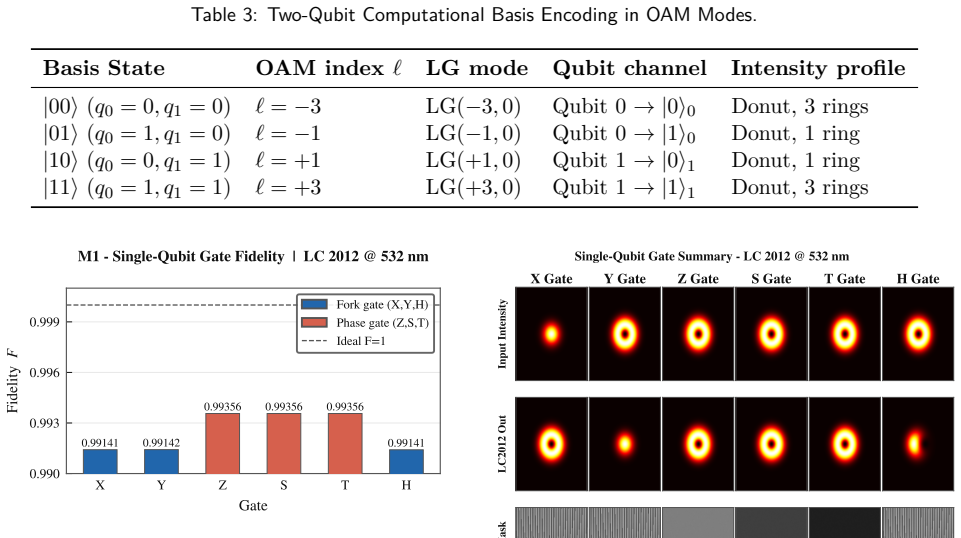
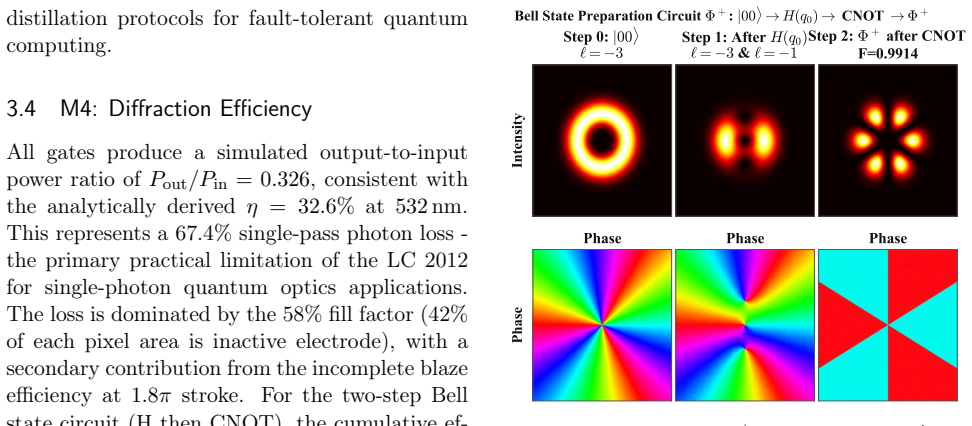
The complete universal single-qubit gate set {X, Y, Z, S, T, H} and two-qubit entangling gates {CNOT, CZ, SWAP} are simulated on photonic OAM qubits using SLM phase holography on a 512 × 512 computational grid, yielding predicted gate fidelities in the range F = 0.9914–0.9936 when a three-channel noise model (8-bit quantisation, TN electronic/thermal noise, phase-wrap clipping) that totals 92.4 mrad is applied; Bell-state preparation via the H-CNOT sequence reaches F(Φ+) = 0.9914 after two SLM interactions, and the wavelength window 450–532 nm is identified as optimal.
What carries the argument
Phase holography patterns on the transmissive SLM, specifically fork gratings that impart OAM shifts and pure phase masks that impart rotations, applied to Laguerre-Gaussian beams, together with the three-channel noise model taken from the manufacturer datasheet.
If this is right
- Fork-grating gates are limited primarily by TN noise while phase gates suffer zero phase-wrap clipping error and therefore reach higher fidelity.
- The H-CNOT sequence prepares the Bell state Φ+ with fidelity 0.9914 after exactly two SLM interactions.
- Operation is optimal in the 450–532 nm wavelength band for this device.
- The simulated fidelities lie within the 78 %–99.6 % range reported in six prior experimental studies.
- The same SLM platform can therefore be used for both single-qubit rotations and two-qubit entanglement without hardware reconfiguration.
Where Pith is reading between the lines
- Because the patterns are software-defined, the same hardware could in principle execute arbitrary quantum circuits by loading successive holograms, provided crosstalk between successive operations remains low.
- Extending the simulation to three or more qubits would test whether cumulative noise remains tolerable or whether higher-resolution SLMs become necessary.
- Direct comparison of the predicted noise spectrum with measured intensity and phase statistics on the physical device would confirm or refute the model’s predictive power.
- Integration of these SLM gates with existing single-photon sources and detectors could yield a compact, reconfigurable testbed for small-scale photonic quantum algorithms.
Load-bearing premise
The three-channel noise model taken directly from the HOLOEYE LC 2012 datasheet without free-parameter fitting accurately captures the real device's behavior for OAM phase holography.
What would settle it
An experimental measurement of gate fidelity on the actual HOLOEYE LC 2012 SLM using OAM-encoded qubits that falls substantially outside the predicted interval 0.9914–0.9936 would falsify the claim that the datasheet noise model is sufficient.
Figures




read the original abstract
Spatial light modulators (SLMs) have emerged as reconfigurable platforms for photonic quantum information processing, offering software-defined control over the orbital angular momentum (OAM) of light encoded in Laguerre-Gaussian (LG) beams. This paper presents a comprehensive simulation and hardware-grounded fidelity analysis of quantum gate operations implemented on the HOLOEYE LC 2012 transmissive SLM. A realistic three-channel noise model comprising 8-bit quantisation noise, twisted-nematic (TN) electronic and thermal noise, and phase-wrap clipping error is obtained from the manufacturer's datasheet without free-parameter fitting, yielding a total noise of $\sigma_{\text{total}} = 92.4\text{mrad}$. The complete universal single-qubit gate set $\{X, Y, Z, S, T, H\}$ and two-qubit entangling gates $\{\text{CNOT}, \text{CZ}, \text{SWAP}\}$ are simulated on a $512 \times 512$ computational grid. Results show that predicted gate fidelity are in the range of $F = 0.9914\text{--}0.9936$, with fork grating gates limited primarily by TN noise and phase gates achieving higher fidelity owing to zero phase-wrap clipping error. In addition, Bell state preparation via the H-CNOT circuit achieves $F(\Phi^+) = 0.9914$ after two SLM interactions. We benchmark our obtained results against six published experimental studies spanning the 78%--99.6% fidelity range. Finally, a wavelength-dependent analysis identifies 450--532 nm operation as the optimal regime for this device.
Editorial analysis
A structured set of objections, weighed in public.
Referee Report
Summary. The manuscript simulates the universal single-qubit gate set {X, Y, Z, S, T, H} and two-qubit entangling gates {CNOT, CZ, SWAP} on photonic OAM qubits encoded in LG modes, implemented via phase holograms on a HOLOEYE LC 2012 transmissive SLM. A three-channel noise model (8-bit quantization, TN electronic/thermal, phase-wrap clipping) with total σ_total = 92.4 mrad is taken directly from the manufacturer datasheet without free-parameter fitting and propagated through 512 × 512 grid simulations, yielding predicted gate fidelities F = 0.9914–0.9936. Fork-grating gates are limited by TN noise while phase gates achieve higher fidelity due to zero clipping error; Bell-state preparation via H-CNOT reaches F(Φ+) = 0.9914. Results are benchmarked against six experimental studies and a wavelength-dependent analysis identifies 450–532 nm as optimal.
Significance. If the datasheet noise model is representative of actual OAM hologram performance, the work supplies a concrete, parameter-free benchmark for SLM-based photonic OAM quantum gates, quantifying the fidelity ceiling set by each noise channel and identifying an optimal operating wavelength. The absence of fitted parameters and the explicit decomposition of noise sources are strengths that allow direct comparison with future device measurements.
major comments (3)
- [Abstract / noise model] Abstract and noise-model section: the headline fidelities F = 0.9914–0.9936 are obtained by propagating a fixed three-channel noise model whose total σ_total = 92.4 mrad is taken verbatim from the HOLOEYE LC 2012 datasheet. No on-device calibration, spatial mapping, or wavelength-specific measurement of phase error for fork or blazed gratings is reported; any systematic deviation between datasheet statistics and real-device behavior for OAM holography therefore scales every reported fidelity number directly.
- [Simulation methodology] Simulation section: grid convergence, LG-mode truncation order, and the precise numerical method used to generate the phase holograms (fork-grating vs. blazed-grating encoding) are not quantified. These choices directly affect the overlap integrals that enter the fidelity calculation and must be shown to be converged before the quoted F values can be treated as robust predictions.
- [Bell-state preparation] Results section (Bell-state paragraph): the reported F(Φ+) = 0.9914 after two successive SLM interactions assumes independent noise realizations on each hologram. The manuscript does not examine whether spatial correlations or residual beam-profile mismatch between the two interactions would alter this number.
minor comments (2)
- [Abstract] The abstract states “predicted gate fidelity are” (plural subject, singular verb); correct to “fidelities are”.
- [Figures] Figure captions should explicitly state the computational grid size, the LG mode indices used, and the exact noise-channel contributions plotted.
Simulated Author's Rebuttal
We thank the referee for their constructive comments, which help clarify the scope and limitations of our simulation study. We respond to each major comment below.
read point-by-point responses
-
Referee: [Abstract / noise model] Abstract and noise-model section: the headline fidelities F = 0.9914–0.9936 are obtained by propagating a fixed three-channel noise model whose total σ_total = 92.4 mrad is taken verbatim from the HOLOEYE LC 2012 datasheet. No on-device calibration, spatial mapping, or wavelength-specific measurement of phase error for fork or blazed gratings is reported; any systematic deviation between datasheet statistics and real-device behavior for OAM holography therefore scales every reported fidelity number directly.
Authors: The manuscript deliberately uses only datasheet values without fitting to supply a parameter-free benchmark, as stated in the abstract and methods. This enables direct future comparison with experiments. We will add an explicit statement in the noise-model section noting that any systematic deviation from the datasheet values would scale the reported fidelities proportionally. revision: partial
-
Referee: [Simulation methodology] Simulation section: grid convergence, LG-mode truncation order, and the precise numerical method used to generate the phase holograms (fork-grating vs. blazed-grating encoding) are not quantified. These choices directly affect the overlap integrals that enter the fidelity calculation and must be shown to be converged before the quoted F values can be treated as robust predictions.
Authors: We agree that convergence details are required. The revised manuscript will include an appendix or subsection reporting grid-size convergence tests confirming 512×512 sufficiency, LG truncation (radial index p ≤ 10), and the standard numerical implementation of fork-grating and blazed-grating holograms. These additions will demonstrate stability of the fidelity results. revision: yes
-
Referee: [Bell-state preparation] Results section (Bell-state paragraph): the reported F(Φ+) = 0.9914 after two successive SLM interactions assumes independent noise realizations on each hologram. The manuscript does not examine whether spatial correlations or residual beam-profile mismatch between the two interactions would alter this number.
Authors: The independent-noise assumption follows directly from the datasheet model in the absence of device-specific correlation data. We will add a clarifying sentence in the results section stating this assumption and noting that spatial correlations or beam mismatch, if present, could modify the value but cannot be quantified without additional experimental characterization beyond the current simulation scope. revision: partial
Circularity Check
No circularity: fidelities computed from fixed external datasheet noise model on independent grid simulation
full rationale
The paper takes a fixed three-channel noise model (quantization + TN + clipping) with σ_total = 92.4 mrad directly from the HOLOEYE LC 2012 datasheet, applies it without any free-parameter fitting or adjustment to the 512×512 grid simulation of the gate holograms, and reports the resulting fidelities. No step equates a fitted parameter to a prediction, renames a known result, or relies on a self-citation chain for the central claim; the derivation chain is self-contained against the external benchmark values.
Axiom & Free-Parameter Ledger
axioms (2)
- domain assumption Manufacturer datasheet values for 8-bit quantisation, TN noise, and phase-wrap clipping accurately describe the physical SLM without additional device-specific calibration.
- domain assumption The 512×512 computational grid and chosen LG mode basis truncation are sufficient to capture all relevant diffraction and phase errors for the simulated gates.
Reference graph
Works this paper leans on
-
[1]
Universal linear optics
J. Carolan et al. “Universal linear optics”. Science349, 711–716 (2015)
2015
-
[2]
Orbital an- gular momentum of light and the transfor- mation of Laguerre-Gaussian laser modes
L. Allen, M. W. Beijersbergen, R. J. C. Spreeuw, and J. P. Woerdman. “Orbital an- gular momentum of light and the transfor- mation of Laguerre-Gaussian laser modes”. Phys. Rev. A45, 8185–8189 (1992)
1992
-
[3]
Orbital angular momentum of photons and the entanglement of Laguerre- Gaussian modes
M. Krenn, M. Malik, M. Erhard, and A. Zeilinger. “Orbital angular momentum of photons and the entanglement of Laguerre- Gaussian modes”. Phil. Trans. R. Soc. A 375, 20150442 (2017)
2017
-
[4]
Management of the angular momentum of light: preparation of pho- tons in multidimensional vector states of an- gular momentum
G. Molina-Terriza, J. P. Torres, and L. Torner. “Management of the angular momentum of light: preparation of pho- tons in multidimensional vector states of an- gular momentum”. Phys. Rev. Lett.88, 013601 (2001)
2001
-
[5]
Simultaneous multichan- nel free-space optical communications using a single transmitter and receiver and or- bitalangularmomentummultiplexing
K. Pang et al. “Simultaneous multichan- nel free-space optical communications using a single transmitter and receiver and or- bitalangularmomentummultiplexing”. Opt. Lett.43, 3889–3892 (2018)
2018
-
[6]
Propagation-invariant high-dimensional orbital angular momentum states
L.-W. Mao, D.-S. Ding, C. Rosales-Guzmán, and Z.-H. Zhu. “Propagation-invariant high-dimensional orbital angular momentum states”. J. Opt.24, 044004 (2022)
2022
-
[7]
Holographic gen- eration of complex fields with spatial light modulators: application to quantum key dis- tribution
M. T. Gruneisen, W. A. Miller, R. C. Dy- male, and A. M. Sweiti. “Holographic gen- eration of complex fields with spatial light modulators: application to quantum key dis- tribution”. Appl. Opt.47, A32–A42 (2008)
2008
-
[8]
Free-space information transfer using light beams carrying orbital angular momentum
G. Gibson et al. “Free-space information transfer using light beams carrying orbital angular momentum”. Opt. Express12, 5448–5456 (2004)
2004
-
[9]
Quantitative orbital angular momentum measurement of perfect vortex beams
J. Pinnell, V. Rodríguez-Fajardo, and A. Forbes. “Quantitative orbital angular momentum measurement of perfect vortex beams”. Opt. Lett.44, 2736–2739 (2019)
2019
-
[10]
Self-healing high-dimensional quantum key distribution using hybrid spin- orbit Bessel states
I. Nape, E. Otte, A. Vallés, C. Rosales- Guzmán, F. Cardano, C. Denz, and A. Forbes. “Self-healing high-dimensional quantum key distribution using hybrid spin- orbit Bessel states”. Opt. Express26, 26946– 26960 (2018)
2018
-
[11]
Spatial light modulators for atomic quantum com- puting (SMAQ)
Fraunhofer IPMS SMAQ Project. “Spatial light modulators for atomic quantum com- puting (SMAQ)”. Technical report. Fraun- hofer Institute for Photonic Microsystems- Dresden, Germany (2025). url:https:// www.ipms.fraunhofer.de
2025
-
[12]
Orbital angular momentum: origins, behavior, and applications
A. M. Yao and M. J. Padgett. “Orbital angular momentum: origins, behavior, and applications”. Adv. Opt. Photon.3, 161– 204 (2011)
2011
-
[13]
Quantum computer networks with the orbital angular momentum of light
J. C. Garcia-Escartin and P. Chamorro- Posada. “Quantum computer networks with the orbital angular momentum of light”. Phys. Rev. A86, 032334 (2012)
2012
-
[14]
High-dimensional single-photon quantum gates: concepts and experiments
A. Babazadeh et al. “High-dimensional single-photon quantum gates: concepts and experiments”. Phys. Rev. Lett.119, 180510 (2017)
2017
-
[15]
Arbitrary unitaries in orbital an- gular momentum of single photons
J. Kysela. “Arbitrary unitaries in orbital an- gular momentum of single photons”. EPJ Quantum Technol.9, 22 (2022)
2022
-
[16]
High-dimensional Quantum Fourier Transform of twisted light
J. Kysela. “High-dimensional Quantum Fourier Transform of twisted light”. Phys. Rev. A104, 012413 (2021)
2021
-
[17]
Continuous-variable quantum computation 16 with spatial degrees of freedom of photons
D. S. Tasca, R. M. Gomes, F. Toscano, P. H. Souto Ribeiro, and S. P. Walborn. “Continuous-variable quantum computation 16 with spatial degrees of freedom of photons”. Phys. Rev. A83, 052325 (2011)
2011
-
[18]
Quantuminformationtrans- fer from spin to orbital angular momen- tum of photons
E.Nagalietal. “Quantuminformationtrans- fer from spin to orbital angular momen- tum of photons”. Phys. Rev. Lett.103, 013601 (2009)
2009
-
[19]
Laguerre-Gaussian mode sorter
N. K. Fontaine et al. “Laguerre-Gaussian mode sorter”. Nature Commun.10, 1865 (2019)
2019
-
[20]
Implementingone-photonthree-qubitquan- tum gates using spatial light modulators
A. F. Abouraddy, G. Di Giuseppe, T. M. Yarnall, M. C. Teich, and B. E. A. Saleh. “Implementingone-photonthree-qubitquan- tum gates using spatial light modulators”. Phys. Rev. A86, 050303(R) (2012)
2012
-
[21]
Single- photon three-qubit quantum logic using spa- tial light modulators
K. H. Kagalwala, G. Di Giuseppe, A. F. Abouraddy, and B. E. A. Saleh. “Single- photon three-qubit quantum logic using spa- tial light modulators”. Nature Commun.8, 739 (2017)
2017
-
[22]
High-dimensional quantum gates using full-field spatial modes of photons
F. Brandt, M. Hiekkämäki, F. Bouchard, M.Huber, andR.Fickler. “High-dimensional quantum gates using full-field spatial modes of photons”. Optica7, 98–107 (2020)
2020
-
[23]
A versatile device for implementing the optical quantum gates in multiple degrees of freedom
H. Ke, S. Fang, and W. Zhang. “A versatile device for implementing the optical quantum gates in multiple degrees of freedom”. Opt. Laser Technol.169, 110137 (2024)
2024
-
[24]
Multi-qubit entanglement and algorithms on a neutral- atom quantum computer
T. M. Graham, M. Kwon, B. Grinkemeyer, Z. Marra, X. Jiang, M. T. Lichtman, Y. Sun, M. Ebert, and M. Saffman. “Multi-qubit entanglement and algorithms on a neutral- atom quantum computer”. Nature604, 457– 462 (2022)
2022
-
[25]
Mapping twisted light into and out of a photonic chip
Y. Chen et al. “Mapping twisted light into and out of a photonic chip”. Phys. Rev. Lett. 121, 233602 (2018)
2018
-
[26]
Ultracom- pact 3D integrated photonic chip for high- fidelity high-dimensional quantum gates
K. Wang, D. Lyu, C. Cai, T. Fu, J. Wang, Q. Wang, J. Liu, and J. Wang. “Ultracom- pact 3D integrated photonic chip for high- fidelity high-dimensional quantum gates”. Sci. Adv.11, eadv5718 (2025)
2025
-
[27]
Ultrahigh-fidelity spatial- mode photonic quantum gates via diffractive deep neural networks
Q. Wang et al. “Ultrahigh-fidelity spatial- mode photonic quantum gates via diffractive deep neural networks”. Light: Sci. Appl.13, 10 (2024)
2024
-
[28]
Transverse mode-encoded quantum gate on a Silicon photonic chip
L.-T. Feng, M. Zhang, X. Xiong, D. Liu, Y.- J. Cheng, F.-M. Jing, X.-Z. Qi, Y. Chen, D.- Y. He, G.-P. Guo, G.-C. Guo, D.-X. Dai, and X.-F. Ren. “Transverse mode-encoded quantum gate on a Silicon photonic chip”. Phys. Rev. Lett.128, 060501 (2022)
2022
-
[29]
Quantum states generation and manipulation in a programmable Silicon- photonic four-qubit system with high- fidelity and purity
J.-M. Lee, J. Park, J. Bang, Y.-I. Sohn, A. Baldazzi, M. Sanna, S. Azzini, and L. Pavesi. “Quantum states generation and manipulation in a programmable Silicon- photonic four-qubit system with high- fidelity and purity”. APL Photonics9, 076110 (2024)
2024
-
[30]
Heralded high-dimensional photon–photon quantum gate
Z.-F. Liu, Z.-C. Ren, P. Wan, W.-Z. Zhu, Z.-M. Cheng, J. Wang, Y.-P. Shi, H.-B. Xi, M. Huber, N. Friis, X. Gao, X.-L. Wang, and H.-T. Wang. “Heralded high-dimensional photon–photon quantum gate”. Nature Pho- ton.20, 460–467 (2026)
2026
-
[31]
Simple framework for systematic high-fidelity gate operations
M. Rimbach-Russ, S. G. J. Philips, X. Xue, and L. M. K. Vandersypen. “Simple framework for systematic high-fidelity gate operations”. Quantum Sci. Technol.8, 045025 (2023)
2023
-
[32]
High-fidelity integrated quantum photonics via programmatic re- routing
J. Mower et al. “High-fidelity integrated quantum photonics via programmatic re- routing”. Phys. Rev. A92, 032322 (2015)
2015
-
[33]
Free-space quan- tum key distribution by rotation-invariant twisted photons
G. Vallone et al. “Free-space quan- tum key distribution by rotation-invariant twisted photons”. Phys. Rev. Lett.113, 060503 (2014)
2014
-
[34]
High-dimensional quantum cryptography with twisted light
M. Mirhosseini et al. “High-dimensional quantum cryptography with twisted light”. New J. Phys.17, 033033 (2015)
2015
-
[35]
Reversible optical memory for twisted photons
L. Veissier et al. “Reversible optical memory for twisted photons”. Opt. Lett.38, 712– 714 (2013)
2013
-
[36]
Long-lived orbital angular mo- mentum memory for photonic qubit in cold atoms
Y. Ye et al. “Long-lived orbital angular mo- mentum memory for photonic qubit in cold atoms”. Phys.Rev.Lett.129, 193601(2022)
2022
-
[37]
LC 2012 spatial light modulator (transmissive) – datasheet
HOLOEYE Photonics AG. “LC 2012 spatial light modulator (transmissive) – datasheet”. [Online]. Available:https://holoeye.com/ lc-2012-spatial-light-modulator/(2023)
2012
-
[38]
Photonic quantum information pro- cessing: a review
F. Flamini, N. Spagnolo, and F. Sciar- rino. “Photonic quantum information pro- cessing: a review”. Rep. Prog. Phys.82, 016001 (2019)
2019
-
[39]
Preparing arbitrary pure states of spatial qudits with a single phase-only spa- tial light modulator
M. A. Solís-Prosser, A. Arias, J. J. M. Varga, L. Rebón, S. Ledesma, C. Iemmi, and L. Neves. “Preparing arbitrary pure states of spatial qudits with a single phase-only spa- tial light modulator”. Opt. Lett.38, 4762– 4765 (2013)
2013
-
[40]
Quantum storage of or- bital angular momentum entanglement in an 17 atomic ensemble
D.-S. Ding et al. “Quantum storage of or- bital angular momentum entanglement in an 17 atomic ensemble”. Phys. Rev. Lett.114, 050502 (2015)
2015
-
[41]
Remote transport of high-dimensional orbital an- gular momentum states and ghost images via spatial-mode-engineered frequency con- version
X. Qiu, H. Guo, and L. Chen. “Remote transport of high-dimensional orbital an- gular momentum states and ghost images via spatial-mode-engineered frequency con- version”. Nature Commun.14, 8244 (2023)
2023
-
[42]
Quan- tum computation and quantum informa- tion
M. A. Nielsen and I. L. Chuang. “Quan- tum computation and quantum informa- tion”. Cambridge Univ. Press. Cambridge, U.K. (2010). 10th anniversary edition. 18 A Simulation Notebooks Three Jupyter notebooks implement the complete simulation framework. All code is written in Python 3.10 (NumPy, Matplotlib). The LC 2012 hardware parameters are defined in a s...
2010
discussion (0)
Sign in with ORCID, Apple, or X to comment. Anyone can read and Pith papers without signing in.