REVIEW 2 major objections 6 minor 15 references
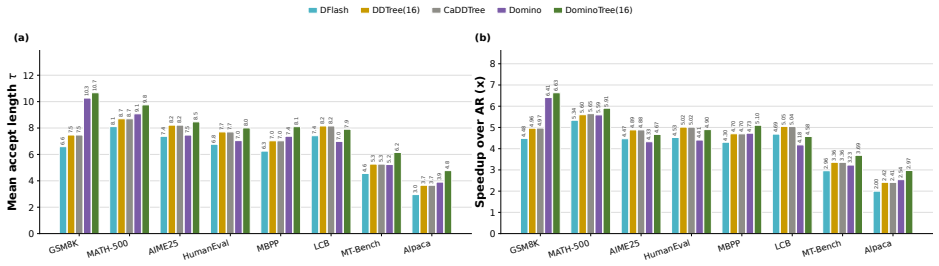
DominoTree scores a best-first draft tree with Domino’s path-dependent corrections, lifting accepted length and throughput over chain and marginal-tree baselines without retraining.
Reviewed by Pith at T0; open to challenge. T0 means a machine referee read the full paper against a public rubric. the ladder, T0–T4 →
2026-07-13 06:33 UTC pith:GEONKL65
load-bearing objection Solid training-free systems paper: plugs Domino's path-dependent correction into DDTree's heap under top-M restriction, ships a bit-identical CUDA-graph builder, and converts higher accept length into CI-clean 4B throughput wins. the 2 major comments →
DominoTree: Conditional Tree-Structured Drafting with Domino for Speculative Decoding
The pith
A machine-rendered reading of the paper's core claim, the machinery that carries it, and where it could break.
Core claim
A training-free best-first draft tree can be scored by Domino’s non-factorized, path-dependent GRU correction along each candidate’s own history rather than by path-independent marginals; when the per-node correction is restricted to the marginal top-M tokens and executed by a bit-identical CUDA-graph builder, the resulting tree delivers both the highest mean accepted length of any compared method and clear overall throughput wins over the released Domino chain and over DDTree/CaDDTree at every temperature on Qwen3-4B.
What carries the argument
Conditional-scored best-first heap: DDTree’s heap mechanism left unchanged, but each node’s children are scored by Domino’s released correction head applied to that node’s specific GRU state (restricted to the depth-wise top-M marginal candidates), then advanced, so cumulative path log-probability reflects the realized prefix rather than a shared marginal.
Load-bearing premise
Even though Domino’s corrected path probabilities systematically over-predict true target acceptance, their relative ranking is still good enough that best-first expansion plus a fixed top-M slice preserves the conditional advantage without dropping the tokens the correction would have promoted.
What would settle it
Re-run the matched Cond@16 vs Marg@16 ablation (same Domino drafter, budget, verifier) on a new model family or longer-generation regime; if the paired throughput delta collapses to zero or negative while acceptance length no longer favors the conditional scorer, the central claim fails.
If this is right
- Any partial-conditional block drafter whose backbone is path-independent can host a conditional draft tree without re-running the expensive backbone per branch.
- Accepted length can be raised above both the single-chain Domino decoder and factorized marginal trees while remaining training-free on public weights.
- A GPU-native per-node correction graph is necessary to convert the acceptance-length lead into a throughput lead once the drafter itself grows heavier.
- Fixed node budgets remain preferable to CaDDTree-style adaptive budgets until the corrected path probabilities are recalibrated as acceptance estimators.
Where Pith is reading between the lines
- The same top-M restriction pattern could be applied to other cheap sequential correctors that sit on top of parallel backbones, not only Domino’s GRU.
- Serving stacks that already capture CUDA graphs for chain drafting could absorb the three-graph per-node builder with modest engineering, turning research throughput into production throughput.
- If a future causal parallel head is trained end-to-end for trees, DominoTree’s training-free reuse of an existing correction head remains the lower-cost baseline against which that investment must be justified.
Editorial analysis
A structured set of objections, weighed in public.
Referee Report
Summary. The paper introduces DominoTree, a training-free best-first draft tree for speculative decoding that scores nodes with Domino’s path-dependent GRU correction rather than DFlash-style factorized marginals. Candidate restriction to a per-depth top-M set and a bit-identical GPU-native CUDA-graph builder make the conditional construction practical. On Qwen3-4B across eight benchmarks, DominoTree reports the highest mean accepted length of any evaluated method at every tested temperature and CI-clean Overall throughput gains over the released Domino chain (≈9–10%) and over DDTree/CaDDTree; on Qwen3-8B it keeps the highest τ and a large T=0 win over DDTree, with the edge narrowing at higher T. CondAdaptive (CaDDTree-style adaptive budget on conditional scores) is reported as a calibration-driven negative result; a controlled Cond@16 vs Marg@16 ablation isolates the gain to conditioning.
Significance. If the reported results hold, DominoTree is a concrete, training-free advance on the block-diffusion drafting line: it exploits Domino’s partial-conditional structure (shared backbone, path-dependent correction) that DDTree/CaDDTree’s factorized formulation cannot represent, and converts an accepted-length lead into a throughput lead via a carefully engineered builder. Strengths that raise confidence include multi-temperature tables with paired-bootstrap 95% CIs (Table 2), the matched-budget Cond@16 vs Marg@16 ablation (+9.2% Overall; Table 5), bit-identical Python vs GPU-native builders (Tables 3–4), budget/M and draft-sampling ablations, flat τ under top-M restriction up to full vocabulary (Table 9), and an honest CondAdaptive negative result with calibration evidence (Appendix B.3). The work is systems-empirical rather than theoretical, but the ablations and negative result are the right kind of evidence for this venue.
major comments (2)
- [Section 4.1, Table 1, Table 2] Section 4.1 and Table 1: the three-harness protocol (reference CaDDTree harness on DFlash, released Domino benchmark, authors’ DominoTree harness) is carefully documented, including lean-common-AR normalization for Domino and ~2% AR agreement. The central Overall claims rest on these cross-harness speedup ratios. A short sensitivity check—e.g., re-running DominoTree and Domino-chain under a single harness for the Overall rollup, or reporting raw TPS where same-harness—would make the 9–10% Domino and DDTree/CaDDTree wins harder to attribute to harness differences. This is not a correctness error given the same-harness Cond@16 vs Marg@16 ablation, but it is load-bearing for the headline baseline comparisons.
- [Section 6, Abstract, Section 4.3] Section 6 and Section 4.3: all throughput numbers come from a single-stream, batch-size-1 HuggingFace research harness; multi-request serving (SGLang/vLLM) is explicitly out of scope. The GPU-native builder’s value is shown to grow with drafter cost (8B build saving ≈11.7 ms). The central claim is still valid as a research result, but the paper should state more sharply in the abstract/intro that reported speedups are research-harness wall-clock, not production-serving throughput, so readers do not over-extrapolate the 6.6× / 9–10% figures.
minor comments (6)
- [Figure 1, Table 1, Table 7] Figure 1 caption and Table 1: clarify that Domino is shown at its CUDA-graph best configuration and that DominoTree’s larger budgets raise τ further (Table 7) so the headline (16) is a cost/quality choice, not the τ maximum.
- [Section 3.2, Algorithm 1] Section 3.2 / Algorithm 1: state explicitly how top-k (children per expansion) relates to M and n; free parameters are listed in the reader’s ledger but the default top-k is easy to miss in the main text.
- [Section 2.5, Section 3.4] Section 2.5 and 3.4: the claim that CaDDTree’s throughput identity “plausibly transfers” while optimality is not claimed is fine; a one-sentence pointer that candidate restriction departs from exhaustive support would help readers who skip the appendix.
- [Abstract, Table 2] Table 2 Code rollup: DominoTree trails DDTree/CaDDTree on Code at several temperatures; the abstract’s “outperforms … at every tested temperature” is Overall-true but should be qualified for the Code category to avoid over-reading.
- [Throughout, Section 5] Typos / polish: “accept length” vs “accepted length” is used inconsistently; “Overall-rollup” hyphenation; arXiv IDs in related work are fine but ensure JetSpec/Domino/DFlash citations match the final versions if available.
- [Section 3.4, Appendix B.3] Appendix B.3 / Figure 2: the over-credit factors (1.16× GSM8K, 1.07× Alpaca) are important; consider promoting a one-line summary into the main CondAdaptive paragraph so the negative result is self-contained without the appendix.
Circularity Check
No significant circularity: empirical systems paper whose claims are measured wall-clock/accept-length results against external baselines, not identities forced by definition or self-citation.
full rationale
DominoTree is a training-free systems construction: it plugs Domino's publicly released GRU correction into DDTree's best-first heap, restricts the correction to a top-M slice for cost, and ships a bit-identical CUDA-graph builder. The central claims (highest mean accepted length at every temperature; CI-clean Overall throughput gains over released Domino and over DDTree/CaDDTree on Qwen3-4B) are empirical measurements on public benchmarks against external harnesses and checkpoints, not predictions derived from fitted parameters that restate the inputs. CondAdaptive is reported as a negative result precisely because the path-probability estimator over-credits acceptance; the paper does not hide the failure or redefine success around it. The Cond@16 vs Marg@16 ablation holds drafter/budget/verifier fixed and isolates scoring, which is an independent control rather than a circular restatement. Citations (DFlash, DDTree, CaDDTree, Domino, SpecInfer, EAGLE) are to prior external work; there is no load-bearing uniqueness theorem or ansatz imported from overlapping authors that forces the result. Reuse of Domino's public weights is ordinary checkpoint reuse, not circular derivation. No step reduces by construction to its own inputs.
Axiom & Free-Parameter Ledger
free parameters (3)
- node budget n =
16 (headline); 32 also competitive
- candidate width M =
64
- top-k children per expansion
axioms (4)
- domain assumption Speculative decoding with target verification is lossless up to floating-point tie-breaking (accepted tokens match the target distribution).
- domain assumption Domino Structural Fact B: backbone hidden states Hi are path-independent; only the GRU correction ΔLi is path-dependent.
- domain assumption DDTree best-first heap + ancestor-only tree-attention verification are correct mechanisms for draft trees.
- ad hoc to paper CaDDTree throughput identity θ(n)=(1+Φ(n))/(Cd+Cv(n)) can be used as a heuristic on non-factorized conditional scores even if the original unimodality proof assumes factorization.
invented entities (3)
-
DominoTree (conditional-scored best-first draft tree with top-M restriction)
independent evidence
-
CondAdaptive (per-round adaptive budget on conditional path probabilities)
no independent evidence
-
GPU-native CUDA-graph per-node correction builder
independent evidence
Cite this review
Pith. "Pith review of DominoTree: Conditional Tree-Structured Drafting with Domino for Speculative Decoding." pith.science (2026). https://pith.science/paper/GEONKL65
@misc{pith2026260708642,
  author       = {Pith},
  title        = {Pith review of: DominoTree: Conditional Tree-Structured Drafting with Domino for Speculative Decoding},
  year         = {2026},
  howpublished = {\url{https://pith.science/paper/GEONKL65}},
  note         = {Machine review of arXiv:2607.08642}
}
read the original abstract
Speculative decoding accelerates LLM inference by drafting several tokens and verifying them in parallel. Block-diffusion drafters such as DFlash produce a draft block in one pass but model only per-position marginals, and best-first tree methods such as DDTree expand candidate trees from those marginals. The released Domino drafter adds a GRU-based causal correction that makes each draft token distribution path-dependent, a structure DDTree's factorized formulation cannot represent. We introduce DominoTree, a training-free best-first draft tree scored by Domino's conditional, non-factorized correction along each root-to-node path, made practical by restricting the per-node correction to a candidate top-M set. On Qwen3-4B across eight benchmarks, DominoTree reaches up to 6.6x speedup over autoregressive decoding and the highest mean accepted length of any evaluated method, up to 10.7 tokens per round, at every tested temperature. DominoTree constructs its tree with a GPU-native CUDA-graph builder that is bit-identical to a reference Python implementation, so acceptance is unchanged, while keeping per-round tree construction cheap. With this builder as default, DominoTree improves throughput over the released Domino decoder, the drafter it builds on, at every tested temperature: 9% to 10% overall on Qwen3-4B and up to 22% on Alpaca. It also outperforms DDTree and CaDDTree at every tested temperature, not only under greedy decoding. On Qwen3-8B, DominoTree keeps the highest accepted length at every temperature and gives a 24% throughput gain over DDTree at T=0; at higher temperature its edge over DDTree and CaDDTree narrows to a tie and a small loss, while its aggregate gains over DFlash and Domino persist.
Figures

Reference graph
Works this paper leans on
-
[6]
2024 , eprint =
Li, Yuhui and Wei, Fangyun and Zhang, Chao and Zhang, Hongyang , booktitle =. 2024 , eprint =
2024
-
[7]
Li, Yuhui and Wei, Fangyun and Zhang, Chao and Zhang, Hongyang , journal =
-
[8]
2024 , eprint =
Miao, Xupeng and Oliaro, Gabriele and Zhang, Zhihao and Cheng, Xinhao and Wang, Zeyu and Zhang, Zhengxin and Wong, Rae Ying Yee and Zhu, Alan and Yang, Lijie and Shi, Xiaoxiang and Shi, Chunan and Chen, Zhuoming and Arfeen, Daiyaan and Abhyankar, Reyna and Jia, Zhihao , booktitle =. 2024 , eprint =
2024
-
[9]
Proceedings of the 40th International Conference on Machine Learning (ICML) , year =
Fast Inference from Transformers via Speculative Decoding , author =. Proceedings of the 40th International Conference on Machine Learning (ICML) , year =. 2211.17192 , archivePrefix =
-
[11]
Accelerating large language model decoding with speculative sampling
Charlie Chen, Sebastian Borgeaud, Geoffrey Irving, Jean-Baptiste Lespiau, Laurent Sifre, and John Jumper. Accelerating large language model decoding with speculative sampling. arXiv preprint arXiv:2302.01318, 2023
Pith/arXiv arXiv 2023
-
[12]
Dflash: Block diffusion for flash speculative decoding
Jian Chen, Yesheng Liang, and Zhijian Liu. Dflash: Block diffusion for flash speculative decoding. arXiv preprint arXiv:2602.06036, 2026
Pith/arXiv arXiv 2026
-
[13]
Jetspec: Breaking the scaling ceiling of speculative decoding with parallel tree drafting
Lanxiang Hu, Zhaoxiang Feng, Yulun Wu, Haoran Yuan, Yujie Zhao, Yu-Yang Qian, Bojun Wang, Peng Zhao, Daxin Jiang, Yibo Zhu, Tajana Rosing, and Hao Zhang. Jetspec: Breaking the scaling ceiling of speculative decoding with parallel tree drafting. arXiv preprint arXiv:2606.18394, 2026
Pith/arXiv arXiv 2026
-
[14]
Domino: Decoupling causal modeling from autoregressive drafting in speculative decoding
Jianuo Huang, Yaojie Zhang, Qituan Zhang, Hao Lin, Hanlin Xu, and Linfeng Zhang. Domino: Decoupling causal modeling from autoregressive drafting in speculative decoding. arXiv preprint arXiv:2605.29707, 2026
Pith/arXiv arXiv 2026
-
[15]
Fast inference from transformers via speculative decoding
Yaniv Leviathan, Matan Kalman, and Yossi Matias. Fast inference from transformers via speculative decoding. In Proceedings of the 40th International Conference on Machine Learning (ICML), 2023
2023
-
[16]
EAGLE : Speculative sampling requires rethinking feature uncertainty
Yuhui Li, Fangyun Wei, Chao Zhang, and Hongyang Zhang. EAGLE : Speculative sampling requires rethinking feature uncertainty. In Proceedings of the 41st International Conference on Machine Learning (ICML), 2024 a
2024
-
[17]
EAGLE-2 : Faster inference of language models with dynamic draft trees
Yuhui Li, Fangyun Wei, Chao Zhang, and Hongyang Zhang. EAGLE-2 : Faster inference of language models with dynamic draft trees. arXiv preprint arXiv:2406.16858, 2024 b
Pith/arXiv arXiv 2024
-
[18]
EAGLE-3 : Scaling up inference acceleration of large language models via training-time test
Yuhui Li, Fangyun Wei, Chao Zhang, and Hongyang Zhang. EAGLE-3 : Scaling up inference acceleration of large language models via training-time test. arXiv preprint arXiv:2503.01840, 2025
Pith/arXiv arXiv 2025
-
[19]
SpecInfer : Accelerating generative large language model serving with tree-based speculative inference and verification
Xupeng Miao, Gabriele Oliaro, Zhihao Zhang, Xinhao Cheng, Zeyu Wang, Zhengxin Zhang, Rae Ying Yee Wong, Alan Zhu, Lijie Yang, Xiaoxiang Shi, Chunan Shi, Zhuoming Chen, Daiyaan Arfeen, Reyna Abhyankar, and Zhihao Jia. SpecInfer : Accelerating generative large language model serving with tree-based speculative inference and verification. In Proceedings of t...
2024
-
[20]
Accelerating speculative decoding with block diffusion draft trees
Liran Ringel and Yaniv Romano. Accelerating speculative decoding with block diffusion draft trees. arXiv preprint arXiv:2604.12989, 2026
Pith/arXiv arXiv 2026
-
[21]
Cost-aware diffusion draft trees for speculative decoding
Shuai Zhang, Huachuan Qiu, Hongliang He, and Yong Dai. Cost-aware diffusion draft trees for speculative decoding. arXiv preprint arXiv:2606.01813, 2026
Pith/arXiv arXiv 2026
This paper was first reviewed by grok-4.5 on July 13, 2026.
discussion (0)
Sign in with ORCID, Apple, or X to comment. Anyone can read and Pith papers without signing in.