REVIEW 5 major objections 4 minor 68 references
Can this Model Also Recognize Dogs? Zero-Shot Model Search from Weights
T0 review · 5 major / 4 minor · reviewed 2026-08-07 · deepseek-v4-flash
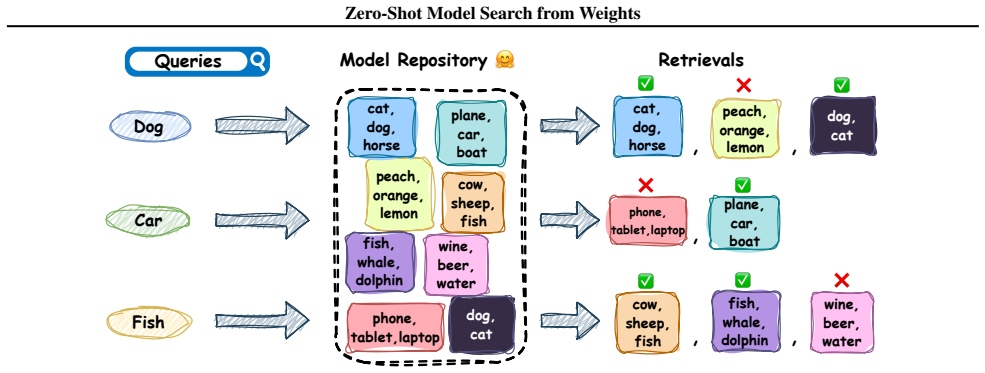
Pith's one-line read This paper introduces ProbeLog, which represents each output dimension of a classifier by its responses to fixed probe images, enabling both logit-based and zero-shot text-based model search using only weights.
desk verdict ProbeLog is a fresh, useful take on model search with some evaluation gaps; the zero-shot text alignment needs harder evidence, but the paper deserves a real review. read the letter →
The pith
A machine-rendered reading of the paper's core claim, the machinery that carries it, and where it could break.
The reading
What carries the argument
The central objects are ProbeLog descriptors defined per logit (Eq. 2), mean-standard-deviation normalization (Eq. 5), a top-$k$ asymmetric discrepancy (Eq. 3), and zero-shot text descriptors built from CLIP dot products (Eq. 4). Together they turn model search into nearest-neighbor search over logit-level functional signatures, with no access to weights beyond forward passes. Collaborative probing (Eq. 6) completes missing probe entries by low-rank matrix factorization, making the gallery construction tractable.
What would settle it
Run the exact text-retrieval pipeline on a held-out repository of classifiers trained on concept sets not overlapping the probe distribution (for instance medical image classes) while keeping COCO probes; if top-1 accuracy does not stay far above the random baseline after normalization, the claimed shared metric space for zero-shot search is refuted.
Extended reading notes
Core claim
ProbeLog represents each logit $i$ of a model $f$ by the vector $\varphi(f,i) = [f(x_1)[i], f(x_2)[i], \ldots, f(x_n)[i]]$ of its outputs on $n$ fixed ordered probe images. The paper shows that after subtracting each descriptor's mean and dividing by its standard deviation, these vectors form a usable semantic index that is invariant to output-class order and to the other classes the model sees. Retrieval uses an asymmetric discrepancy: for a query descriptor, only the $k$ probe positions where the query logit responds most strongly are compared against gallery descriptors in $L_2$. For zero-shot text search, the probe images and the target text are embedded with a joint text-image model such as CLIP; the text descriptor is the vector of dot products between the text embedding and each probe embedding, and the same normalization makes it comparable to real logit descriptors. A final component completes partially probed galleries via truncated-SVD matrix factorization, so repositories can be encoded with a small fraction of probes per model.
Load-bearing premise
The load-bearing premise is that after subtracting the mean and dividing by the standard deviation, CLIP text-probe similarities and raw logit responses occupy the same metric space; the paper's own ablation shows that removing this normalization drops text-to-INet top-1 accuracy from 43.8% to 0%.
Editorial extensions
If this is right
- Model repositories can be searched by capability even when model cards are empty or templates.
- Users can issue a text query for a concept never seen during indexing and retrieve models that recognize it.
- The per-logit representation is naturally invariant to class ordering, so identical models with permuted outputs do not confuse retrieval.
- Gallery construction cost scales down materially: roughly one third of the probes per model suffices when combined with matrix-factorization imputation.
- The representation is lightweight relative to model weights, so a large repository's descriptors can be stored and searched cheaply.
Reading between the lines
- Because the method indexes functions rather than architectures, it could plausibly extend to matching adapters, LoRA modules, or generative model concepts through activation or attention probes, though the paper only claims classification logits.
- The dependence of text retrieval on z-score normalization suggests an empirical correspondence between CLIP's semantic geometry and logit confidence geometry; testing this correspondence across more text models could either broaden or constrain the zero-shot claim.
- A testable design improvement the paper leaves implicit: choosing probes adaptively per concept (coreset selection) rather than uniformly at random could reduce the 4,000-probe requirement while keeping accuracy.
Editorial analysis
A structured set of objections, weighed in public.
Referee Report
Summary. This paper introduces ProbeLog, a method for retrieving classification models by semantic concept using only model weights. For each logit, it records responses to a fixed ordered set of probe images, normalizes the resulting vector (Eq. 5), and compares descriptors with an asymmetric discrepancy that focuses on the query's highest-response probes (Eq. 3). A zero-shot variant computes a probe-level text descriptor from CLIP similarities between probe images and the query concept (Eq. 4), normalizes it like logit descriptors, and applies the same discrepancy measure. Collaborative probing (Eq. 6) uses truncated-SVD imputation to reduce the number of forward passes needed to encode a repository. The method is evaluated on two new hubs, INet-Hub (1,500 models trained on ImageNet subsets) and HF-Hub (71 real Hugging Face models), in both logit-to-logit and text-to-logit retrieval settings, with reported top-1 accuracies up to 72.8% and 43.8%, respectively.
Significance. The problem is timely and important: model hubs are growing quickly, and searching by weights rather than documentation could be practically valuable. The logit-level descriptor is a sensible functional representation that addresses class-order permutation, and collaborative probing is an interesting efficiency idea. If the zero-shot text-to-logit alignment is robust, the paper would make a useful contribution to model retrieval. However, the current evidence for the central text-search claim is incomplete, and several implementation details needed for reproduction are missing. The strengths are the clean problem formulation and the new evaluation hubs, but the quantitative claims need additional support before the paper can be accepted.
major comments (5)
- [Sec. 4.3, Eq. (5), Table 3] This is the load-bearing assumption for the zero-shot contribution; if the revision does not address it, the text-search claim is not supported.
- [Sec. 4.2, Eq. (3); Sec. 4.4, Eq. (6)] I also ask for a sensitivity curve for k, since the ablation in Table 3 only compares top-k against other selection rules, not against different k values.
- [App. A; App. B; Sec. 5.2] The authors should also state how many random seeds or probe-set draws the reported standard deviations correspond to.
- [Sec. 5.2, Tables 1 and 4] The model-level and full-query baselines are useful, but they do not address the paper's stated alternative of metadata-based search.
- [Sec. 4.4, Fig. 7] Please also clarify whether the 'same accuracy' comparison in Fig. 7 uses the same k and normalization as the full-probe experiments.
minor comments (4)
- [Sec. 4.4, Eq. (6)] The sentence defining the mask matrix says 'all ones expect for zeros'; it should read 'all ones except for zeros'.
- [Sec. 4.3] It should be stated explicitly that Eq. (5) is applied to both the logit descriptor and the zero-shot text descriptor; the current notation only shows the logit descriptor, which is a source of confusion.
- [Sec. 5.2] There are typographical issues: 'over40%' should be 'over 40%' and 'IN ettask' should be 'INet task'.
- [Sec. 5.4, Table 2] The conclusion that 'even out-of-distribution probes sampled from COCO retrieve relevant logits with high accuracy' would be easier to evaluate if the table also reported the mean number of relevant logits per query for each task, so the reader can interpret top-k accuracy against chance.
Circularity Check
No derivation-level circularity: ProbeLog descriptors are measured logit responses, and the zero-shot text comparison rests on an empirical CLIP-alignment assumption rather than on an equation that equates inputs with outputs.
full rationale
The derivation chain is self-contained. Logit-level descriptors are defined directly as observed model responses to fixed probes (Eq. 2), not derived from the retrieval target or from the evaluation labels. The discrepancy measure (Eq. 3) is an asymmetric comparison rule over the query's highest-response probes; it is a heuristic design choice, not a definitional encoding of class identity. The zero-shot text descriptor (Eq. 4) is constructed from CLIP image-text similarities, an externally trained representation, and Eq. 5 is a per-vector standardization that is applied identically to text and logit descriptors; no parameter is fitted to the retrieval labels, and no subset of the ground-truth data is used to tune the method's core mapping. The ablations in Tables 2 and 3 select probe distributions, normalization, and top-k selection by observing performance on the same benchmark sets, which is a validation-and-overfitting concern rather than a circularity: the reported numbers are genuine outputs of the fixed procedure, not quantities forced by construction. Self-citations appear only as related-work pointers to the authors' earlier probing and weight-space papers; none is invoked as a load-bearing uniqueness theorem or as justification for the central retrieval claim. Collaborative Probing is an efficiency technique whose matrix factorization is fit to sparse probe responses, and it is evaluated against full probing rather than used to define the retrieval objective. The limitations section honestly flags out-of-distribution concepts and the extension beyond classifiers, which are scope limitations, not admissions of circularity. Overall, no prediction reduces by definition to its inputs, and no fitted parameter is renamed as a prediction.
Assumptions & free parameters
free parameters (4)
- k (number of top probes in discrepancy metric) =
not reported
- Number of probes n =
4,000 (8,000 in some ablations)
- Probe distribution =
COCO images
- Collaborative probing sampling fraction and SVD rank =
Not fully specified
assumptions (4)
- domain assumption A logit's responses to a fixed set of probe inputs are a meaningful descriptor of the concept it recognizes.
- ad hoc to paper After mean/std normalization, CLIP text similarities and raw logit responses share a common metric space.
- domain assumption The probe set can be fixed and reused across all models in the repository.
- domain assumption The models are accessible for arbitrary forward passes with the chosen probes.
invented entities (2)
-
ProbeLog descriptor
-
Zero-shot ProbeLog descriptor
Cite this review
Pith. "Pith review of Can this Model Also Recognize Dogs? Zero-Shot Model Search from Weights." pith.science (2026). https://pith.science/paper/GFSOAZW7
@misc{pith2026250209619,
  author       = {Pith},
  title        = {Pith review of: Can this Model Also Recognize Dogs? Zero-Shot Model Search from Weights},
  year         = {2026},
  howpublished = {\url{https://pith.science/paper/GFSOAZW7}},
  note         = {Machine review of arXiv:2502.09619}
}
read the original abstract
With the increasing numbers of publicly available models, there are probably pretrained, online models for most tasks users require. However, current model search methods are rudimentary, essentially a text-based search in the documentation, thus users cannot find the relevant models. This paper presents ProbeLog, a method for retrieving classification models that can recognize a target concept, such as "Dog", without access to model metadata or training data. Differently from previous probing methods, ProbeLog computes a descriptor for each output dimension (logit) of each model, by observing its responses on a fixed set of inputs (probes). Our method supports both logit-based retrieval ("find more logits like this") and zero-shot, text-based retrieval ("find all logits corresponding to dogs"). As probing-based representations require multiple costly feedforward passes through the model, we develop a method, based on collaborative filtering, that reduces the cost of encoding repositories by 3x. We demonstrate that ProbeLog achieves high retrieval accuracy, both in real-world and fine-grained search tasks and is scalable to full-size repositories.
Figures


Figures from the paper (5 more)


Reference graph
Works this paper leans on
-
[1]
NeRN -- Learning Neural Representations for Neural Networks
Ashkenazi, M., Rimon, Z., Vainshtein, R., Levi, S., Richardson, E., Mintz, P., and Treister, E. Nern--learning neural representations for neural networks. arXiv preprint arXiv:2212.13554, 2022
work page Pith review arXiv 2022
-
[2]
Learning to see by looking at noise
Baradad Jurjo, M., Wulff, J., Wang, T., Isola, P., and Torralba, A. Learning to see by looking at noise. Advances in Neural Information Processing Systems, 34: 0 2556--2569, 2021
work page 2021
-
[3]
Network dissection: Quantifying interpretability of deep visual representations
Bau, D., Zhou, B., Khosla, A., Oliva, A., and Torralba, A. Network dissection: Quantifying interpretability of deep visual representations. In Proceedings of the IEEE conference on computer vision and pattern recognition, pp.\ 6541--6549, 2017
2017
-
[4]
D., Steinke, T., Hayase, J., Cooper, A
Carlini, N., Paleka, D., Dvijotham, K. D., Steinke, T., Hayase, J., Cooper, A. F., Lee, K., Jagielski, M., Nasr, M., Conmy, A., et al. Stealing part of a production language model. arXiv preprint arXiv:2403.06634, 2024
arXiv 2024
-
[5]
Spann: Highly-efficient billion-scale approximate nearest neighborhood search
Chen, Q., Zhao, B., Wang, H., Li, M., Liu, C., Li, Z., Yang, M., and Wang, J. Spann: Highly-efficient billion-scale approximate nearest neighborhood search. Advances in Neural Information Processing Systems, 34: 0 5199--5212, 2021
work page 2021
-
[6]
Where to start? Analyzing the potential value of intermediate models
Choshen, L., Venezian, E., Don-Yehia, S., Slonim, N., and Katz, Y. Where to start? analyzing the potential value of intermediate models. arXiv preprint arXiv:2211.00107, 2022
work page Pith review arXiv 2022
-
[7]
Z., Salti, S., and Di Stefano, L
De Luigi, L., Cardace, A., Spezialetti, R., Ramirez, P. Z., Salti, S., and Di Stefano, L. Deep learning on implicit neural representations of shapes. arXiv preprint arXiv:2302.05438, 2023
arXiv 2023
-
[8]
Imagenet: A large-scale hierarchical image database
Deng, J., Dong, W., Socher, R., Li, L.-J., Li, K., and Fei-Fei, L. Imagenet: A large-scale hierarchical image database. In 2009 IEEE conference on computer vision and pattern recognition, pp.\ 248--255. Ieee, 2009
2009
Show all 68 references
-
[9]
Bert: Pre-training of deep bidirectional transformers for language understanding
Devlin, J. Bert: Pre-training of deep bidirectional transformers for language understanding. arXiv preprint arXiv:1810.04805, 2018
2018 arXiv
-
[10]
and Loynd, R
Diao, C. and Loynd, R. Relational attention: Generalizing transformers for graph-structured tasks. arXiv preprint arXiv:2210.05062, 2022
2022 arXiv
-
[11]
An image is worth 16x16 words: Transformers for image recognition at scale
Dosovitskiy, A. An image is worth 16x16 words: Transformers for image recognition at scale. arXiv preprint arXiv:2010.11929, 2020
2010 arXiv
-
[12]
A., and Shocher, A
Dravid, A., Gandelsman, Y., Efros, A. A., and Shocher, A. Rosetta neurons: Mining the common units in a model zoo. In Proceedings of the IEEE/CVF International Conference on Computer Vision, pp.\ 1934--1943, 2023
1934
-
[13]
A., and Aberman, K
Dravid, A., Gandelsman, Y., Wang, K.-C., Abdal, R., Wetzstein, G., Efros, A. A., and Aberman, K. Interpreting the weight space of customized diffusion models. arXiv preprint arXiv:2406.09413, 2024
2024 arXiv
-
[14]
From data to functa: Your data point is a function and you can treat it like one
Dupont, E., Kim, H., Eslami, S., Rezende, D., and Rosenbaum, D. From data to functa: Your data point is a function and you can treat it like one. arXiv preprint arXiv:2201.12204, 2022
2022 arXiv
-
[15]
Classifying the classifier: dissecting the weight space of neural networks
Eilertsen, G., J \"o nsson, D., Ropinski, T., Unger, J., and Ynnerman, A. Classifying the classifier: dissecting the weight space of neural networks. In ECAI 2020, pp.\ 1119--1126. IOS Press, 2020
2020
-
[16]
Hyperdiffusion: Generating implicit neural fields with weight-space diffusion
Erko c , Z., Ma, F., Shan, Q., Nie ner, M., and Dai, A. Hyperdiffusion: Generating implicit neural fields with weight-space diffusion. In Proceedings of the IEEE/CVF international conference on computer vision, pp.\ 14300--14310, 2023
2023
-
[17]
S., Riley, P
Gilmer, J., Schoenholz, S. S., Riley, P. F., Vinyals, O., and Dahl, G. E. Neural message passing for quantum chemistry. In International conference on machine learning, pp.\ 1263--1272. PMLR, 2017
2017
-
[18]
Knowledge is a region in weight space for fine-tuned language models
Gueta, A., Venezian, E., Raffel, C., Slonim, N., Katz, Y., and Choshen, L. Knowledge is a region in weight space for fine-tuned language models. arXiv preprint arXiv:2302.04863, 2023
2023 arXiv
-
[19]
Ha, D., Dai, A., and Le, Q. V. Hypernetworks. arXiv preprint arXiv:1609.09106, 2016
2016 arXiv
-
[20]
Deep residual learning for image recognition
He, K., Zhang, X., Ren, S., and Sun, J. Deep residual learning for image recognition. In Proceedings of the IEEE conference on computer vision and pattern recognition, pp.\ 770--778, 2016
2016
-
[21]
Learning useful representations of recurrent neural network weight matrices
Herrmann, V., Faccio, F., and Schmidhuber, J. Learning useful representations of recurrent neural network weight matrices. arXiv preprint arXiv:2403.11998, 2024
2024 arXiv
-
[22]
Representing model weights with language using tree experts
Horwitz, E., Cavia, B., Kahana, J., and Hoshen, Y. Representing model weights with language using tree experts. arXiv preprint arXiv:2410.13569, 2024 a
2024 arXiv
-
[23]
Recovering the pre-fine-tuning weights of generative models
Horwitz, E., Kahana, J., and Hoshen, Y. Recovering the pre-fine-tuning weights of generative models. In ICML, 2024 b . URL https://openreview.net/forum?id=761UxjOTHB
2024
-
[24]
On the origin of llamas: Model tree heritage recovery
Horwitz, E., Shul, A., and Hoshen, Y. On the origin of llamas: Model tree heritage recovery. arXiv preprint arXiv:2405.18432, 2024 c
2024 arXiv
-
[25]
Lg-cav: Train any concept activation vector with language guidance
Huang, Q., Song, J., Xue, M., Zhang, H., Hu, B., Wang, H., Jiang, H., Wang, X., and Song, M. Lg-cav: Train any concept activation vector with language guidance. arXiv preprint arXiv:2410.10308, 2024
2024 arXiv
-
[26]
Izmailov, P., Podoprikhin, D., Garipov, T., Vetrov, D., and Wilson, A. G. Averaging weights leads to wider optima and better generalization. arXiv preprint arXiv:1803.05407, 2018
2018 arXiv
-
[27]
V., Krishnawamy, R., and Kadekodi, R
Jayaram Subramanya, S., Devvrit, F., Simhadri, H. V., Krishnawamy, R., and Kadekodi, R. Diskann: Fast accurate billion-point nearest neighbor search on a single node. Advances in Neural Information Processing Systems, 32, 2019
2019
-
[28]
Billion-scale similarity search with gpus
Johnson, J., Douze, M., and J \'e gou, H. Billion-scale similarity search with gpus. IEEE Transactions on Big Data, 7 0 (3): 0 535--547, 2019
2019
-
[29]
Deep linear probe generators for weight space learning
Kahana, J., Horwitz, E., Shuval, I., and Hoshen, Y. Deep linear probe generators for weight space learning. arXiv preprint arXiv:2410.10811, 2024
2024
-
[30]
Scale equivariant graph metanetworks
Kalogeropoulos, I., Bouritsas, G., and Panagakis, Y. Scale equivariant graph metanetworks. arXiv preprint arXiv:2406.10685, 2024
2024 arXiv
-
[31]
Lightgbm: A highly efficient gradient boosting decision tree
Ke, G., Meng, Q., Finley, T., Wang, T., Chen, W., Ma, W., Ye, Q., and Liu, T.-Y. Lightgbm: A highly efficient gradient boosting decision tree. Advances in neural information processing systems, 30, 2017
2017
-
[32]
Kipf, T. N. and Welling, M. Semi-supervised classification with graph convolutional networks. arXiv preprint arXiv:1609.02907, 2016
2016 arXiv
-
[33]
J., Gavves, E., Snoek, C
Kofinas, M., Knyazev, B., Zhang, Y., Chen, Y., Burghouts, G. J., Gavves, E., Snoek, C. G., and Zhang, D. W. Graph neural networks for learning equivariant representations of neural networks. arXiv preprint arXiv:2403.12143, 2024
2024 arXiv
-
[34]
Matrix factorization techniques for recommender systems
Koren, Y., Bell, R., and Volinsky, C. Matrix factorization techniques for recommender systems. Computer, 42 0 (8): 0 30--37, 2009
2009
-
[35]
Learning multiple layers of features from tiny images
Krizhevsky, A., Hinton, G., et al. Learning multiple layers of features from tiny images. 2009
2009
-
[36]
B., Mumford, D., and Huang, J
Lee, A. B., Mumford, D., and Huang, J. Occlusion models for natural images: A statistical study of a scale-invariant dead leaves model. International Journal of Computer Vision, 41: 0 35--59, 2001
2001
-
[37]
Blip-2: Bootstrapping language-image pre-training with frozen image encoders and large language models
Li, J., Li, D., Savarese, S., and Hoi, S. Blip-2: Bootstrapping language-image pre-training with frozen image encoders and large language models. In International conference on machine learning, pp.\ 19730--19742. PMLR, 2023
2023
-
[38]
T., Lorraine, J., and Lucas, J
Lim, D., Maron, H., Law, M. T., Lorraine, J., and Lucas, J. Graph metanetworks for processing diverse neural architectures. arXiv preprint arXiv:2312.04501, 2023
2023 arXiv
-
[39]
Learning on loras: Gl-equivariant processing of low-rank weight spaces for large finetuned models
Lim, D., Gelberg, Y., Jegelka, S., Maron, H., et al. Learning on loras: Gl-equivariant processing of low-rank weight spaces for large finetuned models. arXiv preprint arXiv:2410.04207, 2024
2024 arXiv
-
[40]
Lin, T.-Y., Maire, M., Belongie, S., Hays, J., Perona, P., Ramanan, D., Doll \'a r, P., and Zitnick, C. L. Microsoft coco: Common objects in context. In Computer Vision--ECCV 2014: 13th European Conference, Zurich, Switzerland, September 6-12, 2014, Proceedings, Part V 13, pp....
2014
-
[41]
A convnet for the 2020s
Liu, Z., Mao, H., Wu, C.-Y., Feichtenhofer, C., Darrell, T., and Xie, S. A convnet for the 2020s. In Proceedings of the IEEE/CVF conference on computer vision and pattern recognition, pp.\ 11976--11986, 2022
2022
-
[42]
Content-based search for deep generative models
Lu, D., Wang, S.-Y., Kumari, N., Agarwal, R., Tang, M., Bau, D., and Zhu, J.-Y. Content-based search for deep generative models. In SIGGRAPH Asia 2023 Conference Papers, pp.\ 1--12, 2023
2023
-
[43]
E., Chen, Z., Salakhutdinov, R., and Stoica, I
Luo, M., Wong, J., Trabucco, B., Huang, Y., Gonzalez, J. E., Chen, Z., Salakhutdinov, R., and Stoica, I. Stylus: Automatic adapter selection for diffusion models. arXiv preprint arXiv:2404.18928, 2024
2024 arXiv
-
[44]
Equivariant architectures for learning in deep weight spaces
Navon, A., Shamsian, A., Achituve, I., Fetaya, E., Chechik, G., and Maron, H. Equivariant architectures for learning in deep weight spaces. In International Conference on Machine Learning, pp.\ 25790--25816. PMLR, 2023
2023
-
[45]
A., and Malik, J
Peebles, W., Radosavovic, I., Brooks, T., Efros, A. A., and Malik, J. Learning to learn with generative models of neural network checkpoints. arXiv preprint arXiv:2209.12892, 2022
2022 arXiv
-
[46]
W., Hallacy, C., Ramesh, A., Goh, G., Agarwal, S., Sastry, G., Askell, A., Mishkin, P., Clark, J., et al
Radford, A., Kim, J. W., Hallacy, C., Ramesh, A., Goh, G., Agarwal, S., Sastry, G., Askell, A., Mishkin, P., Clark, J., et al. Learning transferable visual models from natural language supervision. In International conference on machine learning, pp.\ 8748--8763. PMLR, 2021
2021
-
[47]
P., Girshick, R., He, K., and Doll \'a r, P
Radosavovic, I., Kosaraju, R. P., Girshick, R., He, K., and Doll \'a r, P. Designing network design spaces. In Proceedings of the IEEE/CVF conference on computer vision and pattern recognition, pp.\ 10428--10436, 2020
2020
-
[48]
Model ratatouille: Recycling diverse models for out-of-distribution generalization
Ram \'e , A., Ahuja, K., Zhang, J., Cord, M., Bottou, L., and Lopez-Paz, D. Model ratatouille: Recycling diverse models for out-of-distribution generalization. In International Conference on Machine Learning, pp.\ 28656--28679. PMLR, 2023
2023
-
[49]
You only look once: Unified, real-time object detection
Redmon, J. You only look once: Unified, real-time object detection. In Proceedings of the IEEE conference on computer vision and pattern recognition, 2016
2016
-
[50]
High-resolution image synthesis with latent diffusion models
Rombach, R., Blattmann, A., Lorenz, D., Esser, P., and Ommer, B. High-resolution image synthesis with latent diffusion models. In Proceedings of the IEEE/CVF conference on computer vision and pattern recognition, pp.\ 10684--10695, 2022
2022
-
[51]
Self-supervised representation learning on neural network weights for model characteristic prediction
Sch \"u rholt, K., Kostadinov, D., and Borth, D. Self-supervised representation learning on neural network weights for model characteristic prediction. Advances in Neural Information Processing Systems, 34: 0 16481--16493, 2021
2021
-
[52]
W., and Borth, D
Sch \"u rholt, K., Mahoney, M. W., and Borth, D. Towards scalable and versatile weight space learning. arXiv preprint arXiv:2406.09997, 2024
2024 arXiv
-
[53]
Ziplora: Any subject in any style by effectively merging loras
Shah, V., Ruiz, N., Cole, F., Lu, E., Lazebnik, S., Li, Y., and Jampani, V. Ziplora: Any subject in any style by effectively merging loras. arXiv preprint arXiv:2311.13600, 2023
2023
-
[54]
Hugginggpt: Solving ai tasks with chatgpt and its friends in hugging face
Shen, Y., Song, K., Tan, X., Li, D., Lu, W., and Zhuang, Y. Hugginggpt: Solving ai tasks with chatgpt and its friends in hugging face. Advances in Neural Information Processing Systems, 36, 2024
2024
-
[55]
A., Gera, A., Sznajder, B., Choshen, L., Dor, L
Tahan, S. A., Gera, A., Sznajder, B., Choshen, L., Dor, L. E., and Shnarch, E. Label-efficient model selection for text generation. In Proceedings of the 62nd Annual Meeting of the Association for Computational Linguistics (Volume 1: Long Papers), pp.\ 8384--8402, 2024
2024
-
[56]
and Le, Q
Tan, M. and Le, Q. Efficientnet: Rethinking model scaling for convolutional neural networks. In International conference on machine learning, pp.\ 6105--6114. PMLR, 2019
2019
-
[57]
O., Houlsby, N., Kolesnikov, A., Beyer, L., Zhai, X., Unterthiner, T., Yung, J., Steiner, A., Keysers, D., Uszkoreit, J., et al
Tolstikhin, I. O., Houlsby, N., Kolesnikov, A., Beyer, L., Zhai, X., Unterthiner, T., Yung, J., Steiner, A., Keysers, D., Uszkoreit, J., et al. Mlp-mixer: An all-mlp architecture for vision. Advances in neural information processing systems, 34: 0 24261--24272, 2021
2021
-
[58]
Llama: Open and efficient foundation language models
Touvron, H., Lavril, T., Izacard, G., Martinet, X., Lachaux, M.-A., Lacroix, T., Rozi \`e re, B., Goyal, N., Hambro, E., Azhar, F., et al. Llama: Open and efficient foundation language models. arXiv preprint arXiv:2302.13971, 2023
2023 arXiv
-
[59]
N., The, A
Tran, V.-H., Vo, T. N., The, A. N., Huu, T. T., Nguyen-Nhat, M.-K., Tran, T., Pham, D.-T., and Nguyen, T. M. Equivariant neural functional networks for transformers. arXiv preprint arXiv:2410.04209, 2024
2024 arXiv
-
[60]
Predicting neural network accuracy from weights
Unterthiner, T., Keysers, D., Gelly, S., Bousquet, O., and Tolstikhin, I. Predicting neural network accuracy from weights. arXiv preprint arXiv:2002.11448, 2020
2002 arXiv
-
[61]
Attention is all you need
Vaswani, A. Attention is all you need. Advances in Neural Information Processing Systems, 2017
2017
-
[62]
Pytorch image models
Wightman, R. Pytorch image models. https://github.com/rwightman/pytorch-image-models, 2019
2019
-
[63]
Y., Roelofs, R., Gontijo-Lopes, R., Morcos, A
Wortsman, M., Ilharco, G., Gadre, S. Y., Roelofs, R., Gontijo-Lopes, R., Morcos, A. S., Namkoong, H., Farhadi, A., Carmon, Y., Kornblith, S., et al. Model soups: averaging weights of multiple fine-tuned models improves accuracy without increasing inference time. In Internation...
2022
-
[64]
A., and Bansal, M
Yadav, P., Tam, D., Choshen, L., Raffel, C. A., and Bansal, M. Ties-merging: Resolving interference when merging models. Advances in Neural Information Processing Systems, 36, 2024
2024
-
[65]
Phylolm: Inferring the phylogeny of large language models and predicting their performances in benchmarks
Yax, N., Oudeyer, P.-Y., and Palminteri, S. Phylolm: Inferring the phylogeny of large language models and predicting their performances in benchmarks. 2025
2025
-
[66]
Z., and Finn, C
Zhou, A., Yang, K., Burns, K., Cardace, A., Jiang, Y., Sokota, S., Kolter, J. Z., and Finn, C. Permutation equivariant neural functionals. Advances in neural information processing systems, 36, 2024 a
2024
-
[67]
Z., and Finn, C
Zhou, A., Yang, K., Jiang, Y., Burns, K., Xu, W., Sokota, S., Kolter, J. Z., and Finn, C. Neural functional transformers. Advances in neural information processing systems, 36, 2024 b
2024
-
[68]
write newline
" write newline "" before.all 'output.state := FUNCTION n.dashify 't := "" t empty not t #1 #1 substring "-" = t #1 #2 substring "--" = not "--" * t #2 global.max substring 't := t #1 #1 substring "-" = "-" * t #2 global.max substring 't := while if t #1 #1 substring * t #2 gl...
Reviewed August 7, 2026 · model on record in the stance chip above.
Discussion (0). Continue with ORCID to comment.