Big Axions
Pith reviewed 2026-06-28 05:26 UTC · model grok-4.3
The pith
Little big axions solve the strong CP problem and potentially explain dark matter through collective U(1) breaking.
A machine-rendered reading of the paper's core claim, the machinery that carries it, and where it could break.
Core claim
Big axions are defined as axion models in which a Nambu-Goldstone mode emerges from the collective spontaneous breaking of a network of U(1) symmetries delocalized in theory space. They naturally realize high-quality accidental global symmetries, admit both pre- and post-inflationary cosmological histories, and exhibit rich topological structures that interpolate between ordinary Peccei-Quinn axions and axions which descend from extra-dimensional gauge fields. Little big axions, identified as the minimal phenomenologically viable subclass, provide a robust solution to the strong charge-parity problem in quantum chromodynamics while potentially accounting for some or all of the dark matter of
What carries the argument
The collective spontaneous breaking of a network of U(1) symmetries delocalized in theory space, which produces the axion as a high-quality Nambu-Goldstone boson.
If this is right
- Little big axions solve the strong CP problem robustly.
- They can account for some or all of the dark matter.
- They support both pre- and post-inflationary cosmological histories.
- They feature rich topological structures interpolating between standard and extra-dimensional axions.
- They require no additional protection mechanisms for the global symmetries.
Where Pith is reading between the lines
- The delocalized symmetry mechanism might extend to protecting other global symmetries in particle physics models.
- Little big axions could produce distinct signals in direct axion detection experiments compared to conventional models.
- This construction may offer new ways to embed axions in theories with multiple broken symmetries.
- Cosmological data on axion density or relics could help distinguish little big axions from other dark matter candidates.
Load-bearing premise
A network of U(1) symmetries delocalized in theory space undergoes collective spontaneous breaking that produces high-quality accidental global symmetries without additional protection mechanisms.
What would settle it
A direct measurement of the neutron electric dipole moment exceeding the level permitted by little big axion solutions to the strong CP problem, or the absence of axion signals in the expected mass and coupling range for dark matter.
Figures

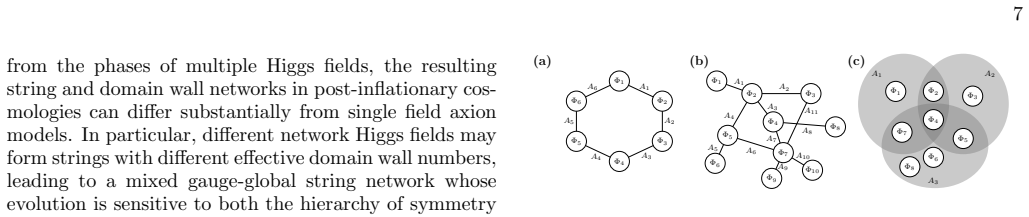
read the original abstract
We introduce big axions: axion models in which a Nambu-Goldstone mode emerges from the collective spontaneous breaking of a network of U(1) symmetries delocalized in theory space. Big axions naturally realize high-quality accidental global symmetries, admit both pre- and post-inflationary cosmological histories, and exhibit rich topological structures that interpolate between ordinary Peccei-Quinn axions and axions which descend from extra-dimensional gauge fields. We identify a minimal phenomenologically viable subclass, little big axions, and demonstrate that they provide a robust solution to the strong charge-parity problem in quantum chromodynamics while potentially accounting for some or all of the dark matter of the universe.
Editorial analysis
A structured set of objections, weighed in public.
Referee Report
Summary. The paper introduces big axions as Nambu-Goldstone modes arising from collective spontaneous breaking of a network of U(1) symmetries delocalized in theory space. These models are claimed to realize high-quality accidental global symmetries without extra protection, admit pre- and post-inflationary cosmologies, and interpolate between standard Peccei-Quinn axions and extra-dimensional gauge-field axions. A minimal phenomenologically viable subclass, little big axions, is identified and asserted to solve the strong CP problem while potentially comprising some or all of the dark matter.
Significance. If the collective-breaking construction produces parametrically high-quality accidental symmetries as claimed, the framework would supply a new, robust route to axion quality that avoids the usual tuning or discrete-symmetry overheads common in the literature. The interpolation between ordinary and extra-dimensional axions, together with the allowance for both cosmological histories, would enlarge the model space available for addressing the strong-CP problem and dark-matter phenomenology.
major comments (2)
- [§3] §3 (collective breaking construction): the manuscript must demonstrate explicitly, via the effective potential or charge assignments, that the accidental U(1) quality is parametrically protected against Planck-suppressed operators of dimension <10; the abstract claim of 'high-quality accidental global symmetries' is load-bearing for the strong-CP solution and requires a concrete suppression factor or symmetry argument.
- [§4.2] §4.2 (little big axions cosmology): the post-inflationary history requires a concrete calculation of the axion decay constant f_a relative to the Hubble scale at the QCD phase transition to confirm that the misalignment mechanism can yield the observed dark-matter density without additional tuning; the current claim that little big axions 'potentially account for some or all' of dark matter is not yet falsifiable from the presented parameter space.
minor comments (2)
- Notation for the network of U(1) symmetries should be standardized (e.g., consistent use of indices for the delocalized charges) to avoid ambiguity when comparing to the effective Lagrangian in Eq. (12).
- Figure 2 (topological structures) would benefit from an explicit comparison table listing the winding numbers or instanton actions for big axions versus ordinary PQ and extra-dimensional cases.
Simulated Author's Rebuttal
We thank the referee for the careful reading and constructive comments on our manuscript. We address each major comment below and indicate the corresponding revisions.
read point-by-point responses
-
Referee: [§3] §3 (collective breaking construction): the manuscript must demonstrate explicitly, via the effective potential or charge assignments, that the accidental U(1) quality is parametrically protected against Planck-suppressed operators of dimension <10; the abstract claim of 'high-quality accidental global symmetries' is load-bearing for the strong-CP solution and requires a concrete suppression factor or symmetry argument.
Authors: We agree that an explicit demonstration is necessary to substantiate the claim. In the revised manuscript we have augmented §3 with an explicit example of charge assignments for a minimal network of delocalized U(1) symmetries together with the resulting effective potential. The calculation shows that the lowest-dimension Planck-suppressed operators that violate the accidental global U(1) begin at dimension 10, with a parametric suppression factor (v/M_Pl)^4 arising from the requirement that all charges must be satisfied simultaneously across the network. This supplies the concrete symmetry argument requested. revision: yes
-
Referee: [§4.2] §4.2 (little big axions cosmology): the post-inflationary history requires a concrete calculation of the axion decay constant f_a relative to the Hubble scale at the QCD phase transition to confirm that the misalignment mechanism can yield the observed dark-matter density without additional tuning; the current claim that little big axions 'potentially account for some or all' of dark matter is not yet falsifiable from the presented parameter space.
Authors: We accept that the original statement was insufficiently quantitative. The revised §4.2 now contains an explicit computation of the axion mass and decay constant relative to the Hubble parameter at the QCD transition. For little big axions with f_a in the window 5×10^9 GeV to 2×10^12 GeV the misalignment mechanism reproduces the observed dark-matter density for O(1) initial angles without additional parameter tuning beyond the standard misalignment scenario. The viable range is now stated explicitly, rendering the claim falsifiable. revision: yes
Circularity Check
No significant circularity detected
full rationale
The provided abstract and context introduce big axions as a conceptual model class arising from collective breaking of delocalized U(1) symmetries, with claims about high-quality accidental symmetries, cosmological histories, and solutions to strong CP. No equations, fitted parameters, self-citations, or ansatze are exhibited that would reduce any prediction or result to its own inputs by construction. The derivation chain remains self-contained as a new model proposal without the enumerated circular patterns.
Axiom & Free-Parameter Ledger
axioms (1)
- domain assumption Existence of a network of U(1) symmetries delocalized in theory space whose collective spontaneous breaking yields a Nambu-Goldstone mode with high-quality accidental global symmetries.
invented entities (2)
-
big axions
no independent evidence
-
little big axions
no independent evidence
Reference graph
Works this paper leans on
-
[1]
Adding anomalous fermion content throughout the Higgs field network such that the multiplicity and couplings of fermions at each site mirrors the struc- ture of the big axion monomial
-
[2]
The latter case effectively amounts to introducing a sec- ond pseudoscalar that couples to QCD and mixes with a subset of sites in the big axion network
Adding anomalous fermion content at a subset of network Higgs field sites, paired with anomaly- canceling Green-Schwarz [67] terms. The latter case effectively amounts to introducing a sec- ond pseudoscalar that couples to QCD and mixes with a subset of sites in the big axion network. Addressing the quality problem of this new QCD axion in a UV- complete ...
-
[3]
Stated differently, the gauge invariance of the quark mass matrix determinant forces its phase to be exactly propor- tional to Θn with proportionality constantN DW
Hence, for a single big gauge anomaly-free axion k+d=N DWn,(B10) withN DW ∈Zbeing the axion domain wall number. Stated differently, the gauge invariance of the quark mass matrix determinant forces its phase to be exactly propor- tional to Θn with proportionality constantN DW. Remov- ing this phase via fermion field redefinitions then gives rise to an effe...
-
[4]
With this as- signment, the KSVZ-like quark contribution to the run- ning is ∆b K Y = 0.44|k|= 4.44
Spe- cific charge values are shown in Table I. With this as- signment, the KSVZ-like quark contribution to the run- ning is ∆b K Y = 0.44|k|= 4.44. Thus, accounting for the SM matter, the extra Higgs doublet, and the new KSVZ quarks alone, the hypercharge Landau pole natu- rally lies far above the Planck scale. However, we must also address any remainingU...
-
[5]
Englert and R
F. Englert and R. Brout, Broken Symmetry and the Mass of Gauge Vector Mesons, Phys. Rev. Lett.13, 321 (1964). spectator sector cosmology of this choice and related models to future work. 11
1964
-
[6]
P. W. Higgs, Broken Symmetries and the Masses of Gauge Bosons, Phys. Rev. Lett.13, 508 (1964)
1964
-
[7]
G. S. Guralnik, C. R. Hagen, and T. W. B. Kibble, Global Conservation Laws and Massless Particles, Phys. Rev. Lett.13, 585 (1964)
1964
-
[8]
R. D. Peccei and H. R. Quinn, CP Conservation in the Presence of Instantons, Phys. Rev. Lett.38, 1440 (1977)
1977
-
[9]
R. D. Peccei and H. R. Quinn, Constraints Imposed by CP Conservation in the Presence of Instantons, Phys. Rev. D16, 1791 (1977)
1977
-
[10]
Weinberg, A New Light Boson?, Phys
S. Weinberg, A New Light Boson?, Phys. Rev. Lett.40, 223 (1978)
1978
-
[11]
Wilczek, Problem of StrongPandTInvariance in the Presence of Instantons, Phys
F. Wilczek, Problem of StrongPandTInvariance in the Presence of Instantons, Phys. Rev. Lett.40, 279 (1978)
1978
-
[12]
A. H. Guth, The Inflationary Universe: A Possible Solu- tion to the Horizon and Flatness Problems, Phys. Rev. D23, 347 (1981)
1981
-
[13]
A. D. Linde, A New Inflationary Universe Scenario: A Possible Solution of the Horizon, Flatness, Homogeneity, Isotropy and Primordial Monopole Problems, Phys. Lett. B108, 389 (1982)
1982
-
[14]
Albrecht and P
A. Albrecht and P. J. Steinhardt, Cosmology for Grand Unified Theories with Radiatively Induced Symmetry Breaking, Phys. Rev. Lett.48, 1220 (1982)
1982
-
[15]
Preskill, M
J. Preskill, M. B. Wise, and F. Wilczek, Cosmology of the Invisible Axion, Phys. Lett. B120, 127 (1983)
1983
-
[16]
L. F. Abbott and P. Sikivie, A Cosmological Bound on the Invisible Axion, Phys. Lett. B120, 133 (1983)
1983
-
[17]
Dine and W
M. Dine and W. Fischler, The Not So Harmless Axion, Phys. Lett. B120, 137 (1983)
1983
-
[18]
Susskind, Dynamics of Spontaneous Symmetry Break- ing in the Weinberg-Salam Theory, Phys
L. Susskind, Dynamics of Spontaneous Symmetry Break- ing in the Weinberg-Salam Theory, Phys. Rev. D20, 2619 (1979)
1979
-
[19]
’t Hooft, Naturalness, chiral symmetry, and sponta- neous chiral symmetry breaking, NATO Sci
G. ’t Hooft, Naturalness, chiral symmetry, and sponta- neous chiral symmetry breaking, NATO Sci. Ser. B59, 135 (1980)
1980
-
[20]
Nambu, Quasiparticles and Gauge Invariance in the Theory of Superconductivity, Phys
Y. Nambu, Quasiparticles and Gauge Invariance in the Theory of Superconductivity, Phys. Rev.117, 648 (1960)
1960
-
[21]
Goldstone, Field Theories with Superconductor Solu- tions, Nuovo Cim.19, 154 (1961)
J. Goldstone, Field Theories with Superconductor Solu- tions, Nuovo Cim.19, 154 (1961)
1961
-
[22]
Goldstone, A
J. Goldstone, A. Salam, and S. Weinberg, Broken Sym- metries, Phys. Rev.127, 965 (1962)
1962
-
[23]
Weinberg, Nonlinear realizations of chiral symmetry, Phys
S. Weinberg, Nonlinear realizations of chiral symmetry, Phys. Rev.166, 1568 (1968)
1968
-
[24]
Salam and J
A. Salam and J. A. Strathdee, Nonlinear realizations. 1: The Role of Goldstone bosons, Phys. Rev.184, 1750 (1969)
1969
-
[25]
S. R. Coleman, J. Wess, and B. Zumino, Structure of phenomenological Lagrangians. 1., Phys. Rev.177, 2239 (1969)
1969
-
[26]
C. G. Callan, Jr., S. R. Coleman, J. Wess, and B. Zu- mino, Structure of phenomenological Lagrangians. 2., Phys. Rev.177, 2247 (1969)
1969
-
[27]
Y. B. Zeldovich, I. Y. Kobzarev, and L. B. Okun, Cos- mological Consequences of the Spontaneous Breakdown of Discrete Symmetry, Zh. Eksp. Teor. Fiz.67, 3 (1974)
1974
-
[28]
Sikivie, Of Axions, Domain Walls and the Early Uni- verse, Phys
P. Sikivie, Of Axions, Domain Walls and the Early Uni- verse, Phys. Rev. Lett.48, 1156 (1982)
1982
-
[29]
Vilenkin, Cosmic Strings and Domain Walls, Phys
A. Vilenkin, Cosmic Strings and Domain Walls, Phys. Rept.121, 263 (1985)
1985
-
[30]
S. B. Giddings and A. Strominger, Loss of incoherence and determination of coupling constants in quantum gravity, Nucl. Phys. B307, 854 (1988)
1988
-
[31]
M. Kamionkowski and J. March-Russell, Planck scale physics and the Peccei-Quinn mechanism, Phys. Lett. B 282, 137 (1992), arXiv:hep-th/9202003
Pith/arXiv arXiv 1992
-
[32]
R. Holman, S. D. H. Hsu, T. W. Kephart, E. W. Kolb, R. Watkins, and L. M. Widrow, Solutions to the strong CP problem in a world with gravity, Phys. Lett. B282, 132 (1992), arXiv:hep-ph/9203206
Pith/arXiv arXiv 1992
-
[33]
S. M. Barr and D. Seckel, Planck scale corrections to axion models, Phys. Rev. D46, 539 (1992)
1992
-
[34]
Ghigna, M
S. Ghigna, M. Lusignoli, and M. Roncadelli, Instability of the invisible axion, Phys. Lett. B283, 278 (1992)
1992
-
[35]
T. Banks and N. Seiberg, Symmetries and Strings in Field Theory and Gravity, Phys. Rev. D83, 084019 (2011), arXiv:1011.5120 [hep-th]
Pith/arXiv arXiv 2011
-
[36]
D. Harlow and H. Ooguri, Symmetries in quantum field theory and quantum gravity, Commun. Math. Phys.383, 1669 (2021), arXiv:1810.05338 [hep-th]
Pith/arXiv arXiv 2021
-
[37]
L. M. Krauss and F. Wilczek, Discrete Gauge Symmetry in Continuum Theories, Phys. Rev. Lett.62, 1221 (1989)
1989
-
[38]
Lazarides, C
G. Lazarides, C. Panagiotakopoulos, and Q. Shafi, Phe- nomenology and Cosmology With Superstrings, Phys. Rev. Lett.56, 432 (1986)
1986
-
[39]
A. G. Dias, V. Pleitez, and M. D. Tonasse, Naturally light invisible axion in models with large local discrete symmetries, Phys. Rev. D67, 095008 (2003), arXiv:hep- ph/0211107
arXiv 2003
-
[40]
K. Harigaya, M. Ibe, K. Schmitz, and T. T. Yanagida, Peccei-Quinn symmetry from a gauged discrete R sym- metry, Phys. Rev. D88, 075022 (2013), arXiv:1308.1227 [hep-ph]
Pith/arXiv arXiv 2013
-
[41]
H. Fukuda, M. Ibe, M. Suzuki, and T. T. Yanagida, A ”gauged”U(1) Peccei–Quinn symmetry, Phys. Lett. B 771, 327 (2017), arXiv:1703.01112 [hep-ph]
Pith/arXiv arXiv 2017
-
[42]
Witten, Some Properties of O(32) Superstrings, Phys
E. Witten, Some Properties of O(32) Superstrings, Phys. Lett. B149, 351 (1984)
1984
-
[43]
N. Arkani-Hamed, H.-C. Cheng, P. Creminelli, and L. Randall, Extra natural inflation, Phys. Rev. Lett.90, 221302 (2003), arXiv:hep-th/0301218
Pith/arXiv arXiv 2003
-
[44]
Choi, A QCD axion from higher dimensional gauge field, Phys
K.-w. Choi, A QCD axion from higher dimensional gauge field, Phys. Rev. Lett.92, 101602 (2004), arXiv:hep- ph/0308024
arXiv 2004
-
[45]
P. Svrcek and E. Witten, Axions In String Theory, JHEP 06, 051, arXiv:hep-th/0605206
-
[46]
M. Reece, TASI Lectures: (No) Global Symme- tries to Axion Physics, PoST ASI2022, 008 (2024), arXiv:2304.08512 [hep-ph]
arXiv 2024
-
[47]
Reece, Extra-dimensional axion expectations, JHEP 07, 130, arXiv:2406.08543 [hep-ph]
M. Reece, Extra-dimensional axion expectations, JHEP 07, 130, arXiv:2406.08543 [hep-ph]
-
[48]
N. Craig and M. Kongsore, High-quality axions from higher-form symmetries in extra dimensions, Phys. Rev. D111, 015047 (2025), arXiv:2408.10295 [hep-ph]
arXiv 2025
-
[49]
N. Arkani-Hamed, A. G. Cohen, and H. Georgi, (De)constructing dimensions, Phys. Rev. Lett.86, 4757 (2001), arXiv:hep-th/0104005
Pith/arXiv arXiv 2001
-
[50]
C. T. Hill, S. Pokorski, and J. Wang, Gauge Invariant Effective Lagrangian for Kaluza-Klein Modes, Phys. Rev. D64, 105005 (2001), arXiv:hep-th/0104035
Pith/arXiv arXiv 2001
-
[51]
N. Arkani-Hamed, A. G. Cohen, D. B. Kaplan, A. Karch, and L. Motl, Deconstructing (2,0) and little string theo- ries, JHEP01, 083, arXiv:hep-th/0110146
-
[52]
Georgi, A Tool Kit for Builders of Composite Models, Nucl
H. Georgi, A Tool Kit for Builders of Composite Models, Nucl. Phys. B266, 274 (1986)
1986
-
[53]
M. R. Douglas and G. W. Moore, D-branes, quivers, and ALE instantons, (1996), arXiv:hep-th/9603167
Pith/arXiv arXiv 1996
-
[54]
N. Arkani-Hamed, A. G. Cohen, and H. Georgi, Elec- 12 troweak symmetry breaking from dimensional decon- struction, Phys. Lett. B513, 232 (2001), arXiv:hep- ph/0105239
arXiv 2001
-
[55]
N. Arkani-Hamed, A. G. Cohen, E. Katz, and A. E. Nelson, The Littlest Higgs, JHEP07, 034, arXiv:hep- ph/0206021
-
[56]
J. E. Kim, Weak Interaction Singlet and Strong CP In- variance, Phys. Rev. Lett.43, 103 (1979)
1979
-
[57]
M. A. Shifman, A. I. Vainshtein, and V. I. Zakharov, Can Confinement Ensure Natural CP Invariance of Strong In- teractions?, Nucl. Phys. B166, 493 (1980)
1980
-
[58]
M. Dine, W. Fischler, and M. Srednicki, A Simple Solu- tion to the Strong CP Problem with a Harmless Axion, Phys. Lett. B104, 199 (1981)
1981
-
[59]
A. R. Zhitnitsky, On Possible Suppression of the Axion Hadron Interactions. (In Russian), Sov. J. Nucl. Phys. 31, 260 (1980)
1980
-
[60]
Q. Lu, M. Reece, and Z. Sun, The quality/cosmology tension for a post-inflation QCD axion, JHEP07, 227, arXiv:2312.07650 [hep-ph]
-
[61]
R. Petrossian-Byrne and G. Villadoro, Open string axi- verse, JHEP07, 049, arXiv:2503.16387 [hep-ph]
-
[62]
V. Loladze, A. Platschorre, and M. Reig, Higher axion strings, JHEP08, 182, arXiv:2503.18707 [hep-ph]
-
[63]
C. T. Hill and A. K. Leibovich, Natural Theories of Ul- tralow Mass PNGB’s: Axions and Quintessence, Phys. Rev. D66, 075010 (2002), arXiv:hep-ph/0205237
Pith/arXiv arXiv 2002
-
[64]
S. Hor, Y. Nakai, M. Suzuki, and J. Xu, Deconstruct- ing the extra-dimensional axion (2026), arXiv:2606.02728 [hep-ph]
Pith/arXiv arXiv 2026
-
[65]
D. E. Kaplan and R. Rattazzi, Large field excursions and approximate discrete symmetries from a clockwork axion, Phys. Rev. D93, 085007 (2016), arXiv:1511.01827 [hep- ph]
Pith/arXiv arXiv 2016
-
[66]
K. Choi and S. H. Im, Realizing the relaxion from multi- ple axions and its UV completion with high scale super- symmetry, JHEP01, 149, arXiv:1511.00132 [hep-ph]
-
[67]
A. Ahmed and B. M. Dillon, Clockwork Gold- stone Bosons, Phys. Rev. D96, 115031 (2017), arXiv:1612.04011 [hep-ph]
Pith/arXiv arXiv 2017
-
[68]
R. Coy, M. Frigerio, and M. Ibe, Dynamical Clockwork Axions, JHEP10, 002, arXiv:1706.04529 [hep-ph]
-
[69]
Q. Bonnefoy, E. Dudas, and S. Pokorski, Axions in a highly protected gauge symmetry model, Eur. Phys. J. C79, 31 (2019), arXiv:1804.01112 [hep-ph]
Pith/arXiv arXiv 2019
-
[70]
Banks, M
H. Banks, M. Kongsore, and N. Weiner, Big Axions and the Topology of Theory Space, In prep (2026)
2026
-
[71]
M. B. Green and J. H. Schwarz, Anomaly Cancellation in Supersymmetric D=10 Gauge Theory and Superstring Theory, Phys. Lett. B149, 117 (1984)
1984
- [72]
-
[73]
L. Di Luzio, F. Mescia, and E. Nardi, Redefining the Axion Window, Phys. Rev. Lett.118, 031801 (2017), arXiv:1610.07593 [hep-ph]
Pith/arXiv arXiv 2017
-
[74]
L. Di Luzio, F. Mescia, and E. Nardi, Window for pre- ferred axion models, Phys. Rev. D96, 075003 (2017), arXiv:1705.05370 [hep-ph]
Pith/arXiv arXiv 2017
-
[75]
Sikivie, Axion Cosmology, Lect
P. Sikivie, Axion Cosmology, Lect. Notes Phys.741, 19 (2008), arXiv:astro-ph/0610440
Pith/arXiv arXiv 2008
-
[76]
T. Hiramatsu, M. Ibe, and M. Suzuki, New Type of String Solutions with Long Range Forces, JHEP02, 058, arXiv:1910.14321 [hep-ph]
arXiv 1910
-
[77]
T. Hiramatsu, M. Ibe, and M. Suzuki, Cosmic string in Abelian-Higgs model with enhanced symmetry — Impli- cation to the axion domain-wall problem, JHEP09, 054, arXiv:2005.10421 [hep-ph]
arXiv 2005
-
[78]
J. R. C. C. C. Correia and C. J. A. P. Martins, Multi- tension strings in high-resolution U(1)×U(1) simulations, Phys. Rev. D106, 043521 (2022), arXiv:2208.01525 [astro-ph.CO]
arXiv 2022
-
[79]
X. Niu, W. Xue, and F. Yang, Gauged global strings, JHEP02, 093, arXiv:2311.07639 [hep-ph]
-
[80]
J. Lee, K. Murai, F. Takahashi, and W. Yin, More is dif- ferent: multi-axion dynamics changes topological defect evolution, JCAP04, 002, arXiv:2409.09749 [hep-ph]
discussion (0)
Sign in with ORCID, Apple, or X to comment. Anyone can read and Pith papers without signing in.