Can giant impacts be directly detected in other star systems?
Pith reviewed 2026-06-25 19:21 UTC · model grok-4.3
The pith
Giant impacts between Earth-composition planets produce post-impact bodies with luminosities from 5e-5 to 0.1 solar that cool over 1-2000 days, creating detectable brighten-then-dim signals in Gaia and LSST photometry.
A machine-rendered reading of the paper's core claim, the machinery that carries it, and where it could break.
Core claim
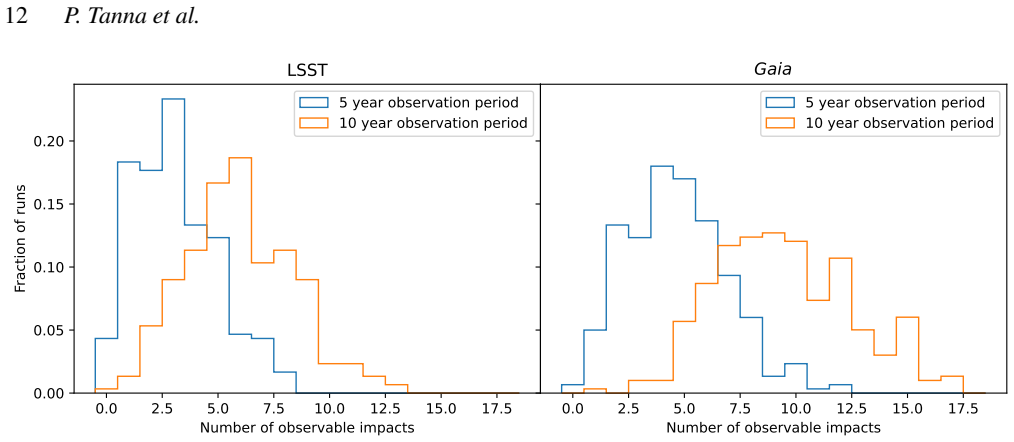
Giant impacts between Earth-composition planets were simulated using the smoothed particle hydrodynamics code SWIFT, with total colliding masses ranging from 0.2 to 4 Earth masses. By constraining the location of the photic surface of the post-impact bodies produced by the simulations, the initial luminosities of post-impact bodies were found to be between 5 times 10 to the minus 5 and 10 to the minus 1 solar luminosities, with luminosity falling roughly exponentially on a timescale between 1 and 2000 days. Based on our results, along with estimates for planet and giant impact occurrence rates, we anticipate that between 0 and 14 terrestrial giant impacts will be observed in the full release
What carries the argument
Smoothed particle hydrodynamics simulations of giant impacts with photic surface location used to derive initial luminosity and exponential cooling timescale of the post-impact body.
If this is right
- Giant impacts appear as sudden brightenings followed by gradual dimming in optical and near-infrared photometry.
- Between 0 and 14 terrestrial giant impacts are expected in Gaia DR4 epoch photometry.
- A comparable number of events should appear in LSST data.
- Multiple identified remnants would directly constrain the galactic frequency of giant impacts during planet formation.
Where Pith is reading between the lines
- Detections would allow direct measurement of how often giant impacts occur across many star systems rather than relying on solar-system statistics alone.
- Non-detections would place tighter upper limits on the role of giant impacts in shaping the observed exoplanet population.
- The same cooling models could be applied to future time-domain surveys or multi-wavelength follow-up to refine occurrence-rate estimates.
Load-bearing premise
Planet occurrence rates and giant impact occurrence rates are used to scale the simulated luminosities into expected detection numbers.
What would settle it
Zero detections or more than 14 detections of the predicted brighten-then-dim transients in the full Gaia DR4 epoch photometry would falsify the rate estimate.
Figures



read the original abstract
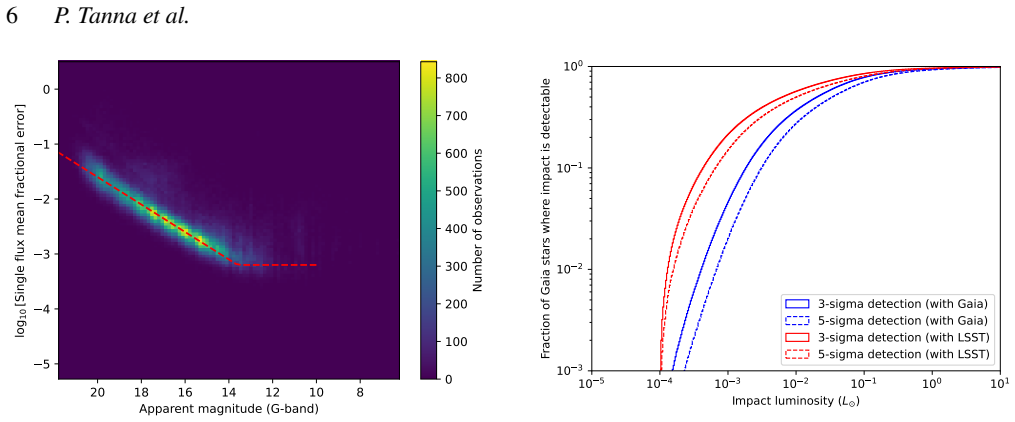
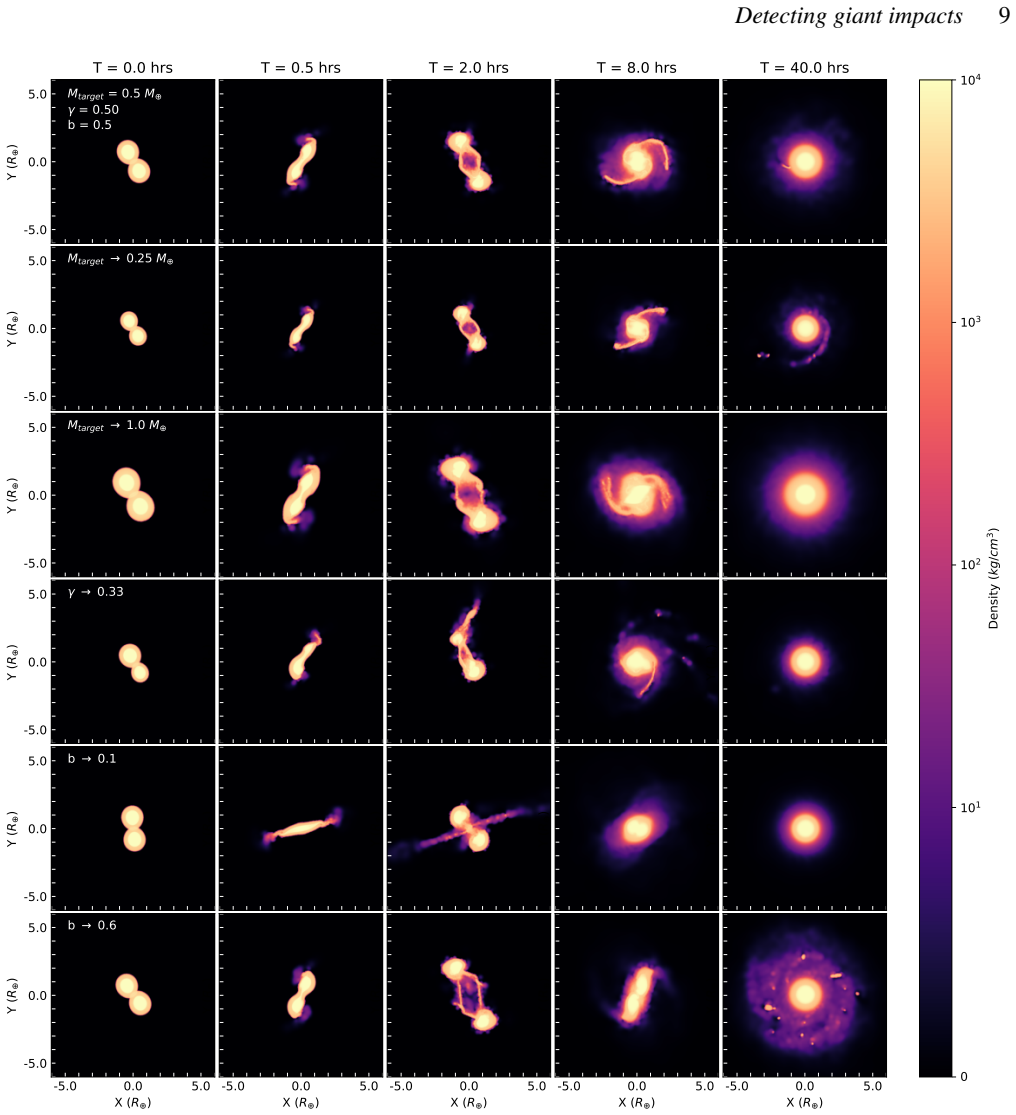
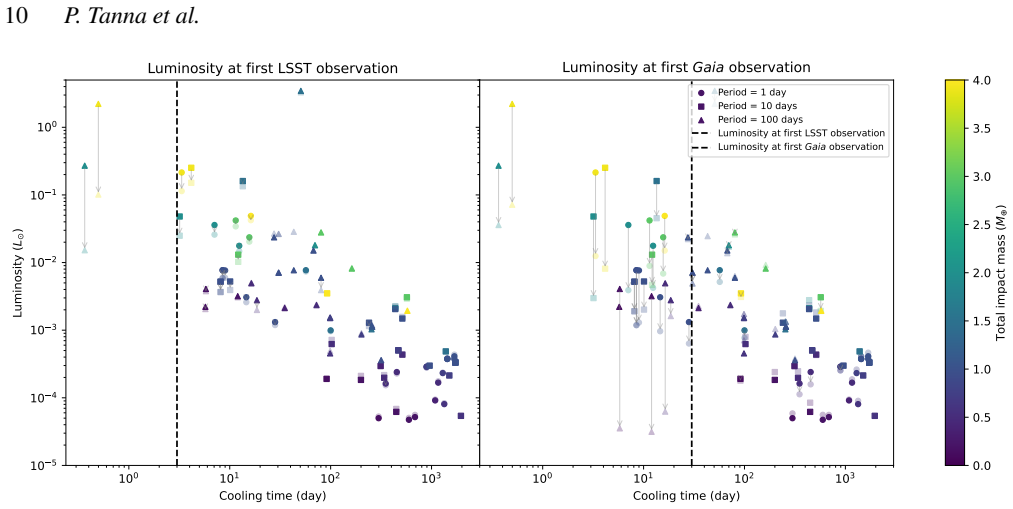
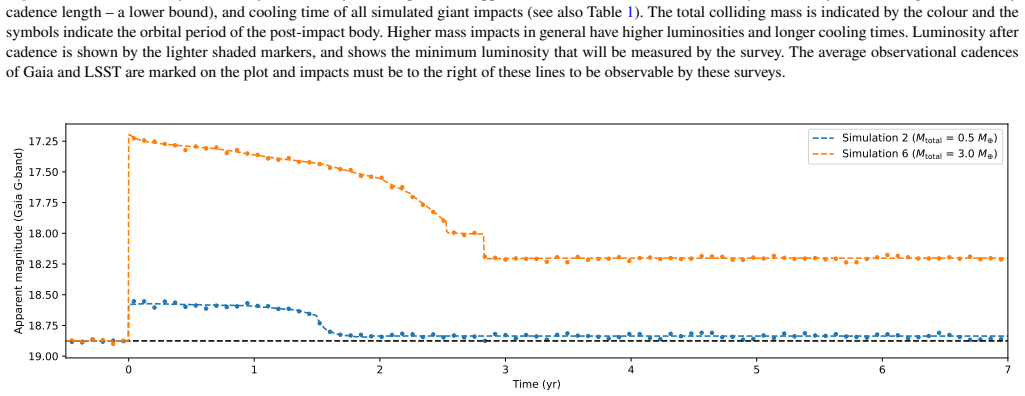
Giant impacts, collisions between planet-sized bodies, play an important role in planet and moon formation. As we enter a new era of large-scale surveys, such as \textit{Gaia} and LSST at the Vera C. Rubin observatory, there is potential to directly observe the remnants produced in such events and gain insights into the process of planet formation. Here, by modelling the emission and cooling of a series of giant impact remnants, we show that giant impacts are detectable as a sudden brightening followed by gradual dimming in the optical and near-infrared. Giant impacts between Earth-composition planets were simulated using the smoothed particle hydrodynamics code {\small SWIFT}, with total colliding masses ranging from 0.2 to 4 $M_{\oplus}$. By constraining the location of the photic surface of the post-impact bodies produced by the simulations, the initial luminosities of post-impact bodies were found to be between $5\times10^{-5}$ and $10^{-1}$ solar luminosities, with luminosity falling roughly exponentially on a timescale between 1 and 2000 days. Based on our results, along with estimates for planet and giant impact occurrence rates, we anticipate that between 0 and 14 terrestrial giant impacts will be observed in the full release of \textit{Gaia} epoch photometry in DR4, with at least a comparable number found by LSST. Identifying the remnants of multiple giant impacts will offer a powerful constraint on the frequency of giant impacts in the galaxy and hence the role of such collisions in planet formation.
Editorial analysis
A structured set of objections, weighed in public.
Referee Report
Summary. The manuscript uses smoothed particle hydrodynamics simulations with the SWIFT code to model giant impacts between Earth-composition planets (total masses 0.2–4 M_⊕). It derives initial post-impact luminosities of 5×10^{-5} to 10^{-1} L_⊙ by locating the photic surface and finds roughly exponential cooling on timescales of 1–2000 days. These results are combined with literature estimates of planet occurrence and giant-impact rates to predict 0–14 detectable events in Gaia DR4 (and a comparable number in LSST) via sudden brightening followed by gradual dimming in optical/near-IR photometry.
Significance. If the luminosity and cooling calculations hold, the work identifies a concrete photometric signature that could allow direct observation of giant impacts, offering an independent constraint on their frequency during planet formation. The use of SPH runs across a mass range to produce observable quantities is a clear strength. However, the headline detection numbers (0–14) are not robust because they scale directly with external occurrence-rate inputs whose uncertainties dominate the reported range.
major comments (1)
- [Abstract] Abstract: the quantitative prediction of 0–14 events in Gaia DR4 is obtained by multiplying simulation-derived per-event luminosities and cooling timescales by external estimates of terrestrial planet occurrence and giant-impact frequency. These rates are drawn from the literature rather than derived or validated within the manuscript; the resulting broad interval (0–14) therefore reflects the span of those external inputs, not the simulation results alone. This scaling dependence is load-bearing for the central claim of survey yields.
minor comments (1)
- [Abstract] The abstract states that the photic surface location is constrained from the simulations, but provides no detail on the method, temperature or optical-depth criterion used, or any validation against known post-impact states; this step is central to the reported luminosity range and should be expanded.
Simulated Author's Rebuttal
We thank the referee for their careful review and constructive comments. We agree that the detection-yield range depends on external literature estimates and will revise the abstract to clarify this distinction.
read point-by-point responses
-
Referee: [Abstract] Abstract: the quantitative prediction of 0–14 events in Gaia DR4 is obtained by multiplying simulation-derived per-event luminosities and cooling timescales by external estimates of terrestrial planet occurrence and giant-impact frequency. These rates are drawn from the literature rather than derived or validated within the manuscript; the resulting broad interval (0–14) therefore reflects the span of those external inputs, not the simulation results alone. This scaling dependence is load-bearing for the central claim of survey yields.
Authors: The referee correctly notes that the 0–14 range arises from the span of literature occurrence rates rather than from the SPH results alone. The manuscript’s core contribution is the simulation-derived luminosities (5×10^{-5} to 10^{-1} L_⊙) and cooling timescales (1–2000 days). The yield estimate is presented as an order-of-magnitude illustration of detectability, using the rates cited in the text. We will revise the abstract to state the simulation results first, followed by the statement that, when combined with literature estimates of planet occurrence and giant-impact frequency, we anticipate 0–14 events in Gaia DR4. This makes the dependence explicit without changing the primary findings. revision: yes
Circularity Check
No significant circularity in derivation chain
full rationale
The paper derives initial luminosities (5e-5 to 0.1 Lsun) and exponential cooling timescales (1-2000 days) directly from SWIFT SPH simulations of Earth-composition collisions (0.2-4 Mearth) plus photic surface constraints; these steps are independent of occurrence rates. The 0-14 Gaia DR4 detection estimate is obtained by scaling the simulation outputs with external literature estimates for planet/giant-impact rates, which are not fitted, self-derived, or reduced to the paper's own inputs by construction. No self-citation load-bearing, uniqueness theorems, or ansatzes appear in the derivation. The central luminosity modeling is self-contained against external benchmarks.
Axiom & Free-Parameter Ledger
free parameters (1)
- planet and giant impact occurrence rates
axioms (1)
- domain assumption Photic surface location can be reliably constrained from the post-impact SPH particle distributions for Earth-composition bodies
Reference graph
Works this paper leans on
-
[1]
Satellite-Sized Planetesimals and Lunar Origin. , keywords =. doi:10.1016/0019-1035(75)90070-6 , adsurl =
-
[2]
Lunar and Planetary Science Conference , year = 1976, series =
The Origin of the Moon. Lunar and Planetary Science Conference , year = 1976, series =
1976
-
[3]
Origin of the Moon , year = 1986, editor =
Moon over Mauna Loa: a review of hypotheses of formation of Earth's Moon. Origin of the Moon , year = 1986, editor =
1986
-
[4]
The Formation of the Martian Moons. Oxford Research Encyclopedia of Planetary Science , year = 2020, eid =. doi:10.1093/acrefore/9780190647926.013.24 , adsurl =
-
[5]
, year = 2001, month = aug, volume =
Origin of the Moon in a giant impact near the end of the Earth's formation. , year = 2001, month = aug, volume =
2001
-
[6]
Making the Terrestrial Planets: N-Body Integrations of Planetary Embryos in Three Dimensions. , keywords =. doi:10.1006/icar.1998.6007 , adsurl =
-
[7]
Geochemical Constraints on the Origin of the Moon and Preservation of Ancient Terrestrial Heterogeneities. , keywords =. doi:10.1007/s11214-020-00729-z , adsurl =
-
[8]
A Star-sized Impact-produced Dust Clump in the Terrestrial Zone of the HD 166191 System. , keywords =. doi:10.3847/1538-4357/ac4bbb , archivePrefix =. 2203.02366 , primaryClass =
-
[9]
The Origin of Mercury. , keywords =. doi:10.1007/s11214-007-9284-1 , adsurl =
-
[10]
One-dimensional calculations of a large impact on Uranus. , keywords =. doi:10.1016/0019-1035(90)90051-A , adsurl =
-
[11]
Dealing with density discontinuities in planetary SPH simulations. , keywords =. doi:10.1093/mnras/stac857 , archivePrefix =. 2202.00472 , primaryClass =
-
[12]
The Pluto System After New Horizons , year = 2021, editor =
On the Origin of the Pluto System. The Pluto System After New Horizons , year = 2021, editor =. doi:10.2458/azu_uapress_9780816540945-ch021 , adsurl =
-
[13]
, year = 2011, month = feb, volume =
Are Phobos and Deimos the result of a giant impact?. , year = 2011, month = feb, volume =. doi:10.1016/j.icarus.2010.10.023 , adsurl =
-
[14]
, year = 2012, month = nov, volume =
On the formation of the martian moons from a circum-martian accretion disk. , year = 2012, month = nov, volume =. doi:10.1016/j.icarus.2012.09.009 , adsurl =
-
[15]
Formation of Phobos and Deimos via a Giant Impact
Formation of Phobos and Deimos via a giant impact. , keywords =. doi:10.1016/j.icarus.2015.02.011 , archivePrefix =. 1503.05623 , primaryClass =
work page internal anchor Pith review Pith/arXiv arXiv doi:10.1016/j.icarus.2015.02.011 2015
-
[16]
Science Advances , year = 2018, month = apr, volume =
Origin of Phobos and Deimos by the impact of a Vesta-to-Ceres sized body with Mars. Science Advances , year = 2018, month = apr, volume =. doi:10.1126/sciadv.aar6887 , adsurl =
-
[17]
The Frequency of Giant impacts on Earth-like Worlds
The Frequency of Giant Impacts on Earth-like Worlds. , keywords =. doi:10.3847/0004-637X/821/2/126 , archivePrefix =. 1511.03663 , primaryClass =
work page internal anchor Pith review Pith/arXiv arXiv doi:10.3847/0004-637x/821/2/126
-
[18]
A hit-and-run Giant Impact scenario
A hit-and-run giant impact scenario. , keywords =. doi:10.1016/j.icarus.2012.07.021 , archivePrefix =. 1207.5224 , primaryClass =
work page internal anchor Pith review Pith/arXiv arXiv doi:10.1016/j.icarus.2012.07.021 2012
-
[19]
Forming a Moon with an Earth-like Composition via a Giant Impact. Science , keywords =. doi:10.1126/science.1226073 , adsurl =
-
[20]
Making the Moon from a Fast-Spinning Earth: A Giant Impact Followed by Resonant Despinning. Science , keywords =. doi:10.1126/science.1225542 , adsurl =
-
[21]
The origin of the Moon within a terrestrial synestia
The Origin of the Moon Within a Terrestrial Synestia. Journal of Geophysical Research (Planets) , keywords =. doi:10.1002/2017JE005333 , archivePrefix =. 1802.10223 , primaryClass =
work page internal anchor Pith review Pith/arXiv arXiv doi:10.1002/2017je005333
-
[22]
The structure of terrestrial bodies: Impact heating, corotation limits and synestias
The structure of terrestrial bodies: Impact heating, corotation limits, and synestias. Journal of Geophysical Research (Planets) , keywords =. doi:10.1002/2016JE005239 , archivePrefix =. 1705.07858 , primaryClass =
work page internal anchor Pith review Pith/arXiv arXiv doi:10.1002/2016je005239
-
[23]
49th Annual Lunar and Planetary Science Conference , year = 2018, series =
When Moons Collide: Surface Mixing and Thermal State. 49th Annual Lunar and Planetary Science Conference , year = 2018, series =
2018
-
[24]
Immediate Origin of the Moon as a Post-impact Satellite. , keywords =. doi:10.3847/2041-8213/ac8d96 , archivePrefix =. 2210.01814 , primaryClass =
-
[25]
Consequences of Giant Impacts on Early Uranus for Rotation, Internal Structure, Debris, and Atmospheric Erosion. , keywords =. doi:10.3847/1538-4357/aac725 , archivePrefix =. 1803.07083 , primaryClass =
work page internal anchor Pith review Pith/arXiv arXiv doi:10.3847/1538-4357/aac725
-
[26]
A planetary collision afterglow and transit of the resultant debris cloud. , keywords =. doi:10.1038/s41586-023-06573-9 , archivePrefix =. 2310.08360 , primaryClass =
-
[27]
2023 , url =
cosmos.esa , author =. 2023 , url =
2023
-
[28]
2026 , url =
cosmos.esa , author =. 2026 , url =
2026
-
[29]
doi:10.71929/RUBIN/2584021 , adsurl =
RTN-011: Rubin Observatory Plans for an Early Science Program. doi:10.71929/RUBIN/2584021 , adsurl =
-
[30]
The Variable Sky of Deep Synoptic Surveys
The Variable Sky of Deep Synoptic Surveys. , keywords =. doi:10.1088/0004-637X/796/1/53 , archivePrefix =. 1409.3265 , primaryClass =
work page internal anchor Pith review Pith/arXiv arXiv doi:10.1088/0004-637x/796/1/53
-
[31]
LSST: from Science Drivers to Reference Design and Anticipated Data Products
LSST: From Science Drivers to Reference Design and Anticipated Data Products. , keywords =. doi:10.3847/1538-4357/ab042c , archivePrefix =. 0805.2366 , primaryClass =
work page internal anchor Pith review Pith/arXiv arXiv doi:10.3847/1538-4357/ab042c
-
[32]
Galactic Stellar Populations in the Era of SDSS and Other Large Surveys
Galactic Stellar Populations in the Era of the Sloan Digital Sky Survey and Other Large Surveys. , keywords =. doi:10.1146/annurev-astro-081811-125504 , archivePrefix =. 1308.6386 , primaryClass =
work page internal anchor Pith review Pith/arXiv arXiv doi:10.1146/annurev-astro-081811-125504
-
[33]
Earth and Planetary Science Letters , keywords =
The energy budget and figure of Earth during recovery from the Moon-forming giant impact. Earth and Planetary Science Letters , keywords =. doi:10.1016/j.epsl.2019.115885 , archivePrefix =. 1910.00619 , primaryClass =
-
[34]
Early evolution of the Earth-Moon system with a fast-spinning Earth. , keywords =. doi:10.1016/j.icarus.2015.02.025 , adsurl =
-
[35]
Tidal evolution of the Moon from a high-obliquity, high-angular-momentum Earth
Tidal evolution of the Moon from a high-obliquity, high-angular-momentum Earth. , keywords =. doi:10.1038/nature19846 , archivePrefix =. 1802.03356 , primaryClass =
work page internal anchor Pith review Pith/arXiv arXiv doi:10.1038/nature19846
-
[36]
AAS/Division for Planetary Sciences Meeting Abstracts , year = 2020, series =
High-Obliquity Early Earth Revisited. AAS/Division for Planetary Sciences Meeting Abstracts , year = 2020, series =
2020
-
[37]
Proceedings of the National Academy of Science , keywords =
Vertical angular momentum constraint on lunar formation and orbital history. Proceedings of the National Academy of Science , keywords =. doi:10.1073/pnas.2003496117 , adsurl =
-
[38]
Journal of Geophysical Research (Planets) , keywords =
The Energy Budgets of Giant Impacts. Journal of Geophysical Research (Planets) , keywords =. doi:10.1029/2019JE006042 , archivePrefix =. 1912.04936 , primaryClass =
-
[39]
Forming Diverse Super-Earth Systems In Situ. , keywords =. doi:10.3847/1538-4357/ab6f04 , archivePrefix =. 2001.06531 , primaryClass =
-
[40]
Bulletin of the American Astronomical Society , year = 2022, volume =
The effects of collisional fragmentation on the formation of super-Earths. Bulletin of the American Astronomical Society , year = 2022, volume =
2022
-
[41]
The 'breaking the chains' migration model for super-Earth formation: the effect of collisional fragmentation. , keywords =. doi:10.1093/mnras/stab3203 , archivePrefix =. 2111.00059 , primaryClass =
-
[42]
Breaking the chains: hot super-Earth systems from migration and disruption of compact resonant chains. , keywords =. doi:10.1093/mnras/stx1232 , archivePrefix =. 1703.03634 , primaryClass =
work page internal anchor Pith review Pith/arXiv arXiv doi:10.1093/mnras/stx1232
-
[43]
Forming iron-rich planets with giant impacts. , keywords =. doi:10.1093/mnras/stac1853 , archivePrefix =. 2204.04925 , primaryClass =
-
[44]
Water/Icy Super-Earths: Giant Impacts and Maximum Water Content
Water/Icy Super-Earths: Giant Impacts and Maximum Water Content. , keywords =. doi:10.1088/2041-8205/719/1/L45 , archivePrefix =. 1007.3212 , primaryClass =
work page internal anchor Pith review Pith/arXiv arXiv doi:10.1088/2041-8205/719/1/l45 2041
-
[45]
Collisional Stripping and Disruption of Super-Earths
Collisional Stripping and Disruption of Super-Earths. , keywords =. doi:10.1088/0004-637X/700/2/L118 , archivePrefix =. 0907.0234 , primaryClass =
work page internal anchor Pith review Pith/arXiv arXiv doi:10.1088/0004-637x/700/2/l118
-
[46]
Nature Communications , keywords =
Large planets may not form fractionally large moons. Nature Communications , keywords =. doi:10.1038/s41467-022-28063-8 , archivePrefix =. 2312.15050 , primaryClass =
-
[47]
Collisional stripping of planetary crusts
Collisional stripping of planetary crusts. Earth and Planetary Science Letters , keywords =. doi:10.1016/j.epsl.2017.12.012 , archivePrefix =. 1712.02790 , primaryClass =
work page internal anchor Pith review Pith/arXiv arXiv doi:10.1016/j.epsl.2017.12.012 2017
-
[48]
Nature Geoscience , year = 2025, month = jan, volume =
Capture of an ancient Charon around Pluto. Nature Geoscience , year = 2025, month = jan, volume =. doi:10.1038/s41561-024-01612-0 , adsurl =
-
[49]
Carbon monoxide gas produced by a giant impact in the inner region of a young system. , keywords =. doi:10.1038/s41586-021-03872-x , archivePrefix =. 2110.15377 , primaryClass =
-
[50]
Abundant Circumstellar Silica Dust and SiO Gas Created by a Giant Hypervelocity Collision in the -0.5ex 12 Myr HD172555 System. , keywords =. doi:10.1088/0004-637X/701/2/2019 , archivePrefix =. 0906.2536 , primaryClass =
work page internal anchor Pith review Pith/arXiv arXiv doi:10.1088/0004-637x/701/2/2019 2019
-
[51]
Extreme Debris Disk Variability: Exploring the Diverse Outcomes of Large Asteroid Impacts During the Era of Terrestrial Planet Formation. , keywords =. doi:10.3847/1538-3881/ab1260 , archivePrefix =. 1903.10627 , primaryClass =
work page internal anchor Pith review Pith/arXiv arXiv doi:10.3847/1538-3881/ab1260 1903
-
[52]
Collisions between Gravity-dominated Bodies. I. Outcome Regimes and Scaling Laws. , keywords =. doi:10.1088/0004-637X/745/1/79 , archivePrefix =. 1106.6084 , primaryClass =
work page internal anchor Pith review Pith/arXiv arXiv doi:10.1088/0004-637x/745/1/79
-
[53]
Building the Terrestrial Planets: Constrained Accretion in the Inner Solar System
Building the terrestrial planets: Constrained accretion in the inner Solar System. , keywords =. doi:10.1016/j.icarus.2009.05.016 , archivePrefix =. 0905.3750 , primaryClass =
work page internal anchor Pith review Pith/arXiv arXiv doi:10.1016/j.icarus.2009.05.016 2009
-
[54]
Journal of Geophysical Research (Planets) , keywords =
Shock vaporization of silica and the thermodynamics of planetary impact events. Journal of Geophysical Research (Planets) , keywords =. doi:10.1029/2012JE004082 , adsurl =
-
[55]
Proceedings of the National Academy of Science , year = 2018, month = may, volume =
Critical vaporization of MgSiO3. Proceedings of the National Academy of Science , year = 2018, month = may, volume =. doi:10.1073/pnas.1719134115 , adsurl =
-
[56]
Davies, E. J. and Carter, P. J. and Root, S. and Kraus, R. G. and Spaulding, D. K. and Stewart, S. T. and Jacobsen, S. B. , title =. Journal of Geophysical Research: Planets , volume =. doi:https://doi.org/10.1029/2019JE006227 , url =. https://agupubs.onlinelibrary.wiley.com/doi/pdf/10.1029/2019JE006227 , note =
-
[57]
Razvan Caracas and Sarah T. Stewart , keywords =. No magma ocean surface after giant impacts between rocky planets , journal =. 2023 , issn =. doi:https://doi.org/10.1016/j.epsl.2023.118014 , url =
-
[58]
AGU Fall Meeting Abstracts , year = 2019, series =
Liquid-vapor coexistence and critical point of Mg _ 2 SiO _ 4 from ab-initio simulations. AGU Fall Meeting Abstracts , year = 2019, series =
2019
-
[59]
Shock equation of state and critical vaporization of
Xu, Fei-Yang and Li, Zhi-Guo and Song, Hongxing and Liu, Lei and Geng, Huayun and Chen, Xiang-Rong and Hu, Jianbo , journal =. Shock equation of state and critical vaporization of. 2025 , month =. doi:10.1103/54bx-5f2n , url =
-
[60]
New approaches to the Moon's isotopic crisis. Philosophical Transactions of the Royal Society of London Series A , year = 2014, month = aug, volume =. doi:10.1098/rsta.2013.0168 , adsurl =
-
[61]
SWIFT: SPH With Inter-dependent Fine-grained Tasking
-
[62]
Josh Borrow and Alexei Borrisov , title =. 2020 , publisher =. doi:10.21105/joss.02430 , url =
-
[63]
Hunter, J. D. , Title =. Computing in Science & Engineering , Volume =
-
[64]
Charles R. Harris and K. Jarrod Millman and St. Array programming with. 2020 , month = sep, journal =. doi:10.1038/s41586-020-2649-2 , publisher =
-
[65]
and Haberland, Matt and Reddy, Tyler and Cournapeau, David and Burovski, Evgeni and Peterson, Pearu and Weckesser, Warren and Bright, Jonathan and
Virtanen, Pauli and Gommers, Ralf and Oliphant, Travis E. and Haberland, Matt and Reddy, Tyler and Cournapeau, David and Burovski, Evgeni and Peterson, Pearu and Weckesser, Warren and Bright, Jonathan and. Nature Methods , year =
-
[66]
Nathan J. Goldbaum and John A. ZuHone and Matthew J. Turk and Kacper Kowalik and Anna L. Rosen , title =. 2018 , month =. doi:10.21105/joss.00809 , url =
-
[67]
Monthly Notices of the Royal Astronomical Society , volume =
Ruiz-Bonilla, S and Eke, V R and Kegerreis, J A and Massey, R J and Teodoro, L F A , title = ". Monthly Notices of the Royal Astronomical Society , volume =. 2020 , month =. doi:10.1093/mnras/staa3385 , url =
-
[68]
doi:10.5281/zenodo.3478631 , version =
Equation of State Model Forsterite-ANEOS-SLVTv1.0G1: Documentation and Comparisons. doi:10.5281/zenodo.3478631 , version =
-
[69]
doi:10.5281/zenodo.3866507 , version =
Equation of State Model Iron ANEOS: Documentation and Comparisons (Version SLVTv0.2G1). doi:10.5281/zenodo.3866507 , version =
-
[70]
Investigation of the initial state of the Moon-forming disk: Bridging SPH simulations and hydrostatic models. , keywords =. doi:10.1016/j.icarus.2014.01.008 , archivePrefix =. 1401.3036 , primaryClass =
work page internal anchor Pith review Pith/arXiv arXiv doi:10.1016/j.icarus.2014.01.008 2014
-
[71]
Terminal Velocity and Shape of Cloud and Precipitation Drops Aloft. Journal of the Atmospheric Sciences , year = 1976, month = may, volume =. doi:10.1175/1520-0469(1976)033<0851:TVASOC>2.0.CO;2 , adsurl =
-
[72]
Astrophysical parameters inference system (Apsis)
Gaia Data Release 3. Astrophysical parameters inference system (Apsis). I. Methods and content overview. , keywords =. doi:10.1051/0004-6361/202243688 , archivePrefix =. 2206.05864 , primaryClass =
-
[73]
Planetary giant impacts: convergence of high-resolution simulations using efficient spherical initial conditions and SWIFT. , keywords =. doi:10.1093/mnras/stz1606 , archivePrefix =. 1901.09934 , primaryClass =
-
[74]
On the use of Gaia magnitudes and new tables of bolometric corrections
On the use of Gaia magnitudes and new tables of bolometric corrections. , keywords =. doi:10.1093/mnrasl/sly104 , archivePrefix =. 1806.01953 , primaryClass =
work page internal anchor Pith review Pith/arXiv arXiv doi:10.1093/mnrasl/sly104
-
[75]
Searching the Entirety of Kepler Data. II. Occurrence Rate Estimates for FGK Stars. , keywords =. doi:10.3847/1538-3881/ab88b0 , archivePrefix =. 2004.05296 , primaryClass =
-
[76]
Terrestrial Planet Occurrence Rates for the Kepler GK Dwarf Sample
Terrestrial Planet Occurrence Rates for the Kepler GK Dwarf Sample. , keywords =. doi:10.1088/0004-637X/809/1/8 , archivePrefix =. 1506.04175 , primaryClass =
work page internal anchor Pith review Pith/arXiv arXiv doi:10.1088/0004-637x/809/1/8
-
[77]
The California-Kepler Survey. III. A Gap in the Radius Distribution of Small Planets. , keywords =. doi:10.3847/1538-3881/aa80eb , archivePrefix =. 1703.10375 , primaryClass =
work page internal anchor Pith review Pith/arXiv arXiv doi:10.3847/1538-3881/aa80eb
-
[78]
A Joint Mass-Radius-Period Distribution of Exoplanets. , keywords =. doi:10.3847/1538-4357/ab6a92 , archivePrefix =. 1911.03582 , primaryClass =
-
[79]
Occurrence Rates of Planets Orbiting FGK Stars: Combining Kepler DR25, Gaia DR2, and Bayesian Inference. , keywords =. doi:10.3847/1538-3881/ab31ab , archivePrefix =. 1902.01417 , primaryClass =
-
[80]
Sensitivity Analyses of Exoplanet Occurrence Rates from Kepler and Gaia. , keywords =. doi:10.3847/1538-3881/ab90fe , archivePrefix =. 1908.00203 , primaryClass =
discussion (0)
Sign in with ORCID, Apple, or X to comment. Anyone can read and Pith papers without signing in.