REVIEW 4 major objections 3 minor 1 cited by
Accelerating Diffusion Transformer via Error-Optimized Cache
T0 review · 4 major / 3 minor · reviewed 2026-08-09 · deepseek-v4-flash
Pith's one-line read A precomputed error trend, injected into cached Diffusion Transformer blocks, cuts FID substantially at strong caching levels while adding under a percent of latency.
desk verdict A cheap, empirically effective calibration trick for cached DiT sampling, but the sign-synchrony justification is not established and hyperparameters are tuned on the test benchmark. read the letter →
The pith
A machine-rendered reading of the paper's core claim, the machinery that carries it, and where it could break.
The reading
What carries the argument
The load-bearing object is the adjacent-step trend $E^l_{t+1}=K^l_{t+1}-K^l_t$, computed from averaged reference outputs $K$ for each attention and MLP module. The cache-optimization decision uses $v_l^t$, the average absolute trend per block, combined with step position in $p_l^t$; when $p_l^t$ exceeds a threshold $\omega$, Eq. (8) replaces the reused feature by $C\cdot(1+\theta E)$ inside the residual branch. This multiplicative embedding is what maps the prior knowledge onto the current sample's feature scale; the paper shows addition does not work because it injects noise rather than scaling the cache.
What would settle it
A concrete test: build the trend profile from half of ImageNet classes and evaluate FID on the held-out half; if the gain vanishes or reverses, the reported improvements are calibration overlap rather than a general correction.
Extended reading notes
Core claim
The central discovery is that caching errors are not random residuals to be hidden by smarter module selection; they have a structured, reusable component. Across reference runs, the change in a block's output between adjacent denoising steps averages into a profile $E$, and cached features that are missing this change can be corrected by multiplying the cached value with $1+\theta E$. The paper proposes a score $p_l^t = \gamma v_l^t + (1-\gamma)(1-t/T)$ that combines the average magnitude of the trend with the step position, so corrections are applied early in sampling, where errors can still be mapped back to normal image content, and withheld late, where injected noise would blur details. The result is a general correction layer that improves FID and sFID across rule-based, training-based, and token-level caching methods with negligible additional FLOPs.
Load-bearing premise
The averaged adjacent-step output difference computed from a small subset of prompts and classes on the same benchmark transfers to all other prompts and to newly sampled content.
Editorial extensions
If this is right
- At the same caching intensity, EOC improves FID and sFID across FORA (25% and 50%), Learning-to-cache (22%), and ToCa token-level caching, while leaving FLOPs essentially unchanged.
- The relative gain grows with caching intensity: FID improves by 4.6% at 25% caching but 15.1% at 50% and 28.8% at 75%, so the method raises the ceiling on how aggressively blocks can be skipped.
- Caching without error correction is the bottleneck; with EOC, both attention and MLP outputs must be corrected together, and applying the correction to only one layer hurts quality.
- Latency overhead stays small in practice: about 0.56% for FORA and 0.22% for L2C in the reported eight-image timing, while FID improves by 4.60% and 2.49% respectively.
Reading between the lines
- The method's transferability claim is the main untested boundary: because the trend is averaged over a subset of prompts, gains on the evaluation split could partly reflect overlap with the prompts used to build the prior. A disjoint-class experiment would separate calibration from correction.
- The multiplicative form $C(1+\theta E)$ suggests a general recipe for cache correction that could be learned rather than pre-sampled; a tiny per-block regressor predicting $E$ from step and prompt embedding would remove the reference-run requirement.
- Because gains are largest at high caching intensities, EOC would likely combine well with token-level or video-diffusion caching, where the compute savings per skipped block are larger and error accumulation is the main quality bottleneck.
- The fixed threshold $\omega$ and strength $\theta$ are tuned per method; making them adaptive per block or per step could recover some of the IS loss the paper reports under L2C.
Editorial analysis
A structured set of objections, weighed in public.
Referee Report
Summary. The paper proposes Error-Optimized Cache (EOC), a training-free add-on for diffusion-transformer feature caching. Prior to the cached run, EOC averages attention/MLP outputs over Q pre-sampled generations to obtain a 'prior-knowledge trend' E = K_{t+1} - K_t (Eqs. 4-5), ranks cache steps by a weighted combination of trend magnitude and step position (Eq. 7), and then, for selected cached steps, multiplies the cached feature by (1 + theta*E) (Eq. 8). The authors report FID/sFID improvements over FORA, Learning-to-Cache, and ToCa on ImageNet and over FORA on MS-COCO/PixArt-alpha at negligible added compute, with the largest relative gains at heavy caching levels (e.g., FID 30.454 to 21.690 at FORA 75% caching).
Significance. If the claimed effect is real and generalizes, EOC would be a valuable cheap wrapper for cache-based DiT acceleration: it is method-agnostic across rule-based and learned caching policies, requires no training, and preserves the accelerator's FLOPs/latency profile. The paper ships code, reports results on multiple backbones and benchmarks, and includes ablations on where to apply the correction and how to embed it. The main intellectual risk is that the method's motivation rests on a statistical inference about sign-synchrony that the paper does not actually establish, and several hyperparameters are tuned on the same evaluation benchmark without a validation split or error bars. As a result, the empirical tables support the headline improvements on the tested configurations, but the paper does not yet support the stronger claim that EOC is an 'error-optimized' correction that transfers to new prompts/classes.
major comments (4)
- [§3.2, Eqs. (6)–(8)] The step from Eq. (6) to Eq. (8) is load-bearing but unsupported. Eq. (6) computes v_t^l as the mean absolute value of the summed attention/MLP trends; it is a magnitude statistic and carries no information about whether the per-sample or per-element signed differences accumulate coherently. The text's assertion that a large v_t^l indicates 'the accumulation of many numbers with the same sign' is therefore not justified: a large mean absolute value can also arise from a small number of large-magnitude entries or from sign-coherent large entries, and the signed average E in Eq. (5) can be close to zero even when v_t^l is large due to cancellation. Since Eq. (8) applies the signed E to every cached feature, the paper should at least report a sign-alignment diagnostic (e.g., mean signed value divided by mean absolute value, or cosine similarity between per-sample differences) and, more directly, show that EOC reduces the actual cache error f_t - C relative to plain caching. Without this, the FID gains in Table 3 could come from a tuned generic perturbation rather than from the stated error-optimization mechanism.
- [§4.2–§4.4, Tables 3–5 and Figures 5–7] Key hyperparameters are selected using the evaluation metric on the same benchmark the paper reports. The cache-optimization step cutoff is chosen by inspecting IS/FID/sFID curves in Figure 5 (index=7,9), theta is chosen per method from Figure 6, and the values of gamma and omega in Eq. (7) are not reported anywhere in the manuscript. Because the reported gains are partly the result of this selection, the improvements in Table 3 may not reflect out-of-the-box performance. Please specify the exact values of gamma, omega, and the step-cutoff rule, describe the selection protocol (e.g., a validation split or cross-validation over prompts/classes), and report sensitivity of FID with respect to these parameters, including for the 50% and 75% caching regimes where the gains are largest.
- [§3.2 and §4.1, Eq. (4)] The prior-knowledge trend is computed from an unspecified subset of prompts/classes and an unspecified number Q of pre-samplings, and the transferability of this single fixed trend to all test prompts/classes is assumed rather than demonstrated. The manuscript does not state Q, which classes/prompts were used, or how the subset was chosen, and it does not ablate the sensitivity of the FID improvement to these choices. This matters because Eq. (8) applies one averaged trend to every cached feature; if the trend is class- or prompt-specific, the reported ImageNet/MS-COCO gains could reflect calibration overlap between the pre-sampling subset and the evaluation set. Please report the pre-sampling protocol and an ablation over Q, over the number/choice of classes or prompts, and over the overlap between pre-sampling and evaluation.
- [§4.4, Table 3] No error bars or repeated-run statistics are given for the FID/sFID/IS/Precision/Recall numbers, although several claimed improvements are small relative to typical FID noise on ImageNet (e.g., FORA+EOC at 25%: FID 3.870 to 3.692; L2C+EOC at 22%: FID 3.539 to 3.451). Table 6 reports latency with standard deviations, so the authors are clearly able to run repeated evaluations; the generation-quality metrics should be treated the same way. In addition, the paper should discuss the fact that IS consistently decreases under EOC for both FORA and L2C, since the conclusion in §5 claims 'higher quality' broadly; the current presentation reserves the caveat only for the conclusion paragraph.
minor comments (3)
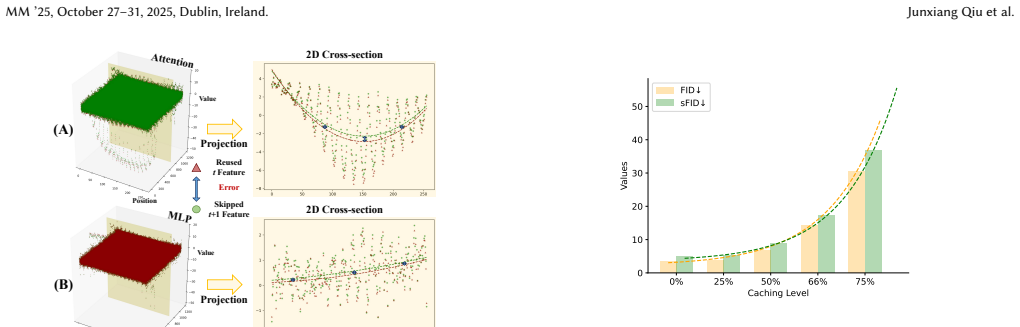
- [Global] There are several presentation issues: the footnote reads 'Correspond Author' instead of 'Corresponding Author'; the contributions list 'threefolds' instead of 'threefold'; Table 3 reports a speedup of '1.3335 ×' for FORA while the other entries use two decimal places; and the axes in Figures 1 and 6 are not fully labeled, making the visual claims hard to evaluate.
- [§3.2, Eq. (6)] The phrase 'Frobenius Inner Production' should be 'Frobenius inner product'. Also, the definition of the inner product with the all-ones matrix J is effectively a sum, so the notation could be simplified; as written, it is unclear whether the division by sum(J) is elementwise or scalar.
- [§3.2, Cache Optimization Determination] The qualitative claim that applying trends in later steps 'causes blurred background details' is supported only by the qualitative Figure 4 and the index sweep in Figure 5. Since the index sweep conflates the number of optimized steps with the step position, it does not isolate the effect of step position from the effect of the total amount of perturbation; this should be clarified or the experiment should be redesigned.
Circularity Check
No significant circularity: the trend correction is calibrated from full-model rollouts rather than derived from the target FID, and the reported gains are empirical tuning outcomes.
full rationale
EOC's pipeline is calibration, not circularity. The prior trend E is computed by Eqs. (4)–(5) from full-model rollouts on a prompt subset and then applied in Eq. (8) to cached features; it is not derived from the cached run's own outputs, nor from the target FID. The FID improvements in Tables 1–5 are empirical outcomes of sweeping hyperparameters (gamma, omega, theta) in Figures 5–6; while tuning on the evaluation metric is a benchmark-contamination concern, it is not a derivation in which the predicted quantity equals an input by construction. The skeptical objection that Eq. (6) uses absolute values and therefore does not establish sign-synchrony of E is a validity/robustness criticism of the transfer assumption, not a circular reduction; no equation sets EOC's output equal to its fitted input. The paper even admits a slight negative impact on IS, which is consistent with a tuned-but-not-universally-better method rather than with a forced identity. Self-citations in the reference list are contextual and not load-bearing for the central claim. Therefore no specific circular step can be quoted that would satisfy the requirement of exhibiting a reduction by construction.
Assumptions & free parameters
free parameters (5)
- gamma =
not reported
- omega =
not reported
- theta =
0.01 for FORA+EOC, 0.005 for L2C+EOC
- cache-optimization step cutoff =
index in {7,9} for FORA N=2 (t <= 7 or t <= 9)
- pre-sampling count Q and prompt subset =
not specified
assumptions (4)
- domain assumption Adjacent sampling steps produce DiT block outputs that are close enough to cache, and the averaged difference between adjacent outputs (the trend) is a meaningful correction signal.
- ad hoc to paper A larger mean-absolute trend v indicates same-sign accumulation that can be injected as a correction, while a smaller v indicates cancellation that should be avoided.
- domain assumption Prior knowledge from a subset of classes/prompts generalizes to all classes/prompts in the evaluation set.
- standard math The reverse diffusion process is modeled as a Markov chain with Gaussian transitions (Eq. 1).
invented entities (1)
-
Prior-knowledge trend tensor E (with averaged feature maps K)
Cite this review
Pith. "Pith review of Accelerating Diffusion Transformer via Error-Optimized Cache." pith.science (2026). https://pith.science/paper/GQJO7JZU
@misc{pith2026250119243,
  author       = {Pith},
  title        = {Pith review of: Accelerating Diffusion Transformer via Error-Optimized Cache},
  year         = {2026},
  howpublished = {\url{https://pith.science/paper/GQJO7JZU}},
  note         = {Machine review of arXiv:2501.19243}
}
read the original abstract
Diffusion Transformer (DiT) is a crucial method for content generation. However, it needs a lot of time to sample. Many studies have attempted to use caching to reduce the time consumption of sampling. Existing caching methods accelerate generation by reusing DiT features from the previous time step and skipping calculations in the next, but they tend to locate and cache low-error modules without focusing on reducing caching-induced errors, resulting in a sharp decline in generated content quality when increasing caching intensity. To solve this problem, we propose the \textbf{E}rror-\textbf{O}ptimized \textbf{C}ache (\textbf{EOC}). This method introduces three key improvements: \textbf{(1)} Prior knowledge extraction: Extract and process the caching differences; \textbf{(2)} A judgment method for cache optimization: Determine whether certain caching steps need to be optimized; \textbf{(3)} Cache optimization: reduce caching errors. Experiments show that this algorithm significantly reduces the error accumulation caused by caching, especially excessive caching. On the ImageNet dataset, without substantially increasing the computational load, this method improves the FID of the generated images when the rule-based model FORA has a caching level of \textbf{75}\%, \textbf{50}\%, and \textbf{25}\%, and the training-based model Learning-to-cache has a caching level of \textbf{22}\%. Specifically, the FID values change from 30.454 to 21.690 (\textbf{28.8}\%), from 6.857 to 5.821 (\textbf{15.1}\%), from 3.870 to 3.692 (\textbf{4.6}\%), and from 3.539 to 3.451 (\textbf{2.5}\%) respectively. Code is available at https://github.com/qiujx0520/EOC_MM2025.git.
Figures


Figures from the paper (4 more)


Forward citations
Cited by 1 Pith paper
-
DiffSparse: Accelerating Diffusion Transformers with Learned Token Sparsity
A learnable cost predictor plus dynamic programming allocates layer-wise token sparsity for diffusion transformers, removing forced full steps and cutting ~54% compute on PixArt-α without quality loss.
Reference graph
Works this paper leans on
-
[1]
Josh Achiam, Steven Adler, Sandhini Agarwal, Lama Ahmad, Ilge Akkaya, Floren- cia Leoni Aleman, Diogo Almeida, Janko Altenschmidt, Sam Altman, Shyamal Anadkat, et al. 2023. Gpt-4 technical report. arXiv preprint arXiv:2303.08774 (2023)
arXiv 2023
-
[2]
Yash Bhalgat, Jinwon Lee, Markus Nagel, Tijmen Blankevoort, and Nojun Kwak
-
[3]
Thibault Castells, Hyoung-Kyu Song, Bo-Kyeong Kim, and Shinkook Choi. 2024. LD-Pruner: Efficient Pruning of Latent Diffusion Models using Task-Agnostic Insights. In Proceedings of the IEEE/CVF Conference on Computer Vision and Pattern Recognition. 821–830
work page 2024
-
[4]
Junsong Chen, Jincheng Yu, Chongjian Ge, Lewei Yao, Enze Xie, Yue Wu, Zhong- dao Wang, James Kwok, Ping Luo, Huchuan Lu, et al. 2023. Pixart-𝛼: Fast training of diffusion transformer for photorealistic text-to-image synthesis. arXiv preprint arXiv:2310.00426 (2023)
arXiv 2023
-
[5]
Pengtao Chen, Mingzhu Shen, Peng Ye, Jianjian Cao, Chongjun Tu, Christos- Savvas Bouganis, Yiren Zhao, and Tao Chen. 2024. Δ−𝐷𝑖𝑇 : A Training- Free Acceleration Method Tailored for Diffusion Transformers. arXiv preprint arXiv:2406.01125 (2024)
arXiv 2024
-
[6]
Jia Deng, Wei Dong, Richard Socher, Li-Jia Li, Kai Li, and Li Fei-Fei. 2009. Imagenet: A large-scale hierarchical image database. In 2009 IEEE conference on computer vision and pattern recognition . Ieee, 248–255
2009
-
[7]
Xin Dong, Shangyu Chen, and Sinno Pan. 2017. Learning to prune deep neural networks via layer-wise optimal brain surgeon. Advances in neural information processing systems 30 (2017)
work page 2017
-
[8]
Weilun Feng, Haotong Qin, Chuanguang Yang, Zhulin An, Libo Huang, Boyu Diao, Fei Wang, Renshuai Tao, Yongjun Xu, and Michele Magno. 2025. Mpq- dm: Mixed precision quantization for extremely low bit diffusion models. In Proceedings of the AAAI Conference on Artificial Intelligence, Vol. 39. 16595–16603
work page 2025
Show all 63 references
-
[9]
Weilun Feng, Chuanguang Yang, Zhulin An, Libo Huang, Boyu Diao, Fei Wang, and Yongjun Xu. 2024. Relational diffusion distillation for efficient image gen- eration. In Proceedings of the 32nd ACM International Conference on Multimedia . 205–213
2024
-
[10]
Demi Guo, Alexander M Rush, and Yoon Kim. 2020. Parameter-efficient transfer learning with diff pruning. arXiv preprint arXiv:2012.07463 (2020)
2020 arXiv
-
[11]
Dan Guo, Shuo Wang, Qi Tian, and Meng Wang. 2019. Dense Temporal Convo- lution Network for Sign Language Translation. In IJCAI. 744–750
2019
-
[12]
Yunhui Guo, Chaofeng Wang, Stella X Yu, Frank McKenna, and Kincho H Law
-
[13]
Jonathan Ho, Ajay Jain, and Pieter Abbeel. 2020. Denoising diffusion probabilistic models. Advances in neural information processing systems 33 (2020), 6840–6851
2020
-
[14]
Namhoon Lee, Thalaiyasingam Ajanthan, Stephen Gould, and Philip HS Torr
-
[15]
Jinghan Li, Yuan Gao, Jinda Lu, Junfeng Fang, Congcong Wen, Hui Lin, and Xiang Wang. 2025. DiffGAD: A Diffusion-based Unsupervised Graph Anomaly Detector. In The Thirteenth International Conference on Learning Representations . https://openreview.net/forum?id=AhcYq4CnfF
2025
-
[16]
Senmao Li, Taihang Hu, Fahad Shahbaz Khan, Linxuan Li, Shiqi Yang, Yaxing Wang, Ming-Ming Cheng, and Jian Yang. 2023. Faster diffusion: Rethinking the role of unet encoder in diffusion models. CoRR (2023)
2023
-
[17]
Xiuyu Li, Yijiang Liu, Long Lian, Huanrui Yang, Zhen Dong, Daniel Kang, Shang- hang Zhang, and Kurt Keutzer. 2023. Q-diffusion: Quantizing diffusion models. In Proceedings of the IEEE/CVF International Conference on Computer Vision . 17535– 17545
2023
-
[18]
Yuhang Li, Ruihao Gong, Xu Tan, Yang Yang, Peng Hu, Qi Zhang, Fengwei Yu, Wei Wang, and Shi Gu. 2021. Brecq: Pushing the limit of post-training quantization by block reconstruction. arXiv preprint arXiv:2102.05426 (2021)
2021 arXiv
-
[19]
Tsung-Yi Lin, Michael Maire, Serge Belongie, James Hays, Pietro Perona, Deva Ramanan, Piotr Dollár, and C Lawrence Zitnick. 2014. Microsoft coco: Common objects in context. In Computer vision–ECCV 2014: 13th European conference, zurich, Switzerland, September 6-12, 2014, proce...
2014
-
[20]
Feng Liu, Shiwei Zhang, Xiaofeng Wang, Yujie Wei, Haonan Qiu, Yuzhong Zhao, Yingya Zhang, Qixiang Ye, and Fang Wan. 2025. Timestep Embedding Tells: It’s Time to Cache for Video Diffusion Model. In Proceedings of the Computer Vision and Pattern Recognition Conference . 7353–7363
2025
-
[21]
Liyang Liu, Shilong Zhang, Zhanghui Kuang, Aojun Zhou, Jing-Hao Xue, Xin- jiang Wang, Yimin Chen, Wenming Yang, Qingmin Liao, and Wayne Zhang
-
[22]
Zhuang Liu, Mingjie Sun, Tinghui Zhou, Gao Huang, and Trevor Darrell. 2018. Rethinking the value of network pruning. arXiv preprint arXiv:1810.05270 (2018)
2018 arXiv
-
[23]
Cheng Lu, Yuhao Zhou, Fan Bao, Jianfei Chen, Chongxuan Li, and Jun Zhu
-
[24]
Jinda Lu, Shuo Wang, Xinyu Zhang, Yanbin Hao, and Xiangnan He. 2023. Semantic-based selection, synthesis, and supervision for few-shot learning. In Proceedings of the 31st ACM International Conference on Multimedia . 3569–3578
2023
-
[25]
Jinda Lu, Junkang Wu, Jinghan Li, Xiaojun Jia, Shuo Wang, YiFan Zhang, Junfeng Fang, Xiang Wang, and Xiangnan He. 2025. DAMO: Data-and Model-aware Alignment of Multi-modal LLMs. arXiv preprint arXiv:2502.01943 (2025)
2025 arXiv
-
[26]
Eric Luhman and Troy Luhman. 2021. Knowledge distillation in iterative gen- erative models for improved sampling speed. arXiv preprint arXiv:2101.02388 (2021)
2021 arXiv
-
[27]
Zhengyao Lv, Chenyang Si, Junhao Song, Zhenyu Yang, Yu Qiao, Ziwei Liu, and Kwan-Yee K Wong. 2024. Fastercache: Training-free video diffusion model acceleration with high quality. arXiv preprint arXiv:2410.19355 (2024)
2024 arXiv
-
[28]
Advances in Neural Information Processing Systems 35 (2022), 5775–5787
Dpm-solver: A fast ode solver for diffusion probabilistic model sampling in around 10 steps. Advances in Neural Information Processing Systems 35 (2022), 5775–5787
2022
-
[29]
Xinyin Ma, Gongfan Fang, and Xinchao Wang. 2024. Deepcache: Accelerating diffusion models for free. In Proceedings of the IEEE/CVF Conference on Computer Vision and Pattern Recognition . 15762–15772
2024
-
[30]
Chenlin Meng, Robin Rombach, Ruiqi Gao, Diederik Kingma, Stefano Ermon, Jonathan Ho, and Tim Salimans. 2023. On distillation of guided diffusion mod- els. In Proceedings of the IEEE/CVF Conference on Computer Vision and Pattern Recognition. 14297–14306
2023
-
[31]
Kevin Meng, David Bau, Alex Andonian, and Yonatan Belinkov. 2022. Locating and editing factual associations in GPT.Advances in Neural Information Processing Systems 35 (2022), 17359–17372
2022
-
[32]
Gustavo Montero, L González, Elizabeth Flórez, María Dolores García, and An- tonio Suárez. 2002. Approximate inverse computation using Frobenius inner product. Numerical linear algebra with applications 9, 3 (2002), 239–247
2002
-
[33]
Xinyin Ma, Gongfan Fang, Michael Bi Mi, and Xinchao Wang. 2024. Learning-to- Cache: Accelerating Diffusion Transformer via Layer Caching. arXiv preprint arXiv:2406.01733 (2024)
2024 arXiv
-
[34]
James R Norris. 1998. Markov chains. Number 2. Cambridge university press
1998
-
[35]
William Peebles and Saining Xie. 2023. Scalable diffusion models with transform- ers. In Proceedings of the IEEE/CVF International Conference on Computer Vision . 4195–4205
2023
-
[36]
Junxiang Qiu, Jinda Lu, and Shuo Wang. 2025. Multimodal Generation with Con- sistency Transferring. In Findings of the Association for Computational Linguistics: NAACL 2025. 504–513
2025
-
[37]
Tim Salimans and Jonathan Ho. 2022. Progressive distillation for fast sampling of diffusion models. arXiv preprint arXiv:2202.00512 (2022)
2022 arXiv
-
[38]
Markus Nagel, Rana Ali Amjad, Mart Van Baalen, Christos Louizos, and Tijmen Blankevoort. 2020. Up or down? adaptive rounding for post-training quantization. In International Conference on Machine Learning . PMLR, 7197–7206
2020
-
[39]
Andy Shih, Suneel Belkhale, Stefano Ermon, Dorsa Sadigh, and Nima Anari. 2024. Parallel sampling of diffusion models. Advances in Neural Information Processing Systems 36 (2024)
2024
-
[40]
Junhyuk So, Jungwon Lee, Daehyun Ahn, Hyungjun Kim, and Eunhyeok Park
-
[41]
Jiaming Song, Chenlin Meng, and Stefano Ermon. 2020. Denoising diffusion implicit models. arXiv preprint arXiv:2010.02502 (2020)
2020 arXiv
-
[42]
Yang Song, Prafulla Dhariwal, Mark Chen, and Ilya Sutskever. 2023. Consistency models. arXiv preprint arXiv:2303.01469 (2023)
2023 arXiv
-
[43]
Pratheba Selvaraju, Tianyu Ding, Tianyi Chen, Ilya Zharkov, and Luming Liang
-
[44]
Yaohui Wang, Xinyuan Chen, Xin Ma, Shangchen Zhou, Ziqi Huang, Yi Wang, Ceyuan Yang, Yinan He, Jiashuo Yu, Peiqing Yang, et al. 2024. Lavie: High-quality video generation with cascaded latent diffusion models. International Journal of Computer Vision (2024), 1–20
2024
-
[45]
Yuan Wang, Ouxiang Li, Tingting Mu, Yanbin Hao, Kuien Liu, Xiang Wang, and Xiangnan He. 2025. Precise, fast, and low-cost concept erasure in value space: Orthogonal complement matters. In Proceedings of the Computer Vision and Pattern Recognition Conference . 28759–28768
2025
-
[46]
Felix Wimbauer, Bichen Wu, Edgar Schoenfeld, Xiaoliang Dai, Ji Hou, Zijian He, Artsiom Sanakoyeu, Peizhao Zhang, Sam Tsai, Jonas Kohler, et al. 2024. Cache me if you can: Accelerating diffusion models through block caching. InProceedings of the IEEE/CVF Conference on Computer ...
2024
-
[47]
Advances in Neural Information Processing Systems 36 (2024)
Temporal dynamic quantization for diffusion models. Advances in Neural Information Processing Systems 36 (2024)
2024
-
[48]
Jiazheng Xu, Xiao Liu, Yuchen Wu, Yuxuan Tong, Qinkai Li, Ming Ding, Jie Tang, and Yuxiao Dong. 2024. Imagereward: Learning and evaluating human prefer- ences for text-to-image generation. Advances in Neural Information Processing Systems 36 (2024)
2024
-
[49]
Tianwei Yin, Michaël Gharbi, Richard Zhang, Eli Shechtman, Fredo Durand, William T Freeman, and Taesung Park. 2024. One-step diffusion with distribution matching distillation. In Proceedings of the IEEE/CVF Conference on Computer Vision and Pattern Recognition . 6613–6623
2024
-
[50]
Shuo Wang, Dan Guo, Wen gang Zhou, Zheng jun Zha, and Meng Wang. 2018. Connectionist Temporal Fusion for Sign Language Translation. In Proceedings of the 26th ACM international conference on Multimedia . 1483–1491
2018
-
[51]
Hongkai Zheng, Weili Nie, Arash Vahdat, Kamyar Azizzadenesheli, and Anima Anandkumar. 2023. Fast sampling of diffusion models via operator learning. In International conference on machine learning . PMLR, 42390–42402
2023
-
[52]
Xingyu Zhu, Shuo Wang, Jinda Lu, Yanbin Hao, Haifeng Liu, and Xiangnan He. 2024. Boosting few-shot learning via attentive feature regularization. In Proceedings of the AAAI Conference on Artificial Intelligence , Vol. 38. 7793–7801
2024
-
[54]
Junyi Wu, Haoxuan Wang, Yuzhang Shang, Mubarak Shah, and Yan Yan. 2024. PTQ4DiT: Post-training Quantization for Diffusion Transformers. arXiv preprint arXiv:2405.16005 (2024)
2024 arXiv
-
[55]
Chang Zou, Xuyang Liu, Ting Liu, Siteng Huang, and Linfeng Zhang. 2024. Accelerating diffusion transformers with token-wise feature caching. arXiv preprint arXiv:2410.05317 (2024)
2024 arXiv
-
[57]
Xuanlei Zhao, Xiaolong Jin, Kai Wang, and Yang You. 2024. Real-time video generation with pyramid attention broadcast. arXiv preprint arXiv:2408.12588 (2024)
2024 arXiv
-
[61]
Advances in Neural Information Processing Systems 37 (2024), 2001–2025
Enhancing zero-shot vision models by label-free prompt distribution learning and bias correcting. Advances in Neural Information Processing Systems 37 (2024), 2001–2025
2024
-
[62]
Xingyu Zhu, Beier Zhu, Yi Tan, Shuo Wang, Yanbin Hao, and Hanwang Zhang
-
[63]
In Pro- ceedings of the 32nd ACM International Conference on Multimedia
Selective vision-language subspace projection for few-shot CLIP. In Pro- ceedings of the 32nd ACM International Conference on Multimedia . 3848–3857
-
[2019]
arXiv preprint arXiv:1906.06307 (2019)
A signal propagation perspective for pruning neural networks at initializa- tion. arXiv preprint arXiv:1906.06307 (2019)
2019 arXiv
-
[2020]
In Proceedings of the IEEE/CVF conference on computer vision and pattern recognition workshops
Lsq+: Improving low-bit quantization through learnable offsets and better initialization. In Proceedings of the IEEE/CVF conference on computer vision and pattern recognition workshops. 696–697
-
[2021]
In International Conference on Machine Learning
Group fisher pruning for practical network compression. In International Conference on Machine Learning . PMLR, 7021–7032
-
[2022]
Journal of Computing in Civil Engineering 36, 5 (2022), 04022024
Adaln: a vision transformer for multidomain learning and predisaster building information extraction from images. Journal of Computing in Civil Engineering 36, 5 (2022), 04022024
2022
-
[2024]
arXiv preprint arXiv:2407.01425 (2024)
Fora: Fast-forward caching in diffusion transformer acceleration. arXiv preprint arXiv:2407.01425 (2024)
2024 arXiv
Reviewed August 9, 2026 · model on record in the stance chip above.
Discussion (0). Continue with ORCID to comment.