REVIEW 4 major objections 5 minor 37 references
Toward Scene Graph and Layout Guided Complex 3D Scene Generation
T0 review · 4 major / 5 minor · reviewed 2026-08-10 · deepseek-v4-flash
Pith's one-line read GraLa3D generates complex 3D scenes from text by separating spatial layout from object interactions, with tests showing better prompt alignment than layout-only and scene-graph-only baselines.
desk verdict The super-node construction is genuinely new and the ablations support it, but the paper's central outperformance claim is built on an unfair comparison: GraphDreamer was run on reduced prompts. read the letter →
The pith
A machine-rendered reading of the paper's core claim, the machinery that carries it, and where it could break.
The reading
What carries the argument
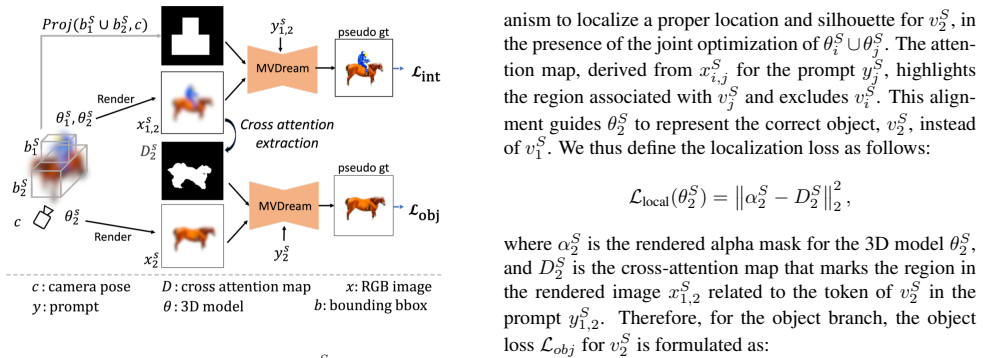
The load-bearing object is the scene graph G = (V, E), split into single-object nodes O and super-nodes S. For each super-node, a union layout box and an interaction loss optimize paired 3D Gaussian splats together, while a localization loss matches each object's rendered alpha mask to its cross-attention map, preventing one object's Gaussians from being absorbed into the other. A masked interval-score-matching loss restricts diffusion guidance to the projected layout box, and a final harmonization stage refines the extracted mesh textures with depth-conditioned global guidance.
What would settle it
Take a fixed set of prompts whose verbs require physical contact (holding, sitting on, riding), inspect the LLM layout boxes before generation, and render the final scenes: if a substantial share of contact pairs have non-overlapping boxes and the renders show objects that do not touch, the central claim fails.
Extended reading notes
Core claim
The central claim is that a scene graph can be decomposed into two node types that are optimized differently: single-object nodes handle objects related only by spatial arrangement, while super-nodes bundle an object-relation-object triplet and optimize the union of their Gaussian splats with a joint interaction loss. A localization loss built from cross-attention maps keeps the two objects inside a super-node from borrowing each other's geometry and appearance, and a masked interval-score-matching loss keeps the diffusion prior from generating incomplete objects that merely fill their layout box. The result, the paper reports, is a 3D scene that respects both the layout and the interactions, on prompts with up to fifteen objects.
Load-bearing premise
The whole pipeline assumes the LLM's predicted bounding boxes place interacting objects in contact; if the boxes do not overlap for a relation like holding, neither the interaction loss nor the localization loss can fix the contact, and the scene silently loses that relation.
Editorial extensions
If this is right
- Scenes with up to fifteen objects and five interacting groups can be generated, far beyond the roughly five objects handled by graph-only baselines.
- Contact interactions such as riding, holding, sitting on, and hatching from can survive generation instead of producing floating or detached objects.
- Layout boxes carry the spatial-relation burden, so interaction modeling does not have to compensate for missing spatial reasoning in the diffusion prior.
- The final harmonization stage fuses separately generated objects into a single coherent mesh scene rather than a loose collection of assets.
Reading between the lines
- Because the pipeline delegates spatial correctness to LLM-predicted boxes, the method's ceiling is set by the LLM's ability to place interacting objects in contact; a layout-validation step that checks overlap before generation would harden the approach.
- The node/super-node decomposition could transfer to 2D multi-object image generation, where attention leakage between interacting instances is a known failure mode.
- The localization loss treats cross-attention maps as pseudo-labels, so improvements in diffusion attention interpretability would directly improve disentanglement without retraining the pipeline.
- Scaling the method to even larger scenes would mainly require better LLM layout reasoning, since spatial relations are outsourced to boxes rather than learned by the diffusion prior.
Editorial analysis
A structured set of objections, weighed in public.
Referee Report
Summary. The paper proposes GraLa3D, a text-to-3D framework that combines LLM-generated scene graphs with layout bounding boxes for complex multi-object 3D scene generation. The scene graph is decomposed into single-object nodes and composite super-nodes, where super-nodes are dedicated to objects involved in interactions. The method uses 3D Gaussian Splatting with masked Interval Score Matching, a layout constraint, an interaction loss over super-node object unions, and a localization loss based on cross-attention maps to prevent appearance leakage between interacting objects. A final scene harmonization stage converts the Gaussians to meshes and refines textures with a ControlNet-based prompt. The paper claims state-of-the-art performance relative to GraphDreamer and GALA3D, supported by CLIP scores, qualitative examples, a user study, and ablations of the two proposed losses.
Significance. If the method works as claimed, the contribution is practically useful: it is one of the few frameworks that explicitly address both spatial layout and inter-object interactions in text-to-3D scene generation, and the super-node decomposition is a sensible way to scale scene-graph-based generation to scenes with many objects. The two loss components are well motivated, and the ablations in §4.3 and Figures 8–9 give credible evidence that the localization loss and the masked ISM loss affect the output in the intended direction. The paper is also honest about known limitations in the supplementary material. However, the central comparative claim — that GraLa3D outperforms existing systems on complex prompts — rests on a quantitative evaluation with five scenes and no reported variance, and on a comparison in which the GraphDreamer baseline is run on reduced prompts for three of those scenes. The user study inherits the same prompt mismatch. These issues are fixable but currently prevent the paper's headline claim from being established.
major comments (4)
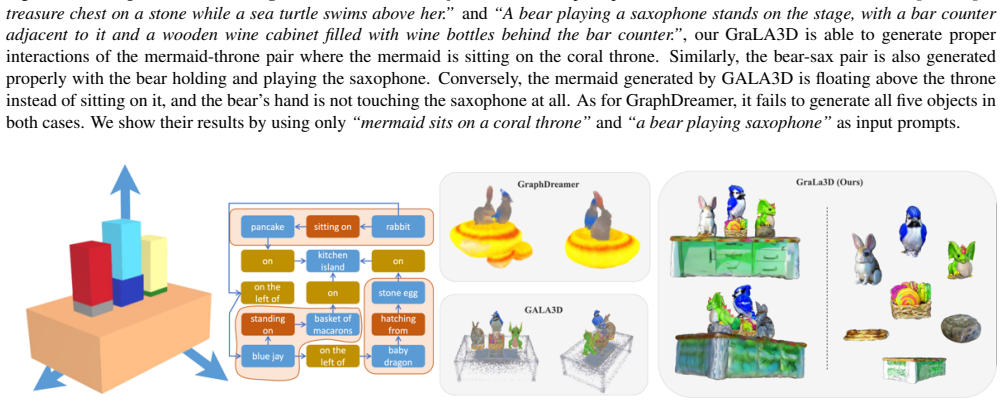
- [§4.2 and Table 1] The comparison with GraphDreamer is not like-for-like. Section 4.2 states that for Figures 1, 6, and 7 the authors 'reduce the number of objects in the text prompt when reproducing their results,' and Figure 6's caption confirms that GraphDreamer received only 'mermaid sits on a coral throne' rather than the full five-object prompt. Table 1 nevertheless reports CLIP scores for GraphDreamer on those cases and instructs the reader to refer to each figure for the text prompts used. The reported GraphDreamer scores are therefore likely computed against shorter prompts, and the headline claim that GraLa3D 'outperforms' GraphDreamer is not established. The authors should run all baselines on identical full prompts for all scenes and report the exact prompt used per method, or clearly separate the reduced-prompt results from the full-prompt comparison.
- [Table 1 and Supplementary B.2] The quantitative evidence is too thin to support the central claim. CLIP scores are averaged over 200 random views but are reported for only five scenes, with no standard deviation, no multiple seeds, and no statistical significance testing. CLIP score is also largely insensitive to spatial arrangement and interaction correctness, which are the paper's main contributions. The user study in Supplementary B.2 has the same prompt-mismatch problem: raters compared outputs that were generated under different prompts for GraphDreamer, so the preference percentages (e.g., 89.7% for GraLa3D on the farm case) may reflect the difficulty of the prompt assigned to the baseline rather than the quality of the method. A corrected evaluation should use identical full prompts for every method and report per-method prompts, variances, and preferably an interaction-aware metric such as mask-overlap or relation classification.
- [§3.2 and Supplementary B.3] The method's reliance on LLM-generated bounding boxes is a load-bearing assumption that the paper itself flags but does not quantify. Section 3.2 uses the LLM's bounding boxes to define both spatial relations and the union regions for interaction losses, yet Supplementary B.3 reports that for 'a monkey holding a plate' the LLM sometimes generates non-overlapping boxes, requiring manual prompt adjustment to fix the layout. If such manual adjustments were used in the main figures, they should be reported; otherwise the automated pipeline may not reproduce the shown results. The authors should report the success rate of the automatic layout generation over a larger prompt set and include a failure analysis showing how often manual intervention is needed.
- [§3.3] The localization loss in Eq. (5)–(6) uses cross-attention maps from the diffusion model as pseudo-ground-truth masks. This is a reasonable self-supervised bootstrap rather than a circular derivation, but the paper does not discuss its failure modes: DAAM-style attention maps can be coarse, mislocalized, or multi-modal, especially for small objects or abstract relations. The ablation in Figure 8 shows only two examples, which is insufficient to demonstrate that the loss robustly prevents appearance leakage across object classes and scene configurations. Adding quantitative results for the localization loss — e.g., mask IoU against manually annotated regions, or the fraction of super-node generations that exhibit leakage — would strengthen the central claim.
minor comments (5)
- [§3.3] There is a typo in the sentence introducing Eq. (7): 'upernode' should be 'super-node.'
- [Figure 9 caption] The caption uses 'Lmsk_ISM' while the main text and Eq. (2) use 'L_mask_ISM'; please unify the notation.
- [Figure 5 caption] 'wizard-crustal ball pair' should be 'wizard-crystal ball pair.'
- [§2.2] The sentence 'GraphDreamer [6] proposed another research direction employing scene graphs' is followed by a grammar issue in 'where each model objects that are involved'; please rephrase for clarity.
- [Supplementary A.2] The cross-attention extraction is described only in the supplementary material and the main text refers to DAAM without citing it at the point of use; please add the citation in §3.3 where L_local is introduced.
Circularity Check
No circularity: GraLa3D's losses are optimization objectives over external diffusion priors, and no fitted parameter is relabeled as a prediction.
full rationale
The paper contains no derivation that reduces to its own inputs. Each loss term is an optimization objective: the masked ISM loss and the layout loss are computed from LLM-produced bounding boxes and external diffusion priors (MVDream, Interval Score Matching, ControlNet), while the localization loss aligns a 3D object's alpha mask to cross-attention maps of a pretrained diffusion model. That is a self-supervised bootstrap used to drive generation, not a fitted parameter presented as a prediction. The super-node construction is an architectural design choice, not a quantity derived from the method's own outputs. I find no load-bearing self-citation: the cited priors and baselines (DreamFusion, LucidDreamer, MVDream, GraphDreamer, GALA3D) are external works with no author overlap with the present paper. The headline comparison is weakened by the unequal prompt reduction for GraphDreamer in Figures 1, 6, and 7 (Section 4.2), but that is an evaluation-fairness issue rather than circularity: the method's outputs are not defined in terms of the baseline scores, and the fairness flaw does not make any claimed derivation equivalent to its inputs. Therefore no circular step can be exhibited, and the circularity score is 0.
Assumptions & free parameters
free parameters (3)
- LLM-generated layout bounding boxes B =
per-prompt, e.g. box coordinates for each object
- Localization loss warmup schedule =
L_local weight set to 0 for first 600 iterations
- CLIP score evaluation sampling =
200 random views per scene, no variance
assumptions (4)
- domain assumption Pre-trained 2D diffusion models (MVDream, ControlNet, Stable Diffusion) provide valid gradients for 3D optimization via ISM.
- domain assumption DAAM cross-attention maps reliably localize each object instance in a rendered 2D view.
- domain assumption LLM-generated scene graphs and layout bounding boxes are physically plausible and consistent with the text prompt.
- domain assumption Occupancy extraction from 3DGS followed by marching cubes yields faithful mesh geometry.
Cite this review
Pith. "Pith review of Toward Scene Graph and Layout Guided Complex 3D Scene Generation." pith.science (2026). https://pith.science/paper/GQZVQREA
@misc{pith2026241220473,
  author       = {Pith},
  title        = {Pith review of: Toward Scene Graph and Layout Guided Complex 3D Scene Generation},
  year         = {2026},
  howpublished = {\url{https://pith.science/paper/GQZVQREA}},
  note         = {Machine review of arXiv:2412.20473}
}
read the original abstract
Recent advancements in object-centric text-to-3D generation have shown impressive results. However, generating complex 3D scenes remains an open challenge due to the intricate relations between objects. Moreover, existing methods are largely based on score distillation sampling (SDS), which constrains the ability to manipulate multiobjects with specific interactions. Addressing these critical yet underexplored issues, we present a novel framework of Scene Graph and Layout Guided 3D Scene Generation (GraLa3D). Given a text prompt describing a complex 3D scene, GraLa3D utilizes LLM to model the scene using a scene graph representation with layout bounding box information. GraLa3D uniquely constructs the scene graph with single-object nodes and composite super-nodes. In addition to constraining 3D generation within the desirable layout, a major contribution lies in the modeling of interactions between objects in a super-node, while alleviating appearance leakage across objects within such nodes. Our experiments confirm that GraLa3D overcomes the above limitations and generates complex 3D scenes closely aligned with text prompts.
Figures


Figures from the paper (8 more)




Reference graph
Works this paper leans on
-
[1]
Mohammadreza Armandpour, Ali Sadeghian, Huangjie Zheng, Amir Sadeghian, and Mingyuan Zhou. Re-imagine the negative prompt algorithm: Transform 2d diffusion into 3d, alleviate janus problem and beyond. ArXiv, abs/2304.04968, 2023. 3
arXiv 2023
-
[2]
Angel X. Chang, Thomas A. Funkhouser, Leonidas J. Guibas, Pat Hanrahan, Qi-Xing Huang, Zimo Li, Silvio Savarese, Manolis Savva, Shuran Song, Hao Su, Jianxiong Xiao, L. Yi, and Fisher Yu. Shapenet: An information-rich 3d model repository. ArXiv, abs/1512.03012, 2015. 2
arXiv 2015
-
[3]
Kevin Chen, Christopher Bongsoo Choy, Manolis Savva, Angel X. Chang, Thomas A. Funkhouser, and Silvio Savarese. Text2shape: Generating shapes from natural lan- guage by learning joint embeddings. In Asian Conference on Computer Vision, 2018. 2
work page 2018
-
[4]
Set-the-scene: Global-local training for generating controllable nerf scenes, 2023
Dana Cohen-Bar, Elad Richardson, Gal Metzer, Raja Giryes, and Daniel Cohen-Or. Set-the-scene: Global-local training for generating controllable nerf scenes, 2023. 2
2023
-
[5]
Shapecrafter: A recursive text-conditioned 3d shape generation model
Rao Fu, Xiaoyu Zhan, Yiwen Chen, Daniel Ritchie, and Sri- nath Sridhar. Shapecrafter: A recursive text-conditioned 3d shape generation model. ArXiv, abs/2207.09446, 2022. 2
arXiv 2022
-
[6]
Graphdreamer: Compositional 3d scene synthesis from scene graphs
Gege Gao, Weiyang Liu, Anpei Chen, Andreas Geiger, and Bernhard Sch ¨olkopf. Graphdreamer: Compositional 3d scene synthesis from scene graphs. 2024 IEEE/CVF Confer- ence on Computer Vision and Pattern Recognition (CVPR) , pages 21295–21304, 2023. 1, 2, 3, 4, 6
work page 2024
-
[7]
Sugar: Surface- aligned gaussian splatting for efficient 3d mesh reconstruc- tion and high-quality mesh rendering
Antoine Gu ´edon and Vincent Lepetit. Sugar: Surface- aligned gaussian splatting for efficient 3d mesh reconstruc- tion and high-quality mesh rendering. CVPR, 2024. 3
2024
-
[8]
Dreamtime: An improved opti- mization strategy for diffusion-guided 3d generation
Yukun Huang, Jianan Wang, Yukai Shi, Boshi Tang, Xian- biao Qi, and Lei Zhang. Dreamtime: An improved opti- mization strategy for diffusion-guided 3d generation. In The Twelfth International Conference on Learning Representa- tions, 2024. 6
work page 2024
Show all 37 references
-
[9]
Barron, P
Ajay Jain, Ben Mildenhall, Jonathan T. Barron, P. Abbeel, and Ben Poole. Zero-shot text-guided object generation with dream fields. 2022 IEEE/CVF Conference on Computer Vi- sion and Pattern Recognition (CVPR), pages 857–866, 2021. 2
2022
-
[10]
Clip-mesh: Generating textured meshes from text using pretrained image-text models
Nasir Mohammad Khalid, Tianhao Xie, Eugene Belilovsky, and Tiberiu Popa. Clip-mesh: Generating textured meshes from text using pretrained image-text models. SIGGRAPH Asia 2022 Conference Papers, 2022. 2
2022
-
[11]
Generative ai meets 3d: A survey on text-to-3d in aigc era
Chenghao Li, Chaoning Zhang, Atish Waghwase, Lik-Hang Lee, Franc ¸ois Rameau, Yang Yang, Sung-Ho Bae, and Choong-Seon Hong. Generative ai meets 3d: A survey on text-to-3d in aigc era. ArXiv, abs/2305.06131, 2023. 2
2023 arXiv
-
[12]
Luciddreamer: Towards high-fidelity text-to-3d generation via interval score match- ing
Yixun Liang, Xin Yang, Jiantao Lin, Haodong Li, Xiao- gang Xu, and Yingcong Chen. Luciddreamer: Towards high-fidelity text-to-3d generation via interval score match- ing. 2024 IEEE/CVF Conference on Computer Vision and Pattern Recognition (CVPR), pages 6517–6526, 2023. 2, 3, 4, 8
2024
-
[13]
Magic3d: High-resolution text-to-3d content creation
Chen-Hsuan Lin, Jun Gao, Luming Tang, Towaki Takikawa, Xiaohui Zeng, Xun Huang, Karsten Kreis, Sanja Fidler, Ming-Yu Liu, and Tsung-Yi Lin. Magic3d: High-resolution text-to-3d content creation. 2023 IEEE/CVF Conference on Computer Vision and Pattern Recognition (CVPR) , pages ...
2023
-
[14]
Lu, Xiaodong Lin, Hui Xiong, and Lin Wang
Yiqi Lin, Haotian Bai, Sijia Li, H. Lu, Xiaodong Lin, Hui Xiong, and Lin Wang. Componerf: Text-guided multi-object compositional nerf with editable 3d scene layout. ArXiv, abs/2303.13843, 2023. 2, 3
2023 arXiv
-
[15]
Towards implicit text-guided 3d shape generation
Zhengzhe Liu, Yi Wang, Xiaojuan Qi, and Chi-Wing Fu. Towards implicit text-guided 3d shape generation. 2022 IEEE/CVF Conference on Computer Vision and Pattern Recognition (CVPR), pages 17875–17885, 2022. 2
2022
-
[16]
Repaint: Inpainting using denoising diffusion probabilistic models
Andreas Lugmayr, Martin Danelljan, Andres Romero, Fisher Yu, Radu Timofte, and Luc Van Gool. Repaint: Inpainting using denoising diffusion probabilistic models. In Proceed- ings of the IEEE/CVF Conference on Computer Vision and Pattern Recognition (CVPR), pages 11461–11471, 2022. 4
2022
-
[17]
Wan-Duo Kurt Ma, J. P. Lewis, W. Kleijn, and Thomas Le- ung. Directed diffusion: Direct control of object placement through attention guidance. In AAAI Conference on Artificial Intelligence, 2023. 2, 3
2023
-
[18]
Latent-nerf for shape-guided gener- ation of 3d shapes and textures
Gal Metzer, Elad Richardson, Or Patashnik, Raja Giryes, and Daniel Cohen-Or. Latent-nerf for shape-guided gener- ation of 3d shapes and textures. 2023 IEEE/CVF Conference on Computer Vision and Pattern Recognition (CVPR), pages 12663–12673, 2022. 1
2023
-
[19]
Gpt-4 technical report, 2024
OpenAI, Josh Achiam, Steven Adler, Sandhini Agarwal, Lama Ahmad, and et al. Gpt-4 technical report, 2024. 2, 4, 6
2024
-
[20]
Compositional 3d scene generation using locally conditioned diffusion
Ryan Po and Gordon Wetzstein. Compositional 3d scene generation using locally conditioned diffusion. 2024 Inter- national Conference on 3D Vision (3DV) , pages 651–663,
2024
-
[21]
Barron, and Ben Milden- hall
Ben Poole, Ajay Jain, Jonathan T. Barron, and Ben Milden- hall. Dreamfusion: Text-to-3d using 2d diffusion. ArXiv, abs/2209.14988, 2022. 1, 2, 4
2022 arXiv
-
[22]
Learning transferable visual models from natural language supervision
Alec Radford, Jong Wook Kim, Chris Hallacy, Aditya Ramesh, Gabriel Goh, Sandhini Agarwal, Girish Sastry, Amanda Askell, Pamela Mishkin, Jack Clark, Gretchen Krueger, and Ilya Sutskever. Learning transferable visual models from natural language supervision. In International Con...
2021
-
[23]
Blattmann, Dominik Lorenz, Patrick Esser, and Bj ¨orn Ommer
Robin Rombach, A. Blattmann, Dominik Lorenz, Patrick Esser, and Bj ¨orn Ommer. High-resolution image synthesis with latent diffusion models. 2022 IEEE/CVF Conference on Computer Vision and Pattern Recognition (CVPR), pages 10674–10685, 2021. 2
2022
-
[24]
Denton, Seyed Kamyar Seyed Ghasemipour, Burcu Karagol Ayan, Seyedeh Sara Mah- davi, Raphael Gontijo Lopes, Tim Salimans, Jonathan Ho, David J
Chitwan Saharia, William Chan, Saurabh Saxena, Lala Li, Jay Whang, Emily L. Denton, Seyed Kamyar Seyed Ghasemipour, Burcu Karagol Ayan, Seyedeh Sara Mah- davi, Raphael Gontijo Lopes, Tim Salimans, Jonathan Ho, David J. Fleet, and Mohammad Norouzi. Photorealistic text- to-image...
2022 arXiv
-
[25]
Lambourne, Ye Wang, Chin- Yi Cheng, and Marco Fumero
Aditya Sanghi, Hang Chu, J. Lambourne, Ye Wang, Chin- Yi Cheng, and Marco Fumero. Clip-forge: Towards zero- shot text-to-shape generation. 2022 IEEE/CVF Conference on Computer Vision and Pattern Recognition (CVPR), pages 18582–18592, 2021. 2
2022
-
[26]
Aditya Sanghi, Rao Fu, Vivian Liu, Karl D. D. Willis, Hooman Shayani, Amir Hosein Khasahmadi, Srinath Srid- har, and Daniel Ritchie. Clip-sculptor: Zero-shot generation of high-fidelity and diverse shapes from natural language. 2023 IEEE/CVF Conference on Computer Vision and P...
2023
-
[27]
Yichun Shi, Peng Wang, Jianglong Ye, Mai Long, Kejie Li, and X. Yang. Mvdream: Multi-view diffusion for 3d gener- ation. ArXiv, abs/2308.16512, 2023. 2, 3, 4, 6, 8
2023 arXiv
-
[28]
Denois- ing diffusion implicit models, 2022
Jiaming Song, Chenlin Meng, and Stefano Ermon. Denois- ing diffusion implicit models, 2022. 3
2022
-
[29]
Dreamgaussian: Generative gaussian splatting for ef- ficient 3d content creation
Jiaxiang Tang, Jiawei Ren, Hang Zhou, Ziwei Liu, and Gang Zeng. Dreamgaussian: Generative gaussian splatting for ef- ficient 3d content creation. InThe Twelfth International Con- ference on Learning Representations, 2024. 4, 5, 3
2024
-
[30]
What the DAAM: Interpreting stable dif- fusion using cross attention
Raphael Tang, Linqing Liu, Akshat Pandey, Zhiying Jiang, Gefei Yang, Karun Kumar, Pontus Stenetorp, Jimmy Lin, and Ferhan Ture. What the DAAM: Interpreting stable dif- fusion using cross attention. In Proceedings of the 61st An- nual Meeting of the Association for Computationa...
2023
-
[31]
Yeh, and Gregory Shakhnarovich
Haochen Wang, Xiaodan Du, Jiahao Li, Raymond A. Yeh, and Gregory Shakhnarovich. Score jacobian chaining: Lift- ing pretrained 2d diffusion models for 3d generation. 2023 IEEE/CVF Conference on Computer Vision and Pattern Recognition (CVPR), pages 12619–12629, 2022. 1
2023
-
[32]
Luciddreaming: Controllable object-centric 3d generation, 2024
Zhaoning Wang, Ming Li, and Chen Chen. Luciddreaming: Controllable object-centric 3d generation, 2024. 2
2024
-
[33]
Improving compositional text-to-image generation with large vision-language models,
Song Wen, Guian Fang, Renrui Zhang, Peng Gao, Hao Dong, and Dimitris Metaxas. Improving compositional text-to-image generation with large vision-language models,
-
[34]
Dream3d: Zero-shot text-to-3d synthesis using 3d shape prior and text-to-image diffusion models
Jiale Xu, Xintao Wang, Weihao Cheng, Yan-Pei Cao, Ying Shan, Xiaohu Qie, and Shenghua Gao. Dream3d: Zero-shot text-to-3d synthesis using 3d shape prior and text-to-image diffusion models. 2023 IEEE/CVF Conference on Com- puter Vision and Pattern Recognition (CVPR), pages 20908...
2023
-
[35]
Adding conditional control to text-to-image diffusion models, 2023
Lvmin Zhang, Anyi Rao, and Maneesh Agrawala. Adding conditional control to text-to-image diffusion models, 2023. 3, 5, 6
2023
-
[36]
A survey of diffusion based im- age generation models: Issues and their solutions
Tianyi Zhang, Zheng Wang, Jin Huang, Mohiuddin Muham- mad Tasnim, and Wei Shi. A survey of diffusion based im- age generation models: Issues and their solutions. ArXiv, abs/2308.13142, 2023. 2, 3
2023 arXiv
-
[37]
A rabbit is eating a cake on a plate. The plate, along with a spoon and fork, is on the table. The spoon is to the right of the plate, and the fork is to the left
Xiaoyu Zhou, Xingjian Ran, Yajiao Xiong, Jinlin He, Zhi- wei Lin, Yongtao Wang, Deqing Sun, and Ming-Hsuan Yang. Gala3d: Towards text-to-3d complex scene genera- tion via layout-guided generative gaussian splatting. ArXiv, abs/2402.07207, 2024. 1, 2, 3, 4, 6 Toward Scene Graph...
2024 arXiv
Reviewed August 10, 2026 · model on record in the stance chip above.
Discussion (0). Continue with ORCID to comment.