Catalytic entanglement transformations with noisy hardware
Pith reviewed 2026-05-22 16:12 UTC · model grok-4.3
The pith
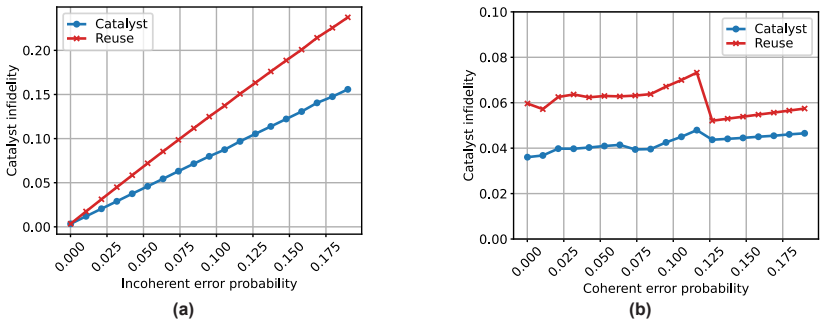
Catalytic entanglement concentration achieves higher conversion rates than distillation or non-catalytic methods under low operational errors and depolarizing noise.
A machine-rendered reading of the paper's core claim, the machinery that carries it, and where it could break.
Core claim
The authors show that, when state-preparation errors and operational errors are modeled as low-level depolarizing noise, catalytic entanglement concentration on mixed states yields strictly higher rates than both non-catalytic entanglement concentration and entanglement distillation. The catalysts remain reusable to a useful degree under the same noise model. These conclusions rest on a novel, systematic construction of the positive-operator valued measurements needed to perform the concentration step; the construction explicitly parametrizes the number of communication rounds versus the number of auxiliary qubits employed.
What carries the argument
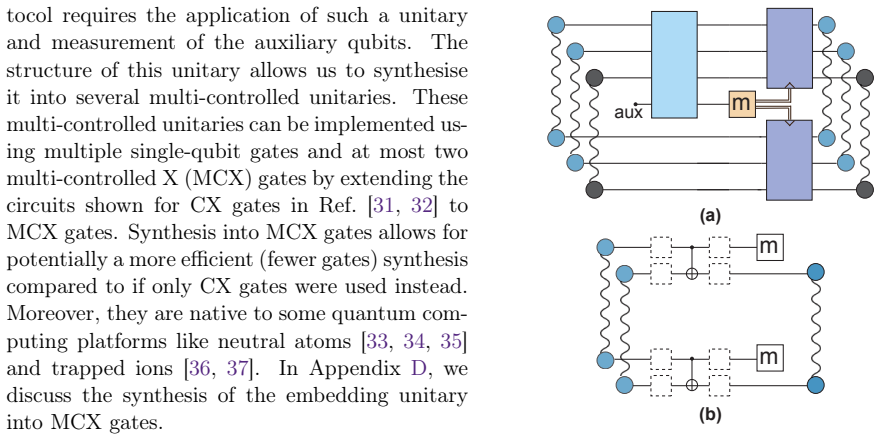
A novel constructive recipe for the positive-operator valued measurements (POVMs) that realize entanglement-concentration transformations on mixed states, which parametrizes the explicit tradeoff between communication rounds and auxiliary-qubit count.
If this is right
- Catalytic EC supplies higher asymptotic rates than distillation once operational errors fall below a modest threshold.
- The introduced POVM construction lets an experimenter trade extra communication rounds for fewer auxiliary qubits while preserving the rate gain.
- Catalyst states remain reusable after a finite number of noisy uses, so the overhead of preparing fresh catalysts does not erase the rate advantage.
- The rate ordering catalytic > non-catalytic > distillation continues to hold when the input states are mixed rather than pure.
Where Pith is reading between the lines
- The same POVM recipe could be applied to other entanglement manipulation tasks such as dilution or swapping, potentially improving their noise resilience as well.
- If the rate advantage persists under more realistic correlated-noise models, then small quantum networks could adopt catalytic steps to reduce the total number of channel uses needed for long-distance entanglement distribution.
- Hardware designers might prioritize lowering operational error rates over state-preparation fidelity, because the paper's advantage appears most sensitive to the former.
Load-bearing premise
The numerical models of state-preparation plus operational errors, together with the specific POVM construction, accurately represent the dominant noise sources present on near-term hardware.
What would settle it
Execute the catalytic protocol on a real device whose error rates match the paper's low-error depolarizing regime and measure whether the observed entanglement yield exceeds that of distillation and non-catalytic concentration performed on the same hardware.
Figures




read the original abstract
The availability of certain entangled resource states (catalyst states) can enhance the rate of converting several less entangled states into fewer highly entangled states in a process known as catalytic entanglement concentration (EC). Here, we extend catalytic EC from pure states to mixed states and numerically benchmark it against non-catalytic EC and distillation in the presence of state-preparation errors and operational errors. Furthermore, we analyse the re-usability of catalysts in the presence of such errors. To do this, we introduce a novel recipe for determining the positive-operator valued measurements (POVM) required for EC transformations, which allows for making tradeoffs between the number of communication rounds and the number of auxiliary qubits required. We find that in the presence of low operational errors and depolarising noise, catalytic EC can provide better rates than distillation and non-catalytic EC.
Editorial analysis
A structured set of objections, weighed in public.
Referee Report
Summary. The manuscript extends catalytic entanglement concentration from pure states to mixed states and introduces a novel POVM construction recipe that trades off the number of communication rounds against the number of auxiliary qubits. It numerically benchmarks catalytic EC against non-catalytic EC and standard distillation under combined state-preparation and operational errors modeled as depolarizing noise, reports higher rates for the catalytic approach at low error strengths, and examines catalyst reusability under the same noise model.
Significance. If the numerical rate advantages survive more detailed scrutiny of the simulation parameters, the work would be significant for near-term quantum hardware by providing concrete evidence that catalysis can improve entanglement transformation yields in the presence of realistic noise. The flexible POVM recipe is a clear methodological contribution that enables systematic exploration of resource trade-offs.
major comments (2)
- [Numerical benchmarks section] Numerical benchmarks section: exact operational error rates, circuit depths, number of Monte Carlo samples, and convergence criteria for the rate optimizations are not stated, which is load-bearing for the central claim that catalytic EC outperforms the baselines under low depolarizing noise.
- [§3.2] §3.2 (POVM recipe): the construction is presented for mixed states, but no analytical bound or sensitivity analysis is given showing that the reported rate advantage remains when the actual device noise deviates from the independent depolarizing assumption toward correlated or amplitude-damping channels.
minor comments (2)
- [Reusability analysis] Notation for the catalyst reusability metric is introduced without an explicit equation reference, making the reusability plots harder to interpret.
- [Figures 3-5] A few figure captions omit the precise noise strength values used in each panel.
Simulated Author's Rebuttal
We thank the referee for their thorough review and valuable feedback on our manuscript. We address the major comments point by point below, indicating where revisions will be made to improve clarity and completeness.
read point-by-point responses
-
Referee: Numerical benchmarks section: exact operational error rates, circuit depths, number of Monte Carlo samples, and convergence criteria for the rate optimizations are not stated, which is load-bearing for the central claim that catalytic EC outperforms the baselines under low depolarizing noise.
Authors: We agree that these simulation parameters must be stated explicitly for reproducibility. In the revised manuscript we will add a dedicated paragraph in the Numerical benchmarks section specifying the exact depolarizing noise strengths (0.001 to 0.05), the circuit depths of the POVM implementations, the number of Monte Carlo samples (10^4 per data point), and the convergence criterion used for the rate optimizations (relative change below 0.5 % over successive iterations). revision: yes
-
Referee: §3.2 (POVM recipe): the construction is presented for mixed states, but no analytical bound or sensitivity analysis is given showing that the reported rate advantage remains when the actual device noise deviates from the independent depolarizing assumption toward correlated or amplitude-damping channels.
Authors: We acknowledge that the manuscript relies on the independent depolarizing model and does not contain an analytical bound for other channels. Deriving a general analytical guarantee for arbitrary correlated or amplitude-damping noise is technically involved and lies outside the scope of the present work. However, we will include additional numerical sensitivity checks in an appendix that compare catalytic and non-catalytic rates under amplitude-damping and weakly correlated noise at low error strengths, showing that the qualitative advantage persists. These results and a brief discussion of model limitations will be added to the revised version. revision: partial
Circularity Check
No significant circularity; numerical benchmarks use independent baselines and explicit assumptions
full rationale
The paper introduces a novel POVM recipe for mixed-state catalytic EC and reports numerical rate comparisons under stated depolarizing noise and error models. These comparisons are performed against separate distillation and non-catalytic baselines using the same forward simulation; the rates are not obtained by fitting parameters to the target advantage data and then relabeling the fit as a prediction. The noise model is presented as an assumption whose validity is external to the derivation, with no self-citation chain or uniqueness theorem invoked to force the central claim. The work is therefore self-contained against its own stated benchmarks.
Axiom & Free-Parameter Ledger
Lean theorems connected to this paper
-
IndisputableMonolith/Cost/FunctionalEquationwashburn_uniqueness_aczel unclear?
unclearRelation between the paper passage and the cited Recognition theorem.
We numerically simulate EC both with and without entanglement catalysis and compare the performances to a canonical protocol of distillation in the presence of both state-preparation errors and operational errors... in the presence of low operational errors and depolarising noise, catalytic EC can provide better rates than distillation and non-catalytic EC.
-
IndisputableMonolith/Foundation/ArithmeticFromLogicembed_strictMono_of_one_lt unclear?
unclearRelation between the paper passage and the cited Recognition theorem.
For the case of EC protocols, we use Naimark’s dilation to convert the required POVMs into projective measurements by introducing auxiliary qubits... synthesis into MCX gates
What do these tags mean?
- matches
- The paper's claim is directly supported by a theorem in the formal canon.
- supports
- The theorem supports part of the paper's argument, but the paper may add assumptions or extra steps.
- extends
- The paper goes beyond the formal theorem; the theorem is a base layer rather than the whole result.
- uses
- The paper appears to rely on the theorem as machinery.
- contradicts
- The paper's claim conflicts with a theorem or certificate in the canon.
- unclear
- Pith found a possible connection, but the passage is too broad, indirect, or ambiguous to say the theorem truly supports the claim.
Reference graph
Works this paper leans on
-
[1]
Advances in quantum cryptography
S. Pirandola, U. L. Andersen, L. Banchi, M. Berta, D. Bunandar, R. Colbeck, D. En- glund, T. Gehring, C. Lupo, C. Ottaviani, J. L. Pereira, M. Razavi, J. Shamsul Shaari, M. Tomamichel, V. C. Usenko, G. Vallone, P. Villoresi, and P. Wallden. “Advances in quantum cryptography”. Advances in Optics and Photonics12, 1012 (2020)
work page 2020
-
[2]
Quantum internet: A vision for the road ahead
Stephanie Wehner, David Elkouss, and Ronald Hanson. “Quantum internet: A vision for the road ahead”. Science 362, eaam9288 (2018)
work page 2018
-
[3]
Dis- tributed quantum computing
Harry Buhrman and Hein Röhrig. “Dis- tributed quantum computing”. In Branislav Rovan and Peter Vojtáš, editors, Mathe- matical Foundations of Computer Science
-
[4]
Pages 1–20. Berlin, Heidelberg (2003). Springer Berlin Heidelberg
work page 2003
-
[5]
Quantum- assisted telescope arrays
E. T. Khabiboulline, J. Borregaard, K. De Greve, and M. D. Lukin. “Quantum- assisted telescope arrays”. Physical Review A100 (2019)
work page 2019
-
[6]
Purifica- tion of noisy entanglement and faithful tele- portation via noisy channels
Charles H. Bennett, Gilles Brassard, Sandu Popescu, Benjamin Schumacher, John A. Smolin, and William K. Wootters. “Purifica- tion of noisy entanglement and faithful tele- portation via noisy channels”. Physical Re- view Letters76, 722–725 (1996)
work page 1996
-
[7]
Quantum privacy amplifi- cation and the security of quantum cryptog- 7 raphy over noisy channels
David Deutsch, Artur Ekert, Richard Jozsa, Chiara Macchiavello, Sandu Popescu, and Anna Sanpera. “Quantum privacy amplifi- cation and the security of quantum cryptog- 7 raphy over noisy channels”. Physical Review Letters 77, 2818–2821 (1996)
work page 1996
-
[8]
Concentrating partial entanglement by lo- cal operations
Charles H. Bennett, Herbert J. Bernstein, Sandu Popescu, and Benjamin Schumacher. “Concentrating partial entanglement by lo- cal operations”. Physical Review A 53, 2046–2052 (1996)
work page 2046
-
[9]
Con- centrating entanglement by local actions— beyond mean values
Hoi-Kwong Lo and Sandu Popescu. “Con- centrating entanglement by local actions— beyond mean values” (1999). arXiv:quant- ph/9707038
-
[10]
Optimizing practi- cal entanglement distillation
Filip Rozpędek, Thomas Schiet, Le Phuc Thinh, David Elkouss, Andrew C. Doherty, and Stephanie Wehner. “Optimizing practi- cal entanglement distillation”. Physical Re- view A97 (2018)
work page 2018
-
[11]
Optimized entanglement pu- rification
Stefan Krastanov, Victor V. Albert, and Liang Jiang. “Optimized entanglement pu- rification”. Quantum3, 123 (2019)
work page 2019
-
[12]
Quantum entan- glement between optical and microwave pho- tonic qubits
Srujan Meesala, David Lake, Steven Wood, Piero Chiappina, Changchun Zhong, An- drew D. Beyer, Matthew D. Shaw, Liang Jiang, and Oskar Painter. “Quantum entan- glement between optical and microwave pho- tonic qubits” (2023). arXiv:2312.13559
-
[13]
Realization of a multinode quantum network of remote solid- state qubits
M. Pompili, S. L. N. Hermans, S. Baier, H. K. C. Beukers, P. C. Humphreys, R. N. Schouten, R. F. L. Vermeulen, M. J. Tiggel- man, L. dos Santos Martins, B. Dirkse, S. Wehner, and R. Hanson. “Realization of a multinode quantum network of remote solid- state qubits”. Science372, 259–264 (2021)
work page 2021
-
[14]
Entangle- ment distillation between solid-state quan- tum network nodes
N. Kalb, A. A. Reiserer, P. C. Humphreys, J. J. W. Bakermans, S. J. Kamerling, N. H. Nickerson, S. C. Benjamin, D. J. Twitchen, M. Markham, and R. Hanson. “Entangle- ment distillation between solid-state quan- tum network nodes”. Science 356, 928– 932 (2017)
work page 2017
-
[15]
Long-distance quantum commu- nication with atomic ensembles and linear optics
L.-M. Duan, M. D. Lukin, J. I. Cirac, and P. Zoller. “Long-distance quantum commu- nication with atomic ensembles and linear optics”. Nature414, 413–418 (2001)
work page 2001
-
[16]
Enhancement of entanglement con- centration using catalysts
Siddhartha Santra and Vladimir S. Mali- novsky. “Enhancement of entanglement con- centration using catalysts”. The Journal of Chemical Physics154, 134108 (2021)
work page 2021
-
[17]
Entangle- ment catalysis for quantum states and noisy channels
ChandanDatta, TuljaVarunKondra, Marek Miller, and Alexander Streltsov. “Entangle- ment catalysis for quantum states and noisy channels”. Quantum8, 1290 (2024)
work page 2024
-
[18]
Catalytic quantum teleportation
Patryk Lipka-Bartosik and Paul Skrzypczyk. “Catalytic quantum teleportation”. Phys. Rev. Lett.127, 080502 (2021)
work page 2021
-
[19]
Fast quantum intercon- nects via constant-rate entanglement distil- lation
Christopher A. Pattison, Gefen Baranes, J. Pablo Bonilla Ataides, Mikhail D. Lukin, and Hengyun Zhou. “Fast quantum intercon- nects via constant-rate entanglement distil- lation” (2024). arXiv:2408.15936
-
[20]
Constant-overhead fault-tolerant bell-pair distillation using high-rate codes
J. Pablo Bonilla Ataides, Hengyun Zhou, Qian Xu, Gefen Baranes, Bikun Li, Mikhail D. Lukin, and Liang Jiang. “Constant-overhead fault-tolerant bell-pair distillation using high-rate codes” (2025). arXiv:2502.09542
-
[21]
Entanglement of pure states for a single copy
Guifré Vidal. “Entanglement of pure states for a single copy”. Physical Review Letters 83, 1046–1049 (1999)
work page 1999
-
[22]
Conditions for a class of en- tanglement transformations
M. A. Nielsen. “Conditions for a class of en- tanglement transformations”. Physical Re- view Letters83, 436–439 (1999)
work page 1999
-
[23]
Simple algorithmforlocalconversionofpurestates
Jens G. Jensen and Rüdiger Schack. “Simple algorithmforlocalconversionofpurestates”. Phys. Rev. A63, 062303 (2001)
work page 2001
-
[24]
Approximate transformations and robust manipulation of bipartite pure-state entanglement
Guifré Vidal, Daniel Jonathan, and M. A. Nielsen. “Approximate transformations and robust manipulation of bipartite pure-state entanglement”. Physical Review A62(2000)
work page 2000
-
[25]
Development of a boston-area 50-km fiber quantum network testbed
Eric Bersin, Matthew Grein, Madison Su- tula, Ryan Murphy, Yan Qi Huan, Mark Stevens, Aziza Suleymanzade, Catherine Lee, Ralf Riedinger, David J. Starling, Pieter-Jan Stas, Can M. Knaut, Neil Sin- clair, DanielR.Assumpcao, Yan-ChengWei, Erik N. Knall, Bartholomeus Machielse, De- nis D. Sukachev, David S. Levonian, Mi- hir K. Bhaskar, Marko Lončar, Scott H...
work page 2024
-
[26]
Experi- mental demonstration of memory-enhanced quantum communication
M. K. Bhaskar, R. Riedinger, B. Machielse, D. S. Levonian, C. T. Nguyen, E. N. Knall, H. Park, D. Englund, M. Lončar, D. D. 8 Sukachev, and M. D. Lukin. “Experi- mental demonstration of memory-enhanced quantum communication”. Nature 580, 60–64 (2020)
work page 2020
-
[27]
Entanglement of nanophotonic quantum memory nodes in a telecom network
Can M. Knaut, Aziza Suleymanzade, Yan- Cheng Wei, Daniel R. Assumpcao, Pieter- Jan Stas, Yan Qi Huan, Bartholomeus Machielse, Erik N. Knall, Madison Sutula, Gefen Baranes, Neil Sinclair, Chawina De- Eknamkul, David S. Levonian, Mihir K. Bhaskar, Hongkun Park, Marko Lončar, and Mikhail D. Lukin. “Entanglement of nanophotonic quantum memory nodes in a telec...
-
[28]
Robust quantum-network memory based on spin qubits in isotopically engineered diamond,
C. E. Bradley, S. W. de Bone, P. F. W. Moller, S. Baier, M. J. Degen, S. J. H. Loe- nen, H. P. Bartling, M. Markham, D. J. Twitchen, R. Hanson, D. Elkouss, and T. H. Taminiau. “Robust quantum-network mem- ory based on spin qubits in isotopically engi- neered diamond” (2021). arXiv:2111.09772
-
[29]
Metropolitan-scale heralded entangle- ment of solid-state qubits
Arian J. Stolk, Kian L. van der En- den, Marie-Christine Slater, Ingmar te Raa- Derckx, Pieter Botma, Joris van Rantwijk, J. J. Benjamin Biemond, Ronald A. J. Ha- gen, Rodolf W. Herfst, Wouter D. Koek, Adrianus J. H. Meskers, René Vollmer, Er- win J. van Zwet, Matthew Markham, An- drew M. Edmonds, J. Fabian Geus, Flo- rian Elsen, Bernd Jungbluth, Constant...
work page 2024
-
[30]
Efficient generation of entangled multiphoton graph states from a single atom
Philip Thomas, Leonardo Ruscio, Olivier Morin, and Gerhard Rempe. “Efficient generation of entangled multiphoton graph states from a single atom”. Nature 608, 677–681 (2022)
work page 2022
-
[31]
Fusion of deterministically generated photonic graph states
Philip Thomas, Leonardo Ruscio, Olivier Morin, and Gerhard Rempe. “Fusion of deterministically generated photonic graph states”. Nature629, 567–572 (2024)
work page 2024
-
[32]
El- ementary gates for quantum computation
Adriano Barenco, Charles H. Bennett, Richard Cleve, David P. DiVincenzo, Nor- man Margolus, Peter Shor, Tycho Sleator, John A. Smolin, and Harald Weinfurter. “El- ementary gates for quantum computation”. Physical Review A52, 3457–3467 (1995)
work page 1995
-
[33]
Synthesis of quantum-logic circuits
V.V. Shende, S.S. Bullock, and I.L. Markov. “Synthesis of quantum-logic circuits”. IEEE Transactions on Computer-Aided Design of Integrated Circuits and Systems 25, 1000–1010 (2006)
work page 2006
-
[34]
High-fidelity parallel entangling gatesonaneutral-atomquantumcomputer
Simon J. Evered, Dolev Bluvstein, Marcin Kalinowski, Sepehr Ebadi, Tom Manovitz, Hengyun Zhou, Sophie H. Li, Alexandra A. Geim, Tout T. Wang, Nishad Maskara, Harry Levine, Giulia Semeghini, Markus Greiner, Vladan Vuletić, and Mikhail D. Lukin. “High-fidelity parallel entangling gatesonaneutral-atomquantumcomputer”. Nature 622, 268–272 (2023)
work page 2023
-
[35]
Quantum optimization via four-body rydberg gates
Clemens Dlaska, Kilian Ender, Glen Bigan Mbeng, Andreas Kruckenhauser, Wolfgang Lechner, and Rick van Bijnen. “Quantum optimization via four-body rydberg gates”. Physical Review Letters128 (2022)
work page 2022
-
[36]
Logical quantum processor based on reconfigurable atom arrays
Dolev Bluvstein, Simon J. Evered, Alexan- dra A. Geim, Sophie H. Li, Hengyun Zhou, Tom Manovitz, Sepehr Ebadi, Made- lyn Cain, Marcin Kalinowski, Dominik Hangleiter, J. Pablo Bonilla Ataides, Nishad Maskara, Iris Cong, Xun Gao, Pedro Sales Rodriguez, Thomas Karolyshyn, Giu- lia Semeghini, Michael J. Gullans, Markus Greiner, Vladan Vuletić, and Mikhail D. ...
work page 2023
-
[37]
Fast design and scaling of multi- qubit gates in large-scale trapped-ion quan- tum computers
Yotam Shapira, Lee Peleg, David Schw- erdt, Jonathan Nemirovsky, Nitzan Aker- man, Ady Stern, Amit Ben Kish, and Roee Ozeri. “Fast design and scaling of multi- qubit gates in large-scale trapped-ion quan- tum computers” (2023). arXiv:2307.09566
-
[38]
Theory of robust multiqubit nonadiabatic gates for trapped ions
Yotam Shapira, Ravid Shaniv, Tom Manovitz, Nitzan Akerman, Lee Peleg, Lior Gazit, Roee Ozeri, and Ady Stern. “Theory of robust multiqubit nonadiabatic gates for trapped ions”. Phys. Rev. A101, 032330 (2020)
work page 2020
-
[39]
A Rudimentary Quantum Compiler
Robert R. Tucci. “A rudimentary quantum compiler” (1998). arXiv:quant-ph/9805015. 9
work page internal anchor Pith review Pith/arXiv arXiv 1998
-
[40]
Op- timal detection of quantum information
Asher Peres and William K. Wootters. “Op- timal detection of quantum information”. Phys. Rev. Lett.66, 1119–1122 (1991)
work page 1991
-
[41]
Yu Xin and Runyao Duan. “Conditions for entanglement transformation between a class of multipartite pure states with gen- eralized schmidt decompositions”. Physical Review A76 (2007)
work page 2007
- [42]
-
[43]
Non-self-adjoint operator alge- bras in hilbert space
M. A. Naimark, A. I. Loginov, and V. S. Shul’man. “Non-self-adjoint operator alge- bras in hilbert space”. Journal of Soviet Mathematics 5, 250–278 (1976)
work page 1976
-
[44]
Neumark’s theorem and quan- tum inseparability
Asher Peres. “Neumark’s theorem and quan- tum inseparability”. Foundations of Physics 20, 1441–1453 (1990). A Local operations and classical com- munication protocols In the context of entanglement distribution, it is generally considered that parties sharing an en- tangled state can only manipulate their systems andcommunicatewitheachotherclassically. Th...
work page 1990
discussion (0)
Sign in with ORCID, Apple, or X to comment. Anyone can read and Pith papers without signing in.