Leveraging Landau-Zener-St\"uckelberg interference for accelerating diabatic quantum annealing
Pith reviewed 2026-06-27 16:42 UTC · model grok-4.3
The pith
A simplified ansatz based on Landau-Zener-Stückelberg interference allows polynomial-time classical optimization of diabatic quantum annealing schedules.
A machine-rendered reading of the paper's core claim, the machinery that carries it, and where it could break.
Core claim
Landau-Zener-Stückelberg interference is the underlying mechanism for the speedup in diabatic quantum annealing with variationally optimized schedules. A simplified ansatz exploiting this allows classical optimization of the schedule parameters in polynomial time, under conditions where the mechanism provides advantage over adiabatic annealing, and coherence is essential.
What carries the argument
The simplified variational schedule ansatz derived from Landau-Zener-Stückelberg interference, which reduces the number of free parameters while preserving the interference effect that accelerates transitions.
If this is right
- Classical optimization of schedule parameters can be performed in polynomial time.
- Substantial improvements over adiabatic annealing are observed in numerical tests on frustrated Ising rings and other instances.
- Coherence is an essential resource for the speedup mechanism to operate.
- The ansatz achieves competitive performance on challenging instances such as a standard MAXCUT benchmark.
Where Pith is reading between the lines
- Mechanism-based ansatzes may simplify schedule design across a wider range of quantum optimization problems.
- Interference-driven schedules could reduce reliance on full black-box variational optimization in hybrid quantum-classical algorithms.
- Similar identification of physical mechanisms might yield efficient parameterizations in other diabatic quantum algorithms.
Load-bearing premise
The speedup observed in the frustrated Ising ring model is due to Landau-Zener-Stückelberg interference rather than some other effect.
What would settle it
A simulation or experiment in which the proposed ansatz fails to produce speedups once parameters are detuned from the Landau-Zener-Stückelberg resonance conditions or once decoherence is added to destroy phase coherence.
Figures



read the original abstract
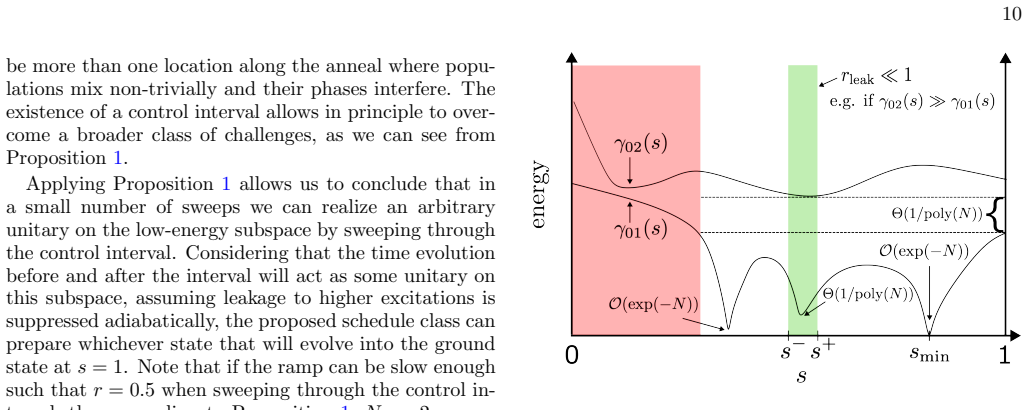
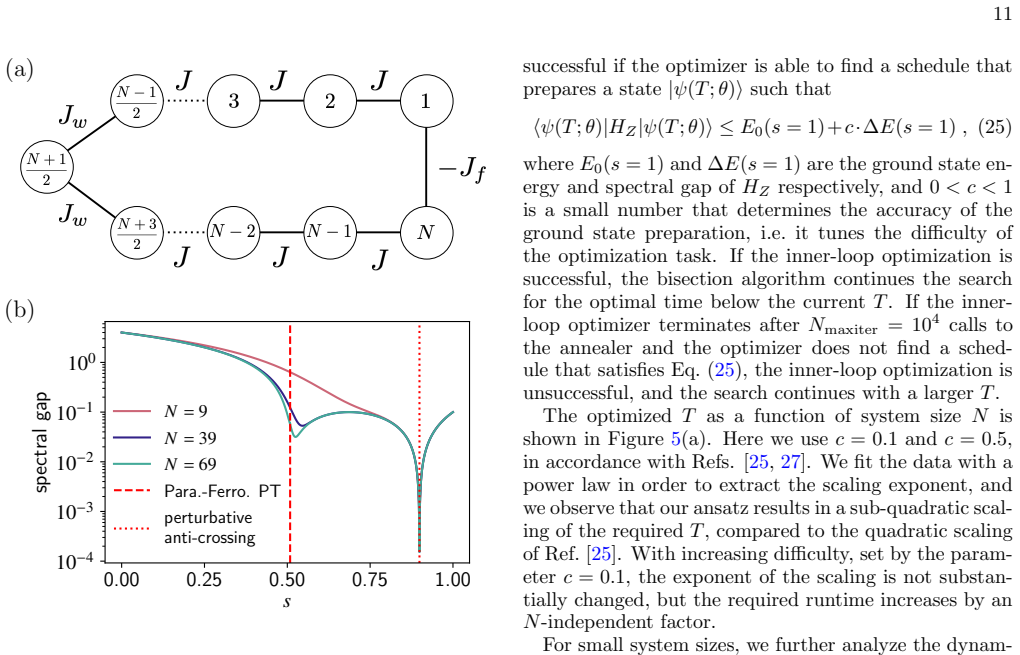
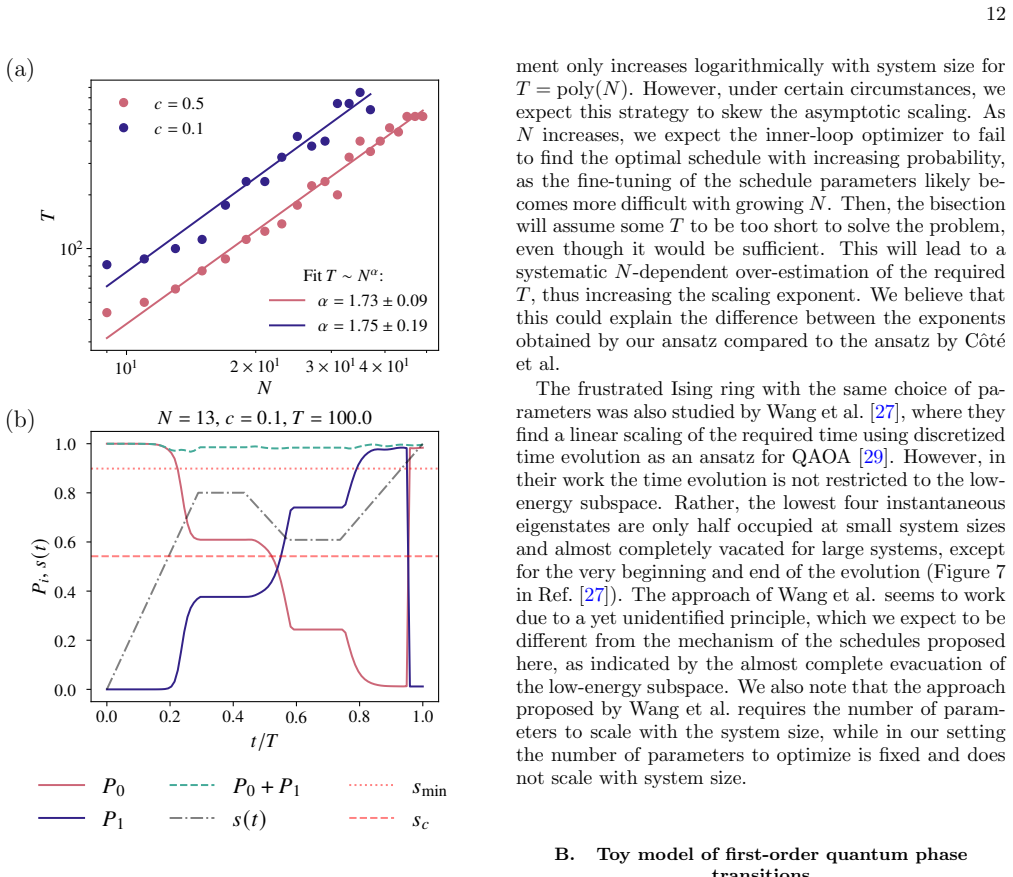
Diabatic quantum annealing with variationally optimized schedules can exhibit exponential speedups over conventional adiabatic quantum annealing, as was demonstrated numerically for a frustrated Ising ring model by C{\^o}t{\'e} et al. Here we identify Landau-Zener-St{\"u}ckelberg interference as the underlying mechanism for this speedup, and based on this insight we propose a variational schedule ansatz with far fewer parameters. This simplified ansatz allows us to show analytically that the classical optimization of the schedule parameters can be done in polynomial time and discuss conditions when we expect this type of mechanism to provide speedups over adiabatic annealing. Furthermore, we provide an analytical argument that coherence is an essential resource for this mechanism, which we verify numerically. We perform extensive numerical tests of the proposed ansatz and observe substantial improvements over adiabatic annealing and competitive performance in particularly challenging problem instances, including a well-studied MAXCUT instance commonly used for benchmarking. Our work shows that explicitly leveraging physical mechanisms can lead to more effective designs of variational annealing algorithms.
Editorial analysis
A structured set of objections, weighed in public.
Referee Report
Summary. The paper claims that Landau-Zener-Stückelberg (LZS) interference is the mechanism responsible for the exponential speedup observed numerically in diabatic quantum annealing on the frustrated Ising ring by Côté et al. Leveraging this identification, the authors introduce a simplified variational schedule ansatz with substantially fewer parameters. From this ansatz they derive an analytical result that classical optimization of the schedule parameters can be performed in polynomial time, discuss conditions under which the mechanism yields speedups over adiabatic annealing, provide an analytical argument that coherence is required, and verify the coherence dependence numerically. Extensive numerical tests on the ansatz are reported to show substantial gains over adiabatic annealing and competitive performance on challenging instances including a standard MAXCUT benchmark.
Significance. If the LZS attribution is robust and the ansatz faithfully captures the relevant interference, the work supplies an analytically tractable route to variational schedule design that explicitly exploits a physical mechanism. The polynomial-time classical optimization result and the coherence argument would constitute concrete advances for diabatic variational annealing, moving beyond purely numerical schedule optimization.
major comments (2)
- [Mechanism identification section] Mechanism identification section (immediately following the review of Côté et al. results): the attribution of the observed speedup to LZS interference is presented as a re-interpretation of prior numerics rather than a direct, independent verification (e.g., explicit comparison of the ansatz evolution against the closed-form LZS transition probability). Because the reduced ansatz and the subsequent polynomial-time claim are derived from this attribution, the lack of such a check is load-bearing for the central analytical result.
- [Analytical polynomial-time optimization paragraph] Analytical polynomial-time optimization paragraph (the derivation immediately after the ansatz is introduced): the claim that parameter optimization is polynomial-time is shown under the assumption that the ansatz fully encodes the LZS mechanism for the models considered. No separate test is supplied demonstrating that the ansatz dynamics reproduce the LZS interference pattern outside the specific frustrated-ring and MAXCUT instances, which limits the generality of the polynomial scaling.
minor comments (2)
- [Ansatz definition] Notation for the schedule parameters in the ansatz definition is introduced without an explicit table or equation cross-reference, making it difficult to track the reduction in parameter count relative to the original variational schedule.
- [Numerical coherence verification] The numerical section on coherence verification would benefit from an explicit statement of the criterion used to declare loss of coherence (e.g., a threshold on off-diagonal density-matrix elements) rather than a qualitative description.
Simulated Author's Rebuttal
We thank the referee for the careful and constructive review. The comments highlight important points regarding the strength of the mechanism identification and the scope of the analytical claims. We address each major comment below and outline the revisions we will make.
read point-by-point responses
-
Referee: [Mechanism identification section] Mechanism identification section (immediately following the review of Côté et al. results): the attribution of the observed speedup to LZS interference is presented as a re-interpretation of prior numerics rather than a direct, independent verification (e.g., explicit comparison of the ansatz evolution against the closed-form LZS transition probability). Because the reduced ansatz and the subsequent polynomial-time claim are derived from this attribution, the lack of such a check is load-bearing for the central analytical result.
Authors: We agree that an explicit side-by-side comparison of the ansatz dynamics to the closed-form LZS transition probability would make the identification more direct. The manuscript constructs the ansatz by design from the LZS probabilities and demonstrates consistency through the observed interference patterns on the studied instances, but we acknowledge this falls short of an independent verification. In the revised manuscript we will add a dedicated paragraph and accompanying figure that computes the transition probabilities under the ansatz for a driven two-level system and compares them quantitatively to the analytic LZS formula, thereby strengthening the central claim. revision: yes
-
Referee: [Analytical polynomial-time optimization paragraph] Analytical polynomial-time optimization paragraph (the derivation immediately after the ansatz is introduced): the claim that parameter optimization is polynomial-time is shown under the assumption that the ansatz fully encodes the LZS mechanism for the models considered. No separate test is supplied demonstrating that the ansatz dynamics reproduce the LZS interference pattern outside the specific frustrated-ring and MAXCUT instances, which limits the generality of the polynomial scaling.
Authors: The polynomial-time result is derived analytically once the ansatz is accepted; the derivation itself does not depend on additional numerical tests. We do not assert that the ansatz (and therefore the polynomial scaling) applies to every possible Hamiltonian, only to those for which the LZS mechanism dominates. To address the concern about demonstrated generality, we will (i) revise the text to state the scope explicitly and (ii) include one additional small-scale numerical example (a different frustrated spin chain) that verifies reproduction of the LZS interference pattern under the ansatz. This will not alter the analytic result but will illustrate its applicability beyond the original instances. revision: partial
Circularity Check
No circularity: analytical result follows from proposed ansatz without reduction to inputs
full rationale
The paper identifies LZS interference as the mechanism based on reinterpreting prior numerical results from Côté et al., proposes a reduced variational ansatz motivated by that insight, and then analytically proves that classical optimization of the ansatz parameters is polynomial-time. This analytical step is self-contained and does not reduce by construction to any fitted quantity, self-citation, or the mechanism attribution itself; the ansatz is an input assumption whose consequences are derived independently. No self-definitional loops, fitted inputs renamed as predictions, or load-bearing self-citations appear in the derivation chain.
Axiom & Free-Parameter Ledger
axioms (2)
- domain assumption The time-dependent Hamiltonian follows the standard transverse-field Ising form with a tunable schedule.
- domain assumption Coherence is preserved long enough for interference phases to accumulate.
Reference graph
Works this paper leans on
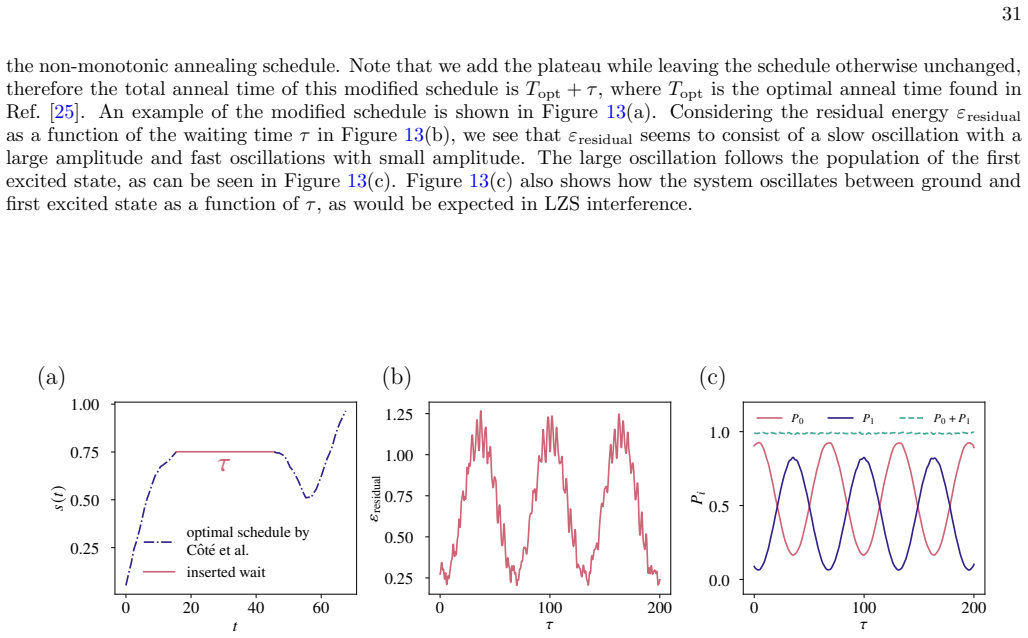
-
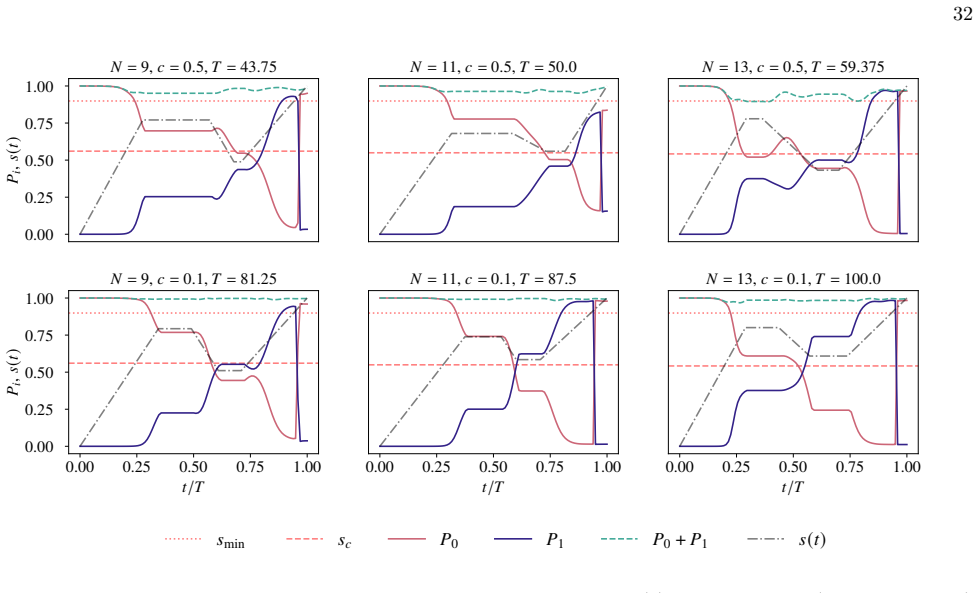
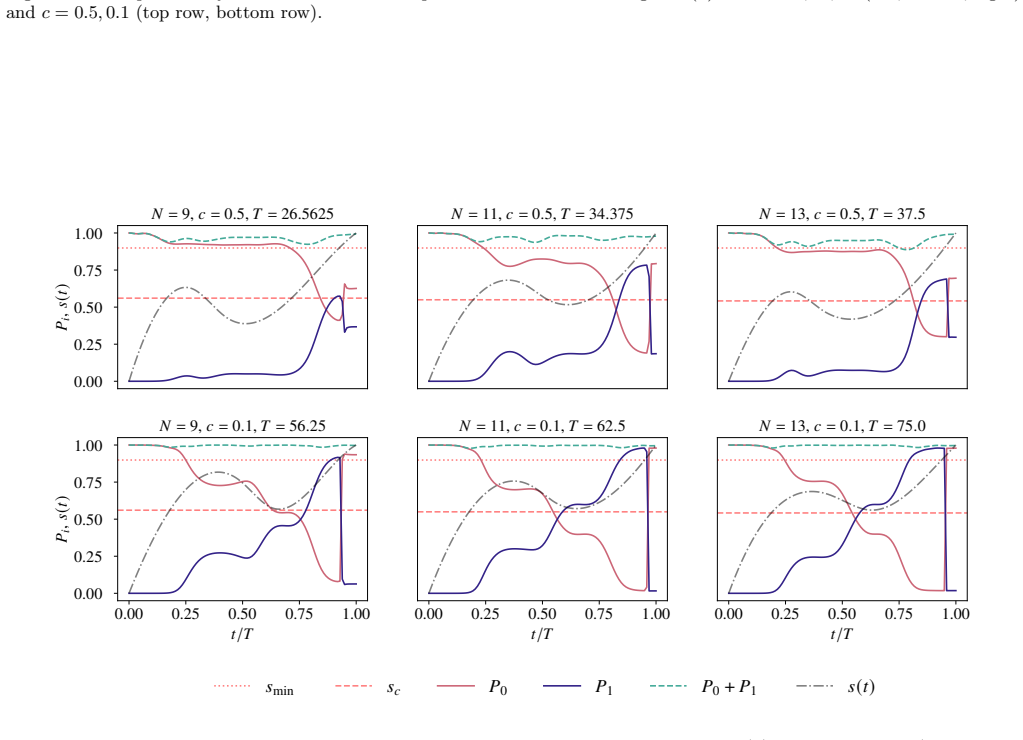
[1]
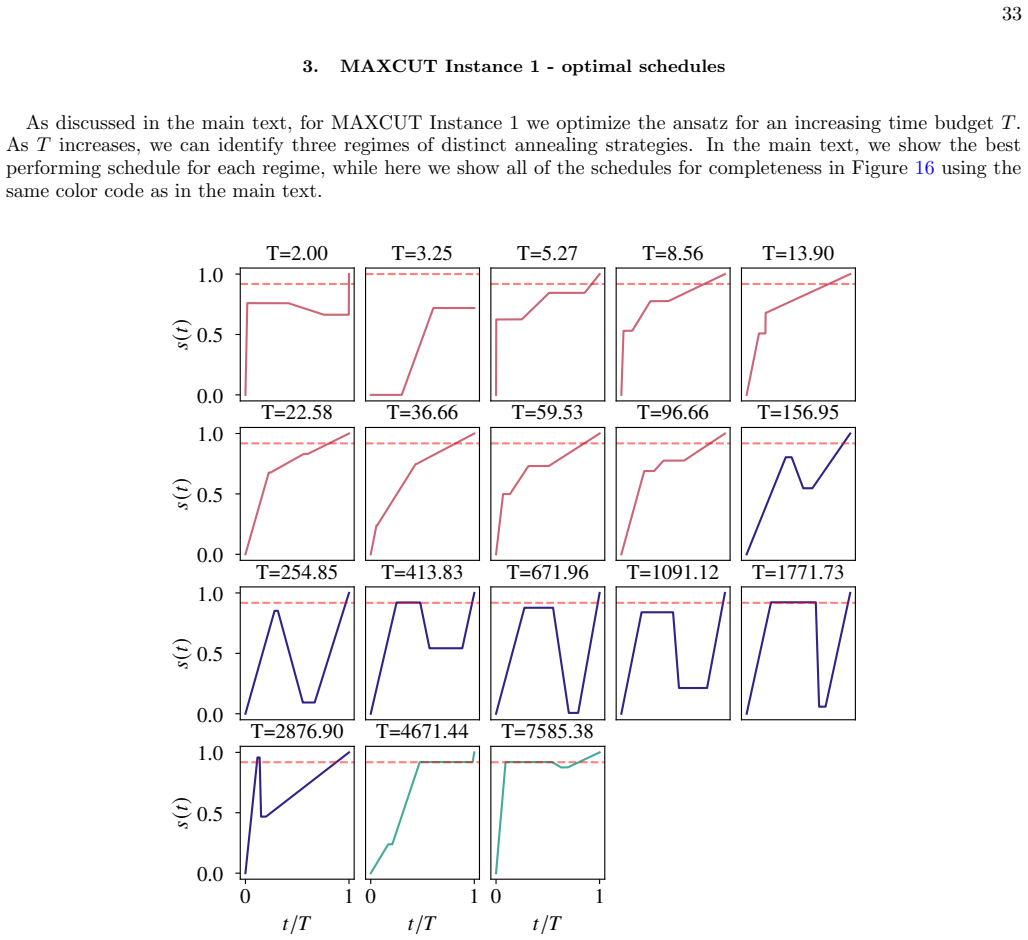
P. Ray, B. K. Chakrabarti, and A. Chakrabarti, Sherrington-kirkpatrick model in a transverse field: Ab- sence of replica symmetry breaking due to quantum fluc- tuations, Phys. Rev. B39, 11828 (1989)
1989
-
[2]
Finnila, M
A. Finnila, M. Gomez, C. Sebenik, C. Stenson, and J. Doll, Quantum annealing: A new method for minimiz- ing multidimensional functions, Chemical Physics Letters 219, 343 (1994)
1994
-
[3]
T. Kadowaki and H. Nishimori, Quantum annealing in the transverse ising model, Phys. Rev. E58, 5355 (1998), cond-mat/9804280
Pith/arXiv arXiv 1998
-
[4]
E. Farhi, J. Goldstone, S. Gutmann, J. Lapan, A. Lund- gren, and D. Preda, A quantum adiabatic evolution al- gorithm applied to random instances of an np-complete problem, Science292, 472 (2001), quant-ph/0104129
Pith/arXiv arXiv 2001
-
[5]
G. E. Santoro, R. Martoˇ n´ ak, E. Tosatti, and R. Car, The- ory of quantum annealing of an ising spin glass, Science 295, 2427 (2002), cond-mat/0205280
Pith/arXiv arXiv 2002
-
[6]
E. Farhi, J. Goldstone, S. Gutmann, and M. Sipser, Quantum Computation by Adiabatic Evolution, arXiv e-prints , quant (2000), arXiv:quant-ph/0001106 [quant- ph]
Pith/arXiv arXiv 2000
-
[7]
Born and V
M. Born and V. Fock, Beweis des adiabatensatzes, Zeitschrift f¨ ur Physik51, 165 (1928)
1928
-
[8]
Kato, On the adiabatic theorem of quantum me- chanics, Journal of the Physical Society of Japan5, 435 (1950)
T. Kato, On the adiabatic theorem of quantum me- chanics, Journal of the Physical Society of Japan5, 435 (1950)
1950
-
[9]
Jansen, M.-B
S. Jansen, M.-B. Ruskai, and R. Seiler, Bounds for the adiabatic approximation with applications to quan- tum computation, Journal of Mathematical Physics48, 102111 (2007)
2007
-
[10]
M. H. S. Amin, Consistency of the adiabatic theorem, Phys. Rev. Lett.102, 220401 (2009)
2009
-
[11]
Albash and D
T. Albash and D. A. Lidar, Adiabatic quantum compu- tation, Rev. Mod. Phys.90, 015002 (2018)
2018
-
[12]
Messiah,Quantum Mechanics, Vol
A. Messiah,Quantum Mechanics, Vol. II (North-Holland Publishing Company, Amsterdam, 1962)
1962
-
[13]
van Dam, M
W. van Dam, M. Mosca, and U. Vazirani, How powerful is adiabatic quantum computation?, inProceedings 42nd IEEE Symposium on Foundations of Computer Science (2001) pp. 279–287
2001
-
[14]
B. W. Reichardt, The quantum adiabatic optimization algorithm and local minima, inProceedings of the Thirty- Sixth Annual ACM Symposium on Theory of Computing, STOC ’04 (Association for Computing Machinery, New York, NY, USA, 2004) p. 502–510
2004
-
[15]
Farhi, D
E. Farhi, D. Gosset, I. Hen, A. W. Sandvik, P. Shor, A. P. Young, and F. Zamponi, Performance of the quan- tum adiabatic algorithm on random instances of two op- timization problems on regular hypergraphs, Phys. Rev. A86, 052334 (2012)
2012
-
[16]
Seki and H
Y. Seki and H. Nishimori, Quantum annealing with an- tiferromagnetic fluctuations, Phys. Rev. E85, 051112 (2012)
2012
-
[17]
V. Choi, Adiabatic Quantum Algorithms for the NP-Complete Maximum-Weight Independent Set, Ex- act Cover and 3SAT Problems, arXiv e-prints , arXiv:1004.2226 (2010), arXiv:1004.2226 [quant-ph]
Pith/arXiv arXiv 2010
-
[18]
N. G. Dickson and M. H. S. Amin, Does adiabatic quan- tum optimization fail for np-complete problems?, Phys. Rev. Lett.106, 050502 (2011)
2011
-
[19]
N. G. Dickson, Elimination of perturbative crossings in adiabatic quantum optimization, New Journal of Physics 13, 073011 (2011)
2011
-
[20]
Kitaev, A
A. Kitaev, A. Shen, and M. Vyalyi,Classical and Quan- tum Computation, Graduate studies in mathematics, Vol. 47 (American Mathematical Society, 2002)
2002
-
[21]
R. D. Somma, D. Nagaj, and M. Kieferov´ a, Quantum speedup by quantum annealing, Phys. Rev. Lett.109, 050501 (2012)
2012
-
[22]
E. Crosson, E. Farhi, C. Yen-Yu Lin, H.-H. Lin, and P. Shor, Different Strategies for Optimization Using the Quantum Adiabatic Algorithm, arXiv e-prints , arXiv:1401.7320 (2014), arXiv:1401.7320 [quant-ph]
Pith/arXiv arXiv 2014
-
[23]
Muthukrishnan, T
S. Muthukrishnan, T. Albash, and D. A. Lidar, Tunneling and speedup in quantum optimization for permutation- symmetric problems, Phys. Rev. X6, 031010 (2016)
2016
-
[24]
E. J. Crosson and D. A. Lidar, Prospects for quantum enhancement with diabatic quantum annealing, Nature Reviews Physics3, 466 (2021)
2021
-
[25]
Cˆ ot´ e, F
J. Cˆ ot´ e, F. Sauvage, M. Larocca, M. Jonsson, L. Cincio, and T. Albash, Diabatic quantum annealing for the frus- trated ring model, Quantum Science and Technology8, 045033 (2023)
2023
-
[26]
Roberts, L
D. Roberts, L. Cincio, A. Saxena, A. Petukhov, and S. Knysh, Noise amplification at spin-glass bottlenecks of quantum annealing: A solvable model, Phys. Rev. A 101, 042317 (2020)
2020
-
[27]
R. Wang, V. Roberto Arezzo, K. Thengil, G. Pecci, and G. E. Santoro, From exponential to quadratic: optimal control for a frustrated ising ring model, Quantum Sci- ence and Technology10, 035052 (2025)
2025
-
[28]
V. R. Arezzo, R. Wang, K. Thengil, G. Pecci, and G. E. Santoro, Digital controllability of transverse-field ising chains, Phys. Rev. A113, 012610 (2026)
2026
-
[29]
E. Farhi, J. Goldstone, and S. Gutmann, A Quantum Approximate Optimization Algorithm, arXiv e-prints , arXiv:1411.4028 (2014), arXiv:1411.4028 [quant-ph]
Pith/arXiv arXiv 2014
-
[30]
Pecci, R
G. Pecci, R. Wang, P. Torta, G. B. Mbeng, and G. San- toro, Beyond quantum annealing: optimal control solu- tions to maxcut problems, Quantum Science and Tech- nology9, 045013 (2024)
2024
-
[31]
Altshuler, H
B. Altshuler, H. Krovi, and J. Roland, Anderson local- ization makes adiabatic quantum optimization fail, Pro- ceedings of the National Academy of Sciences107, 12446 (2010). 21
2010
-
[32]
M. H. S. Amin and V. Choi, First-order quantum phase transition in adiabatic quantum computation, Phys. Rev. A80, 062326 (2009)
2009
-
[33]
Werner, A
M. Werner, A. Garc´ ıa-S´ aez, and M. P. Estarellas, Bound- ing first-order quantum phase transitions in adiabatic quantum computing, Phys. Rev. Res.5, 043236 (2023)
2023
-
[34]
L. D. Landau, Zur theorie der energie¨ ubertragung. ii, Physikalische Zeitschrift der Sowjetunion2, 46 (1932)
1932
-
[35]
Zener, Non-adiabatic crossing of energy levels, Pro- ceedings of the Royal Society of London
C. Zener, Non-adiabatic crossing of energy levels, Pro- ceedings of the Royal Society of London. Series A, Con- taining Papers of a Mathematical and Physical Character 137, 696 (1932)
1932
-
[36]
Majorana, Atomi orientati in campo magnetico vari- abile, Il Nuovo Cimento (1924-1942)9, 43 (1932)
E. Majorana, Atomi orientati in campo magnetico vari- abile, Il Nuovo Cimento (1924-1942)9, 43 (1932)
1924
-
[37]
E. C. G. Stueckelberg, Theorie der unelastischen st¨ osse zwischen atomen, Helvetica Physica Acta5, 369 (1932)
1932
-
[38]
Cerezo, A
M. Cerezo, A. Arrasmith, R. Babbush, S. C. Benjamin, S. Endo, K. Fujii, J. R. McClean, K. Mitarai, X. Yuan, L. Cincio, and P. J. Coles, Variational quantum algo- rithms, Nature Reviews Physics3, 625 (2021)
2021
-
[39]
C. M. Dawson and M. A. Nielsen, The solovay-kitaev algorithm, Quantum Info. Comput.6, 81–95 (2006)
2006
-
[40]
Roland and N
J. Roland and N. J. Cerf, Quantum search by local adi- abatic evolution, Phys. Rev. A65, 042308 (2002)
2002
-
[41]
Teranishi and H
Y. Teranishi and H. Nakamura, Control of time- dependent nonadiabatic processes by an external field, Phys. Rev. Lett.81, 2032 (1998)
2032
-
[42]
Teranishi and H
Y. Teranishi and H. Nakamura, New way of controlling molecular processes by time-dependent external fields, The Journal of Chemical Physics111, 1415 (1999)
1999
-
[43]
Hsiao, Y.-H
I.-Y. Hsiao, Y.-H. Lin, and Y. Teranishi, Efficient control of fluxonium qubits via nonadiabatic transitions, Phys. Rev. Res.7, 033183 (2025)
2025
-
[44]
Callison, M
A. Callison, M. Festenstein, J. Chen, L. Nita, V. Kendon, and N. Chancellor, Energetic perspective on rapid quenches in quantum annealing, PRX Quantum2, 010338 (2021)
2021
-
[45]
Larson and S
J. Larson and S. M. Wild, Asynchronously parallel opti- mization solver for finding multiple minima, Mathemat- ical Programming Computation10, 303 (2018)
2018
-
[46]
M. J. D. Powell, A direct search optimization method that models the objective and constraint functions by lin- ear interpolation, inAdvances in Optimization and Nu- merical Analysis, edited by S. Gomez and J.-P. Hennart (Springer Netherlands, Dordrecht, 1994) pp. 51–67
1994
-
[47]
Lambert, E
N. Lambert, E. Gigu‘ere, P. Menczel, B. Li, P. Hopf, G. Su’arez, M. Gali, J. Lishman, R. Gadhvi, R. Agarwal, A. Galicia, N. Shammah, P. Nation, J. R. Johansson, S. Ahmed, S. Cross, A. Pitchford, and F. Nori, Qutip 5: The quantum toolbox in Python, Physics Reports1153, 1 (2026)
2026
-
[48]
Zhou, S.-T
L. Zhou, S.-T. Wang, S. Choi, H. Pichler, and M. D. Lukin, Quantum approximate optimization algorithm: Performance, mechanism, and implementation on near- term devices, Phys. Rev. X10, 021067 (2020)
2020
-
[49]
Albash and D
T. Albash and D. A. Lidar, Decoherence in adiabatic quantum computation, Phys. Rev. A91, 062320 (2015)
2015
-
[50]
Cerezo, M
M. Cerezo, M. Larocca, D. Garc´ ıa-Mart´ ın, N. L. Diaz, P. Braccia, E. Fontana, M. S. Rudolph, P. Bermejo, A. Ijaz, S. Thanasilp, E. R. Anschuetz, and Z. Holmes, Does provable absence of barren plateaus imply classical simulability?, Nature Communications16, 7907 (2025)
2025
-
[51]
T. F. Rønnow, Z. Wang, J. Job, S. Boixo, S. V. Isakov, D. Wecker, J. M. Martinis, D. A. Lidar, and M. Troyer, Defining and detecting quantum speedup, Science345, 420 (2014). Appendix A: Proof of Proposition 1 - Universality of LZS-gates Consider two 2-level HamiltoniansH i=1,2 and the time-dependent interpolation H(t, T) = 1− t T H1 + t T H2 ,(A1) fort= [...
2014
-
[52]
we requirefto have a global minimum in the parameter domainD ⊆R d
Global optimization of a differentiable function with affinely bounded gradient Letf:D →Rbe a bounded differentiable function with x∗ = arg min x∈D f(x)<∞,(B3) i.e. we requirefto have a global minimum in the parameter domainD ⊆R d. It simplifies the proof to assume D=R d + be the strictly positive orthant ofR d. Additionally, we require that the gradient ...
-
[53]
The loss landscape of the LZS-ansatz: affine gradient bound Assuming that there are parametersθ ∗ of the LZS-ansatz (Eq. (B2)) that give rise to a state that closely approxi- mates the ground state ofH Z inT= poly(N), we need to show that the optimal parametersθ ∗ are polynomially far away from the origin and that the constantsK 1 andK 2 from the affine b...
-
[54]
Denote the computational basis by|0⟩,|1⟩and the instantaneous energy eigenbasis by|E 0(t)⟩,|E 1(t)⟩
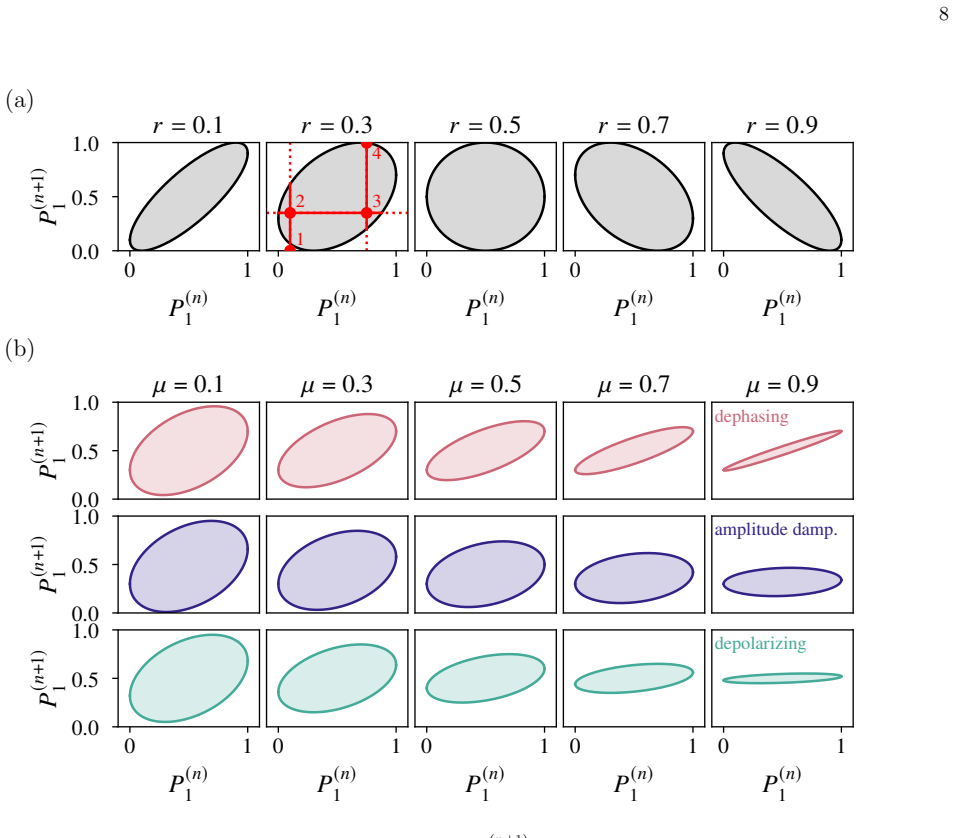
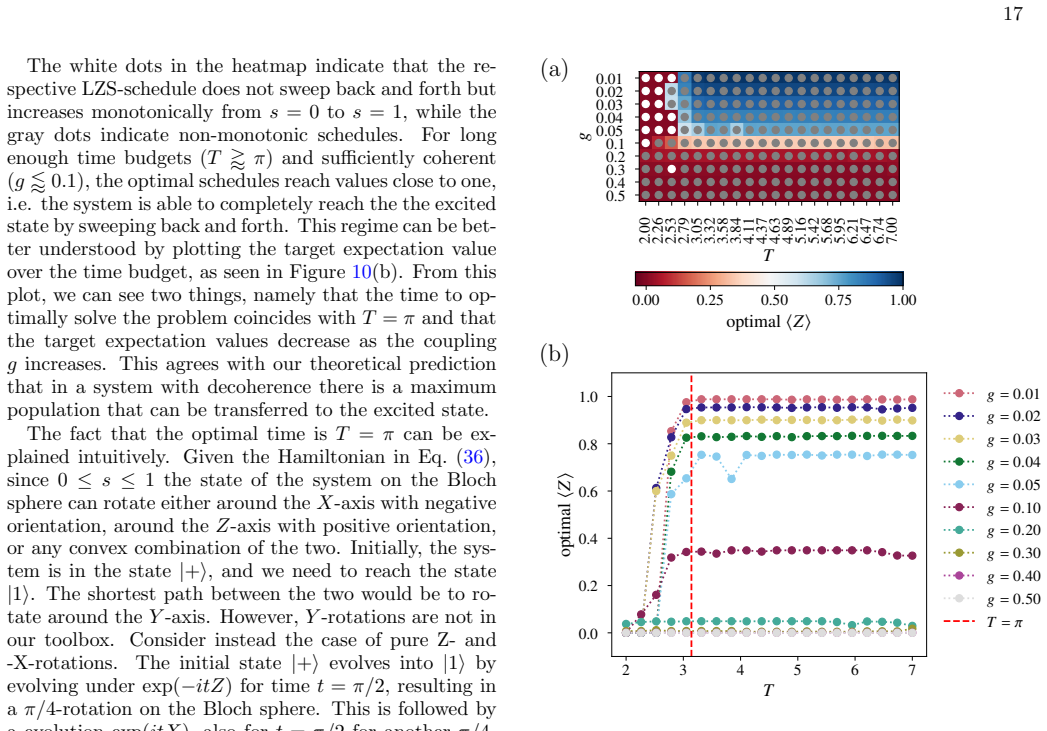
Noise models We assume a two level system for all the noise models we consider. Denote the computational basis by|0⟩,|1⟩and the instantaneous energy eigenbasis by|E 0(t)⟩,|E 1(t)⟩. Some of these cases were explicitly studied in Ref. [49] in the context of slow annealing. When comparing between the different models, one has to be a little careful how to do...
-
[55]
[25] In this section we briefly demonstrate LZS interference in the results by Cˆ ot´ e et al
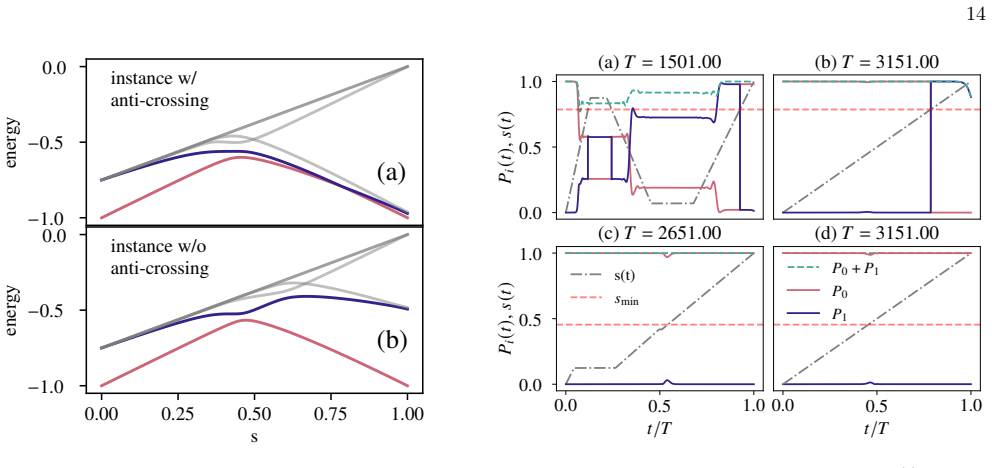
Landau-Zener-St¨ uckelberg interference on the frustrated Ising ring in Ref. [25] In this section we briefly demonstrate LZS interference in the results by Cˆ ot´ e et al. To this end, we take the optimized schedule for the frustrated Ising ring atN= 9 from Ref. [25] and insert a waiting timeτat the first peak of 31 the non-monotonic annealing schedule. N...
-
[56]
As discussed in the main text in Sections III A and III E, the dynamics is qualitatively the same in all cases, except the required timeTis shorter for cubic interpolation
Eigenstate populations for the frustrated Ising ring Here we show the results for the simulation of the full state vector of the optimal annealing schedules for the frustrated Ising ring forN= 9,11,13 andc= 0.5,0.1 for linear (Figure 14) and cubic (Figure 15) interpolation. As discussed in the main text in Sections III A and III E, the dynamics is qualita...
-
[57]
AsTincreases, we can identify three regimes of distinct annealing strategies
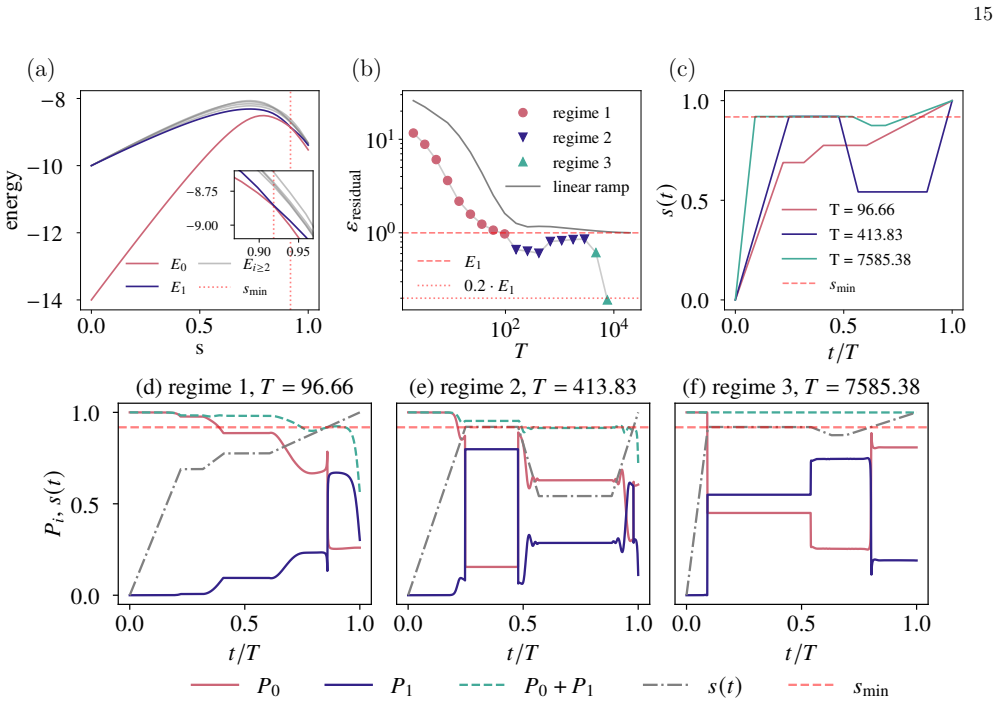
MAXCUT Instance 1 - optimal schedules As discussed in the main text, for MAXCUT Instance 1 we optimize the ansatz for an increasing time budgetT. AsTincreases, we can identify three regimes of distinct annealing strategies. In the main text, we show the best performing schedule for each regime, while here we show all of the schedules for completeness in F...
-
[58]
The instances are constructed by generating random 3-regular graphs withN= 10 nodes and sampling the weights of each edge i.i.d
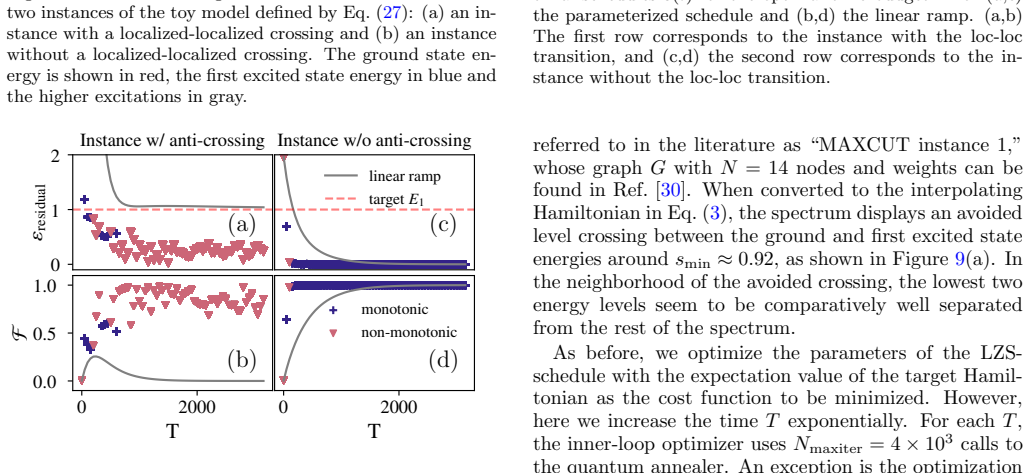
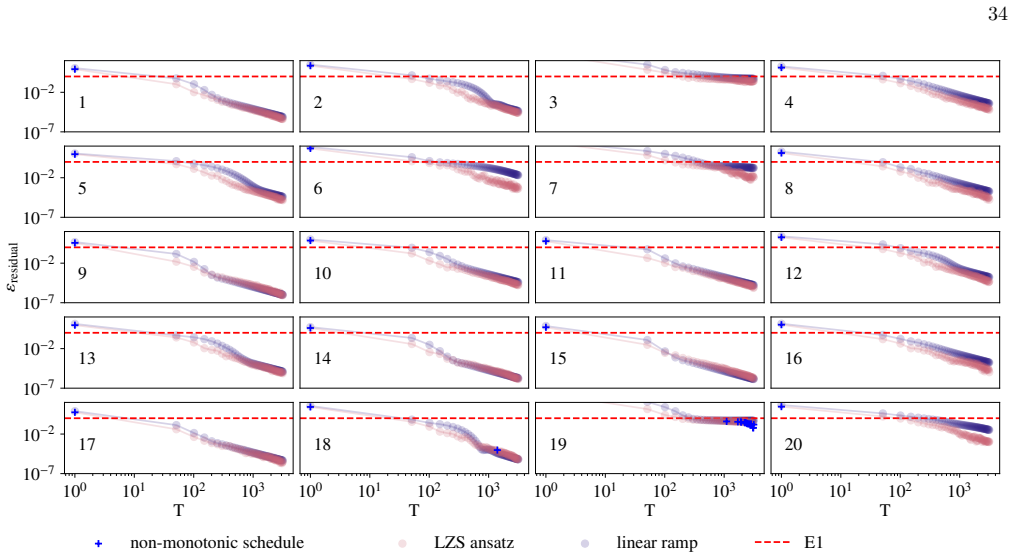
Random MAXCUT instances While we can observe a qualitative improvement of the residual energy on a particular MAXCUT instance with a perturbative anti-crossing, we investigate the generality of the result by applying our ansatz to 20 randomly generated instances of MAXCUT. The instances are constructed by generating random 3-regular graphs withN= 10 nodes...
discussion (0)
Sign in with ORCID, Apple, or X to comment. Anyone can read and Pith papers without signing in.