Dark Z' at a Muon Collider: Radiative Return versus Vector Boson Fusion
Pith reviewed 2026-06-27 21:28 UTC · model grok-4.3
The pith
Relative rates of radiative return and vector boson fusion at a muon collider determine dark Z' mixing parameters with polarized-beam precision.
A machine-rendered reading of the paper's core claim, the machinery that carries it, and where it could break.
Core claim
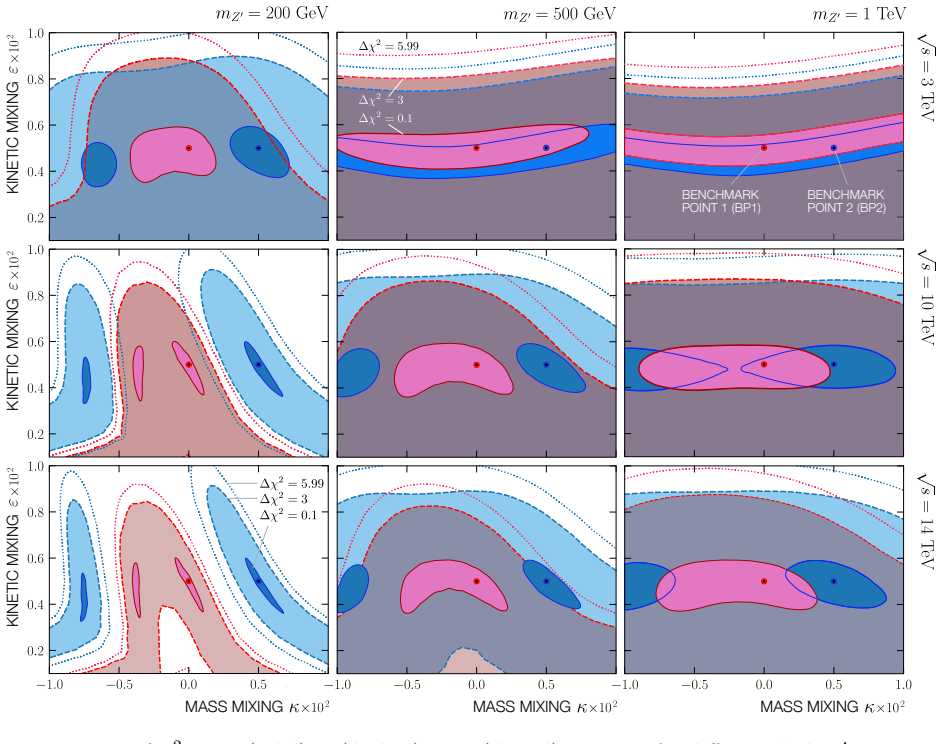
A dark Z' with mass from 100 GeV up to the collider energy can be discovered at a muon collider through radiative return and vector boson fusion. The relative rates of these processes determine the relative mixing parameters to an accuracy comparable to that obtained from a left-right asymmetry with a fully polarized muon beam, even accounting for contributions from soft and collinear photons in the same final state.
What carries the argument
The ratio of the radiative return cross section to the vector boson fusion cross section, which isolates the relative contributions of kinetic mixing versus mass mixing.
If this is right
- The discovery reach extends to the full collider energy for the examined benchmarks up to 14 TeV.
- Sensitivity can be compared directly to current and proposed future colliders.
- The rate ratio provides an alternative to beam polarization for extracting the mixing parameters.
- Contributions from soft and collinear photons do not prevent the ratio from yielding information on the mixings.
Where Pith is reading between the lines
- Muon colliders could characterize hidden gauge bosons without requiring advanced beam polarization.
- Rate-ratio methods might be adapted for other colliders or different hidden-sector particles.
- If photon tagging acceptance turns out harder to control than modeled, the achievable precision on mixing would be reduced.
Load-bearing premise
The calculation assumes that radiative return and vector boson fusion are the only relevant production mechanisms and that a photon tag can be applied without irreducible backgrounds washing out the rate ratio.
What would settle it
A measured rate ratio that deviates from the predicted dependence on the kinetic and mass mixing parameters, or the appearance of other production channels that alter the observed ratio.
Figures








read the original abstract
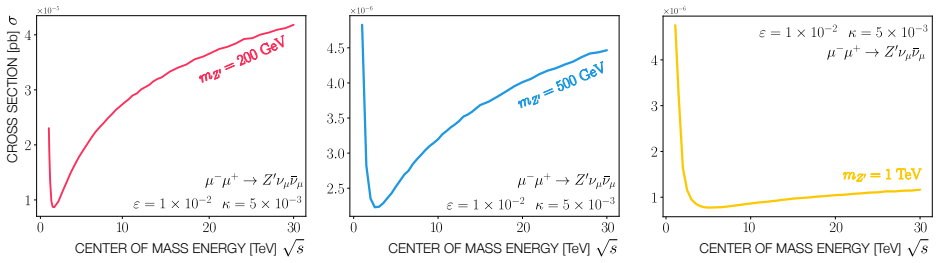
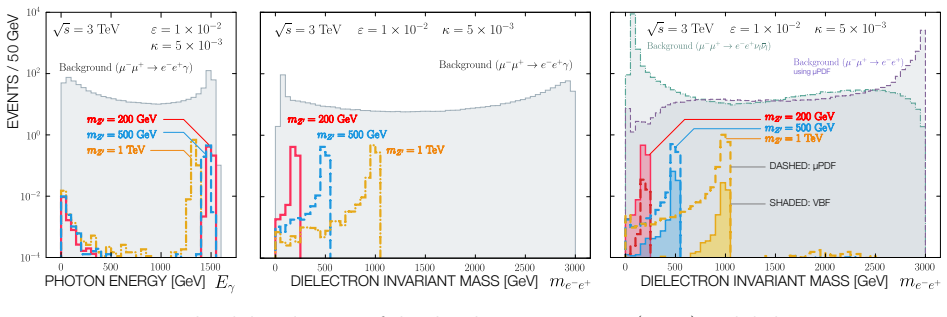
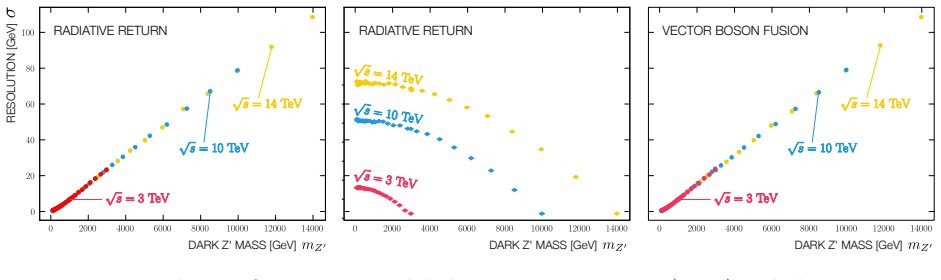
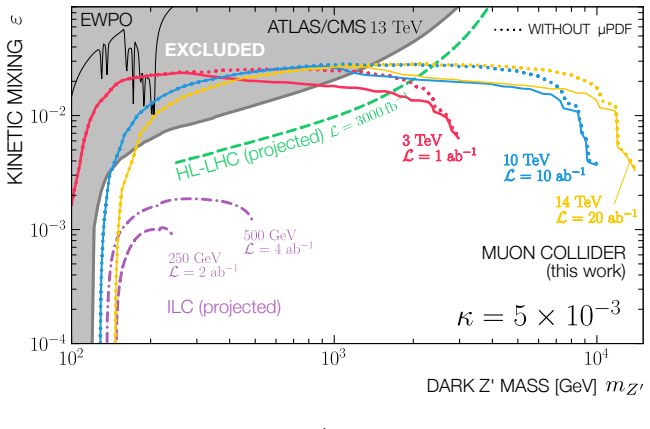
A secluded, massive Abelian gauge boson called a dark Z' may interact with the Standard Model through kinetic mixing and mass mixing in the Higgs sector. We determine the sensitivity of a future high-energy muon collider to discover such a particle and determine its mixing parameters. We examine a dark Z' with mass from 100 GeV up to the collider energy for a set of collider benchmarks up to 14 TeV. We show the discovery reach and compare to the current and proposed future colliders. A muon collider is sensitive to two complementary production modes: radiative return (muon fusion with an associated photon), and vector boson fusion of W bosons. An observable photon distinguishes these production modes and the relative rates of these processes allows one to determine the relative mixing. Soft and collinear photons in the radiative return diagram contribute to the same final state as vector boson fusion. We show that these relative rates alone can determine the mixing to an accuracy comparable to that of a fully polarized muon beam using a left-right asymmetry.
Editorial analysis
A structured set of objections, weighed in public.
Referee Report
Summary. The manuscript examines a secluded dark Z' boson interacting with the SM via kinetic and mass mixing. It computes the discovery reach at a future muon collider (benchmarks up to 14 TeV) for masses 100 GeV to the collider energy, focusing on two production channels—radiative return (muon fusion + photon) and vector-boson fusion of W bosons—that yield the same visible final state. The central claim is that the ratio of these rates, distinguished by an observable photon tag, determines the relative mixing parameters to an accuracy comparable to a left-right asymmetry measurement with a fully polarized muon beam.
Significance. If the rate-ratio method can be shown to survive realistic detector effects, the result would supply a polarization-independent handle on the two mixing angles, which is valuable for muon-collider phenomenology where beam polarization is technically demanding. The comparative sensitivity plots versus other proposed colliders are also useful for planning.
major comments (2)
- [Abstract] Abstract and the paragraph following Eq. (the rate-ratio expression): the assertion that the relative rates alone determine the mixing parameters to an accuracy comparable to polarized-beam left-right asymmetry is load-bearing for the paper’s main result, yet no numerical study of photon-tagging efficiency, angular/energy resolution migration, or irreducible soft/collinear-photon background is presented. Without these, the claimed discriminating power cannot be verified.
- [Production mechanisms] The section discussing the two production mechanisms: the text states that soft and collinear photons from radiative return populate the same final state as VBF, but provides no cut-flow table, efficiency curves, or purity estimate after a photon-tag requirement. This omission directly affects whether the extracted ratio retains the advertised sensitivity.
minor comments (2)
- [Results] The collider-energy benchmarks (3, 10, 14 TeV) and the mass range are clearly stated, but the luminosity assumptions used for the reach plots should be tabulated explicitly for reproducibility.
- [Introduction] Notation for the kinetic-mixing parameter and the mass-mixing angle is introduced without a dedicated equation; a single defining equation would improve clarity.
Simulated Author's Rebuttal
We thank the referee for the thoughtful and detailed report. The comments correctly identify that our parton-level analysis leaves open questions about experimental realism. We address each point below and will revise the manuscript to clarify the scope of our results while preserving the core theoretical observation.
read point-by-point responses
-
Referee: [Abstract] Abstract and the paragraph following Eq. (the rate-ratio expression): the assertion that the relative rates alone determine the mixing parameters to an accuracy comparable to polarized-beam left-right asymmetry is load-bearing for the paper’s main result, yet no numerical study of photon-tagging efficiency, angular/energy resolution migration, or irreducible soft/collinear-photon background is presented. Without these, the claimed discriminating power cannot be verified.
Authors: We agree that the absence of a detector-level study limits the strength of the claim as written. Our calculation demonstrates that, at the parton level, the ratio of the two channels is sensitive to the relative size of kinetic and mass mixing. We will revise the abstract and the paragraph after the rate-ratio equation to state explicitly that this is a parton-level result and that a full simulation including tagging efficiency, resolution smearing, and background rejection is required to confirm the quoted accuracy. We will also add a short paragraph noting that standard photon isolation and pT thresholds used in similar muon-collider studies typically retain >70% efficiency for the signal photon while suppressing soft/collinear radiation, but we will not claim this has been verified in our analysis. revision: partial
-
Referee: [Production mechanisms] The section discussing the two production mechanisms: the text states that soft and collinear photons from radiative return populate the same final state as VBF, but provides no cut-flow table, efficiency curves, or purity estimate after a photon-tag requirement. This omission directly affects whether the extracted ratio retains the advertised sensitivity.
Authors: We accept this criticism. The manuscript currently presents only the parton-level cross sections without applying explicit selection cuts or reporting efficiencies. In the revised version we will add a cut-flow table for both channels that includes a minimum photon pT requirement, isolation criterion, and basic acceptance cuts. We will also provide a brief estimate of the purity after the photon tag, based on the kinematic separation between the hard photon in radiative return and the softer radiation in VBF. These additions will be presented as illustrative rather than exhaustive, and we will note that a dedicated experimental study is needed for a definitive assessment. revision: yes
Circularity Check
No circularity: rate-ratio extraction follows from explicit cross-section calculations
full rationale
The central claim rests on computing the radiative-return and VBF cross sections for a dark Z' with kinetic and mass mixing, then showing that their ratio distinguishes the two mixing parameters at a level comparable to a left-right asymmetry. No equation defines one mixing parameter in terms of the other or renames a fitted quantity as a prediction; the photon-tag separation is an input assumption whose validity is external to the derivation itself. No self-citation is invoked as a uniqueness theorem or load-bearing premise. The result is therefore self-contained against collider kinematics and does not reduce to its inputs by construction.
Axiom & Free-Parameter Ledger
axioms (2)
- standard math Standard Model gauge interactions and particle content govern the vector boson fusion and radiative return processes
- domain assumption Kinetic mixing and Higgs-sector mass mixing are the only portals between the dark Z' and the Standard Model
invented entities (1)
-
dark Z'
no independent evidence
Reference graph
Works this paper leans on
-
[1]
Dark Z at the International Linear Collider,
Y. C. San, M. Perelstein, and P. Tanedo, “Dark Z at the International Linear Collider,”Phys. Rev. D106no. 1, (2022) 015027, arXiv:2205.10304 [hep-ph]
arXiv 2022
-
[2]
On the Possibility of Experimental Observation of Mirror Particles,
I. Kobzarev, L. Okun, and I. Pomeranchuk, “On the Possibility of Experimental Observation of Mirror Particles,”Sov. J. Nucl. Phys.3no. 6, (1966) 837–841
1966
-
[3]
Limits of Electrodynamics: Paraphotons?,
L. Okun, “Limits of Electrodynamics: Paraphotons?,”Sov. Phys. JETP56(1982) 502
1982
-
[4]
Two U(1)’s and Epsilon Charge Shifts,
B. Holdom, “Two U(1)’s and Epsilon Charge Shifts,”Phys. Lett. B166(1986) 196–198
1986
-
[5]
Searching forϵCharges and a New U(1),
B. Holdom, “Searching forϵCharges and a New U(1),”Phys. Lett. B178(1986) 65–70
1986
-
[6]
M. Fabbrichesi, E. Gabrielli, and G. Lanfranchi, “The Dark Photon,”arXiv:2005.01515 [hep-ph]
Pith/arXiv arXiv 2005
-
[7]
Comment on Z Z-prime mixing in extended gauge theories,
R. Foot and X.-G. He, “Comment on Z Z-prime mixing in extended gauge theories,” Phys. Lett. B267(1991) 509–512
1991
-
[8]
’Dark’ Z implications for Parity Violation, Rare Meson Decays, and Higgs Physics,
H. Davoudiasl, H.-S. Lee, and W. J. Marciano, “’Dark’ Z implications for Parity Violation, Rare Meson Decays, and Higgs Physics,”Phys. Rev. D85(2012) 115019,arXiv:1203.2947 [hep-ph]. 30
Pith/arXiv arXiv 2012
-
[9]
Higgs Decays as a Window into the Dark Sector,
H. Davoudiasl, H.-S. Lee, I. Lewis, and W. J. Marciano, “Higgs Decays as a Window into the Dark Sector,”Phys. Rev. D88no. 1, (2013) 015022,arXiv:1304.4935 [hep-ph]
Pith/arXiv arXiv 2013
-
[10]
Higgs boson decays to four fermions through an abelian hidden sector,
S. Gopalakrishna, S. Jung, and J. D. Wells, “Higgs boson decays to four fermions through an abelian hidden sector,”Phys. Rev. D78 (2008) 055002,arXiv:0801.3456 [hep-ph]
Pith/arXiv arXiv 2008
-
[11]
Electroweak precision constraints on dark photon models with generalized mixing,
E. Bertuzzo, C. Csaki, and F. Huller, “Electroweak precision constraints on dark photon models with generalized mixing,”JHEP 03(2026) 155,arXiv:2507.16888 [hep-ph]
arXiv 2026
-
[12]
Illuminating Dark Photons with High-Energy Colliders,
D. Curtin, R. Essig, S. Gori, and J. Shelton, “Illuminating Dark Photons with High-Energy Colliders,”JHEP02(2015) 157, arXiv:1412.0018 [hep-ph]
Pith/arXiv arXiv 2015
-
[13]
Discovering an invisible Z’ at the muon collider,
A. K. Barik, S. K. Rai, and A. Srivastava, “Discovering an invisible Z’ at the muon collider,”Phys. Lett. B866(2025) 139533, arXiv:2408.14396 [hep-ph]
arXiv 2025
-
[14]
Vector portals at future lepton colliders,
S. Airen, E. Broadberry, G. Marques-Tavares, and L. Ricci, “Vector portals at future lepton colliders,”JHEP08(2025) 029, arXiv:2412.09681 [hep-ph]
arXiv 2025
-
[15]
On the Run from the Dark Side of the Muon,
P. Asadi, A. Batz, S. Homiller, and T.-T. Yu, “On the Run from the Dark Side of the Muon,” arXiv:2602.16771 [hep-ph]
-
[16]
Illuminating long-lived dark vector bosons via exotic Higgs decays at√s= 13TeV,
T. Elkafrawy, M. Hohlmann, T. Kamon, P. Padley, H. Kim, M. Rahmani, and S. Dildick, “Illuminating long-lived dark vector bosons via exotic Higgs decays at√s= 13TeV,”PoSLHCP2021(2021) 224, arXiv:2111.03960 [hep-ph]
arXiv 2021
-
[17]
Dark showers from Z-dark Z’ mixing,
H.-C. Cheng, X.-H. Jiang, L. Li, and E. Salvioni, “Dark showers from Z-dark Z’ mixing,”JHEP04(2024) 081, arXiv:2401.08785 [hep-ph]
arXiv 2024
-
[18]
Dark photon effects with the kinetic and mass mixing in Z-boson decay processes,
J. Sun and Z.-P. Xing, “Dark photon effects with the kinetic and mass mixing in Z-boson decay processes,”Phys. Rev. D109no. 3, (2024) 035017,arXiv:2310.06526 [hep-ph]
arXiv 2024
-
[19]
Radiative return capabilities of a high-energy, high-luminositye+e−collider,
M. Karliner, M. Low, J. L. Rosner, and L.-T. Wang, “Radiative return capabilities of a high-energy, high-luminositye+e−collider,” Phys. Rev. D92no. 3, (2015) 035010, arXiv:1503.07209 [hep-ph]
Pith/arXiv arXiv 2015
-
[20]
Search for a heavy dark photon at futuree+e− colliders,
M. He, X.-G. He, C.-K. Huang, and G. Li, “Search for a heavy dark photon at futuree+e− colliders,”JHEP03(2018) 139, arXiv:1712.09095 [hep-ph]
arXiv 2018
-
[21]
Vector boson fusion at multi-TeV muon colliders,
A. Costantini, F. De Lillo, F. Maltoni, L. Mantani, O. Mattelaer, R. Ruiz, and X. Zhao, “Vector boson fusion at multi-TeV muon colliders,”JHEP09(2020) 080, arXiv:2005.10289 [hep-ph]
arXiv 2020
-
[22]
H. Al Aliet al., “The muon Smasher’s guide,” Rept. Prog. Phys.85no. 8, (2022) 084201, arXiv:2103.14043 [hep-ph]
arXiv 2022
-
[23]
Higgs and BSM Physics at the Future Muon Collider,
R. Franceschini and M. Greco, “Higgs and BSM Physics at the Future Muon Collider,” Symmetry13no. 5, (2021) 851, arXiv:2104.05770 [hep-ph]. [24]Muon ColliderCollaboration, M. Casarsa, “Prospects of a future multi-TeV muon collider,” SciPost Phys. Proc.8(2022) 061
arXiv 2021
-
[24]
K. M. Blacket al., “Muon Collider Forum report,”JINST19no. 02, (2024) T02015, arXiv:2209.01318 [hep-ex]
arXiv 2024
-
[25]
On the feasibility of future colliders: report of the Snowmass’21 Implementation Task Force,
T. Roseret al., “On the feasibility of future colliders: report of the Snowmass’21 Implementation Task Force,”JINST18no. 05, (2023) P05018,arXiv:2208.06030 [physics.acc-ph]. [27]Muon ColliderCollaboration, J. de Blas et al., “The physics case of a 3 TeV muon collider stage,”arXiv:2203.07261 [hep-ph]
arXiv 2023
-
[26]
C. Accetturaet al., “Towards a muon collider,” Eur. Phys. J. C83no. 9, (2023) 864, arXiv:2303.08533 [physics.acc-ph]. [Erratum: Eur.Phys.J.C 84, 36 (2024)]
arXiv 2023
-
[27]
Interim report for the International Muon Collider Collaboration (IMCC),
International Muon ColliderCollaboration, C. Accetturaet al., “Interim report for the International Muon Collider Collaboration (IMCC),”CERN Yellow Rep. Monogr.2/2024 (2024) 176,arXiv:2407.12450 [physics.acc-ph]
arXiv 2024
-
[28]
Probing Z/W pole physics at high-energy muon colliders via vector-boson-fusion processes*,
H.-Q. Li, H.-N. Yan, J. Gu, and X.-Z. Tan, “Probing Z/W pole physics at high-energy muon colliders via vector-boson-fusion processes*,”Chin. Phys.49no. 10, (2025) 103102,arXiv:2503.19073 [hep-ph]
arXiv 2025
-
[29]
Electroweak couplings of the Higgs boson at a multi-TeV muon collider,
T. Han, D. Liu, I. Low, and X. Wang, “Electroweak couplings of the Higgs boson at a multi-TeV muon collider,”Phys. Rev. D103 no. 1, (2021) 013002,arXiv:2008.12204 [hep-ph]
arXiv 2021
-
[30]
Multi Higgs production via photon fusion at future multi-TeV muon colliders,
M. Chiesa, B. Mele, and F. Piccinini, “Multi Higgs production via photon fusion at future multi-TeV muon colliders,”Eur. Phys. J. C84 31 no. 5, (2024) 543,arXiv:2109.10109 [hep-ph]
arXiv 2024
-
[31]
Capabilities of e+e−Collisions for Producing Very Heavy Higgs Bosons,
S. Dawson and J. L. Rosner, “Capabilities of e+e−Collisions for Producing Very Heavy Higgs Bosons,”Phys. Lett. B148(1984) 497–501
1984
-
[32]
Heavy Higgs Production ine+e− and e−e−Collisions,
K.-i. Hikasa, “Heavy Higgs Production ine+e− and e−e−Collisions,”Phys. Lett. B164(1985)
1985
-
[33]
[Erratum: Phys.Lett.B 195, 623 (1987)]
1987
-
[34]
Heavy Higgs Production at Future Colliders,
G. Altarelli, B. Mele, and F. Pitolli, “Heavy Higgs Production at Future Colliders,”Nucl. Phys. B287(1987) 205–224
1987
-
[35]
Higgsstrahlung and W W fusion in e+ e- collisions,
W. Kilian, M. Kramer, and P. M. Zerwas, “Higgsstrahlung and W W fusion in e+ e- collisions,”Phys. Lett. B373(1996) 135–140, arXiv:hep-ph/9512355
Pith/arXiv arXiv 1996
-
[36]
Measuring the coupling of a Higgs boson to Z Z at linear colliders,
J. F. Gunion, T. Han, and R. Sobey, “Measuring the coupling of a Higgs boson to Z Z at linear colliders,”Phys. Lett. B429(1998) 79–86,arXiv:hep-ph/9801317
Pith/arXiv arXiv 1998
-
[37]
Electroweak ALP searches at a muon collider,
Y. Bao, J. Fan, and L. Li, “Electroweak ALP searches at a muon collider,”JHEP08(2022) 276,arXiv:2203.04328 [hep-ph]
arXiv 2022
-
[38]
Probing the Inert Doublet Model via vector-boson fusion at a muon collider,
J. Braathen, M. Gabelmann, T. Robens, and P. Stylianou, “Probing the Inert Doublet Model via vector-boson fusion at a muon collider,” JHEP05(2025) 055,arXiv:2411.13729 [hep-ph]
arXiv 2025
-
[39]
P. Bandyopadhyay and S. Parashar, “Probing a scalar singlet-triplet extension of the standard model via vector boson fusion at a muon collider,”Phys. Rev. D110no. 11, (2024) 115032,arXiv:2410.06298 [hep-ph]
arXiv 2024
-
[40]
P. Bandyopadhyay, S. Parashar, C. Sen, and J. Song, “Probing Inert Triplet Model at a multi-TeV muon collider via vector boson fusion with forward muon tagging,”JHEP07 (2024) 253,arXiv:2401.02697 [hep-ph]
arXiv 2024
-
[41]
Vector boson fusion signatures of superheavy Majorana neutrinos at muon colliders,
P. Dehghani, M. Frank, and B. Fuks, “Vector boson fusion signatures of superheavy Majorana neutrinos at muon colliders,”Phys. Rev. D112no. 3, (2025) 035020, arXiv:2506.06159 [hep-ph]
arXiv 2025
-
[42]
Probing CP Violation through Vector Boson Fusion at High-Energy Muon Colliders,
Q.-H. Cao, J.-N. Ding, Y. Liu, and J.-L. Yuan, “Probing CP Violation through Vector Boson Fusion at High-Energy Muon Colliders,” arXiv:2510.23257 [hep-ph]
-
[43]
Searching for heavy neutral leptons at a future muon collider,
T. H. Kwok, L. Li, T. Liu, and A. Rock, “Searching for heavy neutral leptons at a future muon collider,”Phys. Rev. D110no. 7, (2024) 075009,arXiv:2301.05177 [hep-ph]
arXiv 2024
-
[44]
Heavy Vector Triplets at a Muon Collider,
F. Acanfora, M. J. Baker, T. Martonhelyi, and A. Thamm, “Heavy Vector Triplets at a Muon Collider,”arXiv:2605.13957 [hep-ph]
-
[45]
The Phenomenology of extra neutral gauge bosons,
A. Leike, “The Phenomenology of extra neutral gauge bosons,”Phys. Rept.317(1999) 143–250,arXiv:hep-ph/9805494
Pith/arXiv arXiv 1999
-
[46]
K. Cheung, J. Kim, S. Lee, P. Sanyal, and J. Song, “Probing a heavy dark Z boson at multi-TeV muon colliders: Leveraging the optimized recoil mass technique,”Phys. Rev. D 112no. 9, (2025) 095010,arXiv:2501.02224 [hep-ph]
arXiv 2025
-
[47]
Z’ boson mass reach and model discrimination at muon colliders,
K. Korshynska, M. Löschner, M. Marinichenko, K. Mękała, and J. Reuter, “Z’ boson mass reach and model discrimination at muon colliders,”Eur. Phys. J. C84no. 6, (2024) 568, arXiv:2402.18460 [hep-ph]
arXiv 2024
-
[48]
The Effective W Approximation,
S. Dawson, “The Effective W Approximation,” Nucl. Phys. B249(1985) 42–60
1985
-
[49]
The Effective W+-, Z0 Approximation for High-Energy Collisions,
G. L. Kane, W. W. Repko, and W. B. Rolnick, “The Effective W+-, Z0 Approximation for High-Energy Collisions,”Phys. Lett. B148 (1984) 367–372
1984
-
[50]
Radiation emitted in collisions of very fast electrons,
C. F. von Weizsacker, “Radiation emitted in collisions of very fast electrons,”Z. Phys.88 (1934) 612–625
1934
-
[51]
Nature of the high-energy particles of penetrating radiation and status of ionization and radiation formulae,
E. J. Williams, “Nature of the high-energy particles of penetrating radiation and status of ionization and radiation formulae,”Phys. Rev. 45(1934) 729–730
1934
-
[52]
The Effective Vector Boson Approximation in high-energy muon collisions,
R. Ruiz, A. Costantini, F. Maltoni, and O. Mattelaer, “The Effective Vector Boson Approximation in high-energy muon collisions,” JHEP06(2022) 114,arXiv:2111.02442 [hep-ph]
arXiv 2022
-
[53]
Muon Anomaly and Dark Parity Violation,
H. Davoudiasl, H.-S. Lee, and W. J. Marciano, “Muon Anomaly and Dark Parity Violation,” Phys. Rev. Lett.109(2012) 031802, arXiv:1205.2709 [hep-ph]
Pith/arXiv arXiv 2012
-
[54]
Muon g-2, rare kaon decays, and parity violation from dark bosons,
H. Davoudiasl, H.-S. Lee, and W. J. Marciano, “Muon g-2, rare kaon decays, and parity violation from dark bosons,”Phys. Rev. D89 no. 9, (2014) 095006,arXiv:1402.3620 [hep-ph]. 32
Pith/arXiv arXiv 2014
-
[55]
Dark Sectors 2016 Workshop: Community Report,
J. Alexanderet al., “Dark Sectors 2016 Workshop: Community Report,” 8, 2016. arXiv:1608.08632 [hep-ph]
Pith/arXiv arXiv 2016
-
[56]
Us Cosmic Visions: New Ideas in Dark Matter 2017: Community Report,
M. Battaglieriet al., “Us Cosmic Visions: New Ideas in Dark Matter 2017: Community Report,” inU.S. Cosmic Visions: New Ideas in Dark Matter. 7, 2017.arXiv:1707.04591 [hep-ph]
Pith/arXiv arXiv 2017
-
[57]
Dark photon limits: a cookbook,
A. Caputo, C. A. J. O’Hare, A. J. Millar, and E. Vitagliano, “Dark photon limits: a cookbook,”arXiv:2105.04565 [hep-ph]. [59]CMSCollaboration, A. M. Sirunyanet al., “Search for a Narrow Resonance Lighter than 200 GeV Decaying to a Pair of Muons in Proton-Proton Collisions at√s=TeV,”Phys. Rev. Lett.124no. 13, (2020) 131802, arXiv:1912.04776 [hep-ex]. [60]C...
arXiv 2020
-
[58]
Experimentation at a muon collider,
M. Casarsa, D. Lucchesi, and L. Sestini, “Experimentation at a muon collider,”Ann. Rev. Nucl. Part. Sci.74(2024) 233–261, arXiv:2311.03280 [hep-ex]
arXiv 2024
-
[59]
J. P. Delahaye, M. Diemoz, K. Long, B. Mansoulié, N. Pastrone, L. Rivkin, D. Schulte, A. Skrinsky, and A. Wulzer, “Muon Colliders,”arXiv:1901.06150 [physics.acc-ph]
Pith/arXiv arXiv 1901
-
[60]
Muon colliders to expand frontiers of particle physics,
K. Long, D. Lucchesi, M. Palmer, N. Pastrone, D. Schulte, and V. Shiltsev, “Muon colliders to expand frontiers of particle physics,”Nature Phys.17no. 3, (2021) 289–292, arXiv:2007.15684 [physics.acc-ph]
arXiv 2021
-
[61]
High energy leptonic collisions and electroweak parton distribution functions,
T. Han, Y. Ma, and K. Xie, “High energy leptonic collisions and electroweak parton distribution functions,”Phys. Rev. D103no. 3, (2021) L031301,arXiv:2007.14300 [hep-ph]
arXiv 2021
-
[62]
Weak bosons as partons below 10 TeV partonic center-of-momentum,
I. Bigaran and R. Ruiz, “Weak bosons as partons below 10 TeV partonic center-of-momentum,”arXiv:2502.07878 [hep-ph]
-
[63]
EVAluation of the Equivalent Vector boson Approximation at highest energy colliders,
B. Dahlén, M. Löschner, K. Mękała, J. Reuter, and P. Stylianou, “EVAluation of the Equivalent Vector boson Approximation at highest energy colliders,”JHEP11(2025) 002, arXiv:2507.19285 [hep-ph]
arXiv 2025
-
[64]
The Radiative return at phi and B factories: Small angle photon emission at next-to-leading order,
H. Czyz, A. Grzelinska, J. H. Kuhn, and G. Rodrigo, “The Radiative return at phi and B factories: Small angle photon emission at next-to-leading order,”Eur. Phys. J. C27 (2003) 563–575,arXiv:hep-ph/0212225
Pith/arXiv arXiv 2003
-
[65]
Measuring sigma(e+ e- —>hadrons) using tagged photon,
S. Binner, J. H. Kuhn, and K. Melnikov, “Measuring sigma(e+ e- —>hadrons) using tagged photon,”Phys. Lett. B459(1999) 279–287,arXiv:hep-ph/9902399
Pith/arXiv arXiv 1999
-
[66]
K. Melnikov, F. Nguyen, B. Valeriani, and G. Venanzoni, “Contribution of the direct decay phi —>pi+ pi- gamma to the process e+ e- —> pi+ pi- gamma at DAPHNE,”Phys. Lett. B 477(2000) 114–124,arXiv:hep-ph/0001064
Pith/arXiv arXiv 2000
-
[67]
Denner and S
A. Denner and S. Pozzorini, “One loop leading logarithms in electroweak radiative corrections
-
[68]
Results,”Eur. Phys. J. C18(2001) 461–480, arXiv:hep-ph/0010201
Pith/arXiv arXiv 2001
-
[69]
The hadronic contribution to the muon g-2 from hadron production in initial state radiation events at the e+ e- collider DAPHNE,
S. Spagnolo, “The hadronic contribution to the muon g-2 from hadron production in initial state radiation events at the e+ e- collider DAPHNE,”Eur. Phys. J. C6(1999) 637–645
1999
-
[70]
Radiative Return for Heavy Higgs Boson at a Muon Collider,
N. Chakrabarty, T. Han, Z. Liu, and B. Mukhopadhyaya, “Radiative Return for Heavy Higgs Boson at a Muon Collider,”Phys. Rev. D91no. 1, (2015) 015008, arXiv:1408.5912 [hep-ph]
Pith/arXiv arXiv 2015
-
[71]
Precision inclusive Higgs physics at e+e− colliders with tracking detectors and without calorimetry,
P. Draper, J. Kozaczuk, and S. Thomas, “Precision inclusive Higgs physics at e+e− colliders with tracking detectors and without calorimetry,”JHEP09(2020) 174, arXiv:1812.08289 [hep-ph]
Pith/arXiv arXiv 2020
-
[72]
The Higgs→bb,cc, gg measurement at CEPC,
Y. Zhu, H. Cui, and M. Ruan, “The Higgs→bb,cc, gg measurement at CEPC,” JHEP11(2022) 100,arXiv:2203.01469 [hep-ex]
arXiv 2022
-
[73]
Searching for heavy leptophilic Z’: from lepton colliders to gravitational waves,
A. Dasgupta, P. S. B. Dev, T. Han, R. Padhan, S. Wang, and K. Xie, “Searching for heavy leptophilic Z’: from lepton colliders to gravitational waves,”JHEP12(2023) 011, arXiv:2308.12804 [hep-ph]
arXiv 2023
-
[74]
Top Yukawa coupling measurement at the muon collider,
M. Chen and D. Liu, “Top Yukawa coupling measurement at the muon collider,”Phys. Rev. D109no. 7, (2024) 075020, arXiv:2212.11067 [hep-ph]. 33
arXiv 2024
-
[75]
Probing the electromagnetic properties of the neutrinos at future lepton colliders,
H. Denizli, A. Senol, and M. Köksal, “Probing the electromagnetic properties of the neutrinos at future lepton colliders,”Phys. Lett. B853 (2024) 138648,arXiv:2308.13046 [hep-ph]
arXiv 2024
-
[76]
Precision Higgs width and couplings with a high energy muon collider,
M. Forslund and P. Meade, “Precision Higgs width and couplings with a high energy muon collider,”JHEP01(2024) 182, arXiv:2308.02633 [hep-ph]
arXiv 2024
-
[77]
Higgs boson width and couplings at high energy muon colliders with forward muon detection,
P. Li, Z. Liu, and K.-F. Lyu, “Higgs boson width and couplings at high energy muon colliders with forward muon detection,”Phys. Rev. D109no. 7, (2024) 073009, arXiv:2401.08756 [hep-ph]
arXiv 2024
-
[78]
Vector Resonances at Muon and Wakefield Colliders,
M. Cipressi, K. Langhoff, and T. Opferkuch, “Vector Resonances at Muon and Wakefield Colliders,”arXiv:2603.18146 [hep-ph]
-
[79]
Composite resonances at a 10 TeV muon collider,
D. Liu, L.-T. Wang, and K.-P. Xie, “Composite resonances at a 10 TeV muon collider,”JHEP 04(2024) 084,arXiv:2312.09117 [hep-ph]
arXiv 2024
-
[80]
Fusing Vectors into Scalars at High Energy Lepton Colliders,
D. Buttazzo, D. Redigolo, F. Sala, and A. Tesi, “Fusing Vectors into Scalars at High Energy Lepton Colliders,”JHEP11(2018) 144, arXiv:1807.04743 [hep-ph]
Pith/arXiv arXiv 2018
discussion (0)
Sign in with ORCID, Apple, or X to comment. Anyone can read and Pith papers without signing in.