Measurement-Free Toric-Code Memory in Array Globally Controlled Rydberg Array
Pith reviewed 2026-06-27 09:44 UTC · model grok-4.3
The pith
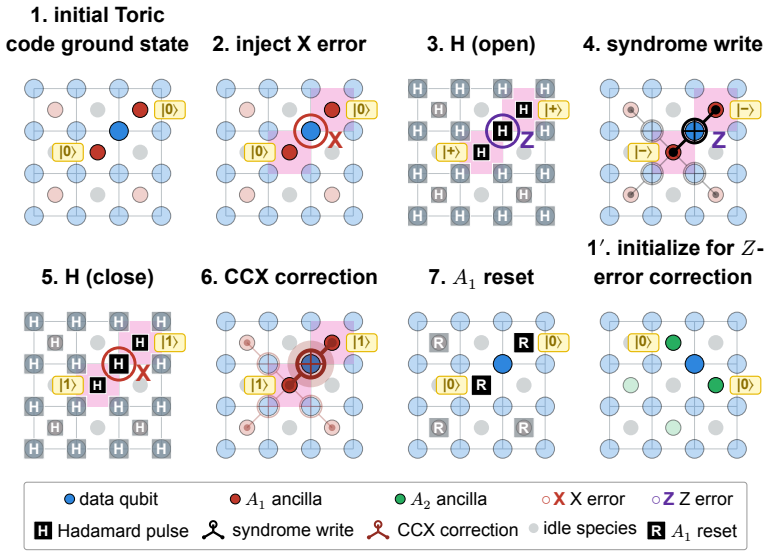
A toric-code quantum memory can be preserved using only global species-selective pulses on a three-species Rydberg array without measurements or local addressing.
A machine-rendered reading of the paper's core claim, the machinery that carries it, and where it could break.
Core claim
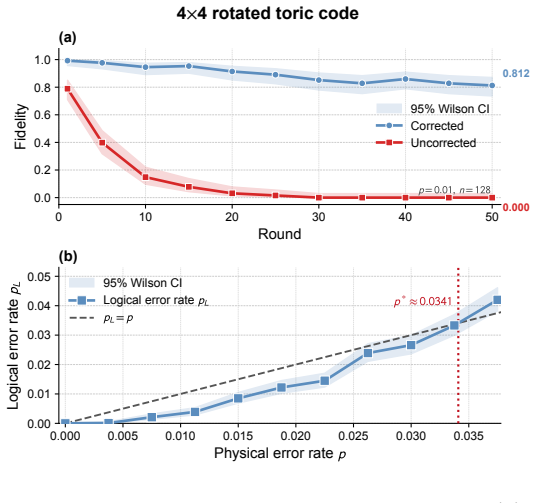
The protocol realizes the complete stabilizer cycle for a rotated toric code using only global, species-selective pulses on a three-species Rydberg array, including coherent correction and ancilla reset, leading to improved memory lifetime in numerical simulations when error rates are below the pseudo-threshold.
What carries the argument
Three-species Rydberg atom array driven by global species-selective laser pulses that implement the full measurement-free stabilizer cycle.
If this is right
- Logical qubit lifetime increases when the physical error rate is below the pseudo-threshold of approximately 0.034.
- The scheme supplies a hardware-efficient route to topological quantum memory in neutral-atom platforms.
- Stabilization proceeds without the latency, atom loss, or crosstalk introduced by fluorescence measurement, inter-zone transport, or local addressing.
- The complete cycle of syndrome extraction, correction, and reset occurs under global control alone.
Where Pith is reading between the lines
- The same global-control approach could apply to other surface-code variants or larger array sizes if the species interactions scale accordingly.
- Avoiding mid-circuit measurements may reduce overall cycle time and allow tighter integration with computation steps in larger processors.
- If gate fidelities improve beyond the simulated values, the effective threshold could rise and support longer memory times.
Load-bearing premise
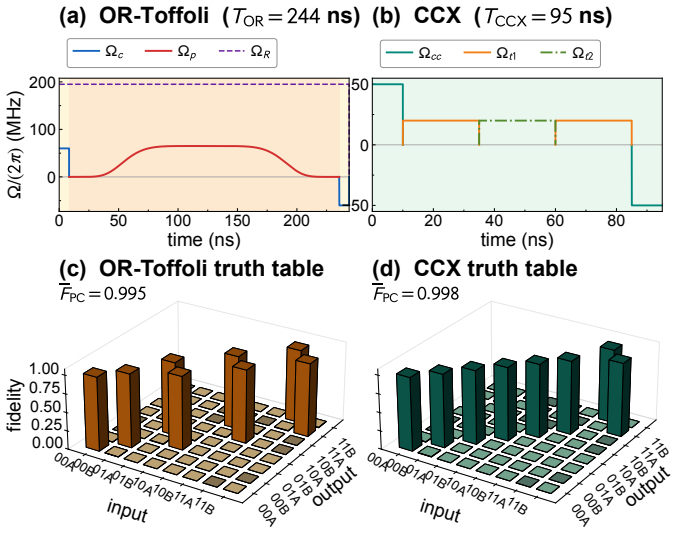
The three-species Rydberg interactions and global pulses can realize the complete stabilizer cycle with fidelity high enough that auxiliary operations are no longer the dominant error source.
What would settle it
A numerical simulation of the 4 by 4 rotated toric code in which the logical qubit lifetime does not increase for physical error rates below 0.034 when the proposed global-pulse operations are used.
Figures


read the original abstract
The central prerequisite of any fault-tolerant quantum architecture is a quantum memory: a block of encoded physical qubits whose logical state is actively preserved against noise across many rounds of error correction. In neutral-atom Rydberg arrays, realizing such a memory is obstructed not by the entangling gates themselves, which are already fast and high-fidelity, but by the auxiliary operations that a conventional error-correction cycle requires: mid-circuit fluorescence measurement, inter-zone atom transport, and locally focused single-qubit addressing. Each of these introduces latency, atom loss, or optical crosstalk that exceeds the cost of the underlying gates by orders of magnitude. These costs accumulate cycle after cycle, progressively degrading the very logical information the code is meant to protect. Here we propose a protocol that stabilizes a toric-code quantum memory without moving, measuring or local addressing atoms. The key is to use a three-species Rydberg atom array for the complete stabilizer cycle, including syndrome extraction, coherent correction, and ancilla reset, under global, species-selective laser pulses. Numerical simulation of a $4 \times 4$ rotated toric code shows a longer qubit lifetime when the physical error rate is below a pseudo-threshold $p^\star \approx 0.034$. The scheme offers a concrete, hardware-efficient route to topological quantum memory in neutral-atom platforms.
Editorial analysis
A structured set of objections, weighed in public.
Referee Report
Summary. The manuscript proposes a measurement-free protocol for a toric-code quantum memory in a three-species Rydberg atom array, using only global species-selective laser pulses to implement the full stabilizer cycle (syndrome extraction, coherent correction, and ancilla reset) without mid-circuit measurements, atom transport, or local addressing. Numerical simulation of a 4×4 rotated toric code reports a pseudo-threshold p⋆ ≈ 0.034 below which logical qubit lifetime is extended.
Significance. If the error model accurately captures the dominant noise from the proposed global-pulse operations, the result would demonstrate a concrete hardware-efficient route to topological quantum memory in neutral-atom platforms by removing the dominant latency and crosstalk costs of conventional auxiliary operations.
major comments (1)
- [Numerical simulation section] Numerical simulation section: The error channels and rates for the auxiliary operations (syndrome extraction, coherent correction, ancilla reset) are introduced via a phenomenological Pauli or depolarizing model whose parameters are chosen independently of the three-species Rydberg Hamiltonian, interaction strengths, detunings, and pulse shapes; without a microscopic derivation linking these to the effective error model, the reported p⋆ cannot be interpreted as evidence that the hardware proposal reaches the claimed regime.
minor comments (1)
- The description of how global species-selective pulses realize ancilla reset would benefit from an explicit sequence or effective Hamiltonian to clarify the reset mechanism.
Simulated Author's Rebuttal
We thank the referee for their detailed review and for highlighting the distinction between phenomenological modeling and microscopic error derivation. We address the single major comment below and will revise the manuscript accordingly to clarify the scope and interpretation of our numerical results.
read point-by-point responses
-
Referee: [Numerical simulation section] Numerical simulation section: The error channels and rates for the auxiliary operations (syndrome extraction, coherent correction, ancilla reset) are introduced via a phenomenological Pauli or depolarizing model whose parameters are chosen independently of the three-species Rydberg Hamiltonian, interaction strengths, detunings, and pulse shapes; without a microscopic derivation linking these to the effective error model, the reported p⋆ cannot be interpreted as evidence that the hardware proposal reaches the claimed regime.
Authors: We agree that the error model employed in the numerical simulations is phenomenological (standard depolarizing channels with independent rates for each auxiliary operation) and is not derived from a microscopic calculation based on the three-species Rydberg Hamiltonian, pulse shapes, or interaction strengths. The simulations are intended to establish a performance benchmark: they show that the proposed global-pulse protocol can extend logical lifetime below p⋆ ≈ 0.034 when the auxiliary operations are subject to this noise model. This provides a target error budget that future hardware implementations would need to meet. A full microscopic derivation of the effective error channels from the Rydberg dynamics would be a valuable extension but lies outside the scope of the present work, which focuses on the protocol architecture itself. We will revise the numerical simulation section and the abstract to explicitly state that the reported pseudo-threshold applies to the phenomenological model and does not constitute a direct prediction of hardware performance without additional error-rate calculations from the underlying Hamiltonian. revision: yes
Circularity Check
No circularity detected in derivation chain
full rationale
The paper proposes a hardware protocol using three-species Rydberg arrays for measurement-free stabilizer cycles and reports a pseudo-threshold p⋆≈0.034 as the output of numerical simulation on a 4×4 rotated toric code under a phenomenological error model. No equations, self-citations, or fitted parameters are shown to reduce this threshold to an input by construction; the simulation result is presented as an independent numerical demonstration rather than a tautological renaming or self-referential fit. The central claim therefore remains self-contained against external benchmarks.
Axiom & Free-Parameter Ledger
free parameters (1)
- p* =
0.034
axioms (1)
- domain assumption Rydberg interactions between the three species can be made species-selective and global pulses can implement the full set of stabilizer measurements and corrections with controllable fidelity.
Reference graph
Works this paper leans on
-
[1]
Saffman, M., Walker, T. G. & Mølmer, K. Quantum information with rydberg atoms. Reviews of modern physics82, 2313 (2010)
2010
-
[2]
& Lahaye, T
Browaeys, A. & Lahaye, T. Many-body physics with individually controlled rydberg atoms. Nature Physics16, 132–142 (2020)
2020
-
[3]
Kaufman, A. M. & Ni, K.-K. Quantum science with optical tweezer arrays of ultracold atoms and molecules.Nature Physics17, 1324–1333 (2021)
2021
-
[4]
& Whitlock, S
Morgado, M. & Whitlock, S. Quantum simulation and computing with rydberg-interacting qubits.AVS Quantum Science3, 023501 (2021)
2021
-
[5]
J.et al.High-fidelity parallel entangling gates on a neutral-atom quantum computer.Nature622, 268–272 (2023)
Evered, S. J.et al.High-fidelity parallel entangling gates on a neutral-atom quantum computer.Nature622, 268–272 (2023)
2023
-
[6]
Nature622, 279–284 (2023)
Ma, S.et al.High-fidelity gates and mid-circuit erasure conversion in an atomic qubit. Nature622, 279–284 (2023)
2023
-
[7]
J.et al.High-fidelity entangling gates and nonlocal circuits with neutral atoms
Evered, S. J.et al.High-fidelity entangling gates and nonlocal circuits with neutral atoms. arXiv preprint arXiv:2604.25987(2026). ArXiv:2604.25987. 18
Pith/arXiv arXiv 2026
-
[8]
Barnes, K.et al.Assembly and coherent control of a register of nuclear spin qubits.Nature Communications13, 2779 (2022)
2022
-
[9]
W., Senoo, A., McGrew, W
Jenkins, A., Lis, J. W., Senoo, A., McGrew, W. F. & Kaufman, A. M. Ytterbium nuclear- spin qubits in an optical tweezer array.Physical Review X12, 021027 (2022)
2022
-
[10]
Ebadi, S.et al.Quantum phases of matter on a 256-atom programmable quantum simu- lator.Nature595, 227–232 (2021)
2021
-
[11]
Scholl, P.et al.Quantum simulation of 2d antiferromagnets with hundreds of rydberg atoms.Nature595, 233–238 (2021)
2021
-
[12]
Bluvstein, D.et al.Logical quantum processor based on reconfigurable atom arrays.Nature 626, 58–65 (2024)
2024
-
[13]
G., Mariantoni, M., Martinis, J
Fowler, A. G., Mariantoni, M., Martinis, J. M. & Cleland, A. N. Surface codes: Towards practical large-scale quantum computation.Physical Review A86, 032324 (2012)
2012
-
[14]
Physical Review X13, 041034 (2023)
Norcia, M.et al.Midcircuit qubit measurement and rearrangement in a 171yb atomic array. Physical Review X13, 041034 (2023)
2023
-
[15]
Graham, T.et al.Midcircuit measurements on a single-species neutral alkali atom quantum processor.Physical Review X13, 041051 (2023)
2023
-
[16]
Mart´ ınez-Rinc´ on, J., Mullan, M., Lett, P. D. & Hafezi, M. Real-time feedback protocols for deterministic entanglement generation.Physical Review Letters117, 023601 (2016)
2016
-
[17]
Physical Review X12, 021049 (2022)
Cong, I.et al.Hardware-efficient, fault-tolerant quantum computation with rydberg atoms. Physical Review X12, 021049 (2022)
2022
-
[18]
Bluvstein, D.et al.A quantum processor based on coherent transport of entangled atom arrays.Nature604, 451–456 (2022)
2022
-
[19]
Weitenberg, C.et al.Single-spin addressing in an atomic mott insulator.Nature471, 319–324 (2011)
2011
-
[20]
Xia, T.et al.Randomized benchmarking of single-qubit gates in a 2d array of neutral-atom qubits.Physical review letters114, 100503 (2015)
2015
-
[21]
Heußen, S., Locher, D. F. & M¨ uller, M. Measurement-free fault-tolerant quantum error correction in near-term devices.PRX Quantum5, 010333 (2024)
2024
-
[22]
Petiziol, F., Wimberger, S., Eckardt, A. & Mintert, F. Non-perturbative Floquet engineer- ing of the toric-code Hamiltonian and its ground state.Physical Review B109, 075126 (2024).2211.09724
arXiv 2024
-
[23]
Singh, K.et al.Mid-circuit correction of correlated phase errors using an array of spec- tator qubits.Science380, 1265–1269 (2023). URLhttps://www.science.org/doi/abs/ 10.1126/science.ade5337.https://www.science.org/doi/pdf/10.1126/science. ade5337
work page doi:10.1126/science.ade5337.https://www.science.org/doi/pdf/10.1126/science 2023
-
[24]
Singh, K.et al.Dual-element, two-dimensional atom array with continuous-mode opera- tion.Physical Review X12, 011040 (2022)
2022
-
[25]
& Yan, B
Wei, Y., Wei, K., Li, S. & Yan, B. Dual-species optical tweezer for Rb and K atoms. Physical Review A110, 043118 (2024). 19
2024
-
[26]
Ang’ong’a, J., Huang, C., Covey, J. P. & Gadway, B. Gray molasses cooling of 39K atoms in optical tweezers.Physical Review Research4, 013240 (2022)
2022
-
[27]
Taglieber, M.et al.Simultaneous magneto-optical trapping of three atomic species.Phys- ical Review A73, 011402(R) (2006)
2006
-
[28]
Beterov, I. I. & Saffman, M. Rydberg blockade, f¨ orster resonances, and quantum state measurements with different atomic species.Phys. Rev. A92, 042710 (2015). URLhttps: //link.aps.org/doi/10.1103/PhysRevA.92.042710
-
[29]
S., Kjærgaard, N
Otto, J. S., Kjærgaard, N. & Deb, A. B. Interspecies Rydberg interactions of Rb and K. Phys. Rev. Research2, 033474 (2020)
2020
-
[30]
M., Walker, D
Ireland, P. M., Walker, D. M. & Pritchard, J. D. Interspecies F¨ orster resonances for Rb- Cs Rydbergd-states for enhanced multi-qubit gate fidelities.Physical Review Research6, 013293 (2024)
2024
-
[31]
W.et al.Mid-circuit operations using the omg-architecture in neutral atom arrays (2023)
Lis, J. W.et al.Mid-circuit operations using the omg-architecture in neutral atom arrays (2023). URLhttps://arxiv.org/abs/2305.19266.2305.19266
arXiv 2023
-
[32]
Kitaev, A. Y. Fault-tolerant quantum computation by anyons.Annals of Physics303, 2–30 (2003)
2003
-
[33]
& Preskill, J
Dennis, E., Kitaev, A., Landahl, A. & Preskill, J. Topological quantum memory.Journal of Mathematical Physics43, 4452–4505 (2002)
2002
-
[34]
Dual Toffoli and Peres reversible gates (2020)
Moraga, C. Dual Toffoli and Peres reversible gates (2020). URLhttps://arxiv.org/ abs/2011.01746.2011.01746
arXiv 2020
-
[35]
OR-Toffoli and OR-Peres reversible gates
Moraga, C. OR-Toffoli and OR-Peres reversible gates. In Yamashita, S. & Yokoyama, T. (eds.)Reversible Computation (RC 2021), vol. 12805 ofLecture Notes in Computer Science, 206–217 (Springer, 2021)
2021
-
[36]
Google Quantum AI, Acharya, R.et al.Suppressing quantum errors by scaling a surface code logical qubit.Nature614, 676–681 (2023). ArXiv:2207.06431
arXiv 2023
-
[37]
Auger, J. M., Bergamini, S. & Browne, D. E. Blueprint for fault-tolerant quantum computation with rydberg atoms.Phys. Rev. A96, 052320 (2017). URLhttps: //link.aps.org/doi/10.1103/PhysRevA.96.052320
-
[38]
D., Adams, C
ˇSibali´ c, N., Pritchard, J. D., Adams, C. S. & Weatherill, K. J. ARC: An open-source library for calculating properties of alkali Rydberg atoms.Comput. Phys. Commun.220, 319–331 (2017)
2017
-
[39]
H., Møller, N
Pedersen, L. H., Møller, N. M. & Mølmer, K. Fidelity of quantum operations.Physics Letters A367, 47–51 (2007)
2007
-
[40]
Isenhower, L.et al.Demonstration of a neutral atom controlled-NOT quantum gate.Phys. Rev. Lett.104, 010503 (2010)
2010
-
[41]
The density-matrix renormalization group in the age of matrix product states.Annals of physics326, 96–192 (2011)
Schollw¨ ock, U. The density-matrix renormalization group in the age of matrix product states.Annals of physics326, 96–192 (2011)
2011
-
[42]
A practical introduction to tensor networks: Matrix product states and projected entangled pair states.Annals of physics349, 117–158 (2014)
Or´ us, R. A practical introduction to tensor networks: Matrix product states and projected entangled pair states.Annals of physics349, 117–158 (2014)
2014
-
[43]
Efficient classical simulation of slightly entangled quantum computations.Phys- ical review letters91, 147902 (2003)
Vidal, G. Efficient classical simulation of slightly entangled quantum computations.Phys- ical review letters91, 147902 (2003). 20
2003
-
[44]
Efficient simulation of one-dimensional quantum many-body systems.Physical review letters93, 040502 (2004)
Vidal, G. Efficient simulation of one-dimensional quantum many-body systems.Physical review letters93, 040502 (2004)
2004
-
[45]
Eypasch, E., Lefering, R., Kum, C. K. & Troidl, H. Probability of adverse events that have not yet occurred: a statistical reminder.BMJ311, 619–620 (1995)
1995
-
[46]
Wilson, E. B. Probable inference, the law of succession, and statistical inference.Journal of the American Statistical Association22, 209–212 (1927)
1927
-
[47]
Perlin, M. A., Premakumar, V. N., Wang, J., Saffman, M. & Joynt, R. Fault-tolerant measurement-free quantum error correction with multiqubit gates.Physical Review A108 (2023). URLhttp://dx.doi.org/10.1103/PhysRevA.108.062426
-
[48]
Google Quantum AI and Collaborators, Acharya, R.et al.Quantum error correction below the surface code threshold.Nature(2024). ArXiv:2408.13687
arXiv 2024
-
[49]
& Thompson, J
Wu, Y., Kolkowitz, S., Puri, S. & Thompson, J. D. Erasure conversion for fault-tolerant quantum computing in alkaline earth Rydberg atom arrays.Nature Communications13, 4657 (2022)
2022
-
[50]
Scholl, P.et al.Erasure conversion in a high-fidelity Rydberg quantum simulator.Nature 622, 273–278 (2023)
2023
-
[51]
R., Nation, P
Johansson, J. R., Nation, P. D. & Nori, F. Qutip: An open-source python framework for the dynamics of open quantum systems.Computer Physics Communications183, 1760–1772 (2012)
2012
-
[52]
quimb: A python package for quantum information and many-body calculations
Gray, J. quimb: A python package for quantum information and many-body calculations. Journal of Open Source Software3, 819 (2018)
2018
-
[53]
Stabilizer codes and quantum error correction.arXiv preprint quant- ph/9705052(1997)
Gottesman, D. Stabilizer codes and quantum error correction.arXiv preprint quant- ph/9705052(1997)
arXiv 1997
-
[54]
Nielsen, M. A. & Chuang, I. L.Quantum Computation and Quantum Information(Cam- bridge University Press, 2010), 10th anniversary edn
2010
-
[55]
Calderbank, A. R. & Shor, P. W. Good quantum error-correcting codes exist.Physical Review A54, 1098–1105 (1996)
1996
-
[56]
Steane, A. M. Error correcting codes in quantum theory.Physical Review Letters77, 793 (1996)
1996
-
[57]
& Gottesman, D
Cleve, R. & Gottesman, D. Efficient computations of encodings for quantum error correc- tion.Physical Review A56, 76–82 (1997)
1997
-
[58]
& Mølmer, K
Dalibard, J., Castin, Y. & Mølmer, K. Wave-function approach to dissipative processes in quantum optics.Phys. Rev. Lett.68, 580–583 (1992)
1992
-
[59]
& Dalibard, J
Mølmer, K., Castin, Y. & Dalibard, J. Monte Carlo wave-function method in quantum optics.J. Opt. Soc. Am. B10, 524–538 (1993)
1993
-
[60]
J.An Open Systems Approach to Quantum Optics, vol
Carmichael, H. J.An Open Systems Approach to Quantum Optics, vol. 18 ofLecture Notes in Physics Monographs(Springer-Verlag Berlin Heidelberg, 1993). 21
1993
discussion (0)
Sign in with ORCID, Apple, or X to comment. Anyone can read and Pith papers without signing in.