REVIEW 2 major objections 2 minor
Closing the Indexing-Decoding Gap in Multimodal Generative Retrieval via Prefix Retention Optimization
T0 review · 2 major / 2 minor · reviewed 2026-06-27 · grok-4.3
Pith's one-line read Prefix retention optimization closes the indexing-decoding gap in multimodal generative retrieval by aligning prefix rankings and reducing early pruning in beam search.
desk verdict The paper gives a concrete engineering fix for prefix loss in multimodal generative retrieval and reports gains on nine tasks, but the survival bound's handling of beam search dependencies is the part that needs the most checking. read the letter →
The pith
A machine-rendered reading of the paper's core claim, the machinery that carries it, and where it could break.
The reading
What carries the argument
The survival bound on prefix retention, which relates retention probability to three controllable factors in indexing and decoding and guides the three mechanisms of PRO.
What would settle it
An experiment that measures actual prefix retention rates during beam search on the nine tasks and finds that the observed rates deviate substantially from the rates predicted by the survival bound even after applying PRO.
Extended reading notes
Core claim
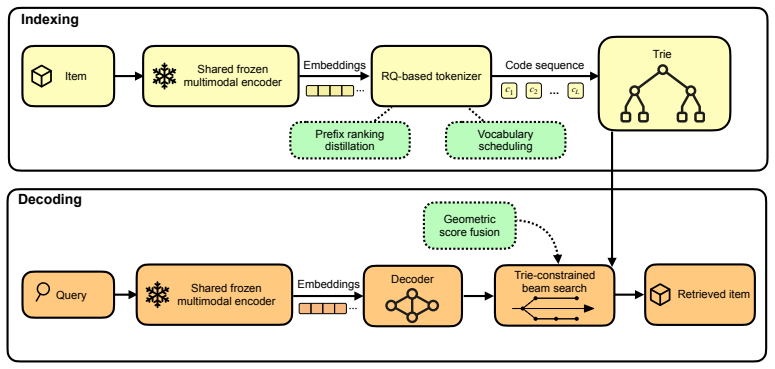
The central claim is that the indexing-decoding gap arises because identifier learning objectives fail to enforce prefix discriminability during decoding, causing low-rank prefixes to be pruned irreversibly in beam search; this gap is characterized by a derived survival bound relating retention to indexing and decoding factors, and it is closed by PRO, which combines prefix ranking distillation to align quantized prefixes with pre-quantization embeddings, vocabulary scheduling to grow codebook sizes across residual levels, and geometric score fusion to incorporate query-prefix similarity into beam scoring.
Load-bearing premise
The derived survival bound correctly captures how prefix retention depends on the three factors, and the proposed mechanisms close the gap without introducing new mismatches.
Editorial extensions
If this is right
- Target identifier prefixes are retained at higher rates during trie-constrained beam search.
- Multimodal generative retrieval outperforms existing baselines on nine retrieval tasks.
- The three mechanisms of distillation, scheduling, and fusion can be applied together in a single training and inference pipeline.
- Identifier learning no longer needs separate post-hoc fixes for early pruning.
Reading between the lines
- The same survival-bound approach could be tested on purely textual generative retrieval to check whether the gap is modality-specific.
- If vocabulary scheduling reduces early competition, it may also lower the required beam width in production systems.
- Geometric score fusion adds a vector similarity term to discrete decoding; this hybrid scoring could be extended to other constrained generation tasks.
Editorial analysis
A structured set of objections, weighed in public.
Referee Report
Summary. The paper claims that multimodal generative retrieval using residual quantization and trie-constrained beam search suffers from an indexing-decoding gap, where even optimized identifiers can be pruned early due to low-rank prefixes. It theoretically characterizes this gap, derives a survival bound relating prefix retention to three controllable factors, and proposes Prefix Retention Optimization (PRO) with three mechanisms—prefix ranking distillation via listwise loss, vocabulary scheduling across residual levels, and geometric score fusion in beam search—to close the gap. Experiments on nine multimodal retrieval tasks show improved target prefix retention and outperformance over existing baselines.
Significance. If the survival bound holds and the mechanisms demonstrably improve retention without new mismatches, the work provides a principled framework for addressing a practical mismatch in generative retrieval, potentially leading to more reliable multimodal systems. The multi-task empirical evaluation is a strength, as is the attempt at a theoretical characterization rather than purely heuristic fixes.
major comments (2)
- [§3] §3 (survival bound derivation): the bound is presented as relating prefix retention to the three factors, but the derivation appears to model the factors independently; this risks overlooking the sequential, cumulative-score dependencies inherent to trie-constrained beam search pruning, which could render the bound loose or mis-specified and weaken the causal link to the three PRO mechanisms.
- [§4.1–4.3] §4.1–4.3 (PRO mechanisms): the justification for distillation, scheduling, and fusion rests directly on the survival bound; if the bound does not fully capture beam-search dynamics, the mechanisms may address symptoms rather than the root gap, and additional analysis (e.g., ablation on bound tightness) is needed to confirm they do not introduce overfitting to the evaluation setup.
minor comments (2)
- [Abstract, §5] Abstract and §5: the claim of 'nine multimodal retrieval tasks' would benefit from an explicit list or table reference to the datasets and metrics used, to allow assessment of baseline fairness and post-hoc tuning.
- [§3] Notation: the survival bound and the three factors should be given explicit equation numbers and variable definitions in §3 to facilitate verification of the derivation steps.
Simulated Author's Rebuttal
Thank you for the opportunity to respond to the referee's comments. We value the feedback on the theoretical characterization and empirical validation of our proposed Prefix Retention Optimization (PRO) framework. Below, we provide point-by-point responses to the major comments.
read point-by-point responses
-
Referee: [§3] §3 (survival bound derivation): the bound is presented as relating prefix retention to the three factors, but the derivation appears to model the factors independently; this risks overlooking the sequential, cumulative-score dependencies inherent to trie-constrained beam search pruning, which could render the bound loose or mis-specified and weaken the causal link to the three PRO mechanisms.
Authors: We acknowledge that the survival bound derivation employs an independence assumption among the three factors to obtain a tractable closed-form expression. This simplification may indeed overlook certain sequential dependencies in the beam search process. However, the bound serves as a guiding principle rather than an exact characterization, and our experiments demonstrate consistent improvements in prefix retention across tasks when optimizing the identified factors. In the revised manuscript, we will expand Section 3 to explicitly discuss the assumptions and limitations of the bound, including its potential looseness, and provide an empirical analysis of bound tightness on representative datasets. This will better substantiate the connection to the PRO mechanisms. revision: partial
-
Referee: [§4.1–4.3] §4.1–4.3 (PRO mechanisms): the justification for distillation, scheduling, and fusion rests directly on the survival bound; if the bound does not fully capture beam-search dynamics, the mechanisms may address symptoms rather than the root gap, and additional analysis (e.g., ablation on bound tightness) is needed to confirm they do not introduce overfitting to the evaluation setup.
Authors: The PRO mechanisms are motivated by both the theoretical bound and the practical observations of the indexing-decoding gap in Section 3. Prefix ranking distillation targets the prefix ranking factor, vocabulary scheduling addresses the vocabulary size factor to mitigate early pruning, and geometric score fusion incorporates query-prefix similarity to adjust decoding scores. To address the concern about potential overfitting and to verify they target the root gap, we will include additional ablations in the revision: (1) measuring the tightness of the survival bound before and after applying PRO, and (2) evaluating on additional held-out multimodal tasks. The current multi-task results on nine diverse tasks already provide evidence of generalization beyond a single evaluation setup. revision: partial
Circularity Check
No significant circularity detected
full rationale
The paper's central derivation is a theoretical survival bound relating prefix retention to three factors in indexing and decoding, presented as derived from gap analysis rather than fitted to data or reduced to self-citations. No equations or claims in the provided text show self-definitional loops, fitted inputs renamed as predictions, or load-bearing self-citations that collapse the result to inputs by construction. The PRO mechanisms are motivated by the bound but remain independent proposals evaluated on external tasks. This is the common case of a self-contained theoretical step with no circular reduction.
Assumptions & free parameters
free parameters (1)
- codebook sizes per residual level
assumptions (2)
- domain assumption Identifier learning uses reconstruction and contrastive losses that do not enforce prefix discriminability
- domain assumption Beam search with trie constraints is the decoding procedure
Cite this review
Pith. "Pith review of Closing the Indexing-Decoding Gap in Multimodal Generative Retrieval via Prefix Retention Optimization." pith.science (2026). https://pith.science/paper/H2GOEYGJ
@misc{pith2026260609241,
  author       = {Pith},
  title        = {Pith review of: Closing the Indexing-Decoding Gap in Multimodal Generative Retrieval via Prefix Retention Optimization},
  year         = {2026},
  howpublished = {\url{https://pith.science/paper/H2GOEYGJ}},
  note         = {Machine review of arXiv:2606.09241}
}
read the original abstract
Multimodal generative retrieval formulates multimodal retrieval as discrete identifier generation, eliminating the need for explicit similarity search over external embeddings. Existing approaches construct identifiers via residual quantization and decode them with trie-constrained beam search. This combination introduces an indexing-decoding gap: identifier learning objectives, including reconstruction and contrastive losses, do not explicitly enforce prefix discriminability during decoding. As a result, even well-optimized identifiers can be irreversibly pruned early in beam search due to low-rank prefixes. We theoretically characterize this gap and derive a survival bound that relates prefix retention to three controllable factors in indexing and decoding. Building on this bound, we propose PRO, prefix retention optimization, a unified framework comprising three mechanisms: (i) prefix ranking distillation aligns quantized prefix rankings with those induced by pre-quantization embeddings using a listwise loss; (ii) vocabulary scheduling increases codebook sizes from shallow to deep residual quantization levels to reduce early competition from non-target prefixes; and (iii) geometric score fusion vectorizes each candidate prefix and incorporates its similarity to the query into beam search scoring, further reducing the indexing-decoding mismatch. Experiments on nine multimodal retrieval tasks show that PRO improves retention of target identifier prefixes and outperforms existing multimodal generative retrieval baselines.
Figures


Figures from the paper (3 more)


Reviewed June 27, 2026 · model on record in the stance chip above.
Discussion (0). Continue with ORCID to comment.