Measuring Asteroid Rotation Periods Using the KMTNet Bulge Survey Data
Pith reviewed 2026-06-26 01:33 UTC · model grok-4.3
The pith
KMTNet bulge survey data supplies reliable rotation periods for 96 asteroids including 84 new ones.
A machine-rendered reading of the paper's core claim, the machinery that carries it, and where it could break.
Core claim
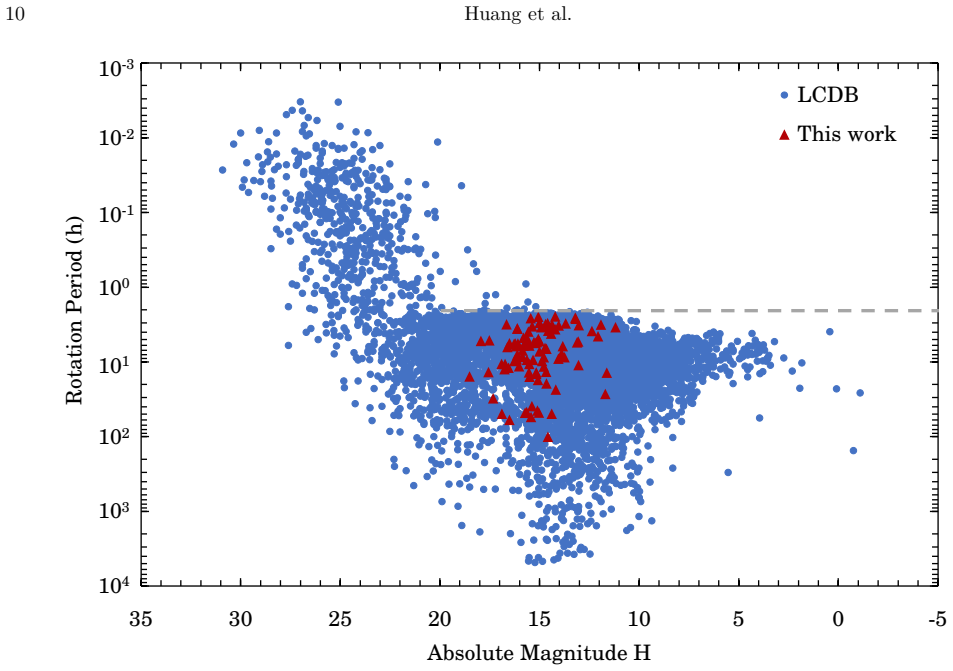
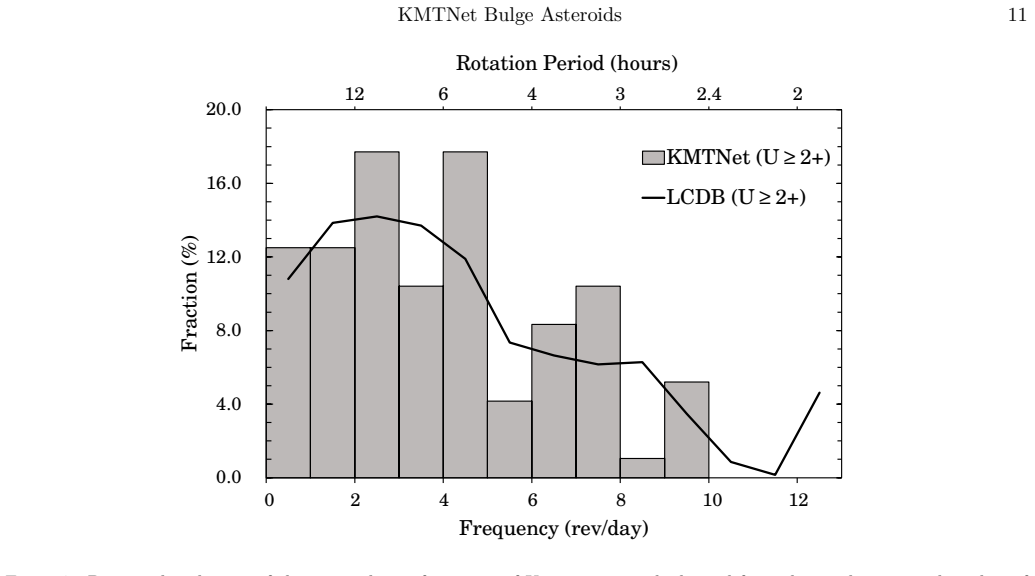
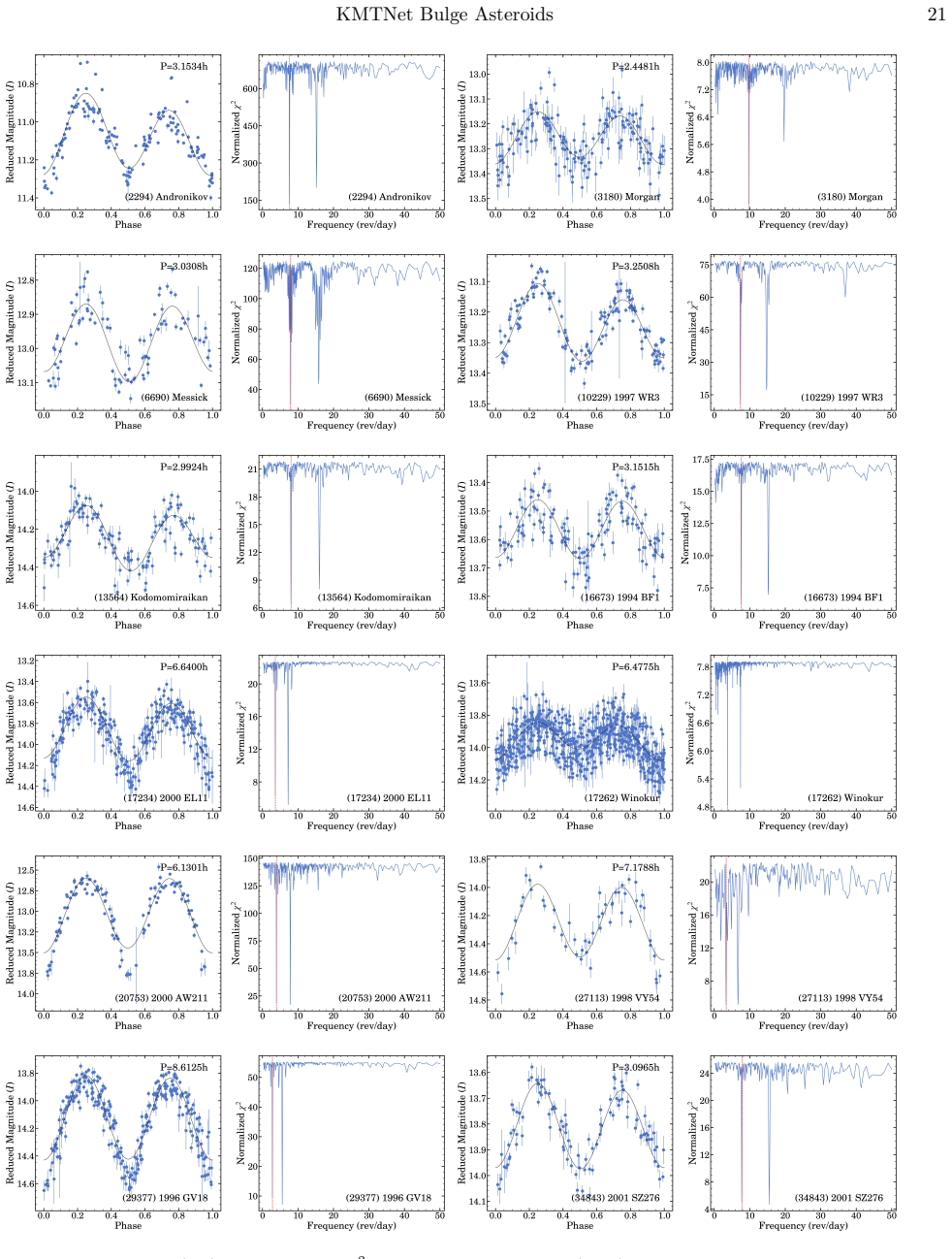
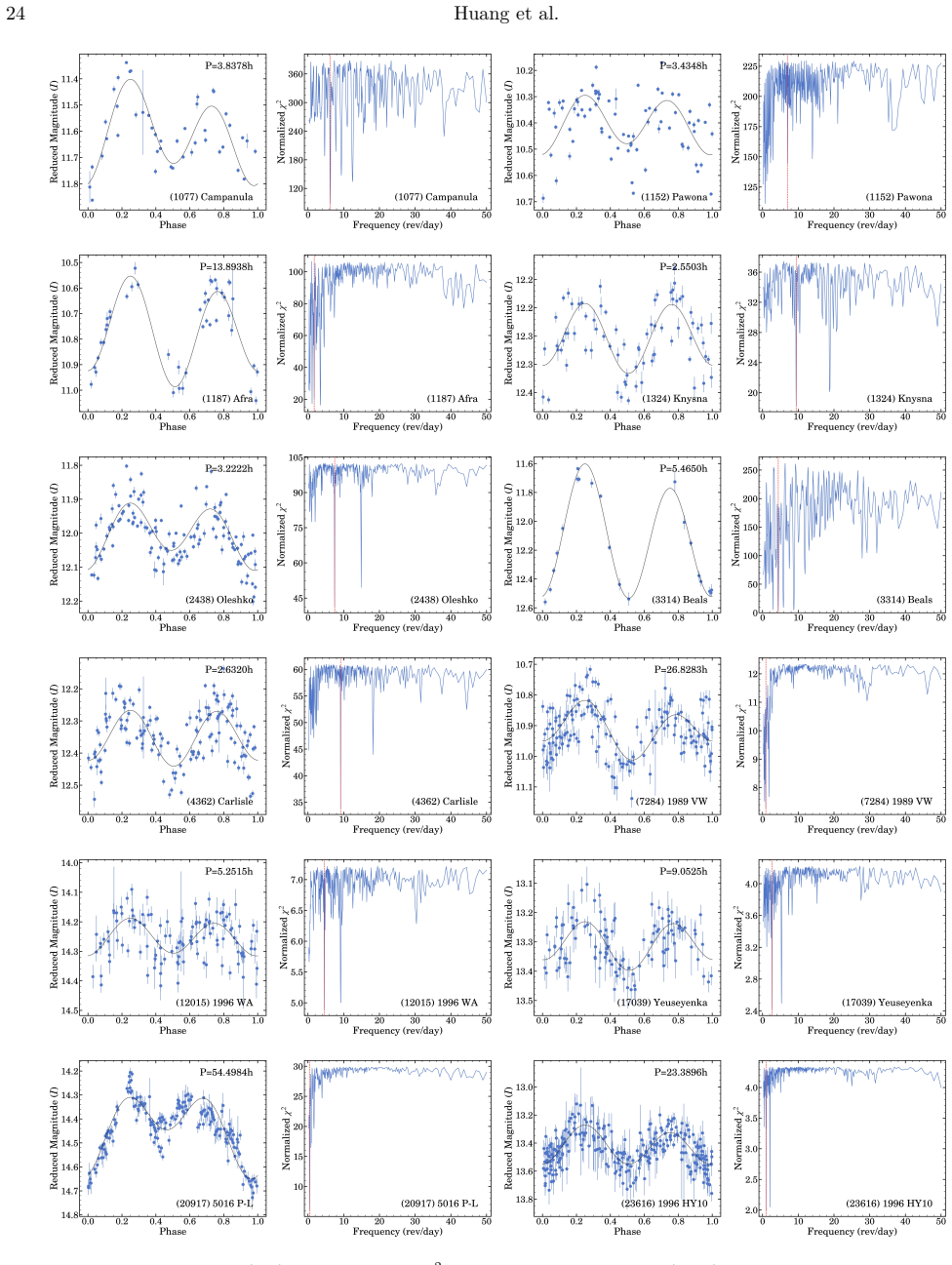
We performed photometric measurements of bright asteroids (V < 20 mag) identified within a one-square-degree field during the 2018 KMTNet bulge season. We derived reliable rotation periods for 96 asteroids, including 84 objects without previously published lightcurves. The reliable spin-rates of the asteroids in our sample are broadly consistent with those reported in the Asteroid Lightcurve Database. This archival mining approach can be readily extended to a much larger KMTNet footprint, and the existing ~12 deg² high-cadence KMTNet dataset has the potential to yield reliable rotation periods (U ≥ 2+) for more than 5,500 asteroids.
What carries the argument
Photometric extraction of asteroid lightcurves from high-cadence KMTNet bulge survey images to determine rotation periods
If this is right
- The derived periods are broadly consistent with values in the Asteroid Lightcurve Database.
- The method can be extended across the full ~12 deg² high-cadence KMTNet dataset.
- This would produce reliable periods (U ≥ 2+) for more than 5,500 asteroids.
- The approach substantially expands the current database of asteroid rotational properties.
Where Pith is reading between the lines
- The same archival technique could be tested on other wide-field high-cadence surveys to increase the total number of known asteroid periods.
- A larger sample of measured periods would enable statistical comparisons of spin properties across different asteroid populations or size ranges.
- Combining these periods with shape or orbital data from other sources could support improved models of asteroid dynamics.
Load-bearing premise
The photometric measurements performed on bright asteroids (V < 20 mag) identified in the one-square-degree field are sufficiently accurate and free of contamination to allow reliable period determination.
What would settle it
Targeted follow-up observations of a substantial fraction of the 96 asteroids that yield rotation periods differing significantly from those derived here.
Figures

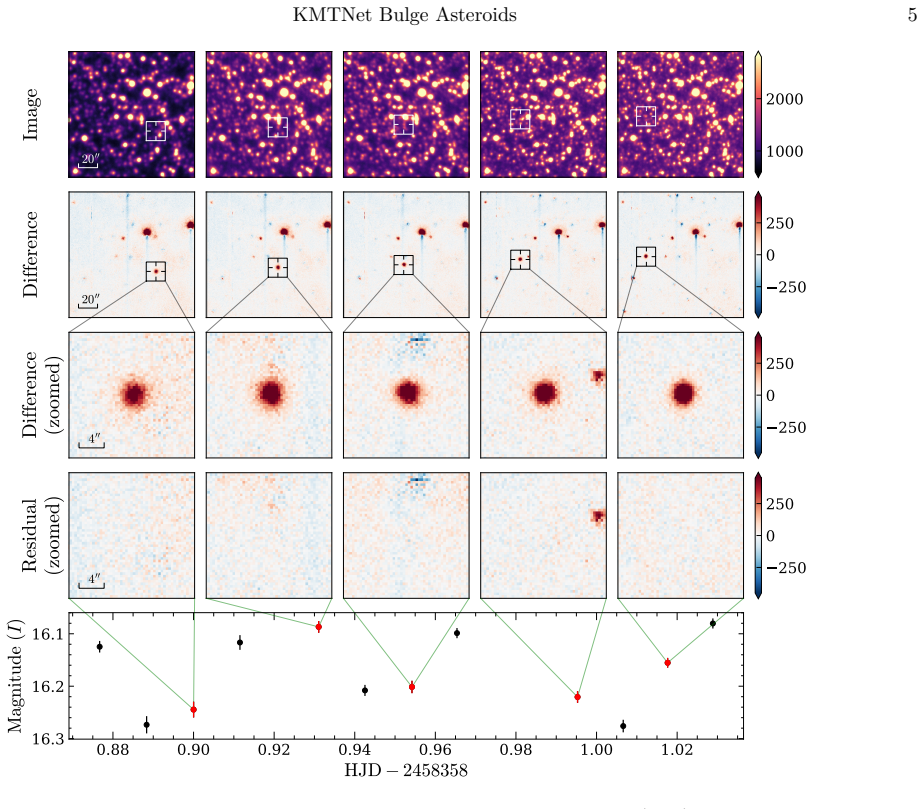
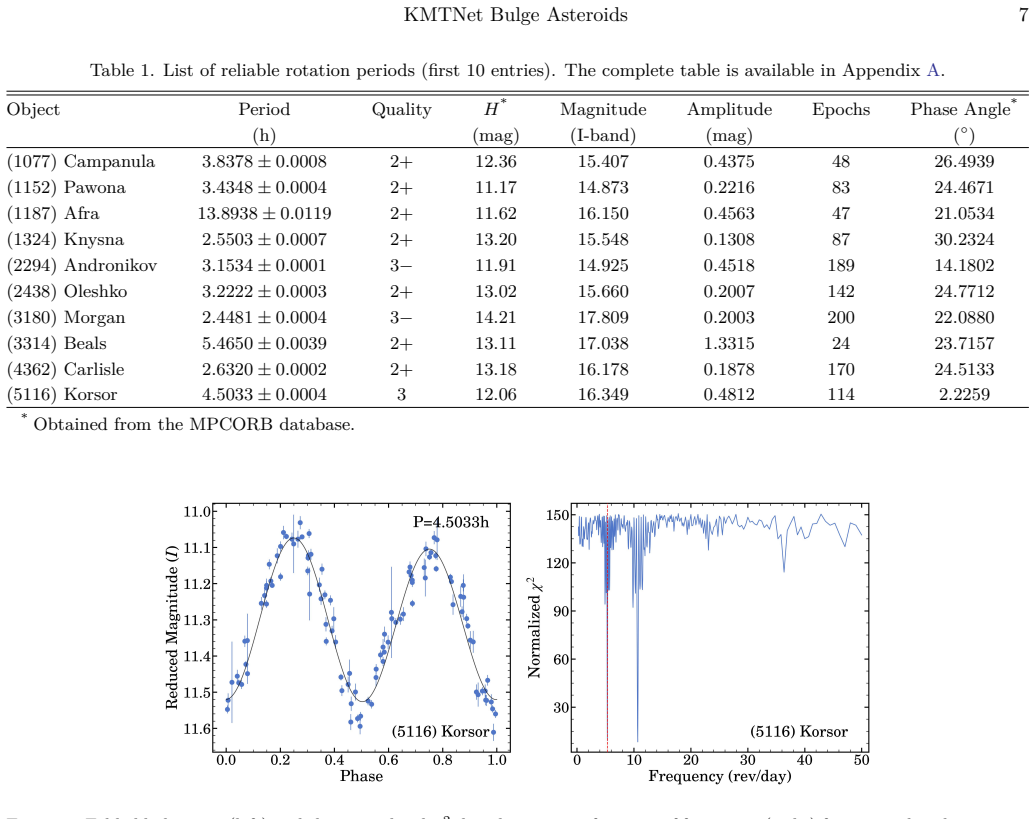
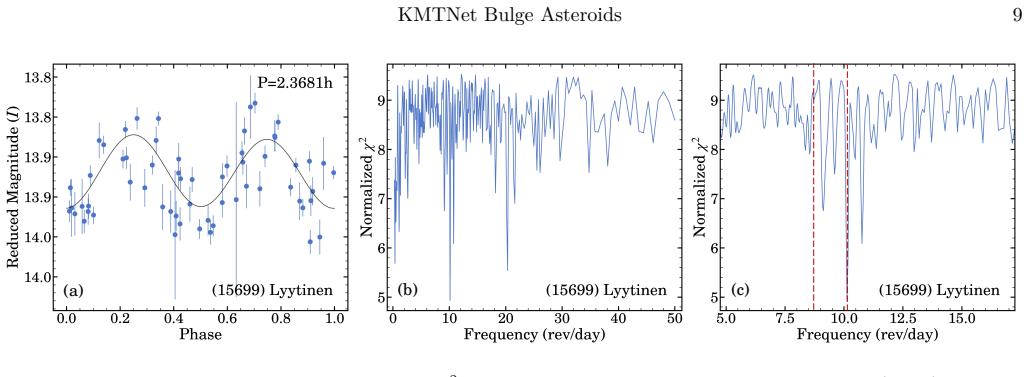
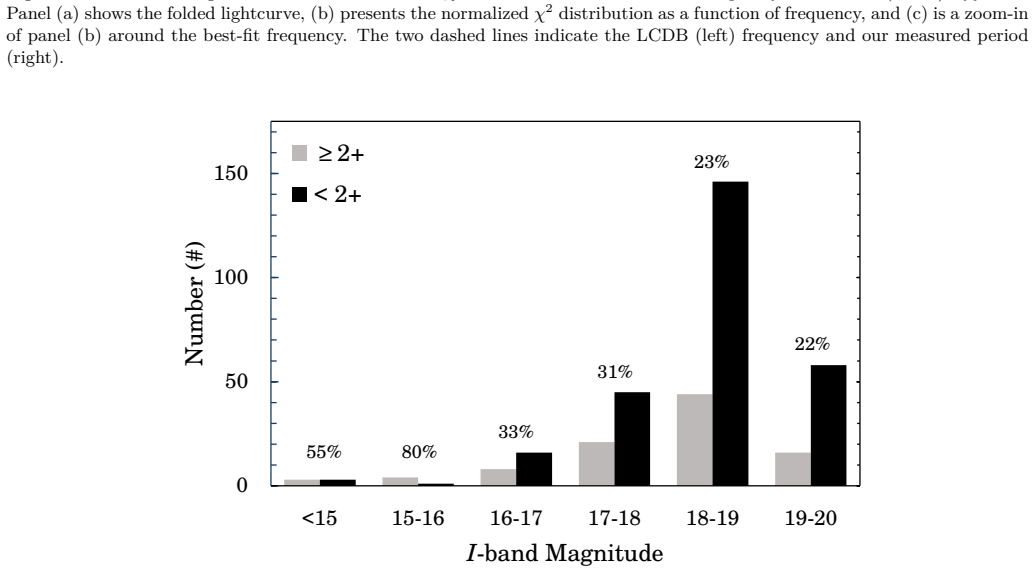




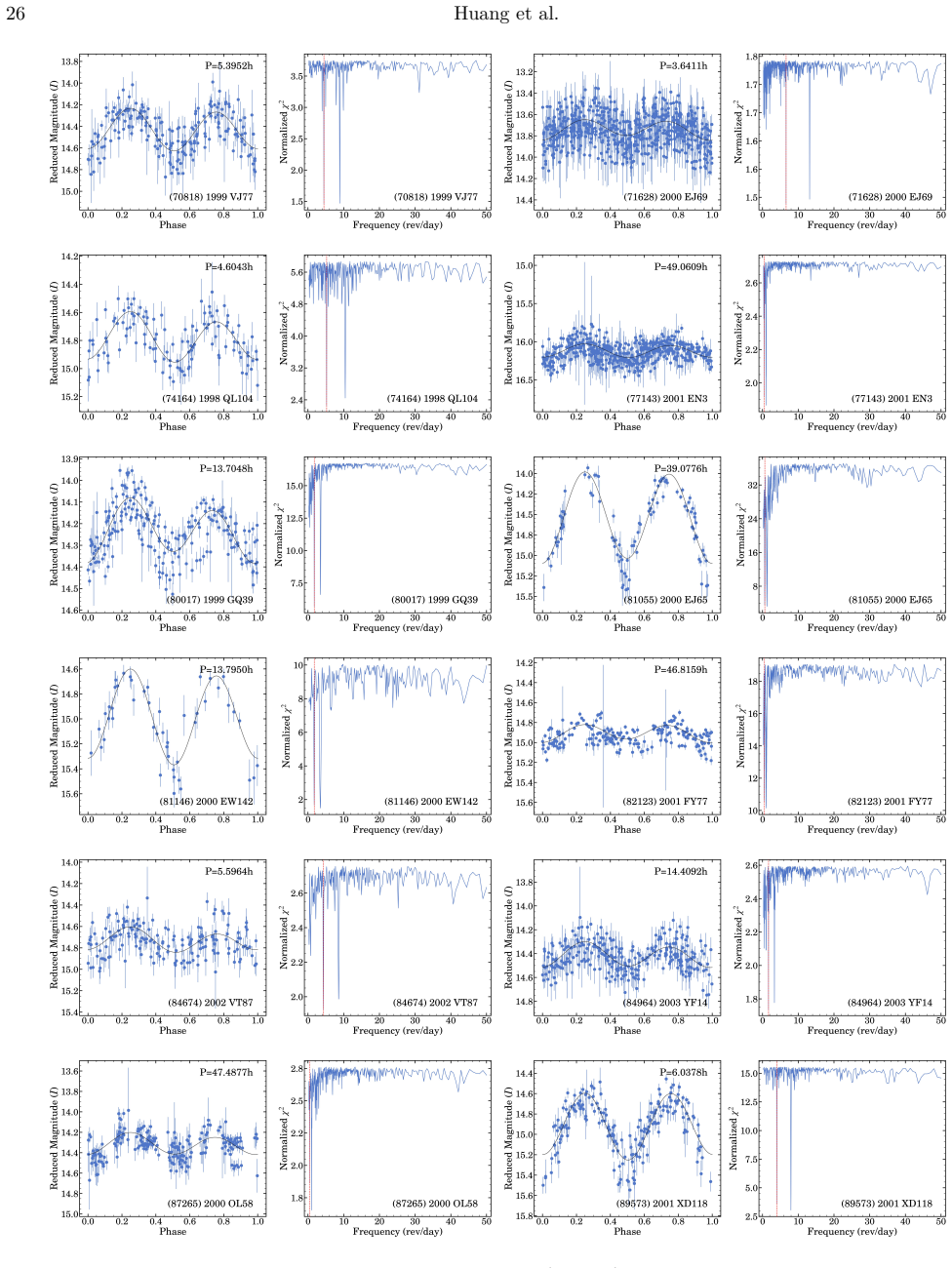


read the original abstract
Since 2015, the Korea Microlensing Telescope Network (KMTNet) has conducted high-cadence, near-continuous observations of the Galactic bulge for nearly nine months each year from three sites in Chile, South Africa, and Australia, and its wide field of view provides a unique opportunity to extract asteroid lightcurves from archival survey data. In this work, we performed photometric measurements of bright asteroids ($V< 20$~mag) identified within a one-square-degree field during the 2018 KMTNet bulge season. We derived reliable rotation periods for 96 asteroids, including 84 objects without previously published lightcurves. The reliable spin-rates of the asteroids in our sample are broadly consistent with those reported in the Asteroid Lightcurve Database. This archival mining approach can be readily extended to a much larger KMTNet footprint, and the existing $\sim12$~deg$^2$ high-cadence KMTNet dataset has the potential to yield reliable rotation periods (U $\geq 2+$) for more than 5,500 asteroids, substantially expanding the current database of asteroid rotational properties.
Editorial analysis
A structured set of objections, weighed in public.
Referee Report
Summary. The paper claims that photometric measurements of bright asteroids (V<20 mag) in a 1 deg² field from the 2018 KMTNet bulge survey yield reliable rotation periods for 96 asteroids (84 previously unpublished), with spin rates broadly consistent with the Asteroid Lightcurve Database (ALCDB); it further extrapolates that the full ~12 deg² high-cadence KMTNet dataset could deliver U≥2+ periods for >5500 asteroids.
Significance. If the photometric accuracy and contamination control hold, the archival-mining approach would provide a low-cost route to substantially enlarge the sample of asteroid rotation periods, enabling better statistical studies of spin distributions and collisional evolution.
major comments (2)
- [Abstract] Abstract: the statement that the 96 periods are 'reliable' and 'broadly consistent' with the ALCDB is presented without error bars on the derived periods, without per-object quality metrics, without exclusion criteria for unreliable fits, and without any injected-source recovery tests or neighbor-flux diagnostics. This directly undermines the central claim that the lightcurves are free of blending or background-subtraction artifacts in crowded bulge fields.
- [Discussion or extrapolation paragraph] The extrapolation to >5500 asteroids from the 1 deg² test field assumes the same success rate applies across the full ~12 deg² dataset; no quantitative assessment of field-to-field variations in crowding, seeing, or asteroid density is provided to support the scaling.
minor comments (2)
- Add a table (or supplementary table) listing the 96 asteroids, their derived periods, uncertainties, U-ratings, and comparison to ALCDB entries so that readers can assess the consistency claim directly.
- Clarify the exact photometric pipeline (aperture vs. PSF photometry, background subtraction method) and the adopted magnitude precision threshold for period fitting.
Simulated Author's Rebuttal
We thank the referee for their constructive comments, which help clarify the presentation of our results. We respond to each major comment below.
read point-by-point responses
-
Referee: [Abstract] Abstract: the statement that the 96 periods are 'reliable' and 'broadly consistent' with the ALCDB is presented without error bars on the derived periods, without per-object quality metrics, without exclusion criteria for unreliable fits, and without any injected-source recovery tests or neighbor-flux diagnostics. This directly undermines the central claim that the lightcurves are free of blending or background-subtraction artifacts in crowded bulge fields.
Authors: The manuscript body details the period determination via Lomb-Scargle and the U quality code adopted from the ALCDB, along with the selection of the 96 objects that meet U ≥ 2+. We agree the abstract is too terse on these points and will revise it to reference the quality assessment and consistency checks described in Sections 3 and 4. Injected-source recovery tests were not performed in this pilot study; the external validation against the ALCDB serves as the primary check for blending artifacts, though we can add an explicit caveat if the editor prefers. revision: partial
-
Referee: [Discussion or extrapolation paragraph] The extrapolation to >5500 asteroids from the 1 deg² test field assumes the same success rate applies across the full ~12 deg² dataset; no quantitative assessment of field-to-field variations in crowding, seeing, or asteroid density is provided to support the scaling.
Authors: The 1 deg^{2} field was chosen as representative of the high-cadence bulge survey conditions. We accept that a quantitative assessment of variations would strengthen the claim and will add a short paragraph in the revised discussion noting the typical ranges of seeing and crowding across the KMTNet fields, while rephrasing the >5500 figure as an order-of-magnitude estimate rather than a firm prediction. revision: yes
Circularity Check
No circularity: data-driven period extraction validated externally
full rationale
The paper reports photometric extraction and period fitting on KMTNet survey images for 96 asteroids, with direct comparison to the independent ALCDB catalog for consistency checks. No equations, fitted parameters, or self-citations are used to derive the reported periods or the 5,500-object extrapolation; the central results rest on standard lightcurve analysis applied to archival data and external validation rather than any self-referential reduction.
Axiom & Free-Parameter Ledger
axioms (1)
- domain assumption Photometric measurements of V<20 mag asteroids in KMTNet data yield lightcurves suitable for period determination.
Reference graph
Works this paper leans on
-
[1]
Brian D. Warner and Alan W. Harris and Petr Pravec , keywords =. The asteroid lightcurve database , journal =. 2009 , issn =. doi:https://doi.org/10.1016/j.icarus.2009.02.003 , url =
-
[2]
Monthly Notices of the Royal Astronomical Society , volume =
Xu, Xiaoyun and Wang, Xiaobing and Muinonen, Karri and Penttilä, Antti and Luo, Nanping and Gu, Shenghong and Sun, Leilei and Xu, Fukun and Liu, Yisi and Xiang, Yue and Cao, Dongtao and Wang, Jianhua , title =. Monthly Notices of the Royal Astronomical Society , volume =. 2023 , month =. doi:10.1093/mnras/stad765 , url =
-
[3]
Photoelectric observations of asteroids 3, 24, 60, 261, and 863 , journal =. 1989 , issn =. doi:https://doi.org/10.1016/0019-1035(89)90015-8 , url =
-
[4]
Yeh, Ting-Shuo and Li, Bin and Chang, Chan-Kao and Zhao, Hai-Bin and Ji, Jiang-Hui and Lin, Zhong-Yi and Ip, Wing-Huen , title =. 2020 , month =. doi:10.3847/1538-3881/ab9a32 , url =
-
[5]
Fast and Slow Rotation of Asteroids , journal =. 2000 , issn =. doi:https://doi.org/10.1006/icar.2000.6482 , url =
-
[6]
On the detectability of lightcurves of Kuiper belt objects , journal =
Pedro Lacerda and Jane Luu , keywords =. On the detectability of lightcurves of Kuiper belt objects , journal =. 2003 , issn =. doi:https://doi.org/10.1016/S0019-1035(02)00019-2 , url =
-
[7]
Tian, Jun and Zhao, Hai-Bin and Li, Bin , title =. 2022 , month =. doi:10.1088/1674-4527/ac977d , url =
-
[8]
I-General theory and new inversion schemes , author=
Interpretation of lightcurves of atmosphereless bodies. I-General theory and new inversion schemes , author=. Astronomy and Astrophysics (ISSN 0004-6361), vol. 259, no. 1, p. 318-332. , volume=
-
[9]
II-Practical aspects of inversion , author=
Interpretation of lightcurves of atmosphereless bodies. II-Practical aspects of inversion , author=. Astronomy and Astrophysics (ISSN 0004-6361), vol. 259, no. 1, p. 333-340. , volume=
-
[10]
Josef Ďurech and Josef Hanuš and Miroslav Brož and Martin Lehký and Raoul Behrend and Pierre Antonini and Stephane Charbonnel and Roberto Crippa and Pierre Dubreuil and Gino Farroni and Gilles Kober and Alain Lopez and Federico Manzini and Julian Oey and Raymond Poncy and Claudine Rinner and René Roy , keywords =. Shape models of asteroids based on lightc...
-
[11]
1989 , publisher=
Asteroids II (Tucson, AZ , author=. 1989 , publisher=
1989
-
[12]
P. Pravec and A.W. Harris and D. Vokrouhlický and B.D. Warner and P. Kušnirák and K. Hornoch and D.P. Pray and D. Higgins and J. Oey and A. Galád and Š. Gajdoš and L. Kornoš and J. Világi and M. Husárik and Yu.N. Krugly and V. Shevchenko and V. Chiorny and N. Gaftonyuk and W.R. Cooney and J. Gross and D. Terrell and R.D. Stephens and R. Dyvig and V. Reddy...
-
[13]
Asteroids IV (Tucson, AZ) , author =. 2015 , month =. doi:10.2458/azu_uapress_9780816532131-ch027 , publisher=
-
[14]
Small main-belt asteroid lightcurve survey , journal =. 1992 , issn =. doi:https://doi.org/10.1016/0019-1035(92)90184-9 , url =
-
[15]
The Thousand Asteroid Light Curve Survey , journal =
Joseph Masiero and Robert Jedicke and Josef Ďurech and Stephen Gwyn and Larry Denneau and Jeff Larsen , keywords =. The Thousand Asteroid Light Curve Survey , journal =. 2009 , issn =. doi:https://doi.org/10.1016/j.icarus.2009.06.012 , url =
-
[16]
Earth, Moon, and Planets , volume=
The EURONEAR lightcurve survey of near earth asteroids , author=. Earth, Moon, and Planets , volume=. 2017 , publisher=. doi:https://doi.org/10.1007/s11038-017-9506-9 , url =
-
[17]
Brian D. Warner and Alan W. Harris , keywords =. Using sparse photometric data sets for asteroid lightcurve studies , journal =. 2011 , issn =. doi:https://doi.org/10.1016/j.icarus.2011.10.007 , url =
-
[18]
Molnár, L. and Pál, A. and Sárneczky, K. and Szabó, R. and Vinkó, J. and Szabó, Gy. M. and Kiss, Cs. and Hanyecz, O. and Marton, G. and Kiss, L. L. , title =. 2018 , month =. doi:10.3847/1538-4365/aaa1a1 , url =
-
[19]
Gábor Marton and Csaba Kiss and László Molnár and András Pál and Anikó Farkas-Takács and Gyula M. Szabó and Thomas Müller and Victor Ali-Lagoa and Róbert Szabó and József Vinkó and Krisztián Sárneczky and Csilla E. Kalup and Anna Marciniak and Rene Duffard and László L. Kiss , keywords =. Light curves of ten Centaurs from K2 measurements , journal =. 2020...
-
[20]
McNeill, A. and Mommert, M. and Trilling, D. E. and Llama, J. and Skiff, B. , title =. 2019 , month =. doi:10.3847/1538-4365/ab5223 , url =
-
[21]
Pál, András and Szakáts, Róbert and Kiss, Csaba and Bódi, Attila and Bognár, Zsófia and Kalup, Csilla and Kiss, László L. and Marton, Gábor and Molnár, László and Plachy, Emese and Sárneczky, Krisztián and Szabó, Gyula M. and Szabó, Róbert , title =. 2020 , month =. doi:10.3847/1538-4365/ab64f0 , url =
-
[22]
Waszczak, Adam and Chang, Chan-Kao and Ofek, Eran O. and Laher, Russ and Masci, Frank and Levitan, David and Surace, Jason and Cheng, Yu-Chi and Ip, Wing-Huen and Kinoshita, Daisuke and Helou, George and Prince, Thomas A. and Kulkarni, Shrinivas , title =. 2015 , month =. doi:10.1088/0004-6256/150/3/75 , url =
-
[23]
Monthly Notices of the Royal Astronomical Society , volume =
Cordwell, A J and Rattenbury, N J and Bannister, M T and Cowan, P and The MOA Collaboration: and Abe, Fumio and Barry, Richard and Bennett, David P and Bhattacharya, Aparna and Bond, Ian A and Fujii, Hirosane and Fukui, Akihiko and Itow, Yoshitaka and Silva, Stela Ishitani and Hirao, Yuki and Kirikawa, Rintaro and Kondo, Iona and Koshimoto, Naoki and Mats...
-
[24]
Greenstreet, Sarah and Li, Zhuofu (Chester) and Vavilov, Dmitrii E. and Singh, Devanshi and Jurić, Mario and Ivezić, Željko and Eggl, Siegfried and Koumjian, Alec and Moeyens, Joachim and Carruba, Valerio and Womack, Maria and Granvik, Mikael and Alexov, Anastasia and Antilogus, Pierre and Baumanć, B̌rian J. and Bellm, Eric C. and Boucaud, Alexandre and B...
-
[25]
Proceedings of the International Astronomical Union , author=
DEEP-South: Preliminary Photometric Results from the KMTNet-CTIO , volume=. Proceedings of the International Astronomical Union , author=. 2015 , pages=. doi:10.1017/S1743921315007255 , number=
-
[26]
2016, Journal of Korean Astronomical Society, 49, 37, doi: 10.5303/JKAS.2016.49.1.37
KMTNET: A Network of 1.6 m Wide-Field Optical Telescopes Installed at Three Southern Observatories. Journal of Korean Astronomical Society , keywords =. doi:10.5303/JKAS.2016.49.1.37 , adsurl =
-
[27]
Korea Microlensing Telescope Network Microlensing Events from 2015: Event-finding Algorithm, Vetting, and Photometry. , keywords =. doi:10.3847/1538-3881/aaa47b , archivePrefix =. 1703.06883 , primaryClass =
work page internal anchor Pith review Pith/arXiv arXiv doi:10.3847/1538-3881/aaa47b 2015
-
[28]
Qian, Qiyue and Yang, Hongjing and Zang, Weicheng and Ryu, Yoon-Hyun and Mao, Shude and Kuang, Renkun and Zhang, Jiyuan and Albrow, Michael D. and Chung, Sun-Ju and Gould, Andrew and Han, Cheongho and Hwang, Kyu-Ha and Jung, Youn Kil and Shin, In-Gu and Shvartzvald, Yossi and Yee, Jennifer C. and Cha, Sang-Mok and Kim, Dong-Jin and Kim, Hyoun-Woo and Kim,...
-
[29]
Erasmus, N. and McNeill, A. and Mommert, M. and Trilling, D. E. and Sickafoose, A. A. and Gend, C. van , title =. 2018 , month =. doi:10.3847/1538-4365/aac38f , url =
-
[30]
Erasmus, N. and Mommert, M. and Trilling, D. E. and Sickafoose, A. A. and van Gend, C. and Hora, J. L. , title =. 2017 , month =. doi:10.3847/1538-3881/aa88be , url =
-
[31]
Monthly Notices of the Royal Astronomical Society , volume =
Yang, Hongjing and Yee, Jennifer C and Hwang, Kyu-Ha and Qian, Qiyue and Bond, Ian A and Gould, Andrew and Hu, Zhecheng and Zhang, Jiyuan and Mao, Shude and Zhu, Wei and Albrow, Michael D and Chung, Sun-Ju and Kim, Seung-Lee and Park, Byeong-Gon and Han, Cheongho and Jung, Youn Kil and Ryu, Yoon-Hyun and Shin, In-Gu and Shvartzvald, Yossi and Cha, Sang-Mo...
-
[32]
Systematic Reanalysis of KMTNet Microlensing Events. II. Two New Planets in Giant-source Events. , keywords =. doi:10.3847/1538-3881/adc73e , archivePrefix =. 2503.19471 , primaryClass =
-
[33]
Asteroids, Comets, Meteors Conference , volume=
Asteroid Lightcurve Survey with the KMTNet , author=. Asteroids, Comets, Meteors Conference , volume=
-
[34]
2023, , 675, A24, 10.1051/0004-6361/202345889
Reconstruction of asteroid spin states from Gaia DR3 photometry , author=. Astronomy & Astrophysics , volume=. doi:https://doi.org/10.1051/0004-6361/202345889 , year=
-
[35]
Asteroid rotation rates , journal =. 1984 , issn =. doi:https://doi.org/10.1016/0019-1035(84)90003-4 , url =
-
[36]
KMT-2025-BLG-1616Lb: First Microlensing Bound Planet From DREAMS. , keywords =. doi:10.3847/1538-3881/ae36ac , archivePrefix =. 2601.11469 , primaryClass =
-
[37]
A Minute-Cadence Deep Bulge Survey: First Data Release of DREAMS
A Minute-Cadence Deep Bulge Survey: First Data Release of DREAMS. arXiv e-prints , keywords =. doi:10.48550/arXiv.2605.27364 , archivePrefix =. 2605.27364 , primaryClass =
work page internal anchor Pith review Pith/arXiv arXiv doi:10.48550/arxiv.2605.27364
-
[38]
Tumbling Asteroids , journal =. 1994 , issn =. doi:https://doi.org/10.1006/icar.1994.1017 , url =
-
[39]
P. Pravec and A.W. Harris and P. Scheirich and P. Kušnirák and L. Šarounová and C.W. Hergenrother and S. Mottola and M.D. Hicks and G. Masi and Yu.N. Krugly and V.G. Shevchenko and M.C. Nolan and E.S. Howell and M. Kaasalainen and A. Galád and P. Brown and D.R. DeGraff and J.V. Lambert and W.R. Cooney and S. Foglia , keywords =. Tumbling asteroids , journ...
-
[40]
, year = 1999, month = nov, volume =
Asteroid Lightcurve Observations from 1981 to 1983 , journal =. 1999 , issn =. doi:https://doi.org/10.1006/icar.1999.6181 , url =
-
[41]
Asteroids, Comets, Meteors Conference , year = 2023, series =
Asteroid Lightcurve Survey with the KMTNet. Asteroids, Comets, Meteors Conference , year = 2023, series =
2023
-
[42]
Difference imaging photometry of blended gravitational microlensing events with a numerical kernel. , archivePrefix = "arXiv", eprint =. doi:10.1111/j.1365-2966.2009.15098.x , adsurl =
-
[43]
2008, MNRAS, 385, L98, doi: 10.1111/j.1745-3933.2008.00441.x —
A new algorithm for difference image analysis. , archivePrefix = "arXiv", eprint =. doi:10.1111/j.1745-3933.2008.00464.x , adsurl =
discussion (0)
Sign in with ORCID, Apple, or X to comment. Anyone can read and Pith papers without signing in.