REVIEW 4 major objections 7 minor 52 references
Gamma-ray and radio populations of millisecond pulsars in globular clusters
T0 review · 4 major / 7 minor · reviewed 2026-08-15 · deepseek-v4-flash
Pith's one-line read Two luminosity models fit Fermi gamma-ray data but imply globular-cluster MSP populations differing by a factor of 6–7; the paper favors the lognormal one.
desk verdict A useful population synthesis with a genuinely testable single-pulsar prediction, but the preference for the lognormal model rests on a fitted radio scaling that fails where it is best tested. read the letter →
The pith
A machine-rendered reading of the paper's core claim, the machinery that carries it, and where it could break.
The reading
What carries the argument
The machinery is a Monte Carlo flux-matching simulation over the 118 clusters in the sample. For each cluster, MSPs are drawn one at a time from a gamma-ray luminosity function and their fluxes $L_\gamma/(4\pi f_\gamma D^2)$ are summed until the Fermi measurement or upper limit is reached; the run is repeated 1000 times with flux and distance errors propagated. Model A uses the 3D fundamental plane $L_\gamma = 2.2\times10^{30}\,\mathrm{W}\,(B/10^4\,\mathrm{T})^{0.12}(\dot{E}/10^{24}\,\mathrm{W})^{0.39}(\epsilon_{\rm cut}/\mathrm{MeV})^{1.39}$, with spin parameters drawn from a synthetic pulsar population; model B draws $L_\gamma$ from the lognormal distribution with mean $\langle L_\gamma\rangle = 5.9\times10^{25}\,\mathrm{W}$ and $\sigma_L = 2.3$. The radio step is what separates the models: converting $L_\gamma$ to radio luminosity through $L_r = \eta L_\gamma$, applying a beaming fraction $f_r = 0.75$, and expressing the result as pseudo-luminosity $L_{\rm pseudo} = S_{1400} D^2$ produces the two very different radio brightness distributions shown in Figure 6.
What would settle it
A deep radio survey of a well-studied globular cluster such as Terzan 5 or 47 Tucanae would settle the central claim: model B predicts a numerous population of faint MSPs with mean $\log L_{\rm pseudo}\approx -1.6$, whereas model A predicts few faint objects and a mean near $-0.3$. If such a survey keeps finding only a sparse faint population, or finds that newly discovered MSPs have pseudo-luminosities near the bright end, model B is disfavored; if the faint population is as large as model B predicts, model A is ruled out.
Extended reading notes
Core claim
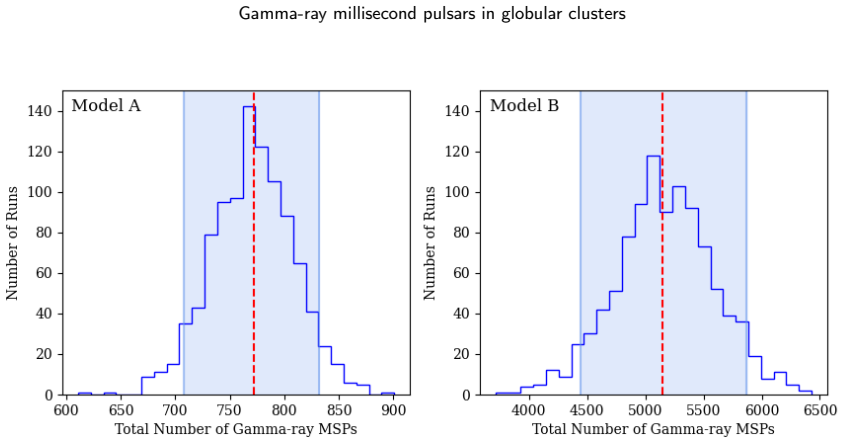
The paper's central claim is that gamma-ray observations of globular clusters determine a luminosity-weighted count of millisecond pulsars, not the total number itself. Two published luminosity functions that both fit the Fermi data therefore imply very different populations: the 3D fundamental plane (model A) gives $770\pm60$ MSPs across 118 clusters, while the lognormal distribution (model B) gives $5150^{+720}_{-710}$. The paper's discriminator is the radio band: adopting $L_r = \eta L_\gamma$ with $\eta \approx 3.5\times10^{-7}$, model B predicts a mean radio pseudo-luminosity $\log L_{\rm pseudo} \approx -1.6$ (mJy kpc$^2$), fainter than the canonical pulsar mean of $-1.1$ and aligned with the geometric explanation for MSP faintness. Model A instead requires $\log L_{\rm pseudo} \approx -0.3$, an intrinsically brighter population the authors say lacks a clear physical basis. On these grounds they conclude that model B is the more natural description of the underlying GC MSP population, and that its large faint population should be observable with forthcoming sensitive radio surveys.
Load-bearing premise
The load-bearing premise is the single radio-to-gamma scaling $L_r = \eta L_\gamma$ with one $\eta$ applied to every MSP in every cluster; the paper itself reports that this assumption cannot explain the radio pulsar counts in NGC 104 (47 Tucanae) and NGC 5139 ($\Omega$ Centauri).
Editorial extensions
If this is right
- The total MSP population across the 118 clusters would be about 5,150 rather than 770, implying that the overwhelming majority of globular-cluster MSPs are too faint to be seen individually in current gamma-ray and radio surveys.
- Model B predicts a mean radio pseudo-luminosity of about $-1.6$ in log mJy kpc$^2$, fainter than the canonical pulsar mean of $-1.1$; this matches the geometric explanation for why MSPs appear faint, whereas model A requires an intrinsically brighter population.
- Deep radio surveys with upcoming facilities should find a substantial population of faint MSPs in globular clusters; the measured luminosity distribution would be a direct test of the two models.
- Both models predict that roughly three clusters should have their aggregate gamma-ray emission dominated by a single bright MSP, consistent with the observed cases of NGC 6624, NGC 6652, and NGC 6626.
- The abundance scaling $N \propto \Gamma^{2/3}$ with stellar encounter rate reproduces the observed gamma-ray fluxes for about 80% of the clusters, supporting dynamical interactions as the main driver of MSP formation.
Reading between the lines
- A natural extension the paper does not pursue is to let $\eta$ vary across clusters or with luminosity; because $\eta$ is fitted to the same well-studied clusters used in the comparison, a luminosity-dependent $\eta$ could either erase or sharpen the preference for model B.
- If model B is right, the globular cluster system holds thousands of MSPs that current telescopes cannot see; confirming such a large hidden population would imply efficient neutron star retention and recycling in dense clusters, with consequences for cluster dynamical evolution that this paper does not quantify.
- The geometric explanation for MSP faintness is invoked after the fact; folding observer geometry and beaming angles directly into the Monte Carlo simulation, rather than applying a fixed $f_r=0.75$, would make the pseudo-luminosity comparison self-consistent.
- The same flux-matching machinery could be applied to unresolved gamma-ray emission from other stellar systems, such as dwarf spheroidal galaxies or the Galactic bulge, to test whether the lognormal luminosity function found here is universal.
Signed reviews
Editorial analysis
A structured set of objections, weighed in public.
Referee Report
Summary. This paper uses Monte Carlo simulations to estimate the millisecond pulsar (MSP) content of 118 Galactic globular clusters (GCs) from Fermi-LAT gamma-ray fluxes and upper limits, under two adopted gamma-ray luminosity functions: the 3DFP-based model A (Kalapotharakos et al.) and the lognormal model B (Holst and Hooper). Each simulated cluster is populated one MSP at a time until the summed flux reaches the observed value or limit, yielding total populations of 770 +/- 60 (model A) and 5150 +720/-710 (model B) MSPs across the GC system. Both models reproduce the Gamma^(2/3) encounter-rate scaling, predict an expected total of roughly three clusters with single-MSP-dominated gamma-ray emission, and, after fitting a radio-to-gamma scaling L_r = eta L_gamma, produce radio counts that broadly track current detections. The authors argue that model B's predicted radio pseudoluminosity distribution (mean log L_pseudo about -1.6) is fainter than the canonical pulsar mean (-1.1), whereas model A's (-0.3) is not, and conclude that model B provides a more natural description of the underlying GC MSP population.
Significance. If the conclusion holds, the GC MSP system contains roughly 5000 objects rather than about 800, which matters for neutron-star recycling rates, dynamical formation efficiency, and the planning of next-generation radio surveys; the falsifiable prediction of a large faint-pseudoluminosity population is a real strength of the paper. The Monte Carlo methodology is clearly specified, the handling of upper limits and of the three bright-MSP clusters is thoughtful, and the single-pulsar dominance statistic is a useful population-level test. The paper is also honest about its simplifications (single eta, crude radio selection). The central weakness is that the gamma-ray agreement is built in by construction and the pseudoluminosity discrimination in Section 4.5 is degenerate with the fitted eta and the input luminosity functions; the genuinely informative evidence for model B is the failure of model A to account for the radio counts of NGC 104 and NGC 5139 and for four clusters where eta_A could not be estimated. As written, the discrimination claim needs substantial reframing and uncertainty quantification.
major comments (4)
- [Section 3 and Section 4.1] The agreement with the observed gamma-ray fluxes is built in by construction. Section 3 specifies that each simulation is stopped when the summed flux reaches the measured Fermi flux or upper limit, so both models necessarily reproduce the flux of every cluster; the abstract's statement that 'both models reproduce the observed gamma-ray fluxes' therefore cannot be read as a validation of either luminosity model. Correspondingly, the headline totals (770 +/- 60 for model A; 5150 +720/-710 for model B) are inversions of the same flux measurements under two different assumed mean luminosities, and the 6-7x ratio is essentially the inverse ratio of the input mean luminosities, as the text itself notes in Section 4.1. The quoted 90% intervals reflect only the Monte Carlo sampling and exclude the dominant systematic uncertainty, namely the choice and parameters of the input luminosity function; this should be stated wherever the totals are quoted.
- [Section 4.5, Eqs. (9)-(10), Fig. 6] The pseudoluminosity comparison is not an independent discriminator between the models. From Eq. (10), log L_pseudo = log eta + log L_gamma - log(4 pi f_r Delta nu), and eta is fitted separately to each model using the same well-studied radio clusters (Section 4.4, Fig. 5). The difference between the two model distributions in Fig. 6 is therefore exactly the difference between the input gamma-ray luminosity distributions, shifted by the two fitted constants; no independent radio luminosity information enters the comparison. The argument that model B's mean (-1.6) is 'more natural' than model A's (-0.3) relative to the canonical value -1.1 is thus a restatement of the input luminosity-function difference, not a new empirical test. The non-circular evidence for model B is the radio-count comparison itself: model A cannot reproduce the radio pulsar counts of NGC 104 (N_A_gamma = 21 +8/-9 gamma-ray pulsars versus 42 radio pulsars) or NGC 5139, and eta_A could not be estimated for four radio-rich clusters (Fig. 5 caption). The discrimination argument in Section 4.5 should be re-based on those failures rather than on the shifted means.
- [Section 4.4-4.5, Table 2] The single-eta radio framework is too uncertain to bear the quantitative conclusion. The weighted means eta_A = 2e-7 and eta_B = 5e-7 are quoted without uncertainties, despite the visible cluster-to-cluster scatter in Fig. 5, and the framework fails badly for both models in NGC 5139 (N_A_Radio = N_B_Radio = 2 versus 19 observed) and under-predicts NGC 104 (16 and 17 versus 42 observed). Because the mean pseudoluminosity scales as log eta, a factor of about 3 in eta (well within the systematic uncertainty implied by these failures) shifts model B's mean from -1.6 to -1.1, erasing the claimed contrast with canonical pulsars. The covariance of eta with the assumed beaming fraction f_r (acknowledged near Eq. 10) adds a further unquantified normalization uncertainty that is not propagated into the pseudoluminosity means. The authors should also state whether NGC 5139 enters the eta fit and, if so, how its 9.5x under-prediction is reconciled with a global eta.
- [Section 4.2, Fig. 4] The reported '92/118 and 97/118 agreement' is a weak test, and the presentation in the Conclusions ('successfully predict the observed gamma-ray fluxes for around 80% of the GCs') overstates it. The alpha Gamma^(2/3) fit is made to the N_gamma values that were themselves derived by forcing each simulation to match the observed flux, so the subsequent flux predictions are largely a re-projection of the same data through a one-parameter scaling. The agreement metric is dominated by the upper-limit clusters, for which the criterion is merely that the lower error of the predicted flux falls below the limit, and the two models' agreement fractions (92 versus 97) do not differ significantly under this metric. The text should report the agreement separately for the 37 detected-flux clusters and the 81 upper-limit clusters, and present Fig. 4 as a consistency check of the Gamma scaling rather than as a validation of the luminosity models.
minor comments (7)
- [Abstract and Section 4.1] Qualify the phrases 'both models reproduce the observed gamma-ray fluxes' and 'both models have been tuned to provide a good match' by noting explicitly that this matching follows from the stopping rule of the simulation, so that readers do not mistake agreement for independent validation.
- [Section 3.1] State the units of the cutoff energy in the sampling distribution: the text says 'log10 epsilon_cut from a normal distribution with a mean of 3.458', which only makes sense if epsilon_cut is expressed in MeV (giving a typical cutoff near 3 GeV); also remove the redundant phrasing 'in log-space, sampling log10'.
- [Section 4.2 and Fig. 3] State explicitly that the alpha fit uses only the detected-flux clusters (the squares in Fig. 3) and specify which Gamma value (central or median) from Bahramian et al. enters the fit, since Table 1 lists lower and upper values as well.
- [Section 4.3] The expected total of roughly three single-pulsar-dominated clusters is a genuine population-level prediction, but only about 0.1 of the expectation comes from the three specially-treated clusters (NGC 6624, NGC 6626, NGC 6652 each have p_B_1 of a few percent), while most comes from faint, low-Gamma clusters with p_1 above 50% (e.g., NGC 7099, NGC 6397, NGC 6121); reporting this breakdown would strengthen the result.
- [Table 2, Section 4.4] The predicted radio counts N_A_Radio and N_B_Radio are quoted as point values with no uncertainties, unlike the N_gamma entries; add uncertainties or state that the quoted values are medians over the 1000 realizations.
- [Section 4.4-4.5] Note that the adopted f_r = 0.75 shifts both model pseudoluminosity means by the same additive constant, so the A-versus-B contrast is independent of f_r, but the comparison with the canonical -1.1 value is not; a plausible range f_r = 0.5-1.0 changes the comparison by up to about 0.2 dex, comparable to the separation being interpreted.
- [Fig. 5 caption] Name the four GCs for which eta could not be estimated for model A (NGC 104 and NGC 5139 are mentioned in the text; listing the other two would aid reproducibility).
Circularity Check
Radio-count predictions and the pseudo-luminosity discriminator reduce to the fitted η and to the input gamma-ray luminosity functions, so the preference for model B is not independently established.
-
fitted input called prediction
[Section 4.4, Eqs. (9)-(11), Fig. 5, Table 2 N_Radio columns.]
"In each realization for a given GC, we then rescale the radio fluxes by an appropriate value of η such that the number of radio pulsars above the minimum detectable radio threshold, S_min, matches the observed number of detections for that GC. ... Assuming these weighted mean values across all GCs, we predict the number of observable radio MSPs whose fluxes are greater than the minimum S_1400 currently observed in each GC. ... As expected, both of these predictions generally track the current number of radio pulsars observed in each GC."
The parameter η is fitted cluster-by-cluster by rescaling simulated radio fluxes until the predicted count above S_min equals the observed detection count, so the per-cluster counts are matched by construction. The weighted-mean η is then re-applied to the same well-studied clusters and the resulting N_A_Radio and N_B_Radio are reported as predictions; the agreement generally tracks the observed counts because the normalization was chosen to enforce it. The only genuinely predictive content is the extrapolation to GCs with few or no detections, and the paper itself notes that the single-η assumption fails for NGC 104 and NGC 5139.
-
renaming known result
[Section 4.5, Eqs. (9)-(10), Fig. 6 and abstract.]
"A very important consequence of this approach is that the underlying distributions of radio luminosities reflect the fundamental differences in gamma-ray luminosity between the two models. ... Model B predicts a vast underlying population of faint MSPs with a mean log L_pseudo ∼ −1.6, which is notably fainter than the canonical pulsar mean found by Faucher-Giguère and Kaspi [18] of log L_pseudo ∼ −1.1. ... We conclude that model B provides a more natural description of the underlying GC MSP population."
From Eqs. (9) and (10), log L_pseudo = log η + log L_γ − log(4π f_r Δν), with η a constant fitted to the radio counts in Section 4.4. The offset between the model A and model B pseudo-luminosity means is therefore exactly the difference between the input gamma-ray luminosity functions plus a fitted constant; no independent radio luminosity information enters the model-to-model comparison. The paper's own wording, that the radio distributions reflect the fundamental differences in gamma-ray luminosity, confirms that the discriminator is a rescaling of the input L_γ. The comparison to the external −1.1 canonical mean is a real external check, but the stated preference for model B over model A reduces to the assumed L_γ distributions.
full rationale
The paper is largely self-contained on the gamma-ray side: model A and model B luminosity functions are taken from external literature (Kalapotharakos et al.; Holst and Hooper), the flux-matching Monte Carlo procedure is transparent, and the Γ^(2/3) abundance scaling is an external empirical relation confirmed rather than assumed. The 6–7× population ratio is openly stated to follow from the 6–7× difference in mean gamma-ray luminosity, so it is a consequence of the inputs rather than a hidden circularity. The Fig. 4 flux agreement is explicitly labeled a self-consistency check, and the α values are fit to the same N_γ values, so it is not presented as an independent prediction. The circularity is concentrated on the radio side. In Section 4.4, η is fit so that the simulated radio counts reproduce the observed counts in the well-studied GCs; the later N_Radio predictions for those same clusters are therefore forced by construction. In Section 4.5, the pseudo-luminosity that drives the final preference for model B is defined by L_pseudo = η L_γ/(4π f_r Δν); hence the model A–B contrast in mean log L_pseudo is the input L_γ contrast shifted by the fitted η. The external comparison with the Faucher-Giguère and Kaspi canonical mean gives the argument some independent content, but the central claim that model B provides a more natural description is largely a restatement of model B's lower input gamma-ray luminosity. The paper itself reports that the single-η scaling fails for NGC 104 and NGC 5139, which further weakens the discriminator (a correctness risk rather than circularity). Self-citations such as Turk and Lorimer, Tabassum and Lorimer, and Kramer et al. supply input parameterizations and an empirical scaling law; none is invoked as a uniqueness theorem or as the sole support for the central conclusion. Overall score 6: one fitted input is renamed as a prediction (radio counts), and the main model-discriminating radio result reduces by construction to the input L_γ distributions.
Assumptions & free parameters
free parameters (8)
- η (radio-to-gamma efficiency) =
η_A = 2e-7, η_B = 5e-7 (weighted means)
- α (abundance normalization in N = α Γ^(2/3)) =
α_A = 0.29 (+0.02/-0.03), α_B = 1.62 (+0.36/-0.15)
- Model B lognormal parameters =
<L_gamma> = 5.9e25 W, σ_L = 2.3
- Model A 3DFP coefficients =
L_gamma = 2.2e30 W (B/1e4 T)^0.12 (Edot/1e24 W)^0.39 (eps_cut/1 MeV)^1.39
- Model A spin-down input distributions =
age uniform 0-5 Gyr; P0 lognormal mean 0.98 ms, σ 0.52; log B0 normal mean 4.2, σ 0.3; log eps_cut normal mean 3.458…
- L_gamma scatter dither (model A) =
σ = 0.2 dex
- Radio beaming fraction f_r =
0.75
- Fiducial S_min for GCs without radio detections =
0.1 mJy
assumptions (5)
- domain assumption N ∝ Γ^(2/3) scaling with fixed exponent
- domain assumption L_r = η L_γ with a single η for all GCs
- domain assumption Gamma-ray emission from GCs is entirely due to MSPs
- domain assumption Fermi sensitivity maps and nearest-source fluxes are valid upper limits
- standard math Spin-down model of Kalapotharakos et al. 2014
Cite this review
Pith. "Pith review of Gamma-ray and radio populations of millisecond pulsars in globular clusters." pith.science (2026). https://pith.science/paper/H4XC6XBU
@misc{pith2026260802768,
  author       = {Pith},
  title        = {Pith review of: Gamma-ray and radio populations of millisecond pulsars in globular clusters},
  year         = {2026},
  howpublished = {\url{https://pith.science/paper/H4XC6XBU}},
  note         = {Machine review of arXiv:2608.02768}
}
abstract
The populations of millisecond pulsars (MSPs) across the Milky Way's globular cluster (GC) system serve as powerful diagnostics of neutron star evolution in a variety of dense stellar environments. Using properties of 118 Galactic GCs, we performed Monte Carlo simulations of their gamma-ray fluxes observed by Fermi. We compared two luminosity models: a 3D fundamental plane (model A) and a lognormal distribution (model B). Both models reproduce the observed gamma-ray fluxes and mirror the scaling law with the GC stellar encounter rate established for low-mass X-ray binaries and radio MSPs. Due to its lower average gamma-ray luminosities, model B predicts a 6-7 times larger MSP population ($5150^{+720}_{-710}$) than model A ($770\pm60$). Furthermore, both models accurately predict a population-wide expectation of roughly three clusters whose aggregate gamma-ray emission is dominated by a single bright MSP. Invoking a radio-to-gamma-ray luminosity scaling ($L_r \sim 3.5 \times 10^{-7} L_{\gamma}$), we find that model B predicts a mean radio pseudoluminosity ($\log L_{\rm pseudo} \sim -1.6$) that is fainter than canonical pulsars. This result is consistent with recent evidence attributing the apparent faintness of Galactic MSPs to geometric effects. In contrast, model A implies an intrinsically brighter population ($\log L_{\rm pseudo} \sim -0.3$) that lacks a clear physical basis and is inconsistent with the results found for Galactic pulsars. The larger underlying population of faint millisecond pulsars predicted by model B could be probed by sensitive surveys with emerging radio facilities to further constrain the evolutionary pathways of MSPs.
Figures


Figures from the paper (3 more)


Reference graph
Works this paper leans on
-
[1]
Fermi Large Area Telescope observa- tions of gamma-ray emission from Galactic globular clusters
Abdo, A.A., Ackermann, M., Ajello, M., Atwood, W.B., Axels- son, M., Baldini, L., Ballet, J., Barbiellini, G., Bastieri, D., Baugh- man, B.M., et al., 2010. Fermi Large Area Telescope observa- tions of gamma-ray emission from Galactic globular clusters. As- tronom. Astrophys. 524, A75. doi:10.1051/0004-6361/201014458, arXiv:1003.3588
arXiv 2010
-
[2]
Backer, D.C., Kulkarni, S.R., Heiles, C., Davis, M.M., Goss, W.M.,
-
[3]
Pulsars in GlobularClustersWiththeSKAO
Bagchi, M., Abbate, F., Balakrishnan, V., Bernadich, M.C.i., Bhat- tacharyya, B., Dutta, A., Freire, P.C.C., Halley, K., Hessels, J.W.T., Kumari, S., Lorimer, D.R., Possenti, A., Nag, R., Ransom, S.M., Ridolfi, A., Venkatraman Krishnan, V., Zhu, W., 2025. Pulsars in GlobularClustersWiththeSKAO. TheOpenJournalofAstrophysics 8, 54251. doi:10.33232/001c.1542...
arXiv 2025
-
[4]
Luminosi- ties of recycled radio pulsars in globular clusters
Bagchi, M., Lorimer, D.R., Chennamangalam, J., 2011. Luminosi- ties of recycled radio pulsars in globular clusters. Mon. Not. R. Astron. Soc. 418, 477–489. doi:10.1111/j.1365-2966.2011.19498.x, arXiv:1107.4521
arXiv 2011
-
[5]
Stellar Encounter Rate in Galactic Globular Clusters
Bahramian, A., Heinke, C.O., Sivakoff, G.R., Gladstone, J.C., 2013. Stellar Encounter Rate in Galactic Globular Clusters. Astrophys. J. 766, 136. doi:10.1088/0004-637X/766/2/136,arXiv:1302.2549
arXiv 2013
-
[6]
GalacticGamma-RayEmissionfrom Radio Pulsars
Bailes,M.,Kniffen,D.A.,1992. GalacticGamma-RayEmissionfrom Radio Pulsars. Astrophys. J. 391, 659. doi:10.1086/171379
-
[7]
Fermi Large Area Telescope Fourth Source Catalog Data Release 4 (4FGL-DR4)
Ballet,J.,Bruel,P.,Burnett,T.H.,Lott,B.,TheFermi-LATcollabora- tion, 2023. Fermi Large Area Telescope Fourth Source Catalog Data Release 4 (4FGL-DR4). arXiv e-prints , arXiv:2307.12546doi:10. 48550/arXiv.2307.12546,arXiv:2307.12546
-
[8]
Baumgardt, H., Vasiliev, E., 2021. Accurate distances to Galactic globular clusters through a combination of Gaia EDR3, HST, and literature data. Mon. Not. R. Astron. Soc. 505, 5957–5977. doi:10. 1093/mnras/stab1474,arXiv:2105.09526
arXiv 2021
Show all 52 references
-
[9]
Simulation-basedInferenceofRadioMillisecondPulsarsinGlobular Clusters
Berteaud, J., Eckner, C., Calore, F., Clavel, M., Haggard, D., 2024. Simulation-basedInferenceofRadioMillisecondPulsarsinGlobular Clusters. Astrophys. J. 974, 144. doi:10.3847/1538-4357/ad6b1e, arXiv:2405.15691
2024 arXiv
-
[10]
Young Radio Pulsars in Galactic Globular Clusters
Boyles, J., Lorimer, D.R., Turk, P.J., Mnatsakanov, R., Lynch, R.S., Ransom, S.M., Freire, P.C., Belczynski, K., 2011. Young Radio Pulsars in Galactic Globular Clusters. Astrophys. J. 742, 51. doi:10. 1088/0004-637X/742/1/51,arXiv:1108.4402
2011 arXiv
-
[11]
The High Time Resolution Universe Pulsar Survey - VII.Discoveryoffivemillisecondpulsarsandthedifferentluminosity properties of binary and isolated recycled pulsars
Burgay,M.,Bailes,M.,Bates,S.D.,Bhat,N.D.R.,Burke-Spolaor,S., Champion, D.J., Coster, P., D’Amico, N., Johnston, S., Keith, M.J., Kramer, M., Levin, L., Lyne, A.G., Milia, S., Ng, C., Possenti, A., Stappers, B.W., Thornton, D., Tiburzi, C., van Straten, W., Bassa, C.G., 2013. T...
2013 arXiv
-
[12]
Cackett, E.M., Wijnands, R., Heinke, C.O., Pooley, D., Lewin, W.H.G., Grindlay, J.E., Edmonds, P.D., Jonker, P.G., Miller, J.M.,
-
[13]
MeerKAT discovery of 13 new pulsars in Omega Centauri
Chen,W.,Freire,P.C.C.,Ridolfi,A.,Barr,E.D.,Stappers,B.,Kramer, M., Possenti, A., Ransom, S.M., Levin, L., Breton, R.P., Burgay, M., Camilo, F., Buchner, S., Champion, D.J., Abbate, F., Venkatraman Krishnan, V., Padmanabh, P.V., Gautam, T., Vleeschower, L., Geyer, M., Grießmeie...
2023 arXiv
-
[14]
Fifteennewmillisecondpulsarsin47Tucanae
Chen,W.,Risbud,D.,Freire,P.C.C.,Ridolfi,A.,Barr,E.,Kramer,M., Stappers,B.,Camilo,F.,Abbate,F.,Possenti,A.,Men,Y.P.,Padman- abh, P.V., Ransom, S.M., Vleeschower, L., Venkatraman Krishnan, V., Champion, D.J., Breton, R., Balakrishnan, V., Buchner, S., 2026. Fifteennewmillisecond...
2026 arXiv
-
[15]
Constraining the luminosity function parameters and population size of radio pulsars in globular clusters
Chennamangalam, J., Lorimer, D.R., Mandel, I., Bagchi, M., 2013. Constraining the luminosity function parameters and population size of radio pulsars in globular clusters. Mon. Not. R. Astron. Soc. 431, 874–881. doi:10.1093/mnras/stt205,arXiv:1207.5732
2013 arXiv
-
[16]
X-ray binaries in globular clusters
Clark, G.W., 1975. X-ray binaries in globular clusters. Astrophys. J. Lett. 199, L143–L145. doi:10.1086/181869
1975 doi
-
[17]
NeutronStarPopulationDynam- ics
Cordes,J.M.,Chernoff,D.F.,1997. NeutronStarPopulationDynam- ics. I. Millisecond Pulsars. Astrophys. J. 482, 971–992. doi:10.1086/ 304179,arXiv:astro-ph/9706162
1997 arXiv
-
[18]
Birth and Evolution of Isolated Radio Pulsars
Faucher-Giguère, C.A., Kaspi, V.M., 2006. Birth and Evolution of Isolated Radio Pulsars. Astrophys. J. 643, 332–355. doi:10.1086/ 501516,arXiv:astro-ph/0512585
2006 arXiv
-
[19]
Fermi Detection of a Luminous𝛾-Ray Pulsar in a Globular Cluster
Freire, P.C.C., Abdo, A.A., Ajello, M., Allafort, A., Ballet, J., Bar- biellini, G., Bastieri, D., Bechtol, K., Bellazzini, R., Bignami, G.F., et al., 2011. Fermi Detection of a Luminous𝛾-Ray Pulsar in a Globular Cluster. Science 334, 1107. doi:10.1126/science.1211533
2011 doi
-
[20]
Gamma- ray pulsations from the energetic millisecond pulsar PSR J1835- 3259BintheglobularclusterNGC6652
Gautam, T., Ridolfi, A., Freire, P.C.C., Ransom, S.M., Possenti, A., Stairs, I.H., Kramer, M., Cadelano, M., Pallanca, C., 2022. Gamma- ray pulsations from the energetic millisecond pulsar PSR J1835- 3259BintheglobularclusterNGC6652. Astronom.Astrophys.664, A48. doi:10.1051/00...
2022 doi
-
[21]
Population Syntheses of Millisecond Pulsars from the Galactic Disk and Bulge
Gonthier, P.L., Harding, A.K., Ferrara, E.C., Frederick, S.E., Mohr, V.E., Koh, Y.M., 2018. Population Syntheses of Millisecond Pulsars from the Galactic Disk and Bulge. Astrophys. J. 863, 199. doi:10. 3847/1538-4357/aad08d,arXiv:1806.11215
2018 arXiv
-
[22]
DSA: Key Science and Reference Design, in: American Astronomical Society Meeting Abstracts, p
Hallinan, G., 2026. DSA: Key Science and Reference Design, in: American Astronomical Society Meeting Abstracts, p. 317.01
2026
-
[23]
Holst,I.,Hooper,D.,2025.Newdeterminationofthemillisecondpul- sar gamma-ray luminosity function and implications for the Galactic Center gamma-ray excess. Phys. Rev. D 111, 023048. doi:10.1103/ PhysRevD.111.023048,arXiv:2403.00978
2025 arXiv
-
[24]
Dynamical Formation of Millisecond Pulsars in Globular Clusters
Hui, C.Y., Cheng, K.S., Taam, R.E., 2010. Dynamical Formation of Millisecond Pulsars in Globular Clusters. Astrophys. J. 714, 1149–
2010
-
[25]
Gamma- RayEmissioninDissipativePulsarMagnetospheres:FromTheoryto Fermi Observations
Kalapotharakos, C., Harding, A.K., Kazanas, D., 2014. Gamma- RayEmissioninDissipativePulsarMagnetospheres:FromTheoryto Fermi Observations. Astrophys. J. 793, 97. doi:10.1088/0004-637X/ 793/2/97,arXiv:1310.3545
2014 arXiv
-
[26]
Kalapotharakos, C., Harding, A.K., Kazanas, D., Wadiasingh, Z.,
-
[27]
Kalapotharakos, C., Wadiasingh, Z., Harding, A.K., Kazanas, D.,
-
[28]
The Thousand-Pulsar-Array programme on MeerKAT – XV
Karastergiou,A.,Johnston,S.,Posselt,B.,Oswald,L.S.,Kramer,M., Weltevrede, P., 2024. The Thousand-Pulsar-Array programme on MeerKAT – XV. A comparison of the radio emission properties of slow and millisecond pulsars. Mon. Not. R. Astron. Soc. 532, 3558–
2024
-
[29]
TheCharacter- istics of Millisecond Pulsar Emission
Kramer,M.,Xilouris,K.M.,Lorimer,D.R.,Doroshenko,O.,Jessner, A.,Wielebinski,R.,Wolszczan,A.,Camilo,F.,1998. TheCharacter- istics of Millisecond Pulsar Emission. I. Spectra, Pulse Shapes, and the Beaming Fraction. Astrophys. J. 501, 270–285. doi:10.1086/ 305790,arXiv:astro-ph/9801177
1998 arXiv
-
[30]
AComparisonofMillisecondPulsarPopulations between Globular Clusters and the Galactic Field
Lee, J., Hui, C.Y., Takata, J., Kong, A.K.H., Tam, P.H.T., Li, K.L., Cheng,K.S.,2023. AComparisonofMillisecondPulsarPopulations between Globular Clusters and the Galactic Field. Astrophys. J. 944,
2023
-
[31]
Understand- ing the Neutron Star Population with the SKAO telescopes
Levin, L., Bagchi, M., Burgay, M., Deller, A.T., Graber, V., Igoshev, A.,Kramer,M.,Lorimer,D.,Posselt,B.,Prabu,T.,Rajwade,K.,Rea, Lawson & Lorimer:Preprint submitted to ElsevierPage 9 of 16 Gamma-ray millisecond pulsars in globular clusters N., Stappers, B., Tauris, T.M., Welt...
2025
-
[32]
The Parkes multibeam pulsar survey - VII
Lorimer, D.R., Esposito, P., Manchester, R.N., Possenti, A., Lyne, A.G.,McLaughlin,M.A.,Kramer,M.,Hobbs,G.,Stairs,I.H.,Burgay, M., Eatough, R.P., Keith, M.J., Faulkner, A.J., D’Amico, N., Camilo, F., Corongiu, A., Crawford, F., 2015. The Parkes multibeam pulsar survey - VII. T...
2015 arXiv
-
[33]
Handbook of Pulsar Astronomy
Lorimer, D.R., Kramer, M., 2004. Handbook of Pulsar Astronomy. volume 4
2004
-
[34]
The discovery of a millisecond pulsar in the globular cluster M28
Lyne, A.G., Brinklow, A., Middleditch, J., Kulkarni, S.R., Backer, D.C., 1987. The discovery of a millisecond pulsar in the globular cluster M28. Nature 328, 399–401. doi:10.1038/328399a0
1987 doi
-
[35]
Surrounded by spiders! New black widows andredbacksintheGalacticfield,in:vanLeeuwen,J.(Ed.),Neutron Stars and Pulsars: Challenges and Opportunities after 80 years, pp
Roberts, M.S.E., 2013. Surrounded by spiders! New black widows andredbacksintheGalacticfield,in:vanLeeuwen,J.(Ed.),Neutron Stars and Pulsars: Challenges and Opportunities after 80 years, pp. 127–132. doi:10.1017/S174392131202337X,arXiv:1210.6903
2013 arXiv
-
[36]
Timing of Seven Iso- lated Pulsars in the Globular Cluster Terzan 1
Singleton, J., DeCesar, M., Dai, S., Bhakta, D., Ransom, S., Strader, J., Chomiuk, L., Miller-Jones, J., 2024. Timing of Seven Iso- lated Pulsars in the Globular Cluster Terzan 1. arXiv e-prints , arXiv:2412.11271doi:10.48550/arXiv.2412.11271,arXiv:2412.11271
-
[37]
TheThirdFermi Large Area Telescope Catalog of Gamma-Ray Pulsars
Smith,D.A.,Abdollahi,S.,Ajello,M.,Bailes,M.,Baldini,L.,Ballet, J., Baring, M.G., Bassa, C., Gonzalez, J.B., Bellazzini, R., Berretta, A., Bhattacharyya, B., Bissaldi, E., Bonino, R., Bottacini, E., Bre- geon,J.,Bruel,P.,Burgay,M.,Burnett,T.H.,Cameron,R.A.,Camilo, F., Caputo, R...
2023 arXiv
-
[38]
Radio Efficiency of Pulsars
Szary, A., Zhang, B., Melikidze, G.I., Gil, J., Xu, R.X., 2014. Radio Efficiency of Pulsars. Astrophys. J. 784, 59. doi:10.1088/0004-637X/ 784/1/59,arXiv:1402.0228
2014 arXiv
-
[39]
Monte Carlo Evaluations of Gamma-Ray and Radio Pulsar Populations
Tabassum, S., Lorimer, D.R., 2025. Monte Carlo Evaluations of Gamma-Ray and Radio Pulsar Populations. Astrophys. J. 988, 78. doi:10.3847/1538-4357/ade13f,arXiv:2504.02677
2025 arXiv
- [40]
-
[41]
An empirical Bayesian analysis appliedtotheglobularclusterpulsarpopulation.Mon.Not.R.Astron
Turk, P.J., Lorimer, D.R., 2013. An empirical Bayesian analysis appliedtotheglobularclusterpulsarpopulation.Mon.Not.R.Astron. Soc. 436, 3720–3726. doi:10.1093/mnras/stt1850,arXiv:1309.7317
2013 arXiv
-
[42]
Search for Pulsed𝛾-Ray Emission from Globular Cluster M28
Wu,J.H.K.,Kong,A.K.H.,Huang,R.H.H.,Cheng,K.S.,Tam,P.H.T., Takata, J., Lin, L.C.C., Hui, C.Y., 2013. Search for Pulsed𝛾-Ray Emission from Globular Cluster M28. Astrophys. J. Lett. 765, L47. doi:10.1088/2041-8205/765/2/L47
2013 doi
-
[43]
Probing globu- lar cluster with MeerKAT and FAST: a pulsar polarization census
Zhang, L., Abbate, F., Li, D., Possenti, A., Bailes, M., Ridolfi, A., Freire, P.C.C., Ransom, S.M., Zhang, Y.K., Guo, M., Ni, M.M., Hu, J.L., Feng, Y., Wang, P., Zhang, J., Zhi, Q.J., 2025. Probing globu- lar cluster with MeerKAT and FAST: a pulsar polarization census. Science...
2025 arXiv
-
[44]
Zhang,S.,Hui,C.Y.,Li,K.L.,Kong,A.K.H.,Takata,J.,Cheng,K.S.,
-
[52]
Mon.Not.R.Astron.Soc.517,1138
Detection of gamma-ray pulsations from PSR J1835-3259B in theglobularclusterNGC6652. Mon.Not.R.Astron.Soc.517,1138. doi:10.1093/mnras/stac265. Lawson & Lorimer:Preprint submitted to ElsevierPage 10 of 16 Gamma-ray millisecond pulsars in globular clusters Table 1 The sample of ...
-
[225]
doi:10.3847/1538-4357/acb5a3,arXiv:2302.08776
-
[1154]
doi:10.1088/0004-637X/714/2/1149,arXiv:1003.4332
-
[1982]
Nature 300, 615–618
A millisecond pulsar. Nature 300, 615–618. doi:10.1038/ 300615a0
-
[2006]
A Chandra X-ray observation of the globular cluster Terzan 1. Mon. Not. R. Astron. Soc. 369, 407–415. doi:10.1111/j.1365-2966. 2006.10315.x,arXiv:astro-ph/0512168
2006 arXiv
-
[2019]
Astrophys
A Fundamental Plane for Gamma-Ray Pulsars. Astrophys. J. Lett. 883, L4. doi:10.3847/2041-8213/ab3e0a,arXiv:1904.01765
1904 arXiv
-
[2022]
Astrophys
The Fundamental Plane Relation for Gamma-Ray Pulsars Implied by 4FGL. Astrophys. J. 934, 65. doi:10.3847/1538-4357/ ac78e3,arXiv:2203.13276
-
[3566]
doi:10.1093/mnras/stae1694,arXiv:2407.06836
Reviewed August 15, 2026 · model on record in the stance chip above.
Discussion (0). Continue with ORCID to comment.