REVIEW 3 major objections 5 minor 41 references
A quasi-monolithic localized high-order ALE finite element method for multi-scale fluid-structure interaction problems
T0 review · 3 major / 5 minor · reviewed 2026-08-03 · deepseek-v4-flash
Pith's one-line read This paper claims that a quasi-monolithic localized ALE method — one implicit FSI system plus an explicit mesh update — delivers high-order accuracy and practical multi-scale microfluidic particle-trajectory simulation.
desk verdict Plausible monolithic ALE-FSI solver with real settling-sphere validation, but the two headline claims (FSI3 within 3%, spiral experimental agreement) are not in the body and the local-updating accuracy is unvalidated; needs referee work before its multi-scale claim is credible. read the letter →
The pith
A machine-rendered reading of the paper's core claim, the machinery that carries it, and where it could break.
The reading
What carries the argument
The central machinery is the quasi-monolithic FSI system on a moving local mesh, cast in a fixed reference configuration through the ALE mapping. All the field equations — the incompressible Navier-Stokes momentum in the fluid, the neo-Hookean momentum in the solid with stress E/Re (B - I), the incompressibility constraints for both phases, and the transport equation for the left Cauchy-Green tensor B — are collected into one implicit nonlinear system; only the harmonic mesh-extension problem (Delta w = 0) is solved explicitly and staggered in time, which is why the scheme is called 'quasi-monolithic.' Spatial discretization uses isoparametric P2 elements for velocity and mesh displacement a
What would settle it
Rerun the double-pillar trajectory (or the Turek-Hron beam-tip) with the local sub-domain radius doubled and then quadrupled, keeping the near-particle mesh unchanged; if the trajectory or tip amplitude shifts by more than the claimed 3% accuracy, the localization assumption is falsified. A companion check is to compare the localized solution against a full-domain ALE solve on the same geometry and measure the velocity disturbance at the local boundary.
Extended reading notes
Core claim
The paper's central claim is that a quasi-monolithic ALE formulation, mapped to a fixed reference configuration, can be combined with a localized updating strategy to deliver a high-order, stable FSI solver for multi-scale microfluidic flow. The monolithic part solves the coupled system — fluid momentum, incompressible neo-Hookean solid, and the left Cauchy-Green tensor B — in one implicit block; the 'quasi' part treats the harmonic mesh-extension problem explicitly and staggers it. Isoparametric P2 elements are used for velocity and the mesh mapping, and P1 for pressures and B, giving accurate curved-interface representation. The localized strategy confines the moving mesh and deformation h
Load-bearing premise
The load-bearing premise is that the flow far from the particle is exactly the precomputed steady background flow, so using that background as the boundary condition on the small moving sub-domain loses nothing; this must hold at every time step, including at the Reynolds numbers and near obstacles used in the benchmarks.
Editorial extensions
If this is right
- If the method is right, high-order ALE FSI no longer requires the whole computational domain to move; only a small body-fitted patch around the structure is updated, so long-range particle migration becomes tractable.
- The monolithic coupling with explicit mesh update resists the added-mass instability that typically destabilizes partitioned schemes at density ratio 1, so light or neutrally buoyant structures can be simulated with standard time steps.
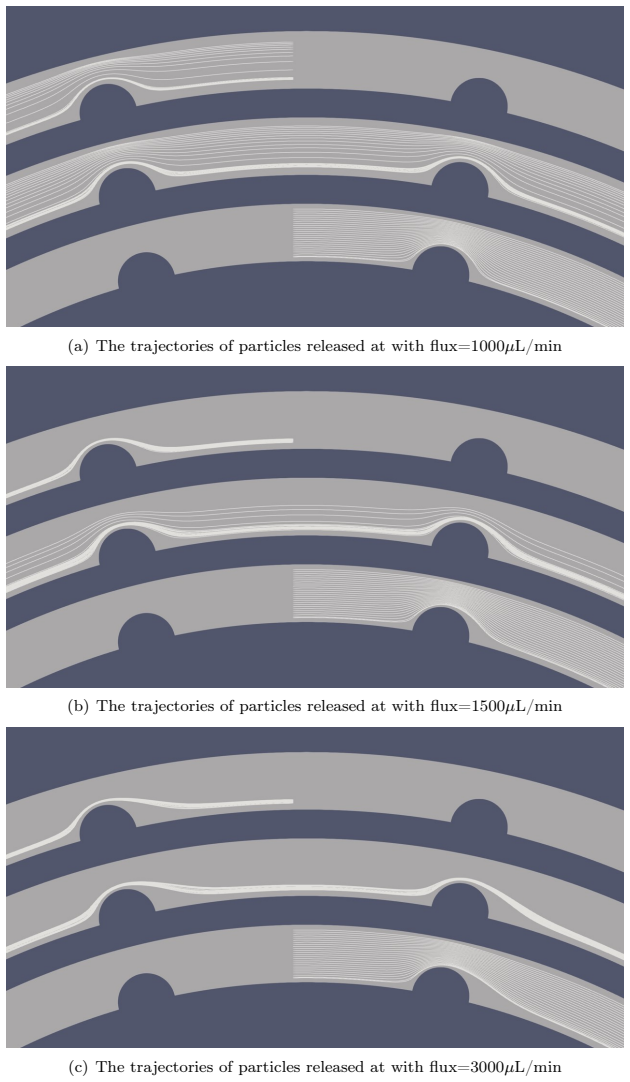
- The claimed second-order time accuracy and high-order geometric fidelity make trajectories reliable enough for quantitative comparison with experiments, as demonstrated in the spiral-channel focusing simulations.
- The same localized strategy should extend to DLD devices and other microfluidic sub-structures where particle shape affects the trajectory, because the body-fitted mesh resolves the particle geometry sharply.
- For industrial microfluidic chip design, this offers a simulation route that can predict particle focusing positions at different flow rates without resolving the entire channel with a moving mesh.
Reading between the lines
- A direct test of the localization assumption would be a convergence study with respect to the local sub-domain size; the paper reports none, so the range of validity of the 3% accuracy claim is untested.
- The interpolation step during remeshing is a silent place where trajectory accuracy could degrade; comparing the scheme against a different transfer operator would isolate that effect.
- The method could be extended to soft particles by carrying the deformation history across remesh boundaries; currently B is kept only in the local patch, which is reasonable for near-rigid particles but questionable for compliant ones.
- For particles approaching walls or obstacles, the steady-background assumption breaks down earlier; a minimal extension would be to enlarge the local domain adaptively when the particle-pillar gap becomes small.
Signed reviews
Editorial analysis
A structured set of objections, weighed in public.
Referee Report
Summary. The manuscript proposes a quasi-monolithic arbitrary Lagrangian-Eulerian (ALE) finite element method for fluid-structure interaction, combining a P2/P1 Taylor-Hood discretization, a P1 approximation of the left Cauchy-Green tensor, isoparametric P2 geometric representation of curved interfaces, and a second-order implicit-explicit partitioned Runge-Kutta time integrator. To address scale disparity, it introduces a localized updating strategy in which the FSI system is solved only on a body-fitted local mesh whose boundary data are taken from a precomputed steady background flow. Numerical results include a 2D convergence study for a particle trajectory, a 3D settling-sphere comparison with the experiments of Ten Cate et al., and a 3D spiral-channel particle-focusing demonstration. The abstract additionally claims that the Turek-Hron FSI3 benchmark reproduces the reference beam-tip amplitude and frequency within 3%.
Significance. The monolithic ALE formulation is standard and the settling-sphere comparison is a useful external validation. If the localized updating strategy were rigorously validated, the method could become a practically useful tool for multiscale microfluidic FSI. However, the headline FSI3 benchmark appears only in the abstract and is absent from the numerical results; the only external validation does not exercise the localized updating strategy; and the spiral-channel demonstration is qualitative. The convergence study is a self-convergence test of a trajectory, not a demonstration of optimal high-order convergence of the ALE scheme. These gaps make the paper's central claims currently unsupported.
major comments (3)
- [Abstract; Section 5] The abstract states that the Turek-Hron FSI3 benchmark, at unit density ratio, reproduces the reference beam-tip amplitude and frequency within 3% and confirms stability under added-mass coupling. I could not find this benchmark anywhere in Section 5 or elsewhere in the manuscript. The numerical results comprise a convergence study (5.1), a falling sphere (5.2), and a spiral channel (5.3), with no FSI3 setup, no reference data, and no error table. This is a load-bearing validation claim and must be either added to the manuscript or removed from the abstract.
- [Section 4 (Steps 3-6) and Section 5.3] The localized updating strategy replaces the true boundary data on the local mesh by the precomputed steady background velocity u_bg (Steps 3-4) and fills newly created non-overlapping mesh regions with u_bg (Step 6). This is valid only if the particle-induced disturbance is negligible at the local boundary. No convergence study with respect to the local-domain size or the particle-boundary distance is reported. The only quantitative experimental validation (Section 5.2) is a full-domain simulation without the local update, while the spiral-channel example (Section 5.3) uses the local update but reports no comparison against experiment or a full-domain reference. Thus the multi-scale accuracy claim is not established.
- [Section 5.1, Eq. (28), Tables 1-4] The convergence study measures the maximum difference in the vertical coordinate of the particle trajectory, with the solution from the finest time step or finest mesh of the same code used as the reference. This is a self-consistency test, not a demonstration of optimal high-order convergence of the underlying ALE scheme. It does not verify the velocity/pressure fields against an exact or independent solution, nor does it use Richardson extrapolation. The abstract's claim that the benchmarks 'confirm the optimal high-order convergence of the underlying ALE scheme' is therefore overstated. The spatial rates in Tables 3-4 also mix mesh-order effects with geometry-approximation effects, so they should be interpreted with care.
minor comments (5)
- [Eq. (7) vs. Eq. (8)] Equation (7) writes the fluid viscous term as an integral over the whole domain Ω, whereas equation (8) correctly restricts it to Ω_f. Please correct the inconsistency.
- [Eq. (12) vs. Eq. (13)/(15)] Equation (12) contains extra F^{-T} factors in the viscous term; compare with (13) and (15), which appear to use the correct form. Please check and harmonize the notation.
- [Table 5] The column headers for viscosity and density appear to be swapped: the first numeric column (970, 965, 962, 960) has units consistent with density in kg/m^3, while the second column (373, 212, 113, 58) is consistent with dynamic viscosity in N s/m^2.
- [Remark 2] Remark 2 says the local updating strategy is demonstrated for a 2D case, but Section 5.3 presents a 3D spiral-channel simulation. Please clarify this discrepancy.
- [Throughout] There are several typos and minor wording issues, e.g., 'Young's mudulous' should be 'Young's modulus', 'Ecperimental data' in the Figure 7 caption should be 'Experimental data', and the description of the first-order scheme in (17)-(19) as 'semi-implicit Euler' could be clarified.
Circularity Check
No significant circularity: the method derivation is self-contained and benchmarks are external or standard self-convergence.
full rationale
The paper's derivation chain is self-contained and does not reduce to its own inputs. The FSI weak form (Eq. 8) and the ALE reference formulation (Eq. 12) are derived directly from the stated continuum model, and the discrete system (13) follows from standard Taylor-Hood P2/P1 finite elements and the IMEX-PRK discretization, with no parameters fitted to the target benchmark outputs. The convergence study (Sec. 5.1) measures error against the finest-resolution run of the same scheme, which is standard self-convergence practice rather than a fitted prediction; it does not itself certify physical accuracy. The falling-sphere validation (Sec. 5.2) is an external benchmark against Ten Cate et al. [37] and involves no calibrated constants, so the agreement reported is independent evidence. The Turek-Hron FSI3 claim in the abstract is likewise an external reference benchmark, and the spiral-channel demonstration (Sec. 5.3) is qualitative; neither depends on a self-citation. There are no load-bearing self-citations: the kinematic relation [22], IMEX schemes [2,18], and experimental references [37] are all independent prior work. The only notable caveat is the local-updating assumption in Sec. 4, Steps 3-4, that the precomputed background velocity u_bg can be imposed on the local-domain boundary; this is an approximation and a correctness risk, but not a circular reduction, because the local FSI solve still computes the particle motion rather than reading it off from u_bg. Accordingly, no circular step is present.
Assumptions & free parameters
free parameters (3)
- local domain size (extent of M_local)
- remeshing thresholds
- PRK coefficients gamma, beta0, beta*, c0, c* =
0.2929, -1.4142, 2.4142, -0.7071, 1.7071
assumptions (6)
- standard math Incompressible Navier-Stokes and incompressible neo-Hookean solid model (Eqs. 1-6) governing fluid-structure interaction
- domain assumption Interface conditions (5): velocity continuity and stress balance; pressures independent in solid and fluid
- ad hoc to paper The harmonic mesh-extension is solved in the reference metric (plain Laplacian in Ω) rather than the physical metric
- domain assumption Background steady flow u_bg is unaffected by the moving particle at the local-domain boundary; Dirichlet interpolation is accurate
- domain assumption The isoparametric P2 discrete interface gives sufficient geometric fidelity and defines the reference configuration
- ad hoc to paper The proposed IMEX-PRK scheme (20)-(25) is second-order and stable for the nonlinear FSI system
Cite this review
Pith. "Pith review of A quasi-monolithic localized high-order ALE finite element method for multi-scale fluid-structure interaction problems." pith.science (2026). https://pith.science/paper/H7G5V5YS
@misc{pith2026260202003,
  author       = {Pith},
  title        = {Pith review of: A quasi-monolithic localized high-order ALE finite element method for multi-scale fluid-structure interaction problems},
  year         = {2026},
  howpublished = {\url{https://pith.science/paper/H7G5V5YS}},
  note         = {Machine review of arXiv:2602.02003}
}
abstract
This paper presents a quasi-monolithic localized high-order arbitrary Lagrangian-Eulerian (qMLH-ALE) finite element method for multi-scale fluid-structure interaction (FSI) in microfluidic systems. The fluid momentum, the incompressible Neo-Hookean constitutive law, and the left Cauchy-Green tensor $\mathcal{B}$ are assembled into a single implicit system, while the harmonic mesh extension is updated explicitly in a staggered manner. Isoparametric $\mathcal{P}_2$ elements provide third-order geometric approximation of curved fluid-solid interfaces, and a second-order implicit-explicit partitioned Runge-Kutta scheme delivers second-order temporal accuracy without the dissipation of backward Euler. A localized updating strategy confines the moving mesh and the deformation history to a body-fitted sub-domain coupled with a precomputed steady background flow, bridging the scale disparity between local FSI dynamics and the macroscopic microchannel geometry. The Turek-Hron FSI3 benchmark, performed at unit fluid-solid density ratio, reproduces the reference beam-tip amplitude and frequency within $3\%$, confirming stability under the strong added-mass coupling that destabilizes conventional partitioned schemes. Three-dimensional particle-focusing simulations in spiral microchannels further illustrate the framework on long-range multi-scale problems.
Figures


Figures from the paper (8 more)


Reference graph
Works this paper leans on
-
[1]
A Sharp-Interface Fluid-Structure Interaction Algo- rithm for Modeling Red Blood Cells
TD AlMomani, SC Vigmostad, and LA Alzube. “A Sharp-Interface Fluid-Structure Interaction Algo- rithm for Modeling Red Blood Cells.” In:Jordan Journal of Mechanical & Industrial Engineering6.2 (2012)
2012
-
[2]
Implicit-explicit Runge-Kutta methods for time-dependent partial differential equations
Uri M Ascher, Steven J Ruuth, and Raymond J Spiteri. “Implicit-explicit Runge-Kutta methods for time-dependent partial differential equations”. In:Applied Numerical Mathematics25.2-3 (1997), pp. 151–167
1997
-
[3]
Numerical Simulation of Biological Particle Separation in a Spiral Microchannel Using the Dielectrophoresis Mechanism
Sajjad Betyar and Abbas Ramiar. “Numerical Simulation of Biological Particle Separation in a Spiral Microchannel Using the Dielectrophoresis Mechanism”. In:Iranica Journal of Energy & Environment 17.1 (2026), pp. 171–179
2026
-
[4]
A microfluidic device integrating spiral focusing and micropillar filtration for Enhanced separation of Overlapping-Sized microparticles
Jin Chen et al. “A microfluidic device integrating spiral focusing and micropillar filtration for Enhanced separation of Overlapping-Sized microparticles”. In:Microchemical Journal208 (2025), p. 112570
2025
-
[5]
A review of sorting, separation and isolation of cells and microbeads for biomedical applications: microfluidic approaches
Arash Dalili, Ehsan Samiei, and Mina Hoorfar. “A review of sorting, separation and isolation of cells and microbeads for biomedical applications: microfluidic approaches”. In:Analyst144.1 (2019), pp. 87– 113
2019
-
[6]
Finite strain poro-hyperelasticity: an asymptotic multi-scale ALE-FSI approach supported by ANNs
Hamidreza Dehghani and Andreas Zilian. “Finite strain poro-hyperelasticity: an asymptotic multi-scale ALE-FSI approach supported by ANNs”. In:Computational Mechanics71.4 (2023), pp. 695–719
2023
-
[7]
Differential sorting of microparticles using spiral microchannels with elliptic con- figurations
Kaan Erdem et al. “Differential sorting of microparticles using spiral microchannels with elliptic con- figurations”. In:Micromachines11.4 (2020), p. 412
2020
-
[8]
Viscoelastic particle focusing and separation in a spiral channel
Haidong Feng et al. “Viscoelastic particle focusing and separation in a spiral channel”. In:Microma- chines13.3 (2022), p. 361
2022
Show all 41 references
-
[9]
Deep learning detector for high precision monitoring of cell encapsulation statistics in microfluidic droplets
Karl Gardner et al. “Deep learning detector for high precision monitoring of cell encapsulation statistics in microfluidic droplets”. In:Lab on a Chip22.21 (2022), pp. 4067–4080
2022
-
[10]
Modeling and controls of fluid-structure interactions (FSI) in dynamic morphing flight
Bibek Gupta, Eric Sihite, and Alireza Ramezani. “Modeling and controls of fluid-structure interactions (FSI) in dynamic morphing flight”. In:arXiv preprint arXiv:2406.13039(2024)
2024 arXiv
-
[11]
An arbitrary Lagrangian-Eulerian computing method for all flow speeds
Cyrill W Hirt, Anthony A Amsden, and JL Cook. “An arbitrary Lagrangian-Eulerian computing method for all flow speeds”. In:Journal of computational physics14.3 (1974), pp. 227–253
1974
-
[12]
A hybrid phase field method for fluid-structure interactions in viscous fluids
Qi Hong and Qi Wang. “A hybrid phase field method for fluid-structure interactions in viscous fluids”. In:arXiv preprint arXiv:2109.07361(2021)
2021 arXiv
-
[13]
Analysis of Separation Efficiency Focusing on Particle Concentration and Size Using a Spiral Microfluidic Device
Mitsuhiro Horade et al. “Analysis of Separation Efficiency Focusing on Particle Concentration and Size Using a Spiral Microfluidic Device”. In:Journal of Robotics and Mechatronics35.5 (2023), pp. 1203– 1212
2023
-
[14]
Material point method applied to fluid-structure interaction (FSI)/aeroelasticity problems
Patrick Hu et al. “Material point method applied to fluid-structure interaction (FSI)/aeroelasticity problems”. In:48th AIAA aerospace sciences meeting including the new horizons forum and aerospace exposition. 2010, p. 1464. 24
2010
-
[15]
Design, control, aerodynamic performances, and structural integrity investigations of compact ducted drone with co-axial propeller for high altitude surveillance
Shyam Sundar Jayakumar et al. “Design, control, aerodynamic performances, and structural integrity investigations of compact ducted drone with co-axial propeller for high altitude surveillance”. In:Sci- entific Reports14.1 (2024), p. 6330
2024
-
[16]
On-chip label-free manipulation and enrichment of microparticles by utilizing DLD microfluidic chip
Shuyue Jiang et al. “On-chip label-free manipulation and enrichment of microparticles by utilizing DLD microfluidic chip”. In:Journal of Physics: Conference Series. Vol. 3021. 1. IOP Publishing. 2025, p. 012097
2025
-
[17]
A variational flexible multibody formu- lation for partitioned fluid–structure interaction: Application to bat-inspired drones and unmanned air-vehicles
Vaibhav Joshi, Rajeev K Jaiman, and Carl Ollivier-Gooch. “A variational flexible multibody formu- lation for partitioned fluid–structure interaction: Application to bat-inspired drones and unmanned air-vehicles”. In:Computers & Mathematics with Applications80.12 (2020), pp. 2707–2737
2020
-
[18]
Additive Runge–Kutta schemes for convection– diffusion–reaction equations
Christopher A Kennedy and Mark H Carpenter. “Additive Runge–Kutta schemes for convection– diffusion–reaction equations”. In:Applied numerical mathematics44.1-2 (2003), pp. 139–181
2003
-
[19]
High throughput viscoelastic particle focusing and separation in spiral mi- crochannels
Tharagan Kumar et al. “High throughput viscoelastic particle focusing and separation in spiral mi- crochannels”. In:Scientific reports11.1 (2021), p. 8467
2021
-
[20]
Full-scale ship collision, grounding and sinking simulation using highly advanced M&S system of FSI analysis technique
Sang-Gab Lee et al. “Full-scale ship collision, grounding and sinking simulation using highly advanced M&S system of FSI analysis technique”. In:Procedia engineering173 (2017), pp. 1507–1514
2017
-
[21]
Numerical Simulation and Analysis of Heart–Aorta Fluid–Structure Interaction Based on S-ALE Method
Xiong Li et al. “Numerical Simulation and Analysis of Heart–Aorta Fluid–Structure Interaction Based on S-ALE Method”. In:Applied Sciences15.14 (2025), p. 7769
2025
-
[22]
An Eulerian description of fluids containing visco-elastic particles
Chun Liu and Noel J Walkington. “An Eulerian description of fluids containing visco-elastic particles”. In:Archive for rational mechanics and analysis159.3 (2001), pp. 229–252
2001
-
[23]
Cascaded filter deterministic lateral displacement microchips for isolation and molecular analysis of circulating tumor cells and fusion cells
Zongbin Liu et al. “Cascaded filter deterministic lateral displacement microchips for isolation and molecular analysis of circulating tumor cells and fusion cells”. In:Lab on a Chip21.15 (2021), pp. 2881– 2891
2021
-
[24]
A 3D phase-field based Eulerian variational frame- work for multiphase fluid–structure interaction with contact dynamics
Xiaoyu Mao, Biswajeet Rath, and Rajeev Jaiman. “A 3D phase-field based Eulerian variational frame- work for multiphase fluid–structure interaction with contact dynamics”. In:Computer Methods in Applied Mechanics and Engineering429 (2024), p. 117172
2024
-
[25]
Margination of white blood cells: a computational approach by a hydrodynamic phase field model
Wieland Marth, Sebastian Aland, and Axel Voigt. “Margination of white blood cells: a computational approach by a hydrodynamic phase field model”. In:Journal of fluid mechanics790 (2016), pp. 389– 406
2016
-
[26]
Immersed boundary methods
Rajat Mittal and Gianluca Iaccarino. “Immersed boundary methods”. In:Annu. Rev. Fluid Mech.37.1 (2005), pp. 239–261
2005
-
[27]
Microfluidic-based approaches in targeted cell/particle separation based on physical properties: fundamentals and applications
Rohollah Nasiri et al. “Microfluidic-based approaches in targeted cell/particle separation based on physical properties: fundamentals and applications”. In:Small16.29 (2020), p. 2000171
2020
-
[28]
Inertial focusing of microparticles in curvilinear microchannels
Arzu Özbey et al. “Inertial focusing of microparticles in curvilinear microchannels”. In:Scientific Re- ports6.1 (2016), p. 38809
2016
-
[29]
Numerical analysis of blood flow in the heart
Charles S Peskin. “Numerical analysis of blood flow in the heart”. In:Journal of computational physics 25.3 (1977), pp. 220–252
1977
-
[30]
Recent Developments in the Immersed Boundary Method for Complex Fluid– Structure Interactions: A Review
Omkar Powar et al. “Recent Developments in the Immersed Boundary Method for Complex Fluid– Structure Interactions: A Review”. In:Fluids10.5 (2025), p. 134. 25
2025
-
[31]
A Phase Field Formulation of Frictional Sliding Contact for 3D Fully Eulerian Fluid Structure Interactions
Biswajeet Rath and Rajeev K Jaiman. “A Phase Field Formulation of Frictional Sliding Contact for 3D Fully Eulerian Fluid Structure Interactions”. In:arXiv preprint arXiv:2509.11611(2025)
2025
-
[32]
An Interface-Driven Adaptive Variational Pro- cedure for Fully Eulerian Fluid-Structure Interaction via Phase-field Modeling
Biswajeet Rath, Xiaoyu Mao, and Rajeev K Jaiman. “An Interface-Driven Adaptive Variational Pro- cedure for Fully Eulerian Fluid-Structure Interaction via Phase-field Modeling”. In:arXiv preprint arXiv:2112.15309(2021)
2021 arXiv
-
[33]
Spirallarge-dimensionmicrofluidicchannelforflow-rate-andparticle-size-insensitive focusing by the stabilization and acceleration of secondary flow
ShaofeiShenetal.“Spirallarge-dimensionmicrofluidicchannelforflow-rate-andparticle-size-insensitive focusing by the stabilization and acceleration of secondary flow”. In:Analytical Chemistry96.4 (2024), pp. 1750–1758
2024
-
[34]
Fluid-structure interaction analysis of ship-ship collisions
Ming Song, Jun Ma, and Yi Huang. “Fluid-structure interaction analysis of ship-ship collisions”. In: Marine Structures55 (2017), pp. 121–136
2017
-
[35]
Immersed boundary methods for simulating fluid–structure in- teraction
Fotis Sotiropoulos and Xiaolei Yang. “Immersed boundary methods for simulating fluid–structure in- teraction”. In:Progress in Aerospace Sciences65 (2014), pp. 1–21
2014
-
[36]
Modeling dynamics of the cardiovascular system using fluid-structure interaction methods
Faiz Syed, Sahar Khan, and Milan Toma. “Modeling dynamics of the cardiovascular system using fluid-structure interaction methods”. In:Biology12.7 (2023), p. 1026
2023
-
[37]
Particle imaging velocimetry experiments and lattice-Boltzmann simulations on a single sphere settling under gravity
A Ten Cate et al. “Particle imaging velocimetry experiments and lattice-Boltzmann simulations on a single sphere settling under gravity”. In:Physics of Fluids14.11 (2002), pp. 4012–4025
2002
-
[38]
An FSI solution technique based on the DSD/SST method and its applications
Fang-Bao Tian et al. “An FSI solution technique based on the DSD/SST method and its applications”. In:Mathematical Models and Methods in Applied Sciences25.12 (2015), pp. 2257–2285
2015
-
[39]
Effects of flowing RBCs on adhesion of a circulating tumor cell in microvessels
LL Xiao et al. “Effects of flowing RBCs on adhesion of a circulating tumor cell in microvessels”. In: Biomechanics and modeling in mechanobiology16.2 (2017), pp. 597–610
2017
-
[40]
Flow-rate and particle-size insensitive inertial focusing in dimension-confined ultra-low aspect ratio spiral microchannel
Lei Zhao et al. “Flow-rate and particle-size insensitive inertial focusing in dimension-confined ultra-low aspect ratio spiral microchannel”. In:Sensors and Actuators B: Chemical369 (2022), p. 132284
2022
-
[41]
Injectable microfluidic hydrogel microspheres for cell and drug delivery
Zhenyu Zhao et al. “Injectable microfluidic hydrogel microspheres for cell and drug delivery”. In:Ad- vanced Functional Materials31.31 (2021), p. 2103339. 26
2021
Reviewed August 3, 2026 · model on record in the stance chip above.
Discussion (0). Continue with ORCID to comment.