Double-pulse control of all optical magnetization reversal in Tb/Co multilayers
Pith reviewed 2026-07-02 10:21 UTC · model grok-4.3
The pith
Varying the delay between two laser pulses controls the final magnetic domain pattern in Tb/Co multilayers after all-optical reversal.
A machine-rendered reading of the paper's core claim, the machinery that carries it, and where it could break.
Core claim
Double-pulse laser excitation with tunable delay between pulses manipulates the recovery of magnetic anisotropy after heat-induced quenching, thereby controlling the precessional magnetization switching and the resulting domain patterns in the multilayers.
What carries the argument
Double-pulse excitation with adjustable temporal delay that intervenes during the anisotropy recovery phase of precessional switching.
Load-bearing premise
The ring-shaped switching arises because heat quenches the anisotropy and its subsequent recovery drives precessional magnetization switching.
What would settle it
Experiments in which changing the pulse delay produces no measurable change in the final domain pattern, or numerical models lacking anisotropy recovery that still reproduce the observed control.
Figures

read the original abstract
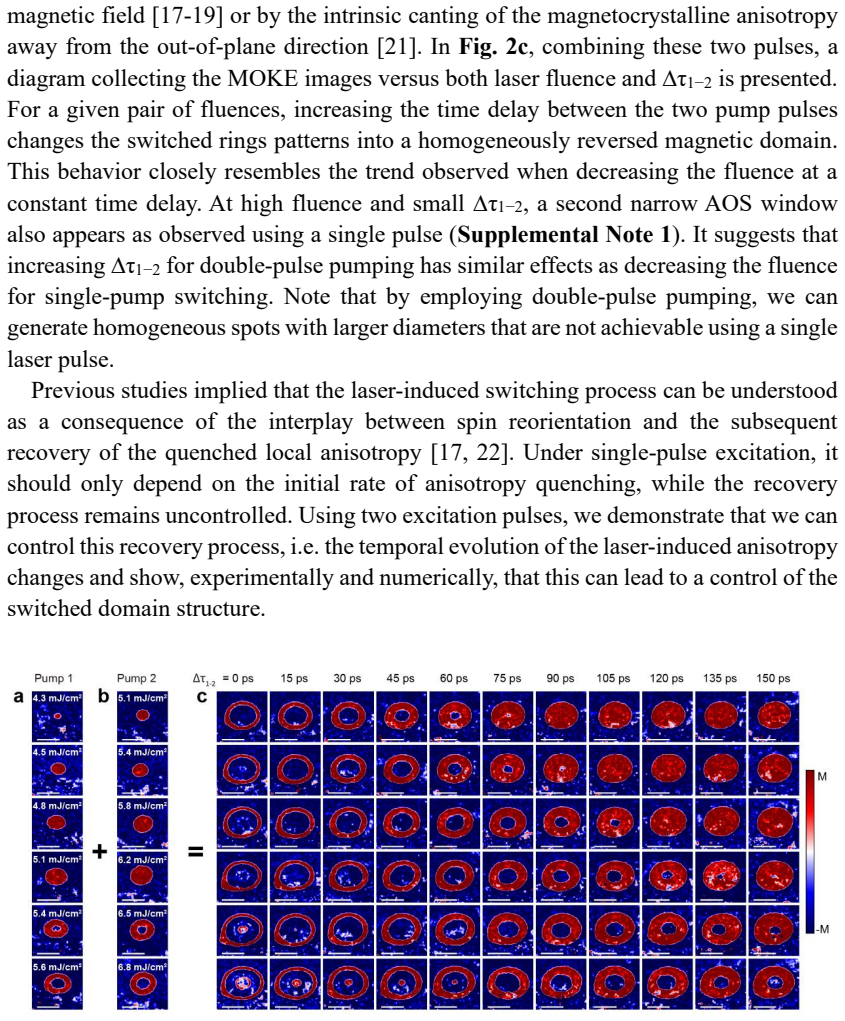
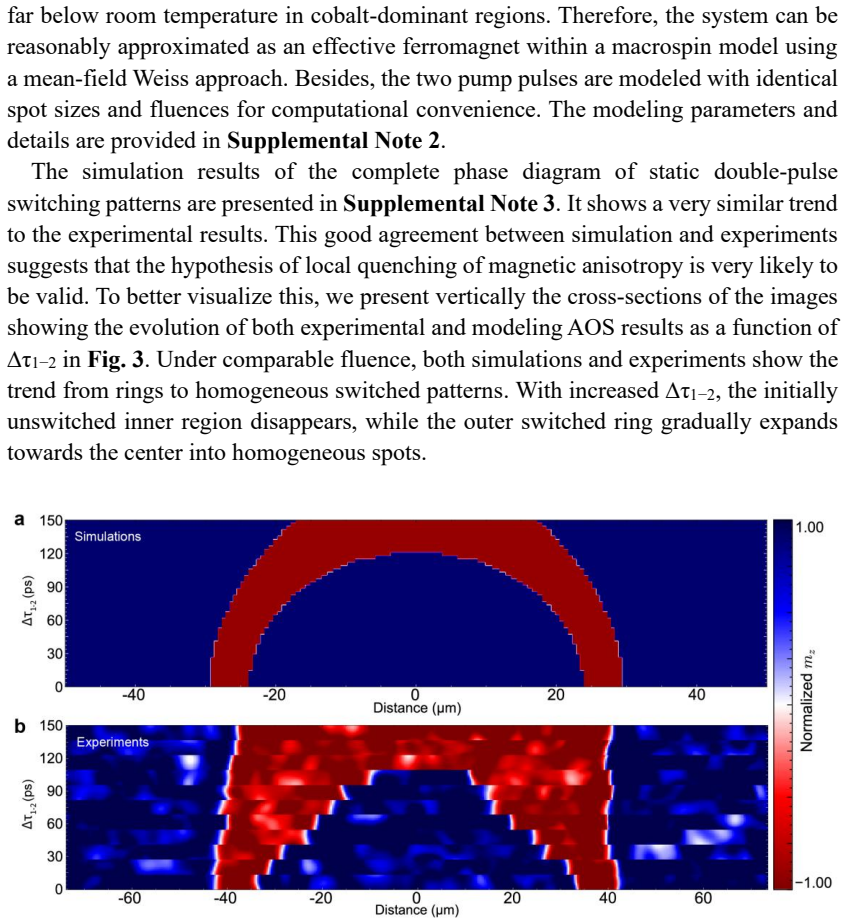
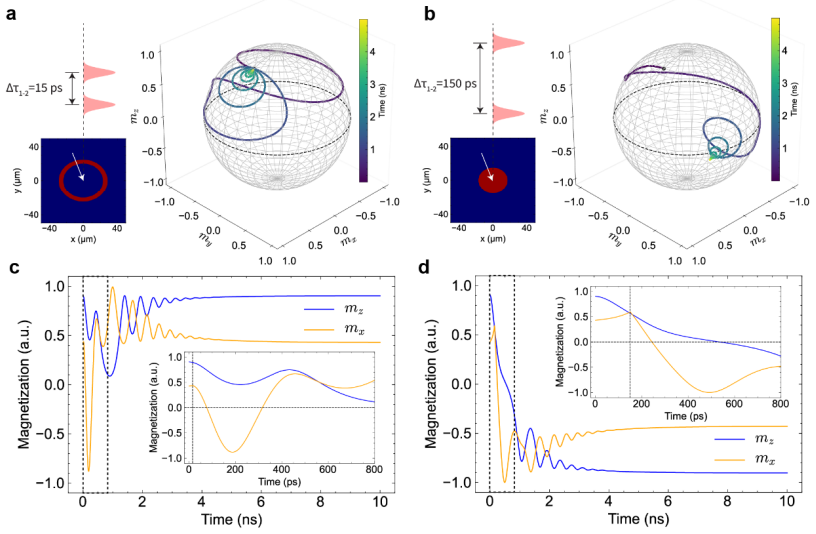
Recent experiments have shown that femtosecond laser pulse with a Gaussian intensity profile can induce magnetization reversal in Tb/Co multilayers with a ring-shaped switching pattern within the laser-irradiated area. Here, we investigate the ultrafast magnetization dynamics leading to such a ring-shaped switching by using double-pulse laser excitation. The laser pulses cause heat-induced quenching and subsequent recovery of the magnetic anisotropy in the multilayers and drive the precessional magnetization switching in the magnetic multilayers. By adjusting the delay between the two pump pulses, we demonstrate that the recovery process can be manipulated and show, experimentally and numerically, that this allows control over the final magnetic domain pattern.
Editorial analysis
A structured set of objections, weighed in public.
Referee Report
Summary. The manuscript investigates ultrafast magnetization dynamics in Tb/Co multilayers under double-pulse femtosecond laser excitation. It claims that the pulses induce heat-driven quenching and recovery of magnetic anisotropy, which drives precessional switching and produces a ring-shaped reversal pattern; by varying the temporal delay between the two pulses, the recovery process can be manipulated to control the final magnetic domain pattern. Both experimental observations and numerical simulations are presented in support of this delay-based control.
Significance. If the central claim holds, the work demonstrates a practical experimental handle (pulse delay) for shaping all-optical switching outcomes in a materials system already known for single-pulse ring reversal. The combination of experiment and simulation is a strength, as it directly links the observed domain control to the proposed anisotropy-recovery mechanism. This could inform design of ultrafast magnetic devices, though the result remains specific to the Tb/Co multilayer geometry and Gaussian excitation profile studied.
major comments (2)
- [Methods] Methods (experimental): the manuscript provides no quantitative details on laser fluence, pulse duration, spot size, or the magneto-optical imaging technique used to extract domain patterns; without these, it is impossible to assess whether the reported delay dependence is reproducible or sensitive to small variations in excitation conditions.
- [Numerical simulations] Numerical simulations: the model for temperature-dependent anisotropy recovery and its coupling to the Landau-Lifshitz-Gilbert dynamics is not specified (e.g., functional form of K(T), damping value, or how the two-pulse heat profile is implemented); this leaves the claim that delay directly controls precessional switching without a clear route to independent verification.
minor comments (2)
- [Abstract] The abstract states the mechanism (heat-induced quenching and recovery driving precessional switching) without a forward reference to the section where this is quantified or tested.
- [Figures] Figure captions should explicitly state the number of experimental repetitions or simulation runs underlying each domain image.
Simulated Author's Rebuttal
We thank the referee for the constructive comments and positive assessment of the significance of our work. We address each major comment below and will revise the manuscript accordingly to improve reproducibility and clarity.
read point-by-point responses
-
Referee: [Methods] Methods (experimental): the manuscript provides no quantitative details on laser fluence, pulse duration, spot size, or the magneto-optical imaging technique used to extract domain patterns; without these, it is impossible to assess whether the reported delay dependence is reproducible or sensitive to small variations in excitation conditions.
Authors: We agree that quantitative experimental parameters are essential for reproducibility. In the revised manuscript we will add a dedicated Methods section that specifies the laser fluences employed, pulse durations, spot sizes, and the magneto-optical Kerr imaging setup together with the procedure used to extract domain patterns. revision: yes
-
Referee: [Numerical simulations] Numerical simulations: the model for temperature-dependent anisotropy recovery and its coupling to the Landau-Lifshitz-Gilbert dynamics is not specified (e.g., functional form of K(T), damping value, or how the two-pulse heat profile is implemented); this leaves the claim that delay directly controls precessional switching without a clear route to independent verification.
Authors: We acknowledge that the simulation details were not fully specified. The revised manuscript will include an expanded description of the numerical model, explicitly stating the functional form of K(T), the Gilbert damping parameter, and the implementation of the two-pulse heat profile within the LLG framework. revision: yes
Circularity Check
No significant circularity
full rationale
The paper reports an experimental and numerical demonstration that varying the delay between two pump pulses manipulates anisotropy recovery to control final magnetic domain patterns via precessional switching. The abstract and described approach directly test this mechanism by adjusting an external experimental parameter (pulse delay) and observing the resulting pattern changes, with no equations, fitted parameters, or self-citations presented that reduce any prediction to a quantity defined by the inputs themselves. The derivation chain is therefore self-contained against external benchmarks and does not exhibit any of the enumerated circularity patterns.
Axiom & Free-Parameter Ledger
Reference graph
Works this paper leans on
-
[1]
C., Dieny, B
Sousa, R. C., Dieny, B. & Prejbeanu, I. L., Sci Rep 10, 5211 (2020). 2 Mishra, K., Blank, T. G. H., Davies, C. S., Avilés-Félix, L., Salomoni, D., Buda-
2020
-
[2]
Kimel, A. V . & Kirilyuk, A., Phys Rev Res 5, 023163 (2023). 3 Byrnes, S. J., arXiv preprint arXiv:1603.02720 (2016). 4 Polyanskiy, M. N., Sci Data 11 (2024). 5 Erskine, J. L., Blake, G. A. & Flaten, C. J., J Opt Soc Am 64, 1332 (1974). 6 Salomoni, D., Peng, Y ., Farcis, L., Auffret, S., Hehn, M., Malinowski, G.,
-
[3]
D., Sousa, R
Mangin, S., Dieny, B., Buda-Prejbeanu, L. D., Sousa, R. C. & Prejbeanu, I. L., Phys Rev Appl 20, 034070 (2023). 7 Avilés-Félix, L., Farcis, L., Jin, Z., Alvaro -Gómez, L., Li, G., Yamada, K. T.,
2023
-
[4]
V ., Rasing, T., Dieny, B., Sousa, R
Kirilyuk, A., Kimel, A. V ., Rasing, T., Dieny, B., Sousa, R. C., Prejbeanu, I. L. & Buda-Prejbeanu, L. D., Sci Rep 11, 6576 (2021). 8 Blank, T. G. H., Hermanussen, S., Lichtenberg, T., Rasing, T., Kirilyuk, A.,
2021
-
[5]
& Kimel, A., Adv Mater Interfaces 9, 202201283 (2022)
Koopmans, B. & Kimel, A., Adv Mater Interfaces 9, 202201283 (2022)
2022
discussion (0)
Sign in with ORCID, Apple, or X to comment. Anyone can read and Pith papers without signing in.