REVIEW 6 major objections 5 minor 1 cited by
SplatMAP: Online Dense Monocular SLAM with 3D Gaussian Splatting
T0 review · 6 major / 5 minor · reviewed 2026-08-10 · deepseek-v4-flash
Pith's one-line read Monocular SLAM plus 3D Gaussians beats prior dense mappers
desk verdict A sensible DROID-SLAM + 3DGS system with honest ablations, but the SOTA margins are inconsistent and the geometric fidelity claim is untested. read the letter →
The pith
A machine-rendered reading of the paper's core claim, the machinery that carries it, and where it could break.
The reading
What carries the argument
The central mechanism is SLAM-Informed Adaptive Densification (SIAD), which converts DROID-SLAM's per-frame reliability masks and iterative depth and pose updates into explicit point-cloud operations: positions are updated by the incremental pose and depth corrections, invalid points are pruned, and newly valid points are added. The reliability masks are derived from three consistency metrics: depth validity, frame-to-frame geometric reprojection distance, and factor-graph confidence weights. The second mechanism is Geometry-Guided Optimization, whose final loss is $L = L_{rgb} + \lambda_{geo} L_{geo}$, where $L_{geo}$ is an edge-aware normal loss computed from depth-map gradients and modulated by a Gaussian-like smooth weighting function $\omega(x) = \exp(-|x-1|^2/\sigma^2)$ that balances edge emphasis with spatial continuity.
What would settle it
Run SplatMAP on any monocular sequence that has ground-truth depth (for instance, an RGB-D SLAM benchmark with synchronized depth sensor) and compare the Gaussian-rendered depth or the SLAM depth updates against that ground truth. If the reliability masks systematically retain wrong depths, or if replacing the masks with random pruning preserves the reported PSNR and ATE gains, then the central claim that SIAD prunes erroneous points and drives the improvements would be refuted.
Extended reading notes
Core claim
The central claim is that SLAM's continuously updated depth and pose estimates can be used as a dynamic supervision signal for a 3D Gaussian scene representation, rather than treating the initial SLAM point cloud as fixed. SplatMAP introduces SLAM-Informed Adaptive Densification (SIAD), which uses DROID-SLAM's reliability masks to prune unreliable points, update the positions of reliable points, and insert newly valid points, replacing the cloning-and-splitting densification of vanilla 3DGS. It then jointly optimizes appearance (an L1 plus multi-scale SSIM photometric loss) and geometry (an edge-aware normal loss with a smooth Gaussian weighting function), so the Gaussian map inherits both photometric and geometric fidelity. The paper argues that this pipeline removes ghosting artifacts and yields state-of-the-art monocular results on Replica and TUM-RGBD, with the best reported trajectory accuracy among the compared methods.
Load-bearing premise
The load-bearing premise is that DROID-SLAM's reliability masks correctly separate trustworthy depth points from unreliable ones: when a depth value is wrong but stays marked reliable, the Gaussian map inherits the error and the photometric and normal losses must fix it, but the paper never evaluates depth or normal accuracy against ground truth.
Editorial extensions
If this is right
- Monocular dense reconstruction can reach or surpass RGB-D reconstruction quality in rendering metrics, without requiring a depth sensor.
- Using SLAM reliability masks to prune and update Gaussians removes ghosting artifacts that vanilla 3DGS densification leaves uncorrected, which should improve rendering from novel viewpoints.
- The reported average ATE of 0.179 on Replica suggests trajectory accuracy comparable to the best RGB-D methods, opening monocular-only navigation and mapping in indoor scenes.
- The 3.74 fps runtime and 14.96 GiB peak GPU memory usage show that the method can run near-real-time on a single high-end GPU, unlike NeRF-based dense SLAM systems.
- The ablation study shows that SIAD, the smooth weighting, and MS-SSIM each add consistent gains on both Replica and TUM-RGBD, indicating the improvements are not dataset-specific.
Reading between the lines
- The paper's internal logic implies a testable prediction: on sequences where DROID-SLAM's confidence masks are noisy (low texture, dynamic scenes), the pruning decisions should correlate with actual depth-error reduction; measuring that correlation would directly probe whether SIAD is doing the work.
- An implicit consequence is that 3DGS densification hyperparameters (cloning and splitting thresholds) become less critical, since SIAD replaces them; this could simplify adapting 3DGS to any SLAM pipeline that outputs dense depth with confidence masks.
- The smooth weighting function in the geometric loss is a transferable loss-design idea: replacing hard gradient switching with Gaussian-like modulation avoids over-penalizing sharp edges, which could benefit other edge-aware rendering and depth-supervision tasks.
- Because the paper does not report the mask thresholds ($thresh$, $\epsilon$) or the loss weights ($\sigma$, $\lambda_{geo}$, $\lambda_{ms-ssim}$), the exact system behavior is unspecified; a fair reimplementation would need those values to confirm the reported margins.
Signed reviews
Editorial analysis
A structured set of objections, weighed in public.
Referee Report
Summary. The paper proposes SplatMAP, an online monocular dense SLAM system that couples DROID-SLAM with 3D Gaussian Splatting. The two technical contributions are SLAM-Informed Adaptive Densification (SIAD), which prunes, updates, and densifies Gaussian positions using SLAM depth and pose updates under reliability masks, and Geometry-Guided Optimization, which adds an edge-aware normal smoothing term and MS-SSIM to the photometric loss. Experiments on Replica and TUM-RGBD report state-of-the-art PSNR/SSIM/LPIPS among monocular systems, competitive ATE, and an ablation study that isolates the proposed components.
Significance. If the reported results are correct, the paper would be a strong empirical demonstration that monocular 3DGS SLAM can match or exceed RGB-D systems in rendering quality, with a practical runtime of 3.74 fps. The ablation study isolates SIAD and the smooth weighting function and shows consistent gains on two datasets, which is a genuine strength. The paper also compares against several recent baselines and provides a demonstration video. However, the absence of geometric fidelity metrics, a promised depth loss that never appears in the final loss, and numerical inconsistencies in the TUM baseline table mean the central claims are currently not fully supported; the paper would be significantly strengthened by addressing these issues.
major comments (6)
- [Sec. 4.3.2, Table 3, Abstract, Conclusion] The reported TUM-RGBD SSIM improvement is not reproducible from the paper's own table. In Sec. 4.3.2 the authors state that GLORIE-SLAM has an average SSIM of 0.82 and that SplatMAP's 0.879 is a 6.6% improvement, but Table 3 lists GLORIE-SLAM's average SSIM as 0.77, which would imply a 14.2% improvement. The abstract and conclusion repeat the 6.6% figure. Additionally, the text quotes PhotoSLAM's average PSNR as 19.53 and SSIM as 0.77, but the per-sequence values in Table 3 (20.97, 21.07, 19.59 for PSNR) do not support those averages. Please recompute all baseline averages and ensure the text, abstract, and conclusion agree exactly with the tables.
- [Sec. 3.3.4, Eq. (8)] The SIAD position update rule in Eq. (8) is under-specified with respect to coordinate frames. The equation reads g_p^(k) = exp(Δξ^(k)) ∘ T_ij ∘ Π_c^{-1}(p, d_i^(k-1) + Δd_i^(k)), but T_ij is defined earlier (Eqs. (1) and (6)) as the relative pose between frames i and j. Taken literally, composing with T_ij maps the back-projected point into frame j's local coordinate system, not the world frame, and the subsequent exp(Δξ) does not repair this unless Δξ is also expressed in frame j. Please define whether T_ij should be the absolute world pose T_iw (or an appropriate inverse) and make the coordinate frames of all quantities in Eq. (8) explicit. This is load-bearing because SIAD is the mechanism by which the Gaussian map is supposed to stay geometrically consistent with the SLAM trajectory.
- [Sec. 3, Sec. 3.3.5, Eq. (14)] The opening paragraph of the Methodology promises that the 3D Gaussian splatting model is trained 'with a dense depth loss weighted by the depths' marginal covariances.' However, the final composite loss in Eq. (14) contains only L_rgb and λ_geo L_geo, where L_geo is the edge-aware normal-smoothness term of Eq. (12). No depth term appears anywhere in the mapping objective. Either the depth loss was part of the implementation and was accidentally omitted from the equation, or the opening paragraph describes a component that was never used. Please correct this inconsistency; if the depth loss exists, report its formulation and weight.
- [Sec. 4.3, Tables 2-3, Eqs. (11)-(13)] The paper's central claim is high-fidelity dense 3D reconstruction with geometric accuracy (Introduction, Fig. 1, Conclusion), but the evaluation reports only PSNR/SSIM/LPIPS for mapping and ATE for tracking. No depth error, normal error, Chamfer distance, or mesh accuracy against Replica/TUM ground truth is reported. The 'geometry-guided' loss in Eqs. (11)-(13) is a smoothness regularizer on rendered normals and image edges; it can improve photometric metrics while leaving Gaussian positions geometrically wrong. Please add quantitative geometric evaluation against ground-truth geometry, or explicitly restrict the claims to rendering quality and trajectory accuracy.
- [Sec. 3.3.4, Sec. 3.3.5, Eqs. (6), (7), (10), (13), (14)] Several thresholds and weights that determine the behavior of the main algorithm are not reported: thresh in Eq. (6), epsilon in Eq. (7), sigma in Eq. (13), lambda_geo in Eq. (14), and lambda_ms-ssim in Eq. (10). The keyframe window size is given only as a default of 25 with no ablation or sensitivity study. Without these values, the exact behavior of SIAD and the loss is unspecified, and the reported results are not reproducible from the paper alone. Please report all hyperparameter values and, ideally, ablate the most sensitive ones.
- [Sec. 4.1, Table 1] Table 1 compares ATE across monocular and RGB-D systems, but the paper does not state the evaluation protocol for monocular trajectories. Monocular SLAM estimates are scale-ambiguous, and ATE is typically reported after 7-DoF similarity alignment; if no alignment was applied, the comparison conflates scale drift with localization error, and if alignment was applied, the procedure and its parameters must be stated. Please specify the alignment protocol and confirm that all baselines were evaluated identically.
minor comments (5)
- [Sec. 4.4, Table 4] The runtime evaluation reports an average of 3.74 fps on 'Replica room0' but does not state the input frame rate or which GPU produced the numbers; Sec. 4.1 mentions both an RTX 4090 and an A6000 server. Please clarify the hardware and note that 3.74 fps is below real-time for 30 fps video, so the 'near real-time' characterization should be qualified accordingly.
- [Eq. (2)] The norm notation in Eq. (2) is malformed; the expression should be written as a squared Mahalanobis norm with subscript Σ_ij rather than with the doubled vertical bars as printed.
- [References] The citation 'Fisher et al. 2021' is used for both COLMAP and the TUM RGB-D dataset, but the cited reference is 'ColMap: A memory-efficient occupancy grid mapping framework,' which appears unrelated to both. Please replace these with the correct COLMAP and TUM RGB-D citations.
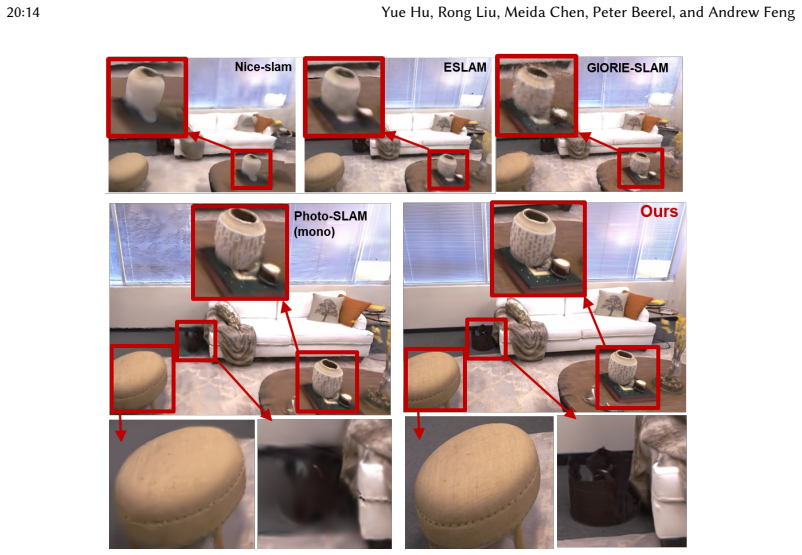
- [Table 1, Fig. 1] The spelling of GLORIE-SLAM is inconsistent: the text and Table 3 use 'GLORIE-SLAM,' while Table 1 and Fig. 1 use 'GIORIE-SLAM' at least once. Please standardize the spelling throughout.
- [Sec. 4.1] The sentence 'All comparison methods using their official implementations' is grammatically incomplete and does not state whether the baseline numbers were rerun or taken from prior papers. Please clarify the evaluation protocol, including how many sequences were used for each baseline.
Circularity Check
No load-bearing circularity; the central claims are empirical evaluations against external benchmarks, with only a minor non-load-bearing self-citation to AtomGS for the edge-aware normal loss.
full rationale
The derivation chain is not circular. SplatMAP is an empirical integration of external components (DROID-SLAM tracking, 3DGS rendering) plus two proposed mechanisms: SLAM-Informed Adaptive Densification (SIAD) and Geometry-Guided Optimization. The SIAD update rule (Eq. 8), pruning (Eq. 9), and densification are defined from SLAM masks and pose/depth updates, not from the PSNR/SSIM/LPIPS metrics used to claim success. The composite loss (Eq. 14) combines an RGB loss (Eq. 10) with an edge-aware normal loss (Eq. 12) whose weighting function is modified in Eq. 13; the claimed improvements are measured against external Replica/TUM benchmarks, so the metrics are not inputs to the method. The only same-author citation is the AtomGS normal loss [Liu et al. 2024] introduced in Sec. 3.3.5: "we add an edge-aware normal loss L_normal [Liu et al. 2024] into our system." It is a component of the loss, not a theorem invoked to force the result, and the paper's own ablation shows the other components (SIAD, SMOOTH, MS-SSIM) contribute independently. Therefore the self-citation is minor and not load-bearing. The under-specified thresholds (thresh, epsilon, sigma, lambda_geo) and the promised but absent depth-covariance loss (Sec. 3 opening vs Eq. 14) are reproducibility and correctness concerns, not circular reductions. Score 2 reflects the single non-load-bearing self-citation; no circular step is identified.
Assumptions & free parameters
free parameters (6)
- Keyframe window size =
25
- Geometric consistency threshold thresh =
not reported
- Confidence threshold epsilon =
not reported
- Smooth weighting sigma =
not reported
- Geometry loss weight lambda_geo =
not reported
- MS-SSIM lambda =
not reported
assumptions (4)
- domain assumption DROID-SLAM's monocular depth, pose, and confidence estimates are accurate enough to seed a Gaussian map
- standard math The 3DGS tile rasterizer supports differentiable rendering of depth and normals for the normal loss
- domain assumption The edge-aware normal loss (from AtomGS, Liu et al. 2024) improves reconstruction without harming appearance
- domain assumption Static scene and photometric consistency between frames
Cite this review
Pith. "Pith review of SplatMAP: Online Dense Monocular SLAM with 3D Gaussian Splatting." pith.science (2026). https://pith.science/paper/HDIQQXH7
@misc{pith2026250107015,
  author       = {Pith},
  title        = {Pith review of: SplatMAP: Online Dense Monocular SLAM with 3D Gaussian Splatting},
  year         = {2026},
  howpublished = {\url{https://pith.science/paper/HDIQQXH7}},
  note         = {Machine review of arXiv:2501.07015}
}
read the original abstract
Achieving high-fidelity 3D reconstruction from monocular video remains challenging due to the inherent limitations of traditional methods like Structure-from-Motion (SfM) and monocular SLAM in accurately capturing scene details. While differentiable rendering techniques such as Neural Radiance Fields (NeRF) address some of these challenges, their high computational costs make them unsuitable for real-time applications. Additionally, existing 3D Gaussian Splatting (3DGS) methods often focus on photometric consistency, neglecting geometric accuracy and failing to exploit SLAM's dynamic depth and pose updates for scene refinement. We propose a framework integrating dense SLAM with 3DGS for real-time, high-fidelity dense reconstruction. Our approach introduces SLAM-Informed Adaptive Densification, which dynamically updates and densifies the Gaussian model by leveraging dense point clouds from SLAM. Additionally, we incorporate Geometry-Guided Optimization, which combines edge-aware geometric constraints and photometric consistency to jointly optimize the appearance and geometry of the 3DGS scene representation, enabling detailed and accurate SLAM mapping reconstruction. Experiments on the Replica and TUM-RGBD datasets demonstrate the effectiveness of our approach, achieving state-of-the-art results among monocular systems. Specifically, our method achieves a PSNR of 36.864, SSIM of 0.985, and LPIPS of 0.040 on Replica, representing improvements of 10.7%, 6.4%, and 49.4%, respectively, over the previous SOTA. On TUM-RGBD, our method outperforms the closest baseline by 10.2%, 6.6%, and 34.7% in the same metrics. These results highlight the potential of our framework in bridging the gap between photometric and geometric dense 3D scene representations, paving the way for practical and efficient monocular dense reconstruction.
Figures


Figures from the paper (3 more)


Forward citations
Cited by 1 Pith paper
-
ContraGS: Codebook-Condensed and Trainable Gaussian Splatting for Fast, Memory-Efficient Reconstruction
ContraGS trains 3D Gaussian Splatting directly on codebook-compressed representations, cutting peak model memory ~3.5x with small quality loss.
Reference graph
Works this paper leans on
- [3]
-
[5]
Nerf: Representing scenes as neural radiance fields for view synthesis. Commun. ACM 65, 1 (2021), 99–106. Raul Mur-Artal, Jose Maria Martinez Montiel, and Juan D Tardos
work page 2021
-
[8]
arXiv preprint arXiv:2407.20219 (2024)
Global Structure-from-Motion Revisited. arXiv preprint arXiv:2407.20219 (2024). Zhexi Peng, Tianjia Shao, Yong Liu, Jingke Zhou, Yin Yang, Jingdong Wang, and Kun Zhou
arXiv 2024
-
[9]
In ACM SIGGRAPH 2024 Conference Papers
Rtg-slam: Real-time 3d reconstruction at scale using gaussian splatting. In ACM SIGGRAPH 2024 Conference Papers . 1–11. Erik Sandström, Yue Li, Luc Van Gool, and Martin R Oswald
work page 2024
-
[11]
arXiv preprint arXiv:2309.16653 (2023)
Dreamgaussian: Generative gaussian splatting for efficient 3d content creation. arXiv preprint arXiv:2309.16653 (2023). Zachary Teed and Jia Deng
arXiv 2023
-
[13]
Advances in neural information processing systems 34 (2021), 16558–16569
Droid-slam: Deep visual slam for monocular, stereo, and rgb-d cameras. Advances in neural information processing systems 34 (2021), 16558–16569. Murad Tukan, Fares Fares, Yotam Grufinkle, Ido Talmor, Loay Mualem, Vladimir Braverman, and Dan Feldman
work page 2021
-
[14]
ORBSLAM3-Enhanced Autonomous Toy Drones: Pioneering Indoor Exploration
Orbslam3-enhanced autonomous toy drones: Pioneering indoor exploration. arXiv preprint arXiv:2312.13385 (2023). Emanuele Vespa, Nikolay Nikolov, Marius Grimm, Luigi Nardi, Paul HJ Kelly, and Stefan Leutenegger
work page Pith review arXiv 2023
-
[17]
In Proceedings of the IEEE/CVF Conference on Computer Vision and Pattern Recognition
4d gaussian splatting for real-time dynamic scene rendering. In Proceedings of the IEEE/CVF Conference on Computer Vision and Pattern Recognition . 20310–20320. Chi Yan, Delin Qu, Dan Xu, Bin Zhao, Zhigang Wang, Dong Wang, and Xuelong Li. 2024a. GS-SLAM: Dense Visual SLAM with 3D Gaussian Splatting. arXiv:2311.11700 [cs.CV] https://arxiv.org/abs/2311.1170...
Show all 22 references
-
[19]
arXiv preprint arXiv:2112.05131 2, 3 (2021),
Plenoxels: Radiance fields without neural networks. arXiv preprint arXiv:2112.05131 2, 3 (2021),
2021 arXiv
-
[20]
arXiv preprint arXiv:2403.19549 (2024)
Glorie-slam: Globally optimized rgb-only implicit encoding point cloud slam. arXiv preprint arXiv:2403.19549 (2024). Youmin Zhang, Fabio Tosi, Stefano Mattoccia, and Matteo Poggi
2024 arXiv
-
[21]
In 2024 International Conference on 3D Vision (3DV)
Nicer-slam: Neural implicit scene encoding for rgb slam. In 2024 International Conference on 3D Vision (3DV) . IEEE, 42–52. Zihan Zhu, Songyou Peng, Viktor Larsson, Weiwei Xu, Hujun Bao, Zhaopeng Cui, Martin R Oswald, and Marc Pollefeys
2024
-
[22]
Publication date: May 2025
2025
-
[2003]
In The Thrity-Seventh Asilomar Conference on Signals, Systems & Computers, 2003 , Vol
Multiscale structural similarity for image quality assessment. In The Thrity-Seventh Asilomar Conference on Signals, Systems & Computers, 2003 , Vol
2003
-
[2015]
IEEE transactions on robotics 31, 5 (2015), 1147–1163
ORB-SLAM: a versatile and accurate monocular SLAM system. IEEE transactions on robotics 31, 5 (2015), 1147–1163. Raul Mur-Artal and Juan D Tardós
2015
-
[2017]
IEEE transactions on robotics 33, 5 (2017), 1255–1262
Orb-slam2: An open-source slam system for monocular, stereo, and rgb-d cameras. IEEE transactions on robotics 33, 5 (2017), 1255–1262. Linfei Pan, Dániel Baráth, Marc Pollefeys, and Johannes L Schönberger
2017
-
[2018]
IEEE Robotics and Automation Letters 3, 2 (2018), 1144–1151
Efficient octree-based volumetric SLAM supporting signed-distance and occupancy mapping. IEEE Robotics and Automation Letters 3, 2 (2018), 1144–1151. Hengyi Wang, Jingwen Wang, and Lourdes Agapito
2018
-
[2019]
arXiv:1906.05797 [cs.CV] https://arxiv.org/abs/1906.05797 Edgar Sucar, Shikun Liu, Joseph Ortiz, and Andrew J Davison
The Replica Dataset: A Digital Replica of Indoor Spaces. arXiv:1906.05797 [cs.CV] https://arxiv.org/abs/1906.05797 Edgar Sucar, Shikun Liu, Joseph Ortiz, and Andrew J Davison
1906 arXiv
-
[2020]
In Computer Vision–ECCV 2020: 16th European Conference, Glasgow, UK, August 23–28, 2020, Proceedings, Part II 16
Raft: Recurrent all-pairs field transforms for optical flow. In Computer Vision–ECCV 2020: 16th European Conference, Glasgow, UK, August 23–28, 2020, Proceedings, Part II 16 . Springer, 402–419. Zachary Teed and Jia Deng
2020
-
[2021]
Robotics and Autonomous Systems 142 (2021), 103755
ColMap: A memory-efficient occupancy grid mapping framework. Robotics and Autonomous Systems 142 (2021), 103755. Binbin Huang, Zehao Yu, Anpei Chen, Andreas Geiger, and Shenghua Gao. 2024b. 2d gaussian splatting for geometrically accurate radiance fields. In ACM SIGGRAPH 2024 ...
2021
-
[2022]
In 2022 IEEE International Symposium on Mixed and Augmented Reality (ISMAR)
Vox-fusion: Dense tracking and mapping with voxel-based neural implicit representation. In 2022 IEEE International Symposium on Mixed and Augmented Reality (ISMAR). IEEE, 499–507. Alex Yu, Sara Fridovich-Keil, Matthew Tancik, Qinhong Chen, Benjamin Recht, and Angjoo Kanazawa
2022
-
[2023]
ESLAM: Efficient Dense SLAM System Based on Hybrid Representation of Signed Distance Fields. arXiv:2211.11704 [cs.CV] https://arxiv.org/abs/2211.11704 Nikhil Keetha, Jay Karhade, Krishna Murthy Jatavallabhula, Gengshan Yang, Sebastian Scherer, Deva Ramanan, and Jonathon Luiten
-
[2024]
arXiv preprint arXiv:2405.12369 (2024)
AtomGS: Atomizing Gaussian Splatting for High-Fidelity Radiance Field. arXiv preprint arXiv:2405.12369 (2024). Hidenobu Matsuki, Riku Murai, Paul HJ Kelly, and Andrew J Davison
2024 arXiv
Reviewed August 10, 2026 · model on record in the stance chip above.
Discussion (0). Continue with ORCID to comment.