Extreme, transient bursts of energy in the auroral ionosphere. II. A magnetotail dipolarization event
Pith reviewed 2026-06-27 07:49 UTC · model grok-4.3
The pith
Transient electric fields up to 330 mV/m in the aurora mark the ionospheric footpoints of shear Alfvén pulses launched by magnetotail dipolarization.
A machine-rendered reading of the paper's core claim, the machinery that carries it, and where it could break.
Core claim
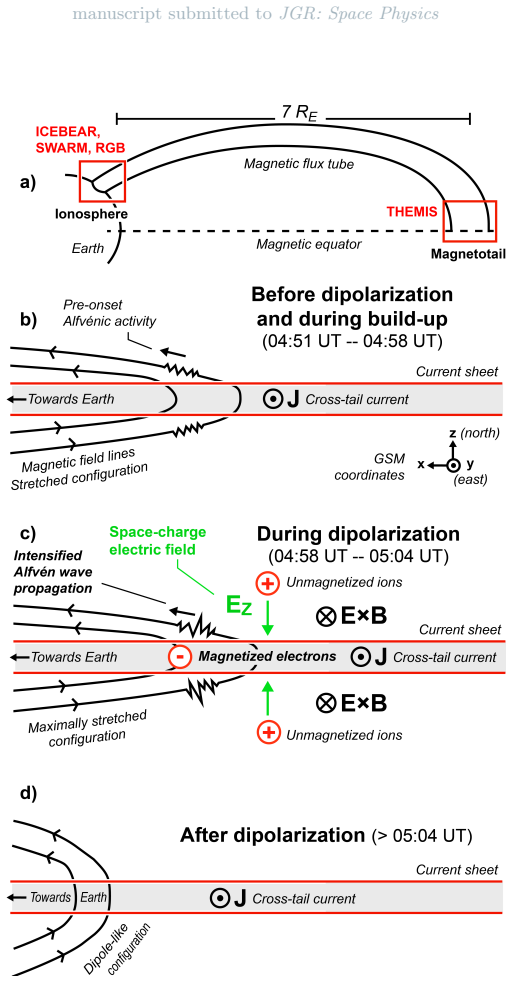
We interpret the ICEBEAR transients as the natural ionospheric foot signature of a shear Alfvén pulse launched by the bipolar space-charge (Hall) electric field of the thinned current sheet, with amplification along the converging flux tube, partial reflection at the ionospheric boundary, and spatial sharpening by precipitation-produced Pedersen-conductance gradients on the auroral arc edges. A one-dimensional wave-transmission analysis recovers the observations.
What carries the argument
shear Alfvén pulse launched by the bipolar Hall electric field of the thinned current sheet, amplified along the converging flux tube, partially reflected at the ionosphere, and sharpened by conductance gradients, recovered by one-dimensional wave-transmission analysis
If this is right
- Magnetotail current sheet thinning produces bipolar Hall electric fields that launch shear Alfvén pulses.
- The pulses amplify during propagation along converging magnetic field lines.
- Partial reflection of the pulse occurs upon reaching the ionospheric boundary.
- Precipitation-induced Pedersen conductance gradients at auroral arc edges spatially sharpen the pulse structure.
- This process directly couples magnetotail dynamics to meter-scale turbulence observed in the auroral electrojets.
Where Pith is reading between the lines
- The same pulse-launch and sharpening process may occur in other substorm events, making existing radar datasets searchable for similar transients.
- Conductance gradients created by precipitation could serve as a general mechanism for localizing energy deposition during magnetospheric activity.
- Three-dimensional extensions of the wave-transmission model could test whether lateral spreading modifies the observed sharpening or reflection.
Load-bearing premise
The observed super-saturation speeds of Farley-Buneman structures result from transient ExB drifts driven by amplified Alfvén electric fields rather than local instabilities or radar artifacts.
What would settle it
Independent measurements showing that the high Doppler velocities do not correspond to actual plasma ExB drifts, or that the transients occur without matching Alfvén wave signatures or timing from the dipolarization site.
Figures





read the original abstract
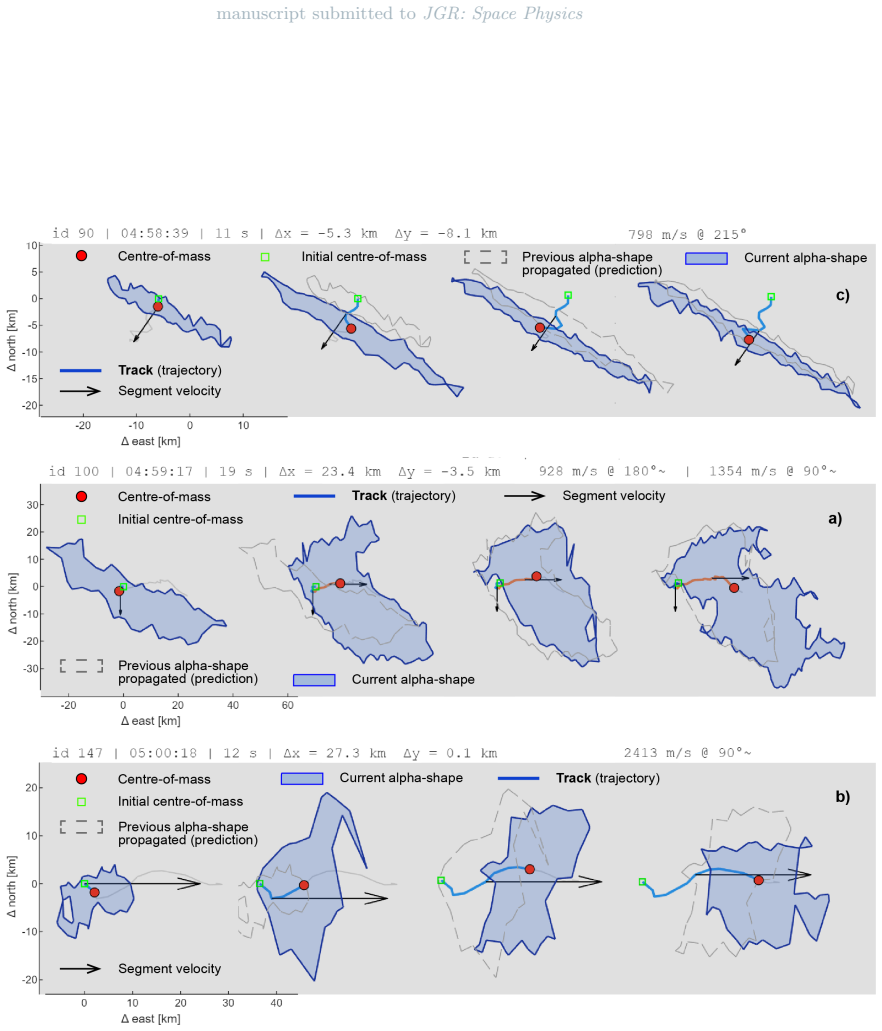
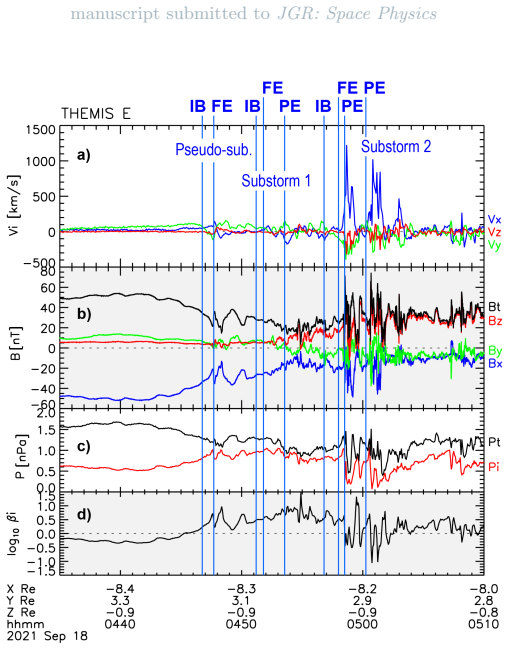
We report ground-based coherent VHF radar observations of extreme turbulent field-structures detected in coincidence with a magnetospheric substorm-associated magnetotail dipolarization. The field-structures are observed by the ICEBEAR radar, in the form of Farley-Buneman (FB) waves in the auroral electrojets, and the field-structures themselves move an order of magnitude faster than the saturation speed of the underlying FB waves, implying transient electric field sources up to 330 mV/m in strength. The field-structures are identified and automatically tracked using an unsupervised clustering & tracking algorithm, applied to clutters of ICEBEAR radar backscatter targets, a method that turns the Doppler radar into a tracking radar capable of measuring the ionospheric ExB-drift by proxy. We place this finding in a coordinated multi-instrument context. Three THEMIS spacecraft observed the dipolarization event in-situ in the near-Earth plasma sheet. In the ionosphere, Swarm A, crossing through the guilty auroral arc at the onset of the dipolarization event, recorded clear signatures of propagating Alfv\'en waves threading the relevant flux tube. We interpret the ICEBEAR transients as the natural ionospheric foot signature of a shear Alfv\'en pulse launched by the bipolar space-charge (Hall) electric field of the thinned current sheet, with amplification along the converging flux tube, partial reflection at the ionospheric boundary, and spatial sharpening by precipitation-produced Pedersen-conductance gradients on the auroral arc edges. A one-dimensional wave-transmission analysis recovers the observations. Our results elucidate a tightly controlled coupling between magnetotail processes and meter-scale auroral plasma turbulence, and demonstrate the capability of ICEBEAR to resolve extreme, transient electric-field enhancements in the ionosphere.
Editorial analysis
A structured set of objections, weighed in public.
Referee Report
Summary. The manuscript reports coordinated multi-instrument observations of extreme, transient field structures in the auroral ionosphere during a magnetotail dipolarization event. ICEBEAR VHF radar data show Farley-Buneman waves whose structures move at super-saturation speeds, interpreted via an unsupervised clustering/tracking algorithm as proxies for ionospheric ExB drifts implying transient electric fields up to 330 mV/m. These are placed in context with THEMIS in-situ dipolarization signatures and Swarm Alfvén-wave detections; the structures are interpreted as the ionospheric footpoint of a shear Alfvén pulse launched by Hall electric fields in the thinned current sheet, amplified along converging flux tubes, partially reflected at the ionosphere, and sharpened by conductance gradients. A one-dimensional wave-transmission analysis is stated to recover the observations.
Significance. If the velocity extraction and model recovery hold, the work would demonstrate a direct, tightly coupled pathway from magnetotail current-sheet dynamics to meter-scale ionospheric turbulence, with implications for understanding extreme electric-field transients. The multi-instrument coordination and the radar-tracking method are potentially valuable contributions, though the absence of quantitative validation metrics for the central inferences limits the strength of the claimed result.
major comments (2)
- [Abstract] Abstract: the claim that speeds imply transient fields up to 330 mV/m and that the 1D wave-transmission analysis recovers the observations is presented without error bars, quantitative fit metrics (e.g., residuals or correlation coefficients), or explicit data-selection criteria for the radar targets fed into the clustering algorithm.
- [Interpretation / methods (clustering section)] The load-bearing premise that the unsupervised clustering algorithm converts observed FB-wave Doppler shifts into reliable ExB-drift proxies at speeds an order of magnitude above the FB saturation limit is not accompanied by validation against potential Doppler ambiguities, range aliasing, or false high-velocity tracks, particularly near the arc edges where conductance gradients are invoked in the interpretation.
minor comments (2)
- Notation for distinguishing raw Doppler shifts from inferred ExB velocities could be made more explicit to avoid reader confusion.
- The manuscript would benefit from a brief statement of the FB saturation speed value adopted and the precise conversion factor used to obtain the 330 mV/m figure.
Simulated Author's Rebuttal
We thank the referee for their constructive and detailed review. We address each major comment below and indicate the revisions we will make to improve the manuscript.
read point-by-point responses
-
Referee: [Abstract] Abstract: the claim that speeds imply transient fields up to 330 mV/m and that the 1D wave-transmission analysis recovers the observations is presented without error bars, quantitative fit metrics (e.g., residuals or correlation coefficients), or explicit data-selection criteria for the radar targets fed into the clustering algorithm.
Authors: The abstract is subject to strict length constraints that preclude inclusion of error bars, fit metrics, or detailed selection criteria. The 330 mV/m value is the upper range of ExB fields inferred from the maximum tracked speeds using the local magnetic field magnitude. Data-selection criteria and clustering performance are described in the methods section, while the wave-transmission analysis is presented as a scale and amplitude recovery rather than a quantitative statistical fit. We will revise the abstract to add a short qualifier noting the approximate nature of the conversion and directing readers to the methods for quantitative details. revision: partial
-
Referee: [Interpretation / methods (clustering section)] The load-bearing premise that the unsupervised clustering algorithm converts observed FB-wave Doppler shifts into reliable ExB-drift proxies at speeds an order of magnitude above the FB saturation limit is not accompanied by validation against potential Doppler ambiguities, range aliasing, or false high-velocity tracks, particularly near the arc edges where conductance gradients are invoked in the interpretation.
Authors: The tracked structures display coherent, multi-beam motion that is temporally aligned with the THEMIS dipolarization and Swarm Alfvén signatures, providing independent consistency checks. The ICEBEAR pulse sequence is configured to limit range aliasing within the observed velocity regime. We will expand the methods section with an explicit discussion of these potential issues, including the criteria used to reject spurious tracks and the physical context used to validate high-velocity features near arc edges. revision: yes
Circularity Check
Observational paper; 1D model recovers data without self-referential reduction
full rationale
The manuscript is primarily multi-instrument observational, reporting ICEBEAR radar transients, THEMIS in-situ dipolarization, and Swarm Alfvén signatures. The 1D wave-transmission analysis is stated to recover the observations; no equations or text indicate that model parameters were fitted to the target data in a way that forces the claimed 330 mV/m value or the amplification narrative. No self-citation chains, self-definitional steps, or fitted-input-called-prediction patterns are present in the abstract or described derivation. The ExB-drift proxy interpretation rests on the clustering algorithm output, which is treated as an independent measurement rather than a constructed result.
Axiom & Free-Parameter Ledger
axioms (2)
- domain assumption Farley-Buneman waves saturate at a characteristic speed set by ion acoustic speed and electron drift
- domain assumption Alfvén waves propagate along converging flux tubes with partial reflection at the ionosphere
Forward citations
Cited by 1 Pith paper
-
Excursion-set structure factor of the auroral electric field
Auroral radar echoes treated as an excursion-set point process yield a structure factor whose |S-1| recovers the ionospheric electric-field spectrum with index near -5/3, matching in-situ data.
Reference graph
Works this paper leans on
-
[1]
Alfven, H. (1942). Existence of Electromagnetic-Hydrodynamic Waves . Nature , 150(3805):405--406
1942
-
[2]
Angelopoulos, V. (2008). The THEMIS Mission . Space Science Reviews , 141(1):5--34
2008
-
[3]
U., Glassmeier, K
Auster, H. U., Glassmeier, K. H., Magnes, W., Aydogar, O., Baumjohann, W., Constantinescu, D., Fischer, D., Fornacon, K. H., Georgescu, E., Harvey, P., Hillenmaier, O., Kroth, R., Ludlam, M., Narita, Y., Nakamura, R., Okrafka, K., Plaschke, F., Richter, I., Schwarzl, H., Stoll, B., Valavanoglou, A., and Wiedemann, M. (2008). The THEMIS Fluxgate Magnetomet...
2008
-
[4]
S., Mann, I
Babu, S. S., Mann, I. R., Donovan, E. F., Smith, A. W., Dimitrakoudis, S., Sydora, R. D., and Kale, A. (2024). Plasma Sheet Counterparts for Auroral Beads and Vortices in Advance of Fast Flows : New Evidence for Near-Earth Substorm Onset . Journal of Geophysical Research: Space Physics , 129(6):e2023JA031957
2024
-
[5]
L., Lummerzheim, D., Larsen, M
Bahcivan, H., Hysell, D. L., Lummerzheim, D., Larsen, M. F., and Pfaff, R. F. (2006). Observations of colocated optical and radar aurora. Journal of Geophysical Research: Space Physics , 111(A12)
2006
-
[6]
Baker, K. B. and Wing, S. (1989). A new magnetic coordinate system for conjugate studies at high latitudes. Journal of Geophysical Research: Space Physics , 94(A7):9139--9143
1989
-
[7]
Banks, P. M. and Kockarts, G. (2013). Aeronomy . Elsevier
2013
-
[8]
Bewley, A., Ge, Z., Ott, L., Ramos, F., and Upcroft, B. (2016). Simple online and realtime tracking. In 2016 IEEE International Conference on Image Processing ( ICIP ) , pages 3464--3468. Ieee
2016
-
[9]
W., and Pignalberi, A
Bilitza, D., Pezzopane, M., Truhlik, V., Altadill, D., Reinisch, B. W., and Pignalberi, A. (2022). The International Reference Ionosphere Model : A Review and Description of an Ionospheric Benchmark . Reviews of Geophysics , 60(4):e2022RG000792
2022
-
[10]
V., and Hesse, M
Birn, J., Nakamura, R., Panov, E. V., and Hesse, M. (2011). Bursty bulk flows and dipolarization in MHD simulations of magnetotail reconnection. Journal of Geophysical Research: Space Physics , 116(A1)
2011
-
[11]
and Perez, J
Boldyrev, S. and Perez, J. C. (2012). SPECTRUM OF KINETIC-ALFV\'EN TURBULENCE . The Astrophysical Journal Letters , 758(2):L44
2012
-
[12]
W., Mozer, F
Bonnell, J. W., Mozer, F. S., Delory, G. T., Hull, A. J., Ergun, R. E., Cully, C. M., Angelopoulos, V., and Harvey, P. R. (2008). The Electric Field Instrument ( EFI ) for THEMIS . Space Science Reviews , 141(1):303--341
2008
-
[13]
E., Birn, J., Echim, M
Borovsky, J. E., Birn, J., Echim, M. M., Fujita, S., Lysak, R. L., Knudsen, D. J., Marghitu, O., Otto, A., Watanabe, T.-H., and Tanaka, T. (2019). Quiescent Discrete Auroral Arcs : A Review of Magnetospheric Generator Mechanisms . Space Science Reviews , 216(1):1
2019
-
[14]
Bretherton, F. P. and Garrett, C. J. R. (1968). Wavetrains in inhomogeneous moving media. Proceedings of the Royal Society of London. A. Mathematical and Physical Sciences , 302(1471):529--554
1968
-
[15]
Buneman, O. (1963). Excitation of Field Aligned Sound Waves by Electron Streams . Physical Review Letters , 10(7):285--287
1963
-
[16]
Carpenter, D. L. and Anderson, R. R. (1992). An ISEE /whistler model of equatorial electron density in the magnetosphere. Journal of Geophysical Research: Space Physics , 97(A2):1097--1108
1992
-
[17]
C., Salem, C., Bonnell, J
Chaston, C. C., Salem, C., Bonnell, J. W., Carlson, C. W., Ergun, R. E., Strangeway, R. J., and McFadden, J. P. (2008). The Turbulent Alfv 'enic Aurora . Physical Review Letters , 100(17):175003
2008
-
[18]
Chau, J. L. and St.-Maurice , J.-P. (2016). Unusual 5 m E region field-aligned irregularities observed from Northern Germany during the magnetic storm of 17 March 2015. Journal of Geophysical Research: Space Physics , 121(10):10,316--10,340
2016
-
[19]
J., and Huang, J
Chen, L., Wu, D. J., and Huang, J. (2013). Kinetic Alfv\'en wave instability driven by field-aligned currents in a low- plasma. Journal of Geophysical Research: Space Physics , 118(6):2951--2957
2013
-
[20]
Cheng, C. Z. and Lui, A. T. Y. (1998). Kinetic ballooning instability for substorm onset and current disruption observed by AMPTE / CCE . Geophysical Research Letters , 25(21):4091--4094
1998
-
[21]
Cowley, S. W. H. (2000). TUTORIAL : Magnetosphere-Ionosphere Interactions : A Tutorial Review . Washington DC American Geophysical Union Geophysical Monograph Series , 118:91
2000
-
[22]
Dai, L., Han, Y., Wang, C., Yao, S., Gonzalez, W., Duan, S., Lavraud, B., Ren, Y., and Guo, Z. (2023). Geoeffectiveness of Interplanetary Alfv\'en Waves . I . Magnetopause Magnetic Reconnection and Directly Driven Substorms . The Astrophysical Journal , 945(1):47
2023
-
[23]
and Galtier, S
David, V. and Galtier, S. (2019). K\_ perp -8/3 Spectrum in Kinetic Alfv\'en Wave Turbulence : Implications for the Solar Wind . The Astrophysical Journal Letters , 880(1):L10
2019
-
[24]
D., No \"e l, J.-M
de Boer , J. D., No \"e l, J.-M. A., and St. -Maurice , J.-P. (2010). The effects of mesoscale regions of precipitation on the ionospheric dynamics, electrodynamics and electron density in the presence of strong ambient electric fields. Annales Geophysicae , 28(6):1345--1360
2010
-
[25]
W., and He, Z
Duan, S., Wang, C., Liu, W. W., and He, Z. (2021). Characteristics of magnetic dipolarizations in the vicinity of the substorm onset region observed by THEMIS . Earth and Planetary Physics , 5(3):eepp2021031
2021
-
[26]
Dungey, J. W. (1961). Interplanetary Magnetic Field and the Auroral Zones . Physical Review Letters , 6:47--48
1961
-
[27]
M., Maggiolo, R., Roth, M., and De Keyser, J
Echim, M. M., Maggiolo, R., Roth, M., and De Keyser, J. (2009). A magnetospheric generator driving ion and electron acceleration and electric currents in a discrete auroral arc observed by Cluster and DMSP . Geophysical Research Letters , 36(12)
2009
-
[28]
and M \"u cke, E
Edelsbrunner, H. and M \"u cke, E. P. (1994). Three-dimensional alpha shapes. ACM Trans. Graph. , 13(1):43--72
1994
-
[29]
T., Drob, D
Emmert, J. T., Drob, D. P., Picone, J. M., Siskind, D. E., Jones Jr., M., Mlynczak, M. G., Bernath, P. F., Chu, X., Doornbos, E., Funke, B., Goncharenko, L. P., Hervig, M. E., Schwartz, M. J., Sheese, P. E., Vargas, F., Williams, B. P., and Yuan, T. (2021). NRLMSIS 2.0: A Whole-Atmosphere Empirical Model of Temperature and Neutral Species Densities . Eart...
2021
-
[30]
Farley, D. T. (1963). A plasma instability resulting in field-aligned irregularities in the ionosphere. Journal of Geophysical Research (1896-1977) , 68(22):6083--6097
1963
-
[31]
Foster, J. C. and Erickson, P. J. (2000). Simultaneous observations of E-region coherent backscatter and electric field amplitude at F-region heights with the Millstone Hill UHF Radar . Geophysical Research Letters , 27(19):3177--3180
2000
-
[32]
Fredricks, R. W. and Coroniti, F. V. (1976). Ambiguities in the deduction of rest frame fluctuation spectrums from spectrums computed in moving frames. Journal of Geophysical Research (1896-1977) , 81(31):5591--5595
1976
-
[33]
Fujii, R., Amm, O., Vanham \"a ki, H., Yoshikawa, A., and Ieda, A. (2012). An application of the finite length Cowling channel model to auroral arcs with longitudinal variations. Journal of Geophysical Research: Space Physics , 117(A11)
2012
-
[34]
Fujii, R., Amm, O., Yoshikawa, A., Ieda, A., and Vanham \"a ki, H. (2011). Reformulation and energy flow of the Cowling channel. Journal of Geophysical Research: Space Physics , 116(A2)
2011
-
[35]
R., Ruohoniemi, J
Gallardo-Lacourt , B., Nishimura, Y., Lyons, L. R., Ruohoniemi, J. M., Donovan, E., Angelopoulos, V., McWilliams, K. A., and Nishitani, N. (2014). Ionospheric flow structures associated with auroral beading at substorm auroral onset. Journal of Geophysical Research: Space Physics , 119(11):9150--9159
2014
-
[36]
and Meyrand, R
Galtier, S. and Meyrand, R. (2015). Entanglement of helicity and energy in kinetic Alfv\'en wave/whistler turbulence. Journal of Plasma Physics , 81(1):325810106
2015
-
[37]
M., Liang, J., Donovan, E., and Spanswick, E
Gillies, D. M., Liang, J., Donovan, E., and Spanswick, E. (2020). The Apparent Motion of STEVE and the Picket Fence Phenomena . Geophysical Research Letters , 47(20):e2020GL088980
2020
-
[38]
M., Bounds, S
Greene, K., Miles, D. M., Bounds, S. R., Bonnell, J. W., Feltman, C., Roglans, R., and Streltsov, A. (2025). In Situ Evidence of Ionospheric Feedback Instability Adjacent to a Quiescent Auroral Arc . Geophysical Research Letters , 52(3):e2024GL110479
2025
-
[39]
H., Swift, D
Hong, M. H., Swift, D. W., and Lin, Y. (2008). Ion dynamics associated with Alfven wave in the near- Earth magnetotail: Two-dimensional global hybrid simulation. Advances in Space Research , 41(8):1298--1304
2008
-
[40]
E., Lester, M., Kadokura, A., Sato, N., and Bjornsson, G
Hosokawa, K., Milan, S. E., Lester, M., Kadokura, A., Sato, N., and Bjornsson, G. (2013). Large flow shears around auroral beads at substorm onset. Geophysical Research Letters , 40(19):4987--4991
2013
-
[41]
Huyghebaert, D., Hussey, G., Vierinen, J., McWilliams, K., and St-Maurice , J.-P. (2019). ICEBEAR : An all-digital bistatic coded continuous-wave radar for studies of the E region of the ionosphere. Radio Science , 54(4):349--364
2019
-
[42]
D., Rutledge, P., and Erion, S
Huyghebaert, D., St.-Maurice , J.-P., McWilliams, K., Hussey, G., Howarth, A. D., Rutledge, P., and Erion, S. (2021). The Properties of ICEBEAR E-Region Coherent Radar Echoes in the Presence of Near Infrared Auroral Emissions , as Measured by the Swarm-E Fast Auroral Imager . Journal of Geophysical Research: Space Physics , 126(12):e2021JA029857
2021
-
[43]
L., Miceli, R., Munk, J., Hampton, D., Heinselman, C., Nicolls, M., Powell, S., Lynch, K., and Lessard, M
Hysell, D. L., Miceli, R., Munk, J., Hampton, D., Heinselman, C., Nicolls, M., Powell, S., Lynch, K., and Lessard, M. (2012). Comparing VHF coherent scatter from the radar aurora with incoherent scatter and all-sky auroral imagery. Journal of Geophysical Research: Space Physics , 117(A10)
2012
-
[44]
F., Huyghebaert, D
Ivarsen, M. F., Huyghebaert, D. R., Gillies, M. D., St-Maurice , J.-P., Themens, D. R., Oppenheim, M., Gustavsson, B. J., Billett, D., Pitzel, B., Galeschuk, D., Donovan, E., and Hussey, G. C. (2024a). Turbulence Around Auroral Arcs . Journal of Geophysical Research: Space Physics , 129(8):e2023JA032309
-
[45]
F., Marei, S., Cho, J., and Hussey, G
Ivarsen, M. F., Marei, S., Cho, J., and Hussey, G. C. (2026). Predictive radar tracking reveals > 500 mV /m electric-field transients during the May 2024 superstorm
2026
-
[46]
F., Miyashita, Y., St-Maurice , J.-P., Hussey, G
Ivarsen, M. F., Miyashita, Y., St-Maurice , J.-P., Hussey, G. C., Pitzel, B., Galeschuk, D., Marei, S., Horne, R. B., Kasahara, Y., Matsuda, S., Kasahara, S., Keika, K., Miyoshi, Y., Yamamoto, K., Shinbori, A., Huyghebaert, D. R., Matsuoka, A., Yokota, S., and Tsuchiya, F. (2025a). Characteristic E-Region Plasma Signature of Magnetospheric Wave-Particle I...
-
[47]
F., Park, J., Kwak, Y.-S., Jin, Y., Knudsen, D
Ivarsen, M. F., Park, J., Kwak, Y.-S., Jin, Y., Knudsen, D. J., and Clausen, L. B. N. (2020). Observational Evidence for the Role of Hall Conductance in Alfv\'en Wave Reflection . Journal of Geophysical Research: Space Physics , 125(12):e2020JA028119
2020
-
[48]
F., St-Maurice , J.-P., Hussey, G
Ivarsen, M. F., St-Maurice , J.-P., Hussey, G. C., Billet, D., Huyghebaert, D. R., Jin, Y., Miyashita, Y., Kasahara, S., Song, K., Jayachandran, P. T., Yokota, S., Miyoshi, Y., Yamamoto, K., Shinbori, A., Kasahara, Y., Shinohara, I., and Matsuoka, A. (2025b). Eastward transients in the dayside ionosphere. I . Electrodynamics on closed field lines. Physica...
-
[49]
F., St-Maurice , J.-P., Hussey, G
Ivarsen, M. F., St-Maurice , J.-P., Hussey, G. C., Huyghebaert, D. R., and Gillies, M. D. (2024b). Point-cloud clustering and tracking algorithm for radar interferometry. Physical Review E , 110(4):045207
-
[50]
F., St-Maurice , J.-P., Hussey, G
Ivarsen, M. F., St-Maurice , J.-P., Hussey, G. C., McWilliams, K., Jin, Y., Huyghebaert, D. R., Miyashita, Y., and Sibeck, D. (2025c). Eastward transients in the dayside ionosphere. II . A parallel-plate capacitorlike effect. Physical Review E , 112(4):045203
-
[51]
F., St-Maurice , J.-P., Huyghebaert, D
Ivarsen, M. F., St-Maurice , J.-P., Huyghebaert, D. R., Gillies, M. D., Lind, F., Pitzel, B., and Hussey, G. C. (2024c). Deriving the Ionospheric Electric Field From the Bulk Motion of Radar Aurora in the E-Region . Journal of Geophysical Research: Space Physics , 129(11):e2024JA033060
-
[52]
M., Vanham \"a ki, H., Grandin, M., Partamies, N., Ganse, U., Honkonen, I., Workayehu, A., Kero, A., and Palmroth, M
Juusola, L., Virtanen, I., Hatch, S. M., Vanham \"a ki, H., Grandin, M., Partamies, N., Ganse, U., Honkonen, I., Workayehu, A., Kero, A., and Palmroth, M. (2025). An empirical model of high-latitude ionospheric conductances based on EISCAT observations. Annales Geophysicae , 43(2):755--781
2025
-
[53]
Kabin, K., Kalugin, G., Donovan, E., and Spanswick, E. (2017). Particle energization by a substorm dipolarization. Journal of Geophysical Research: Space Physics , 122(1):349--367
2017
-
[54]
R., Markowski, D
Kaeppler, S. R., Markowski, D. G., Pepper, A. M., Troyer, R., Jaynes, A. N., Varney, R. H., and Hampton, D. (2023). Data- Driven Empirical Conductance Relations During Auroral Precipitation Using Incoherent Scatter Radar and All Sky Imagers . Journal of Geophysical Research: Space Physics , 128(9):e2023JA031764
2023
-
[55]
Kalmoni, N. M. E., Rae, I. J., Watt, C. E. J., Murphy, K. R., Forsyth, C., and Owen, C. J. (2015). Statistical characterization of the growth and spatial scales of the substorm onset arc. Journal of Geophysical Research: Space Physics , 120(10):8503--8516
2015
-
[56]
R., Cattell, C
Keiling, A., Wygant, J. R., Cattell, C. A., Mozer, F. S., and Russell, C. T. (2003). The Global Morphology of Wave Poynting Flux : Powering the Aurora . Science , 299(5605):383--386
2003
-
[57]
Keogh, E., Chu, S., Hart, D., and Pazzani, M. (2001). An online algorithm for segmenting time series. In Proceedings 2001 IEEE International Conference on Data Mining , pages 289--296. IEEE
2001
-
[58]
J., Mitchell, H
Keskinen, M. J., Mitchell, H. G., Fedder, J. A., Satyanarayana, P., and Zalesak, S. T. (1988). Nonlinear Evolution of the Kelvin-Helmholtz Instability in the High Latitude Ionosphere . Technical Report NRL-MR-6043, NAVAL RESEARCH LAB WASHINGTON DC, NAVAL RESEARCH LAB WASHINGTON DC
1988
-
[59]
Kilpua, E., Koskinen, H. E. J., and Pulkkinen, T. I. (2017). Coronal mass ejections and their sheath regions in interplanetary space. Living Reviews in Solar Physics , 14(1):5
2017
-
[60]
Knudsen, D. J. (1990). Alfven Waves and Static Fields in Magnetosphere/Ionosphere Coupling: In-situ Measurements and a Numerical Model . PhD thesis
1990
-
[61]
J., Kelley, M
Knudsen, D. J., Kelley, M. C., Earle, G. D., Vickrey, J. F., and Boehm, M. (1990). Distinguishing Alfv\'en waves from quasi-static field structures associated with the discrete aurora: Sounding rocket and HILAT satellite measurements. Geophysical Research Letters , 17(7):921--924
1990
-
[62]
Kuhn, H. W. (1955). The Hungarian method for the assignment problem. Naval Research Logistics Quarterly , 2(1-2):83--97
1955
-
[63]
V., Angelopoulos, V., Lin, Y., Zhang, X.-J., Liu, J., Avanov, L
Lu, S., Artemyev, A. V., Angelopoulos, V., Lin, Y., Zhang, X.-J., Liu, J., Avanov, L. A., Giles, B. L., Russell, C. T., and Strangeway, R. J. (2019). The Hall Electric Field in Earth 's Magnetotail Thin Current Sheet . Journal of Geophysical Research: Space Physics , 124(2):1052--1062
2019
-
[64]
Lui, A. T. Y. (2016). Cross-field current instability for auroral bead formation in breakup arcs. Geophysical Research Letters , 43(12):6087--6095
2016
-
[65]
Lysak, R. (1991). Feedback instability of the ionospheric resonant cavity. Journal of Geophysical Research: Space Physics
1991
-
[66]
Lysak, R., Echim, M., Karlsson, T., Marghitu, O., Rankin, R., Song, Y., and Watanabe, T.-H. (2020). Quiet, Discrete Auroral Arcs : Acceleration Mechanisms . Space Science Reviews , 216(5):92
2020
-
[67]
Lysak, R. L. (1990). Electrodynamic coupling of the magnetosphere and ionosphere. Space Science Reviews , 52(1):33--87
1990
-
[68]
Lysak, R. L. (1999). Propagation of Alfv\'en waves through the ionosphere: Dependence on ionospheric parameters. Journal of Geophysical Research: Space Physics , 104(A5):10017--10030
1999
-
[69]
Mallinckrodt, A. J. and Carlson, C. W. (1978). Relations between transverse electric fields and field-aligned currents. Journal of Geophysical Research: Space Physics , 83(A4):1426--1432
1978
-
[70]
R., Milling, D
Mann, I. R., Milling, D. K., Rae, I. J., Ozeke, L. G., Kale, A., Kale, Z. C., Murphy, K. R., Parent, A., Usanova, M., Pahud, D. M., Lee, E.-A., Amalraj, V., Wallis, D. D., Angelopoulos, V., Glassmeier, K.-H., Russell, C. T., Auster, H.-U., and Singer, H. J. (2008). The Upgraded CARISMA Magnetometer Array in the THEMIS Era . Space Science Reviews , 141(1):413--451
2008
-
[71]
P., Carlson, C
McFadden, J. P., Carlson, C. W., Larson, D., Ludlam, M., Abiad, R., Elliott, B., Turin, P., Marckwordt, M., and Angelopoulos, V. (2008). The THEMIS ESA Plasma Instrument and In-flight Calibration . Space Science Reviews , 141(1):277--302
2008
-
[72]
Miyashita, Y., Angelopoulos, V., Fukui, K., and Machida, S. (2018). A Case Study of Near-Earth Magnetotail Conditions at Substorm and Pseudosubstorm Onsets . Geophysical Research Letters , 45(13):6353--6361
2018
-
[73]
and Ieda, A
Miyashita, Y. and Ieda, A. (2018). Revisiting substorm events with preonset aurora. Annales Geophysicae , 36(5):1419--1438
2018
-
[74]
Miyashita, Y., Ieda, A., and Machida, S. (2025). Evolution of the near- Earth magnetotail associated with substorm onsets: Revisiting the issues of onset timing and substorm triggering mechanism. Earth, Planets and Space , 77(1):15
2025
-
[75]
Newcomb, W. A. (1958). Motion of magnetic lines of force. Annals of Physics , 3(4):347--385
1958
-
[76]
Newell, P. T. and Gjerloev, J. W. (2011a). Evaluation of SuperMAG auroral electrojet indices as indicators of substorms and auroral power. Journal of Geophysical Research: Space Physics , 116(A12)
-
[77]
Newell, P. T. and Gjerloev, J. W. (2011b). Substorm and magnetosphere characteristic scales inferred from the SuperMAG auroral electrojet indices. Journal of Geophysical Research: Space Physics , 116(A12)
-
[78]
T., Sotirelis, T., Liou, K., Meng, C.-I., and Rich, F
Newell, P. T., Sotirelis, T., Liou, K., Meng, C.-I., and Rich, F. J. (2007). A nearly universal solar wind-magnetosphere coupling function inferred from 10 magnetospheric state variables. Journal of Geophysical Research: Space Physics , 112(A1)
2007
-
[79]
Ockham, W. (1967). Opera philosophica et theologica. St. Bonaventure, NY: Franciscan Institute , 89
1967
-
[80]
B., and Bonnell, J
Ogasawara, K., Kasaba, Y., Nishimura, Y., Hori, T., Takada, T., Miyashita, Y., Angelopoulos, V., Mende, S. B., and Bonnell, J. (2011). Azimuthal auroral expansion associated with fast flows in the near- Earth plasma sheet: Coordinated observations of the THEMIS all-sky imagers and multiple spacecraft. Journal of Geophysical Research: Space Physics , 116(A6)
2011
discussion (0)
Sign in with ORCID, Apple, or X to comment. Anyone can read and Pith papers without signing in.