Efficient Large-Scale STEM-EELS Simulations With Torched-TACAW
Pith reviewed 2026-07-03 09:28 UTC · model grok-4.3
The pith
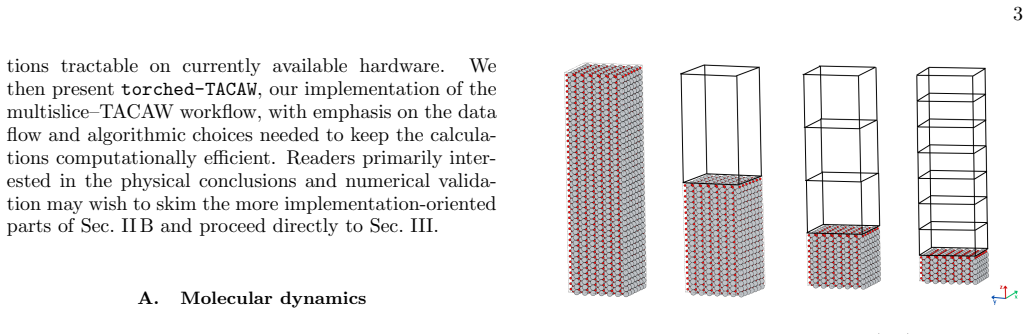
Torched-TACAW combines ML potentials, supercell partitioning and on-the-fly processing to scale TACAW simulations to large defective materials.
A machine-rendered reading of the paper's core claim, the machinery that carries it, and where it could break.
Core claim
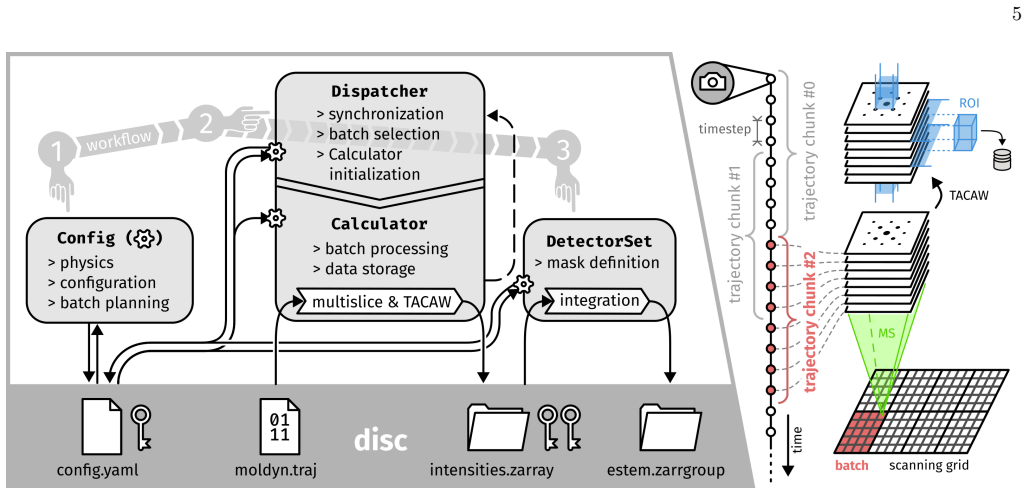
The TACAW method for ultra-low-loss EELS becomes applicable to large systems with defects when molecular dynamics is performed with machine-learned interatomic potentials, elongated supercells are partitioned, and multislice outputs are processed on the fly; torched-TACAW supplies the open implementation of the TACAW step that achieves this with acceptable memory use.
What carries the argument
The time auto-correlation of auxiliary wave functions (TACAW) method, realized in the torched-TACAW code that performs on-the-fly correlation processing after multislice propagation.
If this is right
- Atomic-resolution STEM-EELS maps become computable for thick samples containing grain boundaries or impurities without prohibitive memory requirements.
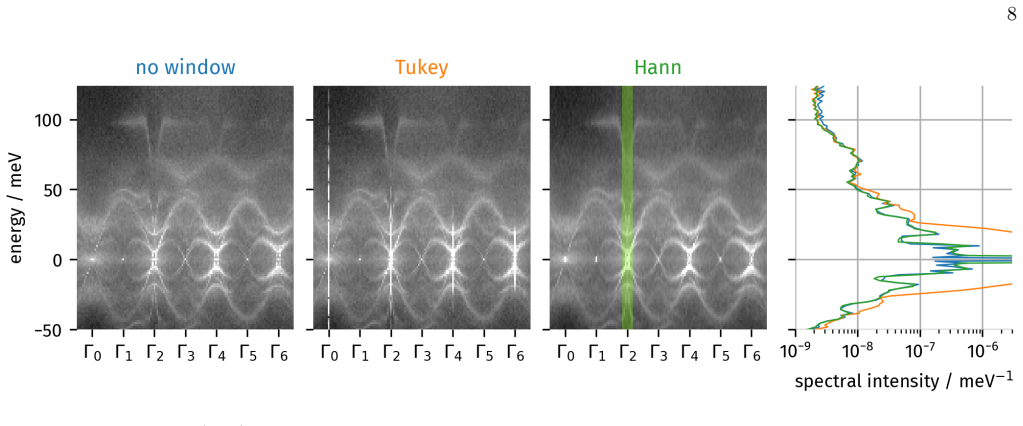
- Numerical tests of window functions and supercell partition sizes become routine parts of the simulation workflow.
- Near ab initio quality spectra remain accessible while the data throughput of molecular dynamics and multislice steps stays manageable.
Where Pith is reading between the lines
- The same partitioning and on-the-fly strategy could be adapted to other correlation-based spectroscopies that currently face memory bottlenecks in large cells.
- If the ML potentials prove transferable, the method could be used to screen defect configurations for their distinct EELS signatures before experiment.
- Extending the workflow to include temperature or strain effects would require only changes to the molecular-dynamics stage, not to the TACAW core.
Load-bearing premise
Machine-learned interatomic potentials trained on foundational data reproduce the vibrational and magnon excitations that dominate the ultra-low-loss EELS signal with enough accuracy for the materials and defects of interest.
What would settle it
A direct comparison showing that torched-TACAW spectra for a small perfect rutile TiO2 cell differ substantially from independent ab initio TACAW results or from measured ultra-low-loss spectra on the same material.
Figures

read the original abstract
The time auto-correlation of auxiliary wave functions (TACAW) method enables efficient simulations of ultra-low-loss electron energy loss spectra (EELS) arising from vibrational and magnon excitations. In practical applications to realistic materials systems, however, TACAW calculations become challenging due to the large system sizes required for models containing defects, interfaces, impurities, or grain boundaries, as well as the substantial computational cost and data throughput associated with molecular dynamics and multislice calculations. Here we discuss a practical methodology for large-scale TACAW simulations and present torched-TACAW, a freely available implementation of the TACAW part of the described workflow for efficient STEM-EELS simulations. The overall approach combines molecular dynamics based on foundational machine-learned interatomic potentials, partitioning of elongated supercells, and on-the-fly processing of multislice outputs in order to enable near ab initio quality simulations with tractable memory use and data flow. Using rutile TiO2 as a model system, we analyze important numerical aspects of the method, including windowing and supercell partitioning, and demonstrate atomic-resolution STEM-EELS simulations for thick samples.
Editorial analysis
A structured set of objections, weighed in public.
Referee Report
Summary. The manuscript presents torched-TACAW, a freely available implementation of the TACAW method for efficient large-scale STEM-EELS simulations of vibrational and magnon excitations. The workflow integrates molecular dynamics driven by foundational machine-learned interatomic potentials, partitioning of elongated supercells, and on-the-fly multislice processing to achieve tractable memory and data flow while targeting near ab initio quality. Numerical aspects including windowing and supercell partitioning are analyzed, with demonstrations of atomic-resolution simulations on thick rutile TiO2 samples containing defects or interfaces.
Significance. If the accuracy claims hold, the approach would enable previously intractable simulations of ultra-low-loss EELS in realistic defective materials systems at scales relevant to experiment, representing a practical advance in computational spectroscopy. The open-source release of torched-TACAW supports reproducibility and community use.
major comments (2)
- [Abstract and demonstration on rutile TiO2] The central claim of near ab initio quality rests on the unvalidated assumption that foundational ML interatomic potentials reproduce vibrational and magnon excitations with sufficient fidelity for EELS in pristine and defective TiO2; no direct benchmarks against DFT-MD trajectories, force-constant comparisons, or experimental reference spectra are reported to quantify errors in peak positions or intensities.
- [Numerical aspects and results] § on supercell partitioning and results: while partitioning is presented as enabling tractable calculations, the manuscript does not quantify how partitioning-induced artifacts propagate into the final TACAW spectra (e.g., via comparison of partitioned vs. full-supercell results for a smaller test case), which is load-bearing for the claim of maintained accuracy at large scales.
minor comments (2)
- [Methods] Notation for the TACAW autocorrelation and auxiliary wave functions should be defined explicitly in the methods section for readers unfamiliar with the prior TACAW reference.
- [Figures] Figure captions for the TiO2 EELS maps should include the specific MD timestep, supercell dimensions, and energy resolution used to allow direct reproduction.
Simulated Author's Rebuttal
We thank the referee for their constructive feedback, which highlights important aspects for strengthening the manuscript's claims. We address each major comment below.
read point-by-point responses
-
Referee: [Abstract and demonstration on rutile TiO2] The central claim of near ab initio quality rests on the unvalidated assumption that foundational ML interatomic potentials reproduce vibrational and magnon excitations with sufficient fidelity for EELS in pristine and defective TiO2; no direct benchmarks against DFT-MD trajectories, force-constant comparisons, or experimental reference spectra are reported to quantify errors in peak positions or intensities.
Authors: We agree that direct validation of the ML potentials for vibrational (and where applicable magnon) excitations in the TiO2 context would strengthen the central claim. Foundational ML interatomic potentials are trained to reproduce DFT forces and energies at scale, with prior literature benchmarks on related systems, but this manuscript does not report new DFT-MD comparisons or experimental EELS matches for the specific excitations. We will revise by adding a dedicated subsection (or supplementary note) with phonon density-of-states comparisons from ML-MD versus short DFT-MD runs on pristine rutile TiO2, and will explicitly discuss the expected error propagation and limitations for defective structures where full DFT-MD is intractable. revision: yes
-
Referee: [Numerical aspects and results] § on supercell partitioning and results: while partitioning is presented as enabling tractable calculations, the manuscript does not quantify how partitioning-induced artifacts propagate into the final TACAW spectra (e.g., via comparison of partitioned vs. full-supercell results for a smaller test case), which is load-bearing for the claim of maintained accuracy at large scales.
Authors: We acknowledge that an explicit quantification of partitioning-induced spectral artifacts is absent from the current manuscript. The presented analysis covers windowing and general numerical stability but does not include a controlled full-versus-partitioned spectral comparison. In the revision we will add such a test on a smaller supercell (where full calculation remains computationally feasible), reporting the difference in peak positions and intensities to demonstrate that artifacts remain below the target accuracy threshold for the chosen partitioning parameters. revision: yes
Circularity Check
Minor self-citation of TACAW method; central workflow remains independent
full rationale
The paper presents an implementation and workflow combining MD with ML potentials, supercell partitioning, and on-the-fly multislice processing. TACAW is referenced as an established prior method without any equations or claims reducing the new large-scale results to a self-defined fit or self-citation chain. No fitted parameters are renamed as predictions, no uniqueness theorems are invoked from the authors' prior work, and the derivation does not collapse by construction. This qualifies as a normal minor self-citation (score 2) with independent content in the presented methodology.
Axiom & Free-Parameter Ledger
Reference graph
Works this paper leans on
-
[1]
Easier availability of GPU-centric nodes on HPCs in recent years motivated us to try to exploit this for the benefit of our calculations
Architecture & design choices As the multislice algorithm consists inherently of re- peated large-matrix multiplications and Fourier trans- forms, it is natural to expect computational advantage from GPUs compared to CPUs [46]. Easier availability of GPU-centric nodes on HPCs in recent years motivated us to try to exploit this for the benefit of our calcu...
-
[2]
Details of implementation a. Configuration.Configobject is basically a nested dictionary (directly accessible byConfig.config) wrapped into an object with various methods generat- ing the partitioning scheme; keeping track of physics, including units and scaling; and simulation grids and coordinates. It is also responsible for keeping track of the locatio...
-
[3]
O. L. Krivanek, T. C. Lovejoy, N. Dellby, T. Aoki, R. Car- penter, P. Rez, E. Soignard, J. Zhu, P. E. Batson, M. J. Lagos, R. F. Egerton, and P. A. Crozier, Vibrational spectroscopy in the electron microscope, Nature514, 209 (2014)
2014
-
[4]
J. A. Hachtel, J. Huang, I. Popovs, S. Jansone-Popova, J. K. Keum, J. Jakowski, T. C. Lovejoy, N. Dellby, O. L. Krivanek, and J. C. Idrobo, Identification of site-specific isotopic labels by vibrational spectroscopy in the electron microscope, Science363, 525 (2019)
2019
-
[5]
Senga, Y.-C
R. Senga, Y.-C. Lin, S. Morishita, R. Kato, T. Yamada, M. Hasegawa, and K. Suenaga, Imaging of isotope diffu- sion using atomic-scale vibrational spectroscopy, Nature 603, 68 (2022)
2022
-
[6]
N. Li, R. Shi, Y. Li, R. Qi, F. Liu, X. Zhang, Z. Liu, Y. Li, X. Guo, K. Liu, Y. Jiang, X.-Z. Li, J. Chen, L. Liu, E.-G. Wang, and P. Gao, Phonon transition across an isotopic interface, Nature Communications14, 2382 (2023)
2023
-
[7]
J. C. Idrobo, A. R. Lupini, T. Feng, R. R. Unocic, F. S. Walden, D. S. Gardiner, T. C. Lovejoy, N. Dellby, S. T. Pantelides, and O. L. Krivanek, Temperature measure- ment by a nanoscale electron probe using energy gain and loss spectroscopy, Phys. Rev. Lett.120, 095901 (2018)
2018
-
[8]
M. J. Lagos and P. E. Batson, Thermometry with sub- nanometer resolution in the electron microscope using the principle of detailed balancing, Nano Letters18, 4556 (2018)
2018
-
[9]
Kikkawa and K
J. Kikkawa and K. Kimoto, Optical and acoustic phonon temperature measurements using electron nanoprobe and electron energy loss spectroscopy, Phys. Rev. B106, 195431 (2022)
2022
-
[10]
F. S. Hage, G. Radtke, D. M. Kepaptsoglou, M. Lazzeri, and Q. M. Ramasse, Single-atom vibrational spec- troscopy in the scanning transmission electron micro- scope, Science367, 1124 (2020)
2020
-
[11]
X. Yan, C. Liu, C. A. Gadre, L. Gu, T. Aoki, T. C. Lovejoy, N. Dellby, O. L. Krivanek, D. G. Schlom, R. Wu, and X. Pan, Single-defect phonons imaged by electron microscopy, Nature589, 65 (2021)
2021
-
[12]
B. Haas, T. M. Boland, C. Els¨ asser, A. K. Singh, K. March, J. Barthel, C. T. Koch, and P. Rez, Atomic- resolution mapping of localized phonon modes at grain boundaries, Nano Letters23, 5975 (2023)
2023
-
[13]
F. S. Hage, D. M. Kepaptsoglou, Q. M. Ramasse, and L. J. Allen, Phonon spectroscopy at atomic resolution, Phys. Rev. Lett.122, 016103 (2019)
2019
-
[14]
Venkatraman, B
K. Venkatraman, B. D. A. Levin, K. March, P. Rez, and P. A. Crozier, Vibrational spectroscopy at atomic resolu- tion with electron impact scattering, Nature Physics15, 1237 (2019)
2019
-
[15]
E. R. Hoglund, H. A. Walker, K. Hussain, D.-L. Bao, H. Ni, A. Mamun, J. Baxter, J. D. Caldwell, A. Khan, S. T. Pantelides, P. E. Hopkins, and J. A. Hachtel, Nonequivalent atomic vibrations at interfaces in a polar superlattice, Advanced Materials36, 2402925 (2024)
2024
-
[16]
X. Yan, P. M. Zeiger, Y. Huang, H. Sun, J. Li, C. A. Gadre, H. Yang, R. He, T. Aoki, Z. Zhong, Y. Nie, R. Wu, J. Rusz, and X. Pan, Atomic-scale imaging of frequency- dependent phonon anisotropy, Nature645, 893 (2025)
2025
-
[17]
B. Haas, C. T. Koch, and P. Rez, Perspective on atomic- resolution vibrational electron energy-loss spectroscopy, Applied Physics Letters125, 150502 (2024)
2024
-
[18]
H. Yang, Y. Zhou, G. Miao, J. Rusz, X. Yan, F. Guzman, X. Xu, X. Xu, T. Aoki, P. Zeiger, X. Zhu, W. Wang, J. Guo, R. Wu, and X. Pan, Phonon modes and electron– phonon coupling at the FeSe/SrTiO 3 interface, Nature 635, 332 (2024)
2024
-
[19]
Kepaptsoglou, J
D. Kepaptsoglou, J. ´Angel Castellanos-Reyes, A. Kerri- gan, J. A. do Nascimento, P. M. Zeiger, K. E. hajraoui, J. C. Idrobo, B. G. Mendis, A. Bergman, V. K. Lazarov, J. Rusz, and Q. M. Ramasse, Magnon spectroscopy in the electron microscope, Nature (2025)
2025
-
[20]
B. D. Forbes and L. J. Allen, Modeling energy-loss spec- tra due to phonon excitation, Physical Review B94, 014110 (2016)
2016
-
[21]
R. J. Nicholls, F. S. Hage, D. G. McCulloch, Q. M. Ra- masse, K. Refson, and J. R. Yates, Theory of momentum- resolved phonon spectroscopy in the electron microscope, Physical Review B99, 094105 (2019). 13
2019
-
[22]
Senga, K
R. Senga, K. Suenaga, P. Barone, S. Morishita, F. Mauri, and T. Pichler, Position and momentum mapping of vi- brations in graphene nanostructures, Nature573, 247 (2019)
2019
-
[23]
Dwyer, Prospects of spatial resolution in vibrational electron energy loss spectroscopy: Implications of dipolar scattering, Physical Review B96, 224102 (2017)
C. Dwyer, Prospects of spatial resolution in vibrational electron energy loss spectroscopy: Implications of dipolar scattering, Physical Review B96, 224102 (2017)
2017
-
[24]
Rez and A
P. Rez and A. Singh, Lattice resolution of vibrational modes in the electron microscope, Ultramicroscopy220, 113162 (2021)
2021
-
[25]
P. M. Zeiger and J. Rusz, Efficient and Versatile Model for Vibrational STEM-EELS, Physical Review Letters 124, 025501 (2020)
2020
-
[26]
P. M. Zeiger and J. Rusz, Simulations of spatially and angle-resolved vibrational electron energy loss spec- troscopy for a system with a planar defect, Phys. Rev. B 104, 094103 (2021)
2021
-
[27]
J. ´A. Castellanos-Reyes, P. M. Zeiger, and J. Rusz, Dy- namical theory of angle-resolved electron energy loss and gain spectroscopies of phonons and magnons in transmis- sion electron microscopy including multiple scattering ef- fects, Phys. Rev. Lett.134, 036402 (2025)
2025
- [28]
-
[29]
B. D. Forbes, A. V. Martin, S. D. Findlay, A. J. D’Alfonso, and L. J. Allen, Quantum mechanical model for phonon excitation in electron diffraction and imaging using a Born-Oppenheimer approximation, Phys. Rev. B 82, 104103 (2010)
2010
-
[30]
N. R. Lugg, B. D. Forbes, S. D. Findlay, and L. J. Allen, Atomic resolution imaging using electron energy-loss phonon spectroscopy, Phys. Rev. B91, 144108 (2015)
2015
-
[31]
J. E. Lennard-Jones, Cohesion, Proceedings of the Phys- ical Society43, 461 (1931)
1931
-
[32]
M. H. M¨ user, S. V. Sukhomlinov, and L. Pastewka, In- teratomic potentials: achievements and challenges, Ad- vances in Physics: X8, 2093129 (2023)
2023
-
[33]
Baroni, S
S. Baroni, S. de Gironcoli, A. Dal Corso, and P. Gi- annozzi, Phonons and related crystal properties from density-functional perturbation theory, Rev. Mod. Phys. 73, 515 (2001)
2001
-
[34]
Zhang, Y
L. Zhang, Y. Wan, Y. Shibuta, and X. Huang, Progress in machine learning interatomic potential and its appli- cations in materials science, Progress in Natural Science: Materials International35, 1079 (2025)
2025
-
[35]
Marx and J
D. Marx and J. Hutter,Ab Initio Molecular Dynamics: Basic Theory and Advanced Methods(Cambridge Uni- versity Press, 2009)
2009
-
[36]
Open Materials 2024 (OMat24) Inorganic Materials Dataset and Models
L. Barroso-Luque, S. Muhammed, X. Fu, B. M. Wood, M. Dzamba, M. Gao, A. Rizvi, C. L. Zitnick, and Z. W. Ulissi, Open materials 2024 (omat24) inorganic materi- als dataset and models, arXiv preprint arXiv:2410.12771 (2024)
work page internal anchor Pith review Pith/arXiv arXiv 2024
-
[37]
Schmidt, N
J. Schmidt, N. Hoffmann, H.-C. Wang, P. Borlido, P. J. Carri¸ co, T. F. Cerqueira, S. Botti, and M. A. Marques, Machine-learning-assisted determination of the global zero-temperature phase diagram of materials, Advanced Materials35, 2210788 (2023)
2023
-
[38]
Chen and S
C. Chen and S. P. Ong, A universal graph deep learn- ing interatomic potential for the periodic table, Nature Computational Science2, 718 (2022)
2022
-
[39]
URLhttps://arxiv.org/ abs/2410.22570.2410.22570
M. Neumann, J. Gin, B. Rhodes, S. Bennett, Z. Li, H. Choubisa, A. Hussey, and J. Godwin, Orb: A fast, scalable neural network potential (2024), arXiv:2410.22570 [cond-mat.mtrl-sci]
-
[40]
A foundation model for atomistic materials chemistry
I. Batatia, P. Benner, Y. Chiang, A. M. Elena, D. P. Kov´ acs, J. Riebesell, X. R. Advincula, M. Asta, M. Avaylon, W. J. Baldwin, F. Berger, N. Bernstein, A. Bhowmik, F. Bigi, S. M. Blau, V. C˘ arare, M. Ceriotti, S. Chong, J. P. Darby, S. De, F. D. Pia, V. L. Deringer, R. Elijoˇ sius, Z. El-Machachi, F. Falcioni, E. Fako, A. C. Ferrari, J. L. A. Gardner,...
work page internal anchor Pith review Pith/arXiv arXiv 2025
-
[41]
Advances in the Simulations of Enzyme Reactivity in the Dawn of the Artificial Intelligence Age
B. Rhodes, S. Vandenhaute, V. ˇSimkus, J. Gin, J. God- win, T. Duignan, and M. Neumann, Orb-v3: atom- istic simulation at scale (2025), arXiv:2504.06231 [cond- mat.mtrl-sci]
-
[42]
B. M. Wood, M. Dzamba, X. Fu, M. Gao, M. Shuaibi, L. Barroso-Luque, K. Abdelmaqsoud, V. Gharakhanyan, J. R. Kitchin, D. S. Levine, K. Michel, A. Sriram, T. Co- hen, A. Das, A. Rizvi, S. J. Sahoo, Z. W. Ulissi, and C. L. Zitnick, Uma: A family of universal models for atoms (2026), arXiv:2506.23971 [cs.LG]
-
[43]
Riebesell, R
J. Riebesell, R. E. A. Goodall, P. Benner, Y. Chiang, B. Deng, G. Ceder, M. Asta, A. A. Lee, A. Jain, and K. A. Persson, A framework to evaluate machine learning crystal stability predictions, Nature Machine Intelligence 7, 836 (2025)
2025
-
[44]
Osmera and J
M. Osmera and J. Rusz, torched-TACAW (2026)
2026
-
[45]
F. Bigi, M. F. Langer, and M. Ceriotti, The dark side of the forces: assessing non-conservative force models for atomistic machine learning, inProceedings of the 42nd International Conference on Machine Learning, Proceed- ings of Machine Learning Research, Vol. 267 (PMLR,
-
[46]
Grimme, J
S. Grimme, J. Antony, S. Ehrlich, and H. Krieg, A con- sistent and accurate ab initio parametrization of den- sity functional dispersion correction (dft-d) for the 94 elements h-pu, The Journal of Chemical Physics132, 154104 (2010)
2010
-
[47]
Barthel, Dr
J. Barthel, Dr. Probe: A software for high-resolution STEM image simulation, Ultramicroscopy193, 1 (2018)
2018
-
[48]
Brown, py multislice, last accesed 12-2-2026, available from https://github.com/HamishGBrown/py multislice
H. Brown, py multislice, last accesed 12-2-2026, available from https://github.com/HamishGBrown/py multislice
2026
-
[49]
Paszke, S
A. Paszke, S. Gross, F. Massa, A. Lerer, J. Bradbury, G. Chanan, T. Killeen, Z. Lin, N. Gimelshein, L. Antiga, A. Desmaison, A. Kopf, E. Yang, Z. DeVito, M. Rai- son, A. Tejani, S. Chilamkurthy, B. Steiner, L. Fang, J. Bai, and S. Chintala, Pytorch: An imperative style, 14 high-performance deep learning library, inAdvances in Neural Information Processing...
2019
-
[50]
Hjorth Larsen, J
A. Hjorth Larsen, J. Jørgen Mortensen, J. Blomqvist, I. E. Castelli, R. Christensen, M. Du lak, J. Friis, M. N. Groves, B. Hammer, C. Hargus, E. D. Hermes, P. C. Jennings, P. Bjerre Jensen, J. Kermode, J. R. Kitchin, E. Leonhard Kolsbjerg, J. Kubal, K. Kaasb- jerg, S. Lysgaard, J. Bergmann Maronsson, T. Max- son, T. Olsen, L. Pastewka, A. Peterson, C. Ros...
2017
-
[51]
io (Last accessed 18-02-2026)
Zarr (version 3), Available at: https://zarr.readthedocs. io (Last accessed 18-02-2026)
2026
-
[52]
Note the incompatibility with zarr v2
-
[53]
Ben-Kiki, C
O. Ben-Kiki, C. Evans, and I. d¨ ot Net, Yaml ain’t markup language (yaml) version 1.2.2, https://yaml.org/spec/1. 2.2/ (2021), yAML specification
2021
-
[54]
P. Welch, The use of fast fourier transform for the estima- tion of power spectra: A method based on time averaging over short, modified periodograms, IEEE Transactions on Audio and Electroacoustics15, 70 (1967)
1967
-
[55]
Bussi, D
G. Bussi, D. Donadio, and M. Parrinello, Canonical sam- pling through velocity rescaling, The Journal of Chemical Physics126, 014101 (2007)
2007
- [56]
-
[57]
J. ´Angel Castellanos-Reyes, I. P. Miranda, P. M. Zeiger, A. Bergman, and J. Rusz, Theory of momentum-resolved electron energy-loss spectra of coupled phonon and magnon excitations (2025), arXiv:2508.07073
-
[58]
How to cook a T ACA W
P. Virtanen, R. Gommers, T. E. Oliphant, M. Haber- land, T. Reddy, D. Cournapeau, E. Burovski, P. Pe- terson, W. Weckesser, J. Bright, S. J. van der Walt, M. Brett, J. Wilson, K. J. Millman, N. Mayorov, A. R. J. Nelson, E. Jones, R. Kern, E. Larson, C. J. Carey, ˙I. Po- lat, Y. Feng, E. W. Moore, J. VanderPlas, D. Laxalde, J. Perktold, R. Cimrman, I. Henr...
2020
-
[59]
not included
Setting up the calculation First step to be done is to setup the calculation. One is recommended to do so by a script similar to the Listing 1. This script should be run only once. The config is setup by keyword parameters in theConfigobject instantia- tion. The concrete structure depends on the specific need of the calculation. Users who prefer to work w...
2000
-
[60]
An ex- ample script that can be used for this purpose can look like 1d i s p a t c h e r = D i s p a t c h e r ( 2config_file , 3device = ’ cuda :0 ’ , 4) 5d i s p a t c h e r
Running the calculation When the configuration is set-up and the config-file saved, the calculation is ready to be executed. An ex- ample script that can be used for this purpose can look like 1d i s p a t c h e r = D i s p a t c h e r ( 2config_file , 3device = ’ cuda :0 ’ , 4) 5d i s p a t c h e r . run () Here, if the device is passed as an argument, i...
discussion (0)
Sign in with ORCID, Apple, or X to comment. Anyone can read and Pith papers without signing in.