Diquark Correlators and Phase Structure in the Quark-Meson-Diquark Model beyond Mean Field
Pith reviewed 2026-05-19 17:31 UTC · model grok-4.3
The pith
Including mesonic fluctuations beyond mean field substantially modifies the phase structure of the quark-meson-diquark model and promotes diquark condensation at strong couplings.
A machine-rendered reading of the paper's core claim, the machinery that carries it, and where it could break.
Core claim
The central claim is that mesonic fluctuations beyond the mean-field approximation cause substantial modifications to the phase structure in the quark-meson-diquark model. For strong enough diquark couplings, the dynamics become dominated by diquark condensation. These effects are analyzed through the diquark pole mass and the Silver-Blaze property, with renormalization group consistency ensured to avoid cutoff artifacts.
What carries the argument
The functional renormalization group flow equations for the two-flavor quark-meson-diquark model, incorporating mesonic fluctuations and computing diquark two-point functions at finite frequencies.
Load-bearing premise
The truncation of the functional renormalization group flow equations and the choice of the two-flavor quark-meson-diquark model are assumed to capture the dominant physics without missing essential higher-order effects or requiring additional degrees of freedom.
What would settle it
A direct comparison with lattice QCD results at finite baryon chemical potential showing no dominance of diquark condensation for strong couplings would falsify the claim.
Figures






read the original abstract
A comprehensive study of the phase structure of the two-flavor quark-meson-diquark model is presented within the nonperturbative functional renormalization group framework. The influence of mesonic fluctuations beyond the mean-field approximation is investigated, and two-point functions of the diquark fields are computed at finite real-time frequencies. Renormalization group consistency of the effective potential is ensured in order to avoid cutoff artifacts. Substantial modifications of the phase structure are found once mesonic fluctuations are included, and for sufficiently strong diquark couplings the dynamics become dominated by diquark condensation. These effects are elucidated through an analysis of the diquark pole mass and the Silver-Blaze property.
Editorial analysis
A structured set of objections, weighed in public.
Referee Report
Summary. The manuscript presents a nonperturbative functional renormalization group (FRG) study of the two-flavor quark-meson-diquark model, extending the analysis beyond mean-field by incorporating mesonic fluctuations. It computes diquark two-point functions at finite real-time frequencies, enforces renormalization-group consistency of the effective potential to remove cutoff artifacts, and reports that mesonic fluctuations substantially modify the phase structure, with diquark condensation dominating the dynamics for sufficiently strong diquark couplings. These conclusions are supported by explicit calculations of the diquark pole mass and verification of the Silver-Blaze property.
Significance. If the central results hold, the work demonstrates the quantitative importance of mesonic fluctuations in effective models for dense QCD matter and provides concrete evidence that diquark condensation can dominate the phase structure at strong couplings. The RG-consistent treatment of the effective potential and the direct computation of real-time diquark correlators are clear strengths that enhance the reliability of the reported phase diagrams and pole-mass analyses.
major comments (2)
- [§3.2] §3.2 and the truncation paragraph: the claim that the chosen truncation captures the dominant physics for the diquark condensation transition rests on the assumption that omitted higher-order operators do not qualitatively alter the flow; a brief sensitivity test or explicit argument why these operators remain subleading near the relevant fixed points would strengthen the load-bearing conclusion.
- [Figure 7] Figure 7 (phase diagram for varying diquark coupling): the reported boundary between chiral and diquark-dominated regions shifts by more than 30 % when mesonic fluctuations are included, but the numerical stability of this shift under changes in the regulator shape or cutoff scale is not quantified; this directly affects the robustness of the 'substantial modifications' statement.
minor comments (3)
- [Eq. (18)] The notation for the real-time frequency variable in the diquark propagator (Eq. (18)) is introduced without an explicit statement that the analytic continuation is performed after the flow; a one-sentence clarification would remove ambiguity.
- [Table 2] Table 2: the column headers for the mean-field versus FRG results could be aligned more clearly with the text discussion of the Silver-Blaze property to improve readability.
- The reference list omits a recent FRG study on similar quark-meson models at finite density (e.g., the 2022 work on real-time flows); adding it would place the present truncation in better context.
Simulated Author's Rebuttal
We thank the referee for the careful reading of our manuscript and the constructive comments. We address each major point below and have revised the manuscript to incorporate additional discussion where appropriate.
read point-by-point responses
-
Referee: [§3.2] §3.2 and the truncation paragraph: the claim that the chosen truncation captures the dominant physics for the diquark condensation transition rests on the assumption that omitted higher-order operators do not qualitatively alter the flow; a brief sensitivity test or explicit argument why these operators remain subleading near the relevant fixed points would strengthen the load-bearing conclusion.
Authors: We agree that an explicit argument for the subleading character of omitted operators would strengthen the presentation. In the revised manuscript we have expanded the truncation discussion in §3.2 with a brief analysis of canonical scaling dimensions and the structure of the beta functions near the relevant fixed points. This shows that the leading four-fermion and meson-diquark interactions dominate the flow in the regime studied. A full sensitivity test with an extended truncation is computationally intensive; we therefore retain the present truncation while noting its limitations. revision: partial
-
Referee: [Figure 7] Figure 7 (phase diagram for varying diquark coupling): the reported boundary between chiral and diquark-dominated regions shifts by more than 30 % when mesonic fluctuations are included, but the numerical stability of this shift under changes in the regulator shape or cutoff scale is not quantified; this directly affects the robustness of the 'substantial modifications' statement.
Authors: We acknowledge the value of quantifying regulator and cutoff dependence. The RG-consistent treatment of the effective potential already suppresses cutoff artifacts by construction. In the revised text we have added a short paragraph after the discussion of Figure 7 noting that the qualitative shift persists under moderate changes of the cutoff scale, as observed in auxiliary runs performed during code validation. A systematic scan over multiple regulator shapes lies beyond the scope of the present work but would not modify the central conclusion that mesonic fluctuations substantially alter the phase structure. revision: partial
Circularity Check
No significant circularity identified
full rationale
The derivation applies standard functional renormalization group flow equations to the two-flavor quark-meson-diquark effective Lagrangian, computes real-time diquark two-point functions, and enforces RG consistency of the effective potential to remove cutoff artifacts. Phase-structure modifications and diquark-condensation dominance emerge from the numerical solution of these flows together with explicit verification of the Silver-Blaze property; none of these steps reduce by construction to fitted parameters, self-defined quantities, or load-bearing self-citations. The model is an effective truncation by design, but the reported results remain independent of the input definitions and are externally falsifiable via the computed pole masses and phase boundaries.
Axiom & Free-Parameter Ledger
free parameters (1)
- diquark coupling strength
axioms (1)
- domain assumption The functional renormalization group flow provides a reliable nonperturbative treatment of mesonic fluctuations in the effective potential.
Lean theorems connected to this paper
-
IndisputableMonolith/Foundation/Cost/FunctionalEquation.leanwashburn_uniqueness_aczel unclear?
unclearRelation between the paper passage and the cited Recognition theorem.
Substantial modifications of the phase structure are found once mesonic fluctuations are included, and for sufficiently strong diquark couplings the dynamics become dominated by diquark condensation. These effects are elucidated through an analysis of the diquark pole mass and the Silver-Blaze property.
-
IndisputableMonolith/Foundation/AlexanderDuality.leanalexander_duality_circle_linking unclear?
unclearRelation between the paper passage and the cited Recognition theorem.
The FRG framework employed in this work builds upon these advances by using a systematically improvable low-energy truncation that incorporates key insights from first-principles QCD at finite temperature and density
What do these tags mean?
- matches
- The paper's claim is directly supported by a theorem in the formal canon.
- supports
- The theorem supports part of the paper's argument, but the paper may add assumptions or extra steps.
- extends
- The paper goes beyond the formal theorem; the theorem is a base layer rather than the whole result.
- uses
- The paper appears to rely on the theorem as machinery.
- contradicts
- The paper's claim conflicts with a theorem or certificate in the canon.
- unclear
- Pith found a possible connection, but the passage is too broad, indirect, or ambiguous to say the theorem truly supports the claim.
Forward citations
Cited by 1 Pith paper
-
Scalar diquarks in the QCD vacuum
A first-principles FRG approach to two-flavor QCD derives low-energy constants for the pion, sigma-meson and scalar diquark without parameters beyond QCD itself, including new diquark properties for color-superconduct...
Reference graph
Works this paper leans on
-
[1]
(38) simplifies to ∂tUk(σ,∆) = k5 12π2 3 ϵπ + 1 ϵσ − 4Nf ϵq θ(ϵ− q ) + ϵ+ q E+q + ϵ− q E−q
Zero temperature flows At zero temperature and finite chemical potential, the flow Eq. (38) simplifies to ∂tUk(σ,∆) = k5 12π2 3 ϵπ + 1 ϵσ − 4Nf ϵq θ(ϵ− q ) + ϵ+ q E+q + ϵ− q E−q . (42) For ∆ = 0, the fermionic energy ratios reduce to ϵ+ q E+q →1 and ϵ− q E−q →2θ(ϵ − q )−1,(43) so that the fermionic flowN cθ(ϵ− q ) exhibits the Silver- Blaze property atT= ...
-
[2]
Quark-meson flows For ∆ = 0 and finite temperature, the quasi-particle energies reduce to E+ q →ϵ + q andE − q → |ϵ − q |.(44) Consequently, the flow converges to that of a quark- meson flow withN c = 3 degenerate colors: ∂tUk(σ,∆ = 0) = k5 12π2 −2Nf Nc ϵq tanh ϵ+ q 2T + tanh ϵ− q 2T + 3 ϵπ coth ϵπ 2T + 1 ϵσ coth ϵσ 2T . (45) B. Parameter fixing To solve ...
-
[3]
RG consistency in the mean-field flow The implementation of RGC at the mean-field level of a QMD model is straightforward. In principle, the corresponding RGC initial condition follows directly from the definition of the scale-dependent mean-field potential in Eq. (48). However, one important difference is that the initial potential at the UV scale – deno...
-
[4]
RG consistency in the mesonic LPA flow Implementing RGC within the LPA is in general more subtle than in the MFA. Mathematically, RG flows form a semi-group rather than a group: the coarse-graining from the UV to the IR is irreversible and no inverse trans- formation exists. While this limitation is less severe in the MFA, enforcing RGC in LPA (or beyond)...
-
[5]
Back-bending of the chiral transition line in mLPA The characteristic back-bending of the chiral transi- tion line at decreasingT(Fig. 3, right panels) has also been observed in other low-energy effective model studies beyond MFA [82–87], as well as in mean-field studies of effective Polyakov-loop theories on the lattice [88]. Due to the Clausius-Clapeyro...
-
[6]
Strong-interaction matter under extreme conditions
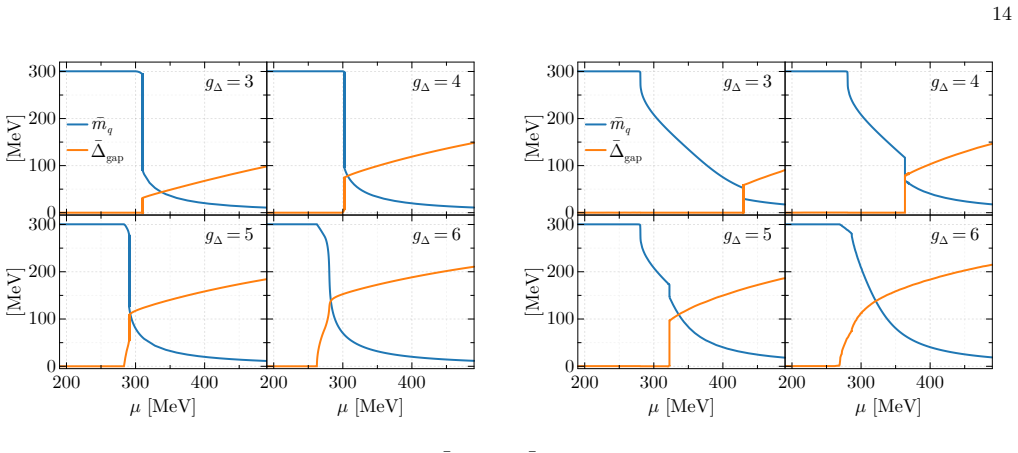
Diquark onset and chiral transition In MFA, the onset of diquark condensation coincides with the chiral transition at low temperature forg ∆ = 3,4. For larger couplings (g ∆ = 5,6), the diquark on- set slightly precedes the chiral transition, which changes from first order to a sharp crossover atg ∆ = 6. This behavior can be seen in Fig. 4, where the quar...
-
[7]
Three-nucleon forces: Implementation and applications to atomic nuclei and dense matter,
K. Hebeler, Three-nucleon forces: Implementation and applications to atomic nuclei and dense matter, Phys. Rept.890, 1 (2021), arXiv:2002.09548 [nucl-th]
- [8]
- [9]
-
[10]
M. G. Alford, A. Schmitt, K. Rajagopal, and T. Sch¨ afer, Color superconductivity in dense quark matter, Rev. Mod. Phys.80, 1455 (2008), arXiv:0709.4635 [hep-ph]
work page internal anchor Pith review Pith/arXiv arXiv 2008
-
[11]
The phase diagram of dense QCD
K. Fukushima and T. Hatsuda, The phase diagram of dense qcd, Rept. Prog. Phys.74, 014001 (2011), arXiv:1005.4814 [hep-ph]. 21
work page internal anchor Pith review Pith/arXiv arXiv 2011
-
[12]
Crystalline color superconductors
R. Anglani, R. Casalbuoni, M. Ciminale, N. Ippolito, R. Gatto, M. Mannarelli, and M. Ruggieri, Crystalline color superconductors, Rev. Mod. Phys.86, 509 (2014), arXiv:1302.4264 [hep-ph]
work page internal anchor Pith review Pith/arXiv arXiv 2014
-
[13]
Inhomogeneous chiral condensates
M. Buballa and S. Carignano, Inhomogeneous chiral condensates, Prog. Part. Nucl. Phys.81, 39 (2015), arXiv:1406.1367 [hep-ph]
work page internal anchor Pith review Pith/arXiv arXiv 2015
- [14]
- [15]
- [16]
- [17]
-
[18]
Schmitt, Phases and properties of color superconduc- tors, (2025), arXiv:2511.07319 [hep-ph]
A. Schmitt, Phases and properties of color superconduc- tors, (2025), arXiv:2511.07319 [hep-ph]
- [19]
-
[20]
Bazavov et al., Chiral crossover in QCD at zero and non-zero chemical potentials, 1812.08235
A. Bazavovet al.(HotQCD), Chiral crossover in QCD at zero and non-zero chemical potentials, Phys. Lett. B 795, 15 (2019), arXiv:1812.08235 [hep-lat]
-
[21]
S. Borsanyi, Z. Fodor, J. N. Guenther, R. Kara, S. D. Katz, P. Parotto, A. Pasztor, C. Ratti, and K. K. Sz- abo, Qcd crossover at finite chemical potential from lat- tice simulations, Phys. Rev. Lett.125, 052001 (2020), arXiv:2002.02821 [hep-lat]
- [22]
-
[23]
Y. Namekawa, K. Kashiwa, H. Matsuda, A. Ohnishi, and H. Takase, Improving efficiency of the path opti- mization method for a gauge theory, Phys. Rev. D107, 034509 (2023), arXiv:2210.05402 [hep-lat]
-
[24]
G. Aartset al., Phase transitions in particle physics: Results and perspectives from lattice quantum chromo- dynamics, Prog. Part. Nucl. Phys.133, 104070 (2023), arXiv:2301.04382 [hep-lat]
-
[25]
C. S. Fischer, Qcd at finite temperature and chemical potential from dyson-schwinger equations, Prog. Part. Nucl. Phys.105, 1 (2019), arXiv:1810.12938 [hep-ph]
work page internal anchor Pith review Pith/arXiv arXiv 2019
-
[26]
Fu, QCD at finite temperature and density within the fRG approach: an overview, Commun
W.-j. Fu, QCD at finite temperature and density within the fRG approach: an overview, Commun. Theor. Phys. 74, 097304 (2022), arXiv:2205.00468 [hep-ph]
- [27]
- [28]
-
[29]
Quark Confinement from Color Confinement
J. Braun, H. Gies, and J. M. Pawlowski, Quark confine- ment from color confinement, Phys. Lett. B684, 262 (2010), arXiv:0708.2413 [hep-th]
work page internal anchor Pith review Pith/arXiv arXiv 2010
-
[30]
From Quarks and Gluons to Hadrons: Chiral Symmetry Breaking in Dynamical QCD
J. Braun, L. Fister, J. M. Pawlowski, and F. Rennecke, From Quarks and Gluons to Hadrons: Chiral Symmetry Breaking in Dynamical QCD, Phys. Rev. D94, 034016 (2016), arXiv:1412.1045 [hep-ph]
work page internal anchor Pith review Pith/arXiv arXiv 2016
-
[31]
Chiral symmetry breaking in continuum QCD
M. Mitter, J. M. Pawlowski, and N. Strodthoff, Chiral symmetry breaking in continuum QCD, Phys. Rev. D 91, 054035 (2015), arXiv:1411.7978 [hep-ph]
work page internal anchor Pith review Pith/arXiv arXiv 2015
-
[32]
A. K. Cyrol, L. Fister, M. Mitter, J. M. Pawlowski, and N. Strodthoff, Landau gauge Yang-Mills corre- lation functions, Phys. Rev. D94, 054005 (2016), arXiv:1605.01856 [hep-ph]
work page internal anchor Pith review Pith/arXiv arXiv 2016
-
[33]
A. K. Cyrol, M. Mitter, J. M. Pawlowski, and N. Strodthoff, Nonperturbative quark, gluon, and me- son correlators of unquenched qcd, Phys. Rev. D97, 054006 (2018), arXiv:1706.06326 [hep-ph]
work page internal anchor Pith review Pith/arXiv arXiv 2018
-
[34]
J. Braun and B. Schallmo, From quarks and gluons to color superconductivity at supranuclear densities, Phys. Rev. D105, 036003 (2022), arXiv:2106.04198 [hep-ph]
-
[35]
Renormalization group consistency and low-energy effective theories
J. Braun, M. Leonhardt, and J. M. Pawlowski, Renor- malization group consistency and low-energy effective theories, SciPost Phys.6, 056 (2019), arXiv:1806.04432 [hep-ph]
work page internal anchor Pith review Pith/arXiv arXiv 2019
- [36]
-
[37]
H. Gholami, L. Kurth, U. Mire, M. Buballa, and B.- J. Schaefer, Renormalizing the Quark-Meson-Diquark Model, (2025), arXiv:2505.22542 [hep-ph]
- [38]
- [39]
-
[40]
J. B. Kogut, M. A. Stephanov, and D. Toublan, On two color QCD with baryon chemical potential, Phys. Lett. B464, 183 (1999), arXiv:hep-ph/9906346
work page internal anchor Pith review Pith/arXiv arXiv 1999
-
[41]
J. O. Andersen and T. Brauner, Phase diagram of two- color quark matter at nonzero baryon and isospin den- sity, Phys. Rev. D81, 096004 (2010), arXiv:1001.5168 [hep-ph]
work page internal anchor Pith review Pith/arXiv arXiv 2010
-
[42]
Quark-meson-diquark model for two-color QCD
N. Strodthoff, B.-J. Schaefer, and L. von Smekal, Quark- meson-diquark model for two-color QCD, Phys. Rev. D 85, 074007 (2012), arXiv:1112.5401 [hep-ph]
work page internal anchor Pith review Pith/arXiv arXiv 2012
-
[43]
N. Khan, J. M. Pawlowski, F. Rennecke, and M. M. Scherer, The Phase Diagram of QC2D from Functional Methods, (2015), arXiv:1512.03673 [hep-ph]
work page internal anchor Pith review Pith/arXiv arXiv 2015
-
[44]
N. J. Evans, S. D. H. Hsu, and M. Schwetz, Nonper- turbative couplings and color superconductivity, Phys. Lett. B449, 281 (1999), arXiv:hep-ph/9810514
work page internal anchor Pith review Pith/arXiv arXiv 1999
-
[45]
T. Sch¨ afer and F. Wilczek, High density quark mat- ter and the renormalization group in qcd with two and three flavors, Phys. Lett. B450, 325 (1999), arXiv:hep- ph/9810509
-
[46]
Renormalization Flow of Bound States
H. Gies and C. Wetterich, Renormalization flow of bound states, Phys. Rev. D65, 065001 (2002), arXiv:hep-th/0107221
work page internal anchor Pith review Pith/arXiv arXiv 2002
- [47]
-
[48]
K. Fukushima, J. M. Pawlowski, and N. Strodthoff, Emergent hadrons and diquarks, Annals Phys.446, 169106 (2022), arXiv:2103.01129 [hep-ph]
- [49]
-
[50]
M. Leonhardt, M. Pospiech, B. Schallmo, J. Braun, C. Drischler, K. Hebeler, and A. Schwenk, Symmetric nuclear matter from the strong interaction, Phys. Rev. Lett.125, 142502 (2020), arXiv:1907.05814 [nucl-th]
-
[51]
J. Braun and B. Schallmo, Zero-temperature thermo- dynamics of dense asymmetric strong-interaction mat- ter, Phys. Rev. D106, 076010 (2022), arXiv:2204.00358 [nucl-th]
-
[52]
Fermion Interactions and Universal Behavior in Strongly Interacting Theories
J. Braun, Fermion Interactions and Universal Behavior in Strongly Interacting Theories, J. Phys. G39, 033001 (2012), arXiv:1108.4449 [hep-ph]
work page internal anchor Pith review Pith/arXiv arXiv 2012
- [53]
-
[54]
D. T. Son, Superconductivity by long range color mag- netic interaction in high density quark matter, Phys. Rev. D59, 094019 (1999), arXiv:hep-ph/9812287
work page internal anchor Pith review Pith/arXiv arXiv 1999
-
[55]
R. D. Pisarski and D. H. Rischke, Gaps and critical temperature for color superconductivity, Phys. Rev. D 61, 051501 (2000), arXiv:nucl-th/9907041
work page internal anchor Pith review Pith/arXiv arXiv 2000
-
[56]
M. Buballa, NJL model analysis of quark matter at large density, Phys. Rept.407, 205 (2005), arXiv:hep- ph/0402234
- [57]
-
[58]
The Phase Diagram of the Quark-Meson Model
B.-J. Schaefer and J. Wambach, The Phase diagram of the quark meson model, Nucl. Phys. A757, 479 (2005), arXiv:nucl-th/0403039
work page internal anchor Pith review Pith/arXiv arXiv 2005
-
[59]
Susceptibilities near the QCD (tri)critical point
B.-J. Schaefer and J. Wambach, Susceptibilities near the qcd (tri)critical point, Phys. Rev. D75, 085015 (2007), arXiv:hep-ph/0603256
work page internal anchor Pith review Pith/arXiv arXiv 2007
-
[60]
Fluctuation-induced modifications of the phase structure in (2+1)-flavor QCD
F. Rennecke and B.-J. Schaefer, Fluctuation-induced modifications of the phase structure in (2+1)- flavor QCD, Phys. Rev. D96, 016009 (2017), arXiv:1610.08748 [hep-ph]
work page internal anchor Pith review Pith/arXiv arXiv 2017
-
[61]
Mass sensitivity of the three-flavor chiral phase transition
S. Resch, F. Rennecke, and B.-J. Schaefer, Mass sensi- tivity of the three-flavor chiral phase transition, Phys. Rev. D99, 076005 (2019), arXiv:1712.07961 [hep-ph]
work page internal anchor Pith review Pith/arXiv arXiv 2019
- [62]
- [63]
- [64]
-
[65]
Exact evolution equation for the effective potential
C. Wetterich, Exact evolution equation for the effec- tive potential, Phys. Lett. B301, 90 (1993), two identi- cal pdf papers original 1993 and 2017, arXiv:1710.05815 [hep-th]
work page internal anchor Pith review Pith/arXiv arXiv 1993
-
[66]
L. Gor’kov, Microscopic derivation of the ginzburg- landau equations in the theory of superconductivity, Sov. Phys. JETP36(9), 1364 (1959)
work page 1959
-
[67]
Nambu, Quasi-particles and gauge invariance in the theory of superconductivity, Phys
Y. Nambu, Quasi-particles and gauge invariance in the theory of superconductivity, Phys. Rev.117, 648 (1960)
work page 1960
-
[68]
M. L. Bellac,Thermal Field Theory, Cambridge Mono- graphs on Mathematical Physics (Cambridge University Press, 2011)
work page 2011
- [69]
-
[70]
M. Hess, F. Karsch, E. Laermann, and I. Wetzorke, Diquark masses from lattice QCD, Phys. Rev. D58, 111502 (1998), arXiv:hep-lat/9804023
work page internal anchor Pith review Pith/arXiv arXiv 1998
-
[71]
Nucleon Properties in the Covariant Quark-Diquark Model
M. Oettel, R. Alkofer, and L. von Smekal, Nucleon prop- erties in the covariant quark diquark model, Eur. Phys. J. A8, 553 (2000), arXiv:nucl-th/0006082
work page internal anchor Pith review Pith/arXiv arXiv 2000
-
[72]
P. Maris, Effective masses of diquarks, Few Body Syst. 32, 41 (2002), arXiv:nucl-th/0204020
work page internal anchor Pith review Pith/arXiv arXiv 2002
-
[73]
H. Gholami, U. Mire, F. Rennecke, B.-J. Schaefer, and S. Yin, (to be published) (2026)
work page 2026
-
[74]
B. J. Schaefer and M. Wagner, QCD critical region and higher moments for three flavor models, Phys. Rev. D 85, 034027 (2012), arXiv:1111.6871 [hep-ph]
work page internal anchor Pith review Pith/arXiv arXiv 2012
- [75]
- [76]
-
[77]
J. M. Pawlowski, M. M. Scherer, R. Schmidt, and S. J. Wetzel, Physics and the choice of regulators in func- tional renormalisation group flows, Annals Phys.384, 165 (2017), arXiv:1512.03598 [hep-th]
work page internal anchor Pith review Pith/arXiv arXiv 2017
-
[78]
T. K. Herbst, M. Mitter, J. M. Pawlowski, B.-J. Schae- fer, and R. Stiele, Thermodynamics of QCD at vanishing density, Phys. Lett. B731, 248 (2014), arXiv:1308.3621 [hep-ph]
work page internal anchor Pith review Pith/arXiv arXiv 2014
-
[79]
H. Gholami, M. Hofmann, and M. Buballa, Renormalization-group consistent treatment of color superconductivity in the NJL model, (2024), arXiv:2408.06704 [hep-ph]
-
[80]
A. Koenigstein, M. J. Steil, N. Wink, E. Grossi, J. Braun, M. Buballa, and D. H. Rischke, Numer- ical fluid dynamics for FRG flow equations: Zero- dimensional QFTs as numerical test cases. I. The O(N) model, Phys. Rev. D106, 065012 (2022), arXiv:2108.02504 [cond-mat.stat-mech]
discussion (0)
Sign in with ORCID, Apple, or X to comment. Anyone can read and Pith papers without signing in.