REVIEW 4 major objections 6 minor 1 cited by
Fitting KEDR and truncated BESIII data to massless QCD yields alpha_s(M_Z) values that rise with each perturbative order, from 0.1179 at NLO to 0.1313 at N3LO.
Reviewed by Pith at T0; open to challenge. T0 means a machine referee read the full paper against a public rubric. the ladder, T0–T4 →
T0 review · deepseek-v4-flash
2026-08-02 16:59 UTC pith:HH6CG2Y6
load-bearing objection Genuinely new alpha_s extraction from KEDR+truncated BESIII, but the N3LO drift is not uniquely pinned to pi^2 effects and the abstract doesn't match the body. the 4 major comments →
Perturbative QCD fitting of KEDR and BESIII e^+e^- data for R(s) and α_s determination
The pith
A machine-rendered reading of the paper's core claim, the machinery that carries it, and where it could break.
Core claim
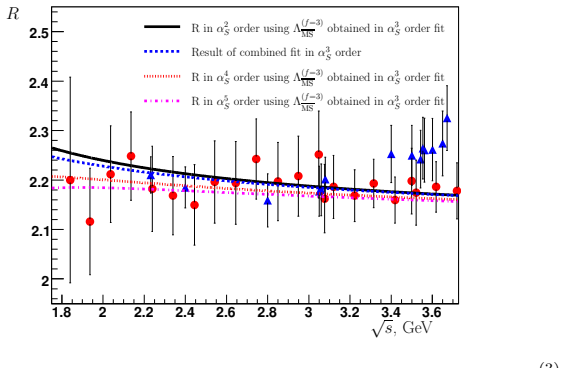
The central claim is that the combined KEDR and truncated BESIII fits provide new, order-dependent determinations of alpha_s(M_Z) from the R-ratio below charm threshold, and that the order dependence is a physical signal rather than a statistical artifact. Using massless f=3 pQCD with fixed-order inverse-log running, the fits give alpha_s(M_Z)=0.1179^{+0.0051}_{-0.0069} (NLO), 0.1221^{+0.0063}_{-0.0080} (NNLO), 0.1313^{+0.0027}_{-0.0067} (N3LO), and about 0.1268 when an estimated N4LO term is included. The growth is attributed to large pi^2 analytic-continuation contributions that make the Minkowski-region coefficients r3=-10.377 and r4=-106.15 negative and sizable, so the fixed-order series
What carries the argument
The central object is the relation between the Euclidean Adler function D(Q^2) and the time-like R-ratio, R(s)=12 pi Im Pi(-s+i epsilon), implemented through the analytic-continuation shifts Delta_k(f) that convert the Euclidean coefficients d_k into the Minkowski coefficients r_k = d_k - Delta_k. The Delta_k contain powers of pi^2 (for example Delta_3 = pi^2 beta_0^2 d_1/3), and they change the sign structure of the series from sign-constant in the Euclidean region to sign-alternating in the time-like region. These shifts, together with the chi^2_1 minimization function that adds a free normalization nu, carry the argument that the extracted coupling's order-dependence is driven by uncontai
Load-bearing premise
The load-bearing premise is that the reconstructed BESIII covariance matrix, built by treating four systematic sources as fully correlated and three as uncorrelated, correctly represents the experiment's true correlations; if it does not, the decision to drop eight BESIII points and the resulting alpha_s values would change.
What would settle it
If the BESIII collaboration released its full correlation matrix and a refit of all 14 points with that matrix gave chi-squared per degree of freedom near 1 and order-stable alpha_s values, the paper's central claims—that the full dataset is incompatible with pQCD and that the order-dependence is driven by pi^2 terms—would be falsified.
If this is right
- If the central claim is right, alpha_s(M_Z) determinations from low-energy R data agree with the world average only at NLO (0.1179) and NNLO (0.1221); the N3LO value 0.1313 overshoots it.
- The eight BESIII points above the J/psi mass are not describable by massless three-flavor pQCD, so future extractions from that energy region must either exclude them or add missing physics.
- The estimated N4LO correction (about 0.1268) partially reverses the N3LO increase, indicating the fixed-order series oscillates before settling.
- Fits to the full 14-point BESIII dataset are statistically unacceptable, so combined analyses should use the truncated set.
- The order-dependence pattern provides a concrete test for when fixed-order perturbation theory fails in the time-like region.
Where Pith is reading between the lines
- A natural extension would be to repeat the fits with contour-improved or analytic perturbation theory, which resum the pi^2 terms; if alpha_s then stabilizes across orders, that would confirm the paper's diagnosis that the growth is a fixed-order artifact.
- The reconstructed BESIII covariance matrix is a single point of failure: if the true correlations differ, the chi^2_0 roughly 54/13 conclusion and the decision to drop eight points could both change, and the combined-fit alpha_s values in Table 5 would shift.
- The same pi^2 mechanism should affect other time-like observables such as hadronic tau decays; the order-dependence seen here could be compared with tau-decay extractions to test whether the effect is universal.
- A dedicated scan of R in the 3.4-3.6 GeV region with reduced systematic correlations would settle whether the eight BESIII points reflect new physics, underestimated uncertainties, or a breakdown of the massless approximation.
Editorial analysis
A structured set of objections, weighed in public.
Referee Report
Summary. The paper compares the KEDR (1.84–3.72 GeV) and BESIII (2.23–3.67 GeV) measurements of the e+e− hadronic R-ratio with fixed-order massless f=3 perturbative QCD expressions, using the MS-bar scheme and the FOPT running coupling. By minimizing χ²0 and a modified χ²1 with an extra normalization parameter ν, the authors extract Λ_MS^(3) and then α_s(M_Z) at NLO, NNLO, N3LO, and an estimated N4LO. For the combined KEDR + truncated BESIII data set (the six BESIII points below the J/ψ mass), the headline results are α_s(M_Z)=0.1179^{+0.0051}_{−0.0069} (NLO), 0.1221^{+0.0063}_{−0.0080} (NNLO), and 0.1313^{+0.0027}_{−0.0067} (N3LO). The authors attribute the order-by-order rise to analytically continued π² contributions that change the signs of the higher-order coefficients, and they comment on the disagreement with other α_s determinations. The full 14-point BESIII sample is found to be incompatible with pQCD (χ²0/ndf ≈ 54/13), which motivates the truncation.
Significance. If the result were fully robust, the paper would provide a new low-energy α_s determination from recent R-ratio data and a concrete illustration of FOPT π² effects below the charm threshold. The manuscript is transparent in stating the fit function, the order-by-order evolution, and the ad hoc elements of the analysis; the tables are informative and the KEDR-only fits are internally consistent. The historical summary and the explicit separation of correlated/uncorrelated BESIII systematics are also useful. However, the significance is currently conditional: the headline combined fits rest on a post-hoc BESIII data selection, on a covariance matrix reconstructed from published error summaries rather than the true correlation matrix, and on the omission of any non-perturbative power-correction term. These issues directly affect the central numerical claims, especially the N3LO value and its interpretation.
major comments (4)
- [§5, Eq. (27)] The BESIII covariance matrix is reconstructed by treating the 'last four sources' of systematic uncertainty as fully correlated across energy points and the remaining three as fully uncorrelated, based only on the qualitative caption of Table I of Ref. [34]. This is a strong assumption that is not validated against the experiment's internal correlations. Since the conclusion that the full 14-point BESIII sample is incompatible with pQCD (χ²0/ndf ≈ 54/13, Table 3) and the subsequent decision to truncate the sample both depend on this matrix, the paper should provide a sensitivity study (e.g., varying the correlation coefficients between 0 and 1 for the four correlated sources) and show how the χ² values and the Table 5 α_s values change. Without such a test, the statistical rejection of BESIII data is partly an artifact of an assumption.
- [§5, Tables 3 and 4] The exclusion of the eight BESIII points above 3.4 GeV is decided after observing the large χ²0/ndf ≈ 54/13 for the full sample, and is motivated by the known tension of those points with KEDR and with pQCD. Using the outcome of the fit to select the data then biases the combined results in Table 5: the 'truncated BESIII' agreement is not an independent confirmation. The paper needs an a priori, physically motivated selection rule — for example, a threshold justified independently of the χ² comparison, with results also shown for the full 14-point sample under a robust treatment of the discrepancy (e.g., an additional correlated systematic parameter). Without this, the combined NLO, NNLO, and N3LO values in Eqs. (31)–(33) are not supported as a single coherent data set.
- [§2 Eq. (20), §6 Eqs. (31)–(33)] The fit function is the massless f=3 fixed-order expansion with no non-perturbative terms. In the fit range √s = 1.84–3.72 GeV, a_s ≈ 0.08–0.10, so the O(a_s³) coefficient −10.377 changes R by roughly −0.008 to −0.010, which is comparable to expected Λ²/s power corrections and to unsubtracted charm-mass effects near the open-charm threshold. Since the KEDR fits have χ²0/ndf ≈ 4–6/21, a 1% shift in the theoretical curve can be absorbed into a substantially different Λ_MS^(3). The conclusion that the NLO→N3LO rise is due to 'not totally controlled π² contributions' is therefore not unique: adding a 1/s² power correction or an OPE parameter would likely move the N3LO α_s downward. The paper should test this by including a power-correction term in a simultaneous fit, or else quote a theoretical uncertainty that covers such effects. As written, the N3LO value of Eq. (33) is over-interpreted.
- [§6, Table 5] The quoted uncertainties on α_s(M_Z) are the experimental fit errors only. The central message of the paper is the order-by-order drift: 0.1179 (NLO), 0.1221 (NNLO), 0.1313 (N3LO), and 0.1268 (N4LO estimate). If truncation effects are the subject, the comparison should include a truncation/scale uncertainty, for example by varying the renormalization scale or by treating the order-by-order spread as a systematic error. Without such an error, the apparent agreement of the NLO/NNLO values with the world average and the disagreement of the N3LO value are not quantified on the same footing as the experimental errors, and the 'tendency of growth' is presented with overprecise error bars.
minor comments (6)
- [Abstract and text] There are several typos and stylistic issues: 'Bejing' should be 'Beijing', 'coordially' should be 'ordinarily' or similar, 'massles' appears in the text, and the abstract contains duplicated punctuation ('BESIII data ,').
- [§5, Table 3] The informal notation 'χ²0 ≈ 50/13 (?!)' and 'χ²1 ≈ 51/12 (?!)' is not appropriate for a journal report; the question marks and exclamation marks should be removed and replaced by a clear statement of the statistical significance.
- [Figure 1 and Figure 2] The figures contain 'PSfrag replacements' and Cyrillic text ('R по результатам КМД-3...'), which appear to be LaTeX/artifact labels. The figures should be regenerated with clean, readable axis labels and legends.
- [§6, Eq. (29)] The underlining and double-underlining in Eq. (29) are not explained in the text. The reader cannot tell which terms are 'directly Euclidean' and which are 'analytical continuation contributions' without an explicit key or a more detailed explanation in the caption or text.
- [§2, Eq. (17)] The notation Δ_k(f) is introduced without a clear statement of its argument (the number of flavors f) and its relation to the coefficients d_k(f). This makes the reader reconstruct the sign convention; a one-sentence definition would help.
- [References] The reference list contains entries that appear to be from the future relative to standard arXiv dates (e.g., Ref. [62], Ref. [40]). While this may be a preprint artifact, the authors should ensure all bibliographic entries are complete and correctly dated.
Circularity Check
No significant circularity: alpha_s is extracted by chi^2 fits to external KEDR/BESIII data; self-citations are peripheral.
full rationale
The central extraction is not circular. The fitted quantity Lambda_MS^(f=3) is obtained by minimizing chi^2_0/chi^2_1 (Eqs. 25-28) against experimental R(s) points from KEDR [31-33] and BESIII [34]; the perturbative coefficients in Eq. (20) (1, a_s, 1.6398 a_s^2, -10.377 a_s^3, -106.15 a_s^4, ~505 a_s^5) are fixed inputs from published calculations (Refs. [13-15,22-24,36,37]), not parameters adjusted to force the resulting alpha_s. The order-by-order drift is not built in by construction: the N4LO estimate, with a still more negative coefficient, actually lowers the extracted value (Table 5: alpha_s(M_Z)=0.1313 at N3LO vs ~0.1268 at N4LO), so the NLO-to-N3LO rise is an emergent feature of the data/theory comparison, not a tautology. The pi^2-related increase is attributed to analytic-continuation terms (Eqs. 16-18) whose coefficients are derived from the standard log/(L +/- i pi) continuation and published beta-function coefficients; no fitted parameter is renamed as a prediction. The reconstructed BESIII covariance matrix (Eq. 27) is an assumption based on the published systematic-error table, and the full-BESIII fit is explicitly acknowledged as unsatisfactory (Table 3: chi^2_0 ~ 50/13 and 'non-physical' Lambda ~ 20 MeV), so the truncation to six points is a disclosed modeling choice rather than a hidden circular step. Several citations are to the authors' own prior work (Refs. [38,43-46,72]), but they concern the N4LO estimate, a critique of the PMC-based analysis [41,42], and the threshold-matching prescription; none of these carries the central NLO/NNLO/N3LO alpha_s determination, which rests on external experimental data and externally calculated pQCD coefficients. Therefore no specific circular reduction can be exhibited.
Axiom & Free-Parameter Ledger
free parameters (4)
- Λ_MS^{(3)} (combined fit) =
379+99-112 MeV (NLO); 428+130-135 (NNLO); 624+64-148 (N3LO); 524 (N4LO est.)
- ν_KEDR (χ²_1 normalization) =
0.988±0.013 (NLO); 0.991±0.013 (NNLO); 0.994±0.011 (N3LO); 0.988 (N4LO)
- ν_BESIII (χ²_1 normalization) =
0.967±0.019 (NLO); 0.970±0.020 (NNLO); 0.964±0.013 (N3LO); 0.955 (N4LO)
- σ0 (minimum correlated systematic) =
0.0171 (KEDR); 0.0349 (BESIII)
axioms (5)
- standard math The published MS-scheme R(s) coefficients and β-function coefficients in Eqs. (15) and (20) are correct.
- standard math Analytic continuation from the Euclidean D-function to the Minkowski R-ratio generates exactly the π² terms in Eqs. (17)-(18).
- domain assumption Massless f=3 pQCD describes the R continuum in the 1.84-3.72 GeV region; non-perturbative power corrections and quark-mass effects are negligible.
- ad hoc to paper The reconstructed BESIII covariance matrix of Eq. (27), treating the last four systematic sources as fully correlated and the rest as uncorrelated, is a valid representation of the published uncertainties.
- ad hoc to paper BESIII data points above the J/ψ mass may be excluded from the final combined fits.
read the original abstract
The experimental data collected by KEDR and BESIII collaborations at the energies below charm quark thresholds are compared with the massless QCD expressions for the $e^+e^-$ annihilation R-ratio truncated at different orders of perturbation theory. The fits demonstrate the dependence of the extracted $\alpha_s(M_Z)$ values on the orders of truncation of the corresponding approximations. The next-to-leading order, next-to-next-to-leading order and next-to-next-to-next-to-leading order fits of the combined KEDR data and BESIII data , truncated at the scale of mass of $J/\Psi$ meson, give the following results $\alpha_s(M_Z)=0.1151_{-0.0069}^{+0.0052}$, $\alpha_s(M_Z)=0.1190_{-0.0081}^{+0.0064}$and $\alpha_s(M_Z)=0.1283_{-0.0075}^{+0.0028}$. The increasing tendency of fitted $\alpha_s(M_Z)$ value is associated with the effects of not totally controlled within asymptotic perturbation theory expansions kinematical $\pi^2$ contributions to R-ratio coefficients due to analytical continuation from the space-like to time-like energy regions. The applications of the fixed orders of perturbation theory expansions and careful treatment of the analytical continuation effects are commented.
Figures

Forward citations
Cited by 1 Pith paper
-
Dispersive estimation of the LO hadronic contribution to the muon ${g-2}$: fitting incompatible ${e^+e^-}$ data
A new procedure for inflating systematic uncertainties in incompatible e+e- hadronic cross-section data yields a muon g-2 Standard Model prediction consistent with experiment at 2σ.
Reference graph
Works this paper leans on
-
[1]
Review of different colliders,
J. Gao, “Review of different colliders,” Int. J. Mod. Phys. A36(2021) no.22, 2142002 doi:10.1142/S0217751X21420021
-
[2]
Anomalous magnetic moment of the muon,
I. B. Logashenko and S. I. Eidelman, “Anomalous magnetic moment of the muon,” Phys. Usp.61(2018) no.5, 480-510 doi:10.3367/UFNe.2018.02.038312
-
[3]
The Role of sigma(e+ e- —>hadrons) in precision tests of the standard model,
F. Jegerlehner, “The Role of sigma(e+ e- —>hadrons) in precision tests of the standard model,” Nucl. Phys. B Proc. Suppl.131(2004), 213-222 doi:10.1016/j.nuclphysbps.2004.02.028 [arXiv:hep-ph/0312372 [hep-ph]]
Pith/arXiv arXiv 2004
-
[4]
S. Navaset al.[Particle Data Group], “Review of particle physics,” Phys. Rev. D110 (2024) no.3, 030001 doi:10.1103/PhysRevD.110.030001
-
[5]
A. Deur, S. J. Brodsky and G. F. de Teramond, “The QCD Running Coupling,” Nucl. Phys.90(2016), 1 doi:10.1016/j.ppnp.2016.04.003 [arXiv:1604.08082 [hep-ph]]
Pith/arXiv arXiv 2016
-
[6]
The strong coupling: a theoretical perspective,
G. P. Salam, “The strong coupling: a theoretical perspective,” In ”From my Vast Reper- toire...” Guido Altarelli’s Legacy , World Scientific, Eds.S. Forte, A.Levy and G.Ridolfi doi:10.1142/9789813238053 0007 [arXiv:1712.05165 [hep-ph]]
-
[7]
Precision physics with inclusive QCD processes,
A. Pich, “Precision physics with inclusive QCD processes,” Prog. Part. Nucl. Phys.117 (2021), 103846 doi:10.1016/j.ppnp.2020.103846 [arXiv:2012.04716 [hep-ph]]
arXiv 2021
-
[8]
The strong coupling constant: state of the art and the decade ahead,
D. d’Enterria, S. Kluth, G. Zanderighi, C. Ayala, M. A. Benitez-Rathgeb, J. Bluemlein, D. Boito, N. Brambilla, D. Britzger and S. Camarda,et al.“The strong coupling constant: state of the art and the decade ahead,” J. Phys. G51(2024) no.9, 090501 doi:10.1088/1361- 6471/ad1a78 [arXiv:2203.08271 [hep-ph]]
Pith/arXiv arXiv 2024
-
[9]
Counting Quarks in e+ e- Annihilation,
A. De Rujula and H. Georgi, “Counting Quarks in e+ e- Annihilation,” Phys. Rev. D13 (1976), 1296-1301 doi:10.1103/PhysRevD.13.1296
-
[10]
Electron positron annihilation in stagnant field theories,
A. Zee, “Electron positron annihilation in stagnant field theories,” Phys. Rev. D8(1973), 4038-4041 doi:10.1103/PhysRevD.8.4038
-
[11]
e+ e- annihilation in gauge theories of strong interactions,
T. Appelquist and H. Georgi, “e+ e- annihilation in gauge theories of strong interactions,” Phys. Rev. D8(1973), 4000-4002 doi:10.1103/PhysRevD.8.4000
-
[13]
Higher Order Corrections to Sigma-t (e+ e- —>Hadrons) in Quantum Chromodynamics,
K. G. Chetyrkin, A. L. Kataev and F. V. Tkachov, “Higher Order Corrections to Sigma-t (e+ e- —>Hadrons) in Quantum Chromodynamics,” Phys. Lett. B85(1979), 277-279 doi:10.1016/0370-2693(79)90596-3
-
[14]
Higher Order QCD Corrections in e+ e- Annihilation,
M. Dine and J. R. Sapirstein, “Higher Order QCD Corrections in e+ e- Annihilation,” Phys. Rev. Lett.43(1979), 668 doi:10.1103/PhysRevLett.43.668
-
[15]
An Analytic Calculation of Higher Order Quantum Chromodynamic Corrections in e+ e- Annihilation,
W. Celmaster and R. J. Gonsalves, “An Analytic Calculation of Higher Order Quantum Chromodynamic Corrections in e+ e- Annihilation,” Phys. Rev. Lett.44(1980), 560 doi:10.1103/PhysRevLett.44.560
-
[16]
The Problem of R ine +e− Annihilation,
R. M. Barnett, M. Dine and L. D. McLerran, “The Problem of R ine +e− Annihilation,” Phys. Rev. D22(1980), 594 doi:10.1103/PhysRevD.22.594 17
-
[17]
H. J. Behrendet al.[CELLO], “Determination of alpha-s and sin**2theta(w) from Mea- surements of the Total Hadronic Cross-Section in e+ e- Annihilation,” Phys. Lett. B183 (1987), 400-411 doi:10.1016/0370-2693(87)90986-5
-
[18]
A Determination of the Strong Coupling Constantα −sFrome +e− Total Cross-section Data,
R. Marshall, “A Determination of the Strong Coupling Constantα −sFrome +e− Total Cross-section Data,” Z. Phys. C43(1989), 595 doi:10.1007/BF01550938
-
[19]
e+ e- annihilation at high energies,
R. Marshall, “e+ e- annihilation at high energies,” Rept. Prog. Phys.52(1989), 1329-1420 doi:10.1088/0034-4885/52/11/001
-
[20]
G. D’Agostini, W. de Boer and G. Grindhammer, “Determination ofα s and theZ 0 Mass From Measurements of the Total Hadronic Cross-section ine +e− Annihilation,” Phys. Lett. B229(1989), 160-168 doi:10.1016/0370-2693(89)90176-7
-
[22]
TheO(α 3 s)-corrections toσ tot(e+e− → hadrons) and Γ(τ − →ν τ +hadrons) in QCD,
S. G. Gorishnii, A. L. Kataev and S. A. Larin, “TheO(α 3 s)-corrections toσ tot(e+e− → hadrons) and Γ(τ − →ν τ +hadrons) in QCD,” Phys. Lett. B259(1991), 144-150 doi:10.1016/0370-2693(91)90149-K
-
[23]
Total hadronic cross-section in e+ e- annihilation at the four loop level of perturbative QCD,
L. R. Surguladze and M. A. Samuel, “Total hadronic cross-section in e+ e- annihilation at the four loop level of perturbative QCD,” Phys. Rev. Lett.66(1991), 560-563 [erratum: Phys. Rev. Lett.66(1991), 2416] doi:10.1103/PhysRevLett.66.560
-
[24]
Corrections of order alpha-s**3 to R(had) in pQCD with light gluinos,
K. G. Chetyrkin, “Corrections of order alpha-s**3 to R(had) in pQCD with light gluinos,” Phys. Lett. B391(1997), 402-412 doi:10.1016/S0370-2693(96)01478-5 [arXiv:hep- ph/9608480 [hep-ph]]
arXiv 1997
-
[25]
Combined fit to R (e+ e- —> hadrons) and data from the CERN e+ e- collider LEP,
V. Branchina, M. Consoli, D. Zappala and R. Fiore, “Combined fit to R (e+ e- —> hadrons) and data from the CERN e+ e- collider LEP,” Phys. Rev. D46(1992), 75-83 doi:10.1103/PhysRevD.46.75
-
[26]
A Measurement of the total cross-section for e+ e- —>hadrons at s**(1/2) = 10.52-GeV,
R. Ammaret al.[CLEO], “A Measurement of the total cross-section for e+ e- —>hadrons at s**(1/2) = 10.52-GeV,” Phys. Rev. D57(1998), 1350-1358 doi:10.1103/PhysRevD.57.1350 [arXiv:hep-ex/9707018 [hep-ex]]
Pith/arXiv arXiv 1998
-
[27]
Determination ofα s and heavy quark masses from recent measurements ofR(s),
J. H. Kuhn and M. Steinhauser, “Determination ofα s and heavy quark masses from recent measurements ofR(s),” Nucl. Phys. B619(2001), 588-602 [erratum: Nucl. Phys. B640 (2002), 415-415] doi:10.1016/S0550-3213(01)00499-0 [arXiv:hep-ph/0109084 [hep-ph]]
Pith/arXiv arXiv 2001
-
[28]
D. Bessonet al.[CLEO], Phys. Rev. D76(2007), 072008 doi:10.1103/PhysRevD.76.072008 [arXiv:0706.2813 [hep-ex]]
Pith/arXiv arXiv 2007
-
[29]
J. H. Kuhn, M. Steinhauser and T. Teubner, Phys. Rev. D76(2007), 074003 doi:10.1103/PhysRevD.76.074003 [arXiv:0707.2589 [hep-ph]]
Pith/arXiv arXiv 2007
-
[30]
A Compilation of total cross-section data on e+ e- —>hadrons and pQCD tests,
O. V. Zenin, V. V. Ezhela, S. B. Lugovsky, M. R. Whalley, K. Kang and S. K. Kang, “A Compilation of total cross-section data on e+ e- —>hadrons and pQCD tests,” [arXiv:hep- ph/0110176 [hep-ph]]
-
[31]
Measurement ofR uds andRbetween 3.12 and 3.72 GeV at the KEDR detector,
V. V. Anashinet al.“Measurement ofR uds andRbetween 3.12 and 3.72 GeV at the KEDR detector,” Phys. Lett. B753(2016), 533-541 doi:10.1016/j.physletb.2015.12.059 [arXiv:1510.02667 [hep-ex]]. 18
Pith/arXiv arXiv 2016
-
[32]
Measurement ofRbetween 1.84 and 3.05 GeV at the KEDR detector,
V. V. Anashinet al.“Measurement ofRbetween 1.84 and 3.05 GeV at the KEDR detector,” Phys. Lett. B770(2017), 174-181 doi:10.1016/j.physletb.2017.04.073 [arXiv:1610.02827 [hep-ex]]
Pith/arXiv arXiv 2017
-
[33]
Precise measurement ofR uds andRbetween 1.84 and 3.72 GeV at the KEDR detector,
V. V. Anashinet al.[KEDR], “Precise measurement ofR uds andRbetween 1.84 and 3.72 GeV at the KEDR detector,” Phys. Lett. B788(2019), 42-51 doi:10.1016/j.physletb.2018.11.012 [arXiv:1805.06235 [hep-ex]]
Pith/arXiv arXiv 2019
-
[34]
Measurement of the Cross Section fore +e− →Hadrons at Energies from 2.2324 to 3.6710 GeV,
M. Ablikimet al.[BESIII], “Measurement of the Cross Section fore +e− →Hadrons at Energies from 2.2324 to 3.6710 GeV,” Phys. Rev. Lett.128(2022) no.6, 062004 doi:10.1103/PhysRevLett.128.062004 [arXiv:2112.11728 [hep-ex]]
arXiv 2022
-
[35]
Perturbative QCD below charm threshold: Theory and tensions with e+e- data,
D. Boito and M. Caram, “Perturbative QCD below charm threshold: Theory and tensions with e+e- data,” Phys. Rev. D112(2025) no.9, 9 doi:10.1103/dtg5-ghdx [arXiv:2509.12956 [hep-ph]]
arXiv 2025
-
[36]
Order alpha**4(s) QCD Corrections to Z and tau Decays,
P. A. Baikov, K. G. Chetyrkin and J. H. Kuhn, “Order alpha**4(s) QCD Corrections to Z and tau Decays,” Phys. Rev. Lett.101(2008), 012002 doi:10.1103/PhysRevLett.101.012002 [arXiv:0801.1821 [hep-ph]]
Pith/arXiv arXiv 2008
-
[37]
On Higgs decays to hadrons and the R-ratio at N 4LO,
F. Herzog, B. Ruijl, T. Ueda, J. A. M. Vermaseren and A. Vogt, “On Higgs decays to hadrons and the R-ratio at N 4LO,” JHEP08(2017), 113 doi:10.1007/JHEP08(2017)113 [arXiv:1707.01044 [hep-ph]]
Pith/arXiv arXiv 2017
-
[38]
A. L. Kataev and V. V. Starshenko, “Estimates of the higher order QCD corrections to R(s), R(tau) and deep inelastic scattering sum rules,” Mod. Phys. Lett. A10(1995), 235-250 doi:10.1142/S0217732395000272 [arXiv:hep-ph/9502348 [hep-ph]]
Pith/arXiv arXiv 1995
-
[39]
Higher-order QCD corrections to hadronicτde- cays from Pad´ e approximants,
D. Boito, P. Masjuan and F. Oliani, “Higher-order QCD corrections to hadronicτde- cays from Pad´ e approximants,” JHEP08(2018), 075 doi:10.1007/JHEP08(2018)075 [arXiv:1807.01567 [hep-ph]]
Pith/arXiv arXiv 2018
-
[40]
Hadronic tau decays at higher orders in QCD,
G. Abbas and V. Singh, “Hadronic tau decays at higher orders in QCD,” [arXiv:2601.11277 [hep-ph]]
-
[41]
J. M. Shen, B. H. Qin, J. Yan, S. Q. Wang and X. G. Wu, “Novel method to reliably deter- mine the QCD coupling from Ruds measurements and its effects to muon g−2 andα M 2 Z within the tau-charm energy region,” JHEP07(2023), 109 doi:10.1007/JHEP07(2023)109 [arXiv:2303.11782 [hep-ph]]
Pith/arXiv arXiv 2023
-
[42]
S. J. Brodsky, M. Mojaza and X. G. Wu, “Systematic Scale-Setting to All Orders: The Principle of Maximum Conformality and Commensurate Scale Relations,” Phys. Rev. D 89(2014), 014027 doi:10.1103/PhysRevD.89.014027 [arXiv:1304.4631 [hep-ph]]
Pith/arXiv arXiv 2014
-
[43]
A. L. Kataev, “Conformal symmetry limit of QED and QCD and identities between perturbative contributions to deep-inelastic scattering sum rules,” JHEP02(2014), 092 doi:10.1007/JHEP02(2014)092 [arXiv:1305.4605 [hep-th]]
Pith/arXiv arXiv 2014
-
[44]
A. L. Kataev and S. V. Mikhailov, “Generalization of the Brodsky-Lepage-Mackenzie optimization within theβ-expansion and the principle of maximal conformality,” Phys. Rev. D91(2015) no.1, 014007 doi:10.1103/PhysRevD.91.014007 [arXiv:1408.0122 [hep- ph]]
Pith/arXiv arXiv 2015
-
[45]
A. L. Kataev and V. S. Molokoedov, “Decomposed photon anomalous dimension in QCD and theβ-expanded representations for the Adler function,” Phys. Rev. D108(2023) no.9, 096027 doi:10.1103/PhysRevD.108.096027 [arXiv:2309.03994 [hep-ph]]. 19
Pith/arXiv arXiv 2023
-
[46]
S. V. Mikhailov, “Adler function, Bjorken polarized sum rule: confirmation of elements of theβ-expansion and the diagrams,” JHEP10(2024), 166 doi:10.1007/JHEP10(2024)166 [arXiv:2406.15014 [hep-ph]]
Pith/arXiv arXiv 2024
-
[47]
Ultraviolet Behavior of Nonabelian Gauge Theories,
D. J. Gross and F. Wilczek, “Ultraviolet Behavior of Nonabelian Gauge Theories,” Phys. Rev. Lett.30(1973), 1343-1346 doi:10.1103/PhysRevLett.30.1343
-
[48]
Reliable Perturbative Results for Strong Interactions?,
H. D. Politzer, “Reliable Perturbative Results for Strong Interactions?,” Phys. Rev. Lett. 30(1973), 1346-1349 doi:10.1103/PhysRevLett.30.1346
-
[49]
Two Loop Diagrams in Yang-Mills Theory,
D. R. T. Jones, “Two Loop Diagrams in Yang-Mills Theory,” Nucl. Phys. B75(1974), 531 doi:10.1016/0550-3213(74)90093-5
-
[50]
Asymptotic Behavior of Nonabelian Gauge Theories to Two Loop Order,
W. E. Caswell, “Asymptotic Behavior of Nonabelian Gauge Theories to Two Loop Order,” Phys. Rev. Lett.33(1974), 244 doi:10.1103/PhysRevLett.33.244
-
[51]
Two Loop Renormalization of the QCD in an Arbitrary Gauge,
E. Egorian and O. V. Tarasov, “Two Loop Renormalization of the QCD in an Arbitrary Gauge,” Teor. Mat. Fiz.41(1979), 26-32 JINR-E2-11757
1979
-
[52]
The Gell-Mann-Low Func- tion of QCD in the Three Loop Approximation,
O. V. Tarasov, A. A. Vladimirov and A. Y. Zharkov, “The Gell-Mann-Low Func- tion of QCD in the Three Loop Approximation,” Phys. Lett. B93(1980), 429-432 doi:10.1016/0370-2693(80)90358-5
-
[53]
The Three loop QCD Beta function and anoma- lous dimensions,
S. A. Larin and J. A. M. Vermaseren, “The Three loop QCD Beta function and anoma- lous dimensions,” Phys. Lett. B303(1993), 334-336 doi:10.1016/0370-2693(93)91441-O [arXiv:hep-ph/9302208 [hep-ph]]
Pith/arXiv arXiv 1993
-
[54]
The Four loop beta function in quantum chromodynamics,
T. van Ritbergen, J. A. M. Vermaseren and S. A. Larin, “The Four loop beta function in quantum chromodynamics,” Phys. Lett. B400(1997), 379-384 doi:10.1016/S0370- 2693(97)00370-5 [arXiv:hep-ph/9701390 [hep-ph]]
Pith/arXiv arXiv 1997
-
[55]
The Four-loop QCD beta-function and anomalous dimensions,
M. Czakon, “The Four-loop QCD beta-function and anomalous dimensions,” Nucl. Phys. B710(2005), 485-498 doi:10.1016/j.nuclphysb.2005.01.012 [arXiv:hep-ph/0411261 [hep- ph]]
Pith/arXiv arXiv 2005
-
[56]
Five-Loop Running of the QCD Coupling Constant,
P. A. Baikov, K. G. Chetyrkin and J. H. K¨ uhn, “Five-Loop Running of the QCD Coupling Constant,” Phys. Rev. Lett.118(2017) no.8, 082002 doi:10.1103/PhysRevLett.118.082002 [arXiv:1606.08659 [hep-ph]]
Pith/arXiv arXiv 2017
-
[57]
The five- loop beta function of Yang-Mills theory with fermions,
F. Herzog, B. Ruijl, T. Ueda, J. A. M. Vermaseren and A. Vogt, “The five- loop beta function of Yang-Mills theory with fermions,” JHEP02(2017), 090 doi:10.1007/JHEP02(2017)090 [arXiv:1701.01404 [hep-ph]]
Pith/arXiv arXiv 2017
-
[58]
The five-loop Beta function for a general gauge group and anomalous dimensions beyond Feynman gauge,
T. Luthe, A. Maier, P. Marquard and Y. Schr¨ oder, “The five-loop Beta function for a general gauge group and anomalous dimensions beyond Feynman gauge,” JHEP10(2017), 166 doi:10.1007/JHEP10(2017)166 [arXiv:1709.07718 [hep-ph]]
Pith/arXiv arXiv 2017
-
[59]
N. V. Krasnikov and A. A. Pivovarov, “The influence of the analytical continuation effects on the value of the QCD scale parameter Lambda extracted from the data on charmonium and Ipsilonium hadonic decays,” Phys. Lett. B116(1982), 168-170 doi:10.1016/0370- 2693(82)91001-2
doi:10.1016/0370- 1982
-
[60]
A. V. Radyushkin, “Optimized Λ - Parametrization for the QCD Running Coupling Con- stant in Space - Like and Time - Like Regions,” Preprint JINR E2-82-159 (1982); JINR Rapid Commun.78(1996), 96-99 [arXiv:hep-ph/9907228 [hep-ph]]. 20
Pith/arXiv arXiv 1982
-
[61]
M. R. Pennington, R. G. Roberts and G. G. Ross, “How to Continue the Predictions of Perturbative QCD From the Space - Like Region Where They Are Derived to the Time - Like Regime Where Experiments Are Performed,” Nucl. Phys. B242(1984), 69-80 doi:10.1016/0550-3213(84)90134-2
-
[62]
On the ultraviolet behavior of the invariant charge in quantum electro- dynamics,
N. V. Krasnikov, “On the ultraviolet behavior of the invariant charge in quantum electro- dynamics,” [arXiv:2603.24092 [hep-th]]
-
[63]
Two topics in Quantum Chromodynamics,
J. D. Bjorken, “Two topics in Quantum Chromodynamics,” Preprint SLAC-PUB-5103 (1989)
1989
-
[64]
Higher-order QCD perturbation theory in different schemes: From FOPT to CIPT to F APT,
A. P. Bakulev, S. V. Mikhailov and N. G. Stefanis, “Higher-order QCD perturbation theory in different schemes: From FOPT to CIPT to F APT,” JHEP06(2010), 085 doi:10.1007/JHEP06(2010)085 [arXiv:1004.4125 [hep-ph]]
Pith/arXiv arXiv 2010
-
[65]
Electron–positron annihilation into hadrons at the higher-loop levels,
A. V. Nesterenko, “Electron–positron annihilation into hadrons at the higher-loop levels,” Eur. Phys. J. C77(2017) no.12, 844 doi:10.1140/epjc/s10052-017-5405-5 [arXiv:1707.00668 [hep-ph]]
Pith/arXiv arXiv 2017
-
[66]
Renormalization group summation and analytic continua- tion from spacelike to timeline regions,
M. S. A. Alam Khan, “Renormalization group summation and analytic continua- tion from spacelike to timeline regions,” Phys. Rev. D108(2023) no.1, 014028 doi:10.1103/PhysRevD.108.014028 [arXiv:2306.10262 [hep-ph]]
Pith/arXiv arXiv 2023
-
[67]
N. G. Gracia, A. H. Hoang and V. Mateu, “Mathematical aspects of the asymptotic expansion in contour improved perturbation theory for hadronic tau decays,” Phys. Rev. D108(2023) no.3, 034013 doi:10.1103/PhysRevD.108.034013 [arXiv:2305.10288 [hep-ph]]
Pith/arXiv arXiv 2023
-
[68]
Renormalization group analysis of the tau lepton decay within QCD,
A. A. Pivovarov, “Renormalization group analysis of the tau lepton decay within QCD,” Z.Phys.C 53 (1992) 461-464 doi:10.1007/BF01625906 [arXiv:hep-ph/0302003 [hep-ph]]
Pith/arXiv arXiv 1992
-
[69]
The perturbative QCD prediction to R(tau) revisited,
F. Le Diberder and A. Pich, “The perturbative QCD prediction to R(tau) revisited,” Phys. Lett. B286(1992), 147-152 doi:10.1016/0370-2693(92)90172-Z
-
[70]
Analytic model for the QCD running cou- pling with universal alpha-s (0) value,
D. V. Shirkov and I. L. Solovtsov, “Analytic model for the QCD running cou- pling with universal alpha-s (0) value,” Phys. Rev. Lett.79(1997), 1209-1212 doi:10.1103/PhysRevLett.79.1209 [arXiv:hep-ph/9704333 [hep-ph]]
Pith/arXiv arXiv 1997
-
[71]
Ten years of the Analytic Perturbation The- ory in QCD,
D. V. Shirkov and I. L. Solovtsov, “Ten years of the Analytic Perturbation The- ory in QCD,” Theor. Math. Phys.150(2007), 132-152 doi:10.1007/s11232-007-0010-7 [arXiv:hep-ph/0611229 [hep-ph]]
Pith/arXiv arXiv 2007
-
[72]
Improved fits to the xF3 CCFR data at the next-to-next-to-leading order and beyond,
A. L. Kataev, G. Parente and A. V. Sidorov, “Improved fits to the xF3 CCFR data at the next-to-next-to-leading order and beyond,” Phys. Part. Nucl.34(2003), 20-46 doi:10.1134/S1063779607060068 [arXiv:hep-ph/0106221 [hep-ph]]
Pith/arXiv arXiv 2003
-
[73]
Decoupling of Heavy Quarks in the Minimal Subtraction Scheme,
W. Bernreuther and W. Wetzel, “Decoupling of Heavy Quarks in the Minimal Subtraction Scheme,” Nucl. Phys. B197(1982), 228-236 [erratum: Nucl. Phys. B513(1998), 758-758] doi:10.1016/0550-3213(82)90288-7
-
[74]
S. A. Larin, T. van Ritbergen and J. A. M. Vermaseren, “The Large quark mass expan- sion of Gamma (Z0→hadrons) and Gamma (tau→tau-neutrino + hadrons) in the order alpha-s**3,” Nucl. Phys. B438(1995), 278-306 doi:10.1016/0550-3213(94)00574-X [arXiv:hep-ph/9411260 [hep-ph]]
Pith/arXiv arXiv 1995
-
[75]
Decoupling relations to O (alpha- s**3) and their connection to low-energy theorems,
K. G. Chetyrkin, B. A. Kniehl and M. Steinhauser, “Decoupling relations to O (alpha- s**3) and their connection to low-energy theorems,” Nucl. Phys. B510(1998), 61-87 doi:10.1016/S0550-3213(97)00649-4 [arXiv:hep-ph/9708255 [hep-ph]]. 21
Pith/arXiv arXiv 1998
-
[76]
K. G. Chetyrkin, J. H. Kuhn, C. Sturm, “QCD decoupling at four loops,” Nucl. Phys. B744(2006), 121-135 doi:10.1016/j.nuclphysb.2006.03.020 [arXiv:hep-ph/0512060 [hep- ph]]
Pith/arXiv arXiv 2006
-
[77]
Strong-coupling constant with flavor thresholds at five loops in the anti-MS scheme,
B. A. Kniehl, A. V. Kotikov, A. I. Onishchenko and O. L. Veretin, “Strong-coupling constant with flavor thresholds at five loops in the anti-MS scheme,” Phys. Rev. Lett.97 (2006), 042001 doi:10.1103/PhysRevLett.97.042001 [arXiv:hep-ph/0607202 [hep-ph]]
Pith/arXiv arXiv 2006
-
[78]
A. Pich and A. Rodr ´ ıguez-S´ anchez, JHEP07(2022), 145 doi:10.1007/JHEP07(2022)145 [arXiv:2205.07587 [hep-ph]]
Pith/arXiv arXiv 2022
-
[79]
D. Boito, M. Golterman, K. Maltman and S. Peris, Phys. Rev. D111(2025) no.7, 074019 doi:10.1103/PhysRevD.111.074019 [arXiv:2402.05588 [hep-ph]]
Pith/arXiv arXiv 2025
-
[80]
M. Beneke and H. Takaura, JHEP03(2026), 033 doi:10.1007/JHEP03(2026)033 [arXiv:2510.12193 [hep-ph]]. 22
arXiv 2026
discussion (0)
Sign in with ORCID, Apple, or X to comment. Anyone can read and Pith papers without signing in.