REVIEW 3 major objections 7 minor 64 references
Numerical investigation on solids settling in a non-Newtonian slurry inside a horizontal flume
T0 review · 3 major / 7 minor · reviewed 2026-08-06 · deepseek-v4-flash
Pith's one-line read A 3D Eulerian-Eulerian model captures solids settling in a non-Newtonian flume within ±15%, and predicts that particle size distribution, flume tilt, and bubble size and loading are control levers.
desk verdict Useful engineering parametric study, but the missing steady-state check on a 21 s simulation of a 35 s advection problem makes the trends provisional until time convergence is shown. read the letter →
The pith
A machine-rendered reading of the paper's core claim, the machinery that carries it, and where it could break.
The reading
What carries the argument
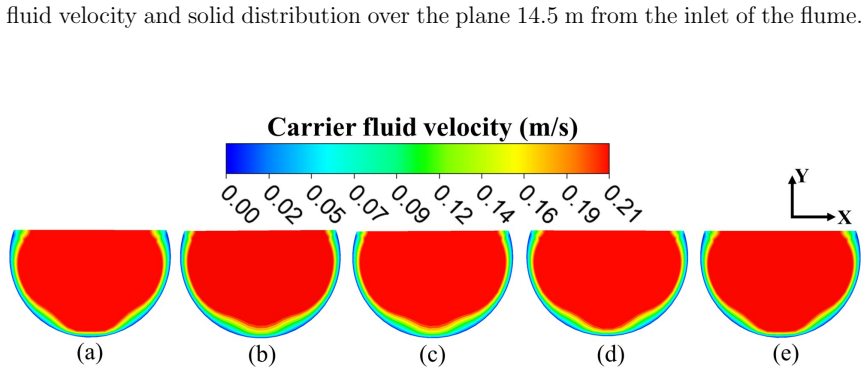
The load-bearing machinery is a 3D unsteady Eulerian-Eulerian multiphase model with seven phases: one non-Newtonian carrier fluid, five solid size classes (75, 105, 149, 210, and 296 µm), and a bubble phase. Solid-phase stresses are closed by kinetic theory of granular flow, the carrier rheology is the Herschel-Bulkley model with $n=1$ (a Bingham fluid with yield stress 40 Pa), and every interphase exchange—carrier-solid, solid-solid, and solid-bubble—uses the symmetric drag model, which the paper selects by mean absolute error against the experiments. This combination is what makes the settling profiles, velocity fields, and wall-shear-stress distributions reproducible in the simulations.
What would settle it
Measure the vertical solid-volume-fraction and carrier-velocity profiles at the 14.5 m station of the real 18.5 m flume with its five open sections and free surface exposed, under the four Spelay operating conditions; if more than roughly 7% of points fall outside the model's ±15% solid-fraction band, or velocities deviate beyond ±5% in a way that grows with bubble volume fraction or open-section location, the flat-lid simplification is load-bearing and the parametric conclusions fail.
Extended reading notes
Core claim
The paper's central claim is that the full multisize settling behaviour of a non-Newtonian thickened slurry in a horizontal semicircular flume can be captured by treating carrier fluid, five solid size classes, and bubbles as interpenetrating continua, with the carrier obeying the Herschel-Bulkley model at $n=1$ (a Bingham fluid) and all phase interactions closed with the symmetric drag model. Against the four experimental cases, the model places about 93% of solid-volume-fraction predictions inside a ±15% uncertainty band and carrier velocity within ±5%. The paper then uses the validated model to claim that flume inclination is a differential lever: fine particles (75–149 µm) settle more as inclination rises, while coarse particles (210–296 µm) disperse; and that bubbles act by size, with 5–50 µm bubbles suspending solids of all sizes and 500–1000 µm bubbles behaving nearly like the no-bubble case, while raising bubble volume fraction from 0.0025 to 0.03 increases overall settling.
Load-bearing premise
The physical flume has five open sections and a deformable free surface, while the simulation uses a truncated domain of constant depth with a flat, zero-shear lid; if free-surface deformation, open-section air entrainment, or bubbles collecting at that lid materially change particle settling, the predicted PSD, inclination, and bubble trends will not transfer to the real flume.
Editorial extensions
If this is right
- If the model is right, the particle size distribution is a primary design variable: PSDs weighted toward coarse sizes produce higher settled beds and distinctly higher wall shear stress (up to about 0.44 Pa for 296 µm particles), which must be accounted for in slope and liner design.
- Raising flume inclination from 3° to 6° at constant depth increases average wall shear stress by about 1.6 times and shifts behaviour from coarse-particle segregation toward fine-particle settling, giving operators a tilt-based way to target fine capture.
- Introducing fine bubbles (5–50 µm) at low volume fractions keeps solids suspended, while coarse bubbles (500–1000 µm) leave settling close to the no-bubble case, making bubble size a possible control knob rather than just a disturbance.
- Increasing bubble volume fraction to 0.03 enhances solids settling because the added bubbles lower the mixture density and raise terminal settling velocity, so bubble loading can be tuned to favour dewatering.
- The validated model supplies an engineering route to evaluate intermediate water exclusion from thickened slurry in open-channel tailings systems without building and testing each case experimentally.
Reading between the lines
- A natural extension the paper does not spell out is to treat the bubble phase as a deliberate actuator: pulsed or staged bubble injection at selected sizes could create alternating suspension and settling zones along one flume, potentially improving water recovery over a fixed geometry.
- Because the free surface is a flat zero-shear lid in the model, the physical flume's open sections and deformable surface may entrain air and let bubbles escape; if so, the simulated bubble-volume-fraction effects are likely an upper bound on suspension and a lower bound on settling enhancement in the field.
- The same symmetric-drag, Bingham closure could be tested at Herschel-Bulkley flow indices $n<1$; the paper's validation only covers the $n=1$ Bingham limit, so extending to shear-thinning slurries would require fresh validation against data.
- The inclination result implies a two-way trade-off: a steeper flume settles fines but disperses coarse solids, so an optimal dewatering design may need a segmented slope rather than a single angle.
Editorial analysis
A structured set of objections, weighed in public.
Referee Report
Summary. The paper presents a 3D unsteady Eulerian–Eulerian (E–E) simulation of multisize solid particles settling in a non-Newtonian (Bingham, with Herschel–Bulkley n=1) slurry inside a semicircular open flume. The model is validated against Spelay's experimental data for four operating cases, with claims of agreement within ±15% for solid volume fraction and ±5% for carrier velocity. The authors then perform parametric studies varying particle size distribution, flume inclination, bubble size, and bubble volume fraction, concluding that inclination and bubble characteristics can control settling and be used for dewatering design.
Significance. If the model and its parametric predictions are correct, the paper provides a useful engineering guideline for slurry dewatering in open-channel tailings transport, addressing a real industrial problem. The work combines a poly-dispersed granular E–E framework with Herschel–Bulkley rheology, performs a drag-model sensitivity analysis, and compares against a published experimental dataset. The parametric trends (PSD, inclination, bubbles) are potentially actionable. However, the significance is tempered by two load-bearing issues: the simulation horizon is shorter than the advective time to the analysis plane, and the drag model is selected and validated on the same dataset. These issues affect the credibility of both the validation and the parametric conclusions.
major comments (3)
- [§II.D.2, Table II; §III.A] The simulation time is limited to 21,000 steps at Δt = 0.001 s, i.e. 21 s of physical time. The analysis plane is at z = 14.5 m and the Case 1 bulk velocity is 0.41 m/s, giving an advective time of roughly 35 s to this plane and about 45 s to the outlet. The paper reports no initial condition, no steady-state criterion, and no time-history check for any monitored quantity. Consequently, the profiles in Figures 4–7 and all parametric comparisons in Figures 8–17 may be evaluated before the flow has reached a quasi-steady state. This is not a minor matter: every validation claim and every bubble/inclination trend is evaluated at this same fixed time, so an unacknowledged transient would undermine the central claim that the model reproduces the experiments and that the parametric trends transfer to the physical flume. The authors should provide time histories of solid volume fraction and velocity at the analysis plane, demonstrate that the flow is converged to a quasi-steady state (or at least invariant over a meaningful interval), and if necessary extend the simulation horizon.
- [§II.F, Fig. 3(f); §II.H, Figs. 4–7] The symmetric drag model is selected because it gives the lowest mean absolute error against the Spelay 2007 dataset (Fig. 3(f)), and the same dataset is then used as the validation benchmark in §II.H. This is a selection-on-validation circularity: the reported ±15% (±5%) agreement for solid volume fraction (carrier velocity) is in-sample, not out-of-sample. The drag-model sensitivity study would be much stronger if performed on a hold-out subset of the data or against an independent experimental dataset. As written, the validation claim overstates the predictive power of the model.
- [§II.C, Fig. 1(b); §III.C–D] The physical flume is replaced by a truncated domain of constant flow depth with a flat, zero-shear free-surface lid (Fig. 1(b)), while the real flume has five open sections and a deformable free surface. The paper acknowledges this simplification but does not quantify its impact on the settling conclusions. In particular, the bubble phase accumulates at this artificial lid in the simulations (as indicated in §III.D, where the authors state that 'accumulation of bubbles near the top free surface' occurs), which may alter the predicted bubble–solid interaction and therefore the bubble size and volume fraction trends in Figures 15 and 17. The authors should either assess the sensitivity of the bubble and particle distributions to the free-surface treatment or temper the conclusions about bubble effects on settling.
minor comments (7)
- [Equations (15)] Equation (15) is used for two different relations (granular temperature dissipation and kinetic energy transfer), leading to duplicate equation numbers; the second expression should be renumbered.
- [§II.F, Fig. 3(e)] In the text 'Figure 4(e) presents the variation of the solid particle velocity' should be 'Figure 3(e)', since Figure 4 is reserved for the validation comparisons.
- [Abstract; §II.B] The spelling 'Hershel-Bulkley' should be 'Herschel–Bulkley' throughout.
- [§II.H, Fig. 5] The statement that the model predicts the solid volume fraction within the ±15% uncertainty band for approximately 93% of data is vague; please specify the number of measurement points and the cases included in this statistic.
- [§III.B; Abstract] The abstract phrase 'the increase in flume inclination progresses the settling and dissipation of fine and coarse particles, respectively' is ambiguous and should be rephrased to match the more precise description in §III.B (fine particles settle more while coarse particles dissipate more with increasing inclination).
- [§IV, Conclusion] The wall shear stress range '9.87e-08 to 0.44 Pa' for particles from 75 to 296 µm appears unusually wide and should be checked for unit consistency; if correct, the authors should explain the physical origin of this twelve-order-of-magnitude spread.
- [General] There are several typographical errors, including 'Futhermore' (§III.B), 'non-newtonian' (Abstract, Introduction), and 'twice of bulk flow velocity' (§II.H) which should read 'twice the bulk flow velocity'.
Circularity Check
Minor circularity: the drag closure is selected on Case 1 and Case 1 is then included in the same validation; otherwise the derivation is anchored to external data and the parametric trends are not fitted.
-
fitted input called prediction
[Section II.F (Drag model selection) and Section II.H (Model validation), Figs. 3(f), 4(a), 6(a)]
"Thus, the preliminary first set of study for the grid and drag model selection is performed for the operating condition of case 1, as mentioned in Table III, ... Figure 3(f) presents the percentage of error observed for the solid volume fraction predicted by different drag models. It indicates that the lowest error in predicted solid volume fraction is obtained by the symmetric drag model. Thus, in further all simulation steps, the symmetric drag model is considered ... The accuracy and validity of the developed numerical model are verified by experimental data as given in Spelay 9."
The symmetric drag closure is chosen because it gives the lowest mean absolute error against the Spelay Case 1 data, and the same Case 1 data are then included in the validation plots (Figures 4(a) and 6(a)) that support the 'within ±15%' solid-fraction claim. The Case-1 component of the validation is therefore an in-sample check of a model component selected on that very dataset, not an independent prediction. Cases 2-4 were not used in the drag/grid selection and provide genuinely out-of-sample support, so the circularity is partial and does not reach the parametric PSD/inclination/bubble conclusions.
full rationale
The paper's central validation is anchored to the external Spelay (2007) experimental data, and the parametric studies (PSD, inclination, bubble size, bubble volume fraction) are not used to fit any constant. The only noteworthy circular step is that the symmetric drag model and the M5 grid are selected by minimizing error on Case 1, and Case 1 then appears in the same validation figures; thus the Case-1 agreement is partly by construction. The out-of-sample Cases 2-4 and the purely predictive parametric trends remain independent, so this is a low-level methodological circularity, not a derivation that reduces to its inputs. The bubble-size range and restitution coefficient are adopted from self-cited prior work, but they are input parameters rather than outputs and do not force any of the reported settling trends. The 21 s simulation horizon, the flat free-surface lid, and the open-section simplifications are correctness and transferability concerns, not circularity.
Assumptions & free parameters
free parameters (4)
- Carrier-solid drag closure =
Symmetric
- Solid-phase restitution coefficient =
0.9
- Bingham rheological constants =
tau_y = 40 Pa, k = 0.04 Pa.s, n = 1
- Bubble size set and volume fractions =
5-1000 µm; 0.0025-0.03
assumptions (5)
- domain assumption Each phase is a continuous interpenetrating medium; no mass transfer between phases; no slip at interfaces; surface tension negligible
- domain assumption The open channel can be represented as a constant-depth domain with a flat zero-shear free surface
- ad hoc to paper The symmetric drag model, calibrated for carrier-solid interaction, also governs solid-solid and solid-bubble momentum exchange
- domain assumption Quasi-steady state is reached at the 14.5 m measurement plane within 21 s of simulated time
- standard math Granular kinetic theory closures (Gidaspow, Lun et al.) for solid pressure, viscosity, and granular temperature
Cite this review
Pith. "Pith review of Numerical investigation on solids settling in a non-Newtonian slurry inside a horizontal flume." pith.science (2026). https://pith.science/paper/HKLLID7G
@misc{pith2026250711657,
  author       = {Pith},
  title        = {Pith review of: Numerical investigation on solids settling in a non-Newtonian slurry inside a horizontal flume},
  year         = {2026},
  howpublished = {\url{https://pith.science/paper/HKLLID7G}},
  note         = {Machine review of arXiv:2507.11657}
}
abstract
Slurry transportation is always crucial for many industrial processes. This study numerically investigates the settling behavior of multisize solid particles in a non-newtonian slurry inside a semicircular open channel (flume). The non-newtonian slurry is modelled using a three-dimensional (3D) unsteady Eulerian-Eulerian (E-E) model coupled with the Hershel-Bulkley (HB) rheological model. A detailed sensitivity analysis of drag models is performed to establish the solid-fluid interaction in the slurry flow. The numerical model is validated with the experimental data from the literature and shows a fair agreement. The validated model is used to simulate the settling behavior of the slurry in the flume. The mean particle diameter of the solid particles in the slurry is in the range of 75-296 $\mu$m with a median diameter of 188 $\mu$m. The effect of particle size distributions (PSDs), flume inclination, bubble size and bubble volume fraction on the particle settling inside the flume is investigated in the parametric study. The analysis of our results revealed that the settling of solids is significantly affected by PSDs in the open channel system. In particular, the increase in flume inclination progresses the settling and dissipation of fine and coarse particles, respectively. Additional simulations showed that the inception of bubbles influences the settling velocity of solids, which changes the settling behavior of multisize solids inside the flume. The presented study can be used as a valuable guideline for the optimisation of intermediate exclusion of water from thickened slurry in order to ensure the stability of tailing storage facility.
Figures


Figures from the paper (14 more)




Reference graph
Works this paper leans on
-
[1]
merlin.mbs aapmrev4-1.bst 2010-07-25 4.21a (PWD, AO, DPC) hacked
FUNCTION id.bst "merlin.mbs aapmrev4-1.bst 2010-07-25 4.21a (PWD, AO, DPC) hacked" ENTRY address archive archivePrefix author bookaddress booktitle chapter collaboration doi edition editor eid eprint howpublished institution isbn issn journal key language month note number organization pages primaryClass publisher school SLACcitation series title translat...
2010
-
[2]
merlin.mbs aipauth4-1.bst 2010-07-25 4.21a (PWD, AO, DPC) hacked
FUNCTION id.bst "merlin.mbs aipauth4-1.bst 2010-07-25 4.21a (PWD, AO, DPC) hacked" ENTRY address archive archivePrefix author bookaddress booktitle chapter collaboration doi edition editor eid eprint howpublished institution isbn issn journal key language month note number organization pages primaryClass publisher school SLACcitation series title translat...
2010
-
[3]
merlin.mbs aipnum4-1.bst 2010-07-25 4.21a (PWD, AO, DPC) hacked
FUNCTION id.bst "merlin.mbs aipnum4-1.bst 2010-07-25 4.21a (PWD, AO, DPC) hacked" ENTRY address archive archivePrefix author bookaddress booktitle chapter collaboration doi edition editor eid eprint howpublished institution isbn issn journal key language month note number organization pages primaryClass publisher school SLACcitation series title translati...
2010
-
[4]
merlin.mbs apsrev4-1.bst 2010-07-25 4.21a (PWD, AO, DPC) hacked
FUNCTION id.bst "merlin.mbs apsrev4-1.bst 2010-07-25 4.21a (PWD, AO, DPC) hacked" ENTRY address archive archivePrefix author bookaddress booktitle chapter collaboration doi edition editor eid eprint howpublished institution isbn issn journal key language month note number organization pages primaryClass publisher school SLACcitation series title translati...
2010
-
[5]
merlin.mbs apsrmp4-1.bst 2010-07-25 4.21a (PWD, AO, DPC) hacked
FUNCTION id.bst "merlin.mbs apsrmp4-1.bst 2010-07-25 4.21a (PWD, AO, DPC) hacked" ENTRY address archive archivePrefix author bookaddress booktitle chapter collaboration doi edition editor eid eprint howpublished institution isbn issn journal key language month note number organization pages primaryClass publisher school SLACcitation series title translati...
2010
-
[6]
author author J. Z. \ Zhou , author H. Li , author R. S. \ Chow , author Q. Liu , author Z. Xu , \ and\ author J. Masliyah ,\ @noop journal journal The Canadian Journal of Chemical Engineering \ volume 98 ,\ pages 330 ( year 2020 ) NoStop
work page 2020
-
[7]
author author T. Hussein ,\ title Recovery of Cyclohexane from Oil Sands Gangue Using Microwave: Influence of Fine Particles ,\ @noop Ph.D. thesis ,\ school University of Alberta ( year 2022 ) NoStop
work page 2022
-
[8]
author author T. Joshi , author O. Parkash , \ and\ author G. Krishan ,\ @noop journal journal Physics of Fluids \ volume 35 ( year 2023 ) NoStop
work page 2023
Show all 64 references
-
[9]
Zheng , author D
author author W. Zheng , author D. Wang , author F. Lyu , author Y. Shen , author Y. Pan , \ and\ author M. Wu ,\ @noop journal journal Physics of Fluids \ volume 36 ( year 2024 ) NoStop
2024
-
[10]
Fear , author E
author author C. Fear , author E. McRoberts , author R. M. \ Nik , \ and\ author G. Esposito ,\ in\ @noop booktitle Proceedings of the 4th International Oil Sands Tailings Conference \ ( organization COSIA, Calgary, AB, Canada ,\ year 2014 )\ p. pages 8 NoStop
2014
-
[11]
Kozicki \ and\ author C
author author W. Kozicki \ and\ author C. Tiu ,\ @noop journal journal The Canadian Journal of Chemical Engineering \ volume 45 ,\ pages 127 ( year 1967 ) NoStop
1967
-
[12]
Kozicki \ and\ author C
author author W. Kozicki \ and\ author C. Tiu ,\ @noop journal journal The Canadian Journal of Chemical Engineering \ volume 49 ,\ pages 562 ( year 1971 ) NoStop
1971
-
[13]
Abulnaga ,\ https://books.google.ca/books?id=HrQhEAAAQBAJ title Slurry Systems Handbook, Second Edition \ ( publisher McGraw Hill LLC ,\ year 2021 ) NoStop
author author B. Abulnaga ,\ https://books.google.ca/books?id=HrQhEAAAQBAJ title Slurry Systems Handbook, Second Edition \ ( publisher McGraw Hill LLC ,\ year 2021 ) NoStop
2021
-
[14]
author author R. B. \ Spelay ,\ title Solids transport in laminar, open channel flow of non-Newtonian slurries ,\ @noop Ph.D. thesis ( year 2007 ) NoStop
2007
-
[15]
author author C. A. \ Shook , author R. G. \ Gillies , \ and\ author R. S. S. \ Sanders ,\ @noop title Pipeline hydrotransport: With applications in the oil sand industry \ ( publisher SRC Pipe Flow Technology Centre ,\ year 2002 ) NoStop
2002
-
[16]
Sumner , author J
author author R. Sumner , author J. Munkler , author S. Carriere , \ and\ author C. Shook ,\ @noop journal journal Journal of Hydrology and Hydromechanics \ volume 48 ,\ pages 110 ( year 2000 ) NoStop
2000
-
[17]
author author R. P. \ Chhabra \ and\ author J. F. \ Richardson ,\ @noop title Non-Newtonian flow in the process industries: fundamentals and engineering applications \ ( publisher Butterworth-Heinemann ,\ year 1999 ) NoStop
1999
-
[18]
Matsuhisa \ and\ author R
author author S. Matsuhisa \ and\ author R. B. \ Bird ,\ @noop journal journal AIChE Journal \ volume 11 ,\ pages 588 ( year 1965 ) NoStop
1965
-
[19]
Haldenwang , author P
author author R. Haldenwang , author P. Slatter , \ and\ author S. Vanyaza \ ( organization BHR Group ,\ year 2004 ) NoStop
2004
-
[20]
Haldenwang , author P
author author R. Haldenwang , author P. Slatter , \ and\ author R. Chhabra ,\ @noop journal journal Journal of the South African Institution of Civil Engineering \ volume 52 ,\ pages 11 ( year 2010 ) NoStop
2010
-
[21]
Slatter , author R
author author P. Slatter , author R. Haldenwang , \ and\ author R. Chhabra ,\ in\ @noop booktitle Paste 2011: Proceedings of the 14th International Seminar on Paste and Thickened Tailings \ ( organization Australian Centre for Geomechanics ,\ year 2011 )\ pp.\ pages 381--388 NoStop
2011
-
[22]
Javadi , author P
author author S. Javadi , author P. Slatter , author S. Bhattacharya , \ and\ author R. Gupta ,\ in\ @noop booktitle Paste 2015: Proceedings of the 18th International Seminar on Paste and Thickened Tailings \ ( organization Australian Centre for Geomechanics ,\ year 2015 )\ pp...
2015
-
[23]
author author S. G. \ Sontti , author M. Sadeghi , author K. Zhou , author E. Zheng , \ and\ author X. Zhang ,\ @noop journal journal Physics of Fluids \ volume 35 ( year 2023 ) NoStop
2023
-
[24]
Feng , author Y
author author Y. Feng , author Y. Lei , author M. Zheng , author Z. Li , author N. Zhao , author J. Ren , \ and\ author L. Fang ,\ @noop journal journal Physics of Fluids \ volume 35 ( year 2023 ) NoStop
2023
-
[25]
author author G. V. \ Messa , author Q. Yang , author O. E. \ Adedeji , author Z. Ch \'a ra , author C. A. R. \ Duarte , author V. Matou s ek , author M. G. \ Rasteiro , author R. S. \ Sanders , author R. C. \ Silva , \ and\ author F. J. \ de Souza ,\ @noop journal journal Pro...
2021
-
[26]
Sharma \ and\ author B
author author S. Sharma \ and\ author B. K. \ Gandhi ,\ @noop journal journal Advanced Powder Technology \ volume 34 ,\ pages 104065 ( year 2023 ) NoStop
2023
-
[27]
Sharma , author B
author author S. Sharma , author B. K. \ Gandhi , \ and\ author L. Pandey ,\ @noop journal journal Engineering Failure Analysis \ volume 122 ,\ pages 105249 ( year 2021 ) NoStop
2021
-
[28]
author author R. Y. \ Guang , author M. Rudman , author A. Chryss , \ and\ author S. Bhattacharya ,\ in\ @noop booktitle 7th International Conference on CFD in the Minerals And Process Industries \ ( year 2009 ) NoStop
2009
-
[29]
Sadeghi , author S
author author M. Sadeghi , author S. G. \ Sontti , author E. Zheng , \ and\ author X. Zhang ,\ @noop journal journal Chemical Engineering Science \ volume 270 ,\ pages 118513 ( year 2023 ) NoStop
2023
-
[30]
Lohse , author X
author author D. Lohse , author X. Zhang , et al. ,\ @noop journal journal Reviews of modern physics \ volume 87 ,\ pages 981 ( year 2015 ) NoStop
2015
-
[31]
Gao , author A
author author Y. Gao , author A. M. \ Dashliborun , author J. Z. \ Zhou , \ and\ author X. Zhang ,\ @noop journal journal Industrial & Engineering Chemistry Research \ volume 60 ,\ pages 3198 ( year 2021 ) NoStop
2021
-
[32]
Zhang , author A
author author X. Zhang , author A. Kumar , \ and\ author P. J. \ Scales ,\ @noop journal journal Langmuir \ volume 27 ,\ pages 2484 ( year 2011 ) NoStop
2011
-
[33]
Zhou , author Z
author author Z. Zhou , author Z. Xu , author J. Finch , author J. Masliyah , \ and\ author R. Chow ,\ @noop journal journal Minerals engineering \ volume 22 ,\ pages 419 ( year 2009 ) NoStop
2009
-
[34]
Zhou , author S
author author K. Zhou , author S. G. \ Sontti , author J. Zhou , author P. Esmaeili , \ and\ author X. Zhang ,\ @noop journal journal Industrial & Engineering Chemistry Research \ volume 61 ,\ pages 17327 ( year 2022 ) NoStop
2022
-
[35]
Zhou , author S
author author K. Zhou , author S. G. \ Sontti , author J. Zhou , \ and\ author X. Zhang ,\ @noop journal journal Fuel \ volume 345 ,\ pages 128249 ( year 2023 ) NoStop
2023
-
[36]
Motamed Dashliborun , author J
author author A. Motamed Dashliborun , author J. Zhou , author P. Esmaeili , \ and\ author X. Zhang ,\ @noop journal journal Energy & Fuels \ volume 34 ,\ pages 16476 ( year 2020 ) NoStop
2020
-
[37]
Ma , author X
author author G. Ma , author X. Bu , author U. Ulusoy , \ and\ author G. Xie ,\ @noop journal journal Journal of Cleaner Production \ volume 429 ,\ pages 139606 ( year 2023 ) NoStop
2023
-
[38]
Jing , author X
author author S. Jing , author X. Song , author Z. Zhu , author B. Yu , \ and\ author S. Duan ,\ in\ @noop booktitle International Conference on Offshore Mechanics and Arctic Engineering ,\ Vol.\ volume 85208 \ ( organization American Society of Mechanical Engineers ,\ year 20...
2021
-
[39]
Mokhtari , author J
author author M. Mokhtari , author J. Shabanian , \ and\ author J. Chaouki ,\ @noop journal journal Chemical Engineering Science \ volume 264 ,\ pages 118148 ( year 2022 ) NoStop
2022
-
[40]
Parvathaneni , author S
author author S. Parvathaneni , author S. Karmakar , \ and\ author V. V. \ Buwa ,\ @noop journal journal Industrial & Engineering Chemistry Research \ volume 62 ,\ pages 11814 ( year 2023 a ) NoStop
2023
-
[41]
author author Ansys ,\ @noop journal journal Ansys Inc., USA \ ( year 2022 ) NoStop
2022
-
[42]
Gidaspow ,\ @noop title Multiphase flow and fluidization: continuum and kinetic theory descriptions \ ( publisher Academic Press ,\ year 1994 ) NoStop
author author D. Gidaspow ,\ @noop title Multiphase flow and fluidization: continuum and kinetic theory descriptions \ ( publisher Academic Press ,\ year 1994 ) NoStop
1994
-
[43]
author author C. K. \ Lun , author S. B. \ Savage , author D. Jeffrey , \ and\ author N. Chepurniy ,\ @noop journal journal Journal of Fluid Mechanics \ volume 140 ,\ pages 223 ( year 1984 ) NoStop
1984
-
[44]
Parvathaneni \ and\ author V
author author S. Parvathaneni \ and\ author V. V. \ Buwa ,\ @noop journal journal Chemical Engineering Science \ volume 245 ,\ pages 116901 ( year 2021 ) NoStop
2021
-
[45]
Syamlal , author W
author author M. Syamlal , author W. Rogers , \ and\ author T. O’Brien ,\ @noop journal journal National Technical Information Service, Springfield, VA \ ( year 1993 ) NoStop
1993
-
[46]
Gidaspow , author R
author author D. Gidaspow , author R. Bezburuah , \ and\ author J. Ding ,\ @noop title Hydrodynamics of circulating fluidized beds: kinetic theory approach , \ type Tech. Rep. \ ( institution Illinois Institute of Technology, Chicago, IL (United States). Dept. of Chemical Engi...
1991
-
[47]
author author D. G. \ Schaeffer ,\ @noop journal journal Journal of differential equations \ volume 66 ,\ pages 19 ( year 1987 ) NoStop
1987
-
[48]
Parvathaneni , author S
author author S. Parvathaneni , author S. Karmakar , \ and\ author V. V. \ Buwa ,\ @noop journal journal Particuology \ volume 75 ,\ pages 50 ( year 2023 b ) NoStop
2023
-
[49]
Visintainer , author V
author author R. Visintainer , author V. Matou s ek , author L. Pullum , \ and\ author A. Sellgren ,\ @noop title Slurry Transport using Centrifugal Pumps \ ( publisher Springer ,\ year 2023 ) NoStop
2023
-
[50]
Moreno , author A
author author E. Moreno , author A. Larese , \ and\ author M. Cervera ,\ @noop journal journal Journal of Non-Newtonian Fluid Mechanics \ volume 228 ,\ pages 1 ( year 2016 ) NoStop
2016
-
[51]
Guo , author Y
author author B. Guo , author Y. Xiao , author A. K. \ Rai , author Q. Liang , \ and\ author J. Liu ,\ @noop journal journal Energy \ volume 218 ,\ pages 119522 ( year 2021 ) NoStop
2021
-
[52]
Schaan , author R
author author J. Schaan , author R. J. \ Sumner , author R. G. \ Gillies , \ and\ author C. A. \ Shook ,\ @noop journal journal The Canadian Journal of Chemical Engineering \ volume 78 ,\ pages 717 ( year 2000 ) NoStop
2000
-
[53]
Liu , author Y
author author W. Liu , author Y. He , author M. Li , author C. Huang , \ and\ author Y. Liu ,\ @noop journal journal Physics of Fluids \ volume 34 ( year 2022 ) NoStop
2022
-
[54]
Gibilaro , author R
author author L. Gibilaro , author R. Di Felice , author S. Waldram , \ and\ author P. U. \ Foscolo ,\ @noop journal journal Chemical Engineering Science \ volume 40 ,\ pages 1817 ( year 1985 ) NoStop
1985
-
[55]
Gidaspow ,\ @noop journal journal Multiphase Flow and Fluidization \ ,\ pages 31 ( year 1994 b ) NoStop
author author D. Gidaspow ,\ @noop journal journal Multiphase Flow and Fluidization \ ,\ pages 31 ( year 1994 b ) NoStop
1994
-
[56]
Huilin \ and\ author D
author author L. Huilin \ and\ author D. Gidaspow ,\ @noop journal journal Chemical Engineering Science \ volume 58 ,\ pages 3777 ( year 2003 ) NoStop
2003
-
[57]
Ishii ,\ https://api.semanticscholar.org/CorpusID:122424997 journal journal Multiphase Science and Technology \ volume 5 ,\ pages 1 ( year 1987 ) NoStop
author author M. Ishii ,\ https://api.semanticscholar.org/CorpusID:122424997 journal journal Multiphase Science and Technology \ volume 5 ,\ pages 1 ( year 1987 ) NoStop
1987
-
[58]
Schiller ,\ @noop journal journal Zeit
author author L. Schiller ,\ @noop journal journal Zeit. Ver. Deutsch. Ing. \ volume 77 ,\ pages 318 ( year 1933 ) NoStop
1933
-
[59]
Javadi , author R
author author S. Javadi , author R. Gupta , author S. Bhattacharya , \ and\ author P. Slatter ,\ @noop journal journal The Canadian Journal of Chemical Engineering \ volume 93 ,\ pages 1922 ( year 2015 b ) NoStop
1922
-
[60]
Eesa \ and\ author M
author author M. Eesa \ and\ author M. Barigou ,\ @noop journal journal Chemical Engineering Science \ volume 64 ,\ pages 322 ( year 2009 ) NoStop
2009
-
[61]
Thomas , author L
author author A. Thomas , author L. Pullum , \ and\ author K. Wilson ,\ in\ @noop booktitle Proceedings of the 16th International Conference Hydraulic Transport of Solids: Hydrotransport 16, Santiago, Chile \ ( year 2004 )\ pp.\ pages 701--716 NoStop
2004
-
[62]
Paterson , author J
author author A. Paterson , author J. Williamson , \ and\ author U. Oliveros Salas ,\ in\ @noop booktitle Proceedings of the 16th International Conference on the Hydraulic Transport of Solids in Pipes \ ( year 2004 )\ pp.\ pages 13--24 NoStop
2004
-
[63]
Sharma \ and\ author B
author author S. Sharma \ and\ author B. K. \ Gandhi ,\ @noop journal journal Powder Technology \ volume 410 ,\ pages 117884 ( year 2022 ) NoStop
2022
-
[64]
author author L. M. \ Rosas , author C. L. \ Bassani , author R. F. \ Alves , author F. A. \ Schneider , author M. A. \ Marcelino Neto , author R. E. \ Morales , \ and\ author A. K. \ Sum ,\ @noop journal journal AIChE Journal \ volume 64 ,\ pages 2864 ( year 2018 ) NoStop
2018
Reviewed August 6, 2026 · model on record in the stance chip above.
Discussion (0). Continue with ORCID to comment.