REVIEW 3 major objections 5 minor 57 references
Effective response theory for Floquet topological systems
T0 review · 3 major / 5 minor · reviewed 2026-08-14 · deepseek-v4-flash
Pith's one-line read For 2D chiral Floquet drives, the Schwinger-Keldysh generating functional reduces to a local theta term $W=\frac{\Theta(\alpha)}{2\pi}\int \frac{dt}{T}\,d^2r\,(B_1-B_2)$ with $\Theta(\alpha)=\pi-\pi\tanh(\alpha/2)$, quantized by…
desk verdict A real exact result for Floquet chiral response, wrapped in an over-broad many-body claim that the authors themselves flag. read the letter →
The pith
A machine-rendered reading of the paper's core claim, the machinery that carries it, and where it could break.
The reading
What carries the argument
The machinery is the Schwinger-Keldysh doubling: two independent background $U(1)$ gauge fields $A_1$ and $A_2$ couple respectively to the forward evolution $U(A_1)$ and backward evolution $U^\dagger(A_2)$ in $Z[A_1,A_2]=\mathrm{Tr}[U(A_1)\rho_0 U^\dagger(A_2)]$, with $\rho_0=e^{\alpha Q}/\mathrm{Tr}\,e^{\alpha Q}$ an infinite-temperature Gibbs state. Writing $W=-i\log Z$ and switching to the Keldysh combination $A_a=A_1-A_2$, the leading derivative term is a topological $\theta$ term in the magnetic field $B_a=\epsilon^{ij}\partial_i A_{aj}$; locality from many-body localization justifies the derivative expansion, particle-hole symmetry quantizes the coefficient, and the vanishing of the disorder-averaged current under deformations proves its stability.
What would settle it
Insert a pair of localized magnetic fluxes $\pm\phi$ into a chiral Floquet drive on a torus with $\alpha=0$ and measure the stroboscopic Schwinger-Keldysh partition function; the theory predicts $Z=\tfrac12(1+\cos\phi)$, which vanishes identically at $\phi=\pi$. Any deviation from this value at long times would falsify the claim that the response is fully captured by the local $\theta$ term.
Extended reading notes
Core claim
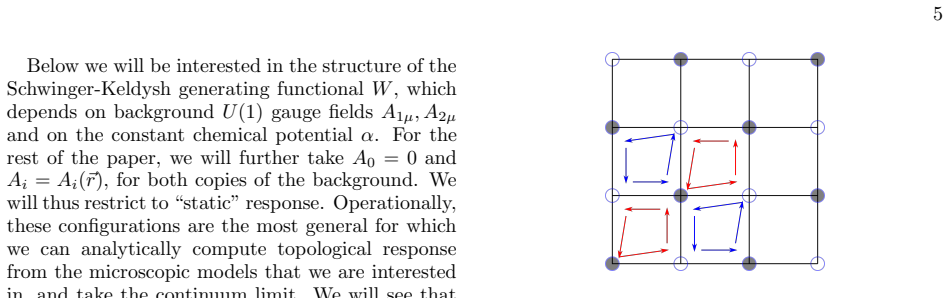
The central claim is that the Schwinger-Keldysh generating functional $W[A_1,A_2]=-i\log Z[A_1,A_2]$ for many-body localized Floquet systems is a local functional of the two background gauge fields and encodes the system's topology. For the 2D chiral Floquet drive, the exact microscopic result reduces, for slowly varying gauge fields, to a topological $\theta$ term $W = \frac{\Theta(\alpha)}{2\pi}\int\frac{dt}{T}\int d^2r\,(B_1(r)-B_2(r))$ with $\Theta(\alpha)=\pi-\pi\tanh(\alpha/2)$, where $B_s$ is the magnetic field of copy $s$ and $\alpha$ the chemical potential carried by the initial Gibbs ensemble. The term is quantized by a unitary on-site particle-hole symmetry and, by a locality-plus-current-conservation argument, cannot change under continuous deformations that preserve many-body localization. The coefficient is therefore a many-body invariant: at $\alpha=0$, $\Theta=\pi$, and the bulk averaged magnetization is half-quantized, doubling to $\theta/\pi$ in the fixed-particle-number sector. The paper further shows that the same response theory reproduces the rational (chiral unitary) index of multi-species $p,q$ drives, and that group-cohomology Floquet unitaries yield response actions valued in $H^d(G,U(1))$.
Load-bearing premise
The chain of reasoning relies on many-body localization making the Schwinger-Keldysh generating functional a local functional of $A_1$ and $A_2$, so that the first-derivative theta term exhausts the topological response; if the system delocalizes or the functional acquires long-range terms, quantization and stability no longer follow.
Editorial extensions
If this is right
- The theta coefficient $\Theta(\alpha)$ provides a many-body topological invariant for Floquet unitaries that is defined without single-particle band structure and remains meaningful in strongly interacting localized systems.
- The response is measurable: at stroboscopic times the partition-function amplitude approaches unity and its phase approaches $\Theta(\alpha)$, and the bulk averaged magnetization is given by $-\Theta(\alpha)/(2\pi T)$, half-quantized at $\alpha=0$.
- The invariant is stable: disorder and local perturbations that preserve many-body localization leave $\Theta(\alpha)$ unchanged, as confirmed numerically for the chiral Floquet model.
- For multi-species drives the response coefficient $\Theta_{p,q}(\alpha)$ depends only on the ratio $p/q$ of coprime factors, reproducing the chiral unitary index as a response-theoretic quantity.
- Group-cohomology Floquet drives realize response actions labeled by $H^d(G,U(1))$, matching the proposed classification of Floquet topological phases.
Reading between the lines
- Because the locality argument uses only many-body localization and not time periodicity, the same theta-term response should appear in aperiodic but localized drives; a natural test is to add slow time-dependent noise to the hopping phases and check that the long-time phase of $Z$ still saturates to $\Theta(\alpha)$.
- The non-factorized, time-ordering-sensitive terms found in higher dimensions (the $c_3$ term in 6+1d) suggest a hierarchy of Floquet topological responses beyond the factorized subset; dimensional reduction of those terms could predict new quantized responses in lower dimensions that await microscopic models.
- The singular-flux prediction $Z[A,0]=\tfrac12(1+\cos\phi)$ at $\alpha=0$, which vanishes at $\phi=\pi$, is a sharp experimental fingerprint: a cold-atom or photonic realization of the chiral Floquet drive should show a complete suppression of the stroboscopic partition function when a $\pi$-flux pair is inserted.
- The channel-state map formulation suggests that Floquet unitaries in class A map to static AIII systems in one higher dimension, so the full tenfold-way classification of static SPT phases could be imported to systematically enumerate Floquet response actions.
Signed reviews
Editorial analysis
A structured set of objections, weighed in public.
Referee Report
Summary. The paper develops a Schwinger-Keldysh effective response theory for Floquet systems by coupling the forward and backward time evolutions to independent background U(1) gauge fields A1 and A2 and studying W[A1,A2] = -i log Z[A1,A2]. For a two-dimensional chiral Floquet drive, the authors compute the generating functional exactly and extract the leading topological term W = Θ(α)/(2π) ∫ (dt/T) ∫ d²r (B1-B2), with Θ(α) = π - π tanh(α/2), quantized for α = 0 by an on-site particle-hole symmetry. They verify that the corresponding magnetization matches the quantized magnetization of Nathan et al., analyze open-boundary systems, argue stability under localization-preserving deformations, present numerical disorder tests, and generalize the response to p,q drives. The paper also proposes a geometric response (energy magnetization) and a time-ordering-sensitive topological coupling in 6+1 dimensions, and connects the formalism to group-cohomology models and the channel-state map in the appendices.
Significance. If the central claim holds, the paper provides a genuinely many-body topological invariant for Floquet drives that is computable from a microscopic model without fitting parameters, and it places chiral Floquet response on the same footing as static topological response theory. The exact evaluation of Θ(α) for the ideal chiral model, the reproduction of the quantized magnetization of Ref. [22], the extension to p,q drives reproducing the chiral unitary index, and the explicit group-cohomology construction are concrete and valuable achievements. The proposed geometric and time-ordering-sensitive response terms are thought-provoking extensions even though no microscopic realization is provided. The main weakness is that the paper’s broad claim of locality for many-body localized systems is asserted rather than derived, and the numerical evidence is restricted to noninteracting fermions.
major comments (3)
- [Sec. I.B.c and Sec. II.C, Eq. (52)] The locality of the Schwinger-Keldysh generating functional W[A1,A2] for many-body localized Floquet systems is the load-bearing assumption of the paper, yet it is introduced only as an expectation (“as far as the system localizes, we expect the generating functional W to be a local functional”, Sec. I.B.c). This assumption is then used to keep only the first-derivative term (17) and to write the position-dependent local form (52) in the deformation-stability argument. If nonlocal terms appear in the derivative expansion, the extraction of the theta term and the proof that Θ(α) is deformation-invariant both fail. The manuscript should either provide a microscopic argument for locality based on many-body localization (e.g., l-bit structure or Lieb-Robinson-type bounds) or explicitly restrict the central claims to the class of models where locality can be proven.
- [Sec. II.D, Hamiltonian (56) and Figs. 5-6] The numerical stability tests use the Hamiltonian (56), which is quadratic: the added disorder and sublattice terms are single-particle potentials and no interaction term is present. These simulations therefore probe Anderson localization, not the interacting many-body localization that the locality assumption requires. The paper’s own wording in Sec. II.D (“the disorder term, when sufficiently strong, guarantees localization”) refers to single-particle localization. This numerical evidence cannot support the claim that the response is stable for generic interacting MBL Floquet systems, and the manuscript should state this limitation clearly or supply interacting numerical results.
- [Sec. II.C, Eq. (55)] The deformation-stability argument in Sec. II.C assumes the local functional form (52) and then shows that the trace of the current operator vanishes on a closed manifold. This does not by itself prove that W remains local under deformation: the current vanishing is a necessary, not sufficient, condition for the assumed local form. The argument would need an additional step showing that nonlocal contributions to W cannot arise while the system remains MBL, or that any nonlocal contribution is irrelevant for the response. Without this step, the claim that Θ(α) is independent of all localization-preserving deformations is not established.
minor comments (5)
- [Sec. II.A, Eq. (27)] The notation ∫ dt in Eq. (27) is explained only in the following paragraph; it would be clearer to write ∫_{-κT}^{κT} dt explicitly at the first occurrence.
- [Sec. II.A, paragraph after Eq. (29)] The discussion of the periodicity Θ(α) ≅ Θ(α) + 2π relies on special features of the ideal model and on a deformation argument that is not yet proven for interacting systems; the text should flag this dependency at that point rather than appearing to give a complete proof.
- [Sec. II.B.2, Eqs. (48) and (51)] The ratio of 1/2 between the full-trace magnetization (48) and the N-particle magnetization (51) is important, but the text explains it only briefly; a short comment identifying the origin of the factor (e.g., the particle-hole symmetrized density matrix) would help the reader.
- [Sec. III.B, Eq. (79)] The status of the 6+1-dimensional time-ordering-sensitive term is only conjectural, as the authors state. It would be useful to add a sentence in Sec. III.B clarifying whether any known microscopic Floquet model is expected to realize c3 ≠ 0.
- [Appendix A, Eq. (A23)] The derivation of the group-cohomology response action is clear, but the sentence “in harmony with (29)” is somewhat informal; spelling out the sense in which the factorized form A23 matches the continuum theta term would improve readability.
Circularity Check
No circular reduction: the theta angle is computed exactly from the microscopic model; the MBL locality assumption is an unproven premise, not a fitted input or self-citation.
full rationale
The central result, the Schwinger-Keldysh theta term with Θ(α) = π − π tanh(α/2), is obtained by an exact microscopic evaluation of Z[A1,A2] in Eq. (27), followed by a continuum limit in Eq. (29). No parameter is fitted to the quantity being predicted, and the result is independently checked against the quantized magnetization of Ref. [22] (Eqs. (48) and (51)). The paper's load-bearing assumption, that many-body localization makes W[A1,A2] a local functional, appears explicitly as an expectation in Sec. I.B.c ('as far as the system localizes, we expect the generating functional W to be a local functional in A1 and A2') and again in Appendix B ('we expect that |U⟩⟩ can be treated as a ground state of a gapped system'). This is an unproven premise, not a circular reduction: the exact calculation of Θ(α) does not depend on it, while the Sec. II.C stability proof is explicitly conditional on the local form (52). The numerical test in Sec. II.D uses Hamiltonian (56), which is quadratic and therefore tests Anderson localization rather than the interacting MBL assumption; this is a support gap, not circularity. Background self-citations, such as [31,32] for Schwinger-Keldysh formalism and [28,29] for many-body invariants, are not load-bearing; the derivation stands on its own exact computation and on external benchmark [22]. No equation reduces to its own input, and no fitted parameter is renamed as a prediction. Accordingly, no circularity is found.
Assumptions & free parameters
free parameters (1)
- Floquet step amplitude J =
2.5π/T
assumptions (6)
- domain assumption Many-body localized (or otherwise non-ergodic) systems yield a local Schwinger-Keldysh generating functional W[A1,A2] in the long-time limit.
- domain assumption The 2D chiral Floquet drive possesses an on-site particle-hole symmetry acting as cr→(-1)^r c†r, Ai→-Ai.
- domain assumption Initial state is the Gibbs state ρ0=e^{αQ}/Tr e^{αQ} at effectively infinite temperature, and the Schwinger-Keldysh contour is symmetric over an integer number of periods.
- standard math Standard fermion determinant identity Tr[e^{Σ c† A c}] = det(I + e^A) (Eq. 22).
- standard math Unitarity constraints (8): W[A1,A2] = -W*[A2,A1], W[A,A]=0, Im W ≥ 0.
- domain assumption Smoothness and large-gauge structure of the background fields, including the relation of λ1 and λ2 at endpoints (13).
invented entities (2)
-
Background time-translation gauge field a_i
-
Time-ordering-sensitive topological coupling c3 in 6+1 dimensions
Cite this review
Pith. "Pith review of Effective response theory for Floquet topological systems." pith.science (2026). https://pith.science/paper/HKPMPREQ
@misc{pith2026190803217,
  author       = {Pith},
  title        = {Pith review of: Effective response theory for Floquet topological systems},
  year         = {2026},
  howpublished = {\url{https://pith.science/paper/HKPMPREQ}},
  note         = {Machine review of arXiv:1908.03217}
}
abstract
We present an effective field theory approach to the topological response of Floquet systems with symmetry group $G$. This is achieved by introducing a background $G$ gauge field in the Schwinger-Keldysh formalism, which is suitable for far from equilibrium systems. We carry out this program for chiral topological Floquet systems (anomalous Floquet-Anderson insulators) in two spatial dimensions, and the group cohomology models of topological Floquet unitaries. These response actions serve as many-body topological invariants for topological Floquet unitaries. The effective action approach also leads us to propose novel topological response functions.
Figures


Figures from the paper (3 more)


Reference graph
Works this paper leans on
-
[42]
Exponentially Slow Heating in Periodically Driven Many-Body Systems,
D. A. Abanin, W. De Roeck, and F. Huveneers, “Exponentially Slow Heating in Periodically Driven Many-Body Systems,” Phys. Rev. Lett. , vol. 115, p. 256803, Dec 2015
work page 2015
-
[22]
C. W. von Keyserlingk and S. L. Sondhi, “Phase structure of one-dimensional interacting Floquet systems. I. Abelian symmetry-protected topological phases,” Phys. Rev. B , vol. 93, p. 245145, June 2016
work page 2016
-
[1]
Separating bulk and boundary unitaries We now move on to discuss the chiral Floquet drive in the presence of open boundary conditions. Let us first recall that, in the absence of boundaries, and with background gauge field, the single-particle unitaryUF (A) is diagonal in the occupation number basis, with the diagonal elements depending on the backgroundA. ...
-
[2]
Magnetization Since the magnetic flux can have a continuous value, we can differentiate Wbulk[B] with respect to B and directly relate our response to magnetization. Indeed, ∂ ∂BeiWbulk[B] ⏐⏐⏐⏐ B=0 = Tr [ ρ0U†(B = 0) ∂ ∂BU(B) ] =−i ∫ κT −κT dt Tr [ ρ0U†(t,−κT )∂H(t) ∂B U(t,−κT ) ] =−i ∫ κT −κT dt Tr [ ρ0U†(t,−κT )MU (t,−κT ) ] (45) where we suppressed the s...
-
[3]
flat”: Its eigenvalues are all either ±1. Any K of this form can be obtained from a more “phys- ical
Building effective response field theories by dimensional reduction Note that the spectrum of K is gappled and com- pletely “flat”: Its eigenvalues are all either ±1. Any K of this form can be obtained from a more “phys- ical” Hamiltonian preserving chiral symmetry and having a energy gap by spectral flattening [49]. As |U⟩⟩is realized as a unique ground stat...
-
[4]
As an example, consider the case of d = 1 andG = Z2 [13]
d = 1 and G = Z2 It is also possible to construct explicit lattice models corresponding to the group cohomology Hd(G,U (1)). As an example, consider the case of d = 1 andG = Z2 [13]. We consider a chain with the two-dimensional on-site local Hilbert space spanned by{|±⟩}, where|±⟩ are the eigen state of the Pauli matrix σx with eigenvalues±1. The Z2 symme...
-
[5]
Generic construction a. The Dijkgraaf-Witten theory The above con- struction for d = 1 and G = Z2 can be readily ex- tended to more generic cases [19]. To describe the generalization, let us briefly recall the basic ingre- dients in the Dijkgraaf-Witten theories [46]. Dijk- graaf and Witten gave a generic construction of (ex- ponentiated) topological actio...
-
[6]
Operator-state map The channel-state map (the Choi-Jamio lkowski isomorphism) applies to an arbitrary quantum chan- nel (trace-preserving completely positive (TPCP) map), and maps it to a quantum state (density ma- trix) in the doubled Hilbert space. In simplest cases, it maps a unitary operator U acting on the Hilbert spaceH to a (pure) state in the doub...
Show all 57 references
-
[7]
orbitals
Fermionic chiral floquet drive Let us now consider a fermionic system described by a set of fermion annihilation/creation operators, { ˆψa, ˆψ† b} = δab. Here, a,b = 1,...,N and N is the number of independent “orbitals”, i.e., the dimen- sion of the single-particle Hilbert spac...
-
[8]
Transport properties of nonequilibrium systems under the application of light: Photoin- duced quantum Hall insulators without Landau lev- els,
T. Kitagawa, T. Oka, A. Brataas, L. Fu, and E. Demler, “Transport properties of nonequilibrium systems under the application of light: Photoin- duced quantum Hall insulators without Landau lev- els,” Phys. Rev. B , vol. 84, p. 235108, Dec. 2011
2011
-
[9]
Colloquium: Atomic quantum gases in periodically driven optical lattices,
A. Eckardt, “Colloquium: Atomic quantum gases in periodically driven optical lattices,” Reviews of Modern Physics, vol. 89, p. 011004, Jan. 2017
2017
-
[10]
Floquet Engineering of Quantum Materials,
T. Oka and S. Kitamura, “Floquet Engineering of Quantum Materials,” ArXiv e-prints, Apr. 2018
2018
-
[11]
Topology and Broken Symmetry in Floquet Sys- tems,
F. Harper, R. Roy, M. S. Rudner, and S. L. Sondhi, “Topology and Broken Symmetry in Floquet Sys- tems,” arXiv e-prints , p. arXiv:1905.01317, May 2019
1905 arXiv
-
[12]
Photovoltaic Hall effect in graphene,
T. Oka and H. Aoki, “Photovoltaic Hall effect in graphene,” Phys. Rev. B , vol. 79, p. 081406, Feb. 2009
2009
-
[13]
Topological characterization of periodically driven quantum systems,
T. Kitagawa, E. Berg, M. Rudner, and E. Demler, “Topological characterization of periodically driven quantum systems,” Phys. Rev. B , vol. 82, p. 235114, Dec. 2010
2010
-
[14]
Photoinduced Tran- sition between Conventional and Topological In- sulators in Two-Dimensional Electronic Systems,
J.-I. Inoue and A. Tanaka, “Photoinduced Tran- sition between Conventional and Topological In- sulators in Two-Dimensional Electronic Systems,” Physical Review Letters , vol. 105, p. 017401, July 2010
2010
-
[15]
Flo- quet topological insulator in semiconductor quan- tum wells,
N. H. Lindner, G. Refael, and V. Galitski, “Flo- quet topological insulator in semiconductor quan- tum wells,” Nature Physics , vol. 7, pp. 490–495, June 2011
2011
-
[16]
Classification of Interacting Topological Floquet Phases in One Dimension,
A. C. Potter, T. Morimoto, and A. Vishwanath, “Classification of Interacting Topological Floquet Phases in One Dimension,” Physical Review X , vol. 6, p. 041001, Oct. 2016
2016
-
[17]
Majorana Fermions in Equi- librium and in Driven Cold-Atom Quantum Wires,
L. Jiang, T. Kitagawa, J. Alicea, A. R. Akhmerov, D. Pekker, G. Refael, J. I. Cirac, E. Demler, M. D. Lukin, and P. Zoller, “Majorana Fermions in Equi- librium and in Driven Cold-Atom Quantum Wires,” Physical Review Letters , vol. 106, p. 220402, June 2011
2011
-
[18]
Topological Index for Periodically Driven Time-Reversal Invariant 2D Systems,
D. Carpentier, P. Delplace, M. Fruchart, and K. Gawedzki, “Topological Index for Periodically Driven Time-Reversal Invariant 2D Systems,”Phys. Rev. Lett. , vol. 114, p. 106806, Mar 2015
2015
-
[19]
There again, we identify topological response actions which are elements of Hd(G,U (1)), in agreement with the previous claim [13–15]
with symmetryG ind-spatial dimensions. There again, we identify topological response actions which are elements of Hd(G,U (1)), in agreement with the previous claim [13–15]. The presence of these topological terms in the response actions provides the (many-body) defini- tion of...
-
[20]
Abelian Floquet symmetry- protected topological phases in one dimension,
R. Roy and F. Harper, “Abelian Floquet symmetry- protected topological phases in one dimension,” Phys. Rev. B , vol. 94, p. 125105, Sep 2016
2016
-
[21]
Absolute stability and spatiotemporal long-range order in Floquet systems,
C. W. von Keyserlingk, V. Khemani, and S. L. Sondhi, “Absolute stability and spatiotemporal long-range order in Floquet systems,” Phys. Rev. B , vol. 94, p. 085112, Aug 2016
2016
-
[23]
Phase structure of one-dimensional interacting Floquet systems. II. Symmetry-broken phases,
C. W. von Keyserlingk and S. L. Sondhi, “Phase structure of one-dimensional interacting Floquet systems. II. Symmetry-broken phases,” Phys. Rev. B , vol. 93, p. 245146, June 2016
2016
-
[24]
Classification of topo- logical phases in periodically driven interacting sys- tems,
D. V. Else and C. Nayak, “Classification of topo- logical phases in periodically driven interacting sys- tems,” Phys. Rev. B , vol. 93, p. 201103, May 2016
2016
-
[25]
Classification of Matrix-Product Unitaries with Symmetries,
Z. Gong, C. S¨ underhauf, N. Schuch, and J. I. Cirac, “Classification of Matrix-Product Unitaries with Symmetries,” arXiv e-prints , p. arXiv:1812.09183, Dec. 2018
2018 arXiv
-
[26]
Dynamically en- riched topological orders in driven two-dimensional systems,
A. C. Potter and T. Morimoto, “Dynamically en- riched topological orders in driven two-dimensional systems,” Phys. Rev. B , vol. 95, p. 155126, Apr. 2017
2017
-
[27]
Floquet topological phases with symmetry in all dimensions,
R. Roy and F. Harper, “Floquet topological phases with symmetry in all dimensions,” Phys. Rev. B , vol. 95, p. 195128, May 2017
2017
-
[28]
Anomalous edge states and the bulk-edge corre- spondence for periodically-driven two dimensional systems,
M. S. Rudner, N. H. Lindner, E. Berg, and M. Levin, “Anomalous edge states and the bulk-edge corre- spondence for periodically-driven two dimensional systems,” ArXiv e-prints, Dec. 2012. 26
2012
-
[29]
Anomalous Floquet-Anderson Insu- lator as a Nonadiabatic Quantized Charge Pump,
P. Titum, E. Berg, M. S. Rudner, G. Refael, and N. H. Lindner, “Anomalous Floquet-Anderson Insu- lator as a Nonadiabatic Quantized Charge Pump,” Physical Review X, vol. 6, p. 021013, Apr. 2016
2016
-
[30]
Quantized Magnetization Density in Periodically Driven Systems,
F. Nathan, M. S. Rudner, N. H. Lindner, E. Berg, and G. Refael, “Quantized Magnetization Density in Periodically Driven Systems,” Physical Review Let- ters, vol. 119, p. 186801, Nov. 2017
2017
-
[31]
Chiral Floquet Phases of Many-Body Localized Bosons,
H. C. Po, L. Fidkowski, T. Morimoto, A. C. Pot- ter, and A. Vishwanath, “Chiral Floquet Phases of Many-Body Localized Bosons,” Physical Review X, vol. 6, p. 041070, Oct. 2016
2016
-
[32]
Interacting invariants for Floquet phases of fermions in two dimensions,
L. Fidkowski, H. C. Po, A. C. Potter, and A. Vish- wanath, “Interacting invariants for Floquet phases of fermions in two dimensions,” ArXiv e-prints , Mar. 2017
2017
-
[33]
Periodic table for Flo- quet topological insulators,
R. Roy and F. Harper, “Periodic table for Flo- quet topological insulators,” Phys. Rev. B , vol. 96, p. 155118, Oct. 2017
2017
-
[34]
Flo- quet topological phases protected by time glide sym- metry,
T. Morimoto, H. C. Po, and A. Vishwanath, “Flo- quet topological phases protected by time glide sym- metry,” Phys. Rev. B , vol. 95, p. 195155, May 2017
2017
-
[35]
Topo- logical field theory of time-reversal invariant insula- tors,
X.-L. Qi, T. L. Hughes, and S.-C. Zhang, “Topo- logical field theory of time-reversal invariant insula- tors,” Phys. Rev. B , vol. 78, p. 195424, Nov. 2008
2008
-
[36]
Many- body topological invariants in fermionic symmetry- protected topological phases: Cases of point group symmetries,
K. Shiozaki, H. Shapourian, and S. Ryu, “Many- body topological invariants in fermionic symmetry- protected topological phases: Cases of point group symmetries,” Physical Review B, vol. 95, p. 205139, May 2017
2017
-
[37]
Many-body topological invariants for fermionic short-range entangled topological phases protected by antiunitary symmetries,
K. Shiozaki, H. Shapourian, K. Gomi, and S. Ryu, “Many-body topological invariants for fermionic short-range entangled topological phases protected by antiunitary symmetries,” Physical Review B , vol. 98, p. 035151, Jul 2018
2018
-
[38]
Kamenev, Field Theory of Non-Equilibrium Sys- tems
A. Kamenev, Field Theory of Non-Equilibrium Sys- tems. Cambridge University Press, 2011
2011
-
[39]
Lectures on non- equilibrium effective field theories and fluc- tuating hydrodynamics,
P. Glorioso and H. Liu, “Lectures on non- equilibrium effective field theories and fluc- tuating hydrodynamics,” arXiv e-prints , p. arXiv:1805.09331, May 2018
2018 arXiv
-
[40]
The second law of ther- modynamics from symmetry and unitarity,
P. Glorioso and H. Liu, “The second law of ther- modynamics from symmetry and unitarity,” arXiv e-prints, p. arXiv:1612.07705, Dec 2016
2016 arXiv
-
[41]
Nonequilibrium quantum order at infinite temperature: spatiotemporal cor- relations and their generating functions,
S. Roy and A. Lazarides, “Nonequilibrium quantum order at infinite temperature: spatiotemporal cor- relations and their generating functions,” ArXiv e- prints, Apr. 2018
2018
-
[43]
A Rigorous Theory of Many-Body Prether- malization for Periodically Driven and Closed Quan- tum Systems,
D. Abanin, W. De Roeck, W. W. Ho, and F. Huve- neers, “A Rigorous Theory of Many-Body Prether- malization for Periodically Driven and Closed Quan- tum Systems,” Communications in Mathematical Physics, vol. 354, pp. 809–827, Sep 2017
2017
-
[44]
Rigorous Bound on Energy Absorption and Generic Relax- ation in Periodically Driven Quantum Systems,
T. Mori, T. Kuwahara, and K. Saito, “Rigorous Bound on Energy Absorption and Generic Relax- ation in Periodically Driven Quantum Systems,” Phys. Rev. Lett. , vol. 116, p. 120401, Mar 2016
2016
-
[45]
Floquet- Magnus theory and generic transient dynamics in periodically driven many-body quantum systems,
T. Kuwahara, T. Mori, and K. Saito, “Floquet- Magnus theory and generic transient dynamics in periodically driven many-body quantum systems,” Annals of Physics , vol. 367, pp. 96–124, Apr 2016
2016
-
[46]
Prethermal Phases of Matter Protected by Time-Translation Symmetry,
D. V. Else, B. Bauer, and C. Nayak, “Prethermal Phases of Matter Protected by Time-Translation Symmetry,” Physical Review X , vol. 7, p. 011026, Jan 2017
2017
-
[47]
Chern-simons gauge theories, confinement, and the chiral spin liq- uid,
E. Fradkin and F. A. Schaposnik, “Chern-simons gauge theories, confinement, and the chiral spin liq- uid,” Phys. Rev. Lett. , vol. 66, pp. 276–279, Jan 1991
1991
-
[48]
Floquet Topological Order in Interacting Systems of Bosons and Fermions,
F. Harper and R. Roy, “Floquet Topological Order in Interacting Systems of Bosons and Fermions,” Physical Review Letters , vol. 118, p. 115301, Mar. 2017
2017
-
[49]
Origins of Global Anomalies in Quantum Mechanics,
S. Elitzur, Y. Frishman, E. Rabinovici, and A. Schwimmer, “Origins of Global Anomalies in Quantum Mechanics,” Nucl. Phys. , vol. B273, pp. 93–108, 1986
1986
-
[50]
Hierarchy of many- body invariants and quantized magnetization in anomalous Floquet insulators,
F. Nathan, D. A. Abanin, N. H. Lindner, E. Berg, and M. S. Rudner, “Hierarchy of many- body invariants and quantized magnetization in anomalous Floquet insulators,” arXiv e-prints , p. arXiv:1907.12228, Jul 2019
1907 arXiv
-
[51]
Energy Magnetization and the Thermal Hall Effect,
T. Qin, Q. Niu, and J. Shi, “Energy Magnetization and the Thermal Hall Effect,” Phys. Rev. Lett. , vol. 107, p. 236601, Dec 2011
2011
-
[52]
Cross-Correlated Responses of Topological Super- conductors and Superfluids,
K. Nomura, S. Ryu, A. Furusaki, and N. Nagaosa, “Cross-Correlated Responses of Topological Super- conductors and Superfluids,” Phys. Rev. Lett. , vol. 108, p. 026802, Jan 2012
2012
-
[53]
Thermal hall effect and geometry with torsion,
A. Gromov and A. G. Abanov, “Thermal hall effect and geometry with torsion,” Physical review letters, vol. 114, no. 1, p. 016802, 2015
2015
-
[54]
Topological gauge the- ories and group cohomology,
R. Dijkgraaf and E. Witten, “Topological gauge the- ories and group cohomology,” Communications in Mathematical Physics, vol. 129, pp. 393–429, Apr. 1990
1990
-
[55]
Symmetry protected topological orders and the group cohomology of their symmetry group,
X. Chen, Z.-C. Gu, Z.-X. Liu, and X.-G. Wen, “Symmetry protected topological orders and the group cohomology of their symmetry group,” Phys. Rev. B , vol. 87, p. 155114, Apr. 2013
2013
-
[56]
Umezawa, Advanced field theory: Micro, macro, and thermal physics
H. Umezawa, Advanced field theory: Micro, macro, and thermal physics . 1993
1993
-
[57]
Topological insulators and superconduc- tors: tenfold way and dimensional hierarchy,
S. Ryu, A. P. Schnyder, A. Furusaki, and A. W. W. Ludwig, “Topological insulators and superconduc- tors: tenfold way and dimensional hierarchy,” New Journal of Physics , vol. 12, p. 065010, June 2010
2010
Reviewed August 14, 2026 · model on record in the stance chip above.
Discussion (0). Continue with ORCID to comment.