Hybrid Neural Ordinary Differential Equations for Data-Efficient Polymerization Modeling with Incomplete Kinetics
Pith reviewed 2026-06-28 15:59 UTC · model grok-4.3
The pith
A hybrid neural ODE keeps explicit physical equations for known polymerization reactions and learns only the radical concentration term to predict from sparse noisy data.
A machine-rendered reading of the paper's core claim, the machinery that carries it, and where it could break.
Core claim
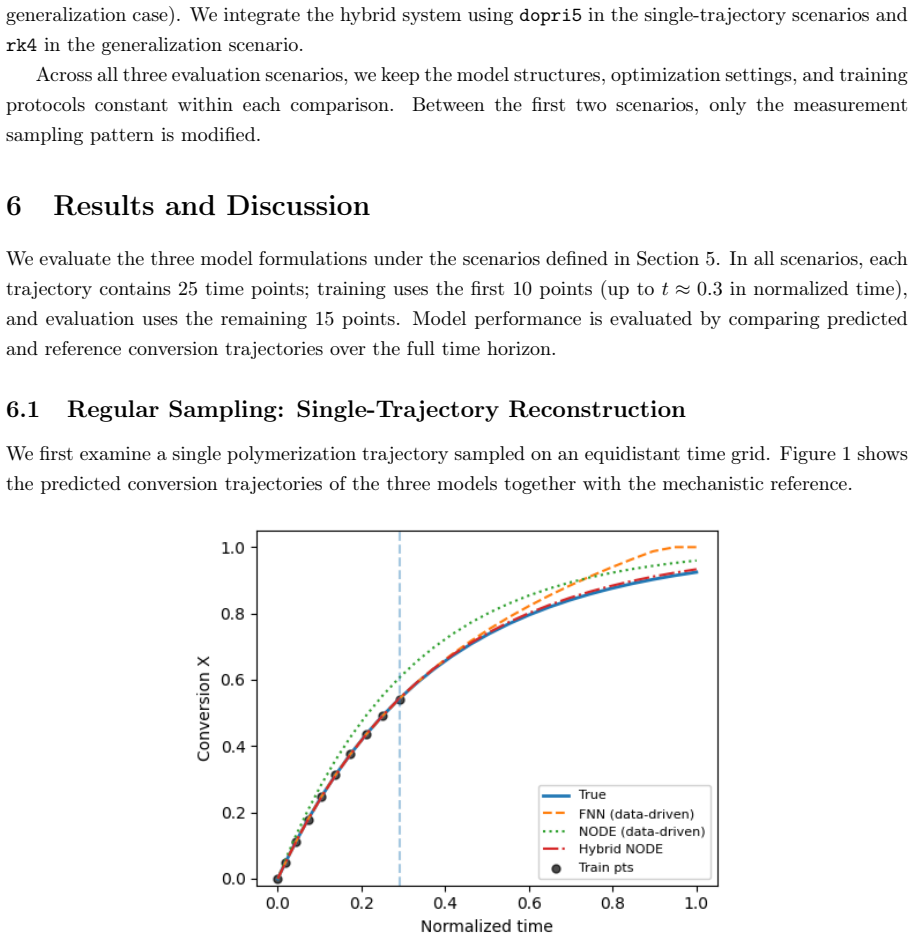
The hybrid Neural ODE framework retains explicit mechanistic mass balances for the established reactions while replacing only the partially characterized effective radical concentration with a neural network surrogate. This separation allows the model to achieve reliable generalization from limited data, as evidenced by consistently lower prediction errors and more physically consistent behavior than a pure data-driven NODE or a discrete-time network when both are trained on sparse measurements.
What carries the argument
The hybrid Neural ODE in which the right-hand side is assembled from explicit physical mass-balance equations for known reactions plus a neural network that supplies only the missing radical concentration term.
If this is right
- Training on as few as ten measurements yields lower RMSE than either a pure data-driven NODE or a discrete-time network.
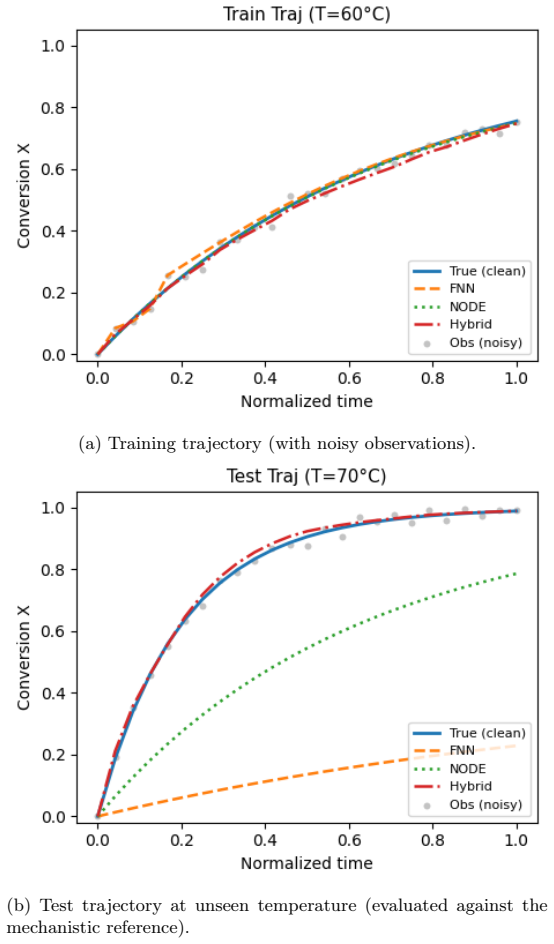
- The hybrid produces more physically consistent predictions when extrapolating to unseen operating conditions.
- Learning only the closure term for radical concentration is sufficient for reliable prediction under noisy and limited data.
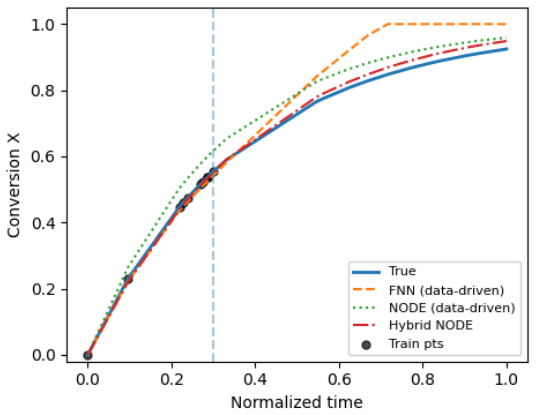
- Performance remains stable under both regular and irregular sampling schedules.
Where Pith is reading between the lines
- The same split between known physical terms and a learned surrogate could be tried on other reaction networks where only a subset of rates is well characterized.
- If the approach works for batch reactors it could be tested on continuous-flow systems to check whether the learned radical term transfers across reactor types.
- The method might shorten the experimental campaign needed for initial process screening by focusing data collection on the unknown term only.
Load-bearing premise
That the known reactions can be modeled accurately with physical equations and that the only missing piece is an effective radical concentration term that a neural network can learn from data.
What would settle it
An experiment in which the hybrid model is trained and tested on data where the assumed physical reaction rates are deliberately misspecified would show whether the performance advantage disappears.
Figures
read the original abstract
Accurate prediction of polymerization dynamics is essential for process design, control, and optimization. Yet, purely mechanistic models require labor-intensive parameterization of partially characterized kinetics, while purely data-driven models demand large, diverse datasets that are costly to obtain, particularly in early-design stages. We propose a hybrid Neural Ordinary Differential Equation (NODE) framework for data-efficient modeling of free-radical polymerization. Using batch polymerization of methyl methacrylate (MMA) as a case study, the mechanistic mass balances are retained explicitly, and only the partially-characterized effective radical concentration governing monomer consumption is learned from data through a neural network surrogate, while established reactions such as initiator decomposition, propagation, and termination remain physically modeled. The hybrid NODE is evaluated against a discrete-time feedforward neural network and a purely data-driven NODE under sparse data conditions, with models trained on as few as ten measurements under both regular and irregular sampling. The hybrid NODE consistently achieves lower prediction errors and more physically consistent extrapolations than both purely data-driven baselines. In a generalization scenario with noisy data and unseen operating conditions, the hybrid NODE achieves an RMSE of 0.013, compared to 0.31 for the data-driven NODE and 0.68 for the discrete-time model, demonstrating that learning only a closure term rather than the full dynamics is sufficient for reliable prediction under limited data availability.
Editorial analysis
A structured set of objections, weighed in public.
Referee Report
Summary. The paper proposes a hybrid Neural ODE framework for free-radical polymerization modeling that retains explicit mechanistic mass balances for initiator decomposition, propagation, and termination while using a neural network surrogate to learn only the partially-characterized effective radical concentration. Using MMA batch polymerization as a case study with as few as ten sparse measurements, the hybrid model is compared to a discrete-time feedforward NN and a purely data-driven NODE, reporting superior performance (RMSE 0.013 vs. 0.31 and 0.68) in a noisy generalization scenario with unseen operating conditions.
Significance. If the central claim holds, the selective hybrid approach could advance data-efficient modeling in chemical engineering by leveraging domain knowledge for most kinetics while learning only a closure term, reducing the data requirements compared to fully data-driven methods and improving physical consistency in extrapolation.
major comments (2)
- [Abstract] Abstract: The claim that 'learning only a closure term rather than the full dynamics is sufficient for reliable prediction' is load-bearing for the reported RMSE advantage, yet no results are provided for the pure mechanistic model (identical equations and parameters with the neural surrogate disabled) on the same generalization set with noisy unseen conditions. Without this baseline, it remains possible that the NN compensates for inaccuracies in the retained physical equations rather than solely addressing the radical concentration term.
- [Abstract] The evaluation relies on the premise that the mechanistic sub-models for initiator decomposition, propagation, and termination are sufficiently complete and correctly parameterized; however, no sensitivity analysis or validation of these sub-models (e.g., via parameter perturbation or comparison to literature values) is described to confirm they do not require the NN to absorb systematic errors.
Simulated Author's Rebuttal
We thank the referee for the constructive comments. We address each major comment below and indicate the planned revisions.
read point-by-point responses
-
Referee: [Abstract] Abstract: The claim that 'learning only a closure term rather than the full dynamics is sufficient for reliable prediction' is load-bearing for the reported RMSE advantage, yet no results are provided for the pure mechanistic model (identical equations and parameters with the neural surrogate disabled) on the same generalization set with noisy unseen conditions. Without this baseline, it remains possible that the NN compensates for inaccuracies in the retained physical equations rather than solely addressing the radical concentration term.
Authors: We agree that the pure mechanistic baseline is necessary to substantiate the central claim. The revised manuscript will include results for the pure mechanistic model (neural surrogate disabled, using the standard quasi-steady-state approximation for radical concentration) evaluated on the identical noisy unseen-conditions test set. This addition will allow direct comparison and clarify the source of the reported performance gains. revision: yes
-
Referee: [Abstract] The evaluation relies on the premise that the mechanistic sub-models for initiator decomposition, propagation, and termination are sufficiently complete and correctly parameterized; however, no sensitivity analysis or validation of these sub-models (e.g., via parameter perturbation or comparison to literature values) is described to confirm they do not require the NN to absorb systematic errors.
Authors: We acknowledge that explicit sensitivity analysis and parameter validation were omitted from the original submission. The revised version will add a sensitivity study in which the mechanistic rate constants are perturbed within literature-reported uncertainty ranges, with the resulting effect on hybrid-model predictions quantified. We will also explicitly cite the literature sources and nominal parameter values employed for the retained sub-models. revision: yes
Circularity Check
No significant circularity; hybrid structure separates independent mechanistic equations from learned closure term.
full rationale
The paper retains explicit mechanistic mass balances for initiator decomposition, propagation, and termination drawn from established domain knowledge, while the neural network surrogate is applied only to the effective radical concentration term. This separation means the reported generalization RMSE on unseen noisy data is not equivalent to the training inputs by construction, nor does any step reduce to a fitted parameter renamed as prediction or a self-citation chain. The central claim rests on the independent physical equations plus data-driven closure, with evaluation on held-out conditions providing external validation rather than tautology. No load-bearing self-citations, uniqueness theorems, or ansatzes imported from prior author work are present in the derivation.
Axiom & Free-Parameter Ledger
free parameters (1)
- neural network weights for radical concentration surrogate
axioms (1)
- domain assumption Mechanistic mass balances for initiator decomposition, propagation, and termination are accurate and can be retained explicitly.
Reference graph
Works this paper leans on
-
[1]
M. Ohshima, M. Tanigaki, Quality control of polymer production processes, Journal of Process Control 10 (2) (2000) 135–148.doi:https://doi.org/10.1016/S0959-1524(99)00042-6
-
[2]
Karuppusamy, R
M. Karuppusamy, R. Thirumalaisamy, S. Palanisamy, S. Nagamalai, E. E. S. Massoud, N. Ayrilmis, A review of machine learning applications in polymer composites: advancements, challenges, and future prospects, Journal of Materials Chemistry A 13 (22) (2025) 16290–16308.doi:10.1039/ D5TA00982K
2025
-
[3]
J. M. Asua, Emulsion polymerization: From fundamental mechanisms to process developments, Journal of Polymer Science Part A: Polymer Chemistry 42 (5) (2004) 1025–1041.doi:https: //doi.org/10.1002/pola.11096
-
[5]
K. Farajzadehahary, S. Hamzehlou, N. Ballard, Adding machine learning to the polymer reaction engineering toolbox, Progress in Polymer Science 170 (2025) 102029.doi:https://doi.org/10. 1016/j.progpolymsci.2025.102029
-
[6]
Y. Fang, H. Gao, Kinetic modeling for radical polymerization and depolymerization, Current Opin- ion in Chemical Engineering 49 (2025) 101152.doi:https://doi.org/10.1016/j.coche.2025. 101152
-
[7]
N. E. Jackson, B. M. Savoie, Ten problems in polymer reactivity prediction, Macromolecules 58 (4) (2025) 1737–1754
2025
-
[8]
B. B. Noble, M. L. Coote, First principles modelling of free-radical polymerisation kinetics, Interna- tional Reviews in Physical Chemistry 32 (3) (2013) 467–513.doi:10.1080/0144235X.2013.797277
-
[9]
G. R. Jones, H. S. Wang, K. Parkatzidis, R. Whitfield, N. P. Truong, A. Anastasaki, Reversed controlled polymerization (rcp): depolymerization from well-defined polymers to monomers, Journal of the American Chemical Society 145 (18) (2023) 9898–9915.doi:10.1021/jacs.3c00589. 21
-
[10]
N. Wulkow, R. Telgmann, K.-D. Hungenberg, C. Schütte, M. Wulkow, Deterministic and stochastic parameter estimation for polymer reaction kinetics i: theory and simple examples, Macromolecular Theory and Simulations 30 (6) (2021) 2100017.doi:https://doi.org/10.1002/mats.202100017
-
[11]
A. M. Schweidtmann, A. D. Clayton, N. Holmes, E. Bradford, R. A. Bourne, A. A. Lapkin, Machine learning meets continuous flow chemistry: Automated optimization towards the pareto front of multiple objectives, Reaction Chemistry & Engineering 5 (5) (2020) 1075–1085.doi:https://doi. org/10.1016/j.cej.2018.07.031
-
[12]
W. Ge, R. De Silva, Y. Fan, S. A. Sisson, M. H. Stenzel, Machine learning in polymer research, Advanced Materials 37 (11) (2025) 2413695.doi:https://doi.org/10.1002/adma.202413695
-
[13]
M. von Stosch, R. Oliveira, J. Peres, S. Feyo de Azevedo, Hybrid semi-parametric modeling in process systems engineering: Past, present and future, Computers & Chemical Engineering 60 (2014) 86–101.doi:https://doi.org/10.1016/j.compchemeng.2013.08.008
-
[14]
Y. Wang, Y. Fang, H. Zhou, H. Gao, A machine learning model for predicting the propaga- tion rate coefficient in free-radical polymerization, Molecules 29 (19) (2024) 4694.doi:10.3390/ molecules29194694
2024
-
[15]
Y. Shi, J. Wang, Q. Wang, Q. Jia, F. Yan, Z.-H. Luo, Y.-N. Zhou, Supervised machine learn- ing algorithms for predicting rate constants of ozone reaction with micropollutants, Industrial & Engineering Chemistry Research 61 (24) (2022) 8359–8367.doi:10.1021/acs.iecr.1c04697
-
[16]
D. Li, Y. Ru, J. Liu, Gatboost: Mining graph attention networks-based important substructures of polymers for a better property prediction, Materials Today Communications 38 (2024) 107577. doi:https://doi.org/10.1016/j.mtcomm.2023.107577
-
[17]
E. Inae, Y. Liu, Y. Zhu, J. Xu, G. Liu, R. Zhang, T. Luo, M. Jiang, Modeling Polymers with Neural Networks, American Chemical Society, 2025
2025
-
[18]
D. Mora-Mariano, A. Flores-Tlacuahuac, I. Zapata-González, E. Saldívar-Guerra, Data-driven deep learning prediction of full molecular weight distribution in polymerization processes, The Cana- dian Journal of Chemical Engineering 103 (8) (2025) 3713–3725.arXiv:https://onlinelibrary. wiley.com/doi/pdf/10.1002/cjce.25635,doi:https://doi.org/10.1002/cjce.25635
-
[19]
A. Bardooli, Y. Dong, C. Georgakis, Data-driven process modeling and optimization aided by ma- terial and energy balances: The case of a batch polymerization process, IFAC-PapersOnLine 54 (3) (2021) 1–6, 16th IFAC Symposium on Advanced Control of Chemical Processes ADCHEM 2021. doi:https://doi.org/10.1016/j.ifacol.2021.08.209
-
[20]
Z. J. Liew, Z. Elkhaiary, A. A. Lapkin, Parameter efficient multi-model vision assistant for polymer solvation behaviour inference, npj Computational Materials 11 (1) (2025) 161
2025
-
[21]
G. Mogk, T. Mrziglod, A. Schuppert, Application of hybrid models in chemical industry, in: J. Grievink, J. van Schijndel (Eds.), European Symposium on Computer Aided Process Engineering- 12, Vol. 10 of Computer Aided Chemical Engineering, Elsevier, 2002, pp. 931–936.doi:https: //doi.org/10.1016/S1570-7946(02)80183-3
-
[22]
O. Kahrs, W. Marquardt, Incremental identification of hybrid process models, Computers & Chem- ical Engineering 32 (4) (2008) 694–705, festschrift devoted to Rex Reklaitis on his 65th Birthday. doi:https://doi.org/10.1016/j.compchemeng.2007.02.014. 22
-
[23]
D. C. Psichogios, L. H. Ungar, A hybrid neural network-first principles approach to process mod- eling, AIChE Journal 38 (10) (1992) 1499–1511.arXiv:https://aiche.onlinelibrary.wiley. com/doi/pdf/10.1002/aic.690381003,doi:https://doi.org/10.1002/aic.690381003
-
[24]
K. Merkelbach, A. M. Schweidtmann, Y. Müller, P. Schwoebel, A. Mhamdi, A. Mitsos, A. Schuppert, T. Mrziglod, S. Schneckener, Hybridml: Open source platform for hybrid modeling, Computers & Chemical Engineering 160 (2022) 107736.doi:https://doi.org/10.1016/j.compchemeng.2022. 107736
-
[25]
G. E. Karniadakis, I. G. Kevrekidis, L. Lu, P. Perdikaris, S. Wang, L. Yang, Physics-informed machine learning, Nature Reviews Physics 3 (6) (2021) 422–440.doi:https://doi.org/10.1038/ s42254-021-00314-5
2021
-
[26]
D. J. Audus, J. J. de Pablo, Polymer informatics: opportunities and challenges, ACS macro letters 6 (10) (2017) 1078–1082.doi:10.1021/acsmacrolett.7b00228
-
[27]
D. Lin, H.-Y. Yu, Deep learning and inverse discovery of polymer self-consistent field theory inspired by physics-informed neural networks, Physical Review E 106 (1) (2022) 014503.doi:https://doi. org/10.1103/PhysRevE.106.014503
- [28]
-
[29]
Y. Li, Y. Lin, Z. Mai, Q. Deng, Z. Ju, B. Cao, W. Li, Theory-guided machine learning for strength prediction of polymers at different temperatures and strain rates with physical information, Mate- rials Today Communications 48 (2025) 113519.doi:https://doi.org/10.1016/j.mtcomm.2025. 113519
-
[30]
M. Velioglu, S. Zhai, S. Rupprecht, A. Mitsos, A. Jupke, M. Dahmen, Physics-informed neural networks for dynamic process operations with limited physical knowledge and data, Computers & Chemical Engineering 192 (2025) 108899.doi:https://doi.org/10.1016/j.compchemeng.2024. 108899
-
[31]
D. J. Audus, A. McDannald, B. DeCost, Leveraging theory for enhanced machine learning, ACS Macro Letters 11 (9) (2022) 1117–1122, pMID: 36018715.doi:10.1021/acsmacrolett.2c00369
-
[32]
N. Zobeiry, A. Poursartip, Theory-guided machine learning for process simulation of advanced com- posites, arXiv preprint arXiv:2103.16010 (2021).doi:https://doi.org/10.48550/arXiv.2103. 16010
-
[33]
R. T. Chen, Y. Rubanova, J. Bettencourt, D. K. Duvenaud, Neural ordinary differential equations, Advances in neural information processing systems 31 (2018)
2018
-
[34]
Massaroli, M
S. Massaroli, M. Poli, J. Park, A. Yamashita, H. Asama, Dissecting neural odes, in: H. Larochelle, M. Ranzato, R. Hadsell, M. Balcan, H. Lin (Eds.), Advances in Neural Information Processing Systems, Vol. 33, Curran Associates, Inc., 2020, pp. 3952–3963
2020
-
[35]
Sorourifar, Y
F. Sorourifar, Y. Peng, I. Castillo, L. Bui, J. Venegas, J. A. Paulson, Physics-enhanced neural ordinary differential equations: Application to industrial chemical reaction systems, Industrial & Engineering Chemistry Research 62 (38) (2023) 15563–15577. 23
2023
- [36]
-
[37]
G. T. Russell, The kinetics of free-radical polymerization: Fundamental aspects, Australian Journal of Chemistry 55 (7) (2002) 399–414.arXiv:https://connectsci.au/ch/article-pdf/55/7/399/ 104682/ch02114.pdf,doi:10.1071/CH02114
-
[38]
O.Walz, C.Marks, J.Viell, A.Mitsos, Systematicapproachformodelingreactionnetworksinvolving equilibrium and kinetically-limited reaction steps, Computers & Chemical Engineering 98 (2017) 143–153.doi:https://doi.org/10.1016/j.compchemeng.2016.12.014
-
[39]
Matyjaszewski, T
K. Matyjaszewski, T. P. Davis, et al., Handbook of radical polymerization, Vol. 922, Wiley Online Library, 2002
2002
-
[40]
R. Guerrero-Santos, E. Saldívar-Guerra, I. Zapata-González, J. Bonilla-Cruz, E. Vivaldo-Lima, Free-Radical Polymerization, John Wiley & Sons, Ltd, 2025, Ch. 3, pp. 65–95.arXiv: https://onlinelibrary.wiley.com/doi/pdf/10.1002/9781119820123.ch3,doi:https://doi. org/10.1002/9781119820123.ch3
-
[41]
F. Ehlers, J. Barth, P. Vana, Kinetics and thermodynamics of radical polymerization, in: Funda- mentals of Controlled/Living Radical Polymerization, The Royal Society of Chemistry, 2013, pp. 1–59.doi:10.1039/9781849737425-00001
-
[42]
G. Moad, D. H. Solomon, The chemistry of radical polymerization, Elsevier, 2005
2005
-
[43]
Butté, G
A. Butté, G. Storti, M. Morbidelli, Evaluation of the chain length distribution in free-radical poly- merization, 1. bulk polymerization, Macromolecular theory and simulations 11 (1) (2002) 22–36
2002
-
[44]
Butté, G
A. Butté, G. Storti, M. Morbidelli, Evaluation of the chain length distribution in free-radical poly- merization, 2. emulsion polymerization, Macromolecular theory and simulations 11 (1) (2002) 37–52
2002
-
[45]
B. Sanderse, P. Stinis, R. Maulik, S. E. Ahmed, Scientific machine learning for closure models in multiscale problems: a review (2024).arXiv:2403.02913. URLhttps://arxiv.org/abs/2403.02913
-
[46]
P. E. Kloeden, M. Rasmussen, Nonautonomous dynamical systems, no. 176, American Mathematical Soc., 2011
2011
-
[47]
X. Wang, E. K. Blum, Discrete-time versus continuous-time models of neural networks, Jour- nal of Computer and System Sciences 45 (1) (1992) 1–19.doi:https://doi.org/10.1016/ 0022-0000(92)90038-K
1992
-
[48]
Massaroli, M
S. Massaroli, M. Poli, J. Park, A. Yamashita, H. Asama, Dissecting neural odes, Advances in neural information processing systems 33 (2020) 3952–3963
2020
-
[49]
J. D. Tan, B. Ramalingam, S. L. Wong, J. Cheng, Y.-F. Lim, V. Chellappan, S. A. Khan, J. Ku- mar, K. Hippalgaonkar, Machine learning predicts conversion and molecular weight distributions in computer controlled polymerization, Journal of Chemical Information and Modeling (2022)
2022
-
[50]
J. R. Richards, J. P. Congalidis, Measurement and control of polymerization reactors, Computers & Chemical Engineering 30 (10) (2006) 1447–1463, papers form Chemical Process Control VII. doi:https://doi.org/10.1016/j.compchemeng.2006.05.021. 24
-
[51]
Paszke, S
A. Paszke, S. Gross, F. Massa, A. Lerer, J. Bradbury, G. Chanan, T. Killeen, Z. Lin, N. Gimelshein, L. Antiga, A. Desmaison, A. Kopf, E. Yang, Z. DeVito, M. Raison, A. Tejani, S. Chilamkurthy, B. Steiner, L. Fang, J. Bai, S. Chintala, Pytorch: An imperative style, high-performance deep learning library, Advances in neural information processing systems 32 (2019)
2019
-
[52]
R. T. Q. Chen, Y. Rubanova, J. Bettencourt, D. K. Duvenaud, Neural ordinary differential equa- tions, Advances in neural information processing systems 31 (2018)
2018
-
[53]
Virtanen, R
P. Virtanen, R. Gommers, T. E. Oliphant, M. Haberland, T. Reddy, D. Cournapeau, E. Burovski, P. Peterson, W. Weckesser, J. Bright, et al., Scipy 1.0: fundamental algorithms for scientific computing in python, Nature methods 17 (3) (2020) 261–272.doi:https://doi.org/10.1038/ s41592-019-0686-2
2020
-
[54]
Decoupled Weight Decay Regularization
I. Loshchilov, F. Hutter, Decoupled weight decay regularization (2019).arXiv:1711.05101. URLhttps://arxiv.org/abs/1711.05101 25
work page internal anchor Pith review Pith/arXiv arXiv 2019
discussion (0)
Sign in with ORCID, Apple, or X to comment. Anyone can read and Pith papers without signing in.