Traversable Casimir Wormholes with Gravitational Memory
Pith reviewed 2026-06-27 04:35 UTC · model grok-4.3
The pith
Gravitational memory deforms Casimir-supported wormholes by adding a positive correction that softens the negative Casimir density and modifies the throat geometry.
A machine-rendered reading of the paper's core claim, the machinery that carries it, and where it could break.
Core claim
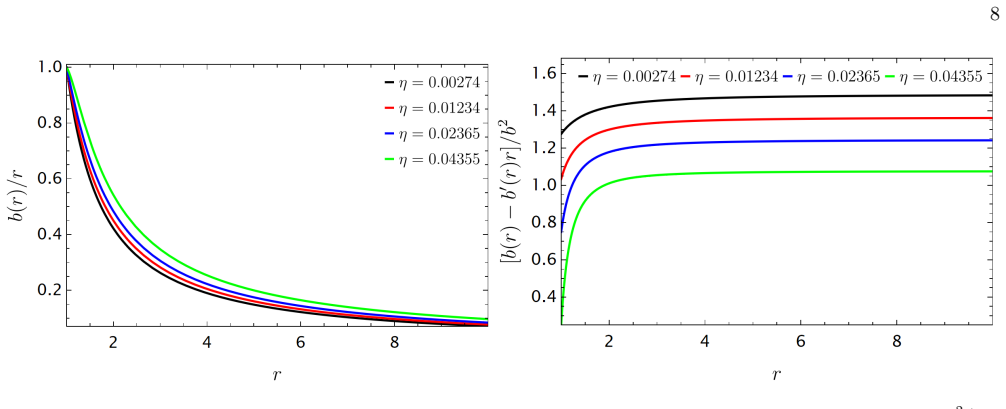
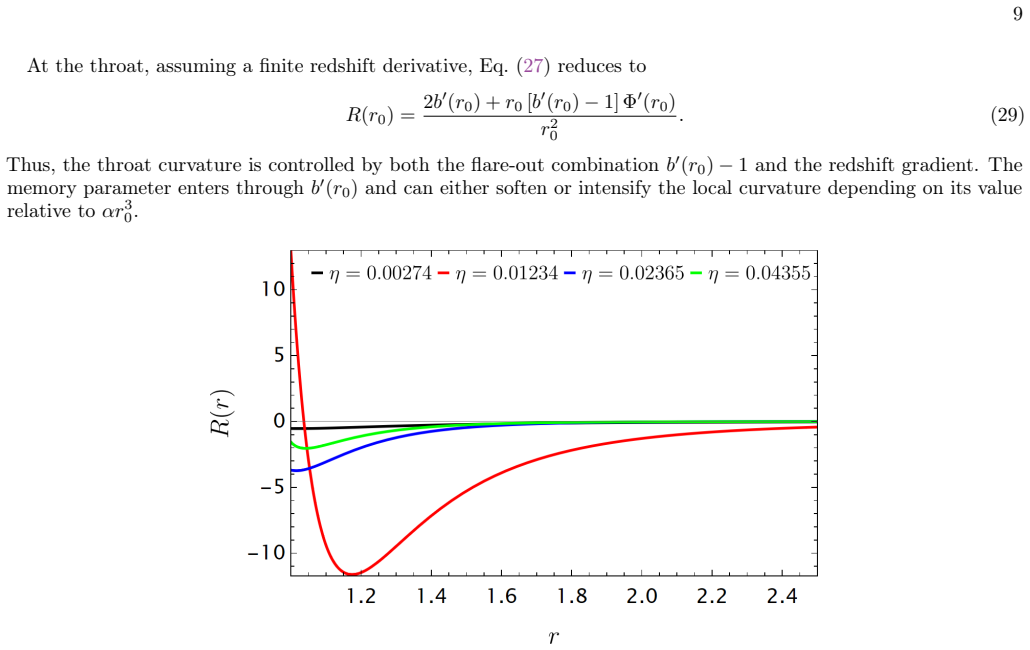
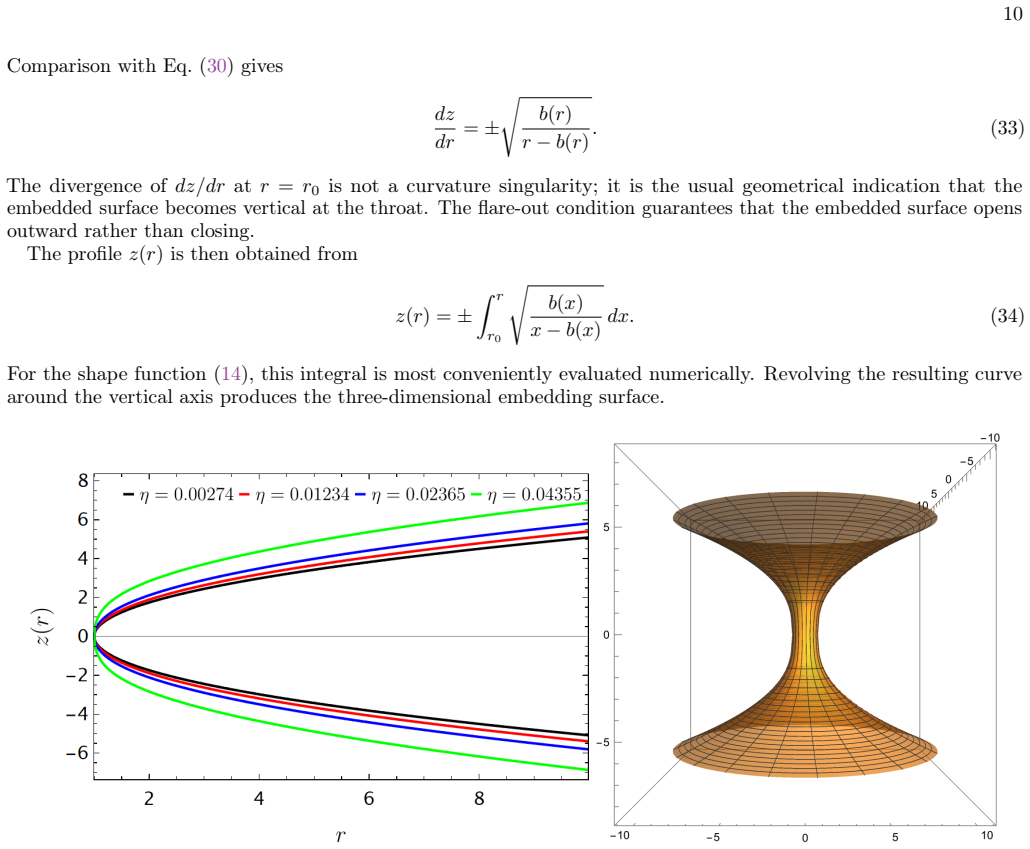
We obtain a density profile composed of the usual negative Casimir contribution, proportional to r^{-4}, and a positive memory-induced correction, proportional to r^{-7}. The corresponding shape function is derived directly from the Einstein equations and satisfies the throat condition by construction. The redshift function is determined from a constant barotropic equation of state together with the requirement of regularity at the throat, which fixes the barotropic parameter in terms of the Casimir and memory coefficients. The flare-out condition defines the admissible range of the memory parameter and separates a Casimir-dominated sector from a phantom-like sector.
What carries the argument
Promotion of the Casimir plate separation to the radial coordinate combined with the addition of a memory-induced positive term proportional to r^{-7} to the vacuum density, enabling derivation of the wormhole shape function.
If this is right
- The shape function satisfies the throat condition by construction from the Einstein equations.
- The redshift function is fixed by a constant barotropic equation of state together with regularity at the throat.
- The flare-out condition separates a Casimir-dominated sector from a phantom-like sector, with a singular limit at the transition point.
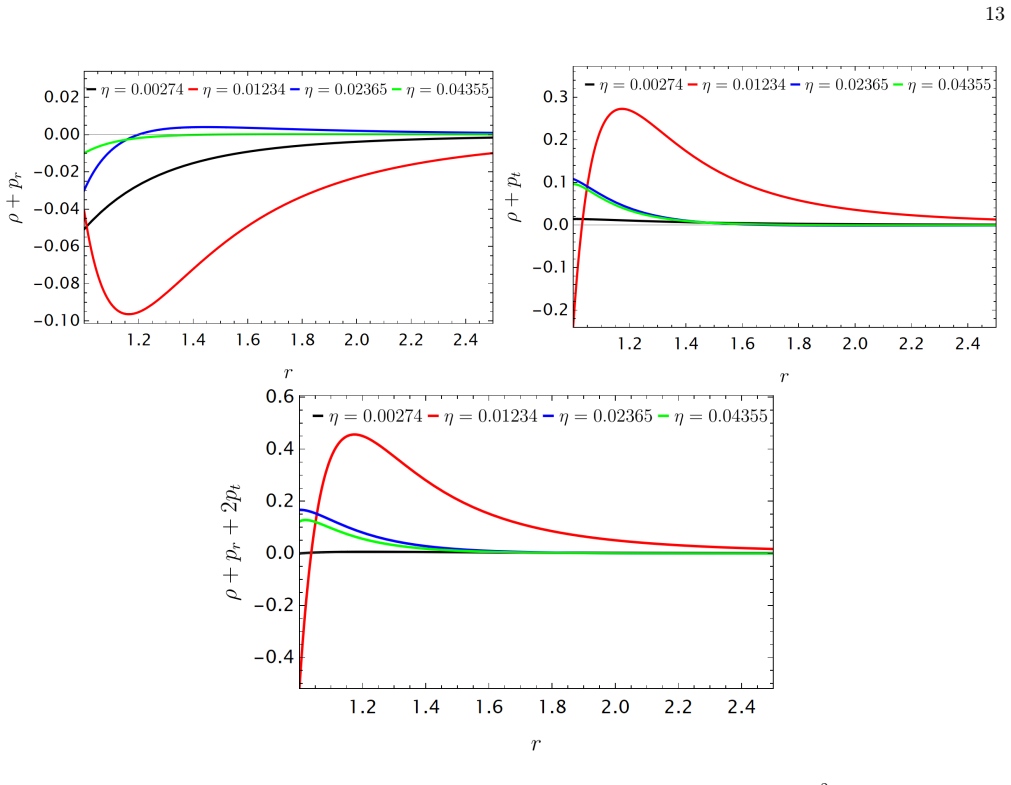
- The radial null energy condition is necessarily violated at the throat, while the tangential sector depends on the redshift gradient.
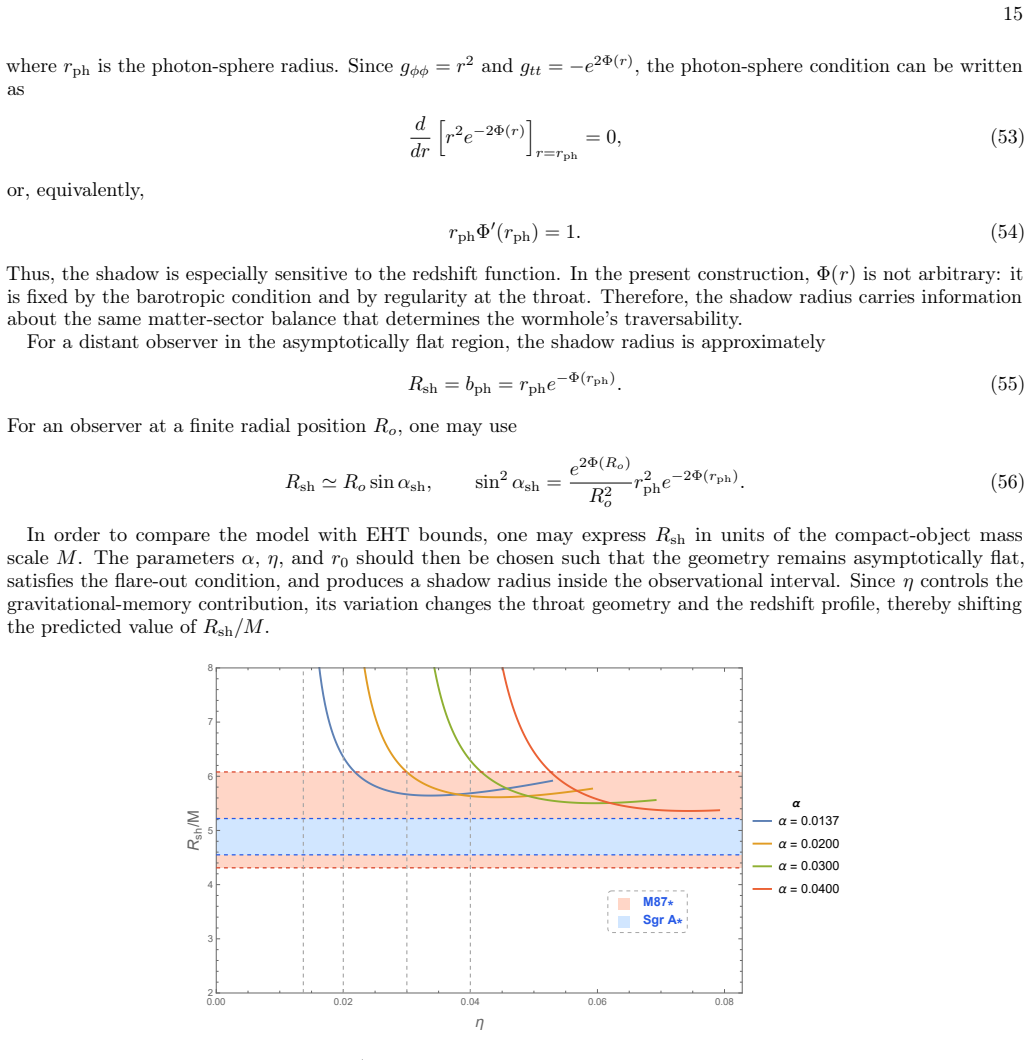
- Admissible solutions can produce shadow radii that overlap the EHT range for M87*.
Where Pith is reading between the lines
- If the memory correction arises in any laboratory time-dependent gravitational setup, it could indicate a route to effective phantom-like stress for macroscopic wormhole support.
- The possible overlap with M87* shadow sizes implies these geometries might require high-precision observations to distinguish from black holes via the Casimir-like density profile.
- Extensions that include rotation or quantum backreaction would likely tighten the allowed range of the memory coefficient beyond the static case considered here.
Load-bearing premise
The separation between plates in a Casimir cavity can be treated as the radial coordinate in a wormhole metric, and the memory effect adds a positive term scaling as the inverse seventh power of that coordinate to the energy density.
What would settle it
A measurement or calculation showing that gravitational memory does not produce a positive shift in Casimir vacuum polarization that scales as the inverse seventh power of the plate separation would falsify the model.
Figures

read the original abstract
We investigate a class of traversable wormhole geometries supported by an effective Casimir source corrected by gravitational memory. The construction is motivated by the fact that a time-dependent gravitational background can leave a permanent positive shift in the vacuum polarization of a quantum field confined to a Casimir cavity. By promoting the plate separation to an effective radial scale in the Morris-Thorne spacetime, we obtain a density profile composed of the usual negative Casimir contribution, proportional to $r^{-4}$, and a positive memory-induced correction, proportional to $r^{-7}$. The corresponding shape function is derived directly from the Einstein equations and satisfies the throat condition by construction. We determine the redshift function from a constant barotropic equation of state together with the requirement of regularity at the throat, which fixes the barotropic parameter in terms of the Casimir and memory coefficients. The flare-out condition defines the admissible range of the memory parameter and separates a Casimir-dominated sector from a phantom-like sector, with the transition point associated with a singular limit of the constant-barotropic description. We analyze the curvature scalar, the embedding structure, the energy conditions, and the Tolman-Oppenheimer-Volkoff equilibrium of the anisotropic matter source. The radial null energy condition is necessarily violated at the throat, while the tangential sector depends sensitively on the redshift gradient. We also examine the shadow radius as a phenomenological diagnostic and show that admissible solutions can overlap the EHT range for M87*. The results indicate that gravitational memory can deform Casimir-supported wormholes by softening the ordinary Casimir contribution, modifying the near-throat geometry, and reshaping the internal stress balance required to sustain traversability.
Editorial analysis
A structured set of objections, weighed in public.
Referee Report
Summary. The paper constructs a class of traversable wormhole geometries in the Morris-Thorne framework supported by an effective Casimir energy density that includes a gravitational-memory correction. The density is taken as the sum of the standard negative Casimir term ~ r^{-4} and a positive memory term ~ r^{-7}, obtained by promoting the Casimir plate separation to the radial coordinate. The shape function b(r) follows directly from the Einstein equations; the redshift function is fixed by imposing a constant barotropic equation of state together with regularity at the throat, which determines the barotropic parameter in terms of the Casimir and memory coefficients. The flare-out condition then restricts the admissible range of the memory parameter and separates a Casimir-dominated regime from a phantom-like regime. The authors examine the curvature scalar, embedding diagram, energy conditions (noting the necessary violation of the radial null energy condition at the throat), Tolman-Oppenheimer-Volkoff equilibrium, and the shadow radius, claiming that admissible solutions can overlap the EHT range reported for M87*.
Significance. If the r^{-7} correction can be placed on a firmer microscopic footing, the construction would supply an explicit example of how a permanent shift in vacuum polarization induced by gravitational memory can deform the near-throat geometry and internal stress balance of a Casimir-supported wormhole, while still permitting traversability and producing an observationally plausible shadow. The explicit derivation of b(r), the fixing of the barotropic parameter, the separation into Casimir versus phantom sectors, and the shadow calculation constitute concrete, falsifiable outputs that could be compared with other wormhole models or with future shadow data.
major comments (3)
- [Abstract and §2 (energy-density ansatz)] The central modeling step—identifying the Casimir plate separation with the Morris-Thorne radial coordinate r and adding a memory-induced term proportional to r^{-7}—is introduced without a derivation from the underlying quantum-field-theoretic calculation in a spacetime possessing gravitational memory. The abstract states only that the correction is “motivated by” a permanent positive shift; no explicit computation of the exponent or of possible curvature-dependent factors is supplied. Because the shape function, the admissible memory range, the flare-out transition, and all subsequent energy-condition and TOV results follow directly from this ansatz, the absence of a first-principles justification is load-bearing for the claimed deformation of the wormhole geometry.
- [§3 (redshift function and flare-out analysis)] The barotropic parameter is fixed by the regularity condition at the throat and the memory-parameter range is delimited by the flare-out condition. Both steps amount to selecting the free parameters so that the metric functions satisfy the wormhole requirements by construction. This procedure renders the solutions circular with respect to the very conditions they are meant to realize, limiting the predictive content of the model.
- [§6 (shadow-radius diagnostic)] The claim that admissible solutions can overlap the EHT range for M87* rests on the specific numerical values obtained from the r^{-7} ansatz. If the leading memory correction scales differently or acquires additional curvature factors, the throat radius, the redshift gradient, and therefore the shadow radius will change, undermining the phenomenological comparison.
minor comments (2)
- [Abstract and §2] Notation for the Casimir and memory coefficients should be introduced once and used consistently; the abstract and early sections employ slightly different symbols for the same quantities.
- [§4 and §5] The embedding diagram and curvature-scalar plots would benefit from explicit labels indicating the Casimir-dominated versus phantom-like regimes so that the transition point is visually clear.
Simulated Author's Rebuttal
We thank the referee for the careful reading and constructive comments on our manuscript. We respond point by point to the major comments below.
read point-by-point responses
-
Referee: [Abstract and §2 (energy-density ansatz)] The central modeling step—identifying the Casimir plate separation with the Morris-Thorne radial coordinate r and adding a memory-induced term proportional to r^{-7}—is introduced without a derivation from the underlying quantum-field-theoretic calculation in a spacetime possessing gravitational memory. The abstract states only that the correction is “motivated by” a permanent positive shift; no explicit computation of the exponent or of possible curvature-dependent factors is supplied. Because the shape function, the admissible memory range, the flare-out transition, and all subsequent energy-condition and TOV results follow directly from this ansatz, the absence of a first-principles justification is load-bearing for the claimed deformation of the wormhole geometry.
Authors: We agree that the r^{-7} term is introduced phenomenologically, motivated by the permanent positive shift in vacuum polarization from gravitational memory rather than derived from an explicit QFT computation in a memory-carrying spacetime. A full microscopic derivation lies outside the scope of this work. We have added a clarifying paragraph in §2 stating the phenomenological nature of the ansatz and citing relevant memory-effect literature. This revision improves context but leaves the subsequent derivations unchanged. revision: partial
-
Referee: [§3 (redshift function and flare-out analysis)] The barotropic parameter is fixed by the regularity condition at the throat and the memory-parameter range is delimited by the flare-out condition. Both steps amount to selecting the free parameters so that the metric functions satisfy the wormhole requirements by construction. This procedure renders the solutions circular with respect to the very conditions they are meant to realize, limiting the predictive content of the model.
Authors: Fixing the barotropic parameter via throat regularity follows the standard procedure for obtaining explicit Morris-Thorne solutions and yields closed-form metric functions. The flare-out condition then constrains the memory parameter, separating Casimir-dominated and phantom-like sectors. This defines the viable parameter space for traversable geometries rather than introducing circularity; the resulting relations between coefficients constitute the model's predictions. revision: no
-
Referee: [§6 (shadow-radius diagnostic)] The claim that admissible solutions can overlap the EHT range for M87* rests on the specific numerical values obtained from the r^{-7} ansatz. If the leading memory correction scales differently or acquires additional curvature factors, the throat radius, the redshift gradient, and therefore the shadow radius will change, undermining the phenomenological comparison.
Authors: The shadow-radius results are computed explicitly for the r^{-7} ansatz. We acknowledge that different scalings would produce different numerical values. We have added a note in §6 stating that the EHT overlap is specific to this model and would require re-evaluation under alternative memory corrections. The qualitative effect of memory on the shadow remains tied to the adopted density profile. revision: partial
- A first-principles QFT derivation of the r^{-7} memory correction in a spacetime with gravitational memory.
Circularity Check
Throat condition satisfied by construction and barotropic parameter fixed by regularity requirement after density ansatz
specific steps
-
self definitional
[Abstract]
"The corresponding shape function is derived directly from the Einstein equations and satisfies the throat condition by construction."
With the density profile fixed as the sum of the r^{-4} Casimir term and r^{-7} memory correction, the Einstein equations determine b(r) such that b(r_0)=r_0 holds automatically once the integration constants are chosen to match the ansatz; the throat condition is therefore satisfied by the choice of source rather than emerging as a derived result.
-
fitted input called prediction
[Abstract]
"We determine the redshift function from a constant barotropic equation of state together with the requirement of regularity at the throat, which fixes the barotropic parameter in terms of the Casimir and memory coefficients."
The barotropic parameter is not an output or prediction but is solved for to enforce regularity (finite redshift function and derivatives) at the throat; the model is therefore tuned to satisfy the regularity condition by adjusting the input parameter.
-
self definitional
[Abstract]
"The flare-out condition defines the admissible range of the memory parameter and separates a Casimir-dominated sector from a phantom-like sector, with the transition point associated with a singular limit of the constant-barotropic description."
The range of the memory coefficient is delimited exactly by the mathematical requirement that the flare-out condition b'(r_0)<1 hold, so the 'admissible' solutions and the separation into regimes are defined by the same condition imposed on the input parameters.
full rationale
The paper adopts an effective density ansatz (Casimir r^{-4} plus memory r^{-7}) by promoting plate separation to the radial coordinate, inserts it into the Einstein equations to obtain b(r), and states that the throat condition holds by construction. The constant barotropic parameter is then fixed by the regularity requirement at the throat, and the admissible memory range is delimited by the flare-out condition. These steps reduce the central solutions and their properties to the input ansatz plus the imposed conditions rather than independent derivations.
Axiom & Free-Parameter Ledger
free parameters (3)
- Casimir coefficient
- memory coefficient
- barotropic parameter
axioms (3)
- standard math Einstein field equations govern the spacetime geometry
- domain assumption Morris-Thorne metric form is appropriate for traversable wormholes
- domain assumption Constant barotropic equation of state holds for the effective source
invented entities (1)
-
gravitational memory correction to Casimir vacuum polarization
no independent evidence
Reference graph
Works this paper leans on
-
[1]
Since then, wormhole physics has evolved into a broad field
showed that traversable wormholes may also lead to chronology-violation mechanisms, emphasizing their deep connection with the causal structure of spacetime. Since then, wormhole physics has evolved into a broad field. Visser developed spacetime-surgery methods and thin-shell constructions, providing simple examples in which the exotic matter is concentra...
Pith/arXiv arXiv 2026
-
[2]
In modern language, gravitational memory is deeply connected with the infrared structure of gravity
and physically interpreted by Thorne [39] as a gravitational-wave burst with a permanent displacement effect. In modern language, gravitational memory is deeply connected with the infrared structure of gravity. Weinberg’s soft graviton theorem [40], the BMS asymptotic symmetry group, and gravitational-wave memory were shown to form different aspects of th...
-
[3]
≪ 1, where the memory term remains a small correction to the ordinary Casimir density at the throat, from an extended effective sector in which the 4 memory correction becomes comparable to the Casimir scale. The latter should be understood as a phenomenological continuation of the leading-order density profile, useful for probing how the geometry respond...
-
[4]
Since the throat condition imposesb(r0) = r0, one of these roots is alwayssi = r0
In this notation, Φ′(r) = b0r4 +A(1−ω)r 3 +B(4ω−1) 2r(r 5 −b 0r4 − Ar3 +B) .(20) The denominator contains the polynomial P5(r) =r 5 −b 0r4 − Ar3 +B=r 4 [r−b(r)],(21) whose roots will be denoted bysi. Since the throat condition imposesb(r0) = r0, one of these roots is alwayssi = r0. The integrated redshift function can then be written as Φ(r) = Φ0 + 1 2(4ω...
-
[5]
The remaining geometric conditions, namelyb(r) < r for r > r 0 and b(r)/r→ 0, must be examined globally
≪ 1should be regarded as the conservative sector directly connected with a small memory correction, whereas values closer to or aboveαr3 0 explore an effective phenomenological extension of the same density profile. The remaining geometric conditions, namelyb(r) < r for r > r 0 and b(r)/r→ 0, must be examined globally. The second one is automatically sati...
-
[6]
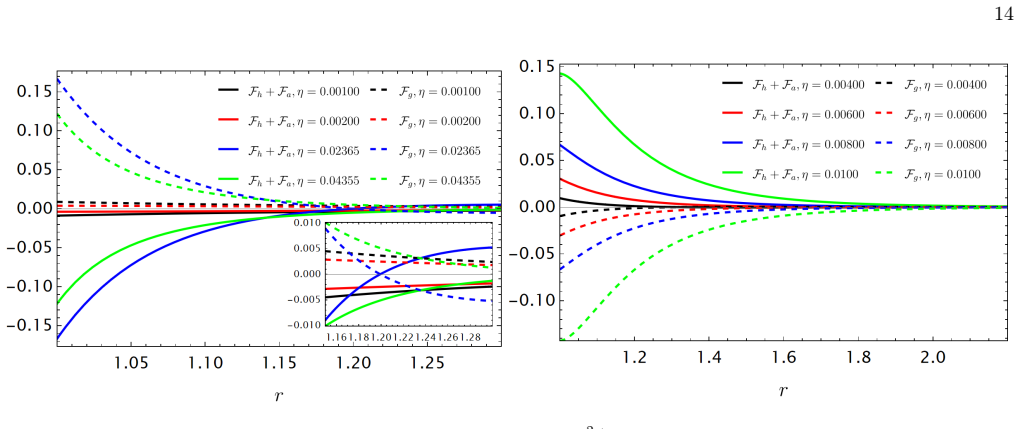
In this case, the redshift sector becomes more sensitive to the near-throat geometry, producing a sharper curvature profile. Away from this transition region, the memory parameter changes the intensity of the curvature in a smoother way: the curves forη = 0.02365and η = 0.04355remain less steep and approach the asymptotic regime more regularly. Therefore,...
2025
-
[7]
Einstein and N
A. Einstein and N. Rosen, Physical Review48, 73 (1935)
1935
-
[8]
M. S. Morris and K. S. Thorne, American Journal of Physics56, 395 (1988)
1988
-
[9]
M. S. Morris, K. S. Thorne, and U. Yurtsever, Physical Review Letters61, 1446 (1988)
1988
-
[10]
Visser, Physical Review D39, 3182 (1989)
M. Visser, Physical Review D39, 3182 (1989)
1989
-
[11]
Poisson and M
E. Poisson and M. Visser, Physical Review D52, 7318 (1995)
1995
-
[12]
Hochberg and M
D. Hochberg and M. Visser, Physical Review D58, 044021 (1998)
1998
-
[13]
Teo, Physical Review D58, 024014 (1998)
E. Teo, Physical Review D58, 024014 (1998)
1998
-
[14]
Visser, S
M. Visser, S. Kar, and N. Dadhich, Physical Review Letters90, 201102 (2003)
2003
-
[15]
K. K. Nandi, Y.-Z. Zhang, and K. B. V. Kumar, Physical Review D70, 127503 (2004)
2004
-
[16]
C. J. Fewster and T. A. Roman, Physical Review D72, 044023 (2005)
2005
-
[17]
H. B. G. Casimir, Proceedings of the Koninklijke Nederlandse Akademie van Wetenschappen51, 793 (1948)
1948
-
[18]
H. B. G. Casimir and D. Polder, Physical Review73, 360 (1948)
1948
-
[19]
L. S. Brown and G. J. Maclay, Physical Review184, 1272 (1969)
1969
-
[20]
S. K. Lamoreaux, Physical Review Letters78, 5 (1997)
1997
-
[21]
Mohideen and A
U. Mohideen and A. Roy, Physical Review Letters81, 4549 (1998)
1998
-
[22]
Bordag, U
M. Bordag, U. Mohideen, and V. M. Mostepanenko, Physics Reports353, 1 (2001)
2001
-
[23]
K. A. Milton, Journal of Physics A: Mathematical and General37, R209 (2004)
2004
-
[24]
R. L. Jaffe, Physical Review D72, 021301 (2005)
2005
-
[25]
S. A. Fulling, K. A. Milton, P. Parashar, A. Romeo, K. V. Shajesh, and J. Wagner, Physical Review D76, 025004 (2007)
2007
-
[26]
K. A. Milton, P. Parashar, K. V. Shajesh, and J. Wagner, Journal of Physics A: Mathematical and Theoretical40, 10935 (2007)
2007
-
[27]
K. V. Shajesh, K. A. Milton, P. Parashar, and J. A. Wagner, Journal of Physics A: Mathematical and Theoretical41, 164058 (2008)
2008
-
[28]
K. A. Milton, K. V. Shajesh, S. A. Fulling, and P. Parashar, Physical Review D89, 064027 (2014)
2014
-
[29]
Nazari and M
B. Nazari and M. Nouri-Zonoz, Physical Review D82, 044047 (2010)
2010
-
[30]
Sorge, Classical and Quantum Gravity36, 235006 (2019)
F. Sorge, Classical and Quantum Gravity36, 235006 (2019)
2019
-
[31]
Sorge and J
F. Sorge and J. H. Wilson, Physical Review D100, 105007 (2019)
2019
-
[32]
J. H. Wilson, F. Sorge, and S. A. Fulling, Physical Review D101, 065007 (2020)
2020
-
[33]
A. R. Khabibullin, N. R. Khusnutdinov, and S. V. Sushkov, Classical and Quantum Gravity23, 627 (2006)
2006
-
[34]
V. B. Bezerra, E. R. Bezerra de Mello, N. R. Khusnutdinov, and S. V. Sushkov, Physical Review D81, 084034 (2010)
2010
-
[35]
Garattini and F
R. Garattini and F. S. N. Lobo, Physics Letters B671, 146 (2009)
2009
-
[36]
Garattini, The European Physical Journal C79, 951 (2019)
R. Garattini, The European Physical Journal C79, 951 (2019)
2019
-
[37]
A. C. L. Santos, C. R. Muniz, and R. V. Maluf, Journal of Cosmology and Astroparticle Physics2023, 022 (2023)
2023
-
[38]
A. C. L. Santos, R. V. Maluf, and C. R. Muniz, Annals of Physics469, 169775 (2024)
2024
-
[39]
Hassan, S
Z. Hassan, S. Ghosh, P. K. Sahoo, and K. Bamba, The European Physical Journal C82, 1116 (2022)
2022
-
[40]
Hassan, S
Z. Hassan, S. Ghosh, P. K. Sahoo, and V. S. H. Rao, General Relativity and Gravitation55, 90 (2023)
2023
-
[41]
Garattini and A
R. Garattini and A. G. Tzikas, The European Physical Journal C85, 336 (2025)
2025
-
[42]
Y. B. Zel’dovich and A. G. Polnarev, Soviet Astronomy18, 17 (1974)
1974
-
[43]
V. B. Braginsky and L. P. Grishchuk, Soviet Physics JETP62, 427 (1985)
1985
-
[44]
Christodoulou, Physical Review Letters67, 1486 (1991)
D. Christodoulou, Physical Review Letters67, 1486 (1991)
1991
-
[45]
K. S. Thorne, Physical Review D45, 520 (1992)
1992
-
[46]
Weinberg, Physical Review140, B516 (1965)
S. Weinberg, Physical Review140, B516 (1965)
1965
-
[47]
T. He, V. Lysov, P. Mitra, and A. Strominger, Journal of High Energy Physics2015, 151 (2015)
2015
-
[48]
Strominger and A
A. Strominger and A. Zhiboedov, Journal of High Energy Physics2016, 086 (2016)
2016
-
[49]
Pasterski, A
S. Pasterski, A. Strominger, and A. Zhiboedov, Journal of High Energy Physics2016, 053 (2016)
2016
-
[50]
Favata, The Astrophysical Journal Letters696, L159 (2009)
M. Favata, The Astrophysical Journal Letters696, L159 (2009)
2009
-
[51]
Favata, Classical and Quantum Gravity27, 084036 (2010)
M. Favata, Classical and Quantum Gravity27, 084036 (2010)
2010
-
[52]
Bieri and D
L. Bieri and D. Garfinkle, Classical and Quantum Gravity30, 195009 (2013)
2013
-
[53]
Bieri, P
L. Bieri, P. Chen, and S.-T. Yau, Classical and Quantum Gravity29, 215003 (2012)
2012
-
[54]
Tolish and R
A. Tolish and R. M. Wald, Physical Review D89, 064008 (2014)
2014
-
[55]
P. D. Lasky, E. Thrane, Y. Levin, J. Blackman, and Y. Chen, Physical Review Letters117, 061102 (2016)
2016
-
[56]
Heisenberg, N
L. Heisenberg, N. Yunes, and J. Zosso, Physical Review D108, 024010 (2023)
2023
-
[57]
Sorge, Physical Review D108, 104003 (2023)
F. Sorge, Physical Review D108, 104003 (2023)
2023
-
[58]
Akiyamaet al.(Event Horizon Telescope), Astrophys
K. Akiyamaet al.(Event Horizon Telescope), Astrophys. J. Lett.875, L1 (2019), arXiv:1906.11238 [astro-ph.GA]
Pith/arXiv arXiv 2019
-
[59]
E. H. T. Collaboration, K. Akiyama, A. Alberdi, W. Alef, J. C. Algaba, R. Anantua, K. Asada, R. Azulay, U. Bach, A.-K. Baczko, D. Ball, M. Baloković, J. Barrett, M. Bauböck, B. A. Benson, D. Bintley, L. Blackburn, R. Blundell, K. L. Bouman, G. C. Bower, H. Boyce, M. Bremer, C. D. Brinkerink, R. Brissenden, S. Britzen, A. E. Broderick, D. Broguiere, T. Bro...
2022
discussion (0)
Sign in with ORCID, Apple, or X to comment. Anyone can read and Pith papers without signing in.