Skyrmion Phase and Non-Fermi Liquid Behavior in Nonsymmorphic Magnetic Weyl Semimetals
Pith reviewed 2026-05-21 12:26 UTC · model grok-4.3
The pith
A Skyrmion lattice in nonsymmorphic magnetic Weyl semimetals drives non-Fermi liquid behavior with resistivity scaling as T to a power between 3 and 5.
A machine-rendered reading of the paper's core claim, the machinery that carries it, and where it could break.
Core claim
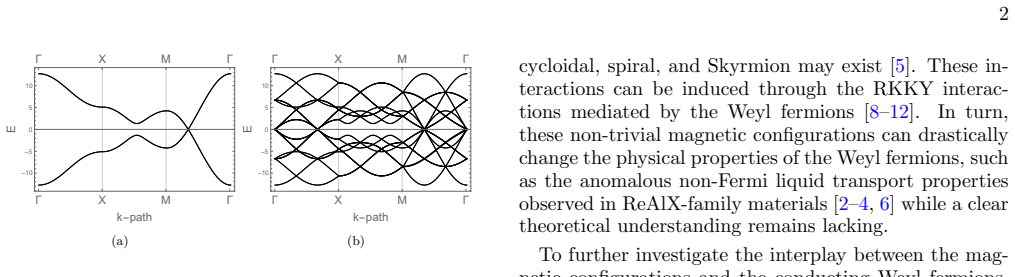
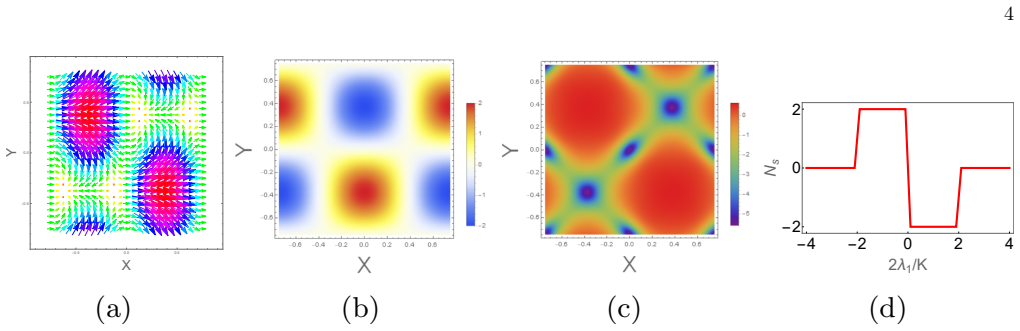
In the lattice model of Weyl fermions coupled to magnetic moments, the Skyrmion lattice formed under an in-plane Zeeman field modifies the band structure via magnetic Brillouin zone folding. This leads to significant changes in longitudinal and Hall conductivities calculated via the Kubo formula. The temperature-dependent resistivity deviates from the Fermi-liquid T squared dependence to a non-Fermi liquid power law with exponent alpha between 3 and 5 in the clean limit.
What carries the argument
The Skyrmion lattice arising from a multi-Q cycloid magnetic configuration under an in-plane Zeeman field, which induces magnetic Brillouin zone folding and interacts with Weyl fermions through Kondo coupling to alter conductivities.
If this is right
- The longitudinal resistivity shows non-Fermi liquid scaling rho_xx ~ T^alpha with 3 < alpha < 5 rather than the usual T^2.
- Hall conductivity exhibits large magnitudes and can change sign depending on parameters.
- The system enters a non-Fermi liquid state due to the Skyrmion-induced modifications to the electronic structure.
Where Pith is reading between the lines
- If the mechanism holds, similar non-Fermi liquid behavior might appear in other systems with Skyrmion lattices and topological bands.
- External magnetic fields could be used to switch between Fermi liquid and non-Fermi liquid regimes in these materials.
Load-bearing premise
The multi-Q cycloid configuration transitions into a Skyrmion lattice under an in-plane Zeeman field, and the Kondo coupling combined with magnetic Brillouin zone folding produces the non-Fermi liquid transport in the clean limit.
What would settle it
Measurement of the resistivity temperature dependence in ReAlX compounds under applied in-plane magnetic fields that stabilize the Skyrmion phase, checking if the exponent falls between 3 and 5.
Figures

read the original abstract
We investigate the interplay between complex magnetic orders and topological electronic states in nonsymmorphic magnetic Weyl semimetals of the ReAlX family (Re is a rare earth element and X is Si or Ge). We show that a Skyrmion lattice can fundamentally alter the behavior of Weyl fermions, driving the system into a non-Fermi liquid state and producing large, sign-tunable Hall responses. To this end, we construct a lattice model incorporating conduction Weyl fermions coupled to localized magnetic moments via Kondo interaction. Considering a multi-${\bf Q}$ cycloid magnetic configuration that evolves into a Skyrmion lattice under an in-plane Zeeman field, we analyze its profound impact on the band structure through magnetic Brillouin zone and band-folding. Using the Kubo formula, we calculate the conductivity tensor and examine the transport properties in the clean limit. Our results reveal that the Skyrmion lattice induces significant changes in both longitudinal and Hall conductivities. Remarkably, the temperature-dependent resistivity deviates from standard Fermi-liquid behavior ($\rho_{xx}\sim T^2$), exhibiting a non-Fermi liquid power-law scaling ($\rho_{xx}\sim T^\alpha$ with $\alpha$ between 3 and 5). This work provides a unified theoretical framework connecting multi-${\bf Q}$ magnetic textures, Skyrmion physics, and anomalous transport in topological semimetals, bridging the fields of topological magnetism and topological fermions.
Editorial analysis
A structured set of objections, weighed in public.
Referee Report
Summary. The manuscript constructs a lattice model for Weyl fermions in nonsymmorphic ReAlX compounds coupled to localized moments via Kondo interaction. It considers a multi-Q cycloid magnetic order that evolves into a Skyrmion lattice under an in-plane Zeeman field, examines the resulting magnetic Brillouin-zone folding and band reconstruction, and computes the conductivity tensor via the Kubo formula in the clean limit. The central claims are that the Skyrmion texture produces large, sign-tunable Hall responses and drives non-Fermi-liquid longitudinal resistivity with power-law exponent α between 3 and 5 rather than the conventional T² Fermi-liquid form.
Significance. If the transport calculations are correct, the work would supply a concrete microscopic route by which a static Skyrmion lattice, through zone folding and Kondo coupling, can generate non-Fermi-liquid scaling and tunable anomalous Hall conductivity in a Weyl semimetal. The explicit lattice Hamiltonian and the focus on the ReAlX family provide a falsifiable framework that could be tested against experiment. The strength lies in linking multi-Q magnetism directly to topological transport without invoking additional dynamical scattering channels.
major comments (2)
- [Transport calculations] Transport section (Kubo-formula results for ρ_xx): the reported non-Fermi-liquid exponents α = 3–5 in the clean limit with a static Skyrmion texture require explicit justification. In the DC Kubo formula the temperature dependence enters only through the Fermi window −∂f/∂ω and any T-dependent band renormalization; for Weyl dispersions this ordinarily produces linear or quadratic scaling. The manuscript must show the spectral function, the effective density of states after magnetic folding, or the precise manner in which the Kondo term generates the higher powers, or else demonstrate that the exponents are robust against reasonable variations in Kondo strength and Zeeman field.
- [Hall conductivity results] Results on Hall conductivity: the claim of sign-tunable Hall responses is load-bearing for the Skyrmion-phase narrative, yet the manuscript does not report the separate contributions from Berry curvature versus scattering asymmetry or quantify how the in-plane Zeeman field reverses the sign. A plot or table of σ_xy versus Zeeman magnitude at fixed temperature would make the tunability verifiable.
minor comments (2)
- [Abstract] The abstract states α lies “between 3 and 5” without indicating whether these values are obtained from a fit, from an analytic approximation, or from a specific parameter set; a brief statement of the fitting procedure or the range of parameters explored would improve clarity.
- [Model Hamiltonian] Notation for the multi-Q vectors and the magnetic Brillouin zone should be defined once in the model section and used consistently; occasional redefinition of Q_i or the folding procedure obscures the band-structure discussion.
Simulated Author's Rebuttal
We thank the referee for the careful reading and valuable comments on our manuscript. We address each major point below and will revise the manuscript to incorporate the requested clarifications and additional data.
read point-by-point responses
-
Referee: [Transport calculations] Transport section (Kubo-formula results for ρ_xx): the reported non-Fermi-liquid exponents α = 3–5 in the clean limit with a static Skyrmion texture require explicit justification. In the DC Kubo formula the temperature dependence enters only through the Fermi window −∂f/∂ω and any T-dependent band renormalization; for Weyl dispersions this ordinarily produces linear or quadratic scaling. The manuscript must show the spectral function, the effective density of states after magnetic folding, or the precise manner in which the Kondo term generates the higher powers, or else demonstrate that the exponents are robust against reasonable variations in Kondo strength and Zeeman field.
Authors: We agree that explicit justification is needed for the reported exponents. The non-Fermi-liquid scaling originates from the magnetic Brillouin-zone folding by the Skyrmion lattice, which reconstructs the Weyl bands and produces a modified density of states with van Hove features that, when integrated against the Fermi window in the Kubo formula, yield α between 3 and 5. The Kondo coupling further renormalizes the effective bandwidth in a T-dependent manner. In the revision we will add plots of the spectral function A(k,ω) and the folded density of states, together with a brief derivation showing how these features produce the higher powers. We will also include supplementary calculations demonstrating that the exponents remain in the 3–5 range for moderate variations of Kondo strength and Zeeman field. revision: yes
-
Referee: [Hall conductivity results] Results on Hall conductivity: the claim of sign-tunable Hall responses is load-bearing for the Skyrmion-phase narrative, yet the manuscript does not report the separate contributions from Berry curvature versus scattering asymmetry or quantify how the in-plane Zeeman field reverses the sign. A plot or table of σ_xy versus Zeeman magnitude at fixed temperature would make the tunability verifiable.
Authors: In the clean limit employed throughout the work there is no impurity scattering, so the Hall conductivity is entirely intrinsic and arises from the Berry curvature of the magnetically folded bands. The in-plane Zeeman field continuously distorts the Skyrmion texture, altering the real-space topological charge and thereby the integrated Berry curvature, which produces the sign change. We will add a new figure plotting σ_xy versus Zeeman-field magnitude at fixed temperature and will explicitly state in the text that scattering-asymmetry (skew-scattering) contributions are absent in this limit. This will make the tunability both quantitative and directly verifiable. revision: yes
Circularity Check
No significant circularity detected; derivation remains self-contained
full rationale
The paper constructs an explicit lattice model of Weyl fermions with Kondo coupling to localized moments, adopts a multi-Q cycloid texture that evolves into a Skyrmion lattice under an in-plane Zeeman field, folds the bands via the magnetic Brillouin zone, and applies the Kubo formula to compute the conductivity tensor in the clean limit. The reported non-Fermi-liquid exponent range (α = 3–5) is presented as the numerical or analytic outcome of that calculation rather than a parameter fitted to data or a quantity defined into the model by construction. No self-citations, ansatz smuggling, or uniqueness theorems imported from prior work by the same authors appear in the provided text, and the central transport claim retains independent content from the model and formula. The derivation is therefore scored as non-circular.
Axiom & Free-Parameter Ledger
free parameters (2)
- Kondo coupling strength
- In-plane Zeeman field magnitude
axioms (2)
- domain assumption The system remains in the clean limit with negligible disorder scattering.
- domain assumption Magnetic Brillouin zone folding due to the Skyrmion lattice accurately captures the modification of Weyl fermion bands.
Lean theorems connected to this paper
-
IndisputableMonolith/Foundation/RealityFromDistinction.leanreality_from_one_distinction unclear?
unclearRelation between the paper passage and the cited Recognition theorem.
We construct a lattice model incorporating conduction Weyl fermions coupled to localized magnetic moments via Kondo interaction... Using the Kubo formula, we calculate the conductivity tensor... ρxx∼T^α with α between 3 and 5
-
IndisputableMonolith/Cost/FunctionalEquation.leanwashburn_uniqueness_aczel unclear?
unclearRelation between the paper passage and the cited Recognition theorem.
the temperature-dependent resistivity deviates from standard Fermi-liquid behavior (ρxx∼T²), exhibiting a non-Fermi liquid power-law scaling
What do these tags mean?
- matches
- The paper's claim is directly supported by a theorem in the formal canon.
- supports
- The theorem supports part of the paper's argument, but the paper may add assumptions or extra steps.
- extends
- The paper goes beyond the formal theorem; the theorem is a base layer rather than the whole result.
- uses
- The paper appears to rely on the theorem as machinery.
- contradicts
- The paper's claim conflicts with a theorem or certificate in the canon.
- unclear
- Pith found a possible connection, but the passage is too broad, indirect, or ambiguous to say the theorem truly supports the claim.
Reference graph
Works this paper leans on
- [1]
-
[2]
D. Destraz, L. Das, S. S. Tsirkin, Y. Xu, T. Neupert, J. Chang, A. Schilling, A. G. Grushin, J. Kohlbrecher, L. Keller, P. Puphal, E. Pomjakushina and J. S. White, Magnetism and anomalous transport in the Weyl semimetal PrAlGe: possible route to axial gauge fields, npj Quantum Materials5, 5 (2020)
work page 2020
-
[3]
J. Gaudet, H.-Y. Yang, S. Baidya, B. Lu, G. Xu, Y. Zhao, J. A. Rodriguez-Rivera, C. M. Hoffmann, D. E. Graf, D. H. Torchinsky, P. Nikoli´ c, D. Vanderbilt, F. Tafti, and C. L. Broholm, Weyl-mediated helical magnetism in NdAlSi, Nat. Mater.20, 1650 (2021)
work page 2021
-
[4]
Forbes, Christopher Gassen, Raghad S
Niraj Bhattarai, Andrew W. Forbes, Christopher Gassen, Raghad S. H. Saqat, Ian L. Pegg, and J. Philip, Experi- mental study of transport properties of Weyl semimetal LaAlGe thin films grown by molecular beam epitaxy, J. Vac. Sci. Technol. A39, 063407 (2021)
work page 2021
-
[5]
X. Yao, J. Gaudet, R. Verma, D. E. Graf, H.-Y. Yang et al., Large Topological Hall Effect and Spiral Magnetic Order in the Weyl Semimetal SmAlSi, Phys. Rev. X13, 011035 (2023)
work page 2023
-
[6]
N. C. Drucker, T. Nguyen, F. Han, P. Siriviboon, X. Luo, N. Andrejevic, Z. Zhu, G. Bednik, Q. T. Nguyen, Z. Chen, L. K. Nguyen, T. Liu, T. J. Williams, M. B. Stone, A. I. Kolesnikov, S. Chi, J. Fernandez-Baca, C. S. Nelson, A. Alatas, T. Hogan, A. A. Puretzky, S. Huang, Y. Yu, and Mingda Li, Topology stabilized fluctuations in a magnetic nodal semimetal, ...
work page 2023
- [7]
- [8]
-
[9]
M. V. Hosseini and M. Askari, Ruderman-Kittel-Kasuya- Yosida interaction inWeyl semimetals, Phys. Rev. B92, 224435 (2015)
work page 2015
- [10]
-
[11]
S.-X. Wang, H.-R. Chang, and J. Zhou, RKKY interac- tion in three-dimensional electron gases with linear spin- orbit coupling, Phys. Rev. B96, 115204 (2017)
work page 2017
-
[12]
M. Zhou, H.-R. Chang, L. Yang, and L. Liang, Weyl-mediated Ruderman-Kittel-Kasuya-Yosida interac- tion revisited: Imaginary-time formalism and finite tem- perature effects, Phys. Rev. B112, 054449 (2025)
work page 2025
- [13]
-
[14]
R. Ritz, M. Halder, M. Wagner, C. Franz, A. Bauer, and C. Pfleiderer, Formation of a topological non-Fermi liquid in MnSi, Nature497, 231 (2013)
work page 2013
-
[15]
A. Neubauer, C. Pfleiderer, B. Binz, A. Rosch, R. Ritz, P. G. Niklowitz, and P. B¨ oni, Topological Hall Effect in the A Phase of MnSi, Phys. Rev. Lett.102, 186602 (2009)
work page 2009
-
[16]
M. Hirschberger, T. Nakajima, S. Gao, L. Peng, A. Kikkawa, T. Kurumaji, M. Kriener, Y. Yamasaki, H. Sagayama, H. Nakao, K. Ohishi, K. Kakurai, Y. Taguchi, X. Yu, T.-h. Arima, and Y. Tokura, Skyrmion Phase and Competing Magnetic Orders on a Breathing Kagom´ e Lattice, Nat. Commun.10, 5831 (2019)
work page 2019
-
[17]
A. K. Mitchell and L. Fritz, Kondo effect in three- dimensional Dirac and Weyl systems, Phys. Rev. B92, 121109(R) (2015)
work page 2015
- [18]
-
[19]
B. A. Bernevig, C. Felser, and H. Beidenkopf, Progress and prospects in magnetic topological materials, Nature 6 603, 41 (2022)
work page 2022
-
[20]
Z. Wang, Y. Su, S.-Z. Lin, and C. D. Batista, Meron, Skyrmion, and Vortex Crystals in Centrosymmetric Tetragonal Magnets, Phys. Rev. B103, 104408 (2021)
work page 2021
-
[21]
J. Repicky, P.-K.Wu, T. Liu, J. P. Corbett, T. Zhu, S. Cheng, A. S. Ahmed, N. Takeuchi, J. Guerrero-Sanchez, M. Randeria, R. K. Kawakami, and J. A. Gupta, Atomic- Scale Visualization of Topological Spin Textures in the Chiral Magnet MnGe, Science374, 1484 (2021)
work page 2021
- [22]
- [23]
-
[24]
B. Binz and A. Vishwanath, Chirality induced anomalous-Hall effect in helical spin crystals, Physica B: Condensed Matter403, 1336 (2008)
work page 2008
-
[25]
M. Kohmoto, Zero modes and the quantized Hall conduc- tance of the two-dimensional lattice in a magnetic field, Phys. Rev. B39, 11943 (1989)
work page 1989
-
[26]
Y. Hatsugai and M. Kohmoto, Energy spectrum and the quantum Hall effect on the square lattice with next- nearest-neighbor hopping, Phys. Rev. B42, 8282 (1990)
work page 1990
-
[27]
Y. Hatsugai, Edge states in the integer quantum Hall effect and the Riemann surface of the Bloch function, Phys. Rev. B48, 11851 (1993)
work page 1993
- [28]
-
[29]
Di Xiao, Ming-Che Chang, and Qian Niu, Berry phase effects on electronic properties, Rev. Mod. Phys.82, 1959 (2010)
work page 1959
-
[30]
N. Nagaosa, J. Sinova, S. Onoda, A. H. MacDonald, and N. P. Ong, Anomalous Hall effect, Rev. Mod. Phys.82, 1539 (2010). Appendix A: Detailed construction of the Harper equation Define the partial Fourier transformation, c† x,y = Z d2k (2π)2 c† kx,ky eikxx+ikyy.(A1) Then X x,y cos(Q(x+y))c † x,ycx,y = Z d2k (2π)2 1 2(c† kx−Q,ky−Qckx,ky +c † kx+Q,ky+Qckx,ky...
work page 2010
discussion (0)
Sign in with ORCID, Apple, or X to comment. Anyone can read and Pith papers without signing in.