REVIEW 4 major objections 5 minor 61 references
A 3D Multimodal Feature for Infrastructure Anomaly Detection
T0 review · 4 major / 5 minor · reviewed 2026-08-08 · deepseek-v4-flash
Pith's one-line read A handcrafted intensity histogram fused with FPFH lets PatchCore detect cracks and water ingress in masonry bridge and tunnel point clouds.
desk verdict A useful proof-of-concept for fusing FPFH with a 3D intensity histogram, but the paper's own Limitations section undercuts its headline claim of improved small-crack detection. read the letter →
The pith
A machine-rendered reading of the paper's core claim, the machinery that carries it, and where it could break.
The reading
What carries the argument
The central object is 3DMulti-FPFHI. For each point, a ball query finds neighbours; FPFH encodes local shape through histograms of Darboux-frame angles, and the new 3D intensity feature encodes local radiometric contrast through a histogram of absolute relative intensity values between the centre point and its neighbours. Concatenating the two histograms gives PatchCore a single feature vector carrying both geometric and radiometric anomaly signals, and the absolute-relative encoding is meant to damp intensity drift between scans taken under different environmental conditions.
What would settle it
A controlled experiment would register two scans of the same defect-free wall taken under different lighting, moisture, or scanner settings and run the 3D intensity feature alone through PatchCore: if non-defect points produce anomaly scores as high as those from a real crack or water patch, the absolute-relative encoding has not cancelled environmental intensity drift. A second check is to apply the full method to a large uniform water patch and observe whether only its boundary is flagged, which the paper predicts.
Extended reading notes
Core claim
The paper's central claim is that 3DMulti-FPFHI—the vector formed by concatenating Fast Point Feature Histograms (FPFH) with a per-point 3D intensity histogram built from absolute relative intensity differences between each point and its neighbours—outperforms FPFH alone and the CPMF multimodal baseline for infrastructure anomaly detection inside the PatchCore framework. The intensity channel increases anomaly separation for intrados cracks and for water patches, while the FPFH channel preserves detection of extrados cracks that appear only as geometric distortions. The method requires no training, only a normal point cloud and a test point cloud, which the paper argues makes it practical where learning-based methods lack data.
Load-bearing premise
The method assumes that for undamaged surfaces, local brightness contrast between a point and its neighbours stays nearly unchanged between the normal scan and the test scan, even when lighting, moisture, or scanner settings change; the paper itself notes this fails where brightness is nearly uniform, which is why the interiors of large water patches are missed.
Editorial extensions
If this is right
- On the synthetic arch, 3DMulti-FPFHI achieves higher F1 scores than FPFH in most support-movement cases and localizes intrados cracks more sharply, while also outperforming CPMF.
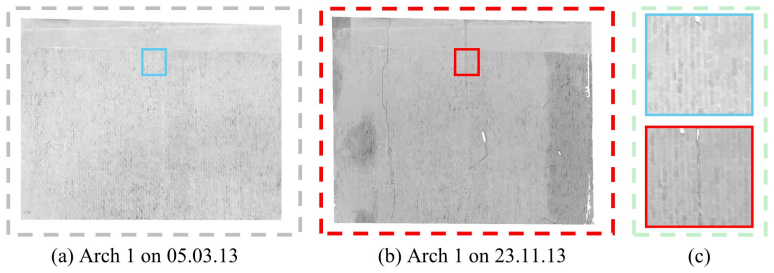
- On the real masonry bridge, FPFH alone scores F1 = 0, whereas 3DMulti-FPFHI locates the intrados crack and several water patches.
- On the concrete tunnel, 3DMulti-FPFHI keeps intrados-crack detection close to FPFH despite intensity noise, with higher F1 scores at later loading steps.
- The pipeline needs only two registered point clouds and no training, making it usable for anomaly detection when labelled defect data are scarce.
- Intensity anomalies enable detection of non-geometric defects such as water patches, which no purely geometric feature can reveal.
Reading between the lines
- Beyond the paper: because the 3D intensity histogram works through local contrast, a pre-processing step that normalizes intensity across scans (or over surface albedo) could extend detection into the uniform interiors of large water patches.
- Beyond the paper: the handcrafted intensity histogram could be combined with learned geometric descriptors, not just FPFH, to push crack detection below the current resolution limits once denser scans are available.
- Beyond the paper: the claimed superiority over image-based multimodal features should be re-tested on cracks wider than a few millimetres, where the paper's limitation section says both geometry and intensity channels start to fail.
- Beyond the paper: the F1-based comparisons depend on user-chosen thresholds; a threshold-free metric such as area under the ROC curve on the same datasets would give a more portable comparison across bridges and tunnels.
Editorial analysis
A structured set of objections, weighed in public.
Referee Report
Summary. The paper proposes a 3D multimodal feature, 3DMulti-FPFHI, that concatenates a modified FPFH descriptor with a handcrafted 3D intensity histogram and integrates it into the PatchCore anomaly detection framework. The method is evaluated on synthetic masonry arch point clouds, a real masonry arch bridge, and a full-scale concrete tunnel experiment. The authors claim that the intensity feature improves crack detection and enables detection of water ingress, and that 3DMulti-FPFHI outperforms FPFH and the CPMF baseline. The paper also documents updates to a synthetic dataset, including crack-surface geometry and intensity simulation.
Significance. If the claims held, the method would offer a training-free anomaly detection approach for infrastructure point clouds that leverages both geometric and radiometric information, with the code and dataset made publicly available. The empirical evidence, however, does not fully support the central claims: the method fails on small cracks (the motivating regime), CPMF is not evaluated on real data, and the F1 results are low and threshold-dependent. The water-patch detection results and the release of code/data are positive contributions, as is the effort to create a more realistic synthetic dataset with crack surfaces.
major comments (4)
- [§1 and Limitations] The central claim of the paper is that 3DMulti-FPFHI improves crack detection, with the introduction explicitly motivated by FPFH's insufficient sensitivity to small cracks. However, the Limitations section states verbatim that the proposed 3D multimodal feature failed to capture small cracks in the synthetic dataset (intrados and extrados cracks with maximum values of 2 mm and 6 mm, respectively) and in the real tunnel (crack widths from 0.02 mm to several millimetres). This is a direct contradiction with the abstract's 'improving crack detection' claim. The stated reasons (subtle geometry and point-cloud resolution below crack width) are structural rather than incidental, so the claim must be qualified to the detectable crack-width regime or supported with evidence of small-crack detection.
- [§4.2, Table 2 and §4.4, Table 4] The claim that 3DMulti-FPFHI 'outperforms FPFH and a state-of-the-art multimodal anomaly detection method' is only partially supported. On the synthetic dataset, CPMF achieves a higher F1 score than 3DMulti-FPFHI for the z-displacement case at threshold 0.5*s (0.531 vs 0.102) and for the x-rotation/z-translation case at 0.5*s (0.427 vs 0.318); on the real tunnel, FPFH alone has a higher F1 at loading step 103 for threshold 0.5*s (0.043 vs 0.026), and Section 4.4 notes that the intensity feature compromises extrados crack detection. The superiority claim should be restricted to the datasets, thresholds, and crack types for which it actually holds, with exceptions acknowledged.
- [§4.1 and §4.2] The CPMF baseline is evaluated only on synthetic data; it is not applied to the real arch or tunnel datasets, yet the abstract and conclusions claim outperformance against this state-of-the-art method without this restriction. In addition, no confidence intervals, standard deviations, or repeated-run statistics are provided for any F1 score or distribution metric, and the 'statistical analysis' in Section 4.2.2 is purely descriptive (KDE and sample means) rather than inferential. The paper should either provide statistical evidence for the claimed differences or explicitly frame the comparisons as indicative rather than conclusive.
- [§2.1 and §4.3] The 3D intensity feature is built on the assumption that absolute relative intensity differences between a point and its neighbours remain stable for non-defect points between the normal and test scans. The paper acknowledges in Section 4.3 that this assumption fails when intensity is nearly uniform (water patch interiors) and in Section 4.4 that scan resolution below crack width makes the intensity feature useless. These are not edge cases but central operating conditions for the proposed feature; the paper should state these limitations upfront and temper the conclusions about generalizability accordingly, since the claimed advantages of the feature disappear in precisely those regimes.
minor comments (5)
- [Abstract] The abstract's statement that the method 'outperforms FPFH and a state-of-the-art multimodal anomaly detection method' should be qualified, since the CPMF comparison is conducted only on synthetic data and the F1 results are mixed across thresholds and datasets.
- [§4.1] The choice of anomaly thresholds 0.3*s and 0.5*s is arbitrary and not justified; the paper would benefit from reporting a threshold-independent metric such as area under the ROC curve or precision-recall curve.
- [§4.3] The statement that 'the metric alone cannot fairly evaluate the performance' is not accompanied by an alternative evaluation metric; providing a quantitative localization metric would strengthen the assessment.
- [References] There is a typographical error in the reference list: the Dais et al. (2021) entry contains the stray string 'claslogoglu2016cospairs' in the title, and several author names appear with unintended spaces (e.g., 'Sta lowska').
- [Figure 9] In the discussion of Figure 9, the text states that '(c) is retrieved by overlapping (b) and (c)', which appears to be a typo; likely one of these should be (a).
Circularity Check
No circular derivation found: the intensity feature is a handcrafted input to an empirical benchmark, not a quantity defined by the target it predicts.
full rationale
The paper's derivation chain is empirical rather than analytical. 3DMulti-FPFHI is built by concatenating a standard FPFH descriptor with a handcrafted histogram of absolute relative intensity differences; neither component is fitted to crack labels or to the anomaly scores it later predicts. PatchCore builds a memory bank from normal point clouds only and scores test points by nearest-neighbour distance, so no fitted parameter is renamed as a prediction. The thresholds and radii are dataset-specific hyperparameters reported for reproducibility, and F1-scores are shown at multiple thresholds rather than optimised on the test labels. The synthetic dataset intentionally couples crack geometry to simulated intensity reduction, so the synthetic ablation partly tests the feature against a signal that was inserted by construction; however, the real masonry arch and tunnel experiments provide external data where the intensity contrast arises from actual mortar reflectivity or is absent, so the central claim is not forced by the simulation. Self-citations (Jing et al. 2024b for the PatchCore implementation and synthetic arch framework) provide the baseline and infrastructure but are not invoked as a uniqueness theorem or as the justification for the intensity feature's benefit. The Limitations section concedes that small cracks are missed, which weakens the scope of the claim but is not circularity. No step equates the output to the input by definition.
Assumptions & free parameters
free parameters (6)
- FPFH bin count =
30
- 3D intensity histogram bin count =
30
- Ball query and FPFH radii =
0.12 m normals, 1 m arch FPFH, 0.6 m tunnel FPFH
- PatchCore memory bank size =
4000
- Anomaly threshold and F1 thresholds =
0.5 visual; 0.3*s and 0.5*s for F1
- CPMF camera settings =
focal 700/450 mm, 512x512, 27 orientations
assumptions (5)
- standard math FPFH and PatchCore methods work as published
- domain assumption A scalar intensity value represents meaningful material response
- domain assumption Uniform reflectivity in synthetic models
- domain assumption Absolute-relative intensity encoding makes non-defect points comparable across scans
- domain assumption Crack labels extend uniformly along the tunnel ring
Cite this review
Pith. "Pith review of A 3D Multimodal Feature for Infrastructure Anomaly Detection." pith.science (2026). https://pith.science/paper/HPGNSIRL
@misc{pith2026250205779,
  author       = {Pith},
  title        = {Pith review of: A 3D Multimodal Feature for Infrastructure Anomaly Detection},
  year         = {2026},
  howpublished = {\url{https://pith.science/paper/HPGNSIRL}},
  note         = {Machine review of arXiv:2502.05779}
}
read the original abstract
Ageing structures require periodic inspections to identify structural defects. Previous work has used geometric distortions to locate cracks in synthetic masonry bridge point clouds but has struggled to detect small cracks. To address this limitation, this study proposes a novel 3D multimodal feature, 3DMulti-FPFHI, that combines a customized Fast Point Feature Histogram (FPFH) with an intensity feature. This feature is integrated into the PatchCore anomaly detection algorithm and evaluated through statistical and parametric analyses. The method is further evaluated using point clouds of a real masonry arch bridge and a full-scale experimental model of a concrete tunnel. Results show that the 3D intensity feature enhances inspection quality by improving crack detection; it also enables the identification of water ingress which introduces intensity anomalies. The 3DMulti-FPFHI outperforms FPFH and a state-of-the-art multimodal anomaly detection method. The potential of the method to address diverse infrastructure anomaly detection scenarios is highlighted by the minimal requirements for data compared to learning-based methods. The code and related point cloud dataset are available at https://github.com/Jingyixiong/3D-Multi-FPFHI.
Figures


Figures from the paper (17 more)




Reference graph
Works this paper leans on
-
[1]
write newline
" write newline "" before.all 'output.state := FUNCTION n.dashify 't := "" t empty not t #1 #1 substring "-" = t #1 #2 substring "--" = not "--" * t #2 global.max substring 't := t #1 #1 substring "-" = "-" * t #2 global.max substring 't := while if t #1 #1 substring * t #2 global.max substring 't := if while FUNCTION word.in bbl.in ":" * " " * FUNCTION f...
-
[2]
write newline
" write newline "" before.all 'output.state := FUNCTION n.dashify 't := "" t empty not t #1 #1 substring "-" = t #1 #2 substring "--" = not "--" * t #2 global.max substring 't := t #1 #1 substring "-" = "-" * t #2 global.max substring 't := while if t #1 #1 substring * t #2 global.max substring 't := if while FUNCTION word.in bbl.in ":" * " " * FUNCTION f...
-
[3]
write newline
" write newline "" before.all 'output.state := FUNCTION n.dashify 't := "" t empty not t #1 #1 substring "-" = t #1 #2 substring "--" = not "--" * t #2 global.max substring 't := t #1 #1 substring "-" = "-" * t #2 global.max substring 't := while if t #1 #1 substring * t #2 global.max substring 't := if while FUNCTION word.in bbl.in ":" * " " * FUNCTION f...
-
[4]
author Acikgoz, S. , author DeJong, M.J. , author Soga, K. , year 2018 . title Sensing dynamic displacements in masonry rail bridges using 2d digital image correlation . journal Structural Control and Health Monitoring volume 25 , pages e2187 . https://doi.org/10.1002/stc.2187
doi:10.1002/stc.2187 2018
-
[5]
author Acikgoz, S. , author Soga, K. , author Woodhams, J. , year 2017 . title Evaluation of the response of a vaulted masonry structure to differential settlements using point cloud data and limit analyses . journal Construction and Building Materials volume 150 , pages 916--931 . https://doi.org/10.1016/j.conbuildmat.2017.05.075
-
[7]
author Attard, L. , author Debono, C.J. , author Valentino, G. , author Di Castro, M. , author Masi, A. , author Scibile, L. , year 2019 . title Automatic crack detection using mask r-cnn , in: booktitle 2019 11th international symposium on image and signal processing and analysis (ISPA) , organization IEEE . pp. pages 152--157 . 10.1109/ISPA.2019.8868619
-
[8]
author Beggel, L. , author Pfeiffer, M. , author Bischl, B. , year 2020 . title Robust anomaly detection in images using adversarial autoencoders , in: booktitle Machine Learning and Knowledge Discovery in Databases: European Conference, ECML PKDD 2019, W \"u rzburg, Germany, September 16--20, 2019, Proceedings, Part I , organization Springer . pp. pages ...
-
[9]
author Bergmann, P. , author Jin, X. , author Sattlegger, D. , author Steger, C. , year 2021 . title The mvtec 3d-ad dataset for unsupervised 3d anomaly detection and localization . journal arXiv preprint arXiv:2112.09045 https://doi.org/10.5220/0010865000003124
arXiv 2021
Show all 61 references
-
[10]
, year 2022
author Brackenbury, D. , year 2022 . title Automated image-based inspection of masonry arch bridges
2022
-
[11]
, author Wan, Q
author Cao, Y. , author Wan, Q. , author Shen, W. , author Gao, L. , year 2022 . title Informative knowledge distillation for image anomaly segmentation . journal Knowledge-Based Systems volume 248 , pages 108846 . https://doi.org/10.1016/j.knosys.2022.108846
2022
- [12]
-
[13]
u y \"u k \
author Cha, Y.J. , author Choi, W. , author B \"u y \"u k \"o zt \"u rk, O. , year 2017 . title Deep learning-based crack damage detection using convolutional neural networks . journal Computer-Aided Civil and Infrastructure Engineering volume 32 , pages 361--378 . https://doi...
2017 doi
-
[14]
u y \"u k \
author Cha, Y.J. , author Choi, W. , author Suh, G. , author Mahmoudkhani, S. , author B \"u y \"u k \"o zt \"u rk, O. , year 2018 . title Autonomous structural visual inspection using region-based deep learning for detecting multiple damage types . journal Computer-Aided Civi...
2018 doi
-
[15]
, author Jahanshahi, M.R
author Chen, F.C. , author Jahanshahi, M.R. , year 2017 . title Nb-cnn: Deep learning-based crack detection using convolutional neural network and na \" ve bayes data fusion . journal IEEE Transactions on Industrial Electronics volume 65 , pages 4392--4400 . 10.1109/TIE.2017.2764844
2017
-
[16]
, author Ramirez, P.Z
author Costanzino, A. , author Ramirez, P.Z. , author Lisanti, G. , author Di Stefano, L. , year 2024 . title Multimodal industrial anomaly detection by crossmodal feature mapping , in: booktitle Proceedings of the IEEE/CVF Conference on Computer Vision and Pattern Recognition...
-
[17]
, author Bal, I.E
author Dais, D. , author Bal, I.E. , author Smyrou, E. , author Sarhosis, V. , year 2021 . title Automatic crack claslogoglu2016cospairsification and segmentation on masonry surfaces using convolutional neural networks and transfer learning . journal Automation in Construction...
2021
-
[18]
, author Birdal, T
author Deng, H. , author Birdal, T. , author Ilic, S. , year 2018 . title Ppfnet: Global context aware local features for robust 3d point matching , in: booktitle Proceedings of the IEEE conference on computer vision and pattern recognition , pp. pages 195--205 . https://doi.o...
-
[19]
, author Dong, W
author Deng, J. , author Dong, W. , author Socher, R. , author Li, L.J. , author Li, K. , author Fei-Fei, L. , year 2009 . title Imagenet: A large-scale hierarchical image database , in: booktitle 2009 IEEE Conference on Computer Vision and Pattern Recognition , pp. pages 248-...
2009
-
[20]
, author Wang, S
author Dong, Q. , author Wang, S. , author Chen, X. , author Jiang, W. , author Li, R. , author Gu, X. , year 2023 . title Pavement crack detection based on point cloud data and data fusion . journal Philosophical Transactions of the Royal Society A volume 381 , pages 20220165...
2023
-
[21]
, author Li, C
author Fan, Z. , author Li, C. , author Chen, Y. , author Wei, J. , author Loprencipe, G. , author Chen, X. , author Di Mascio, P. , year 2020 . title Automatic crack detection on road pavements using encoder-decoder architecture . journal Materials volume 13 , pages 2960 . ht...
2020 doi
-
[22]
, author Dixit, M
author Gupta, P. , author Dixit, M. , year 2022 . title Image-based crack detection approaches: a comprehensive survey . journal Multimedia Tools and Applications volume 81 , pages 40181--40229 . https://doi.org/10.1007/s11042-022-13152-z
2022 doi
-
[23]
, author Napolitano, R.K
author Hallee, M.J. , author Napolitano, R.K. , author Reinhart, W.F. , author Glisic, B. , year 2021 . title Crack detection in images of masonry using cnns . journal Sensors volume 21 , pages 4929 . https://doi.org/10.3390/s21144929
2021 doi
-
[24]
, author Zhang, X
author He, K. , author Zhang, X. , author Ren, S. , author Sun, J. , year 2016 . title Deep residual learning for image recognition , in: booktitle Proceedings of the IEEE conference on computer vision and pattern recognition , pp. pages 770--778
2016
-
[25]
, author Han, S
author Jiang, Y. , author Han, S. , author Bai, Y. , year 2021 . title Building and infrastructure defect detection and visualization using drone and deep learning technologies . journal Journal of Performance of Constructed Facilities volume 35 , pages 04021092 . https://doi....
2021
-
[26]
, author Sheil, B
author Jing, Y. , author Sheil, B. , author Acikgoz, S. , year 2022 . title Segmentation of large-scale masonry arch bridge point clouds with a synthetic simulator and the bridgenet neural network . journal Automation in Construction volume 142 , pages 104459 . https://doi.org...
2022
-
[27]
, author Sheil, B
author Jing, Y. , author Sheil, B. , author Acikgoz, S. , year 2023 . title A method to generate realistic synthetic point clouds of damaged single-span masonry arch bridges , in: booktitle International Conference on Structural Analysis of Historical Constructions , organizat...
2023 doi
-
[28]
, author Sheil, B
author Jing, Y. , author Sheil, B. , author Acikgoz, S. , year 2024 a. title A lightweight transformer-based neural network for large-scale masonry arch bridge point cloud segmentation . journal Computer-Aided Civil and Infrastructure Engineering https://doi.org/10.1111/mice.13201
2024 doi
-
[29]
, author Zhong, J.X
author Jing, Y. , author Zhong, J.X. , author Sheil, B. , author Acikgoz, S. , year 2024 b. title Anomaly detection of cracks in synthetic masonry arch bridge point clouds using fast point feature histograms and patchcore . journal Automation in Construction volume 168 , pages 105766
2024
-
[30]
, author Fan, Z
author Lee, E.T. , author Fan, Z. , author Sencer, B. , year 2023 . title A new approach to detect surface defects from 3d point cloud data with surface normal gabor filter (sngf) . journal Journal of Manufacturing Processes volume 92 , pages 196--205 . https://doi.org/10.1016...
2023 doi
-
[31]
, author Ma, B
author Li, G. , author Ma, B. , author He, S. , author Ren, X. , author Liu, Q. , year 2020 . title Automatic tunnel crack detection based on u-net and a convolutional neural network with alternately updated clique . journal Sensors volume 20 , pages 717 . https://doi.org/10.3...
2020 doi
-
[32]
, author Rui, Y
author Li, T. , author Rui, Y. , author Zhu, H. , author Lu, L. , author Li, X. , year 2024 a. title Comprehensive digital twin for infrastructure: A novel ontology and graph-based modelling paradigm . journal Advanced Engineering Informatics volume 62 , pages 102747 . https:/...
2024
-
[33]
, author Yao, J
author Li, Y. , author Yao, J. , author Chen, K. , author Zhang, H. , author Sun, X. , author Qian, Q. , author Wu, X. , year 2024 b. title A collaborative anomaly localization method based on multi-modal images , in: booktitle 2024 27th International Conference on Computer Su...
2024 arXiv
-
[34]
, author Yue, Y
author Liao, J. , author Yue, Y. , author Zhang, D. , author Tu, W. , author Cao, R. , author Zou, Q. , author Li, Q. , year 2022 a. title Automatic tunnel crack inspection using an efficient mobile imaging module and a lightweight cnn . journal IEEE Transactions on Intelligen...
2022
-
[35]
, author Yue, Y
author Liao, J. , author Yue, Y. , author Zhang, D. , author Tu, W. , author Cao, R. , author Zou, Q. , author Li, Q. , year 2022 b. title Automatic tunnel crack inspection using an efficient mobile imaging module and a lightweight cnn . journal IEEE Transactions on Intelligen...
2022
-
[36]
, author Goyal, P
author Lin, T.Y. , author Goyal, P. , author Girshick, R. , author He, K. , author Dollar, P. , year 2017 . title Focal loss for dense object detection , in: booktitle Proceedings of the IEEE International Conference on Computer Vision (ICCV) . https://doi.org/10.48550/arXiv.1...
-
[37]
, author Li, P
author Lin, W. , author Li, P. , author Xie, X. , author Cao, Y. , author Zhang, Y. , year 2023 . title A novel back-analysis approach for the external loads on shield tunnel lining in service based on monitored deformation . journal Structural Control and Health Monitoring vo...
2023 doi
-
[38]
, author Sheil, B
author Lin, W. , author Sheil, B. , author Zhang, P. , author Zhou, B. , author Wang, C. , author Xie, X. , year 2024 . title Seg2tunnel: A hierarchical point cloud dataset and benchmarks for segmentation of segmental tunnel linings . journal Tunnelling and Underground Space T...
2024
-
[39]
, author Xie, G
author Liu, J. , author Xie, G. , author Chen, R. , author Li, X. , author Wang, J. , author Liu, Y. , author Wang, C. , author Zheng, F. , year 2024 . title Real3d-ad: A dataset of point cloud anomaly detection . journal Advances in Neural Information Processing Systems volum...
-
[40]
, author Chen, S
author Liu, W. , author Chen, S. , author Hauser, E. , year 2011 . title Lidar-based bridge structure defect detection . journal Experimental Techniques volume 35 , pages 27--34 . https://doi.org/10.1111/j.1747-1567.2010.00644.x
2011
-
[41]
, author Cao, Y
author Liu, Z. , author Cao, Y. , author Wang, Y. , author Wang, W. , year 2019 . title Computer vision-based concrete crack detection using u-net fully convolutional networks . journal Automation in Construction volume 104 , pages 129--139 . https://doi.org/10.1016/j.autcon.2...
2019 doi
-
[42]
, author Kalkan, S
author Logoglu, K.B. , author Kalkan, S. , author Temizel, A. , year 2016 . title Cospair: colored histograms of spatial concentric surflet-pairs for 3d object recognition . journal Robotics and Autonomous Systems volume 75 , pages 558--570 . https://doi.org/10.1016/j.robot.20...
2016 doi
-
[43]
, author Sarhosis, V
author Loverdos, D. , author Sarhosis, V. , year 2022 . title Automatic image-based brick segmentation and crack detection of masonry walls using machine learning . journal Automation in Construction volume 140 , pages 104389 . https://doi.org/10.1016/j.autcon.2022.104389
2022
-
[44]
, author Wood, R.L
author Mohammadi, M.E. , author Wood, R.L. , author Wittich, C.E. , year 2019 . title Non-temporal point cloud analysis for surface damage in civil structures . journal ISPRS International Journal of Geo-Information volume 8 , pages 527 . https://doi.org/10.3390/ijgi8120527
2019 doi
-
[45]
, author Hoskere, V
author Narazaki, Y. , author Hoskere, V. , author Yoshida, K. , author Spencer, B.F. , author Fujino, Y. , year 2021 . title Synthetic environments for vision-based structural condition assessment of japanese high-speed railway viaducts . journal Mechanical Systems and Signal ...
2021
-
[46]
, author Lou, Z
author Nguyen, D.T. , author Lou, Z. , author Klar, M. , author Brox, T. , year 2019 . title Anomaly detection with multiple-hypotheses predictions , in: booktitle International Conference on Machine Learning , organization PMLR . pp. pages 4800--4809 . https://doi.org/10.4855...
-
[47]
, author Tah, J.H
author Perez, H. , author Tah, J.H. , author Mosavi, A. , year 2019 . title Deep learning for detecting building defects using convolutional neural networks . journal Sensors volume 19 , pages 3556 . https://doi.org/10.3390/s19163556
2019 doi
-
[48]
, author Casula, G
author Pesci, A. , author Casula, G. , author Boschi, E. , year 2011 . title Laser scanning the garisenda and asinelli towers in bologna (italy): Detailed deformation patterns of two ancient leaning buildings . journal Journal of cultural heritage volume 12 , pages 117--127 . ...
2011 doi
-
[49]
, author Voulodimos, A
author Protopapadakis, E. , author Voulodimos, A. , author Doulamis, A. , author Doulamis, N. , author Stathaki, T. , year 2019 . title Automatic crack detection for tunnel inspection using deep learning and heuristic image post-processing . journal Applied intelligence volume...
2019 doi
-
[50]
, author Neumann, L
author Reitmann, S. , author Neumann, L. , author Jung, B. , year 2021 . title Blainder—a blender ai add-on for generation of semantically labeled depth-sensing data . journal Sensors volume 21 , pages 2144 . https://doi.org/10.3390/s21062144
2021 doi
-
[51]
, author Soil \'a n, M
author del R \' o-Barral, P. , author Soil \'a n, M. , author Gonz \'a lez-Collazo, S.M. , author Arias, P. , year 2022 . title Pavement crack detection and clustering via region-growing algorithm from 3d mls point clouds . journal Remote Sensing volume 14 , pages 5866 . https...
2022 doi
-
[52]
, author Pemula, L
author Roth, K. , author Pemula, L. , author Zepeda, J. , author Sch \"o lkopf, B. , author Brox, T. , author Gehler, P. , year 2022 . title Towards total recall in industrial anomaly detection , in: booktitle Proceedings of the IEEE/CVF Conference on Computer Vision and Patte...
2022
-
[53]
, author Blodow, N
author Rusu, R.B. , author Blodow, N. , author Beetz, M. , year 2009 . title Fast point feature histograms (fpfh) for 3d registration , in: booktitle 2009 IEEE international conference on robotics and automation , organization IEEE . pp. pages 3212--3217 . 10.1109/ROBOT.2009.5152473
2009
-
[54]
, author Seeb \"o ck, P
author Schlegl, T. , author Seeb \"o ck, P. , author Waldstein, S.M. , author Langs, G. , author Schmidt-Erfurth, U. , year 2019 . title f-anogan: Fast unsupervised anomaly detection with generative adversarial networks . journal Medical image analysis volume 54 , pages 30--44...
2019 doi
- [55]
-
[56]
, author Suchocki, C
author Sta owska, P. , author Suchocki, C. , author Rutkowska, M. , year 2022 . title Crack detection in building walls based on geometric and radiometric point cloud information . journal Automation in Construction volume 134 , pages 104065 . https://doi.org/10.1016/j.autcon....
2022
-
[57]
, author Shazeer, N
author Vaswani, A. , author Shazeer, N. , author Parmar, N. , author Uszkoreit, J. , author Jones, L. , author Gomez, A.N. , author Kaiser, . , author Polosukhin, I. , year 2017 . title Attention is all you need . journal Advances in neural information processing systems volum...
2017
-
[58]
, author Gao, L
author Wan, Q. , author Gao, L. , author Li, X. , author Wen, L. , year 2021 . title Industrial image anomaly localization based on gaussian clustering of pretrained feature . journal IEEE Transactions on Industrial Electronics volume 69 , pages 6182--6192 . 10.1109/TIE.2021.3094452
2021
-
[59]
, author Peng, J
author Wang, Y. , author Peng, J. , author Zhang, J. , author Yi, R. , author Wang, Y. , author Wang, C. , year 2023 . title Multimodal industrial anomaly detection via hybrid fusion , in: booktitle Proceedings of the IEEE/CVF Conference on Computer Vision and Pattern Recognit...
2023
-
[60]
, year 2018
author Weglarczyk, S. , year 2018 . title Kernel density estimation and its application , in: booktitle ITM web of conferences , organization EDP Sciences . p. pages 00037
2018
-
[61]
, author Acikgoz, S
author Ye, C. , author Acikgoz, S. , author Pendrigh, S. , author Riley, E. , author DeJong, M. , year 2018 . title Mapping deformations and inferring movements of masonry arch bridges using point cloud data . journal Engineering Structures volume 173 , pages 530--545 . https:...
2018 doi
-
[62]
, author Yoon, S
author Yi, J. , author Yoon, S. , year 2020 . title Patch svdd: Patch-level svdd for anomaly detection and segmentation , in: booktitle Proceedings of the Asian conference on computer vision . https://doi.org/10.1007/978-3-030-69544-6_23
2020 doi
Reviewed August 8, 2026 · model on record in the stance chip above.
Discussion (0). Continue with ORCID to comment.