REVIEW 5 major objections 7 minor 3 cited by
Epistemic Gain, Aleatoric Cost: Uncertainty Decomposition in Multi-Agent Debate for Math Reasoning
T0 review · 5 major / 7 minor · reviewed 2026-08-02 · deepseek-v4-flash
Pith's one-line read Effective multi-agent debate depends on keeping the gain from disagreement ahead of the cost of decoding noise; the authors train agents to do exactly that.
desk verdict Read this for the UMAD training results, not the theory: the empirical win is real but the theoretical wrapping is circular and the optimized uncertainty proxy doesn't match the analyzed one. read the letter →
The pith
A machine-rendered reading of the paper's core claim, the machinery that carries it, and where it could break.
The reading
What carries the argument
The carrying identity is the system-level decomposition TU = Sys-EU + Sys-AU, obtained by applying generalized Jensen–Shannon divergence to the mixture of agents' answer-level empirical distributions; Sys-EU measures inter-agent disagreement, Sys-AU measures intra-agent decoding noise. On the training side, two mechanisms do the work: an aleatoric-uncertainty-aware advantage that weights the GRPO advantage by an exponential of the standardized token-level mean negative log-likelihood, and an epistemic-influence intrinsic reward that credits an agent for the average correctness improvement its reference solution produces in peers at the next turn. The decomposition turns the measured trade-of
What would settle it
Re-run the same debate pairs using semantic clustering—grouping responses by meaning before computing entropy—instead of token-level NLL. If the success/failure separation by Sys-AU disappears or reverses, the claimed trade-off is an artifact of the uncertainty proxy; if the separation survives, the mechanism is robust. Alternatively, find a debate where Sys-AU stays low but Sys-EU never falls and accuracy still improves; that would break the necessity of the epistemic-gain condition.
Extended reading notes
Core claim
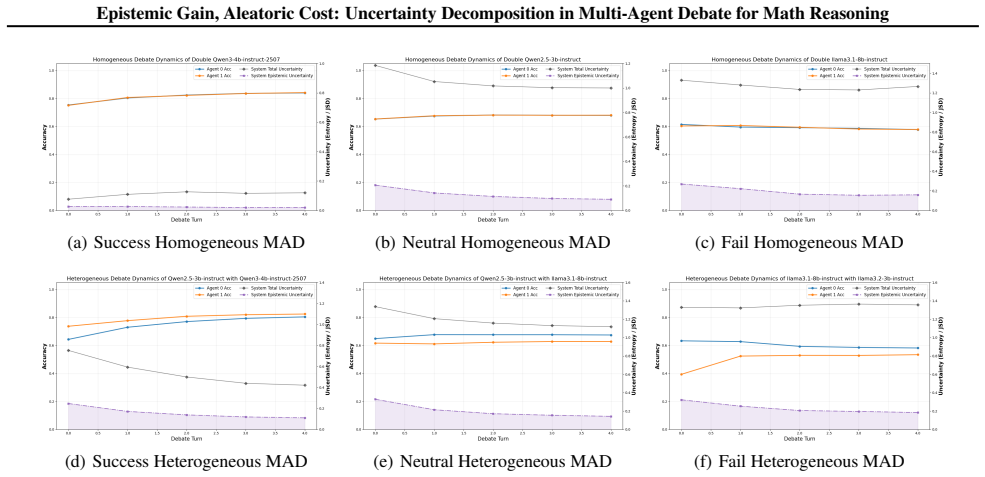
The central claim is that debate effectiveness is governed by a trade-off between epistemic gain and aleatoric cost. Total predictive uncertainty decomposes exactly into Sys-EU, the Jensen–Shannon divergence among agents' answer distributions, and Sys-AU, the mean per-agent entropy. Empirically, Sys-EU falls monotonically in every debate—debate is consensus-seeking regardless of correctness—so what separates success from failure is whether Sys-AU stays low or explodes. Heterogeneous pairs start with higher Sys-EU and thus larger potential gain, but benefit only when aleatoric cost is controlled; a theorem shows heterogeneous evidence yields strictly larger epistemic gain under a novelty cond
Load-bearing premise
The load-bearing premise is that K=16 independent answer rollouts faithfully estimate an agent's predictive distribution and that token-level mean negative log-likelihood is an adequate proxy for aleatoric uncertainty; the paper itself concedes in Section 8 that token-level NLL is not always perfectly correlated with semantic uncertainty, especially for poorly calibrated models.
Editorial extensions
If this is right
- If the trade-off is right, tracking Sys-EU and Sys-AU across rounds yields a direct, quantitative diagnostic of whether a debate is on track or about to collapse.
- Heterogeneous pairs are not automatically better: their larger epistemic potential pays off only when aleatoric noise is controlled, so model pairing should balance diversity with stability.
- UMAD trained on two debate rounds generalizes to five, so long-context stability can be obtained without expensive long-horizon training.
- Uncertainty-guided training improves individual post-debate accuracy even without majority voting, implying the model internalizes the debate benefit instead of relying on aggregation.
Reading between the lines
- The decomposition suggests a practical early-stopping rule: if Sys-AU starts growing after Sys-EU has flattened, additional rounds are more likely to hurt than help—an intervention the paper does not itself propose.
- The log-odds update lemma is task-agnostic: any setting where answers reduce to a correctness event should exhibit the same evidence-versus-noise structure, so the framework likely transfers beyond math to factual or code reasoning.
- Because the epistemic-influence reward depends on a verifiable correctness signal, applying UMAD to open-ended domains would require a judge or learned proxy and could otherwise reward persuasive but wrong arguments—a risk the paper's impact statement acknowledges.
- Replacing token-level NLL with semantic clustering would test whether Sys-AU measures genuine decoding noise or merely surface wording variance; the paper itself flags NLL as imperfectly correlated with semantic uncertainty.
Signed reviews
Editorial analysis
A structured set of objections, weighed in public.
Referee Report
Summary. The paper studies multi-agent debate (MAD) for math reasoning through an uncertainty-decomposition lens. It models the system’s predictive distribution as a mixture of agents’ answer-level distributions and uses the textbook identity H(mixture) = JSD + mean entropy to define system epistemic uncertainty (Sys-EU) and system aleatoric uncertainty (Sys-AU). It claims that, empirically, successful debates reduce Sys-EU while keeping Sys-AU low, and that heterogeneous debates start with larger Sys-EU and therefore have greater epistemic potential. On this basis it introduces UMAD, a multi-agent GRPO variant whose advantages are weighted by token-level negative log-likelihood and whose reward is augmented by an epistemic intrinsic reward that credits an agent for improving peers’ correctness. Experiments compare UMAD with Zero-Shot MAD and IPPO on homogeneous/heterogeneous Qwen pairs across MATH, GSM8K, AMC, and AIME.
Significance. If the empirical claims held, this would be a useful step toward making MAD a stable, learnable mechanism rather than a fragile inference-time heuristic. Proposition 3.2 is correct, though elementary; the more interesting contributions are the UMAD training objective and the attempted empirical link between uncertainty dynamics and debate success. The paper is transparent about prompts, compute, and limitations, and the IPPO ablation is a reasonable control. However, the current manuscript does not establish that the quantity optimized (token-level NLL) is the quantity measured and theorized (answer-level Sys-AU), and the statistical evidence is too weak to support the headline claims. The theoretical Theorem 3.3 is circular as stated and should not be presented as a theorem.
major comments (5)
- [§3.3, Theorem 3.3] The 'heterogeneous novelty condition' is essentially the claim being proved. The theorem states Gepi(m_hetero) ≥ Gepi(m_homo) for Gepi(m):=I(φ;m|x,c), but the proof only shows, under the stated condition, that I(φ;m_homo,m_hetero|x,c) ≥ I(φ;m_homo,m'_homo|x,c). Because the condition is conditional on m_homo, it does not imply the claimed ordering of unconditional mutual informations. If 'epistemic gain' is instead read as the incremental information after m_homo, then the conclusion is just the assumption restated. I recommend removing the theorem label and presenting the condition as a testable empirical hypothesis.
- [§4.2, Eq. (4) vs. §3.2, Eq. (3)] The training signal Ĥ_i in Eq. (4) is the mean token-level negative log-likelihood of a single generated response, whereas Sys-AU in Eq. (3) is the entropy of an answer-level distribution estimated from K=16 rollouts at temperature 1.0. The paper itself concedes in §8 that 'token-level NLL are not always perfectly correlated with semantic uncertainty.' Training uses G=5 rollouts at temperature 0.8, while the decomposition is computed with K=16 at temperature 1.0. No evidence is provided that the ranking of Ĥ_i correlates with Sys-AU or that the proxy transfers across temperature/group-size regimes. Because Eq. (4) is the only uncertainty-specific mechanism distinguishing UMAD from IPPO, the reported gains could be due to confidence/entropy regularization rather than to controlling the aleatoric cost identified in §3.2. Please add a calibration/correlation analysis and an ablation with a
- [§5.2, Table 1] Results are reported without error bars, multiple seeds, or significance tests. Several datasets are very small: AMC23 has 40 problems and AIME24/25 have 30 each. For example, the heterogeneous A1 AIME24 T=5 difference of 10.0 vs 3.3 is 3 vs 1 correct answers, and many AIME rows are 0.0 for A0 across all methods. The claims of 'consistent improvements' and 'largest gains at T=5' are not supportable without an estimate of variability. I recommend reporting mean ± std over at least three seeds, or bootstrapped confidence intervals for the headline T=5 numbers.
- [§3.2, Figure 6] The success/neutral/fail trajectories are selected post hoc by final accuracy outcome. The observation that 'successful debates can keep Sys-AU low or decreasing' is therefore a selected pattern; it is not established on the full dataset. The figure shows only representative trajectories, with no aggregate statistics such as mean Sys-AU over successful versus failing trajectories, or a correlation between ΔSys-AU and final accuracy. Please report the full distribution or a quantitative regression over all trajectories.
- [Appendix B.1 vs. Algorithm 1 / Appendix C.5] The K sampling protocol is contradictory. Appendix B.1 states that K=16 rollouts are generated at t=0 and K=1 for all t>0, while Algorithm 1 and Appendix C.5 state K=16 at every turn. Since Sys-AU in Eq. (3) is the mean entropy of per-agent answer distributions at each turn, K=1 after the first turn would make Sys-AU uncomputable. The manuscript must clarify which protocol is used for the decomposition results and which is used for training; if B.1 describes training rollouts and C.5 describes evaluation, this should be stated explicitly.
minor comments (7)
- [§1, §3.3, Appendix E.1] Typos: 'develope' should be 'develop'; 'manifesting as a tend for consensus' should be 'tendency'; 'Corret to Both Wrong' should be 'Correct to Both Wrong'.
- [Figure 6 caption] The caption is inconsistent: panel labels repeat 'Success Homogeneous MAD' (f appearing twice), and the figure appears to duplicate Figure 2. Please fix the labels and unify the figure numbering.
- [§3.2 vs. Figure 2/6] The text references Figure 6 in §3.2 and Figure 2 earlier; it should be clear which figure supports which claim. Consider consolidating or renumbering.
- [Algorithm 1 caption] The caption says 'The pseudo-code is demonstrated in Table 1'; it should refer to Algorithm 1.
- [§4.2, Eq. (5) and Algorithm 2] Eq. (5) defines r_eu_{i,t} = η/(N−1) Σ_{j≠i} ΔR_peer, but Algorithm 2 line 22 sets R_total = R_corr + η·ΔR_peer. Clarify whether the average over peers is included in η or is part of the implementation.
- [Appendix G vs. Table 2] The compute statement says 'rollout group size of G=16' but Table 2 lists Group Size (G)=5; it also mentions models 3B to 7B, while the experiments use 3B and 4B models. Please align these numbers.
- [§3.3] The law-of-total-entropy decomposition uses a latent variable φ_i, but no posterior over φ_i is ever computed. This is fine as conceptual framing, but the paper should state explicitly that φ_i is a formal device rather than an implemented Bayesian quantity.
Circularity Check
The theoretical wrapper is partly circular: Proposition 3.2 is the definition of JSD relabeled, and Theorem 3.3's heterogeneous novelty condition is essentially the conclusion restated as an assumption; the UMAD experiments are independent.
-
self definitional
[Section 3.2, Proposition 3.2 (proof in Appendix A.2)]
"TU(t) = JSD(p1,t, . . . , pN,t) + 1/N Σ H(pi,t), where Sys-EU(t) := JSD(...) = H(psys(y)) − 1/N Σ H(pi,t), and Sys-AU(t) := 1/N Σ H(pi,t). ... Proof. This follows directly from the definition of the Generalized Jensen-Shannon Divergence (JSD)."
The proposition is an algebraic restatement of the definition of JSD: Sys-EU and Sys-AU are defined as the two terms whose sum is H(psys). Any set of distributions satisfies the equation, so the claimed theoretical decomposition into epistemic and aleatoric parts is equivalent to the labels assigned to those terms. The paper presents this definitional identity as a derived Proposition and builds the debate trade-off narrative on it; the identity itself carries no independent content.
-
other
[Section 3.3, Theorem 3.3 (proof in Appendix A.3)]
"Assume the heterogeneous novelty condition: I(φ;mhetero | x, c, mhomo) ≥ I(φ;m′homo | x, c, mhomo), where m′homo is another independent homogeneous sample. Then the heterogeneous message provides strictly larger epistemic gain: Gepi(mhetero) ≥ Gepi(mhomo). ... Under the heterogeneous novelty condition assumed in the theorem ... the RHS is non-negative. Thus, the total information gain ... is greater in the heterogeneous setting."
Gepi is defined as I(φ;m|x,c), and the proof only compares joint informations I(φ;mhomo,mhetero) − I(φ;mhomo,m′homo), which is the assumed conditional inequality plus an identical baseline term. The theorem therefore does not derive Gepi(mhetero) ≥ Gepi(mhomo) from independent assumptions; it either restates the heterogeneous novelty condition as the conclusion or, read literally, commits a non-sequitur. The claim that heterogeneous debate yields larger epistemic gain is forced by an assumption that already asserts that gain.
full rationale
Two theoretical steps reduce to their own inputs. Proposition 3.2 defines Sys-EU as JSD and Sys-AU as mean entropy, so Eq. 3 is the definition of JSD rearranged; the paper's own proof says it follows directly from that definition. Theorem 3.3 assumes a conditional mutual-information advantage for heterogeneous messages and then, via the chain rule, concludes a mutual-information advantage; the proof establishes only that the assumed conditional advantage survives adding the same baseline term, making the theorem a restatement of its own premise (or a non-sequitur if Gepi is read as the marginal I(φ;m|x,c)). These two items are load-bearing in the paper's narrative that MAD success is an epistemic-gain/aleatoric-cost trade-off and that heterogeneity is theoretically superior. The UMAD training results, however, are largely independent of these wrappers: UMAD is compared against IPPO and Zero-Shot on held-out sets, and the reward used in Eq. 4-5 is not the same object as the Sys-AU/Sys-EU metrics, so the experimental contribution does not inherit the circularity. The paper's own Section 8 limitation that token-level NLL is not always correlated with semantic uncertainty is a validity concern about the reward proxy, not a by-construction equivalence. No load-bearing self-citations were identified. Overall: partial circularity in the theoretical framing, with independent empirical content, so score 6.
Assumptions & free parameters
free parameters (6)
- alpha_au (aleatoric advantage weight) =
0.25
- eta / epistemic influence reward magnitude =
0.25
- K (rollout samples for uncertainty estimation) =
16
- G (GRPO group size) =
5 (Table 2) / 16 (Appendix G)
- T_train (training debate rounds) =
2
- KL coefficient beta =
0.001
assumptions (5)
- domain assumption LLM decoding can be modeled as implicit Bayesian inference over a latent belief phi_i (Section 3.1).
- domain assumption Answer-level empirical frequency from K samples approximates p(y_{i,t}|x,c_{i,t}).
- domain assumption Token-level mean NLL is a valid proxy for aleatoric uncertainty (Eq. 4).
- ad hoc to paper Heterogeneous novelty condition in Theorem 3.3.
- domain assumption The ensemble mixture 1/N sum p_i approximates a Bayesian model average.
invented entities (1)
-
latent belief variable phi_i
Cite this review
Pith. "Pith review of Epistemic Gain, Aleatoric Cost: Uncertainty Decomposition in Multi-Agent Debate for Math Reasoning." pith.science (2026). https://pith.science/paper/HSU5WAS3
@misc{pith2026260301221,
  author       = {Pith},
  title        = {Pith review of: Epistemic Gain, Aleatoric Cost: Uncertainty Decomposition in Multi-Agent Debate for Math Reasoning},
  year         = {2026},
  howpublished = {\url{https://pith.science/paper/HSU5WAS3}},
  note         = {Machine review of arXiv:2603.01221}
}
read the original abstract
Multi-Agent Debate (MAD) has shown promise in improving reasoning and reducing hallucinations, yet it remains unclear how information exchange shapes individual reasoning behavior. Empirically, MAD exhibits paradoxical phenomena, including rising accuracy with increasing token entropy and marked differences between homogeneous and heterogeneous agent combinations. In this paper, we introduce a Bayesian uncertainty analysis framework for MAD, which decomposes answer-level predictive uncertainty into epistemic uncertainty and aleatoric uncertainty, corresponding to the potential gain and cost of debate. Across multiple agent configurations, we find that effective debate depends on achieving high epistemic gain under controlled aleatoric cost. Building on this insight, we design an uncertainty-guided multi-agent reinforcement learning algorithm that encourages lower aleatoric cost and more effective epistemic information utilization. Experiments show that our approach simultaneously enhances each agent's accuracy and promotes a more productive debate process, providing an operational Bayesian perspective for understanding and improving MAD.
Figures


Figures from the paper (3 more)


Forward citations
Cited by 3 Pith papers
-
Group Perspective Matters: Regulating Debate Relationships Can Mitigate Blind Conformity in Multi-Agent Debate
DEAR trains two RL policies, peer selection and generation-behavior control, to regulate how LLM debaters reference each other, improving benchmark accuracy while cutting token use.
-
Oracle Gap and Signal Fidelity: A Fixed-Pool Diagnostic for Test-Time Collaboration
Training-free LLM collaboration gains are bounded by the fixed pool's oracle gap and then by signal coverage, fidelity, and harm, measurable with a small labeled audit.
-
Multiagent Protocols with Aggregated Confidence Signals
Introduces protocols to aggregate transformed confidence signals from multiagent debates via soft voting or Bayesian fusion, yielding higher AUARC than single agents or standard baselines while keeping F1 stable acros...
Reference graph
Works this paper leans on
-
[1]
Radius of the Sphere: The correct radius r of the inscribed sphere is derived from the similar triangles property. The ratio of the radius of the base to the height of the cone is equal to the ratio of the radius of the sphere to the distance from the center of the sphere to the base of the cone. We have: 3 4 = r 4−r Solving this, we get: 3(4−r) = 4r=⇒12−...
-
[2]
The volume of the sphere is given by: Vsphere = 4 3 πr3 = 4 3 π 3 2 3 = 4 3 π· 27 8 = 9π 2 Next, we calculate the volume of the cone. The volume of a cone is given by: Vcone = 1 3 πr2 basehcone = 1 3 π(3)2(4) = 1 3 π·9·4 = 12π The ratio of the volume of the sphere to the volume of the cone is: Ratio= Vsphere Vcone = 9π 2 12π = 9π 2 · 1 12π = 9 24 = 3 8 Th...
-
[3]
V olume of the Cone: The volumeVcone of the cone is: Vcone = 1 3 πR2h= 1 3 π(3)2(4) = 1 3 π·9·4 = 12π
-
[4]
Consider a vertical cross-section of the cone through its axis
The sphere is inscribed in the cone, meaning it touches the base of the cone and the lateral surface of the cone. Consider a vertical cross-section of the cone through its axis. This cross-section is an isosceles triangle with a height of 4 and a base of 6 (since the diameter of the base of the cone is 6). The inscribed sphere touches the base of the cone...
-
[5]
V olume of the Sphere: The volumeVsphere of the sphere is: Vsphere = 4 3 πr3 = 4 3 π 12 7 3 = 4 3 π 1728 343 = 2304π 1029
-
[6]
Corrected Reasoning:
Ratio of the V olume of the Sphere to the V olume of the Cone: The ratioVsphere Vcone is: Vsphere Vcone = 2304π 1029 12π = 2304 1029·12 = 2304 12348 = 192 1029 = 64 343 Conclusion: The ratio of the volume of the sphere to the volume of the cone is: 64 343 Turn 1 Agent 1 Response: Let’s summarize and correct the reasoning process to find the correct ratio ...
-
[7]
The radius of the sphere, r, is the radius of the inscribed sphere
Radius of the Sphere Calculation: - The cone has a height of 4 and a base radius of 3. The radius of the sphere, r, is the radius of the inscribed sphere. - The distance from the center of the sphere to the base of the cone is 4−r . - Using the similar triangles property, we have: 3 4 = r 4−r - Cross-multiplying gives: 3(4−r) = 4r=⇒12−3r= 4r=⇒12 = 7r=⇒r= ...
-
[8]
V olume of the Sphere: - The volume of the sphere is given by: Vsphere = 4 3 πr3 = 4 3 π 12 7 3 = 4 3 π 1728 343 = 2304π 1029
Show all 10 references
-
[9]
V olume of the Cone: - The volume of the cone is given by: Vcone = 1 3 πR2h= 1 3 π(3)2(4) = 1 3 π·9·4 = 12π
-
[10]
approximation traps,
Ratio of V olumes: - The ratio of the volume of the sphere to the volume of the cone is: Vsphere Vcone = 2304π 1029 12π = 2304 1029·12 = 2304 12348 = 192 1029 = 64 343 Final Answer: 64 343 E.2. Heterogeneous Success Debate Examples The debate illustrates a successful transitio...
Reviewed August 2, 2026 · model on record in the stance chip above.
Discussion (0). Continue with ORCID to comment.