Orientation Mapping via Dictionary Indexing of AC-STEM Kikuchi patterns using Open-source Software
Pith reviewed 2026-06-25 19:59 UTC · model grok-4.3
The pith
Open-source template matching indexes AC-STEM transmission Kikuchi patterns for crystal orientation mapping.
A machine-rendered reading of the paper's core claim, the machinery that carries it, and where it could break.
Core claim
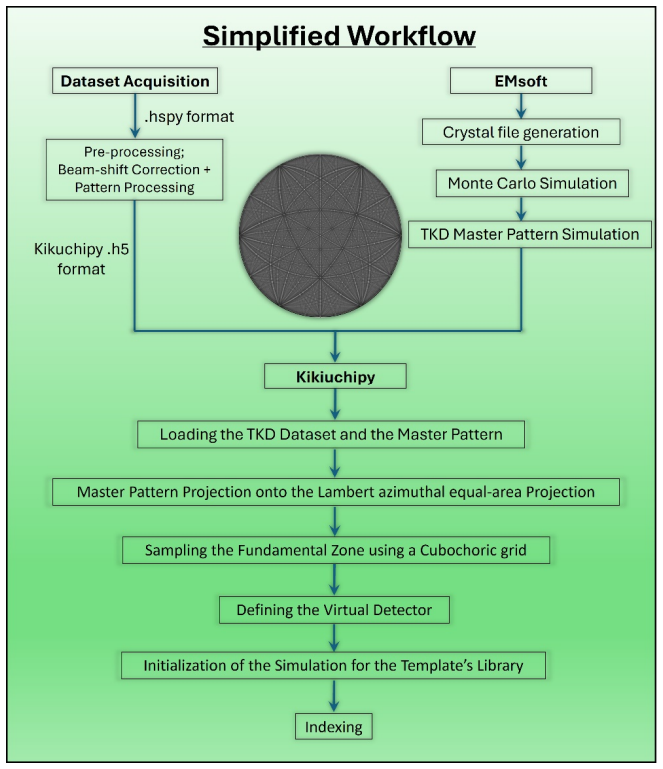
A master pattern produced by dynamical simulation in open-source software can be imported into a second open-source geometric-simulation package to index experimental AC-STEM TKD Kikuchi patterns, and the best-matched simulated patterns exhibit strong agreement with the recorded data even when only limited diffraction space is available for matching.
What carries the argument
Template matching of experimental AC-STEM TKD Kikuchi patterns against a simulated master pattern (angular intensity distribution on the unit sphere) generated by dynamical simulation.
If this is right
- Orientation mapping becomes feasible at nanometer spatial resolution using only open-source tools for both simulation and indexing.
- The same workflow can be applied to other polycrystalline energy materials where grain orientation influences performance.
- Indexing remains possible even when the detector captures only a small portion of the diffraction sphere.
- The approach provides an alternative to spot-pattern ACOM when higher orientation precision is required.
Where Pith is reading between the lines
- The workflow could be chained with other open-source analysis packages to create end-to-end, parameter-free orientation pipelines.
- If the matching accuracy holds across a wider range of materials and probe conditions, it may enable real-time orientation tracking during in-situ STEM experiments.
- The limited-diffraction-space tolerance suggests the method could work with smaller convergence angles or off-axis detectors.
Load-bearing premise
The dynamical simulations produce master patterns whose band intensities and positions accurately represent the experimental AC-STEM TKD Kikuchi patterns for the materials studied.
What would settle it
Acquisition of experimental AC-STEM TKD patterns from the same BZCYYb4411 or LiNiO2 samples that show systematic, reproducible mismatches in Kikuchi band positions or relative intensities when compared to the simulated master patterns.
Figures

read the original abstract
The properties of polycrystalline materials are strongly influenced by the spatial arrangement and orientations of individual grains within the microstructure, making nanoscale characterization of grain orientation essential. This is also often the case for small grains in the nm regime explored using scanning transmission electron microscopy (STEM). Automated crystal orientation mapping (ACOM) is traditionally performed using spot-like diffraction patterns. In contrast, orientation mapping based on transmission Kikuchi diffraction (TKD) using an aberration-corrected (AC) convergent STEM probe remains relatively underexplored, despite its superior orientation sensitivity and higher spatial resolution. In this work, we present an open-source software-based template-matching approach for orientation mapping using AC-STEM TKD. A master pattern (a simulated angular distribution of Kikuchi band intensities on the unit sphere) is first generated through a dynamical simulation implemented in open-source software. This resulting pattern is subsequently imported into another open-source package for geometric simulations and orientation indexing. We demonstrate the capability of the proposed method by applying it to orientation mapping in BaZr0.4Ce0.4Y0.1Yb0.1O3-{\delta} (BZCYYb4411) fuel-cell material and LiNiO2 (LNO) lithium-ion battery cathode material. The best-matched simulated patterns exhibit strong agreement with experimental data, even under the challenging conditions with limited diffraction space available for matching.
Editorial analysis
A structured set of objections, weighed in public.
Referee Report
Summary. The paper presents an open-source template-matching approach for automated crystal orientation mapping (ACOM) using aberration-corrected scanning transmission electron microscopy (AC-STEM) transmission Kikuchi diffraction (TKD) patterns. A dynamical master pattern is generated via open-source simulation software, then imported into a second open-source package for geometric simulation and dictionary-based orientation indexing. The method is applied to polycrystalline BaZr0.4Ce0.4Y0.1Yb0.1O3-δ (BZCYYb4411) and LiNiO2 (LNO), with the abstract asserting that best-matched simulated patterns exhibit strong agreement with experimental data despite limited diffraction space.
Significance. If the simulation-to-experiment fidelity can be quantitatively established, the work would provide a reproducible, open-source route to high-resolution orientation mapping in convergent-beam STEM geometries for energy materials, extending dictionary indexing beyond conventional spot patterns.
major comments (2)
- [Abstract / Results] Abstract and results: the central claim that 'the best-matched simulated patterns exhibit strong agreement with experimental data' is unsupported by any numerical similarity metric (normalized cross-correlation, residual band intensities, or orientation deviation statistics). Visual figure comparison alone cannot establish whether residuals are negligible or systematic under convergent-beam conditions and restricted diffraction space.
- [Methods] Methods: the assumption that the open-source dynamical simulation produces master patterns that accurately reproduce experimental AC-STEM TKD Kikuchi intensities for BZCYYb4411 and LNO is load-bearing but untested; no comparison to established dynamical codes or quantitative validation against experimental intensities is reported.
Simulated Author's Rebuttal
We thank the referee for their constructive and detailed comments, which highlight important aspects of quantitative validation. We address each major comment below and will revise the manuscript to incorporate additional quantitative support where feasible.
read point-by-point responses
-
Referee: [Abstract / Results] Abstract and results: the central claim that 'the best-matched simulated patterns exhibit strong agreement with experimental data' is unsupported by any numerical similarity metric (normalized cross-correlation, residual band intensities, or orientation deviation statistics). Visual figure comparison alone cannot establish whether residuals are negligible or systematic under convergent-beam conditions and restricted diffraction space.
Authors: We agree that quantitative metrics would strengthen the central claim. In the revised manuscript we will report normalized cross-correlation coefficients between selected experimental patterns and their best-matched simulated counterparts, together with a short discussion of residual band intensities. These additions will be placed in the results section and referenced in the abstract. revision: yes
-
Referee: [Methods] Methods: the assumption that the open-source dynamical simulation produces master patterns that accurately reproduce experimental AC-STEM TKD Kikuchi intensities for BZCYYb4411 and LNO is load-bearing but untested; no comparison to established dynamical codes or quantitative validation against experimental intensities is reported.
Authors: The open-source dynamical simulation implements established many-beam dynamical diffraction theory; its use here is justified by the end-to-end success of orientation indexing on two independent experimental datasets. We will expand the methods section to cite prior validations of the underlying simulation code and to clarify simulation parameters. A direct side-by-side comparison with commercial codes lies outside the present scope but can be noted as future work. revision: partial
Circularity Check
No significant circularity; derivation relies on independent simulation and experimental matching
full rationale
The paper generates master patterns via dynamical simulation in open-source software, imports them into a separate open-source package for geometric simulation and indexing, then matches to experimental AC-STEM TKD patterns in two materials. No equations or steps reduce by construction to fitted inputs, self-citations, or ansatzes imported from prior author work. The agreement claim rests on direct comparison of independent simulations to raw data, which is externally falsifiable and does not invoke uniqueness theorems or rename known results. This is the normal non-circular case for template-matching methods.
Axiom & Free-Parameter Ledger
axioms (1)
- domain assumption Dynamical diffraction simulation in open-source software accurately generates Kikuchi master patterns
Reference graph
Works this paper leans on
-
[1]
IntroducƟon: Scanning transmission electron microscopy (STEM) is a powerful technique for nanoscale orientaƟon and phase analysis in polycrystalline materials .1–5 Thereby, a spot-like nano-beam diffracƟon (NBD) paƩern can be generated by employing a small semi -convergence angle (typically ≤ 2 mrad). By scanning this quasi-parallel probe across the sample...
-
[2]
The open- source soŌware used, along with its key parameters and seƫngs, are then introduced
Methods: This secƟon describes the procedures for acquiring the dataset and processing the paƩerns. The open- source soŌware used, along with its key parameters and seƫngs, are then introduced. 2.1. Dataset acquisiƟon and paƩern processing: The 4D STEM-TKD datasets were acquired in aberraƟon-corrected STEM convergent-beam mode using a double -aberraƟon-co...
-
[3]
The subsequent discussion reports our findings, followed by an analysis of the method's advantages, limitaƟons, and potenƟal applicaƟons
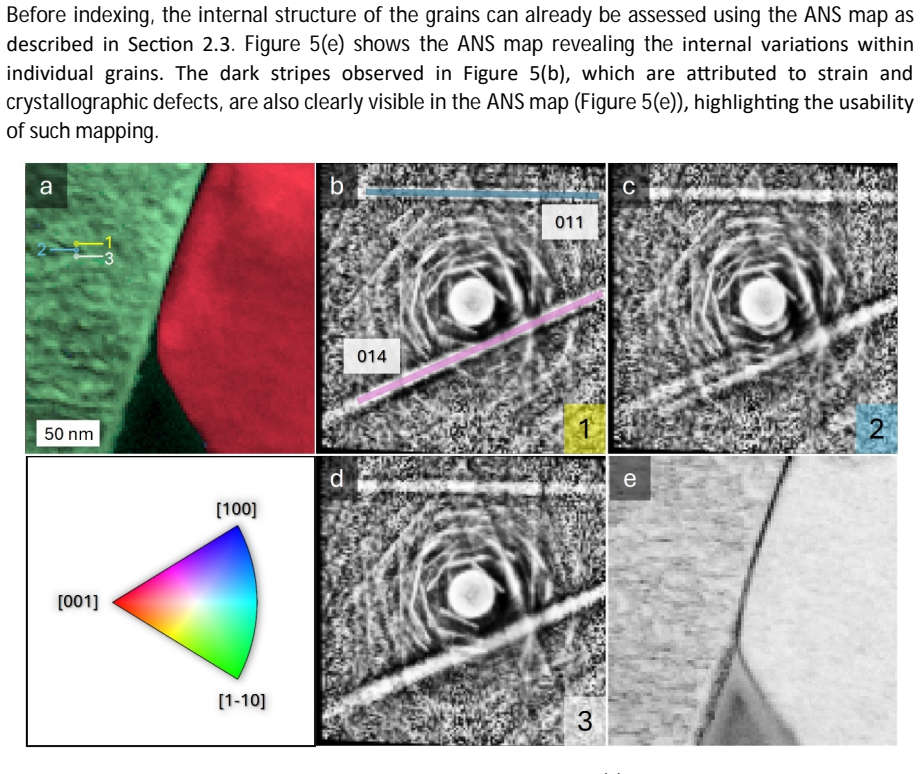
Results: We apply the template matching approach for orientaƟon mapping using STEM -TKD datasets to samples BZCYYb4411 and LNO. The subsequent discussion reports our findings, followed by an analysis of the method's advantages, limitaƟons, and potenƟal applicaƟons . The details regarding the dicƟonary generaƟon for the two samples are provided in the exper...
-
[4]
Discussion: Although the indexing results are already highly promising, further improvements are expected as the simulated templates more closely approximate the experimental paƩerns. This can be achieved by incorporaƟng realisƟc specimen thickness in the simulaƟons, using models that account for excess- deficiency effects, dynamical diffracƟon of an incoher...
-
[5]
Conclusion: In contrast to the well-established SNBD and SPED methodologies, orientaƟon mapping via STEM-TKD remains an underuƟlized technique despite its superior sensiƟvity to subtle crystallographic misorientaƟons. This study demonstrates a robust open -source p ipeline, integraƟng EMsoŌ and Kikuchipy, capable of generaƟng dynamical simulaƟons and perf...
-
[6]
Experimental SecƟon DicƟonary generaƟon for the BZCYYb4411 sample IniƟal SNBD characterizaƟon indicated that our BZCYYb4411 adopts a cubic structure with space group Pm¯3m. Using a cubochoric grid with an angular resoluƟon of 0.6°, a total of 4,325,557 templates were simulated using the master paƩern and then subsequently matched with each experimental pa...
-
[7]
https://doi.org/10.1007/s40192-019-00137-4. (19) Ram, F.; De Graef, M. Phase DiƯerentiation by Electron Backscatter DiƯraction Using the Dictionary Indexing Approach. Acta Mater. 2018, 144, 352 –364. https://doi.org/10.1016/j.actamat.2017.10.069. (20) De Graef, M. A Dictionary Indexing Approach for EBSD. IOP Conf. Ser. Mater. Sci. Eng. 2020, 891 (1), 0120...
work page internal anchor Pith review Pith/arXiv arXiv doi:10.1007/s40192-019-00137-4 2018
discussion (0)
Sign in with ORCID, Apple, or X to comment. Anyone can read and Pith papers without signing in.