Developing fast, accurate and spin pure calculations of organic diradical electronic structure
Pith reviewed 2026-06-25 19:41 UTC · model grok-4.3
The pith
D-ExROPPP computes spin-pure diradical electronic states with accuracy matching high-level ab initio methods but at far lower cost.
A machine-rendered reading of the paper's core claim, the machinery that carries it, and where it could break.
Core claim
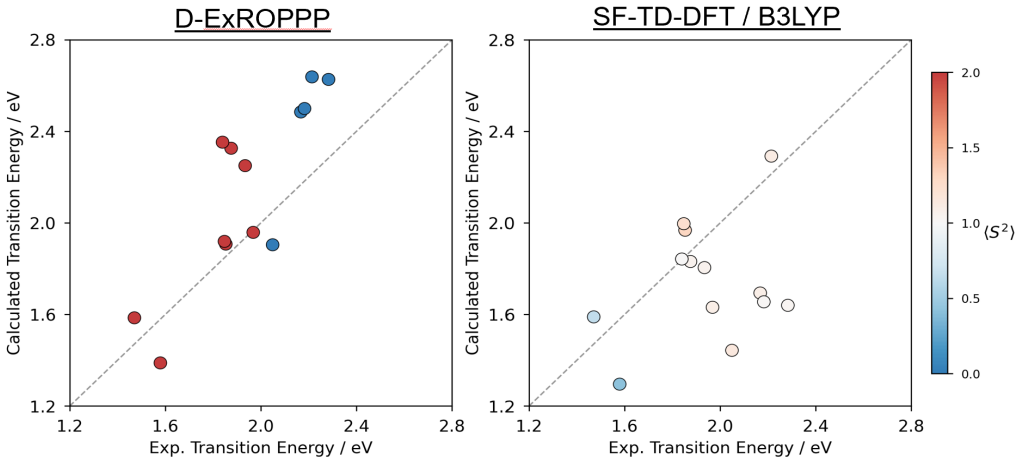
D-ExROPPP theory yields accurate and spin-pure electronic states for organic diradicals by implementing a novel spin-adapted configuration interaction within the semi-empirical Pariser-Parr-Pople framework. On three prototypical molecules the method produces excitation energies that match the accuracy of high-level ab initio calculations while requiring up to five orders of magnitude less computational time. When applied to a set of recently reported stable emissive diradicals, the computed transitions agree qualitatively with experimental UV-vis spectra and the spin states can be assigned reliably.
What carries the argument
D-ExROPPP theory: a spin-adapted configuration interaction placed inside the Pariser-Parr-Pople semi-empirical model that captures multi-reference diradical character at low cost.
If this is right
- Larger emissive diradicals become accessible to routine calculation where post-Hartree-Fock methods remain prohibitive.
- Experimental UV-vis spectra of new diradicals can be assigned to specific spin states with the reported qualitative reliability.
- Rapid evaluation of candidate structures supports rational design of diradical-based optoelectronic or quantum devices.
- The approach supplies spin-pure states that can serve as starting points for further dynamical or transport simulations.
Where Pith is reading between the lines
- If the spin-adaptation step generalizes cleanly, the same framework could be tested on other multi-reference organic systems such as biradicaloids or certain transition-metal complexes.
- The low cost opens the possibility of screening hundreds of substituted diradicals to map structure-property trends before synthesis.
- Direct comparison against measured excited-state lifetimes would test whether the static accuracy extends to dynamic observables the paper does not address.
Load-bearing premise
The Pariser-Parr-Pople semi-empirical model plus the added spin-adapted configuration interaction is sufficient to capture the essential multi-reference effects in diradicals without introducing errors larger than the claimed agreement with post-Hartree-Fock benchmarks.
What would settle it
A collection of diradical molecules where D-ExROPPP excitation energies deviate from experimental or high-level ab initio values by more than the similarity level reported for the three prototypes, or where the computed states exhibit measurable spin contamination.
Figures




read the original abstract
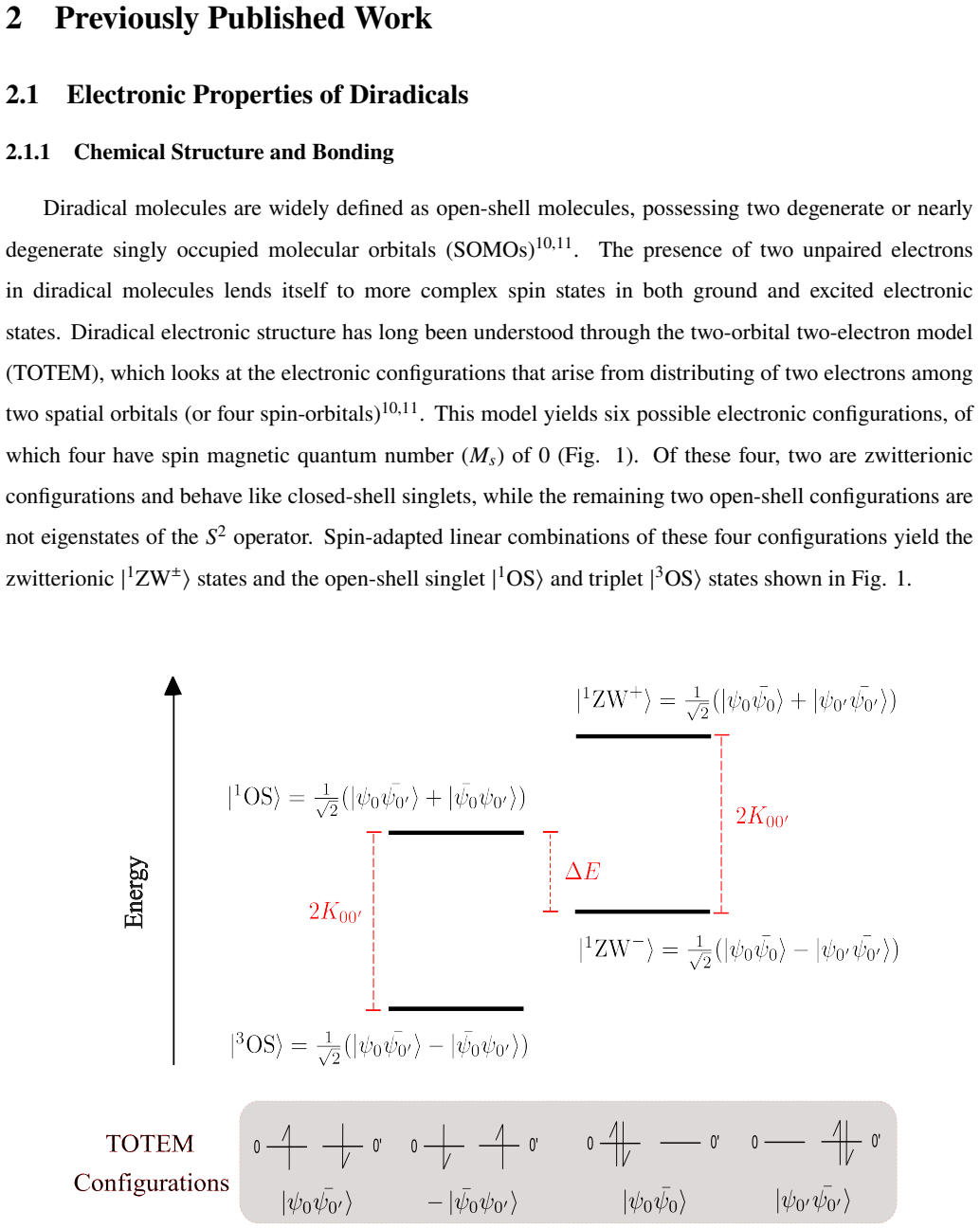
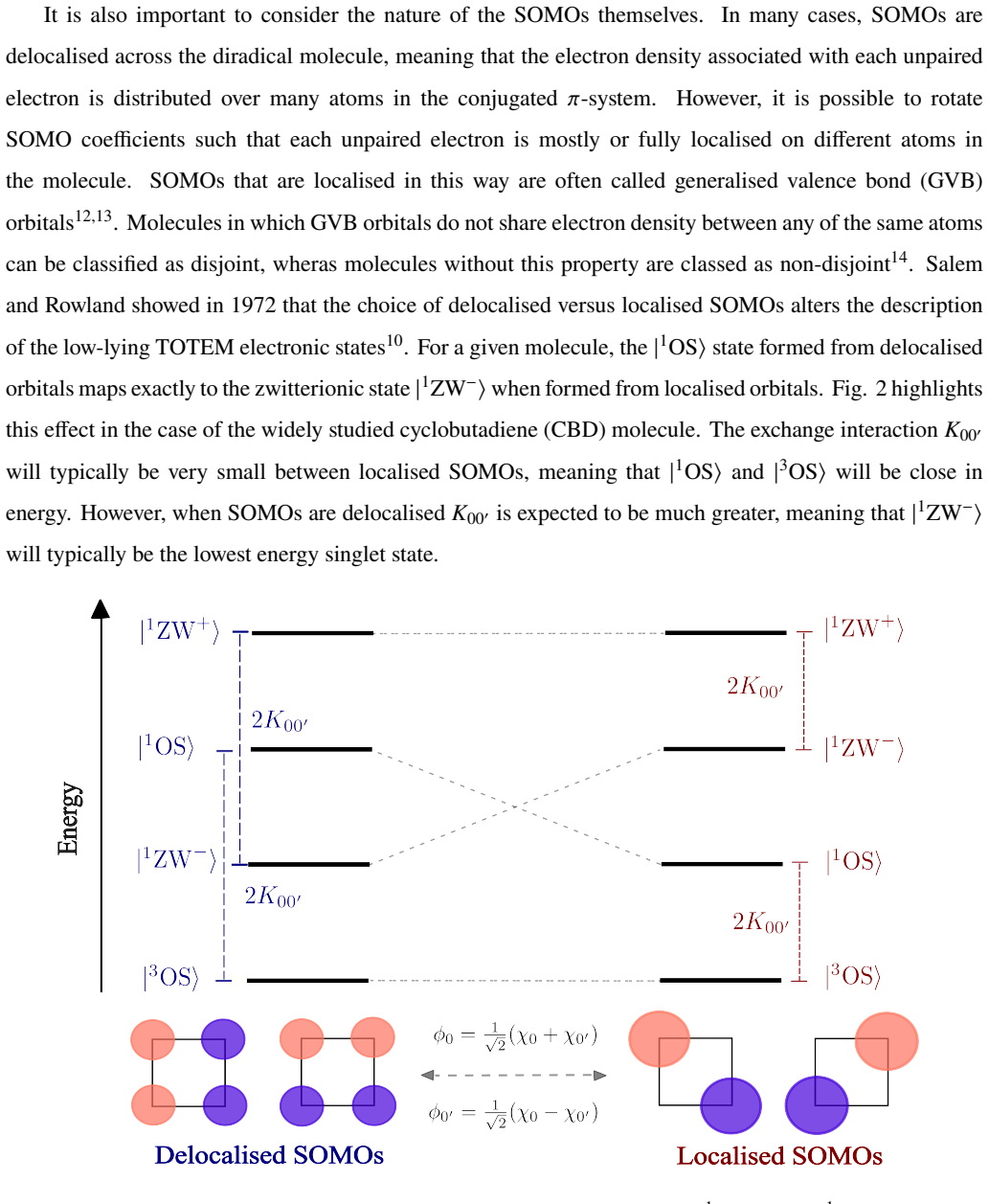
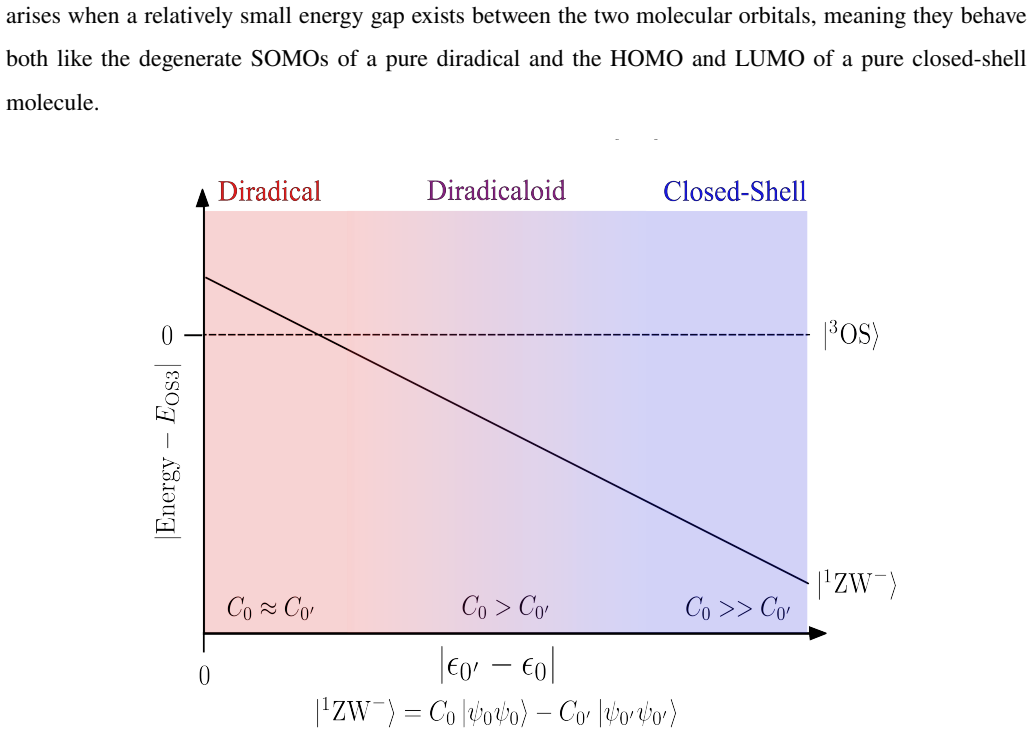
Organic diradical molecules have emerged in recent years as highly promising candidates for next generation optoelectronic and quantum information technologies. As efforts continue to synthesise diradicals with unique photophysical properties, developing our theoretical understanding of their complex electronic structure is crucial to enable rational design strategies. However, existing computational tools struggle to properly describe the multi-reference character of diradical electronic states while also preserving a low computational scaling that enables fast calculations on large emissive diradicals. This work presents a new computational method, termed Diradical Extended Restricted Open-shell PPP (D-ExROPPP) theory, which we show yields accurate and spin-pure electronic states at a very low computational cost relative to existing approaches. This is achieved by implementing a novel, spin-adapted configuration interaction approach within the semi-empirical Pariser-Parr-Pople framework. D-ExROPPP is then used to study the electronic structure of three prototypical organic diradicals, and benchmarked against results from computationally intensive, post-Hartree-Fock methods. Excitation energies for these molecules are predicted that show a similar level of accuracy as high-level ab-initio calculations, while requiring up to five orders of magnitude less computational time. We further apply D-ExROPPP to a number of recently reported stable, emissive, organic diradicals. In the majority of cases, electronic transitions measured in experimental UV-vis spectra are reproduced with qualitative accuracy and the spin states involved can be reliably assigned. Together, these results establish D-ExROPPP as a promising new tool for efficiently predicting and interpreting the photophysics of organic diradical molecules.
Editorial analysis
A structured set of objections, weighed in public.
Referee Report
Summary. The paper introduces D-ExROPPP, a novel spin-adapted configuration interaction method implemented within the semi-empirical Pariser-Parr-Pople (PPP) framework for organic diradicals. It claims to deliver accurate, spin-pure electronic states (including singlet-triplet gaps and excitations) at computational costs up to five orders of magnitude lower than post-Hartree-Fock methods, with excitation energies showing similar accuracy to high-level ab initio benchmarks and qualitative reproduction of experimental UV-vis spectra for several stable emissive diradicals.
Significance. If the accuracy and spin-purity claims hold across a broader set of systems, D-ExROPPP would provide a practical tool for screening large diradical candidates in optoelectronics and quantum information applications where full ab initio multi-reference methods remain prohibitive. The combination of semi-empirical scaling with explicit spin adaptation addresses a recognized gap, and the reported speedup is a clear practical strength if the deviations from post-HF benchmarks remain below ~0.3 eV.
major comments (2)
- [results section] Benchmarking against post-HF methods (results section): the central accuracy claim requires explicit quantitative metrics such as mean absolute deviations or maximum errors for singlet-triplet gaps and excitation energies on the three prototypical molecules; without these tabulated values and direct comparison to the cited high-level methods, it is impossible to verify that deviations remain small enough to support the 'similar level of accuracy' assertion.
- [methods section] Spin-adapted CI implementation (methods section): the novel spin-adaptation scheme must be shown to recover the multi-reference character of diradical states without truncation or PPP-integral errors that systematically deviate from CASSCF or NEVPT2 benchmarks; a concrete test (e.g., comparison of natural orbital occupations or CI coefficients for the lowest singlet and triplet) is needed to confirm the scheme does not introduce bias that would invalidate the speedup-accuracy tradeoff.
minor comments (2)
- [abstract] The abstract and introduction should explicitly state the size of the active space and the number of configurations retained in the CI expansion for the benchmark molecules.
- [figures] Figure captions for UV-vis comparisons should include the experimental solvent and the computed transition assignments with oscillator strengths.
Simulated Author's Rebuttal
We thank the referee for their thoughtful and constructive comments on our manuscript. We address each major comment below and indicate the revisions we will make to strengthen the presentation of our results.
read point-by-point responses
-
Referee: [results section] Benchmarking against post-HF methods (results section): the central accuracy claim requires explicit quantitative metrics such as mean absolute deviations or maximum errors for singlet-triplet gaps and excitation energies on the three prototypical molecules; without these tabulated values and direct comparison to the cited high-level methods, it is impossible to verify that deviations remain small enough to support the 'similar level of accuracy' assertion.
Authors: We agree that explicit quantitative metrics will make the accuracy claims more verifiable. In the revised manuscript, we will add a dedicated table in the results section reporting mean absolute deviations (MAD) and maximum absolute errors for singlet-triplet gaps and excitation energies on the three prototypical molecules, with side-by-side comparison to the cited high-level post-HF methods (CASSCF, NEVPT2, etc.). This will allow direct assessment of whether deviations remain within the ~0.3 eV range referenced in the referee summary. revision: yes
-
Referee: [methods section] Spin-adapted CI implementation (methods section): the novel spin-adaptation scheme must be shown to recover the multi-reference character of diradical states without truncation or PPP-integral errors that systematically deviate from CASSCF or NEVPT2 benchmarks; a concrete test (e.g., comparison of natural orbital occupations or CI coefficients for the lowest singlet and triplet) is needed to confirm the scheme does not introduce bias that would invalidate the speedup-accuracy tradeoff.
Authors: We recognize the value of an explicit validation of the spin-adaptation scheme's ability to capture multi-reference character. While the current manuscript emphasizes energy accuracy and spin purity, the revised version will include a new subsection (or supplementary table) comparing natural orbital occupations and the dominant CI coefficients for the lowest singlet and triplet states of the three prototypical diradicals against corresponding CASSCF results. This will demonstrate that the D-ExROPPP scheme recovers the expected diradical character without systematic bias from the PPP parameterization or CI truncation. revision: yes
Circularity Check
No significant circularity; method benchmarked against independent post-HF calculations
full rationale
The paper introduces D-ExROPPP as a novel spin-adapted CI implementation inside the semi-empirical PPP framework and directly benchmarks its excitation energies and spin states against external high-level ab-initio/post-Hartree-Fock results on the same molecules. No load-bearing steps reduce by construction to fitted parameters from the target data, self-citations, or ansatzes imported from the authors' prior work; the claimed accuracy and speedup rest on comparison to independent reference calculations rather than internal re-derivation of the inputs.
Axiom & Free-Parameter Ledger
axioms (1)
- domain assumption The Pariser-Parr-Pople semi-empirical framework combined with a novel spin-adapted configuration interaction is adequate to describe the multi-reference character of organic diradical electronic states.
Reference graph
Works this paper leans on
-
[1]
and Hele, Timothy J
Green, James D. and Hele, Timothy J. H. , year =. ExROPPP: Fast, accurate, and spin-pure calculation of the electronically excited states of organic hydrocarbon radicals , volume =. The Journal of Chemical Physics , publisher =
-
[2]
Multiconfigurational perturbation theory with level shift — the Cr2 potential revisited , volume =
Roos, Bj\". Multiconfigurational perturbation theory with level shift — the Cr2 potential revisited , volume =. Chemical Physics Letters , publisher =. 1995 , pages =
1995
-
[3]
Theoretical basis and design of the PPP model Hamiltonian , volume =
Jug, Karl , year =. Theoretical basis and design of the PPP model Hamiltonian , volume =. International Journal of Quantum Chemistry , publisher =
-
[4]
Ueber einen chinoïden Kohlenwasserstoff , volume =
Thiele, Johannes and Balhorn, Hans , year =. Ueber einen chinoïden Kohlenwasserstoff , volume =. Berichte der deutschen chemischen Gesellschaft , publisher =
-
[5]
Diradicals – A Fifty Year Fascination , booktitle =
Borden, Weston Thatcher , year =. Diradicals – A Fifty Year Fascination , booktitle =
-
[6]
and Dunning, Thom H
Goddard, William A. and Dunning, Thom H. and Hunt, William J. and Hay, P. Jeffrey , year =. Generalized valence bond description of bonding in low-lying states of molecules , volume =. Accounts of Chemical Research , publisher =
-
[7]
On the electronic structure of alternant conjugated organic radicals for light-emitting diode applications , booktitle =
Hele, Tim , year =. On the electronic structure of alternant conjugated organic radicals for light-emitting diode applications , booktitle =
-
[8]
Luminescent Mono‐, Di‐, and Triradicals: Bridging Polychlorinated Triarylmethyl Radicals by Triarylamines and Triarylboranes , volume =
Hattori, Yohei and Michail, Evripidis and Schmiedel, Alexander and Moos, Michael and Holzapfel, Marco and Krummenacher, Ivo and Braunschweig, Holger and M\". Luminescent Mono‐, Di‐, and Triradicals: Bridging Polychlorinated Triarylmethyl Radicals by Triarylamines and Triarylboranes , volume =. Chemistry – A European Journal , publisher =. 2019 , pages =
2019
-
[9]
A stable triplet diradical emitter , volume =
Feng, Zhongtao and Chong, Yuanyuan and Tang, Shuxuan and Fang, Yong and Zhao, Yue and Jiang, Jun and Wang, Xinping , year =. A stable triplet diradical emitter , volume =. Chemical Science , publisher =
-
[10]
A novel [2.2]paracyclophane bridged tris(2, 4, 6-trichlorophenyl)methyl-diradical and its interaction with circularly polarized light , volume =
Sch\". A novel [2.2]paracyclophane bridged tris(2, 4, 6-trichlorophenyl)methyl-diradical and its interaction with circularly polarized light , volume =. Journal of Materials Chemistry C , publisher =. 2026 , pages =
2026
-
[11]
Arnold, Mona E. and Lebzelter, Anika and Thielert, Philipp and Blinder, Rémi and Schmid, Jonas and Zolg, Julia and Spatola, Emanuele and Jelezko, Fedor and von Delius, Max and Richert, Sabine and Kuehne, Alexander J. C. , year =. Photostable triphenylmethyl-based diradicals with a degenerate singlet-triplet ground state and strong photoluminescence , volu...
-
[12]
Kekulé versus Lewis: When Aromaticity Prevents Electron Pairing and Imposes Polyradical Character , volume =
Trinquier, Georges and Malrieu, Jean‐Paul , year =. Kekulé versus Lewis: When Aromaticity Prevents Electron Pairing and Imposes Polyradical Character , volume =. Chemistry – A European Journal , publisher =
-
[13]
Rivero, Pablo and Moreira, Ibério de P. R. and Illas, Francesc and Scuseria, Gustavo E. , year =. Reliability of range-separated hybrid functionals for describing magnetic coupling in molecular systems , volume =. The Journal of Chemical Physics , publisher =
-
[14]
, year =
Valero, Rosendo and Illas, Francesc and Truhlar, Donald G. , year =. Magnetic Coupling in Transition-Metal Binuclear Complexes by Spin-Flip Time-Dependent Density Functional Theory , volume =. Journal of Chemical Theory and Computation , publisher =
-
[15]
Lee, Seunghoon and Filatov, Michael and Lee, Sangyoub and Choi, Cheol Ho , year =. Eliminating spin-contamination of spin-flip time dependent density functional theory within linear response formalism by the use of zeroth-order mixed-reference (MR) reduced density matrix , volume =. The Journal of Chemical Physics , publisher =
-
[16]
and Schlegel, H
Wittbrodt, Joanne M. and Schlegel, H. Bernhard , year =. Some reasons not to use spin projected density functional theory , volume =. The Journal of Chemical Physics , publisher =
-
[17]
Costa, Ramon and Valero, Rosendo and Mañeru, Daniel Reta and Moreira, Ibério de P. R. and Illas, Francesc , year =. Spin Adapted versus Broken Symmetry Approaches in the Description of Magnetic Coupling in Heterodinuclear Complexes , volume =. Journal of Chemical Theory and Computation , publisher =
-
[18]
UMRSF-TDDFT: Unrestricted Mixed-Reference Spin-Flip-TDDFT , volume =
Komarov, Konstantin and Oh, Minseok and Nakata, Hiroya and Lee, Seunghoon and Choi, Cheol Ho , year =. UMRSF-TDDFT: Unrestricted Mixed-Reference Spin-Flip-TDDFT , volume =. The Journal of Physical Chemistry A , publisher =
-
[19]
and Moreira, Ibério de P
Reta Mañeru, Daniel and Pal, Arun K. and Moreira, Ibério de P. R. and Datta, Sambhu N. and Illas, Francesc , year =. The Triplet–Singlet Gap in the m-Xylylene Radical: A Not So Simple One , volume =. Journal of Chemical Theory and Computation , publisher =
-
[20]
and Das, G
Wahl, Arnold C. and Das, G. , title =. Methods of Electronic Structure Theory , editor =. 1977 , pages =
1977
-
[21]
2022 , volume =
Neese, Frank , title =. 2022 , volume =
2022
-
[22]
and Baldridge, Kim K
Schmidt, Michael W. and Baldridge, Kim K. and Boatz, Jerry A. and Elbert, Steven T. and Gordon, Mark S. and Jensen, Jan H. and Koseki, Shiro and Matsunaga, Nikita and Nguyen, Kiet A. and Su, Shujun and Windus, Theresa L. and Dupuis, Michel and Montgomery, John A. , title =. Journal of Computational Chemistry , year =
-
[23]
Barca, Giuseppe M. J. and others , title =. The Journal of Chemical Physics , year =
-
[24]
A Strategy to Determine Appropriate Active Orbitals and Accurate Magnetic Couplings in Organic Magnetic Systems , volume =
Suaud, Nicolas and Ruamps, Renaud and Guihéry, Nathalie and Malrieu, Jean-Paul , year =. A Strategy to Determine Appropriate Active Orbitals and Accurate Magnetic Couplings in Organic Magnetic Systems , volume =. Journal of Chemical Theory and Computation , publisher =
-
[25]
Starikov, A. G. and Chegerev, M. G. and Starikova, A. A. and Minkin, V. I. , year =. Magnetic properties of diradical dihydropyrene derivatives: a computational modeling , volume =. Russian Chemical Bulletin , publisher =
-
[26]
and Feller, David , year =
Borden, Weston Thatcher and Davidson, Ernest R. and Feller, David , year =. RHF and two-configuration SCF calculations are inappropriate for conjugated diradicals , volume =. Tetrahedron , publisher =
-
[27]
and Thatcher Borden, Weston , year =
Carl Lineberger, W. and Thatcher Borden, Weston , year =. The synergy between qualitative theory, quantitative calculations, and direct experiments in understanding, calculating, and measuring the energy differences between the lowest singlet and triplet states of organic diradicals , volume =. Physical Chemistry Chemical Physics , publisher =
-
[28]
Tetramethylene: A CASPT2 study , volume =
Moriarty, Nigel W and Lindh, Roland and Karlstr\". Tetramethylene: A CASPT2 study , volume =. Chemical Physics Letters , publisher =. 1998 , pages =
1998
-
[29]
and Gill, Peter M
Pople, John A. and Gill, Peter M. W. and Handy, Nicholas C. , year =. Spin‐unrestricted character of Kohn‐Sham orbitals for open‐shell systems , volume =. International Journal of Quantum Chemistry , publisher =
-
[30]
Theoretical Evidence for the Singlet Diradical Character of Square Planar Nickel Complexes Containing Two o-Semiquinonato Type Ligands , volume =
Bachler, Vinzenz and Olbrich, Gottfried and Neese, Frank and Wieghardt, Karl , year =. Theoretical Evidence for the Singlet Diradical Character of Square Planar Nickel Complexes Containing Two o-Semiquinonato Type Ligands , volume =. Inorganic Chemistry , publisher =
-
[31]
Extremely Stable Perylene Bisimide‐Bridged Regioisomeric Diradicals and Their Redox Properties , volume =
Feng, Zhibin and Zhou, Jiadong and He, Xiandong and Wang, Bohan and Xie, Guojing and Qiao, Xianfeng and Liu, Linlin and Xie, Zengqi and Ma, Yuguang , year =. Extremely Stable Perylene Bisimide‐Bridged Regioisomeric Diradicals and Their Redox Properties , volume =. Chemistry – A European Journal , publisher =
-
[32]
Facile Preparation Methods for Triarylmethyl‐Type Stable Luminescent Diradicals and Higher Multiradicals , volume =
Hattori, Yohei and Rapenne, Gwénaël , year =. Facile Preparation Methods for Triarylmethyl‐Type Stable Luminescent Diradicals and Higher Multiradicals , volume =. European Journal of Organic Chemistry , publisher =
-
[33]
Angewandte Chemie International Edition , volume =
Arikawa, Shinobu and Shimizu, Akihiro and Shiomi, Daisuke and Sato, Kazunobu and Takui, Takeji and Sotome, Hikaru and Miyasaka, Hiroshi and Murai, Masahito and Yamaguchi, Shigehiro and Shintani, Ryo , title =. Angewandte Chemie International Edition , volume =
-
[34]
and Forbes, Malcolm D
Wasielewski, Michael R. and Forbes, Malcolm D. E. and Frank, Natia L. and Kowalski, Karol and Scholes, Gregory D. and Yuen-Zhou, Joel and Baldo, Marc A. and Freedman, Danna E. and Goldsmith, Randall H. and Goodson, Theodore and Kirk, Martin L. and McCusker, James K. and Ogilvie, Jennifer P. and Shultz, David A. and Stoll, Stefan and Whaley, K. Birgitta , ...
-
[35]
Luminescent Trityl‐based Diradicaloids: A Theoretical and Experimental Assessment of Charge‐Resonance in Low‐Lying Excited States , volume =
Mesto, Davide and Orza, Michele and Bardi, Brunella and Punzi, Angela and Ratera, Imma and Veciana, Jaume and Farinola, Gianluca and Painelli, Anna and Terenziani, Francesca and Blasi, Davide and Negri, Fabrizia , year =. Luminescent Trityl‐based Diradicaloids: A Theoretical and Experimental Assessment of Charge‐Resonance in Low‐Lying Excited States , vol...
-
[36]
Spin-Correlated Luminescence of a Carbazole-Containing Diradical Emitter: Single-Molecule Magnetoluminescence and Thermally Activated Emission , volume =
Mizuno, Asato and Matsuoka, Ryota and Kimura, Shojiro and Ochiai, Keisuke and Kusamoto, Tetsuro , year =. Spin-Correlated Luminescence of a Carbazole-Containing Diradical Emitter: Single-Molecule Magnetoluminescence and Thermally Activated Emission , volume =. Journal of the American Chemical Society , publisher =
-
[37]
Stable Luminescent Diradicals: The Emergence and Potential Applications , volume =
Zhu, Yujie and Zhu, Zihao and Wang, Saixue and Peng, Qiming and Abdurahman, Alim , year =. Stable Luminescent Diradicals: The Emergence and Potential Applications , volume =. Angewandte Chemie International Edition , publisher =
-
[38]
and Hadt, Ryan G
Poh, Yong Rui and Morozov, Dmitry and Kazmierczak, Nathanael P. and Hadt, Ryan G. and Groenhof, Gerrit and Yuen-Zhou, Joel , year =. Alternant Hydrocarbon Diradicals as Optically Addressable Molecular Qubits , volume =. Journal of the American Chemical Society , publisher =
-
[39]
and Nakamura, Shunta and Phelan, Brian T
Kopp, Sebastian M. and Nakamura, Shunta and Phelan, Brian T. and Poh, Yong Rui and Tyndall, Samuel B. and Brown, Paige J. and Huang, Yuheng and Yuen-Zhou, Joel and Krzyaniak, Matthew D. and Wasielewski, Michael R. , year =. Luminescent Organic Triplet Diradicals as Optically Addressable Molecular Qubits , volume =. Journal of the American Chemical Society...
-
[40]
Electro-optical -radicals: design advances, applications and future perspectives , volume =
Murto, Petri and Bronstein, Hugo , year =. Electro-optical -radicals: design advances, applications and future perspectives , volume =. Journal of Materials Chemistry C , publisher =
-
[41]
and Bjornsson, Ragnar and Kr\"
Byrne, Keelan M. and Bjornsson, Ragnar and Kr\". The diradicaloid electronic structure of dialumenes: a benchmark study at the Full-CI limit , volume =. Physical Chemistry Chemical Physics , publisher =. 2024 , pages =
2024
-
[42]
Reference Energies for Cyclobutadiene: Automerization and Excited States , volume =
Monino, Enzo and Boggio-Pasqua, Martial and Scemama, Anthony and Jacquemin, Denis and Loos, Pierre-Fran. Reference Energies for Cyclobutadiene: Automerization and Excited States , volume =. The Journal of Physical Chemistry A , publisher =. 2022 , pages =
2022
-
[43]
and Hu, Jun and Squires, Robert R
Wenthold, Paul G. and Hu, Jun and Squires, Robert R. and Lineberger, W. C. , year =. Photoelectron Spectroscopy of the Trimethylene- methane Negative Ion. The Singlet-Triplet Splitting of Trimethylenemethane , volume =. Journal of the American Chemical Society , publisher =
-
[44]
The Cyclobutadiene Problem , volume =
Maier, G\". The Cyclobutadiene Problem , volume =. Angewandte Chemie International Edition in English , publisher =. 1974 , pages =
1974
-
[45]
, year =
Borden, Weston T. , year =. Can a square or effectively square singlet be the ground state of cyclobutadiene , volume =. Journal of the American Chemical Society , publisher =
-
[46]
Reeves, P. C. and Henery, J. and Pettit, R. , year =. Further experiments pertaining to the ground state of cyclobutadiene , volume =. Journal of the American Chemical Society , publisher =
-
[47]
and Krylov, Anna I
Slipchenko, Lyudmila V. and Krylov, Anna I. , year =. Spin-conserving and spin-flipping equation-of-motion coupled-cluster method with triple excitations , volume =. The Journal of Chemical Physics , publisher =
-
[48]
Luminescent Radicals Based on the Tris(trichlorophenyl)methyl acceptor: How to Choose the Donor Component , volume =
Cho, Eunkyung and Sun, Qi and McBride, Eleanor Patricia and Brédas, Jean-Luc and Coropceanu, Veaceslav , year =. Luminescent Radicals Based on the Tris(trichlorophenyl)methyl acceptor: How to Choose the Donor Component , volume =. ACS Materials Letters , publisher =
-
[49]
Methods of Electronic Structure Theory , year =
Shavitt, Isaiah , title =. Methods of Electronic Structure Theory , year =
-
[50]
2000 , address =
Helgaker, Trygve and Jorgensen, Poul and Olsen, Jeppe , title =. 2000 , address =
2000
-
[51]
and Deustua, J
Chakraborty, Arnab and Yuwono, Stephen H. and Deustua, J. Emiliano and Shen, Jun and Piecuch, Piotr , year =. Benchmarking the semi-stochastic CC(<b> <i>P</i> </b>;<b> <i>Q</i> </b>) approach for singlet–triplet gaps in biradicals , volume =. The Journal of Chemical Physics , publisher =
-
[52]
The Electronic Spectra of Aromatic Molecules IV: Excited States of Odd Alternant Hydrocarbon Radicals and Ions , volume =
H C Longuet-Higgins and J A Pople , year =. The Electronic Spectra of Aromatic Molecules IV: Excited States of Odd Alternant Hydrocarbon Radicals and Ions , volume =. Proceedings of the Physical Society. Section A , publisher =
-
[53]
On the Nature of Electronic Transitions in Radicals: An Extended Single Excitation Configuration Interaction Method , volume =
Maurice, David and Head-Gordon, Martin , year =. On the Nature of Electronic Transitions in Radicals: An Extended Single Excitation Configuration Interaction Method , volume =. The Journal of Physical Chemistry , publisher =
-
[54]
, year =
Pariser, Rudolph and Parr, Robert G. , year =. A Semi-Empirical Theory of the Electronic Spectra and Electronic Structure of Complex Unsaturated Molecules. I. , volume =. The Journal of Chemical Physics , publisher =
-
[55]
, year =
Pariser, Rudolph and Parr, Robert G. , year =. A Semi-Empirical Theory of the Electronic Spectra and Electronic Structure of Complex Unsaturated Molecules. II , volume =. The Journal of Chemical Physics , publisher =
-
[56]
Spin Coupling in Symmetric and Asymmetric Allyl and Phenalenyl Diradicals Bridged by an Inverted Singlet–Triplet System , volume =
Barreca, Marco Tommaso and Di Maiolo, Francesco , year =. Spin Coupling in Symmetric and Asymmetric Allyl and Phenalenyl Diradicals Bridged by an Inverted Singlet–Triplet System , volume =. The Journal of Physical Chemistry A , publisher =
-
[57]
Pople, J. A. , year =. Electron interaction in unsaturated hydrocarbons , volume =. Transactions of the Faraday Society , publisher =
-
[58]
Hele, Timothy J. H. and Fuemmeler, Eric G. and Sanders, Samuel N. and Kumarasamy, Elango and Sfeir, Matthew Y. and Campos, Luis M. and Ananth, Nandini , year =. Anticipating Acene-Based Chromophore Spectra with Molecular Orbital Arguments , volume =. The Journal of Physical Chemistry A , publisher =
-
[59]
and Ma, Kevin and Green, James D
Shen, Jingkun and Walker, Lucy E. and Ma, Kevin and Green, James D. and Bronstein, Hugo and Butler, Keith T. and Hele, Timothy J. H. , year =. Learning radical excited states from sparse data , volume =. Chemical Science , publisher =
-
[60]
1989 , author =
Modern quantum chemistry : Introduction to advanced electronic structure theory , keywords =. 1989 , author =
1989
-
[61]
The Electronic Properties of Diradicals , volume =
Salem, Lionel and Rowland, Colin , year =. The Electronic Properties of Diradicals , volume =. Angewandte Chemie International Edition in English , publisher =
-
[62]
Do Diradicals Behave Like Radicals? , volume =
Stuyver, Thijs and Chen, Bo and Zeng, Tao and Geerlings, Paul and De Proft, Frank and Hoffmann, Roald , year =. Do Diradicals Behave Like Radicals? , volume =. Chemical Reviews , publisher =
-
[63]
and Plasser, Felix , year =
Matasović, Lujo and Bronstein, Hugo and Friend, Richard H. and Plasser, Felix , year =. Classification and quantitative characterisation of the excited states of -conjugated diradicals , volume =. Faraday Discussions , publisher =
-
[64]
, year =
Borden, Weston Thatcher and Davidson, Ernest R. , year =. Effects of electron repulsion in conjugated hydrocarbon diradicals , volume =. Journal of the American Chemical Society , publisher =
-
[65]
and Despres, A
LeJeune, V. and Despres, A. and Migirdicyan, E. , year =. Site selection spectroscopy of the non-Kekule m-xylylene biradical and its methylated derivatives in Shpolskii matrixes , volume =. The Journal of Physical Chemistry , publisher =
-
[66]
Matrix Isolation, Spectroscopic Characterization, and Photoisomerization of m-Xylylene , volume =
Neuhaus, Patrik and Grote, Dirk and Sander, Wolfram , year =. Matrix Isolation, Spectroscopic Characterization, and Photoisomerization of m-Xylylene , volume =. Journal of the American Chemical Society , publisher =
-
[67]
Haider, K. W. and Migirdicyan, E. and Platz, M. S. and Soundararajan, N. and Despres, A. , year =. Recent Studies of Meta-Xylylene and a Diaza Derivative , volume =. Molecular Crystals and Liquid Crystals Incorporating Nonlinear Optics , publisher =
-
[68]
and Baudet, J
Migirdicyan, E. and Baudet, J. , year =. Electron spectra of o- and m-xylylenes and their methylated derivatives. Experimental and theoretical study , volume =. Journal of the American Chemical Society , publisher =
-
[69]
, title =
Werner, Hans-Joachim and Knowles, Peter J. , title =. The Journal of Chemical Physics , volume =
-
[70]
and Murcko, Mark A
Hrovat, David A. and Murcko, Mark A. and Lahti, Paul M. and Thatcher Borden, Weston , year =. The effects of heteroatom substitution on the singlet–triplet energy differences in diradicals—ab initio calculations of. Journal of the Chemical Society, Perkin Transactions 2 , publisher =
-
[71]
, year =
Wang, Tao and Krylov, Anna I. , year =. The effect of substituents on electronic states’ ordering in meta-xylylene diradicals: Qualitative insights from quantitative studies , volume =. The Journal of Chemical Physics , publisher =
-
[72]
The electronic structures of biradicals in the unrestricted Hartree-Fock approximation , volume =
Yamaguchi, Kizashi , year =. The electronic structures of biradicals in the unrestricted Hartree-Fock approximation , volume =. Chemical Physics Letters , publisher =
-
[73]
, year =
Shao, Yihan and Head-Gordon, Martin and Krylov, Anna I. , year =. The spin–flip approach within time-dependent density functional theory: Theory and applications to diradicals , volume =. The Journal of Chemical Physics , publisher =
-
[74]
The Journal of Chemical Physics , volume =
Angeli, Celestino and Cimiraglia, Renzo and Malrieu, Jean-Paul , title =. The Journal of Chemical Physics , volume =. 2002 , doi =
2002
-
[75]
Journal of Computational Chemistry , volume =
Nakano, Haruyuki and Uchiyama, Reiko and Hirao, Kimihiko , title =. Journal of Computational Chemistry , volume =. 2002 , doi =
2002
-
[76]
and Sorensen, Danny C
Lehoucq, Richard B. and Sorensen, Danny C. and Yang, Chao , title =
-
[77]
Determinant based configuration interaction algorithms for complete and restricted configuration interaction spaces , volume =
Olsen, Jeppe and Roos, Bj\". Determinant based configuration interaction algorithms for complete and restricted configuration interaction spaces , volume =. The Journal of Chemical Physics , publisher =. 1988 , pages =
1988
-
[78]
Characterizing unpaired electrons from the one-particle density matrix , volume =
Head-Gordon, Martin , year =. Characterizing unpaired electrons from the one-particle density matrix , volume =. Chemical Physics Letters , publisher =
-
[79]
, title =
Bleaney, Brebis and Bowers, Kenneth D. , title =. Proceedings of the Royal Society of London. Series A. Mathematical and Physical Sciences , year =
-
[80]
and Platz, Matthew S
Wright, Bradford B. and Platz, Matthew S. , year =. Electron spin resonance spectroscopy of the triplet state of m-xylylene , volume =. Journal of the American Chemical Society , publisher =
discussion (0)
Sign in with ORCID, Apple, or X to comment. Anyone can read and Pith papers without signing in.